
Forgotten Weapons
Published 29 Sept 2025Today we are taking a look at an interesting silenced Bulgarian Makarov with a mechanism added to lock the slide. This sort of feature is usually thought of as a sneaky way to avoid ejecting brass and leaving it behind, but it actually serves a much more practical purpose. One of the loudest elements of a suppressed pistol firing subsonic ammunition is actually the noise of pressurized gas escaping when the empty case is extracted and then the slide chambering a new round. A slide lock eliminates these sources of noise by preventing the slide from opening. While this is not a factory-made variant of the Makarov, it is an interesting mechanism that I thought worth covering.
(more…)
February 22, 2026
An Interesting Silenced Bulgarian Makarov
Comments Off on An Interesting Silenced Bulgarian Makarov
QotD: The shift from “motte-and-bailey” construction to stone castles
As we move to stone construction and especially full stone construction (which we’ll define as the point when at least one complete curtain wall – don’t worry, we’ll define that in a second – is in stone) in the 12th century, we’re beginning to contemplate a different kind of defense. The wooden motte and bailey, as we’ve seen, mostly served to resist both raids and “hasty” assaults, thus forcing less coordinated or numerous attackers to set in to starve the castle out or go home. But stone walls are a much larger investment in time and resources; they also require a fair bit more careful design in order to be structurally sound. For all of that expense, the builder wants quite a bit of a security, and in the design of stone castles it is hard not to notice increasing attention towards resisting a deliberate assault; stone castles of the 12th century and beyond are increasingly being designed to stand up to the best that the “small army” playbook can throw at them. Of course it is no accident that this is coming at the same time that medieval European population and wealth is beginning to increase more rapidly, leaving political authorities (read: the high nobility) with both the resources for impressive new castles (although generally the number of castles falls during this period – fewer, stronger castles) and at the same time with more resources to invest in the expertise of siegecraft (meaning that an attacker is more likely to have fancy tools like towers, catapults and better coordination to use them).
To talk about how these designs work, we need to clear some terminology. The (typically thin) wall that runs the circuit of the castle and encloses the bailey is called a “curtain wall“. In stone castles, there may be multiple curtain walls, arranged concentrically (a design that seems to emerge in the Near East and makes its way to Europe in the 13th century via the crusades); the outermost complete circuit (the primary wall, as it were) is called the enceinte. Increasingly, the keep in stone castles is moved into the bailey (that is, it sits at the center of the castle rather than off to one side), although of course stone versions of motte and bailey designs exist. In some castle design systems, with stone the keep itself drops away, since the stone walls and towers often provided themselves enough space to house the necessary peacetime functions; in Germany there often was no keep (that is, no core structure that contained the core of the fortified house), but there often was a bergfriede, a smaller but still tall “fighting tower” to serve the tactical role of the keep (an elevated, core position of last-resort in a defense-in-depth arrangement) without the peacetime role.
While the wooden palisade curtain walls of earlier motte and bailey castles often lacked many defensive features (though sometimes you’d have towers and gatehouses to provide fighting positions around the gates), stone castles tend to have lots of projecting towers which stick out from the curtain wall. The value of projecting towers is that soldiers up on those towers have clear lines of fire running down the walls, allowing them to target enemies at the base of the curtain wall (the term for this sort of fire is “enfilade” fire – when you are being hit in the side). Clearly what is being envisaged here is the ability to engage enemies doing things like undermining the base of walls or setting up ladders or other scaling devices.
The curtain walls themselves also become fighting positions. Whether on a tower or on the wall itself, the term for the fighting position at the top is a “battlement”. Battlements often have a jagged “tooth” pattern of gaps to provide firing positions; the term for the overall system is crenellation; the areas which have stone are merlons, while the gaps to fire through are crenals. The walkway behind both atop the wall is the chemin de ronde, allure or “wall-walk”. One problem with using the walls themselves as fighting positions is that it is very hard to engage enemies directly beneath the wall or along it without leaning out beyond the protection of the wall and exposing yourself to enemy fire. The older solution to this were wooden, shed-like projections from the wall called “hoarding”; these were temporary, built when a siege was expected. During the crusades, European armies encountered Near Eastern fortification design which instead used stone overhangs (with the merlons on the outside) with gaps through which one might fire (or just drop things) directly down at the base of the wall; these are called machicolations and were swiftly adopted to replace hoardings, since machicolations were safer from both literal fire (wood burns, stone does not) and catapult fire, and also permanent. All of this work on the walls and the towers is designed to allow a small number of defenders to exchange fire effectively with a large number of attackers, and in so doing to keep those attackers from being able to “set up shop” beneath the walls.
[I]t is worth noting something about the amount of fire being developed by these projecting towers: the goal is to prevent the enemy operating safely at the wall’s base, not to prohibit approaches to the wall. These defenses simply aren’t designed to support that much fire, which makes sense: castle garrisons were generally quite small, often dozens or a few hundred men. While Hollywood loves sieges where all of the walls of the castle are lined with soldiers multiple ranks deep, more often the problem for the defender was having enough soldiers just to watch the whole perimeter around the clock (recall the example at Antioch: Bohemond only needs one traitor to access Antioch because one of its defensive towers was regularly defended by only one guy at night). It is actually not hard to see that merely by looking at the battlements: notice in the images here so far often how spaced out the merlons of the crenellation are. The idea here isn’t maximizing fire for a given length of wall but protecting a relatively small number of combatants on the wall. As we’ll see, that is a significant design choice: castle design assumes the enemy will reach the walls and aims to prevent escalade once they are there; later in this series we’ll see defenses designed to prohibit effective approach itself.
As with the simpler motte and bailey, stone castles often employ a system of defense in depth to raise the cost of an attack. At minimum, generally, that system consists of a moat (either wet or dry), the main curtain walls (with their towers and gatehouses) and then a central keep. Larger castles, especially in the 13th century and beyond, adopting cues from castle design in the Levant (via the crusades) employed multiple concentric rings of walls. Generally these were set up so that the central ring was taller, either by dint of terrain (as with a castle set on a hill) or by building taller walls, than the outer ring. The idea here seems not to be stacking fire on approaching enemies, but ensuring that the inner ring could dominate the outer ring if the latter fell to attackers; defenders could fire down on attackers who would lack cover (since the merlons of the outer ring would face the other way). As an aside, the concern to be firing down is less about the energy imparted by a falling arrow (though this is more meaningful with javelins or thrown rocks) and more about a firing position that denies enemies cover by shooting down at them (think about attackers, for instance, crossing a dry moat – if your wall is the right height and the edges of the moat are carefully angled, you can set up a situation where the ditch never actually offers the attackers any usable cover, but you need to be high up to do it!).
Speaking of the moat, this is a common defensive element (essentially just a big ditch!) which often gets left out of pop culture depictions of castles and siege warfare, but it accomplishes so many things at such a low cost premium. Even assuming the moat is “dry”! For attackers on foot (say, with ladders) looking to approach the wall, the moat is an obstacle that slows them down without potentially providing any additional cover (it is also likely to disorder an attack). For sappers (attackers looking to tunnel under the walls and then collapse the tunnel to generate a breach), the depth of the ditch forces them to dig deeper, which in turn raises the demands in both labor and engineering to dig their tunnel. For any attack with siege engines (towers, rams, or covered protective housings made so that the wall can be approached safely), the moat is an obstruction that has to be filled in before those engines can move forward – a task which in turn broadcasts the intended route well in advance, giving the defenders a lot of time to prepare.
Well-built stone castles of this sort were stunningly resistant to assault, even with relatively small garrisons (dozens or a few hundred, not thousands). That said, building them was very expensive; maintaining them wasn’t cheap either. For both castles and fortified cities, one ubiquitous element in warfare of the period (and in the ancient period too, by the by) was the rush when war was in the offing to repair castle and town walls, dig out the moat and to clear buildings that during peace had been built int he firing lines of the castle or city walls.
Bret Devereaux, “Collections: Fortification, Part III: Castling”, A Collection of Unmitigated Pedantry, 2021-12-10.
Comments Off on QotD: The shift from “motte-and-bailey” construction to stone castles
February 21, 2026
Books for boys (unlike the vast majority of books for children these days)
Just pointing out that boys and girls have different interests is enough to get you labelled as a right-wing extremist, if not an outright white supremacist/homophobic transphobe. Progressives believe, as a matter of deep conviction, that children are tabula rasa and any indication of interest on their part in male-coded activities is proof of patriarchal brainwashing. This is clearly nonsense, but we’re deep in the propagandized years where even pointing out elements of reality will get you added to terrorist watchlists if it doesn’t actually get you arrested and charged. But boys are interested in different things than girls are and trying to force them to be interested in the things that girls like will almost always turn that boy against whatever you’re trying to shove down his throat.
Boys don’t read as much as girls do, but when almost everything they’re given to read is girl-coded, it makes it even more uninteresting to boys. Yet the tiny minority of books that do appeal to boys are not made available in libraries and schools for fear of somehow leading in the direction of “toxic masculinity” or something.
Among the few publishers who do produce books intended to interest boys is Raconteur Press, who explain here why historical adventure books appeal to boys:

In an era dominated by screens and instant gratification, fostering a deep appreciation for history in young readers can feel like an uphill battle. Yet, historical fiction — especially in the form of thrilling boys’ adventure books — offers a powerful gateway. By weaving real historical events into gripping narratives, these stories not only entertain but also educate, encouraging boys to discover the past, develop essential skills, and cultivate a lifelong love of reading and exploration. Books like A Boy Against the Boxers by Jacob Sharp, Meteor Men by Scott Schad, and Fossil Force by Graham Bradley, all from Raconteur Press, exemplify this approach. Each integrates historical elements in unique ways, showing how adventure can transform history from dry facts into vivid, relatable experiences.
Discovery and Learning Through Historical Events
Historical fiction immerses young readers in the past, making abstract events tangible and personal. By placing protagonists in real-world scenarios, these books help boys “live” history, fostering empathy and understanding that textbooks often lack. For instance, in A Boy Against the Boxers, fourteen-year-old Eddie Donahue is thrust into the heart of the 1900 Boxer Rebellion in Peking (now Beijing). The story draws on actual events like the 55-day Siege of the International Legations, where foreign diplomats and civilians were trapped by anti-Western nationalists. Eddie witnesses martial arts demonstrations, evades violent chases, and participates in scavenging supplies and firing an old black powder cannon known as the “International Gun”. Through Eddie’s eyes, readers learn about the geopolitical tensions of turn-of-the-century China, the unlikely alliances among nations (which would soon fracture in World War I), and the brutal realities of siege warfare. This viewpoint helps boys grasp how ordinary people — much like themselves — navigated chaos, turning history into a lesson in resilience and global interconnectedness.
Similarly, Meteor Men blends scientific discovery with American Civil War history. The five boys — Cinch, Frank, Keith, Joel, and Ronaldo — start as amateur meteorite hunters, using library research and borrowed gadgets like a magnetic probe mounted on a radio-controlled plane. Their quest leads to an unexpected find: a buried Union ironclad riverboat and its Confederate counterpart, solving a fictionalized mystery tied to real Civil War naval battles, such as those on the Mississippi River. Drawing from actual historical markers and artifacts (like the USS Cairo, the only surviving Union armored riverboat), the boys learn about steam-powered warfare, the role of ironclads in river combat, and the human cost of the conflict. From a boy’s perspective, this reveals history as a puzzle to be solved, emphasizing how everyday curiosity can uncover forgotten stories and honor the soldiers who fought.
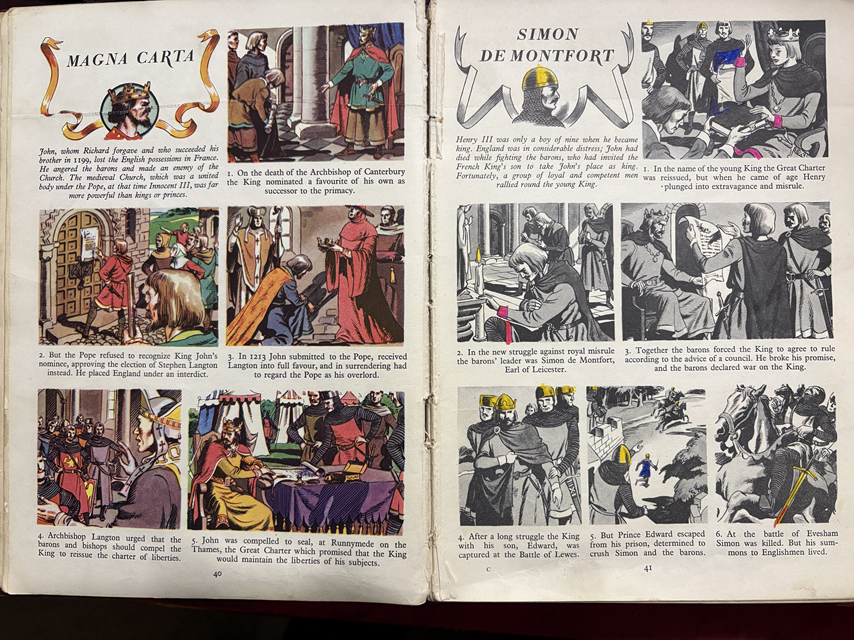
My own interest in history as a child was nursed by the Ladybird picture books my parents and grandparents bought me (with topics like Alexander the Great, Richard the Lionheart, Henry V, and other interesting-to-boys subjects). One that I still have, in diminished form is a very battered copy of British History in Strip Pictures by James Mainwaring, which must have been published in the late 1950s or early 1960s, as I got it in 1965 and it was already quite battered:
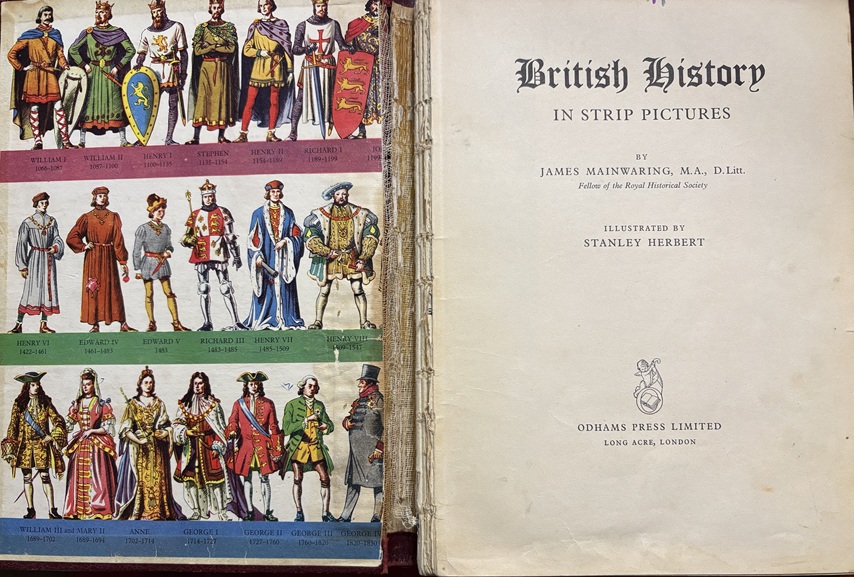
The body of the book got separated from the cover many years ago, and the first few pages got lost, sadly.
It might have been jingoistic “whig history for children”, but I loved it (please pardon the occasional attempts to colour the black-and-white images … I couldn’t help myself at that age):
Comments Off on Books for boys (unlike the vast majority of books for children these days)
The Bomber Mafia by Malcolm Gladwell
Based on the few books of his I’d heard of, I wouldn’t have expected Malcolm Gladwell to dip into military history … and from what Secretary of Defense Rock says, it might have been better if Gladwell had steered clear of this particular topic anyway:
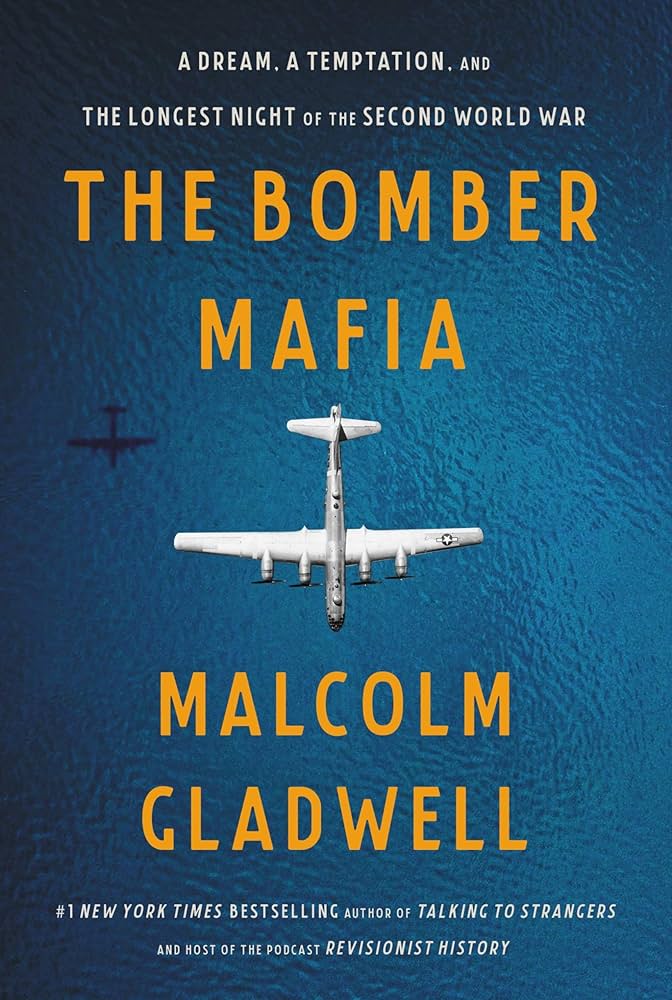
I recently received The Bomber Mafia as a gift for my birthday, and it was bad, so bad that I felt compelled to write this review. In so many ways, the book is everything that is wrong with the “pop history” genre: a bestselling author with a massive built-in audience, with a hit podcast to cross-promote the material, and a framing promise to reveal a supposedly “great untold story” about the strategic and moral struggles of American airmen in World War II. The problem in this case is that Gladwell’s narrative about Curtis LeMay, Haywood Hansell, and the evolution of strategic bombing repeatedly collides with the existing scholarship and often ignores it altogether. From his treatment of the raids of Münster and Schweinfurt–Regensburg to his use of the United States Strategic Bombing Survey and his confident claims about what compelled Japan to surrender, The Bomber Mafia exemplifies the worst tendencies of popular history: sweeping pronouncements built on selective reading, caricatured context, and a startling indifference to both primary sources and a vast secondary literature.1
I was only vaguely familiar with Malcolm Gladwell and his work, but for those who don’t know (like me until recently), he has been a staff writer for The New Yorker since 1996, has written a bunch of New York Times bestselling books on sociology, psychology, and economics, and also hosts a very popular podcast called Revisionist History.2 This is all to say he is widely known and already has a big audience that is generally receptive to his projects. The book was originally based on four episodes he did on this topic in July 2020, and then turned into print, so it isn’t so much an actual book as it is a printed podcast.3
Unsurprisingly, both the audiobook and print editions were widely acclaimed upon release. Writing in the Wall Street Journal, Yale professor Paul Kennedy praised the book as “a wonderful book”.4 The journalist Michael Lewis described it as “a riveting tale”, while the bestselling biographer Walter Isaacson called it “a wonderful narrative”.5 The book was named a Kirkus Reviews Best Book of the Year and selected as an Editors’ Choice by The New York Times Book Review. It also enjoyed significant commercial success, reaching number two on The New York Times Best Sellers list.6 To promote the book, Gladwell made appearances on Jimmy Kimmel, MSNBC, and CBS’s Sunday Morning show. MSNBC even stated in the segment title that this is “A great untold story”, which is hilarious, given that I don’t know how much ink has been spilled on the strategic bombing campaigns.7
But it should be noted that the book has been criticized by virtually anyone who has seriously studied this topic. Much of the criticism of the book has come from the fact that it hardly focuses on the Japanese and German perspectives, misinterprets why members of the air tactical school focused on precision bombing, and the actual role strategic bombing played in the surrender of Japan.8 All of that is valid, but what was initially more startling to me was how little use was made of primary or secondary sources. So many important works are left out makes me wonder how much research Gladwell even put in.9 To write about strategic bombing in World War II and not include Michael Sherry’s The Rise of American Air Power, Richard Overy’s The Bombing War, Donald Miller’s Masters of the Air, Ken Werrell’s Blankets of Fire or Death From the Heavens, Geoffrey Perrett’s Winged Victory, and barely using any of the official histories is borderline negligence.10 Anyone doing research on strategic bombing and Air Power in World War II almost certainly would have come across these.
- Popular history is a form of historical writing aimed at broad audiences that usually prioritizes storytelling over real scholarship. See Gerald Strauss, “The Dilemma of Popular History,” Past & Present, no. 132 (1991): 130–49, and more recently, Ben Alpers, “The Promise and Perils of Popular History,” Society for U.S. Intellectual History, August 17, 2021.
- The show itself isn’t really a conversation with experts and historians (though they do appear) so much as storytelling.
- I would also preface that I generally don’t have a problem with this premise. There is definitely a segment of the historical profession that dislikes pop history for reasons tied as much to credentials as to content. Much “popular history” is produced by journalists, independent writers, or commentators rather than credentialed academic historians, and that fact alone generates suspicion. In some cases, this skepticism is warranted: weak sourcing, thin engagement with the scholarship, and overconfident claims do real damage. But the problem is not who writes history so much as how it is written. Plenty of non-historians have produced outstanding historical works by taking the craft seriously — immersing themselves in primary sources, engaging honestly with existing scholarship, and resisting the temptation to oversimplify for the sake of narrative punch. Conversely, academic credentials have never been a guarantee for insight or even accuracy. If a writer does the work, respects the evidence, and treats complexity as something to be explained rather than avoided, there is no real reason to dismiss the result simply because of the writer’s background.
- Paul Kennedy, “The Bomber Mafia’ Review: Architects of a Firestorm”, The Wall Street Journal, April 30, 2021.
- Summary of reviews in paperback.
- “Hardcover Nonfiction – May 16, 2021”. The New York Times.
- Malcolm Gladwell: ‘Bomber Mafia’ Looks At A Great Untold Story From WWII.
- Some critical reviews include David Fedman and Cary Karacas, “When Pop History Bombs: A Response to Malcolm Gladwell’s Love Letter to American Air Power”, Los Angeles Review of Books, June 12, 2021; Saul David, “Malcolm Gladwell’s The Bomber Mafia is misleading history-lite”, The Daily Telegraph, April 25, 2021, and Steve Agoratus, Air & Space Power History 68, no. 4 (2021): 52–53.
- This is also coming from a guy who famously wrote that achieving world-class expertise in any field is, to a large extent, a function of accumulating roughly 10,000 hours of deliberate practice, as described in his book Outliers: The Story of Success.
- Gladwell doesn’t really deal with British strategic bombing; there’s just a brief chapter on Arthur Harris. If interested, see Noble Frankland, Bomber Offensive, the Devastation of Europe (New York: Ballantine Books, 1971) Max Hastings, Bomber Command: The Myths and Reality of the Strategic Bombing Offensive, 1939-45 (New York: Dial Press/James Wade, 1979), and Norman Longmate, The Bombers: The RAF Air Offensive against Germany, 1939-1945 (London: Hutchinson, 1983).
Comments Off on The Bomber Mafia by Malcolm Gladwell
Canada’s Only Mass-Production Fighter Jet – Avro Canada CF-100 Canuck
Ruairidh MacVeigh
Published 18 Oct 2025During the 1940s and 50s, with World War II rapidly transitioning into the Cold War, Canada, as a major ally of the NATO nations and with large swathes of remote countryside that could easily be penetrated by Soviet fighters and bombers, created the CF-100 Canuck, one of the earliest production jet fighters in the world an a machine that, despite some early flaws, would go on to prove itself rugged and robust for patrolling the turbulent weather of the frozen Canadian north.
At the same time, though, the CF-100 was very much a product of its time, and despite its exceptional rigidity, by the middle of the 1950s it was very much obsolete as swept-wing and delta fighters rapidly became the norm for both Communist and Capitalist factions alike, and through its initial success would lay the groundwork for even more ambitious projects that sadly would not continue Canada’s major involvement in cutting edge military aerospace design.
Chapters:
0:00 – Preamble
0:49 – Facing a New Kind of War
4:28 – Ups and Downs
7:12 – Reworking the Design
10:36 – The CF-103 Project
15:51 – The Canuck Career
19:06 – Later Years
20:30 – Conclusion
(more…)
Comments Off on Canada’s Only Mass-Production Fighter Jet – Avro Canada CF-100 Canuck
QotD: Warren G. Harding’s successful depression-breaking policies
Driven by academia, this is where American history has placed Franklin Delano Roosevelt (in office 1933-1945) and Warren Gamaliel Harding (in office 1921-1923). It is impossible to see FDR absent a “great presidents” ranking; it is likewise impossible to see Harding absent the lowest rungs.
Both men came into office with an economy in tatters and both men instituted ambitious agendas to correct the respective downturns. Yet their policies were the polar opposite of one another and, as a result, had the opposite effect. In short, Harding used laissez faire-style capitalism and the economy boomed; FDR intervened and things went from bad to worse.
Despite these clear facts, in C-SPAN’s latest poll ranking US presidents, FDR finished third in the rankings, while Harding finished 37th. Surveying how both handled the economy, scholars ranked FDR third in that category, while Harding came in at 32. This is a tragedy of history.
America in 1920, the year Harding was elected, fell into a serious economic slide called by some “the forgotten depression“. Coming out of World War I and the upheavals of 1919, the economy struggled to adjust to peacetime realities, falling into a serious slump.
The depression lasted about 18 months, from January 1920 to July 1921. During that time, the conditions for average Americans steadily deteriorated. Industrial production fell by a third, stocks dropped nearly 50 percent, corporate profits were down more than 90 percent. Unemployment rose from 4 percent to 12, putting nearly 5 million Americans out of work. Small businesses were devastated, including a Kansas City haberdashery owned by Edward Jacobson and future president Harry S. Truman.
The nation’s finances were also in shambles. America had spent $50 billion on the Great War, more than half the nation’s GNP (gross national product). The national debt jumped from $1.2 billion in 1916 to $26 billion in 1919, while the Allied Powers owed the US Treasury $10 billion. Annual government spending soared more than twenty-five times, from around $700 million in 1916 to nearly $19 billion in 1919.
Harding campaigned on exactly what he wanted to do for the economy – retrenchment. He would slash taxes, cut government spending, and roll back the progressive tide. He would return the country to fiscal sanity and economic normalcy.
“We need a rigid and yet sane economy, combined with fiscal justice,” he said in his inaugural address, “and it must be attended by individual prudence and thrift, which are so essential to this trying hour and reassuring for our future”.
The business community expressed excitement about the new administration. The Wall Street Journal headlined on Election Day, “Wall Street sees better times after election”. The Los Angeles Times headlined the following day, “Eight years of Democratic incompetency and waste are drawing rapidly to a close”. Others read “Harding’s Advent Means New Prosperity” and “Inauguration ‘Let’s Go!’ Signal to Business”.
The day after Harding’s inauguration, the Times editors predicted “good times ahead”, writing, “The inauguration yesterday of President Harding and the advent of an era of Republicanism after years of business harassment and uncertainty under the Democratic regime were hailed” by the nation’s business leaders. I. H. Rice, the president of the Merchants and Manufacturers Association, told the press, “Good times are now ahead of us. Prosperity is at our door. We are headed toward pre-war conditions … Business men are well pleased with President Harding’s selections for his Cabinet and by the caliber of men he has chosen we know that he means business”.
Under Harding and his successor, Calvin Coolidge, and with the leadership of Andrew Mellon at Treasury, taxes were slashed from more than 70 percent to 25 percent. Government spending was cut in half. Regulations were reduced. The result was an economic boom. Growth averaged 7 percent per year, unemployment fell to less than 2 percent, and revenue to the government increased, generating a budget surplus every year, enough to reduce the national debt by a third. Wages rose for every class of American worker. It was unparalleled prosperity.
Ryan S. Walters, “The Two Presidents Whose Economic Policies Are Most Misunderstood by Historians”, Foundation for Economic Education, 2022-03-05.
Comments Off on QotD: Warren G. Harding’s successful depression-breaking policies
February 20, 2026
Sci-Fi, Satire, and the Post-WWII Mythos
Feral Historian
Published 17 Oct 2025The caricature of fascism as the arch-evil, born in WWII propaganda and endlessly re-imagined in popular entertainment ever since, has served both as an inoculation against that particular brand of tyranny and blinders to many others. Is it still relevant? Or has it become one of our culture’s foundational archetypes that will live on for centuries disconnected from its roots? Let’s explore a bunch of facets and ask some odd, sometimes difficult questions along the way.
00:00 Intro
03:02 Myth of Singular Evil
06:06 Andor and Now
09:18 Fading Narratives
12:01 Iron Sky
16:21 What Comes Next?
(more…)
Comments Off on Sci-Fi, Satire, and the Post-WWII Mythos
February 19, 2026
Hotchkiss Model 1886 3-pounder Quick Firing Gun
Forgotten Weapons
Published 26 Sept 2025Small fast boats with torpedos (or other explosives) have always been a threat to large warships. One of the weapons the British Royal Navy adopted to counter that threat was the Hotchkiss Model 1886 “Quick Fire” gun. This meant that it was a breech-loaded gun that used self-contained cartridge ammunition, instead of separate powder bags and projectiles. Mounted on a recoil-adsorbing soft mount with a wide range of movement and steep depression angle, guns like this could fire at small mobile torpedo boats that a capital ship’s main armament couldn’t handle.
This particular model is a 47mm bore, or 3-pounder as described in British service. It uses a vertically-traveling breech block, and more than 3,000 or them were acquired by the British. Two of them were employed as part of the Falkland Islands coastal defenses at one time. This example is one of two brought down from Gibraltar fairly recently and refurbished for ceremonial use on the Islands. Thanks to the FIDF for setting it up on its mount so I could film it for you!
(more…)
Comments Off on Hotchkiss Model 1886 3-pounder Quick Firing Gun
QotD: The Donation of Constantine
I love it because it’s clearly a watershed moment in human thought. I don’t mean the rediscovery of the classical past; I mean the shift between a more cyclical orientation towards life, versus an orientation around linear time. Time as the regular procession of the seasons, vs. time as a stream or river.
Some examples will help. The 15th century saw not just the creation of archives-based history, but the techniques in various fields that make archival work possible. For instance, the Donation of Constantine was definitively proved to be a forgery in the 15th century, on the basis of philological evidence. Before that point, the people using the Donation – both ways — wouldn’t have cared too much if they knew it was a fake. Not because they were opportunists (although they were), but because “factual accuracy”, to use one of my favorite of the Media’s many Freudian slips, just didn’t matter much back then.
When they said “the Donation of Constantine” they meant “hallowed by tradition”, and if you’d proved to them that the Donation was fake, they’d just keep on keepin’ on — ok, then, “hallowed by tradition” it is, everyone update your style books accordingly.
Severian, “The Ghosts (II)”, Founding Questions, 2022-05-18.
Comments Off on QotD: The Donation of Constantine
February 18, 2026
The Korean War Week 87: What’s Going On In Compound 62? – February 17, 1952
The Korean War by Indy Neidell
Published 17 Feb 2026UN forces kick off this week with an operation to ensnare and capture North Korean and Chinese patrols, as significant progress is made elsewhere at the armistice talks. Prisoners really do seem to be the focus of the week, as rumblings of discontent continue to build at the POW camp on Koje-do island as UN control of the camp slips a little more each day. Just what is happening inside Compound 62 there? And do UN forces have a hope to stop it?
00:00 Intro
00:48 Recap
01:17 Clam Up
01:50 Repatriation
05:02 Item 5 Agreed Upon
07:35 Troop Rotation
09:47 Coastal Waters and Islands
11:02 Compound 62
13:45 The Bigger Picture
14:31 Summary
14:45 Conclusion
(more…)
Comments Off on The Korean War Week 87: What’s Going On In Compound 62? – February 17, 1952
Battle of Manila, 1945
Real Time History
Published 3 Oct 2025The Battle of Manila 1945 was the only urban battle in the American Pacific War comparable with Stalingrad, Berlin or other European battles. In gruelling weeks of fighting the 6th Army fought in house-to-house combat against entrenched Japanese.
(more…)
Comments Off on Battle of Manila, 1945
QotD: Defending the borders of the Roman Empire
The thing is, approximately none of this logic applied in the Roman situation. First of all, as we’ve already noted, a huge fraction of the threats the Romans faced were “low-intensity”: border skirmishes, slave raids, pirates and brigands, that sort of thing. Static fortifications, walls and towers, are often more than sufficient for dealing with these problems. Paradoxically, that actually increases the mobility and responsiveness of the main forces. If they aren’t constantly running back and forth along the border dealing with bandits, that means they can respond with short notice to “high-intensity” threats (like major invasions and rebellions) that pop up, and are probably better rested and better provisioned when the emergency arrives. So, far from diluting their strength, a lightly-manned series of linear fortifications actually enabled the Romans to concentrate it.
Secondly, those linear fortifications can also be very useful when that major invasion shows up, even if they are overrun. A defense system doesn’t have to be impenetrable in order to still be very, very useful. One thing it can do is buy time, either for the main army to arrive or for some other strategic purpose. The defenses can also act to channel opposing forces into particular well-scouted avenues of attack, or change the calculus of which invasion routes are more and less appealing. Finally, in the process of setting up those defenses, you probably got to know the terrain extremely well, such that when the battle comes you have a tactical advantage.
[…]
The third, and perhaps most important, reason why the Roman frontier fortifications were actually very smart is that they were carefully designed to double as a springboard for invasions into enemy territory. Luttwak coins the term “preclusive defense” to describe this approach. The basic idea is that an army can take bigger risks — pursue a retreating foe, seize a strategic opportunity that might be an ambush, etc. — if it knows that there are strong, prepared defensive lines that it can retreat to nearby. Roman armies were constantly taking advantage of this, and moreover taking advantage of the fact that the system of border fortifications was also a system of roads, supply lines, food and equipment storage depots, and so on. The limes were not a wall that the Romans huddled behind, they were a weapon pointed outwards, magnifying the power that the legions could project, helping them to do more with less.
John Psmith, “REVIEW: The Grand Strategy of the Roman Empire by Edward Luttwak”, Mr. and Mrs. Psmith’s Bookshelf, 2023-11-13.
- I, an ignoramus, assumed this was all downstream of the Maginot line’s bad reputation, but Luttwak says it’s actually the fault of Clausewitz.
Comments Off on QotD: Defending the borders of the Roman Empire
February 17, 2026
Eating in Japan During World War 2
Tasting History with Max Miller
Published 19 Aug 2025Fried sweet potato paste on top of roasted seaweed with a soy glaze and brown rice
City/Region: Japan
Time Period: December 1942Contrary to the government’s promises, the availability of food declined in Japan as World War 2 went on. Journal entries from 1945 highlight just how bad things had gotten. People were unable to get ahold of staples like rice, soy sauce, miso, and fuel for cooking fires, and many were scavenging for anything to eat.
This recipe comes from a few years earlier when things were tight, but not quite so dire. While it doesn’t exactly taste like grilled eel, it is quite good. There’s a nice crispiness to it (more so before the glazing and grilling), and the glaze is delicious. It kind of reminds me of the breading that you might get on some katsu.
Kabayaki of Sweet Potato
Ingredients for 5 servings
100 monme sweet potatoes
2 tablespoons wheat flour
1 teaspoon salt
15 sheets of roasted seaweed
Grate the sweet potatoes with a grater and grind. Mix in the flour and salt. Spread the mixture onto the roasted nori to a thickness of about 1/2 cm. Fry them in oil until golden brown. Separately, make a soy sauce glaze in the ratio of 3 parts soy sauce to 2 parts sugar. Dip in the glaze and grill them. Repeat this twice, brushing with sauce each time. On the third, use only the sauce without grilling.— Fujin no Tomo (The Woman’s Friend), December 1942
Comments Off on Eating in Japan During World War 2
February 16, 2026
Unsung Heroes of the Eastern Front – Soviet Fighter Aces – WW2 Gallery 08
World War Two
Published 15 Feb 2026We’re back with another helping of fighter ace tales, this time taking us to the USSR. From the personal brilliance of Ivan Kozhedub, to the cerebral genius of Alexander Pokryshkin, come with us as we explore five more individual stories of skill, determination, self-sacrifice, and tragedy, who defined a generation of Soviet aviation in a theatre of WW2 where the aerial campaign is so often overlooked in favor of the ground war.
Check out Sabaton History‘s episode about the Night Witches: • Night Witches – Female Soviet Pilots – Sab…
(more…)
Comments Off on Unsung Heroes of the Eastern Front – Soviet Fighter Aces – WW2 Gallery 08
The destruction of Dresden, February 1945
If you’ve watched the two-part video on the bombing of Dresden by LordHardThrasher (Part 1, Part 2), much of this will already be familiar to you, as Ed West discusses the history of the city up to the point the RAF bombs began to fall on Shrove Tuesday in 1945:
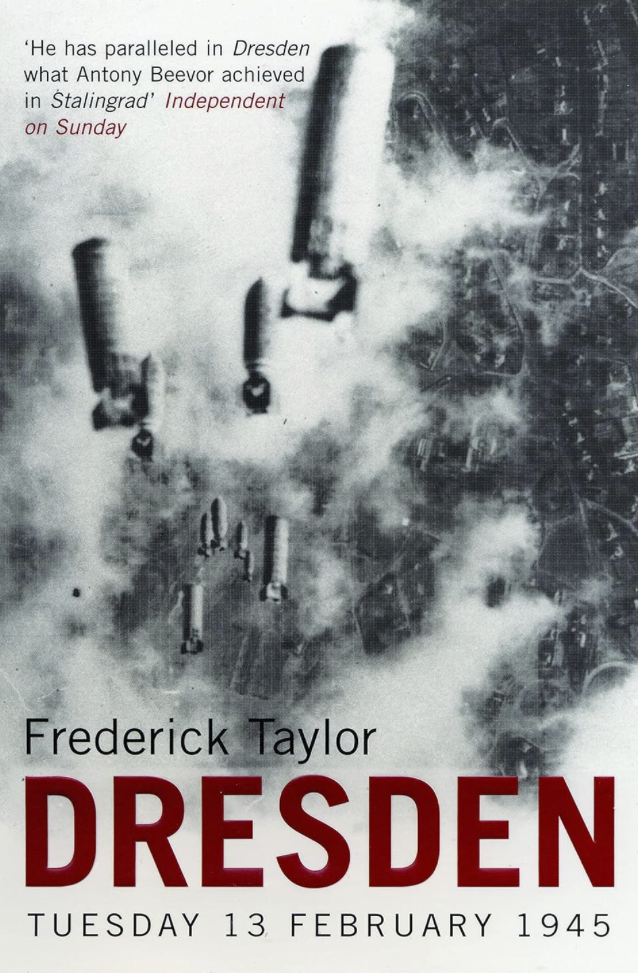
… Just over six years later the city of Dresden would be reduced to ashes by hundreds of bombers from the RAF and US Air Force, a horror that began on the evening of Shrove Tuesday, February 13, 1945, lasting until Thursday morning. Griebel would survive, but all his art went up in the blaze.
Dresden is perhaps, after Hiroshima, the name most synonymous with slaughter from the air, and in Britain at least the most controversial. Last year, while visiting this incredibly beautiful city — much of it now rebuilt — I reread Frederick Taylor’s account of the bombing, published back in 2005 on the 60th anniversary of the event.
Dresden’s destruction was extensive. Almost no buildings in the centre or its inner suburbs survived the bombs, and the death toll was immense, although difficult to assess in a city packed with refugees from the east. Anything between 20,000 and 80,000 fatalities is possible, although the consensus seems to be around 25,000.
That night was to be the worst of many wartime firestorms, a meteorological event in which the heat of the blaze becomes so intense, up to a thousand degrees centigrade, that the oxygen is sucked out of the surrounding air. More died in Dresden from asphyxiation than fire, and even those who thought they had found shelter in fountains were boiled alive. Many more drowned in the city’s reservoir, where they had gone to seek protection, their energy sapped by the soaring temperatures, unable to climb out. The bombers, thousands of feet above, could feel the warmth of the thousand fires below.
[…]
As everyone in the 1930s was well aware, the new war would bring aerial destruction on a hideously greater scale, and when it came again, it was the Luftwaffe who first put these ideas into practise, first in Poland and then Rotterdam.
After failing to destroy the Royal Air Force over the summer of 1940, the Nazis switched to aerial bombing of British cities. Between September 7, 1940 and New Year’s Day 1941, London was attacked on 57 consecutive nights, killing 14,000 inhabitants, a rate of 250 fatalities for each day of bombing. The German air force went on to kill an estimated 43,000 British civilians over the course of the war, with V-1 attacks continuing until the last weeks of the war.
On November 14, 1940, over 500 German bombers took off for a mission that would gift their language a new verb: Coventrated. Five hundred tons of high explosives, 30,000 incendiary bombs, fifty landmines and twenty petroleum mines were dropped on the target, and the medieval city went up in flames.
Like the blitz on other British cities, morale was not crushed in Coventry, but something dawned on the British high command. The destruction of Coventry’s infrastructure, utilities and transport had proved far more damaging than the destruction of any purely “military” target. Furthermore, bombers were notoriously inaccurate, and one survey showed that only 2 per cent of bombs fell within even one thousand feet of their intended point. Aerial bombardment of cities would prove far more effective than any hopeless targeting of particular coordinates.
They also learned that a large enough bombing raid would result in a firestorm, in which air currents are drawn in from the surrounding area, causing the fire to burn far more intensely. Indeed, a major attack on the City of London on December 29, 1940 might have become another firestorm but for the bad weather.
The British had been initially reluctant to take the war to Germany. While Poland was left to endure hell, leaflets were dropped over Berlin in October 1939 claiming that Nazi leaders were secretly profiting from the war, leading Noel Coward to suggest that it looked like we were trying to bore the Germans to death. There is even the apocryphal story about British official Sir Kingsley Wood refusing to bomb industrial targets in the Black Forest because it was private property. Indeed, our attempts to bomb Germany in 1940 were so feeble that Goebbels had to fake British “atrocities” to rouse the German public
With the entry of the United States and Soviet Union into the war in 1941, and with the German defeat at Stalingrad, the shoe was now on the other foot. The British invested more resources in Bomber Command and its head, Air Marshall Arthur Harris. “Bomber” Harris would become representative of the entire policy of destroying Germany’s cities, and a figure of controversy; the unveiling of his statue in 1992 attracted protests and has been repeatedly vandalised, but like many architects of wartime destruction, he was motivated by a desire to prevent a repeat of what he saw in 1914-18. The son of a colonial official who might have spent the rest of his life as a farm manager in Rhodesia were it not for war, he had joined the Royal Flying Corp in the first conflict and from his plane saw the horror of trench warfare and became determined that this sort of stalemate should never be repeated.
Having stuck to targeted industrial centres, in February, 1942 Allied command issued the Area Bombing Directive authorising the wide scale destruction of enemy cities. On 28 March the Hanseatic town of Lübeck was destroyed in a firestorm, and its most famous son, the anti-Nazi novelist Thomas Mann, appeared on BBC radio saying that while he regretted the destruction of his native city, “I think of Coventry, and have no objection to the lesson that everything must be paid for. Did Germany believe that she would never have to pay for the atrocities that her leap into barbarism seemed to allow?”
After the Lübeck bombing, Goebbels approached a state of panic for the first time, describing the damage as “really enormous”. He responded, in April 1942, by saying that he would “bomb every building in England marked with three stars in the Baedeker Guide” – Exeter was now hit in retaliation.
On May 30 the Allies launched what Harris called “the Thousand Plan”, the first thousand-bomber raid. Cologne and Hamburg were singled out for destruction, but on last-minute meteorological advice only the Rhineland city was chosen. Hamburg’s citizens would never know how fate had saved them – if only for another year.
So shocked were the Germans by the attack that the authorities forced the city’s fleeing citizens to sign a pledge of secrecy about what they saw, which ended with the sinister line “I know what the consequences of breaking this undertaking will be”.
Things would only get worse, and the Allies were getting both more destructive and more skilled. In faraway Utah, the Americans were now busy testing the destruction of German-style buildings, even hiring German refugee architect Erich Mendelssohn to recreate a German apartment block.
Comments Off on The destruction of Dresden, February 1945


