
World War Two
Published 6 May 2023A command crisis in the Chinese Nationalist Army benefits the Japanese invaders, in Italy, Mark Clark spends his birthday planning new offensives, the Japanese are pushing for Imphal, and the Soviets for Sevastopol — another busy week of the war!
(more…)
May 7, 2023
Total Chaos on the Chinese Front! – WW2 – Week 245 – May 6, 1944
Comments Off on Total Chaos on the Chinese Front! – WW2 – Week 245 – May 6, 1944
Africa after colonialism
Hannes Wessels on the plight of so many African nations once the various colonial powers were off the scene and they were at least formally independent:
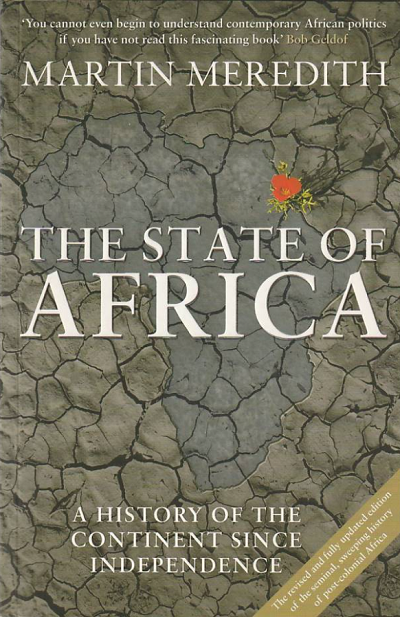
If you have a heart in Africa it’s probably not a good idea to read Martin Meredith’s State of Africa because if you do, it will, in all likelihood, break it. In it, he covers, in gory detail, what has happened on the continent in the postcolonial era, and while it’s riveting, it is also deeply disturbing.
[…] “by the end of the 1980s not a single African head of state in three decades had allowed himself to be voted out of office. Of some 150 heads of state who had trodden the African stage, only six had voluntarily relinquished power”?
Or the fact that, in the Congo alone, in 1964, over a million people, virtually all civilians, died in sectarian strife. Nobody knows precisely how many more millions have died in the benighted country since. Or that Mobutu Sese Seko, prior to coming to power, had $6 in his bank account. By 1987 a team of editors and reporters from Fortune magazine disclosed that he was one of the richest men in the world at an estimated $5 billion.
Or the fact that Jean Bedel Bokassa “combined not only extreme greed and personal violence … unsurpassed by any other African leader. His excesses included seventeen wives, a score of mistresses and an official brood of 55 children … [He] also gained a reputation for cannibalism. Political prisoners … were routinely tortured on Bokassa’s orders, their cries clearly audible to nearby residents”. In an effort to compare himself to Napoleon, he declared himself an emperor and spent a large chunk of the national budget on his coronation while his people suffered and starved.
Or the fact that Uganda’s Idi Amin, in a bid to crush political opposition, ordered the gruesome deaths of thousands of alleged opponents at the hands of his “death squads”. “The Chief Justice was dragged away from the High Court never to be seen again. The university’s Vice Chancellor disappeared. The bullet-riddled body of an Anglican Archbishop, still in ecclesiastical robes, was dumped at the mortuary of a Kampala hospital. One of Amin’s former wives was found with her limbs dismembered in the boot of a car. Amin was widely believed to perform blood rituals over the bodies of his victims.” He was heard on several occasions boasting about his penchant for eating human flesh.
Or the fact that foreign researcher Robert Klintberg reported on oil-rich Equatorial Guinea as being “a land of fear and devastation no better than a concentration camp — the ‘cottage industry Dachau of Africa’.” Under Macias Nguema, more than half of the population was either killed or fled into exile. Finally deposed by his nephew, Obiang was indicted for the murder of 80,000 people. The plunder continued.
Or that in Nigeria, between 1988 and 1993, an official report estimated $12.2 billion was “diverted” from the fiscus. In 1990, the United Nations concluded that Nigeria had one of the worst records for human deprivation of any country in the developing world.
These are only a smattering of an almost endless litany of entirely avoidable man-made catastrophes that have blighted Africa since the imperial exit. One is left wondering if there is any precedent in history for such calamitous misrule that has led to the early, often violent deaths of millions, and delivered unspeakable misery to hundreds of millions more, which is where we are today.
Having read the book, I’m left pondering the fact that Cecil Rhodes, a colonial colossus, looms large in contemporary history as one of the great villains of the last century, better known for his alleged malfeasance than any of the abovementioned leaders. But as far as I know, Rhodes never stole from anyone and never killed anyone, and he certainly didn’t eat anyone. I know he did use his money and military muscle to stop slavery and intertribal slaughter. And I know he plowed most of his fortune into building roads, railways, educational facilities, and other infrastructure needed to transform a wilderness into a developed country. It looks to me like his generosity of spirit is reflected in the Rhodes scholarships he provided for, aimed at nurturing the talents of a select few from across the racial divides in a bid to make the world he was leaving a better place.
Comments Off on Africa after colonialism
Tank Chats Reloaded | S-Tank | The Tank Museum
The Tank Museum
Published 27 Jan 2023In this episode of Tank Chats Reloaded, we are delighted to be joined by Stefan Karlsson, the director and curator of The Swedish Tank Museum. He shares his remarkable journey with the S-Tank, from his first experience driving it at the age of nine, to his later service in the Swedish Army. Stefan’s passion for the S-Tank is evident, and his story is sure to captivate and inspire.
(more…)
Comments Off on Tank Chats Reloaded | S-Tank | The Tank Museum
QotD: The long-term instability of bison hunting on the Great Plains
Unlike in Mongolia, where there were large numbers of wild horses available for capture, it seems that most Native Americans on the Plains were reliant on trade or horse-raiding (that is, stealing horses from their neighbors) to maintain good horse stocks initially. In the southern plains (particularly areas under the Comanches and Kiowas), the warm year-round temperature and relatively infrequent snowfall allowed those tribes to eventually raise large herds of their own horses for hunting and as a trade good. While Mongolian horses know to dig in the snow to get the grass underneath, western horses generally do not do this, meaning that they have to be stall-fed in the winter. Consequently in the northern plains, horses remained a valuable trade good and a frequently object of warfare. In both cases, horses were too valuable to be casually eating all of the time and instead Isenberg notes that guarding horses carefully against theft and raiding was one of the key and most time-demanding tasks of life for those tribes which had them.
So to be clear, the Great Plains Native Americans are not living off of their horses, they are using their horses to live off of the bison. The subsistence system isn’t horse based, but bison-based.
At the same time, as Isenberg (op. cit. 70ff) makes clear that this pure-hunting nomadism still existed in a narrow edge of subsistence. From his description, it is hard not to conclude that the margin or survival was quite a bit narrower than the Eurasian Steppe subsistence system and it is also clear that group-size and population density were quite a bit lower. It’s also not clear that this system was fully sustainable in the long run; Pekka Hämäläinen argues in The Comanche Empire (2008) that Comanche bison hunting was potentially already unsustainable in the very long term by the 1830s. It worked well enough in wet years, but an extended drought (which the Plains are subjected to every so often) could cause catastrophic decline in bison numbers, as seems to have happened the 1840s and 1850s. A sequence of such events might have created a receding wave phenomenon among bison numbers – recovering after each dry spell, but a little less each time. Isenberg (op. cit., 83ff) also hints at this, pointing out that once one factors for things like natural predators, illness and so on, estimates of Native American bison hunting look to come dangerously close to tipping over sustainability, although Isenberg does not offer an opinion as to if they did tip over that line. Remember: complete reliance on bison hunting was new, not a centuries tested form of subsistence – if there was an equilibrium to be reached, it had not yet been reached.
In any event, the arrival of commercial bison hunting along with increasing markets for bison goods drove the entire system into a tailspin much faster than the Plains population would have alone. Bison numbers begin to collapse in the 1860s, wrecking the entire system about a century and a half after it had started. I find myself wondering if, given a longer time frame to experiment and adapt the new horses to the Great Plains if Native American society on the plains would have increasingly resembled the pastoral societies of the Eurasian Steppe, perhaps even domesticating and herding bison (as is now sometimes done!) or other animals. In any event, the westward expansion of the United States did not leave time for that system to emerge.
Consequently, the Native Americans of the plains make a bad match for the Dothraki in a lot of ways. They don’t maintain population density of the necessary scale. Isenberg (op. cit., 59) presents a chart of this, to assess the impact of the 1780s smallpox epidemics, noting that even before the epidemic, most of the Plains Native American groups numbered in the single-digit thousands, with just a couple over 10,000 individuals. The largest, the Sioux at 20,000, far less than what we see on the Eurasian Steppe and also less than the 40,000 warriors – and presumably c. 120-150,000 individuals that implies – that Khal Drogo alone supposedly has [in Game of Thrones]. They haven’t had access to the horse for nearly as long or have access to the vast supply of them or live in a part of the world where there are simply large herds of wild horses available. They haven’t had long-term direct trade access to major settled cities and their market goods (which expresses itself particularly in relatively low access to metal products). It is also clear that the Dothraki Sea lacks large herds of animals for the Dothraki to hunt as the Native Americans could hunt bison; there are the rare large predators like the hrakkar, but that is it. Mostly importantly, the Plains Native American subsistence system was still sharply in flux and may not have been sustainable in the long term, whereas the Dothraki have been living as they do, apparently for many centuries.
Bret Devereaux, “That Dothraki Horde, Part II: Subsistence on the Hoof”, A Collection of Unmitigated Pedantry, 2020-12-11.
Comments Off on QotD: The long-term instability of bison hunting on the Great Plains
May 6, 2023
Face-palm-worthy Coronations of the past
I’m sure almost everyone — except the tiny number of Republicans in England — hopes for a smooth and spectacular Coronation for His Majesty King Charles III, there are plenty of examples of past Coronations that were anything but:
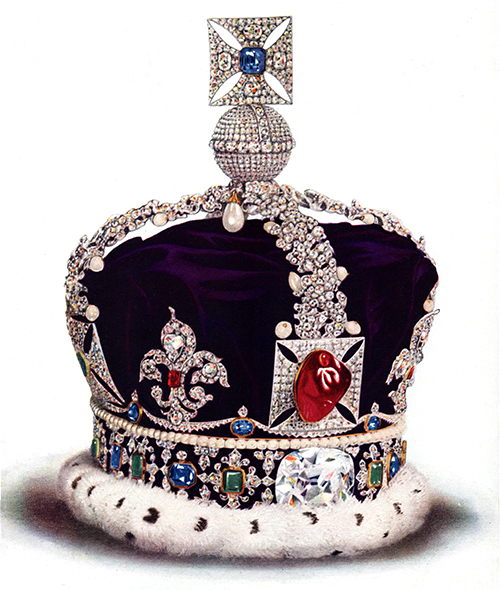
The Imperial State Crown, worn by the British monarch in the royal procession following the Coronation and at the opening of Parliament.
Wikimedia Commons.
Whereas so many traditions are 19th-century inventions, as any student of history knows, the coronation of Britain’s monarch is a rare example of a truly ancient custom, dating to the 10th century in its structure and with origins stretching back further, to the Romans and even Hebrews. As Tom Holland said on yesterday’s The Rest is History, it is like going to a zoo and seeing a woolly mammoth.
It is a sacred moment when the sovereign becomes God’s anointed, an almost unique state ceremony in a secular world. The custom originates with the late Roman emperors, associated with Constantine the Great and certainly established by the mid-fifth century in Constantinople. In the West, and following the fall of that half of the empire, barbarian leaders were eager to imitate imperial styles (a bit like today). Germanic and Celtic tribes had ceremonies for new leaders in which particular swords were displayed, a feature of later rites, but as they developed the practice of kingship, so their rituals began to imitate the Roman form.
[…]
Athelstan, the first king of England, had been crowned in 925 at Kingston, a spot where seven kings of England had been enthroned. Perhaps the most notorious was Edwig, a 16-year-old whose proto-rock star qualities were not appreciated at the time of his coronation in 955. Indeed he failed to turn up, and when Bishop Dunstan marched to the king’s nearby quarters to drag him along, he found the teenager in bed with a “strumpet” and the strumpet’s mother.
However, Edwig died four years later, and Dunstan was elevated to Canterbury, became a saint and, through chronicles recorded by churchmen, got his version of history.
This reign might seem impossibly distant and obscure, yet it was under Edwig’s brother Edgar that the current coronation format was established. Edgar was a powerful king, and the last of the Anglo-Saxon rulers to live a happily Viking-free existence. His coronation on 11 May 973 was an illustration of his strength, and also his aspirations. Held at Bath, most likely because of its association with Rome, it involved a bishop placing the crown on the king’s head, in the Carolingian style, and would become the template for the ceremony for his direct descendent Charles III.
But not all coronations would run so smoothly. After Edgar’s death his elder son Edward was killed in possibly nefarious circumstances, and his stepmother placed her son Ethelred on the throne. Ethelred’s reign was plagued by disaster, and it was later said in the chronicles — the medieval equivalent of “and then the whole bus clapped” Twitter tales — that Bishop Dunstan lambasted the boy-king for “the sin of your shameful mother and the sin of the men who shared in her wicked plot” and that it “shall not be blotted out except by the shedding of much blood of your miserable subjects”.
This would have been merely awkward, whereas many coronations ended in riot or bloodshed. The most notorious incident in English history occurred on Christmas Day 1066: Duke William got off to a bad start PR-wise when his nervous Norman guards mistook cheers for booing and began attacking the crowd, before setting fire to buildings.
[…]
Perhaps the most scandalous coronation took place at the newly completed St Paul’s Cathedral in February 1308. The young queen, Isabella, was the 12-year-old daughter of France’s King Philippe Le Bel, and had inherited her father’s good looks, with thick blonde hair and large blue, unblinking eyes. Her husband, Edward II, was a somewhat boneheaded man of 24 years whose idea of entertainment was watching court fools fall off tables.
It was a fairy tale coronation for the young girl, apart from a plaster wall collapsing, bringing down the high altar and killing a member of the audience, and the fact that her husband was gay and spent the afternoon fondling his lover Piers Gaveston, while ignoring her. Isabella’s two uncles, who had made the trip from France, were furious at the behaviour of their new English in-law, though perhaps not surprised.
[…]
One of the most disastrous coronations occurred during the Hundred Years’ War. Inspired by Joan of Arc, in 1429 the French had beaten the English at the Battle at Patay, after which their leader Charles VII entered Reims and was crowned at the spot where the kings of France had been enthroned for almost a thousand years. In response, on 26 December 1431 the English had their candidate, the 10-year-old Henry VI, crowned King of France at Notre-Dame in Paris, where one road was turned into a river of wine filled with mermaids, and Christmas plays were performed on an outdoor stage.
Unfortunately, the coronation was a complete mess. The entire service was in English, the weather was freezing, the event rushed, too packed, filled with pickpockets, and worst of all the English made such bad food that even the sick and destitute at the Hotel-Dieu complained they had never tasted anything so vile.
Comments Off on Face-palm-worthy Coronations of the past
Coronation Weekend
Jago Hazzard
Published 5 May 2023For us train nerds, “Coronation” means something very different.
Comments Off on Coronation Weekend
History Summarized: Chicago’s Tribune Tower
Overly Sarcastic Productions
Published 20 Jan 2023It’s not a Dome, but it’s still pretty darn good.
(more…)
Comments Off on History Summarized: Chicago’s Tribune Tower
May 5, 2023
Alligator Creek: America Learns to Fight the Japanese
Forgotten Weapons
Published 7 Jan 2023The Battle of Alligator Creek (aka Battle of the Tenaru) was a formative moment in the American World War Two psyche. After making an unopposed landing on Guadalcanal and taking its mostly-completed airfield at minimal cost, the US Marines had to defend their permitter on the night of August 21st, 1942.
Colonel Kiyonoa Ichiki was sent from the Japanese base at Truk with about 900 tough veteran soldiers to push the Marines off the airfield. These men had originally been slated to assault Midway Island, but the Japanese naval defeat there forced a change in plans. Ichiki was overconfident, and more concerned about retaking the islands of Tulagi, Gavutu, and Tanambogo across the straights, where Japan’s main base in the area had also been captured by Marine Raiders. Marching up the coastline towards Henderson Field, Ichiki’s men hit the thin single strand of Marine barbed wire about about 1:30am on the morning of there 21st. An intense firefight erupted, with the well dug-in Marine positions opening up with .30 caliber and .50 caliber machine guns, small arms, and 37mm canister rounds.
The fighting continued after daybreak, with Ichiki’s men digging in on the east bank of Alligator Creek. The Marines launched a two prong counterattack, with one force crossing the Creek inland and advancing down the east bank while a second group, including several Stuart light tanks, advanced across the sandbar. These two groups linked up in the early afternoon of the 21st, almost completely annihilating the Ichiki Detachment.
This was the first real land combat between American and Japanese forces in which American soldiers were able to report back on their experience. It was here that the US military as an institution learned that the Japanese would die rather than surrender, and this engagement set the American expectations for the rest of the Pacific campaign.
(more…)
Comments Off on Alligator Creek: America Learns to Fight the Japanese
May 4, 2023
Fierce fighting on Gallipoli … before WW1
Bruce Gudmundsson outlines the operations of Ottoman Empire forces defending “Turkey in Europe” against Greek and Bulgarian invasion (in alliance with Serbia and Montenegro) in 1913:
In the English speaking world, the name Gallipoli invariably evokes memories of the great events of 1915 and 1916. A location of such strategic importance, however, rarely serves as the site of a single battles. Two years before the landings of the British, Indian, Australian, and New Zealand troops on the south-west portion of the the peninsula (and the concurrent French landings on the nearby mainland of Asia Minor near the ruins of the ancient city of Troy), Ottoman soldiers defended the Dardanelles against the forces of the Balkan League.
By the end of January of 1913, the combined efforts of Greece, Serbia, Montenegro, and Bulgaria had driven Ottoman forces from most of “Turkey in Europe”. Indeed, the only intact Ottoman formations on European soil were those trapped in the fortress of Adrianople, those holding the fortified line just west of Constantinople, and those that had recently arrived at Gallipoli.
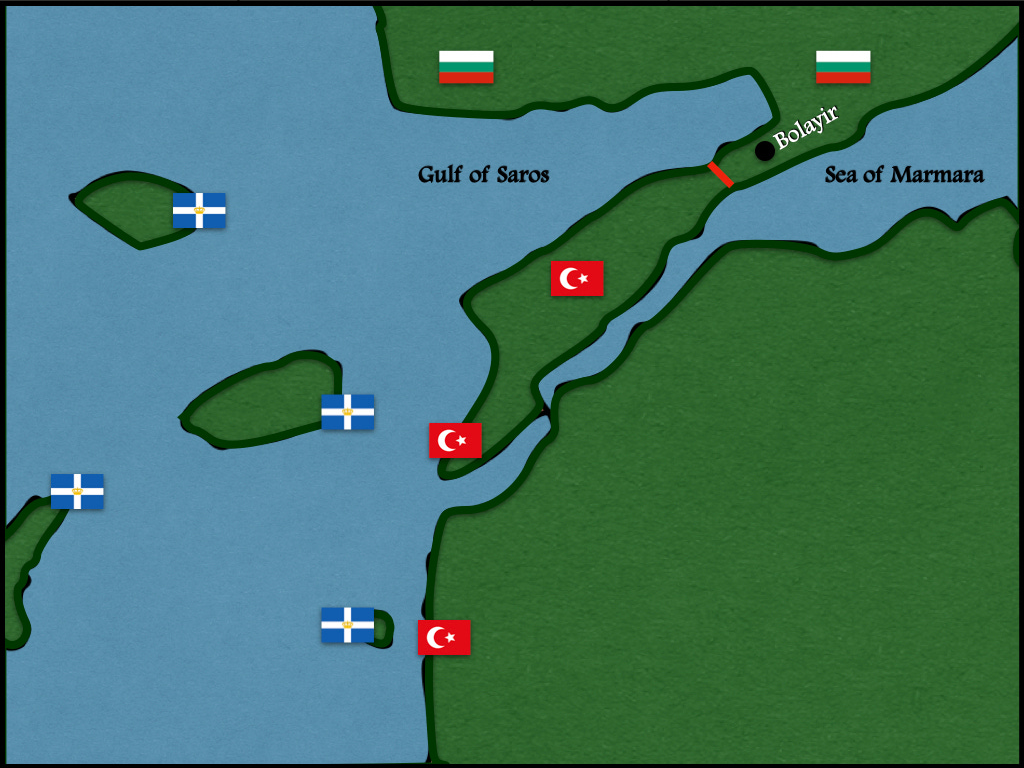
Soon after arriving, the Ottoman forces on Gallipoli began to build a belt of field fortifications across the narrowest part of the peninsula, a line some five kilometers (three miles) west of the the town of Bolayir. At the same time, they occupied outposts some twenty kilometers east of the line, at the place where the peninsula connected to the mainland.
The general situation in (and around) the Gallipoli Peninsula, 31 January 1913.
On 4 February 1913, the Bulgarians attacked. On the first day of this attack, they drove in the Ottoman outposts. On the second day, they broke through a hastily erected line of resistance, thereby convincing the Ottoman forces in front of them to evacuate Bolayir. However, rather than taking the town, or otherwise attempting to exploit their victory, they withdrew to positions some ten kilometers (six miles) east of the Ottoman earthworks.
While the Ottoman land forces returned to the earthworks along the neck of the Peninsula, ships of the Ottoman Navy operating in the Sea of Marmora located, and began to bombard, the Bulgarian forces near the coast. This caused the Bulgarians to move inland, where they took up, and improved, new positions on the rear slopes of nearby hills.
On 9 February, the Ottomans launched a double attack. While the main body of the Ottoman garrison of Gallipoli advanced overland, a smaller force, supported by the fire of Ottoman warships, landed on the far side of the Bulgarian position. Notwithstanding the advantages, both numerical and geometric, enjoyed by the Ottoman attackers, this pincer action failed to destroy the Bulgarian force. Indeed, in the course of two failed attacks, the Ottomans suffered some ten thousand casualties.
Though the Ottoman maneuver failed to dislodge the Bulgarians from their trenches, the two-sided attack convinced the Bulgarian commander to seek ground that was, at once, both easier to defend against terrestrial attack and less vulnerable to naval gunfire. He found this on the east bank of a river, thirteen kilometers (eight miles) northeast of Bolayir and ten kilometers (six miles) north of the place where the Ottoman landing had taken place.
Comments Off on Fierce fighting on Gallipoli … before WW1
Why British train enthusiasts hate this man – Dr. Beeching’s Railway Axe
Train of Thought
Published 27 Jan 2023In today’s video, we take a look at one Doctor Richard Beeching, the man who ripped up a third of Britain’s railways with nothing but a pen and paper.
May 3, 2023
The History of the Hawaiian Luau
Tasting History with Max Miller
Published 2 May 2023
(more…)
Comments Off on The History of the Hawaiian Luau
Finland’s High Power Rig
Forgotten Weapons
Published 6 Jan 2023Finland used a variety of FN pistols prior to WW2, and had already evaluated the High Power when Russian invaded and the Winter War began. With an urgent need for more arms, Finland ordered a batch of High Power pistols, which FN was happy to include with the other arms orders already being delivered to Finland. In total, the Finns bought 2,400 of them, with 900 delivered in February 1940 and 1,500 in March 1940. All of them were bought as rigs with leather holsters riveted to flat board shoulder stocks (note that a Finnish pistol with a Finnish-contract original stock is exempted form the NFA in the US, and need not be registered as a short-barreled rifle).
This delivery schedule meant that only a few were available in time to be used in the Winter War, and they saw much greater use in the Continuation War. They were particularly appreciated by the Finnish Air Force as survival weapons. This is often misinterpreted to mean that they were exclusively used by the Air Force; in fact the quantity of Finnish aircraft was small enough that only a small fraction of the pistols were issued to pilots.
Finnish contract pistols have serial numbers falling between 11,000 and 15,000 (and not all guns in that range are Finnish). The stocks were marked in large numbers with the serial number of the gun, although matching rigs are quite scarce today. Some, but not all, were later marked “SA” by the Finnish Army. During the continuation War some of the holsters were separated from the stocks, and some of the pistols had new square front sights put on (a common Finnish preference, done to Lugers as well).
About 40% of the High Powers were lost or rendered unserviceable by the end of the Continuation War. The remainder were kept in service until the 1980s, when they were replaced by the Browning Double Action and slowly sold as surplus.
(more…)
Comments Off on Finland’s High Power Rig
QotD: The first system of war
The main tool of this form of warfare (detailed more extensively in A. Gat, War in Human Civilization (2006) and L. Keeley, War Before Civilization (1996)) was the raid. Rather than announcing your movements, a war party would attempt to advance into enemy territory in secret, hoping (in the best case) to catch an enemy village or camp unawares (typically by night) so that the population could be killed or captured (mostly killed; these are mostly non-specialized societies with limited ability to incorporate large numbers of subjugated captives) safely. Then you quickly get out of enemy territory before villages or camps allied to your target can retaliate. If you detected an incoming raid, you might rally up your allied villages or camps and ambush the ambusher in an equally lopsided engagement.
Only rarely in this did a battle result – typically when both the surprise of the raid and the surprise of the counter-raid ambush failed. At that point, with the chance for surprise utterly lost, both sides might line up and exchange missile fire (arrows, javelins) at fairly long range. Casualties in these battles were generally very low – instead the battle served both as a display of valor and a signal of resolve by both sides to continue the conflict. That isn’t to say these wars were bloodless – indeed the overall level of military mortality was much higher than in “pitched battle” cultures, but the killing was done almost entirely in the ambush and the raid.
We may call this the first system of war. It is the oldest, but as noted above, never entirely goes away. We tend to call this style “asymmetric” or “unconventional” war, but it is the most conventional war – it was the first convention, after all. It is also sometimes denigrated as primitive, but should not be judged so quickly – first system armies have managed to frustrate far stronger opponents when terrain and politics were favorable.
Bret Devereaux, “Collections: The Universal Warrior, Part IIa: The Many Faces of Battle”, A Collection of Unmitigated Pedantry, 2021-02-05.
Comments Off on QotD: The first system of war
May 2, 2023
Dad’s Army: What Was The Military Career of Lance Corporal Jones?
The History Chap
Published 25 Jan 2023Lance Corporal Jack Jones is one of the most loved characters in the classic British comedy Dad’s Army. Constantly referring to his exploits in the Sudan, the North West Frontier (India) and the First World War.
So I thought I would make a short video exploring his long (& fictitious) military career.
The local butcher, Jack Jones, is a member of Walmington-on-Sea Home Guard during World War Two. This fictitious Home Guard unit are the stars of the classic BBC comedy: Dad’s Army.
What I found amazing is that the BBC created a back story for the character of Lance Corporal Jones. researching the medal ribbons that Jones wears on his Home Guard uniform I have put together a timeline of his military career in the 1st battalion, Warwickshire Regiment.
The story starts when young Jack Jones joins the Royal Warwickshire’s in 1884 as a drummer boy. He is to spend 31 years serving in the British army where he participates in the Gordon Relief Expedition, the re-conquest of Sudan under General Kitchener, the Boer War, the North West Frontier of India, and the First World War.
Comments Off on Dad’s Army: What Was The Military Career of Lance Corporal Jones?
QotD: The musical importance of the city of Córdoba
Is it New York or London? Paris or Tokyo? Los Angeles or Shanghai? Nashville or Vienna? Berlin or Rio de Janeiro?
That depends on what you’re looking for. Do you value innovation or tradition? Do you want insider acclaim or crossover success? Is your aim to maximize creativity or promote diversity? Are you seeking timeless artistry or quick money attracting a large audience?
Ah, I want all of these things. So I only have one choice — but I’m sure my city isn’t even on your list.
My ideal music city is Córdoba, Spain.
But I’m not talking about today. I’m referring to Córdoba around the year 1000 AD.
I will make a case that medieval Córdoba had more influence on global music than any other city in history. That’s probably not something you expected. But even if you disagree — and I already can hear some New Yorkers grumbling in the background — I think you will discover that the “Córdoba miracle,” as I call it, is an amazing role model for us.
It’s a case study in how communities foster the arts — and in a way that benefits everybody, not just the artists.
[…] a thousand years before New Orleans spurred the rise of jazz, and instigated the Africanization of American music, a similar thing happened in Córdoba, Spain. You could even call that city the prototype for all the decisive musical trends of our modern times.
“This was the chapter in Europe’s culture when Jews, Christians, and Muslims lived side by side,” asserts Yale professor María Rosa Menocal, “and, despite their intractable differences and enduring hostilities, nourished a complex culture of tolerance.”
There’s even a word for this kind of cultural blossoming: Convivencia. It translates literally as “live together.” You don’t hear this term very often, but you should — because we need a dose of it now more than ever. And when scholars discuss and debate this notion of Convivencia, they focus their attention primarily on one city: Córdoba.
It represents the historical and cultural epicenter of living together as a norm and ideal.
Even today, we can see the mixture of cultures in Spain’s distinctive architecture, food, and music. These are both part of Europe, but also separate from it. It is our single best example of how the West can enter into fruitful cultural dialogue with the outsider — to the benefit of both.
Ted Gioia, “The Most Important City in the History of Music Isn’t What You Think It Is”, The Honest Broker, 2023-01-26.
Comments Off on QotD: The musical importance of the city of Córdoba


