
The Great War
Published Jun 14, 2024The Battle of the Somme was one of the bloodiest of the First World War. From July to November 1916, millions of men struggled to fight in mud, under crushing shellfire, or in a hail of machine gun bullets. The Somme has been a synonym for the futility of trench warfare, but also the subject of fierce debate – who really won the Battle of the Somme?
(more…)
October 13, 2024
The Deadliest Day of the British Army: The Battle of the Somme
Comments Off on The Deadliest Day of the British Army: The Battle of the Somme
October 12, 2024
Classics Summarized: The Oresteia
Overly Sarcastic Productions
Published Jul 19, 2017Nobody look at how long ago I promised to do this.
That’s right! The sequel to Iphigenia, which itself was a prequel to the Iliad, has finally been given the ol’ OSP treatment! And it only took me TWO AND A HALF YEARS
(more…)
Comments Off on Classics Summarized: The Oresteia
October 11, 2024
“[T]he past is like a thriving civilization; they do things better there”
Another recommended link from the “Your Weekly Stack” set of links to interesting posts on Substack. This, like the previous post, is from an author I hadn’t read before and thought was worth sharing with you.
This is from The American Tribune, making the case that modern Americans (and westerners in general) are in a similar situation to the white minority in Rhodesia:

We stand today in the ruins of civilization. Much as the 9th Century Anglo-Saxons looked at the stone works of the Romans and thought they must have been giants,1 or the Greeks of the post-Sea Peoples Dark Age saw the works of the Minoans and Myceneans and thought only Cyclopses could have constructed such structures,2 we stare at the achievements of the 19th and early 20th Centuries in near-disbelief.
The moon hasn’t been stepped upon since the 70s. Mars remains uncolonized. Municipal infrastructure like water treatment and provision is falling apart and the government either can’t or won’t respond to natural disasters.3 Whereas we once built beautiful buildings that lasted for centuries, structures such as Chatsworth and the Horse Guards Building of Whitehall, now we have ugly structures of concrete and steel that are falling apart already.4
The situation as regards crime and squalor is even worse. As Curtis Yarvin notes in “An Open Letter to Open-Minded Progressives”:
If you read travel narratives of what is now the Third World from before World War II (I’ve just been enjoying Erna Fergusson’s Guatemala, for example), you simply don’t see anything like the misery, squalor and barbarism that is everywhere today. (Fergusson describes Guatemala City as “clean”. I kid you not.) What you do see is social and political structures, whether native or colonial, that are clearly not American in origin, and that are unacceptable not only by modern American standards but even by 1930s American standards.
So whereas Guatemala was once clean, now America’s cities are towers of concrete surrounded by piles of refuse, mobs of zombie-like drug addicts living on the streets,5 and infested with criminals of both the petty and highly violent variety. As Hartley put it, “The past is a foreign country; they do things differently there”. More accurately, the past is like a thriving civilization; they do things better there.
In short, we, like those in the Belgian Congo after the Belgians left, live in an “Empire of Dust” where much of what remains is the ruin of a prior civilization destroyed not because it didn’t work, but because the demented ideology of the present conflicted with its continued, functional existence.6
What happened? A sort of decolonization inflicted upon the Great Powers themselves — namely America, Germany, Britain, and France — after the outlying colonies had long been destroyed. The decay of law and order, the promotion of anti-white hatred, the decay of infrastructure, and the filling of positions with corrupt thugs rather than honorable gentlemen,7 all of it is more or less what happened to the colonies in the ’50s and ’60s. Further, it is similar to what happened later on in South Africa, where a collection of communists, leftists, and NGOs with like mindsets and funded by those like George Soros turned a formerly thriving civilization into what now amounts to a land like Mad Max but with more murder.8
But while the South Africanization of America is certainly an issue that we face,9 it’s not the most accurate comparison to our present problem. South Africa was, when it fell, filled with decades of racial hatred sparked by decades of apartheid that ended only then (though was somewhat overblown), something that Europe never had and nowhere in America has had in over half a century. That unique circumstance created a degree of hatred that was overpowering and, though one with which we largely disagree, understandable. We, then, are somewhat different in terms of where we are and what is happening.
1. https://espace.library.uq.edu.au/data/UQ_363155/s40110183_phd_final_thesis_copy.pdf
2. See The Glory that Was Greece by Stobart
3. https://en.wikipedia.org/wiki/Jackson,_Mississippi_water_crisis; https://nypost.com/2024/10/03/us-news/north-carolina-hurricane-victims-slam-biden-harris-admin-as-fema-response-sputters/
4. See, for example, https://www.vintagebuilding.com/houses-longer-houses/
5. See, for example: https://youtu.be/9iSkKkzabnM
6. This is what the phrase “empire of dust” comes from: https://www.imdb.com/title/tt2148945/
7. https://www.theamericantribune.news/p/the-death-of-the-gentleman-and-the
8. https://www.theamericantribune.news/p/george-soross-hand-in-south-africas
9. I wrote an article on this for Tablet: https://www.tabletmag.com/sections/news/articles/united-states-south-africa-racial-justice
Comments Off on “[T]he past is like a thriving civilization; they do things better there”
Japanese Pedersen Rifle
Forgotten Weapons
Published Apr 18, 2015After he failed to win US military adoption of his toggle-locked rifle design, John Pedersen went looking for other countries that might be interested in the gun. One of these was Japan, which experimented with toggle-locked Pedersen rifles and carbines for several years in the early/mid 1930s. This particular one is serial number 8, and has a scope mounting rail attached to it. It functions like a normal Pedersen rifle, but has a rotary magazine instead of the en bloc clip used in the US trial and British-produced rifles.
Comments Off on Japanese Pedersen Rifle
QotD: Fascists are inherently bad at war
For this week’s musing, I wanted to take the opportunity to expand a bit on a topic that I raised on Twitter which draw a fair bit of commentary: that fascists and fascist governments, despite their positioning are generally bad at war. And let me note at the outset, I am using fascist fairly narrowly – I generally follow Umberto Eco’s definition (from “Ur Fascism” (1995)). Consequently, not all authoritarian or even right-authoritarian governments are fascist (but many are). Fascist has to mean something more specific than “people I disagree with” to be a useful term (mostly, of course, useful as a warning).
First, I want to explain why I think this is a point worth making. For the most part, when we critique fascism (and other authoritarian ideologies), we focus on the inability of these ideologies to deliver on the things we – the (I hope) non-fascists – value, like liberty, prosperity, stability and peace. The problem is that the folks who might be beguiled by authoritarian ideologies are at risk precisely because they do not value those things – or at least, do not realize how much they value those things and won’t until they are gone. That is, of course, its own moral failing, but society as a whole benefits from having fewer fascists, so the exercise of deflating the appeal of fascism retains value for our sake, rather than for the sake of the would-be fascists (though they benefit as well, as it is, in fact, bad for you to be a fascist).
But war, war is something fascists value intensely because the beating heart of fascist ideology is a desire to prove heroic masculinity in the crucible of violent conflict (arising out of deep insecurity, generally). Or as Eco puts it, “For Ur-Fascism there is no struggle for life, but, rather, life is lived for struggle … life is permanent warfare” and as a result, “everyone is educated to become a hero“. Being good at war is fundamentally central to fascism in nearly all of its forms – indeed, I’d argue nothing is so central. Consequently, there is real value in showing that fascism is, in fact, bad at war, which it is.
Now how do we assess if a state is “good” at war? The great temptation here is to look at inputs: who has the best equipment, the “best” soldiers (good luck assessing that), the most “strategic geniuses” and so on. But war is not a baseball game. No one cares about your RBI or On-Base percentage. If a country’s soldiers fight marvelously in a way that guarantees the destruction of their state and the total annihilation of their people, no one will sing their praises – indeed, no one will be left alive to do so.
Instead, war is an activity judged purely on outcomes, by which we mean strategic outcomes. Being “good at war” means securing desired strategic outcomes or at least avoiding undesirable ones. There is, after all, something to be said for a country which manages to salvage a draw from a disadvantageous war (especially one it did not start) rather than total defeat, just as much as a country that conquers. Meanwhile, failure in wars of choice – that is, wars a state starts which it could have equally chosen not to start – are more damning than failures in wars of necessity. And the most fundamental strategic objective of every state or polity is to survive, so the failure to ensure that basic outcome is a severe failure indeed.
Judged by that metric, fascist governments are terrible at war. There haven’t been all that many fascist governments, historically speaking and a shocking percentage of them started wars of choice which resulted in the absolute destruction of their regime and state, the worst possible strategic outcome. Most long-standing states have been to war many times, winning sometimes and losing sometimes, but generally able to preserve the existence of their state even in defeat. At this basic task, however, fascist states usually fail.
The rejoinder to this is to argue that, “well, yes, but they were outnumbered, they were outproduced, they were ganged up on” – in the most absurd example, folks quite literally argued that the Nazis at least had a positive k:d (kill-to-death ratio) like this was a game of Call of Duty. But war is not a game – no one cares what your KDA is if you lose and your state is extinguished. All that matters is strategic outcomes: war is fought for no other purpose because war is an extension of policy (drink!). Creating situations – and fascist governments regularly created such situations. Starting a war in which you will be outnumbered, ganged up on, outproduced and then smashed flat: that is being bad at war.
Countries, governments and ideologies which are good at war do not voluntarily start unwinnable wars.
So how do fascist governments do at war? Terribly. The two most clear-cut examples of fascist governments, the ones most everyone agrees on, are of course Mussolini’s fascist Italy and Nazi Germany. Fascist Italy started a number of colonial wars, most notably the Second Italo-Ethiopian War, which it won, but at ruinous cost, leading it to fall into a decidedly junior position behind Germany. Mussolini then opted by choice to join WWII, leading to the destruction of his regime, his state, its monarchy and the loss of his life; he managed to destroy Italy in just 22 years. This is, by the standards of regimes, abjectly terrible.
Nazi Germany’s record manages to somehow be worse. Hitler comes to power in 1933, precipitates WWII (in Europe) in 1939 and leads his country to annihilation by 1945, just 12 years. In short, Nazi Germany fought one war, which it lost as thoroughly and completely as it is possible to lose; in a sense the Nazis are necessarily tied for the position of “worst regime at war in history” by virtue of having never won a war, nor survived a war, nor avoided a war. Hitler’s decision, while fighting a great power with nearly as large a resource base as his own (Britain) to voluntarily declare war on not one (USSR) but two (USA) much larger and in the event stronger powers is an act of staggeringly bad strategic mismanagement. The Nazis also mismanaged their war economy, designed finicky, bespoke equipment ill-suited for the war they were waging and ran down their armies so hard that they effectively demodernized them inside of Russia. It is absolutely the case that the liberal democracies were unprepared for 1940, but it is also the case that Hitler inflicted upon his own people – not including his many, horrible domestic crimes – far more damage than he meted out even to conquered France.
Beyond these two, the next most “clearly fascist” government is generally Francisco Franco’s Spain – a clearly right-authoritarian regime, but there is some argument as to if we should understand them as fascist. Francoist Spain may have one of the best war records of any fascist state, on account of generally avoiding foreign wars: the Falangists win the Spanish Civil War, win a military victory in a small war against Morocco in 1957-8 (started by Moroccan insurgents) which nevertheless sees Spanish territory shrink (so a military victory but a strategic defeat), rather than expand, and then steadily relinquish most of their remaining imperial holdings. It turns out that the best “good at war” fascist state is the one that avoids starting wars and so limits the wars it can possibly lose.
Broader definitions of fascism than this will scoop up other right-authoritarian governments (and start no end of arguments) but the candidates for fascist or near-fascist regimes that have been militarily successful are few. Salazar (Portugal) avoided aggressive wars but his government lost its wars to retain a hold on Portugal’s overseas empire. Imperial Japan’s ideology has its own features and so may not be classified as fascist, but hardly helps the war record if included. Perón (Argentina) is sometimes described as near-fascist, but also avoided foreign wars. I’ve seen the Baathist regimes (Assad’s Syria and Hussein’s Iraq) described as effectively fascist with cosmetic socialist trappings and the military record there is awful: Saddam Hussein’s Iraq started a war of choice with Iran where it barely managed to salvage a brutal draw, before getting blown out twice by the United States (the first time as a result of a war of choice, invading Kuwait!), with the second instance causing the end of the regime. Syria, of course, lost a war of choice against Israel in 1967, then was crushed by Israel again in another war of choice in 1973, then found itself unable to control even its own country during the Syrian Civil War (2011-present), with significant parts of Syria still outside of regime control as of early 2024.
And of course there are those who would argue that Putin’s Russia today is effectively fascist (“Rashist”) and one can hardly be impressed by the Russian army managing – barely, at times – to hold its own in another war of choice against a country a fourth its size in population, with a tenth of the economy which was itself not well prepared for a war that Russia had spent a decade rearming and planning for. Russia may yet salvage some sort of ugly draw out of this war – more a result of western, especially American, political dysfunction than Russian military effectiveness – but the original strategic objectives of effectively conquering Ukraine seem profoundly out of reach while the damage to Russia’s military and broader strategic interests is considerable.
I imagine I am missing other near-fascist regimes, but as far as I can tell, the closest a fascist regime gets to being effective at achieving desired strategic outcomes in non-civil wars is the time Italy defeated Ethiopia but at such great cost that in the short-term they could no longer stop Hitler’s Anschluss of Austria and in the long-term effectively became a vassal state of Hitler’s Germany. Instead, the more standard pattern is that fascist or near-fascist regimes regularly start wars of choice which they then lose catastrophically. That is about as bad at war as one can be.
We miss this fact precisely because fascism prioritizes so heavily all of the signifiers of military strength, the pageantry rather than the reality and that pageantry beguiles people. Because being good at war is so central to fascist ideology, fascist governments lie about, set up grand parades of their armies, create propaganda videos about how amazing their armies are. Meanwhile other kinds of governments – liberal democracies, but also traditional monarchies and oligarchies – are often less concerned with the appearance of military strength than the reality of it, and so are more willing to engage in potentially embarrassing self-study and soul-searching. Meanwhile, unencumbered by fascism’s nationalist or racist ideological blinders, they are also often better at making grounded strategic assessments of their power and ability to achieve objectives, while the fascists are so focused on projecting a sense of strength (to make up for their crippling insecurities).
The resulting poor military performance should not be a surprise. Fascist governments, as Eco notes, “are condemned to lose wars because they are constitutionally incapable of objectively evaluating the force of the enemy”. Fascism’s cult of machismo also tends to be a poor fit for modern, industrialized and mechanized war, while fascism’s disdain for the intellectual is a poor fit for sound strategic thinking. Put bluntly, fascism is a loser’s ideology, a smothering emotional safety blanket for deeply insecure and broken people (mostly men), which only makes their problems worse until it destroys them and everyone around them.
This is, however, not an invitation to complacency for liberal democracies which – contrary to fascism – have tended to be quite good at war (though that hardly means they always win). One thing the Second World War clearly demonstrated was that as militarily incompetent as they tend to be, fascist governments can defeat liberal democracies if the liberal democracies are unprepared and politically divided. The War in Ukraine may yet demonstrate the same thing, for Ukraine was unprepared in 2022 and Ukraine’s friends are sadly politically divided now. Instead, it should be a reminder that fascist and near-fascist regimes have a habit of launching stupid wars and so any free country with such a neighbor must be on doubly on guard.
But it should also be a reminder that, although fascists and near-fascists promise to restore manly, masculine military might, they have never, ever actually succeeded in doing that, instead racking up an embarrassing record of military disappointments (and terrible, horrible crimes, lest we forget). Fascism – and indeed, authoritarianisms of all kinds – are ideologies which fail to deliver the things a wise, sane people love – liberty, prosperity, stability and peace – but they also fail to deliver the things they promise.
These are loser ideologies. For losers. Like a drunk fumbling with a loaded pistol, they would be humiliatingly comical if they weren’t also dangerous. And they’re bad at war.
Bret Devereaux, “Fireside Friday, February 23, 2024 (On the Military Failures of Fascism)”, A Collection of Unmitigated Pedantry, 2024-02-23.
October 10, 2024
Trump’s tariff proposals will rival Smoot-Hawley for self-inflicted economic woes
J.D. Tuccille explains why Trump’s economic plans are very much a curate’s egg of good and bad ideas, but the proposed tariff plans would more than compensate for any good positive effects from the rest of his proposals:
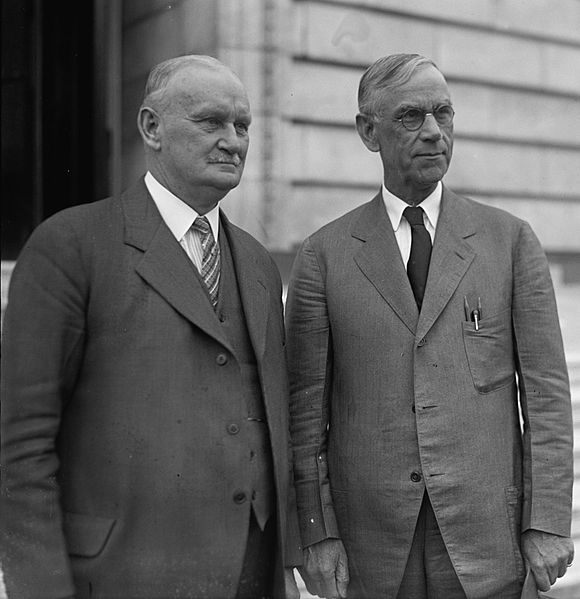
Willis C. Hawley (left) and Reed Smoot in April 1929, shortly before the Smoot–Hawley Tariff Act passed the House of Representatives.
Library of Congress photo via Wikipedia Commons.
Former president and current Republican presidential candidate Donald Trump wants to extend the tax cuts passed when he was in the White House, which are due to expire next year. That would not just be welcomed by the many Americans who would benefit, it could boost economic activity. But there’s a big problem: The protectionist tariffs favored by Trump would undo the good done by his tax cuts, reducing rather than increasing prosperity.
Tariffs Not Seen Since the Great Depression
“Former President Donald Trump’s proposals to impose a universal tariff of 20 percent and an additional tariff on Chinese imports of at least 60 percent would spike the average tariff rate on all imports to highs not seen since the Great Depression,” warns Erica York of the Tax Foundation.
Trump has actually been a little vague on the size of his universal tariff, first floating it at 10 percent while allowing “it may be more than that”, and then upping the ante to 20 percent. Either way, it’s a cost that ends up being largely paid by Americans in terms of higher retail prices and more expensive imported parts and materials for domestic manufacturing.
The Trump administration’s 2018 “tariffs resulted in higher prices for a wide variety of goods that U.S. consumers and businesses purchase,” the Tax Foundation’s Alex Durante and Alex Muresianu concluded.
Even when tariffs don’t directly affect the cost of imported goods purchased by consumers, they still drive up the prices of many things made in the U.S. The Cato Institute’s Pierre Lemieux points out that “a tariff on an input (say, steel) is paid by the American importer who will typically pass it down the supply chain to his customers and eventually to the consumers of the final good (say, a car)”. Instead of boosting domestic production, that can do harm, instead.
“For manufacturing employment, a small boost from the import protection effect of tariffs is more than offset by larger drags from the effects of rising input costs and retaliatory tariffs,” Federal Reserve Board economists found when they researched the 2018 tariffs.
That’s not to say Trump is alone in his protectionism. Last month, Bob Davis noted for Foreign Policy that “the Biden administration is the first since at least President John F. Kennedy’s time to fail to negotiate a major free trade deal, instead embracing tariffs” while Trump pursued both tariffs and trade deals.
Comments Off on Trump’s tariff proposals will rival Smoot-Hawley for self-inflicted economic woes
The Road to Serfdom by F.A. Hayek
David Warren recommends one of the first economics books I ever read and I fully concur with his appreciation of Friedrich Hayek’s most famous work:
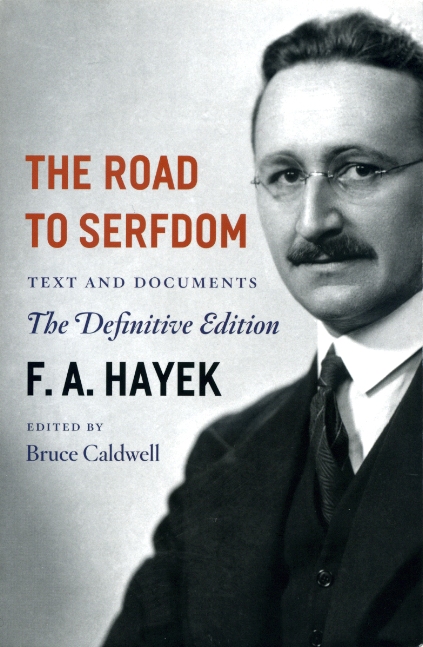
For those who have an interest in politics, who also wish to have some knowledge of this subject, I can recommend a book published in 1944. It is by Friedrich Hayek, and is dedicated “To the socialists of all parties”. The title is, The Road to Serfdom.
It is extraordinarily well-written, for an academic whose native language wasn’t English, in less than two hundred exhilarating pages. The book predicts, correctly, that while they will lose the War, German ideological notions that began to prevail before the War in e.g. Germany, Russia, Italy, and throughout the West, would continue to do so, in Britain and America. They were plausible and were thought to have been proved in wartime. In the coming peacetime, all the intellectuals would be on board.
Yet they were wrong, and had always been wrong. The professor, Hayek, shows why neither a little nor a lot of socialism will ever work; why it invariably makes everyone poorer, except for an ideological elite; and why it traps whole societies in the condition of serfdom. Oddly enough, almost no one wants to be a serf, but some wish to have power over serfs. Hence the popularity of socialism among the power-hungry.
Too, ambiguous and poorly understood political terms fool people. (My father explained this as the Triple-B principle: “Bullshit Baffles Brains”.)
The idle reader should still be captivated by this book, which hasn’t dated, even slightly. Re-reading it, as I have been doing since high school, I find the arguments irresistible and compelling. Other members of the “Austrian School” out of which Hayek sprang (it was originally a Catholic movement, incidentally) are also informative, but none are so articulate.
The “Chicago School”, of Milton Friedman et alia, was the nearest American equivalent. But that was based on numbers, more than upon the ironical ideas, which old Austro-Hungaria had the leisure to mull.
Comments Off on The Road to Serfdom by F.A. Hayek
HBO’s Rome – Ep. 2 “How Titus Pullo brought down the Republic” – History and Story
Adrian Goldsworthy. Historian and Novelist
Published Jun 26, 2024A look at episode 2 of the first series/season of HBO’s Rome drama. Once again we talk about the actual history and how the characters, events and institutions are presented in the series. This time this includes Antony becoming tribune of the plebs, as well as a meeting of the Senate and Julius Caesar crossing the Rubicon.
Vidcaps taken from the dvd edition, so copyright belongs to HBO.
Comments Off on HBO’s Rome – Ep. 2 “How Titus Pullo brought down the Republic” – History and Story
QotD: Why did ancient China lose its early lead in science and technology?
There are all kinds of answers given to this question, from ones based around the concept of “agricultural involution” (which I briefly surveyed in my review of Energy and Civilization), to ones that blame the complexity of the Chinese system of writing and other more outlandish theories. But would you know it, this question is commonly referred to within Sinology as the “Needham puzzle” or the “Needham question”, so what does the man himself think? Needham got the credit for posing the question, not for answering it, but in the final chapter of this book, “Attitudes Towards Time and Change”, he drops some fascinating hints.
A belief common to the great civilizations of the Axial Age was that time itself was somehow unreal. Greek philosophers from the pre-Socratics to the Neo-Platonists all expressed it in very different ways, but all agreed that in some sense the world of mutability and change was an illusion, and that outside of it stood an eternal, absolute reality sufficient in itself, unchanging in its perfection, αἰῶνας τῶν αἰώνων. The Buddhist civilizations include this under the doctrine of maya (illusion), and traditional Hinduism also exhibits time as a dreamlike and incidental quality of the world.
If time is somehow unreal and nothing can ever change, then it’s easy to see the attraction of a cyclic conception of history. And indeed, in the ancient world these cyclic theories predominate. The Babylonians had their Great Year, and Greek thinkers as diverse as Hesiod, Pythagoras, Plato, and Aristotle all speculated about the eternal repetition and recurrence of the ages of the world. In the Mahabharata the great yugas and kalpas, the Days of Brahma, follow one another in an inevitable fourfold cycle of world ages, the profusion of Hindu and Buddhist sects have promulgated a thousand interpretations and variations on this basic pattern. On the other side of the world, the Mayans had their own Great Year, and countless other peoples besides. This cosmology almost feels like a human universal (at least for civilizations at a particular stage of development), and why wouldn’t it be? We open our eyes and all we see are cycles within cycles — the cycle of the day, the cycle of the moon, the cycle of the seasons, the cycle of the generations. As sure as day follows night, why wouldn’t we expect that the universe too, a grand mechanism made by the gods, must eventually return to its starting point.
Various philosophers of science have asserted that this view of history makes scientific progress impossible, because of its fatalism and pessimism. If everything that happens has happened before and will happen again, then why bother trying to change anything? It’ll just get undone in the Kali Yuga anyway. But Needham points out another connection: if time is cyclic, or worse yet somehow unreal, then it makes no sense to stretch it out into an independent coordinate. In this way, the entire metaphysics of cyclical time resists the mathematization of physics. One can imagine the analytic geometry of Descartes being discovered in ancient Alexandria or Tikal or Harappa, but would it have been possible for one of the coordinate axes to represent time? A Descartes was possible, but a Newton or a Bernoulli was inconceivable.
All of this changes with the advent of Christianity, for which the most important fact about the world, the Incarnation, takes place at a particular moment in history, once and for all, κατὰ πάντα καὶ διὰ πάντα. The cosmos is fixed around this central point, and cannot curl back upon itself. Kairos transfigures chronos, and in so doing makes it real, gives it force and meaning. History is not a cycle, but a story of creation, separation, incarnation, and redemption, speeding towards its culmination as assuredly as a stone tracing a parabolic arc through the air. Or as Needham puts it:
[In the Indo-Hellenic world] space predominates over time, for time is cyclical and eternal, so that the temporal world is much less real than the world of timeless forms, and indeed has no ultimate value … The world eras go down to destruction one after the other, and the most appropriate religion is therefore either polytheism, the deification of particular spaces, or pantheism, the deification of all space … For the Judaeo-Christian, on the other hand, time predominates over space, for its movement is directed and meaningful … True being is immanent in becoming, and salvation is for the community in and through history. The world era is fixed upon a central point which gives meaning to the entire process, overcoming any self-destructive trend and creating something new which cannot be frustrated by cycles of time.
Some historians of science have argued that without this linear conception of time introduced by Christianity, we lack the conceptual vocabulary for various things ranging from analytic methods in physics to the idea of causality itself. So is that the answer? Is the solution to the Needham Puzzle that China progressed as far as it could until, weighed down by the fatalism of cyclic history and the impoverished mathematical vocabulary of timeless metaphysics, it ground to a halt?
Unfortunately, the answer is no. This theory sounds great, but it’s totally wrong.
There’s a bad habit among Western historians and philosophers of engaging in a shallow sort of Orientalism that aggregates all of the exotic East into a single entity.1 But when it comes to attitudes towards time, change, and history; the traditional Chinese attitude is much closer to that of Christendom than it is to the Hindu or Buddhist view. Needham does a good job summarizing the basic Chinese outlook, but includes a lot of details I didn’t know, including that the view of civilizations as ascending through distinct historical stages (e.g. the Stone Age, Bronze Age, Iron Age, etc.) is of Chinese origin! Needham also discusses the veneration, sometimes deification, of great inventors that saturates Chinese folk religion. All in all, the picture is one of China as a progress-obsessed society almost from its earliest moments, and as a society that was steadily progressing right up until it was suddenly and dramatically eclipsed by European science.
John Psmith, “REVIEW: Science in Traditional China, by Joseph Needham”, Mr. and Mrs. Psmith’s Bookshelf, 2023-08-14.
1. I am infuriated by restaurants that advertise “Asian food”. There’s more culinary diversity inside some regions of China than there is in most of Europe.
Comments Off on QotD: Why did ancient China lose its early lead in science and technology?
October 9, 2024
The Korean War 016 – South Koreans Invade the North! – October 8, 1950
The Korean War by Indy Neidell
Published 8 Oct 2024This week the KPA continue to grapple with the hole made by the landings at Incheon, as South Korean forces push past the 38th Parallel. MacArthur’s attention, however, is already on his next big gambit: a landing at Wonsan. South Korean forces may very well beat him to the punch, though, as their drive north continues. Beyond the Yalu River, Mao Zedong watches these developments closely, and plans his response.
Chapters
00:51 Recap
01:12 Seoul Aftermath
03:50 ROK Enters North Korea
05:28 The UN Resolution
07:36 Crossing the Parallel
14:25 The Wonsan Plan
16:38 Conclusion
(more…)
Comments Off on The Korean War 016 – South Koreans Invade the North! – October 8, 1950
QotD: The hijacking of the Canadian identity
But before we dismiss this three-year interregnum as a dystopian fever dream, it’s worth asking how our collective Canadian identity could be hijacked — even temporarily — in such a radicalized manner. And the truth is that it isn’t just progressive ideologues who bear responsibility; but also their counterparts on all parts of the political spectrum, few of whom exhibited any inclination to offer pushback while these falsehoods took root in the media. Even many writers at this newspaper, generally held to be a right-leaning outlet, greeted the unmarked-graves claims by heaping shame on their country.
In every other comparably advanced society, there exists a natural tension between conservative nationalists who reverentially sentimentalize their history, and the progressive critics who reflexively denounce it. And it is from out of that tension that something approaching the historical truth emerges. Or, at least something close enough to the historical truth that it provides a stable and coherent basis upon which a society can confidently pin its collectively embraced national identity.
What we learned in 2021 is that this necessary tension doesn’t exist in Canada, because traditionalists can no longer describe their nation’s history in a way that gives voice to their emotionally felt patriotism without attracting claims of racism and neocolonialism. As a result, our marketplace of ideas lacks the checks and balances required to inure us against — oh, gee, I don’t know, let’s take a crazy example — apocalyptic medieval fables in which legions of Indigenous children are thrown into furnaces and shallow graves by cackling nuns and diabolical priests.
So yes, shame on Trudeau for lowering the Canadian flag on federal buildings for half a year to honour victims entombed in non-existent mass graves. But shame on the rest of us for staring at our shoes while this blood libel was being signal-boosted. And now that Trudeau seems on his way out — and, with him, the maudlin, tear-soaked, bent-knee political shtick that accompanied this descent into hysteria — we might turn our attention toward developing a national self-identity sufficiently robust that it doesn’t fall to pieces the next time someone claims to have found genocide’s residue under an old tetherball court.
Jonathan Kay, “Don’t let politicians misinform you. Learn about Canada’s true history for yourself”, National Post, 2024-07-01.
Comments Off on QotD: The hijacking of the Canadian identity
October 8, 2024
Making the Black Mead of Medieval France – Bochet
Tasting History with Max Miller
Published Jun 25, 2024Black mead, or bochet, made with spices and wood chips
City/Region: Paris
Time Period: 1393Mead was very popular from Russia to England, but started to lose favor in part due to the rise of cheaper brews like vodka and hopped ales. Mead was often still drunk for its medicinal properties, especially when it was infused with herbs and spices.
This mead has some of those wonderfully warming spices, and I added wood chips from the local brewing store to mimic the wood barrels that it would have been fermented in. The burnt caramel scent softens and mellows out during fermentation, and the resulting mead is not sweet at all and is more complex than many meads I’ve had.
To make six sextier of bochet, take six pints of very sweet honey, and put it in a cauldron on the fire and boil it, and stir for so long that it starts to grow, and you see that it also boils with bubbles like small blisters which will burst, releasing a little bit of dark smoke. Then add seven sextier of water and boil so much that it reduces to six sextiers, and keep stirring. And then put it in a vat to cool until it is lukewarm; then strain it through a cloth, and put it in a barrel and add a pint of yeast from ale, because that is what makes it piquant, (though if you use bread yeast, it makes as good a flavor, but the color will be duller), and cover well and warmly so it ferments.
If you want to make it very good, add an ounce of ginger, long pepper, grains of paradise and cloves in equal amounts, except for the cloves of which there should be the least, and put them in a cloth bag and toss it in. And when it has been two or three days and the bochet smells of spices and is strong enough, take out the bag and wring it out and put it in the next barrel that you make. And so this powder will serve you well up to three or four times.
— Le Ménagier de Paris, 1393.
Comments Off on Making the Black Mead of Medieval France – Bochet
October 7, 2024
The demographic impact of modern cities
Lorenzo Warby touches on some of the social and demographic issues that David Friedman discussed the other day:
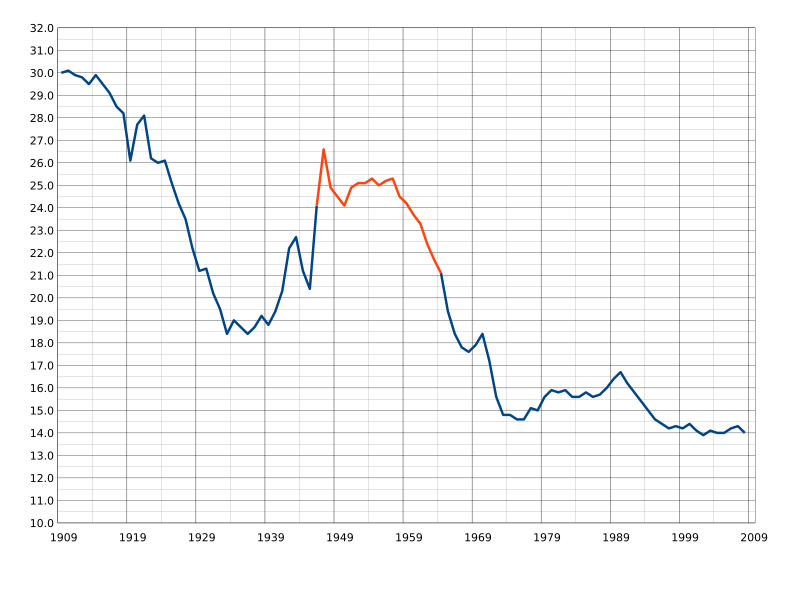
US Birth Rates from 1909-2008. The number of births per thousand people in the United States. The red segment is known as the Baby Boomer period. The drop in 1970 is due to excluding births to non-residents.
Graph by Saiarcot895 via Wikimedia Commons
Cities are demographic sinks. That is, cities have higher death rates than fertility rates.
For much of human history, cities have been unhealthy places to live. This is no longer true: cities have higher average life expectancies than rural areas. But they are still demographic sinks, for cities collapse fertility rates.
The problem is not that more women have no children, or only one child, making it to adulthood. Such women have always existed, though their share of the population has gone up across recent decades.
The key problem is the collapse in the demographic “tail” of large families. Cities are profoundly antipathetic to large families, and have always been so. This is particularly true of apartment cities — suburbs are somewhat more amenable to large families, though not enough to make up for the urbanisation effect.
While modern cities do not have slaves and household servants who were blocked from reproducing as ancient cities did, various aspects of modern technology have fertility-suppressing effects. Cars that presume a maximum of three children, for instance. An effect that is worsened by compulsory baby car-seats. Or ticketing and accommodation that presumes two children or less. There is also the deep problems of modern online dating. Plus the effects that endocrine disrupters and falling testosterone may be having.
These effects also extend to rural populations: falling fertility in rural populations is far more of a mystery than falling fertility in urban populations. How much declining metabolic health plays in all this is unclear. Indeed, futurist Samo Burja is correct, we do not really understand the “social technology” of human breeding.
Be that as it may, cities as demographic sinks is a continuation of patterns that go back to the first cities.
Matters at the margin
There are factors at the margin known to make a difference. Religious folk breed more than secular folk, though that is in part because rural people are more religious and city folk more secular.
Educating women reduces fertility. This is, in part, an urbanisation effect, as more education is available in cities. It is also an opportunity cost effect — there is more to do in cities, both paid and unpaid.
Education increases the general opportunity cost of motherhood, by expanding women’s opportunities. This also makes moving to cities more attractive. Women having more career opportunities reduces the relative attractiveness of men as marriage partners, reducing the marriage rate.
Strong cultural barriers against children outside marriage can reduce the fertility rate, by largely restricting motherhood to married women. This makes the fertility rate more dependant on the marriage rate.
Educating women makes children more expensive, as educated mothers have educated children. Part of the patterns that economist Gary Becker analysed.
Comments Off on The demographic impact of modern cities
Handguns in the US Army in World War Two
Forgotten Weapons
Published Jun 28, 2024Was the 1911 an emotional support totem or a viable combat weapon? Or both? American soldiers had a bit different take on handguns than soldiers of many other armies, and I think it stems from the American identity with the frontier — the Wild West was well within memory for many people when World War Two broke out. So today, let’s look at the American take on handguns during that war …
https://utreon.com/c/forgottenweapons/
http://www.floatplane.com/channel/For…Cool Forgotten Weapons merch! http://shop.forgottenweapons.com
Comments Off on Handguns in the US Army in World War Two
October 6, 2024
Will the President Abolish Democracy? – Rise of Hitler 03, March 1930
World War Two
Published 5 Oct 2024In the March 1930 Issue of the Weimar Wire Chancellor Muller resigns, the coalition government collapses, and Heinrich Brüning tries to build a new cabinet amidst street violence and political chaos. With the Nazis and Communists gaining strength, will Brüning succeed, or is the Weimar Republic heading for disaster?
(more…)
Comments Off on Will the President Abolish Democracy? – Rise of Hitler 03, March 1930


