
Quotulatiousness

July 14, 2011

The Eurozone crises

Filed under: Economics, Europe, Greece, Italy — Tags: , , , , — Nicholas @ 17:30

That’s right, crises, not crisis. There are three interlinked crises, not just one:

The crisis in the Eurozone has been lurching from one country to another over the past year or so. After bailouts for Greece, Ireland and Portugal, and with a second bailout for Greece in the offing, the financial markets this week turned their attention to Italy, a far larger economy than those previously affected. Spain, another country struggling to pay its way, has also been hit by austerity measures and political turmoil. But while it is easy to get caught up in the specifics of each new stage of the crisis, it is worth taking a step back to understand what is going on and the possibilities for the future.

The Euro crisis, like just about every other economic story these days, has a three-fold character. It is not, in fact, a single crisis; it has three inter-related elements: financial, economic and political.

Of the three, the financial crisis is, paradoxically, the least significant, even though it is the most prominent of the three and the one which threatens to spin out of control with serious broader consequences. Alongside the financial, the economic aspect is the most entrenched and material of the three, while the political crisis — that is, the failure of the political elites to get on top of the other two challenges — is the most critical, as it is, or should have been, the key to the resolution of the other two. The shift in focus to Italy, the Eurozone’s third largest economy, indicates that time may have run out for effective containment. The Euro genie is probably out of the bottle.

July 13, 2011

Calling the PM “a limp-wristed, tofu-eating, faux-Tory abomination”

Filed under: Britain, Media, Politics — Tags: , , — Nicholas @ 11:28

Oddly enough, he’s not talking about Stephen “Liberal-lite” Harper:

Today David Cameron finds himself in the “awkward” position of having to back a Labour motion calling for Murdoch’s News Corporation to drop its bid for BSKyB. Of course in the current climate of almost Death-of-Diana outrage (so brilliantly orchestrated by the BBC and the Guardian), there is probably not much wriggle room for doing otherwise. But in fact it all suits him very nicely for the very last thing our pathologically Heathite prime minister really wants is for the BSkyB to go through.

Why? Because the purpose of Murdoch’s BSkyB bid is essentially so that he can set up a UK version of America’s most popular news channel Fox News. Fox News acts as the conscience of the right in the US: it’s one of the things which made the Tea Party possible. A British version would achieve the same over here, destroying the crushing hegemony enjoyed by the BBC, restoring a balance to the political debate in Britain which for decades has been so sorely lacking – whatever the BBC’s supposed charter to commitment to fairness and balance might pretend.

[. . .]

If the BSkyB deal ever goes through, Cameron will no longer have that option available. Worse still, he will have a new TV news channel explaining to viewers every day of the week what a limp-wristed, tofu-eating, faux-Tory abomination their supposedly Conservative prime minister really is.

I don’t think he wants that. Do you?

July 11, 2011

The Euro: who’ll be the first to leave?

Filed under: Economics, Europe, Government, Greece, Italy — Tags: , , — Nicholas @ 11:15

With all eyes on Greece recently, the troubles of Italy come as a sudden shock to many:

Greece, Ireland, Portugal, (maybe) Spain…and now Italy? Contagion. The hope on the part of the EU and ECB was to contain the contagion by throwing money at it, but every time they fill one sink-hole with Euros another one opens up. It’s been obvious for a long time that the Eurozone was simply a bad idea, and this crisis has exposed the rotten underpinnings for all to see. Europe wanted to have a currency union just like the United States, but they are finding out the hard way that a monetary union without a fiscal-policy union just won’t work. European countries are not like US states — they have different langauges, different work rules, different governing philosophies…different cultures. The big question in everyone’s mind is…now what? Some countries must default, and a default will probably require leaving the Euro and going back to the sovereign currency. But no one knows exactly how this will work, or what the consequences will be.

Some people are floating the idea of a Euro-Bond, but I find that a little nonsensical absent any fiscal-policy union backing it. But of course this may be the point to the enterprise: to “force” Europeans into a closer union without having to go through the messy (and time-consuming) processes of holding a vote. The EU project has never really been a democratic enterprise from the very first — the Eurozone was implemented without the say-so (even over the protests of) its citizens. If I Eurobond is floated, I expect it to be another example of droit de Seigneur on the part of the Eurozone elite. (And it probably won’t work, and will piss away a lot more good money after bad, but none of that has stopped them so far.)

The highly localized outrage in the News of the World affair

Filed under: Britain, Media — Tags: , , — Nicholas @ 09:09

Frank Furedi points out the amazingly restricted view of the media:

The furore that surrounds the demise of the News of the World has little to do with the specific morally corrupt practices at that tabloid. Rather, as with other highly stylised outbursts of outrage in recent years — from ‘cash for questions’ to the MPs’ expenses scandal to bankers’ bonuses — this is a media-constructed and media-led furore. The main reason the sordid phone-hacking affair has become the mother of all scandals is because the media assume that anything which affects them is far more important than the troubles facing normal human beings.

It’s understandable: media folks frequently point out that politicians and celebrities move in “bubbles” which rarely bring them into contact with ordinary people — yet only occasionally seem to be aware that the media lives in its own set of bubbles.

Outrage-mongering, which is essentially an accomplishment of the media, is parasitical on today’s depoliticised and disorganised public life. In the absence of true political conviction, of any meaningful political alternative, strongly held views have been replaced by expressions of frustration and outrage. In such circumstances, the cultural elite can substitute its own agenda for that of the public, and in effect an outraged media reality becomes the reality.

Over the past week, many have claimed that the News of the World’s phone-hacking practices have offended the British public. Time and again, journalists claim to have detected a powerful public revulsion against the machinations of News International. Even a sensible columnist like Matthew d’Ancona argues that ‘David Cameron and Rupert Murdoch are swept up in a public fit of morality’. In truth, this ‘public fit of morality’ is actually confined to a relatively narrow stratum of British society. People in the pub or on the streets are not having animated debates about the News of the World’s heinous behaviour. Rather it is the Twitterati and those most directly influenced by the cultural elite and its lifestyle and identity who are emotionally drawn to the anti-Murdoch crusade.

July 8, 2011

Culinary cage match: Middlesbrough’s “Parmo” versus Canadian Poutine

Filed under: Britain, Cancon, Food, Humour, Randomness — Tags: , — Nicholas @ 10:52

I was born in Middlesbrough, but it was news to me that they have their own “signature dish”: the parmo:

As promised, our highly-trained operatives took time off from audacious spaceplane projects to tackle the parmo — a Middlesbrough delicacy whose fame has already spread as far as Sunderland, but is now set to burst onto the international stage.

However, in the interests of science, we decided to pitch the parmo against another dish whose name is uttered in hushed tones: Canadian poutine.

Yes, we hear you ask, qu’est-ce que c’est this poutine of which you parlez? Since you ask, it’s an unholy alliance of chips, gravy and cheese curds, which will now do battle with the parmo’s deep-fried pork fillet for the ultimate post-pub nosh deathmatch crown.

I should probably warn you that poutine is really a Quebec dish, and has only recently become well known outside the province of its birth. It’s also been described as “the culinary equivalent of having unprotected sex with a stripper in the parking lot of a truck stop in eastern Quebec.”

So, what’s the verdict? Well, I’d like to be able to report that the Spanish locals were willing to give these two tempting dishes a go and report back, but no sooner did we emerge from the kitchen bearing platters of goodness, than the bar immediately emptied.

Among the excuses offered for not being able to stick around to try our hearty fare was one bloke who’d forgotten it was his mother’s funeral in 10 minutes, and another chap who after 40 years as a committed atheist, decided it was an opportune moment to go to Mass and be reclasped to the bosom of the Church.

A contrarian view on the News of the World closure

Filed under: Britain, Liberty, Media — Tags: , , , — Nicholas @ 09:28

Well, somebody had to point out the cloud to this lovely silver lining that everyone else is enjoying:

Around the world, miles of column inches and hours of television and radio debate have been devoted to the closure of the News of the World. And yet the gravity of what occurred yesterday, the unprecedented, head-turningly historic nature of it, has not been grasped anywhere. A newspaper of some 168 years’ standing, a public institution patronised by millions of people, has been wiped from history — not as a result of some jackbooted military intrusion or intolerant executive decree or coup d’état, but under pressure from so-called liberal campaigners who ultimately felt disgust for the newspaper’s ‘culture’. History should record yesterday as a dark day for press freedom.

In a civilised society we tend to associate the loss of a newspaper, the pressured shutting down of a media outlet, with some major corrosion of public or democratic values. We look upon the extinction of a paper for non-commercial reasons, whatever the paper’s reputation or sins, as a sad thing, normally the consequence of a tyrannical force stamping its boot and its authority over the upstarts of the media. Yet yesterday’s loss of a newspaper has given rise, at best, to speculative analysis of what is going on inside News International, or at worst to expressions of schadenfreude and glee that the four million dimwits who liked reading phone-hacked stories about Wayne Rooney on a Sunday morning will no longer be at liberty to do so. Many of those politically sensitive commentators who shake their heads in solemn fury upon hearing that a newspaper in a place like Belarus has closed down have barely been able to contain their excitement about the self-immolation of a tabloid here at home.

Many people, including us at spiked, had reservations about the News of the World’s mode of behaviour, especially following this week’s revelations of deplorable phone-hacking activity involving murdered teenager Milly Dowler and the families of dead British soldiers. The paper undoubtedly infuriated many people, too. Yet this was a longstanding public institution. Just because a newspaper is the private property of an individual — even if that individual is Rupert Murdoch — does not detract from the fact that it is also a public institution, with an historic reputation and an ongoing political and social engagement with a regular, in this case numerically formidable readership. That such a public institution can be dispensed with so swiftly, that a huge swathe of the British people can overnight be deprived of an institution they had a close relationship with, ought to be causing way more discomfort and concern than it is. How would we feel if other public institutions — the BBC, perhaps, or parliament — were likewise to disappear?

July 7, 2011

“Bodice-rippers” guilty of perverting women’s lives

Filed under: Books, Britain, Education, Health, Media — Tags: , , — Nicholas @ 13:00

Apparently, The Guardian thinks that women are weak-willed and easily (mis-)lead, especially when it comes to their sex lives:

Mills & Boon’s romance novels should come with a health warning, according to a report published in an academic journal.

Blaming romance novels for unprotected sex, unwanted pregnancies, unrealistic sexual expectations and relationship breakdowns, author and psychologist Susan Quilliam says that “what we see in our consulting rooms is more likely to be informed by Mills & Boon than by the Family Planning Association”, advising readers of the Journal of Family Planning and Reproductive Health Care that “sometimes the kindest and wisest thing we can do for our clients is to encourage them to put down the books — and pick up reality”.

Her comments follow a recent claim that romance novels can “dangerously unbalance” their readers, with Christian psychologist Dr Juli Slattery saying she was seeing “more and more women who are clinically addicted to romantic books”, and that “for many women, these novels really do promote dissatisfaction with their real relationships”.

British tabloids

Filed under: Britain, Liberty, Media, Politics — Tags: , , , , — Nicholas @ 09:19

Brendan O’Neill views with some puzzlement the degree of outrage at the News of the World phone-hacking compared to earlier tabloid excesses:

Even some of those involved in the campaign recognise that there is a disparity between their earlier reaction to breaches of morality by tabloid newspapers and their reaction to this one. The campaigner who has successfully managed to get some big corporations to withdraw their advertising from the News of the World says she had previously learned to live with a ‘generalised, low-level irritation with the content of some of the tabloids’, yet following the Milly Dowler revelations those ‘years of irritation were transformed into rage’. Others have referred to the Dowler claims as ‘a tipping point’, arguing that we knew Murdoch’s tabloids were value-free and ethics-lite, but we didn’t know ‘they were this bad’.

In truth, there has been a distinct lack of journalistic integrity amongst some of the tabloids (and other media outlets) for many years now. For example, in 1988 the News of the World hounded the mentally ill EastEnders actor David Scarboro, not only revealing that he was in a psychiatric institution but also publishing photos of the institution and describing Scarboro as ‘mad’. Forced, under the glare of tabloid publicity, to flee the institution, Scarboro committed suicide by leaping off Beachy Head. He was just 20 years old. More famously, or rather infamously, the Sun libelled Liverpool football supporters following the Hillsborough disaster in 1989, falsely claiming that they had pickpocketed and urinated on dead and dying fans. There are many other instances over the past 30 years where the tabloids have used harassment and intimidation to get stories that have sometimes ruined people’s lives or denigrated the dead.

Yet none of those episodes gave rise to a widespread anti-tabloid campaign that galvanised prime ministers, opposition leaders, the respectable media, political activists and lawyers, as the Milly Dowler revelations have. Nor did they result in three-hour emergency debates in the House of Commons, with politicians battling it out to see who could express the most vociferous disdain for tabloid culture. The most striking thing about the anti-Murdoch campaign that has been so speedily consolidated over the past 48 hours is that it includes a smorgasbord of people who are normally at each other’s throats — from Conservative MPs to left-wing agitators, from big businesses such as William Hill and Coca-Cola (which are withdrawing their adverts from the News of the World) to religious spokespeople.

July 5, 2011

Would-be terrorists advised to pretend to be gay

Filed under: Britain, Media — Tags: , , , , — Nicholas @ 09:42

A link from Jon, my former virtual landlord, discussing a document that fell into the hands of the Sunday Mirror:

al-Qaeda fanatics in Britain are being taught to avoid detection — by pretending to be gay.

A new terror training manual tells Islamic extremists to lie about their sexuality if a woman approaches them in case she is a “honeytrap” spy sent by security services.

The handbook, which was uncovered by a Sunday Mirror ­investigation, says: “Many hotels — especially in busy UK cities — have women hanging around the lobby areas in order to attract men.

“A young beautiful woman may come and talk to you. The first thing you do to protect yourself from such a ­situation is to make dua (prayers) to Allah for ­steadfastness.

“The second thing is to find an excuse to get away from her that is realistic and sensible, such as you having a girlfriend for the past few years and you are loyal to her or you are ­homosexual.”

The suggestion is one of many tips in the manual, called Class Notes From The Security and ­Intelligence Course.

Of course, if they were drawing their recruits from Pashtun tribesmen, they might not have to pretend much.

When (not if) Greece defaults

Filed under: Economics, Europe, Government, Greece — Tags: , , — Nicholas @ 09:30

John Lanchester explains why default is inevitable, and that the only question remaining is how it will happen:

The economic crisis in Greece is the most important thing to have happened in Europe since the Balkan wars. That isn’t because Greece is economically central to the European order: at barely 3 per cent of Eurozone GDP, the Greek economy could vanish without trace and scarcely be missed by anyone else. The dangers posed by the imminent Greek default are all to do with how it happens.

I speak of the Greek default as a sure thing because it is: the markets are pricing Greek government debt as if it has already defaulted. This in itself is a huge deal, because the euro was built on the assumption that no country in it would ever default, and as a result there is no precedent and, more important still, no mechanism for what is about to happen. The prospective default could come in any one of several different flavours. From everybody’s perspective, the best of them would be what is known as a ‘voluntary rollover’. In that scenario, the institutions that are owed money by the Greek government will swallow heavily and, when their loan is due to be repaid, will permit their borrowings to be rolled over into another long loan. There is a gun-to-the-side-of-the-head aspect to this ‘voluntary’ deal, since the relevant institutions are under enormous governmental pressure to comply and are also faced with the fact that if they say no, they will have triggered a proper default, which means their loans will plummet in value and they’ll end up worse off. The deal on offer is: lend us more money, or lose most of the money you’ve already lent.

This is, at the moment, the best-case scenario and the current plan A. It reflects the failure of the original plan A, which involved lending the government of George Papandreou €110 billion in May last year in return for a promise to cut government spending and increase tax revenue, both by unprecedented amounts. The joint European Central Bank-EU-IMF loan was necessary because, in the aftermath of the financial crisis of 2008, Greece was exposed as having an economy based on phoney data and cheap credit. The cheap credit had now dried up, and Greece was faced by the simplest and worst economic predicament of any government: it couldn’t pay its debts.

July 4, 2011

The difference between the 4th of July and the 1st is more than a few days

Filed under: Britain, Cancon, Government, USA — Tags: , — Nicholas @ 16:06

Publius, from his Dominion Day post this year:

It’s a quibbling nonsense and very foreign. The idea of an independence day is unCanadian. It is mostly an unconscious American import. Well, if the Yankees have it then so must we. Given that history is not taught in the school it is a plausible enough mistake. One of the reasons we are not taught our history in the schools is that so much of it is, how to put this, British. Not Swinging Sixties British. Not even Cool Britannia British. It’s the boring old sort of British. Queen Victoria. Old men in wigs. Long speeches that refer in passing to Magna Carta. Very dull. Since history abhors a vacuum many Canadians simply import whatever they’ve picked up about our southern neighbours.

It is one of this blog’s governing theses that Canada is the most boring nation on earth. Boring in the sense that nothing “exciting” ever happens her. No civil wars, insurrections, coups, putsch and the last rebellion was during Queen Victoria’s reign. Dull, duller, Canada. That is why the idea of an independence day is so unCanadian. A clean break from something implies drama. A gradual development is very dull. It is also very practical and very sensible, thus very Canadian. We might even venture to say that it is positively Burkean.

I was once asked, many moons ago now, by an American friend to explain how Canada became independent. My explanation ran like this: We went over to London, along with the Australians, New Zealanders, South Africans, Irish and Newfoundlanders and asked, very politely, if we might become independent. Nothing personal. It was just time to leave. We’d definitely stay in touch. Family being family and all. We’re definitely keeping the monarchy. Send us a telegrams if the European continent starts getting dicey. All the best chaps.

I can’t really improve on that explanation. I’m missing the odd imperial conference, to say nothing of the battle of Vimy Ridge and the Hundred Days. The gist is about right. No muskets, no machine guns, no blood bath. Civilized men speaking in polite tones to one another. A fuss was not made. Everyone was terribly decent. The British officials sighed about how time had passed. Their work was done and all. The final act of parenthood is to see the young ones off. So they did. Nary a tear. Upper lip being kept quite stiff.

More on the British MoD shake-up

Filed under: Britain, Bureaucracy, Military — Tags: , , — Nicholas @ 10:26

Lewis Page has more on the British government’s major re-organization of the Ministry of Defence:

In outline, the three single services — and their chiefs — will lose massively in power and influence: and there will be an attempt to create a Joint Forces Command which will be the first step towards a future in which the services actually expect to work together as routine, rather than only when forced to or when there’s a war on.

The Levene report says that the First Sea Lord, the Chief of the General Staff and the Chief of the Air Staff — heads of the navy, army and air force respectively — should be booted out of MoD Main Building on Whitehall and made to go and sit in their service headquarters outside London. They will be allowed to leave behind only a small number of staff types to fight their Service’s corner in the corridors of power, and these rump contingents will be headed by mere two-star officers: a rear-admiral, a major-general and an air vice-marshal. If they commanded combat formations, such officers would be important indeed — the entire British Army can put into the field only one or two formations worthy of being commanded by a major-general — but among the mandarins of Whitehall, many of whom are equivalent to three-, four- and even five-star military officers, they will be insignificant small fry.

[. . .]

Or in other words, the Service heads may retain their headquarters, maps etc but in fact they will almost never be in charge of what their people are doing: another blow to their prestige, and another boost for that of the Joint Force Command.

If all this happens, it will be a fairly seismic shift at the MoD: the Joint way of doing business might actually gain ascendance, as any smart officer would have his sights set on an interesting career at PJHQ and the Joint command in Whitehall, actually involved with operations and action, rather than boring routine work in his Service HQ out of town sorting out training and recruitment and leave rosters etc.

It’s probably a good thing, as anyone who knows the MoD would admit that foolish interservice squabbling is one of the main factors paralysing it. That said, any such knowledgeable person would enter the caveat that Joint could be a disaster if it turned out merely to mean one Service achieving dominance over the other two (which would be the most disastrous varies with the commentator).

British Green activist recants opposition to nuclear power

Filed under: Britain, Environment, Technology — Tags: , , — Nicholas @ 09:51

Unlike Germany, which has announced it will be shutting down its nuclear power plants, Britain is considering a new generation of plants to provide an even greater share of their electricity needs. Even a few green activists are changing their tune:

Also, as much as Greens are enthusiastic about solar electricity, in cloudy countries such as ours it is extremely inefficient and expensive. Nuclear power, on the other hand, is one of the cheapest ways of producing electricity, and it is much safer than many environmentalists would have us believe.

The objection of environmentalists to nuclear power — fears about the dangers of nuclear waste and the cost of decommissioning it — are overblown, which explains why many people don’t like the Greens.

[. . .]

Solving many of the world’s most critical environmental challenges will, in some cases, involve doing the exact opposite of what most environmentalists want.

Rather than retreating into hair-shirt austerity, I believe that, just as technology got us into this mess, technology is vital to get us out of it.

That means embracing some things that will make a lot of Green believers choke on their organic muesli.

It has taken me a long time to reach this conclusion. I used to passionately oppose not only nuclear power but GM crops. I once even threw a pie in the face of a Danish scientist who dared to question the orthodox environmental line. So what changed?

Through research, I found that much of what I believed about environmental issues had little, if any, basis in science. Put simply, though my concerns were right, my solutions were wrong.

Britain’s overdue defence reforms

Filed under: Britain, Bureaucracy, Military — Tags: , , — Nicholas @ 09:30

Britain has, proportional to American forces, four times the number of general officers. This is a visible sign of an unbalanced force. The current government has announced some changes that may begin to correct this problem:

George Osborne, the chancellor of the exchequer, reportedly observed that the defence budget was “the most chaotic, the most disorganised, the most overcommitted.” In addition to the 8% cut in its funding (over four years) demanded as part of the government’s fiscal-austerity plan, the Ministry of Defence (MoD) has somehow to close an unfunded liability of £38 billion ($61 billion) up to 2020. This week, just before announcing a major shake-up of the way his department and the armed forces are run, Dr Fox said: “The future defence programme was worse than a delusion — it was a deliberate lie.”

The problem with correcting long-term issues like those in the MoD is that you have to maintain the active forces at a minimum level of effectiveness while addressing issues that may have been developing for a generation. I’ve mentioned in earlier posts how the most effective arm of the British forces in the last ten years has clearly been the Royal Air Force — not so much for their performance of their military duties, but for the skill with which they outmatched the army and the Royal Navy in bureaucratic infighting. The RN has been gutted, losing their force projection capabilities (the aircraft carriers), the army has been left over-extended and lacking airlift capabilities, while the RAF has kept their core anti-Soviet flying white elephants almost completely untouched by budget cuts.

At the heart of Lord Levene’s plan is a new slimmed-down Defence Board, the MoD’s senior decision-making body, which will be chaired by the secretary of state and will no longer include the three service chiefs. There will be a fresh emphasis on integrating the armed forces through the establishment of a Joint Forces Command led by a four-star officer. That will bring together capabilities such as logistics, planning, intelligence, cyber and some equipment purchases. Dr Fox sees the Joint Forces Command as both an important organisation in its own right and a symbol of the ethos of co-operation and flexibility he wants to cultivate.

One consequence is that the role of the three service chiefs in influencing departmental strategy and resource allocations will be sharply reduced. They will be kept busy by being given greater responsibility for managing their own budgets. Lord Levene also wants to see a halt to the merry-go-round of staff changes that undermines accountability by insisting that senior military and civilian staff should stay in their posts for at least four years.

July 1, 2011

Guardian contributer learns not to confuse “sociopathy” with “social network”

Filed under: Britain, Media, Technology — Tags: , , , , — Nicholas @ 11:40

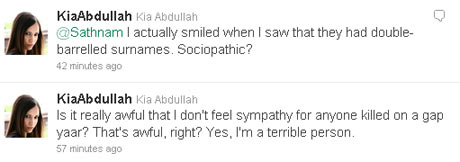
Kia Abdullah will think twice before letting her inner sociopath out on Twitter in future:

In the early hours of Tuesday morning, three young British men were killed in a bus crash in Thailand, just days after starting their gap year travels. A deeply tragic case — and one that will have left many British parents sick with worry. Annually about 100,000 young Brits take gap years.

But here’s a Twitter reaction from Kia Abdullah, a Guardian contributor:

Even if you think this sort of thing, sending it out immediately over Facebook or Twitter is just asking for a landslide of public abuse to land on your head. People who work in media have the least excuse for this kind of absent-minded faux pas, as they often pounce on celebrity or politician errors of exactly this sort.

« Newer PostsOlder Posts »

Powered by WordPress

