Quotulatiousness

March 16, 2012

One symptom, but lots of different causes

Filed under: Britain, Economics, History, India — Tags: , , , , — Nicholas @ 08:41

Tim Worstall responds to a simplistic definition of poverty:

What we then want to know is why do some individuals have a shortage of money? At which point we enter a forest of different explanations.

By far the largest cause of poverty is that people live in societies ruled by people variously ignorant, stupid or evil. N Korean poverty I would ascribe to that last. The early Soviets, I am sure along with Socialists of the time, really did think that planning would be more efficient, create more wealth. The evil came later, it was ignorance at first.

[. . .]

And, yes, really, there is also that culture of poverty that Ms. Ehrenreich wants to insist does not exist. Choices over drugs, booze, delayed gratification, marriage, children, education, all have their effects on poverty or not poverty.

Sure, poverty is indeed the lack of money. But there are different reasons for different people at different times about why they lack money. Given these different reasons therefore different solutions have to be applied. Our Down’s Syndrome lad does simply need a transfer of resources, of wealth, from others in the society to him.

But that is not to say that the cure for all poverty is such a transfer: poverty in India is going to be better alleviated by the continuing destruction of Nehru’s extentions of the Licence Raj, poverty among some others in the UK is going to be best addressed by a change in the behaviour of those individuals.
March 15, 2012

Rome Reborn 2.2: A Tour of Imperial Rome in 320CE

Filed under: Europe, History, Italy — Tags: , , — Nicholas @ 00:07

Rome Reborn 2.2: A Tour of Ancient Rome in 320 CE from Bernard Frischer on Vimeo.

This video presents a fly-through of the latest version of Rome Reborn (2.2). The new version incorporates some new content (including the Pantheon) and for the first time includes animations.

Rome Reborn is an international initiative to create a 3D digital model of the ancient city as it might have appeared in A.D. 320. For more about the project, please see: www.romereborn.virginia.edu.

For more information, contact the project director, Prof. Bernard Frischer at: bernard.d.frischer@gmail.com; cell +1-310-266-0183

March 14, 2012

A possible solution to Canada’s long, long search for new search-and-rescue aircraft

Filed under: Bureaucracy, Cancon, Italy, Military, USA — Tags: — Nicholas @ 11:46

David Akin in the Toronto Sun:

Here’s the back story: For nearly a decade, the Department of National Defence has had cabinet approval to go out and spend $3.1 billion on new search-and-rescue planes. That’s a big contract and several aircraft vendors wanted to win that deal.

Aircraft makers and their lobbyists knew which buttons to push within DND but also at other key government departments such as Public Works and Government Services and at Industry Canada.

The goal of the lobbyists was to rig the bid so only their plane could win.

Pulled eight ways to Sunday by the heavy lobbying, the bureaucrats at three departments kept pushing pieces of paper at each other but never got close to making some purchase decisions.

Now, with the possibility that the search-and-rescue purchase process could be tied up in the bureaucracy for yet another year (followed by delivery of planes years after that!) the government may be ready to slice through this Gordian Knot and simply turn to our American allies to pick up most of their fleet of C-27 Spartans.

Apparently one of the remaining hurdles to be cleared is that the manufacturer of the Spartan aircraft, Alenia Aermacchi, is trying to prevent the sale and is even threatening not to provide spare parts or service to any country that buys the aircraft from the US. I have no idea why, but I’m sure there’s a reason for it.

March 12, 2012

The hidden dangers of driving an antique BMW Isetta

Filed under: Europe, Germany, History, Media, Technology — Tags: , , — Nicholas @ 00:04

March 11, 2012

Music control freaks? The Nazis got there well before you

Filed under: Europe, Germany, History, Liberty, Media — Tags: , , , , — Nicholas @ 10:27

J.J. Gould in The Atlantic a couple of months ago, but brought to my attention by the folks at BoingBoing:

Skvorecky left no shortage of legacies to remember him by, but one of the more notable themes in his nonfiction writing is an emphasis on, as Welch puts it, “the oftentime minute similarities between applied fascism and communism.” And some of Skvorecky’s more notable variations on that theme in turn are found in his recollections and insights on the common totalitarian hatred of, among all things, jazz.

[. . .]

Anyone who finds this proposition fascinating won’t, I promise, be disappointed to read the rest of this book, or for that matter all of Talkin’ Moscow Blues: Essays About Literature, Politics, Movies, and Jazz. But maybe the single most remarkable example of 20th-century totalitarian invective against jazz that Skvorecky ever relayed was here in the intro to The Bass Saxophone, where he recalls — faithfully, he assures us (“they had engraved themselves deeply on my mind”) — a set of regulations, issued by a Gauleiter — a regional official for the Reich — as binding on all local dance orchestras during the Nazi occupation of Czechoslovakia. Get this:

  1. Pieces in foxtrot rhythm (so-called swing) are not to exceed 20% of the repertoires of light orchestras and dance bands;
  2. in this so-called jazz type repertoire, preference is to be given to compositions in a major key and to lyrics expressing joy in life rather than Jewishly gloomy lyrics;
  3. As to tempo, preference is also to be given to brisk compositions over slow ones so-called blues); however, the pace must not exceed a certain degree of allegro, commensurate with the Aryan sense of discipline and moderation. On no account will Negroid excesses in tempo (so-called hot jazz) or in solo performances (so-called breaks) be tolerated;
  4. so-called jazz compositions may contain at most 10% syncopation; the remainder must consist of a natural legato movement devoid of the hysterical rhythmic reverses characteristic of the barbarian races and conductive to dark instincts alien to the German people (so-called riffs);
  5. strictly prohibited is the use of instruments alien to the German spirit (so-called cowbells, flexatone, brushes, etc.) as well as all mutes which turn the noble sound of wind and brass instruments into a Jewish-Freemasonic yowl (so-called wa-wa, hat, etc.);
  6. also prohibited are so-called drum breaks longer than half a bar in four-quarter beat (except in stylized military marches);
  7. the double bass must be played solely with the bow in so-called jazz compositions;
  8. plucking of the strings is prohibited, since it is damaging to the instrument and detrimental to Aryan musicality; if a so-called pizzicato effect is absolutely desirable for the character of the composition, strict care must be taken lest the string be allowed to patter on the sordine, which is henceforth forbidden;
  9. musicians are likewise forbidden to make vocal improvisations (so-called scat);
  10. all light orchestras and dance bands are advised to restrict the use of saxophones of all keys and to substitute for them the violin-cello, the viola or possibly a suitable folk instrument.

March 10, 2012

More on the story of the WWII poster “Keep Calm and Carry On”

Filed under: Books, Britain, History, Media, WW2 — Tags: , — Nicholas @ 00:02

That looks like my kind of book shop! If/when I’m next in Alnwick, I’ll have to stop in for a visit.

Earlier item about the poster here.

March 9, 2012

Dalrymple: “British police have … become simultaneously bullying and ineffectual, a disastrous combination”

Filed under: Britain, Law — Tags: , , , , — Nicholas @ 11:08

Theodore Dalrymple on a recent article by British author China Miéville in the New York Times Magazine decrying the cruel, disproportionate sentences handed out to London rioters:

Some figures: in 2011, there were 12,699 knife attacks in London known to the police (up 13.6 percent from the previous year); 58,160 burglaries (up 8.8 percent); and 68,754 street robberies (up 13 percent). The average national detection rate for burglaries is about one in 12, though even this is an overstatement, due to police manipulation of the figures. Approximately 800,000 domestic burglaries took place in Great Britain in 2009; this means that some 67,000 were detected by the police. In that same year, 6,136 people went to prison in Great Britain for burglary (for an average of 17 months each). Considering the 800,000 burglaries annually, a domestic burglary attracts on average four days’ imprisonment: hardly indicative of judicial ferocity, and not much of a deterrent to burglary.

One cannot say often enough that the victims of crime are, like the perpetrators, more likely to be poor than rich. For example, single-parent households in Britain have a more than one-in-20 chance of being burgled in any given year; and since most burglars are recidivists, indeed multiply so, it follows that the class of victim is much larger than the class of perpetrator. Leniency toward criminals is not therefore a form of sympathy for the poor, but a failure to take either their lives or their property seriously. For Miéville to talk of “panicked reaction” in these circumstances is a form of moral exhibitionism. He is showing off in front of his peers.

The notion that the disorder in London (and elsewhere in the country) is a protest against injustice — a thread that runs through Miéville’s article — is both crude and laughable. It is true that the British police have, after years of liberal-inspired reform, become simultaneously bullying and ineffectual, a disastrous combination.

March 7, 2012

“The EU’s definition of a free society is where people do the authorities’ bidding voluntarily”

Filed under: Economics, Europe, Government, Liberty — Tags: , , , , — Nicholas @ 11:24

George Jonas who “imbibed too many Molotov-cocktails in his youth” on the European project:

The news comes on a day when market analysts observe “a sea of red.” European bourses are down 1.5%, China’s growth target is lowered from 8% to 7.5%, and the Greek government’s contingent liabilities are likely to exceed a trillion euros. While Europe’s debts are going through the roof, Viviane Reding has her eye glued to the glass ceiling. The European Commissioner for Justice doesn’t like what she sees.

“The European Commission is considering introducing mandatory quotas for female members on corporate boards,” reports Germany’s Suddeutsche Zeitung. The meticulous newspaper leaves no doubt about the reason. “Pleas for companies to voluntarily introduce such quotas themselves produced no effect.”

The EU’s definition of a free society is where people do the authorities’ bidding voluntarily. The EU is socialist, of course, not communist. Socialists consider an intermediate stage of voluntary compliance essential before turning to coercion.

Communists find this a hoot. They say it’s hypocritical and a waste of time. It’s hard to disagree with them. Communists are always nasty, but not always wrong.

Update: Of course, with their top-down, we-know-best approach, it’s no surprise that they were totally astonished when people interpreted their latest pro-expansion video a bit less positively than they expected:

H/T to the Adam Smith Institute blog for the video:

Critics of the EU are often accused of being “Little Englanders”. In the light of rhetoric like this from the EU it’s clear that the mindset behind the EU itself is little more than Little Englanderism writ large across the continent — still preoccupied with keeping out scary foreigners and closing Europe off from alien cultures. If the EU is offering an insular Europe that demonizes and builds walls against foreigners, I would turn it down. There’s a whole world out there to trade and engage with.

Wind turbines are “a technology that isn’t ready for prime time”

Filed under: Britain, Economics, Environment, Technology — Tags: , — Nicholas @ 10:20

Andrew Orlowski on the bad economic and technological decision by the British government to put so much reliance on wind power:

Two studies published this week calculate the astounding cost of Britain’s go-it-alone obsession with using wind turbines to generate so much of the electricity the nation needs.

Both studies make remarkably generous concessions that favour wind technology; the true cost, critics could argue, will be higher in each set of calculations. One study reckons that the UK can still meet its carbon dioxide emissions targets and save £140bn — but only if it dumps today’s inefficient hippie technology. The other puts the potential saving at £120bn — pointing out that the same amount of electricity could be generated using open cycle gas plants at one-tenth the cost of using wind turbines.

“There is nothing inherently good or bad about investing in renewable energy and green technology,” writes economist Professor Gordon Hughes — formerly of the World Bank and now at the University of Edinburgh. “The problem is that the government has decided to back a technology that isn’t ready for prime time, thus distorting the market.”

Hughes’ study — Why is Wind power so expensive? An economic analysis — is published by the Global Warming Policy Foundation today, and simply looks at the costs. The other study, by technical consulting group AF-Mercados, specifically looks at how to reduce CO2 in the cheapest manner — by incurring the least collateral economic damage. It’s called Powerful Targets: Exploring the relative cost of meeting decarbonisation and renewables targets in the British power sector. KPMG originally commissioned the study, but then got cold feet. Both come to similar conclusions: wind is astronomically expensive compared to other sources of energy — and consumers and businesses must pay a high price for the privilege of subsidising such an inefficient technology.

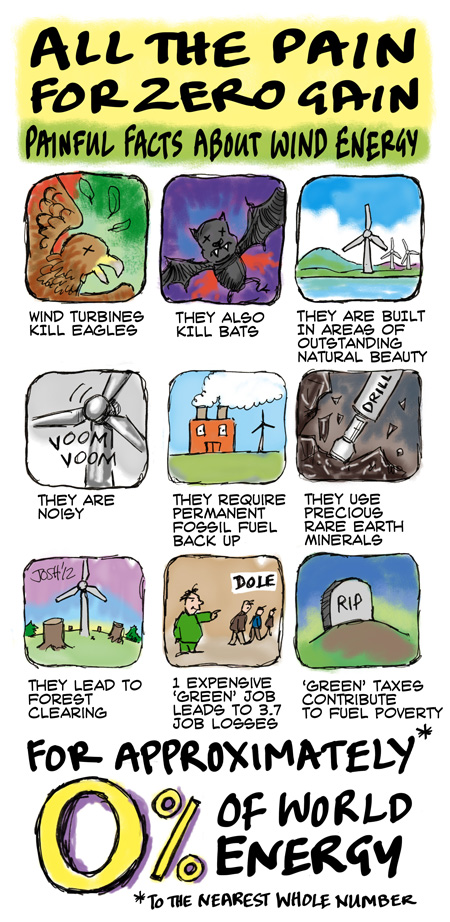
Update, 10 March: A lovely little cartoon from Watts Up With That on this topic:

March 5, 2012

The European Court of Human “Rights”

Filed under: Europe, Liberty — Tags: , , , , — Nicholas @ 10:41

Luke Samuel thinks it’s time for people to declare themselves to be “human rights sceptics“:

You don’t have to be a little Englander, or even right wing, to recognise that it is an affront to democracy that unelected and completely unaccountable judges, who have absolutely no democratic mandate, are able to override the decisions of elected representatives. It is appalling that European judges can make significant political decisions over a body of citizens across Europe to whom they will never have to answer.

But there is a more fundamental reason that liberals should be sceptical of human-rights law: because it makes us all less free. Human rights are not ‘rights’ in a liberal sense at all. They bear no resemblance to the ‘rights’ fought for by the radical liberals of the English Civil War, or the French and American revolutions, which sought to limit the power of the state and protect the autonomy of citizens. Instead, human rights treat people as fundamentally vulnerable and in need of state protection. This view of human vulnerability, in the eyes of the human-rights lobby, justifies the granting of absolute power to the state to set the boundaries of freedom.

Take, for example, the ‘right to a private and family life’ protected under Article 8 of the European Convention on Human Rights. The courts will not consider a claim under Article 8 unless it is convinced in the courtroom that you have a ‘family life’ worth protecting. How the courts have defined ‘family life’ for the purposes of Article 8 is laughably antiquated. In 2002, the courts ruled that ‘family life’ does not exist where a relationship between parents and their grown-up children is ‘only emotional’, in that the children are no longer economically dependent on their parents. Neither are unmarried parents likely to be considered a family, unless they maintain sufficient levels of contact with their children. How can any ‘liberal’ support the idea that your family life is only worthwhile if it conforms to what the state decides a family should look like?

Or take Article 10, which purports to protect our freedom of expression. Of course, the very concept of ‘freedom of expression’ owes its existence to radical liberals like John Stuart Mill and Voltaire, who argued that there can be no exceptions to free speech, otherwise you do not have free speech at all. But human-rights lawyers will tell you that Article 10, along with most other human rights, is a ‘qualified right’ because there is a long list of conditions under which the state can interfere with it. This list includes where it is necessary in the ‘interests of public safety’ or for the ‘protection of health or morals’. Such broad qualifications mean that as a means of limiting state power, ‘qualified’ human rights are all but useless.

Tim Worstall: “Neoliberal” has a meaning

Filed under: Economics, Europe, Greece — Tags: , , — Nicholas @ 09:55

He’s ticked off at an article at the Guardian, blaming “neoliberals” for the Greek crisis:

In what paranoid fantasy is what is happening in Greece neoliberal?

The actual neoliberal position (recently affirmed at our meeting in the underground secret headquarters under the volcano that sank Atlantis) is that the euro itself was and is a bad idea as it’s not an optimal currency area. And if there is to be a euro then Greece should not be a part of it. Since it is, and it’s bust, then it should default and devalue.

In short, the neoliberal solution is the Icelandic one, not the Irish, Greek or Portuguese.

So how come we neoliberals (as you know, the modern incarnation of the Green Lizards, Rosicrucians and Illuminati all rolled into one) are getting blamed for the entire fuck up that is happening precisely because no one will follow the prescriptions of neoliberal economics?

The failure of wind power

Matt Ridley on the inability of wind power advocates to distort reality:

To the nearest whole number, the percentage of the world’s energy that comes from wind turbines today is: zero. Despite the regressive subsidy (pushing pensioners into fuel poverty while improving the wine cellars of grand estates), despite tearing rural communities apart, killing jobs, despoiling views, erecting pylons, felling forests, killing bats and eagles, causing industrial accidents, clogging motorways, polluting lakes in Inner Mongolia with the toxic and radioactive tailings from refining neodymium, a ton of which is in the average turbine — despite all this, the total energy generated each day by wind has yet to reach half a per cent worldwide.

If wind power was going to work, it would have done so by now. The people of Britain see this quite clearly, though politicians are often wilfully deaf. The good news though is that if you look closely, you can see David Cameron’s government coming to its senses about the whole fiasco. The biggest investors in offshore wind — Mitsubishi, Gamesa and Siemens — are starting to worry that the government’s heart is not in wind energy any more. Vestas, which has plans for a factory in Kent, wants reassurance from the Prime Minister that there is the political will to put up turbines before it builds its factory.

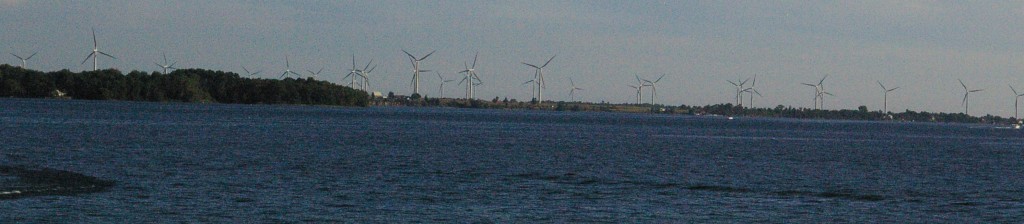
It’s a lesson we still need the Ontario government to learn: our electricity prices are scheduled to go up substantially to finance the massive wind farm investment the McGuinty government has signed up for. Much more of our landscape will look like this in future:

Even in a boom, wind farms would have been unaffordable — with their economic and ecological rationale blown away. In an era of austerity, the policy is doomed, though so many contracts have been signed that the expansion of wind farms may continue, for a while. But the scam has ended. And as we survey the economic and environmental damage, the obvious question is how the delusion was maintained for so long. There has been no mystery about wind’s futility as a source of affordable and abundant electricity — so how did the wind-farm scam fool so many policymakers?

One answer is money. There were too many people with snouts in the trough. Not just the manufacturers, operators and landlords of the wind farms, but financiers: wind-farm venture capital trusts were all the rage a few years ago — guaranteed income streams are what capitalists like best; they even get paid to switch the monsters off on very windy days so as not to overload the grid. Even the military took the money. Wind companies are paying for a new £20 million military radar at Brizlee Wood in Northumberland so as to enable the Ministry of Defence to lift its objection to the 48-turbine Fallago Rig wind farm in Berwickshire.

March 4, 2012

“Assuming this account is accurate, this was a war crime”

Heresy Corner on the story being serialized in the Daily Mail from Tony Banks:

Banks says that “we simply did not have the resources to take prisoners” and “they had started the war and they had not shown much respect for the white flag when they had shot my three mates who went forward to take the surrender at Goose Green.” Neither is an excuse recognised by the Geneva Convention.

To issue an order to take no prisoners is a fundamental violation of the principles of international law and thus a war crime. Section 40 of Additional Protocol I of the Geneva Conventions provides that soldiers who have clearly expressed an intention to surrender (for example by raising their arms or waving a white flag) are considered to be hors de combat and they must be given quarter (i.e. allowed to peacefully surrender). The officer who gave that order is not named but presumably Banks, along with other surviving members of his unit, knows who it was.

[. . .]

Assuming this account is accurate, this was a war crime. The fact that the Paras involved plainly knew that it was a war crime (hence the “brief argument”) exacerbates rather than mitigates their guilt. One soldier killed this boy in cold blood and the others covered up for him. That makes them all guilty, morally and legally. The fact that this took place thirty years ago is no reason why it cannot now be investigated and the perpetrators brought to trial. At the very least Banks should be taken in for questioning.

March 2, 2012

Britain’s railway engineering heritage

Filed under: Architecture, Britain, History, Railways, Technology — Tags: , — Nicholas @ 00:02

Sarah Bakewell at the Guardian on the wonderful products of the railway building era in Britain:

Once I saw merely bridges, tunnels and stations, and mostly I didn’t even notice these, so busy was I rushing to get over or through them. Now, I see a delicate ecosystem of rivets, cleats, plates, gussets, joggles, spans, arches, ribs of attenuated iron and steel.

Scholars can already study railway archives in repositories all over the country, but Network Rail has just put part of its beautiful archive of Victorian and Edwardian infrastructure diagrams on the web. This amounts to an invitation to anyone, anywhere, to contemplate such images out of sheer curiosity and love of beauty. They give us plans of the high-level bridge at Newcastle upon Tyne, with its columns trailing down the screen like tall sepia waterfalls, and Bristol’s neo-gothic Temple Meads station, in ethereal ink outline. The Forth bridge of 1890 appears side on, elongated and webby as if someone had pulled a string cat’s cradle as far as it would go. Its vertical columns climb visibly week by week; target dates are marked at each level, like the tracking of a child’s growth against a wall.

Maidenhead bridge, designed in brick by Isambard Kingdom Brunel in 1839, has two middle arches spanning the river in great cheetah leaps. They were lower and broader than anything previously constructed in brick, and the Great Western Railway’s directors feared the bridge would collapse: they insisted on the bridge’s temporary timber supports remaining even after it opened. Annoyed, Brunel secretly lowered the supports a bit so they did not actually support anything.

(All links in the original article.)

March 1, 2012

A Kickstarter campaign for … Greece

Filed under: Europe, Greece, Humour, Media — Tags: , , — Nicholas @ 13:12

I guess it’s about their last available option:

Greece is a small country in the south of Europe known for inventing democracy and western philosophy and for its national motto, “Release the Kraken!” Our shores are a popular destination for backpackers and tourists wishing to relax amid sun-drenched beaches by day and intoxicated British tourists by night.

We wish to continue this good work, but to do so our creditors are demanding €14.5 billion ($18.6 billion) by March 20. We do not have this money, nor do we think we can raise it in time: Our asset sales have gone nowhere, and the EU has nixed our plan to close shop and re-open a few blocks away as “Greeze”. And so we come to you, our friends, for help.

A donation of any amount is appreciated, and gifts are available for those who give at premium levels. We promise these funds will be used only to pay down debt, and any funds received above the requested amount will be rolled over to our next, inevitable Kickstarter campaign.

« Newer PostsOlder Posts »

Powered by WordPress