Quotulatiousness

March 1, 2012

The plight of Britain under austerity

Filed under: Britain, Economics, Government, Media — Tags: , , , , , — Nicholas @ 10:03

Vuk Vukovic wonders why the notion that the British government has imposed austerity still has any traction in the media:

The UK had the one of the strongest fiscal stimuli (relative to the size of its economy) in the world as a response to the crisis, during the premiership of Gordon Brown. The result was making the situation much worse with a rising public debt and the third highest budget deficit in the world behind only Greece and Egypt in 2011, and behind Greece and Iceland in 2010. This comparison is striking since these countries were doing much worse than the UK at the time and were countries with highly unstable economies – Iceland before the restructuring, Greece whenever, and Egypt after a year-long revolution which saw the downfall of a dictator and an inability to consolidate ever since.

So the argument of Keynesians is that this wasn’t enough, and that Britain is crippled with austerity. The media is supporting the former view as well. Britain is running the hardest austerity policy in Europe and this is resulting in terrible growth performance and the inability to start up the recovery. However, Britain is far from austerity. Yes, some painful cuts have been made, tuitions were rising, unions were hit, wages in the public sector are stagnant, a lot of public sector workers have been laid off, but what does the government do with this saved up money? It “invests” in credit easing, housing subsidies, the youth contract and infrastructural projects. On the other hand, it’s guiding private sector investment and centrally planning credit, it announces an increase of the minimum wage, abolishing of the default retirement age, more regulation after claiming to remove regulation, the 50p tax rate and so on. None of these policies are policies aimed at growth. They are all part of a Keynesian response to the crisis.

After all, if one would just observe the spending data for the UK, it is still increasing, both relatively (as percent of GDP) and absolutely.

“You keep using that word. I do not think it means what you think it means.” To call a situation where government’s share of GDP is rising as “austerity” requires a brand new definition for the word.

February 29, 2012

Ireland introduces the doomsday scenario: allowing voters to have a say on the Euro

Filed under: Europe, Government, Law — Tags: , , , , — Nicholas @ 09:33

The EU is not a democratic institution, and is actively hostile to any attempt to consult the people as it tries to become a super-state. Ireland just tossed a medium-sized spanner into the works:

Premier Enda Kenny said Dublin was acting on legal advice from Ireland’s attorney-general that “on balance” the fiscal compact requires a vote under the country’s constitution. “It gives the Irish people the opportunity to reaffirm Ireland’s commitment to membership of the euro,” he told ashen-faced members of the Dail.

All three major parties back the treaty but analysts say there is a high risk of rejection by angry voters in the current fractious mood. The compact gives the EU intrusive powers to police the budgets of debtor states, and has been denounced as feudal bondage by Sinn Fein and Ireland’s vociferous eurosceptics. The Irish voted “No” to both the Nice and Lisbon treaties before being made to vote again. Dublin has ruled out a second vote this time.

The Taoiseach’s announcement sent the euro into sharp dive against the dollar, though it rebounded later. Europe’s leaders thought they had tweaked the wording of the text just enough to avoid an Irish vote.

Note that last sentence closely. Avoiding consulting the very people who’ll be most affected is standard practice in the EU. Good for Ireland that they aren’t willing to be steamrolled yet again.

Is it time to abandon the RCN’s submarine experiment?

Filed under: Britain, Cancon, Military — Tags: , , — Nicholas @ 00:05

John Ivison recounts the ill-fated story of the Royal Canadian Navy’s current submarines in the National Post:

The Liberal government bought four second-hand subs for $750-million from the British in 1998 and renamed them the Victoria class — HMCS Victoria, HMCS Windsor, HMCS Chicoutimi and HMCS Corner Brook.

Since then, billions more have been spent trying to “Canadianize” the subs, including thousands of dollars blown trying to stop pigeons roosting in them, such is the length of time they have been in dry-dock. At various times over the past 10 years, the whole fleet has been out of commission.

The history of Canada’s submarine fleet would be laughable, were it not so tragic. People in government at the time remember the surprise expressed by Liberal ministers that the Defence department accepted the British military’s statement of quality assurance, without doing their own due diligence. That the buyer should have been more wary quickly became apparent.

The Chicoutimi caught fire on her maiden voyage from Faslane in Scotland in October 2004, with the death of one sailor and smoke-inhalation injuries to nine others. The sub has been in dry-dock ever since and is scheduled to return to service in 2013, although some stories have suggested 2016 is more realistic and others that she may never again be operational.

I blogged about HMCS Chicoutimi at the old blog, when it was expected that she’d be back in service in 2010.

Last year, HMCS Corner Brook had what some wag at the Department of National Defence characterized as a “fender bender”:

Some fender. The CBC reported on the extent of the damage:

The Canadian navy admitted that the submarine crashed off British Columbia in June, but it never described the extent of damage or released a photograph.

“I was gobsmacked. I had no idea that this level of damage had occurred,” said Senator Colin Kenny, the former head of the Senate defence committee. “That may explain why the navy took it out of the water at night.”

[. . .]

Some familiar with the submarine say its pressure hull, the area in which the sailors are housed, may be heavily damaged and that would mean the sub will never go to sea again.

“Canada needs a submarine fleet, and to have this boat not be available would be tragic,” Kenny said

The RCN claimed that there was no cover-up and that they have been completely above-board and “transparent” about the incident. It’s an odd definition of “transparency” that requires you to submit a formal Access to Information request to get the report — and the photos of the damage to the hull were censored from the report anyway.

Back in 2004, it was reported that our submarines were without torpedo armament, but that they would be “fully armed” by 2006. The CBC report mentioned in passing that eight years later, they’re still lacking torpedoes:

The navy said HMCS Windsor is to undergo trials “in the coming months” and is also expected to be back in operation later in 2012.

Not one submarine is capable of firing a torpedo, however the navy said Tuesday that a test firing of a torpedo from HMCS Victoria is planned for the coming weeks and the submarine is supposed to be operational this year.

Back to John Ivison:

In all this time, the fleet has hardly been crucial to our defence. According to people familiar with its role, it has spent time at sea monitoring fishing fleets and acting as “prey” for U.S. forces, who don’t have diesel-electric subs of their own and like to use ours for hunting practice.

Peter MacKay, the Defence Minister, recently lamented the decision to buy the British diesel-electric subs, which are not capable of diving below ice in the Arctic. “In an ideal world, I know nuclear subs are what’s needed under deep water, deep ice,” he mused.

That we do not live in an ideal world was quickly made apparent by Government House Leader Peter Van Loan, who all but disowned the fleet in a response to a question in the House. “There is no plan to replace the diesel-electric fleet purchased by the Liberals,” he said.

But if there is no plan to replace the fleet, is there a plan to scrap it?

[. . .]

The Navy defines “full operational capability” as having a weapons-ready sub on each coast. It has yet to put one sub to sea that meets that standard, a decade after the first one was received.

The hope is that two boats will be fully operational within two years, with a “swing boat” available to take over when one goes for refit. That may prove wildly optimistic. Submarines may be a useful addition to our battery of defences — but only if they work. And not at any cost.

These subs have proven themselves to be lemons, they are already past mid-life and the odds are against us having even three boats with operational capacity at any one time.


February 28, 2012

Yet another death due to excessive concern for ‘elf an’ safety issues

Filed under: Britain, Bureaucracy, Government, Health — Tags: , , — Nicholas @ 14:25

Bagehot blogs about the unhealthy results of paying too close attention to the health and safety regulations:

[T]he Mail on Sunday ran an interesting feature this weekend about a different example of what certainly sounded like a health and safety overreaction. It told the tale of a man who drowned in a shallow boating pond in his local park, after suffering an epileptic seizure while feeding swans. A passer-by (a woman who was in charge of a small child so did not dare enter the pond) called the emergency services. But the first firemen to show up announced that they only had Level One training, for ankle-deep water, and needed to wait for a specialist team with Level Two training for chest-deep water. By the time that team arrived, the man had been floating in the pond for 37 minutes. While waiting for that specialist help, the same firemen also strongly urged a policeman not to attempt a rescue in the pond, even refusing to lend the policeman a life-vest. Then the policeman’s control room told him not to enter the water, as the victim had been in the pond so long that it was a body retrieval mission, not a rescue.

The MoS, which sent its reporter out into the same pond equipped with no more than rubber waders, called it a story that “shames Britain”. Certainly its photograph of the eventual retrieval of the poor victim’s body, featuring 25 separate emergency workers, an inflatable tent, several fire engines and a helicopter, is suggestive of an over-reaction after an under-reaction.

It is tempting to conclude that Britain has fallen into a serious problem with regulation, red tape and crippling risk-aversion. Certainly, the newspapers have recently been filled with all manner of depressing stories about pancake races being cancelled, policemen being urged not to pursue criminals onto roof tops, party bunting being outlawed or council workers refusing to mount shoulder-height step ladders to fix broken signs without logistical back-up once reserved for the cleaning of the Sistine Chapel ceiling.

[. . .]

All of which is sensible. You don’t have to be a wild-eyed libertarian to suspect that something has gone wrong with the management of risk in Britain. It is also depressing to see so many advertisements for ambulance-chasing lawyers, urging anyone who has had the smallest accident to sue. Anecdotally, members of parliament grumble about the role played by some insurance companies who hold special advice-sessions on liability for local councils, seeking to terrify them into taking out expensive cover and in the process filling the heads of municipal bosses with all manner of scare stories.

But listening to my rather cautious Jersey host, and reading the MoS report of the pond rescue, I found myself wondering if the British character may not also play a role. Read the report by Lord Young, or even the detail of the admirably comprehensive Mail report, and the rules themselves are sometimes less the problem than their interpretation. It turns out that emergency workers can break all sorts of health and safety rules when lives are at stake, without fear of prosecution, for example. And those guidelines on Level One and Level Two water training were intended for rescuers in fast-moving flood waters, the inquest into the pond case was told.

Occupy London has become an open-air asylum

Filed under: Britain, Politics — Tags: , , , — Nicholas @ 10:16

Brendan O’Neill in the Telegraph on the state of the Occupy London protests:

Even though I am an absolutist with it comes to the right to protest, I couldn’t help feeling relieved when a court decided this week that the Occupy camp outside St Paul’s Cathedral should sling its hook. For what started life as a middle-class shantytown packed with self-righteous haters of the rich — an annoying spectacle, yes, but hardly the end of world — has in recent weeks descended into something far more degenerate. Occupy London is now effectively a holding camp for the mentally ill, a space where the psychologically afflicted and deeply troubled can gather to eat, drink and be un-merry. And to have such a makeshift lunatic asylum on the steps of St Paul’s is not good for London nor for the inhabitants of the camp, who clearly need somewhere better to go.

On the five occasions I have visited Occupy London, I have noticed a steady decline in the calibre of the campers. To begin with, the inhabitants were mostly young, with red cheeks and purple hair, talking utter rubbish, of course, but not unpleasant to look at. Before long, that contingent seemed to disappear, to be replaced by straggly-haired conspiracy theorists banging on about 7/7 and the chemicals in our food. Now the camp has the distinct whiff of rotting food and decaying socks, and its dwellers are all sad-eyed and pathetic, many of them old, confused, and clearly too fond of booze. “GET TAE F**K!” one of them was shouting, at absolutely no one, the last time I was there.

[. . .]

All those commentators who wrote glowing reports about the camp a few months back, who took their organically fed children on day trips to visit it, who slammed anyone who criticised it and said we didn’t understand its “historic momentum” or “strategic function”, are now nowhere to be seen. That’s not surprising. What they giddily described as a turning point in radical politics has turned out to be more like a modern-day Bedlam, where respectable people on their way to work peer with increasingly wide-eyed bemusement at the strange, mumbling folk inside this unhygienic and collapsing institution.

Did Greece get bailed out or did it default? A little from column A and a bit from column B

Filed under: Economics, Europe, Government, Greece, Politics — Tags: , , , — Nicholas @ 09:56

Detlev Schlichter explains what happened in the “big fat Greek bailout”:

Greece was bailed out for the second time in four months. Or did it default? Well, a bit of both, I guess.

All bondholders are equal. But some are more equal than others. If you are the ECB, your Greek bonds were exchanged, par for par, for new Greek bonds, and you can go on pretending that they are worth their principal amount. You won’t have to report a loss for now. But if you are a ‘private’ entity — and that is a rather loosely used term these days as it includes the banking industry which is either now partially owned by the state or to a considerable degree dependent on ongoing support from the lender-of-last resort — more than half your Greek investment was wiped out. So Greece defaulted. But as you ‘agreed’ to the ‘haircut’ it was in fact a ‘voluntary restructuring’, although you really had no choice.

[. . .]

I guess we shouldn’t lose sight of the fact that Greece’s economic model is fundamentally unsustainable, whichever way you cut it. Greece has been living beyond its means for a long time, and has managed to do so by flying under air-cover of the EMU project and with the tailwind of cheap credit and easy money. Spending by the Greek state accounts for more than half of registered economic activity, and a third of the workforce is employed by the public sector. ‘Activities’ are being subsumed under the heading of ‘Greek GDP’ that nobody would voluntarily pay for, that are to a large degree wasteful, and that are simply unaffordable under anything but the most bizarrely generous credit conditions, i.e. precisely those that Greece enjoyed from 2001 to 2008. Easy money has been used to paper over grave economic imbalances. Some of what is generously labelled ‘GDP’ should be discontinued — and fast.

To even suggest that such an economic model would be manageable if Greece, a country with about three quarters of the population of metropolitan Los Angeles but with less than half of L.A.’s GDP, only had its own paper currency and could inflate and devalue to its heart’s content, is economically illiterate. No country ever prospered by running budget deficits funded by the printing press or by creating domestic inflation. Devaluing your currency may give your exporters a shot in the arm — for about five minutes. But it scares your domestic savers away for years to come and severely diminishes your ability to keep or attract capital, the backbone of any sustainable economic model. To even try and attempt to ‘inflate away’ a debt load worth 160 percent of a generously calculated GDP would cause economic damage of gigantic proportion. One must have swallowed the Keynesian mythology of deficit-spending whole to believe that the country could borrow and print itself out of this mess. A proper default on its existing debt and rebuilding from a lower base — but with a hard currency — are the better options.

Hacker-Artist group UX roves under Paris streets

Filed under: Europe, France, History, Media — Tags: , — Nicholas @ 09:03

A fascinating article in Wired talks about a French group that does the opposite of vandalism — unauthorized repairs to neglected historical objets d’art:

This stealthy undertaking was not an act of robbery or espionage but rather a crucial operation in what would become an association called UX, for “Urban eXperiment.” UX is sort of like an artist’s collective, but far from being avant-garde — confronting audiences by pushing the boundaries of the new — its only audience is itself. More surprising still, its work is often radically conservative, intemperate in its devotion to the old. Through meticulous infiltration, UX members have carried out shocking acts of cultural preservation and repair, with an ethos of “restoring those invisible parts of our patrimony that the government has abandoned or doesn’t have the means to maintain.” The group claims to have conducted 15 such covert restorations, often in centuries-old spaces, all over Paris.

What has made much of this work possible is UX’s mastery, established 30 years ago and refined since, of the city’s network of underground passageways — hundreds of miles of interconnected telecom, electricity, and water tunnels, sewers, catacombs, subways, and centuries-old quarries. Like computer hackers who crack digital networks and surreptitiously take control of key machines, members of UX carry out clandestine missions throughout Paris’ supposedly secure underground tunnels and rooms. The group routinely uses the tunnels to access restoration sites and stage film festivals, for example, in the disused basements of government buildings.

H/T to CuthSpies for the link.

February 27, 2012

BBC: Could Britain still defend the Falkland Islands?

Filed under: Americas, Britain, Military — Tags: , , , , , — Nicholas @ 11:09

The BBC has a then-and-now summary of the military balance in the south Atlantic in 1982 and today:

1982: On the eve of the invasion, there were about 70 Royal Marines stationed on the islands — twice the usual number due to a changeover. They were, in theory, backed up by about 120 local reservists, although only a small proportion reported for duty. HMS Endurance, an Antarctic ice patrol vessel, was the only ship based in the South Atlantic at the time. And there were no fighter jets — none of the island’s airstrips were long enough. The only planes that could land before the war came from Argentina. Supplying the Falklands by sea from Britain took two weeks.

2012: The major difference is the construction of RAF Mount Pleasant, a modern air base housing four Eurofighter Typhoon strike fighters, a Hercules transport plane and VC-10 tanker plane. There are also Rapier missile batteries in several locations. The British garrison numbers 1,200, including 100 infantrymen, with 200 reservists in the Falkland Islands Defence Force. The Royal Navy has a patrol vessel, an auxiliary support ship, and frigate or state-of-the-art destroyer. It’s reported that a British nuclear-powered submarine is in the South Atlantic, but the Ministry of Defence will not discuss operational matters. “It’s quite a considerable deterrent force,” says Peter Felstead, editor of Jane’s Defence Weekly. Military experts believe the islands are now virtually impregnable. Any sign of Argentine invasion and the islands could be quickly reinforced by air.

Just as we established the last time this was up for discussion, Argentina doesn’t have the military forces for a stand-up fight, but if they can take the RAF base in a surprise attack by special forces, Britain probably can’t recapture the islands.

February 26, 2012

VisitBritain’s spelling problem

Filed under: Britain, Media — Tags: , , , — Nicholas @ 09:20

A bit of an embarrassment for Britain’s national tourism agency:

Tourists attempting to follow VisitBritain’s tip to travel to the Welsh region of the “Breacon Beacons” may find themselves rather lost when entering the destination into their satnav.

The misspelling of the Brecon Beacons was spotted by an eagle-eyed tourist on a New York subway advertisement, which was accompanied with a picturesque photograph capturing the countryside of Llandovery, a market town in Carmarthenshire.

The promotional image, which also currently appears in the advertising spaces in front of passenger seats in New York taxis, was promptly posted on Facebook.

Reason.tv: Margaret Thatcher, Meryl Streep, & The Iron Lady

Filed under: Britain, History, Media — Tags: , , — Nicholas @ 09:08

February 25, 2012

Burger King latest corporation to pull out of UK work experience program

Filed under: Britain, Bureaucracy, Economics, Government — Tags: , , , , , — Nicholas @ 10:14

The British government’s work experience program for unemployed would-be workers loses another employer:

The fast food giant said it had decided to cease its involvement in the Get Britain Working programme because of recent concerns expressed by the public.

The scheme has attracted growing criticism in recent weeks with opponents describing it as a form of slave labour because young people worked for nothing, while keeping their benefits.

Burger King said it had registered for the programme six weeks ago intending to take on young people for work experience at its Slough headquarters, but had not recruited anyone.

It sounds like the program was well intended — allowing people without work experience to at least have something to put down on a resumé — but fails the PR test because the corporation is seen as “getting work for nothing”. And, without a doubt, some corporations will use the program in exactly that way. Despite that, on balance it seems that the potential benefit to young entrants to the work force is greater than the actual benefit to the companies that get that “free labour”.

The value of that “free labour” may well be lower than the costs to the employer for training them: new employees with no marketable skills are not the bonanza of profit that some seem to think that they are. Some people I worked with early in my working life could be proven to be a net loss for months after hiring …

February 21, 2012

Greece: “now officially a ward of the international community”

Filed under: Economics, Europe, Government, Greece — Tags: , , , — Nicholas @ 10:40

Felix Salmon on the dire Greek financial future:

Greece is now officially a ward of the international community. It has no real independence when it comes to fiscal policy any more, and if everything goes according to plan, it’s not going to have any independence for many, many years to come. Here, for instance, is a little of the official Eurogroup statement:

    We therefore invite the Commission to significantly strengthen its Task Force for Greece, in particular through an enhanced and permanent presence on the ground in Greece… The Eurogroup also welcomes the stronger on site-monitoring capacity by the Commission to work in close and continuous cooperation with the Greek government in order to assist the Troika in assessing the conformity of measures that will be taken by the Greek government, thereby ensuring the timely and full implementation of the programme. The Eurogroup also welcomes Greece’s intention to put in place a mechanism that allows better tracing and monitoring of the official borrowing and internally-generated funds destined to service Greece’s debt by, under monitoring of the troika, paying an amount corresponding to the coming quarter’s debt service directly to a segregated account of Greece’s paying agent.

The problem, of course, is that all the observers and “segregated accounts” in the world can’t turn Greece’s economy around when it’s burdened with an overvalued currency and has no ability to implement any kind of stimulus. Quite the opposite: in order to get this deal done, Greece had to find yet another €325 million in “structural expenditure reductions”, and promise a huge amount of front-loaded austerity to boot.

UK Catholic sex-ed includes materials plagiarized from John Norman’s Gor series

Filed under: Books, Britain, Education, Humour, Media — Tags: , , — Nicholas @ 10:33

Really, it’s another of those stories that are “so weird that it’s too good to verify“:

As The Guardian reports today, Catholic faith schools in Lancashire have been handing out copies of a booklet called “Pure Manhood: How to become the man God wants you to be”, written by an American fundamentalist preacher. The booklet includes statements like this: “the homosexual act is disordered, much like contraceptive sex between heterosexuals. Both acts are directed against God’s natural purpose for sex — babies and bonding.” It also insists that, “scientifically speaking, safe sex is a joke”.

[. . .]

Weird ideas about sex, however, are not the only strange things in the booklet. All sorts of aspects of macho-ness are explored, including the need for real men to kill animals to prove their virility. There is a particularly bizarre passage about how to kill a wolf by sacrificing a goat. I won’t go into the gory details. The important point is that, as this blog post reveals, that piece of text was lifted from the book Beasts of Gor by John Norman.

February 19, 2012

Tim Worstall on the dilemma facing the social housing authorities

Filed under: Britain, Bureaucracy, Cancon, Government — Tags: , , , — Nicholas @ 10:45

I don’t know what the actual situation is in Britain, but here in Ontario the responsibility for public housing is a regional or municipal responsibility. There’s no automatic mechanism for planners in one area to anticipate the need for additional housing, so apartments, townhouses and other subsidized accommodations are informally “swapped” between city, town, and regional governments. Would-be tenants are able to refuse being moved from one municipality to another (if you’re in Oakville, but the offered housing is in Pickering, for example).

I suspect, based on Tim Worstall’s thought experiment here, that the British system does not work quite the same way:

What’s the first thing that rational planner is going to do? Note that there’s a number of people living in London without the means to afford housing in London. And no particular economic reason for living in London either. She’s also going to note that’s there’s great swathes of housing up North which is indeed affordable. And given that there’s no particular economic reason for those in London to be in London why shouldn’t they be on benefits up North in the much cheaper housing?

This will be, after all, greatly to the benefit of society even if a bit tough on the personal liberty side. But then that’s what planning of all these things is about, doing what is best for society, yes?

So you can see the amusement: the Statists, the planners, those who insist that society is more important than the desires of any mere individual, are in something of a bind. The current reforms to the housing market are producing exactly what a rational planner would produce. The poor are sent off to be poor in cheap housing, individual desires be damned.

While cutting back the troops, the MoD bureaucrats get big bonus payments

Filed under: Britain, Bureaucracy, Military — Tags: , , — Nicholas @ 10:28

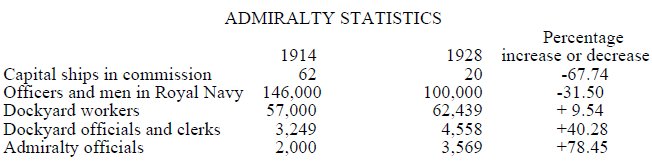
C. Northcote Parkinson formulated the law that bears his name. He documented the phenomenon (PDF) of more and more bureaucrats supporting fewer and fewer ships and sailors back in 1955:

The accompanying table is derived from Admiralty statistics for 1914 and 1928. The criticism voiced at the time centered on the comparison between the sharp fall in numbers of those available for fighting and the sharp rise in those available only for administration, the creation, it was said, of “a magnificent Navy on land.” But that comparison is not to the present purpose. What we have to note is that the 2,000 Admiralty officials of 1914 had become the 3,569 of 1928; and that this growth was unrelated to any possible increase in their work. The Navy during that period had diminished, in point of fact, by a third in men and two-thirds in ships. Nor, from 1922 onwards, was its strength even expected to increase, for its total of ships (unlike its total of officials) was limited by the Washington Naval Agreement of that year. Yet in these circumstances we had a 78.45 percent increase in Admiralty officials over a period of fourteen years; an average increase of 5.6 percent a year on the earlier total. In fact, as we shall see, the rate of increase was not as regular as that. All we have to consider, at this stage, is the percentage rise over a given period.

Parkinson_Admiralty_Statistics

His law is still operative, as shown recently in healthy bonus payments to bureaucrats in the British Ministry of Defence at the same time that the troops are under a pay freeze and reduction in force:

One senior civil servant was awarded an £85,831 bonus on top of their six-figure salary — at the same time as members of the armed forces have been subject to a two-year pay freeze and 20,000 are to be made redundant.

The bonuses have been paid since April last year and have seen more than 55,000 officials awarded extra payments for their performance — out of a payroll of 83,000.

The ministry expects to pay more in bonuses in the current financial year than the last, even thought it is attempting to drastically reduce the number of civil servants as part of cuts to Government expenditure.

« Newer PostsOlder Posts »

Powered by WordPress