
Professor Hayek is also probably right in saying that in this country the intellectuals are more totalitarian-minded than the common people. But he does not see, or will not admit, that a return to “free” competition means for the great mass of people a tyranny probably worse, because more irresponsible, than that of the State. The trouble with competitions is that somebody wins them. Professor Hayek denies that free capitalism necessarily leads to monopoly, but in practice that is where it has led, and since the vast majority of people would far rather have State regimentation than slumps and unemployment, the drift towards collectivism is bound to continue if popular opinion has any say in the matter.
George Orwell, “The Road to Serfdom by F.A. Hayek / The Mirror of the Past by K. Zilliacus”, Observer, 1944-04-09.
June 1, 2019
QotD: Orwell’s fear of private monopolies
May 31, 2019
“Hearts of Iron” – The Battle of Berlin – Sabaton History 017 [Official]
Sabaton History
Published on 30 May 2019The Sabaton song “Hearts of Iron” (on the Heroes album) tells the story of a German commander who is ordered to relieve Berlin in face of an overwhelming attack from the east and the west. Berlin is almost fully surrounded, but instead of following orders from his superiors who have clearly lost touch with reality, he decides to use his men to get as many civilians as possible out of Berlin.
Support Sabaton History on Patreon: https://www.patreon.com/sabatonhistory
Check out the trailer for Sabaton’s new album The Great War right here: https://www.youtube.com/watch?v=HCZP1…
Listen to Sabaton on Spotify: http://smarturl.it/SabatonSpotify
Official Sabaton Merchandise Shop: http://bit.ly/SabatonOfficialShopHosted by: Indy Neidell
Written by: Markus Linke and Indy Neidell
Directed by: Astrid Deinhard and Wieke Kapteijns
Produced by: Pär Sundström, Astrid Deinhard and Spartacus Olsson
Creative Producer: Joram Appel
Executive Producers: Pär Sundström, Joakim Broden, Tomas Sunmo, Indy Neidell, Astrid Deinhard, and Spartacus Olsson
Maps by: Eastory
Edited by: Iryna Dulka
Sound Editing by: Marek KaminskiEastory YouTube Channel: https://www.youtube.com/channel/UCEly…
Archive by: Reuters/Screenocean https://www.screenocean.com
Music by Sabaton.Source:
– Colorization by Ruffneck88, Phot-colorizationAn OnLion Entertainment GmbH and Raging Beaver Publishing AB co-Production.
© Raging Beaver Publishing AB, 2019 – all rights reserved.
From the comments:
Sabaton History
1 day ago
This episode is one of the few which shows the humanity in the German army. As with all conflicts, this was not a binary where it was the “good guys” versus “the bad guys”. And before anyone else says it – some people will probably complain how we frame the Soviets as the bad guys. We chose to tell this story from a neutral perspective, but fact is that many German civilians feared what the Soviets would do to them, and preferred to live under American occupation. This might be considered anti-Soviet, but it simply is how many Germans viewed the Soviet army and one of the reasons why Wenck and his 12th created a corridor for the civilian refugees to escape into American occupied territories. We’re happy to have a reasonable and research-based discussion in the comments, but we won’t tolerate any extremism or revisionism.Another note: while this episode is about a moment where the German army thought for humanity instead of against it, it nowhere near proves any sort of clean-Wehrmacht myth – and we won’t tolerate any comments of that sort either.
And with that, I will leave you. Enjoy the video!
Cheers!
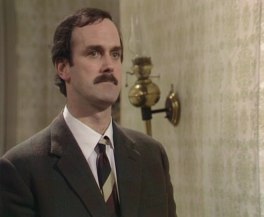
Basil Fawlty’s “John Cleese” moment
Renowned English comedian Basil Fawlty had a thinko the other day when he (accidentally?) tweeted in the character of noted racist, sexist, white supremacist, homophobe, transphobe, neo-Nazi, etc., etc., “John Cleese”:
Some years ago I opined that London was not really an English city any more
Since then, virtually all my friends from abroad have confirmed my observation
So there must be some truth in it…
I note also that London was the UK city that voted most strongly to remain in the EU
— John Cleese (@JohnCleese) May 29, 2019
Arthur Chrenkoff somehow mistakes the actor for his character (because no real life person like “John Cleese” could possibly exist in post-Cool Brittania, could they?).
As you can imagine, this sentiment didn’t go down very well. The mayor of London, Saddiq Khan, tweeted back “These comments make John Cleese sound like he’s in character as Basil Fawlty. Londoners know that our diversity is our greatest strength. We are proudly the English capital, a European city and a global hub.” Don’t mention the culture war, I guess. Needless to say, various other worthies have joined in to chide Cleese, including questioning what is Englishness anyway?
That’s a good question. Cleese no doubt had in mind the ethnic English, or people who come from the Anglo-Saxon or at least the Anglo-Celtic stock and heritage, who for the great majority of the past millennium and more have constituted the great, if not the overwhelming, majority of the inhabitants of England, and who, again over the course of centuries, have created what we know and understand as the English culture, tradition and institutions. Yes, there have always been migrants arriving and contributing to the mix – Normans, French Huguenots, Jews – but they have been relatively small in number and by and large ethnically and culturally similar. But Cleese’s definition is increasingly at odds with the post-nation state view of belonging. As TV presenter Anila Chowdhry replied to the Monty Python alumnus, “John Cleese, your comment is not only ironic as you live in the Caribbean, but it fails to recognise the benefits of multiculturalism AND that people of different colour in London may actually be English too! I was born & bred in England. I’m brown, English & proud. #ThisIsMyHome”, which of course can be true too, if anything as a legal and cultural matter. This is also coincidentally while it is easier to “become” an American or an Australian or another -an of one of the historically migrant countries where the “-anness” is built on shared civic ideas rather than ethnicity.
(For the record, over 40 per cent of London residents have been born overseas, which is one of the highest proportions in the world, and if you consider major cities, over one million in population, only Toronto, Sydney and Melbourne have more first-generation migrants. Whatever you think, and whatever you think of it, the London of today is certainly not the London of Cleese’s childhood or even his middle age.)
History Buffs: Master and Commander
History Buffs
Published on 18 Sep 2016History Buffs is back! To thank you all for your patience while I’ve been away on holiday, I’m starting off with Master and Commander!
SUPPORT HISTORY BUFFS ON PATREON
https://www.patreon.com/HistoryBuffs● Follow us on Twitter: https://twitter.com/HistoryBuffsNH
_________________________________________________________________________
Master and Commander: The Far Side of the World is a 2003 American epic historical drama film written, produced and directed by Peter Weir. The film stars Russell Crowe as Captain Jack Aubrey and Paul Bettany as Dr. Stephen Maturin. The film, which cost $150 million to make, was a co-production of 20th Century Fox, Miramax Films, Universal Pictures, and Samuel Goldwyn Films, and released on November 14, 2003 to critical acclaim. The film’s plot and characters are adapted from three novels in author Patrick O’Brian’s Aubrey–Maturin series, which includes 20 completed novels of Jack Aubrey’s naval career.
At the 76th Academy Awards, the film was nominated for 10 Oscars, including Best Picture. It won in two categories, Best Cinematography and Best Sound Editing and lost in all other categories to The Lord of the Rings: The Return of the King.
May 30, 2019
Tank Chats #47 King Tiger | The Tank Museum
The Tank Museum
Published on 2 Mar 2018Known variously as the Tiger Ausf. B, Tiger II or Königstiger (the British also referred to it as the “Royal Tiger”), 489 Tiger IIs, were produced at the Henschel assembly plant, between January 1944 and March 1945. However, despite lacking in numbers, and being prone to mechanical and mobility issues based on its size and weight, the Tiger II’s combination of devastating firepower, and thick sloped armour plate made it a formidable adversary.
Support the work of The Tank Museum on Patreon: ► https://www.patreon.com/tankmuseum
Or donate http://tankmuseum.org/support-us/donateVisit The Tank Museum SHOP: ►https://tankmuseumshop.org/
Twitter: ► https://twitter.com/TankMuseum
Tiger Tank Blog: ► http://blog.tiger-tank.com/
Tank 100 First World War Centenary Blog: ► http://tank100.com/ #tankmuseum #tanks #tigertank
QotD: Wahhabism and the West
“You’re right,” he says, “it shouldn’t be different for Islam, but we make it different. Muslims fought for king and empire in both world wars. Muslims were the backbone of the Indian army. Ataturk’s Turkey was an example of Muslims functioning perfectly well in a modern democratic society — but Ataturk’s Turkey is going away. We don’t have that trust any more. It was a Wahhabi who assassinated the chief justice in British India, and that is more or less the only brand of Islam exported today — extremist Saudi-style Wahhabism. All these giant mosques you see going up in cities all over the world are not paid for locally, they’re paid for by Saudi Arabia. They’re trying to make it one-size-fits-all Islam, and a type of Islam that regards the West as its enemy, instead of the mom-and-pop Islam of the past.”
So you’re saying the problem is not Islam, the problem is Wahhabism?
“No! Wahhabism is the symptom. The problem is us. We don’t defend ourselves. If you are a woman living alone in a Muslim community in Europe, you do not venture out after 6 p.m. If there are sexual assaults by Muslims, and the allegations are made public by the victims, the accuser is inevitably accused of racism. Nobody disputes that it happened, but they’re held to a different standard because the victims are Swedes or Danes and the accused is from a Muslim country. It’s believed that it’s unreasonable to expect decent behaviour from an Afghan or an Iraqi — which is racist. You’re denying the humanity of these people. And so you surrender incrementally. You live in a citadel. You make ridiculous changes to your own culture. In Britain the banks don’t give piggy banks to children any more, because the “piggy” might be offensive. There’s a fetishisation of the burka, which should be regarded as what it is — a prison for women. Why should we abandon our own heritage to barbarism? I’m a nineteenth-century imperialist a hundred years past my sell-by date.”
Mark Steyn, interviewed by John Bloom, “Mark Steyn, Cole Porter and Free Speech”, Quadrant, 2017-05-11.
May 29, 2019
US Soldiers Fighting in Russia – The End of the “Polar Bear Expedition” I THE GREAT WAR May 1919
The Great War
Published on 28 May 2019The so called Allied intervention into the Russian Civil War suffered from no clear operational goals and mandate and when US President Woodrow Wilson pulled out the American soldiers that were fighting in Northern Russia in May 1919, the operation suffered another setback. Public pressure against US foreign intervention was increasing now that Germany had been beaten and many people didn’t understand what American soldiers were doing in Russia anyway. At the same time Winston Churchill and his supporters maintained that it was vital to defeat the Bolsheviks in Russia once and for all.
» SUPPORT THE CHANNEL
Patreon: https://www.patreon.com/thegreatwar
Merchandise: https://shop.spreadshirt.de/thegreatwar/» SOURCES
Crownover, Roger. The United States Intervention in North Russia, 1918-1919: The Polar Bear Odyssey. Edwin Mellen Press, 2001.Wright, Damien. Churchill’s Secret War With Lenin: British and Commonwealth Military Intervention in the Russian Civil War, 1918-20, Helion and Company, 2017
Long, John W. “American Intervention in Russia: the North Russian Expedition, 1918-1919,” in Arthur Dudden, ed. American empire in the Pacific: from trade to strategic balance 1700 – 1922 (Aldershot: Ashgate, 2004): 321-344.
Mawdsley Evan. The Russian Civil War, Pegasus Books, 2019
Moore, Joel. The History of the American Expedition Fighting the Bolsheviki Campaigning in North Russia 1918-1919 (1920)
»CREDITS
Presented by: Jesse Alexander
Written by: Jesse Alexander
Director: Toni Steller & Florian Wittig
Director of Photography: Toni Steller
Sound: Toni Steller
Editing: Toni Steller
Mixing, Mastering & Sound Design: http://above-zero.com
Motion Design: Christian Graef – GRAEFX
Maps: Daniel Kogosov (https://www.patreon.com/Zalezsky)
Research by: Jesse Alexander
Fact checking: Florian WittigChannel Design: Alexander Clark
Original Logo: David van StepholdA Mediakraft Networks Original Channel
Contains licensed material by getty images
All rights reserved – Real Time History GmbH 2019
The EU election was “the Tories’ worst result since 1678”
Mark Steyn on the results of last week’s EU parliamentary elections:
In any normal UK election, it would be inconceivable for either of the two main parties – Conservative and Labour – to attract just 23 per cent of the vote. The fact that that is all they could muster between them is hilarious, and greatly to be enjoyed. As I put it on the radio last week, the departing Theresa May has led the Tories to their worst result in two hundred years. But, really, that’s praising with faint damns. I saw Daniel Hannan on the telly extending Mrs May’s impressive feat back through the pre-Reform Act era and accounting it the Tories’ worst result since 1678. Which is kind of hard to spin. Her forced resignation last Friday morning (by which point her party had made it clear they wouldn’t stick with her past lunch) ensures that she and that election result will be yoked together for all time. And jolly well deserved it is.
When the party of government falls from favor, the beneficiary is usually the principal opposition. Instead, Jeremy Corbyn’s Labour Party saw its vote fall almost as precipitously as the Tories’. Against the Conservatives’ single-digit nine per cent, Labour could muster only fourteen per cent, its own worst result in a century – in fact, since 1910. Which would also be hard to spin, had Theresa May not done Corbyn the favor of pulling off an unbeatable record.
[…]
Instead, Mrs May in particular but also Parliament in general chose to double-down on the estrangement from the masses revealed by the referendum, and spent the next three years demonstrating that, whatever the Prime Minister had in mind when she first declared “Brexit means Brexit”, it obviously doesn’t mean leaving the European Union. Either through malice or stupidity or condescension, the political class opted to widen its breach with the people – and Nigel Farage, who is a very canny fellow, decided six weeks ago to create a party to fill the gap in a European election the UK shouldn’t have had to participate in.
Listening and/or watching to the BBC on Sunday for as long as I could stomach it, I detected a strange urge to suggest that the Brexit Party had somehow under-performed, as though it’s normal for a six-week-old party to win twenty-nine out of seventy-three seats, while the century-old Labour Party wins only ten, and the Tories four and the nearest Nigel gets to a run for his money is the second-placed Liberal Democrats with sixteen seats. Farage and the other officially pro-Brexit parties (Labour, Tory, Democratic Unionist) won 44 seats. The Lib Dems and the other officially Remainer parties (Green, Scottish Nationalists, Plaid Cymru, Sinn Féin, Alliance Party) got 29. Adding in the unelected UKIP and Ulster Unionists, the Leave share of the vote was 58 per cent.
Yes, yes, I know, that’s a bit of a simplification, in that the Tories are supposedly pro-Brexit but totally bollocksed it, and Labour is only pretending to be pro-Brexit as part of a difficult straddle between its Old Labour working-class base and the New Labour preening metropolitan Euro-luvvies. Many of the latter – including such hitherto loyal champagne socialists as actors Simon Callow and Michael Cashman and even Blair’s old Cabinet Secretary Gus O’Donnell. – flew Corbyn’s coop and voted for the Lib Dems. Even so, for those demanding a second referendum (or, as they cynically call it, a “people’s vote”), there’s not much evidence for a second-time-around sadder-but-wiser Remain majority. Among riven Tory families, Jacob Rees-Mogg’s sister stood for the new Brexit Party while Boris Johnson’s sister stood for the equally new “Change UK”, a militantly anti-Brexit party formed by a coterie of disaffected Remainer media self-promoters of the soft left and soft right. Annuziata Rees-Mogg was duly elected in the Farage surge, while Rachel Johnson flopped out because “Change UK” had barely any statistical support outside the more desperate bookers of telly current affairs shows.
QotD: Past civilizations
… when anyone says “there was a civilization before us” your head (our head) jumps to airplanes, trains, steel mills, refrigerators, dentistry.
I’m telling you the chances of that are negligible, though I won’t scruple using a more advanced than us past civilization to give my characters a nasty shock when they get to space. I won’t because that’s just cool.
However of things like Ancient Greece or Rome? I almost think the chances against it are worse. And of course civilizations that live and die by coastal sailing would be mostly engulfed in the great melt of the last ice age.
And no, Europe hasn’t been extensively studied. As I said before, Europe is mostly built on Europe. And you can’t dig in a field without finding SOMETHING. If you think everyone runs to the academics or the authorities when something is found, you don’t understand people’s interest in building a house, or sowing a field, as opposed to you know, giving up ownership of their land in all but fact. Frankly I’m amazed so many people do report discoveries.
But the thought of “superior civilizations” got me to thinking of what say the Romans or the Greeks, or those other ancient civilizations if they ever existed, would make of us in the West. We cross the globe by flying through the air. Not just heads of state or priests, no, common people. Hell, our pets fly. Most places have clean, fresh water that someone doesn’t have to carry a mile or so (which has been most of the work of humanity I think, forever.) Forget aqueducts. We have water that comes from our faucets whenever we want it. Cold AND hot. We have temperature control inside our houses, allowing us ignore the weather and keep warm in winter and cold in summer. We can magically cure diseases that killed millions of people by injecting this magical elixir into the sick person’s veins. Our old live a long time in relative comfort. We get our teeth fixed and replaced, so most people can chew to the end of their lives. Most of us can read, and most of us have access to untold wisdom of the sort their hermetic orders would kill for.
We are the superior civilization. We are the enlightened ones, the shining and resplendent inhabitants of the wonderful future.
And we worry about what gender we feel like being that day, who is allowed to pee where, whether someone used the wrong word to refer to someone else who might be offended, whether our use of fossil fuels offends Gaia, whether slapping a kid on the behind is a criminal offense, whether we are doing all we could do with our lives.
In other words, we’re neurotic, unsatisfied, and a bit crazy like most of people who were born and raised rich throughout most of human history.
Which is why if we really were doomed to repeating a cycle, and if the civilizations before us were the same but more advanced, the message of the pyramids would be “Don’t use so much toilet paper. Just wash one square and reuse it.”
Perhaps we should be grateful they are truly profoundly unlikely to ever have existed or tried to send us any message.
Sarah Hoyt, “We Are The Superior Civilization”, According to Hoyt, 2017-05-15.
May 28, 2019
Brexit Party wins big in European elections
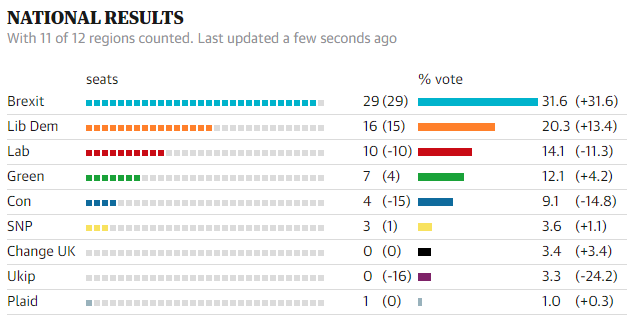
Nigel Farage and his brand-new Brexit Party took 31.6% of the popular vote in England, Scotland, and Wales in the European elections (the Northern Irish results are delayed):
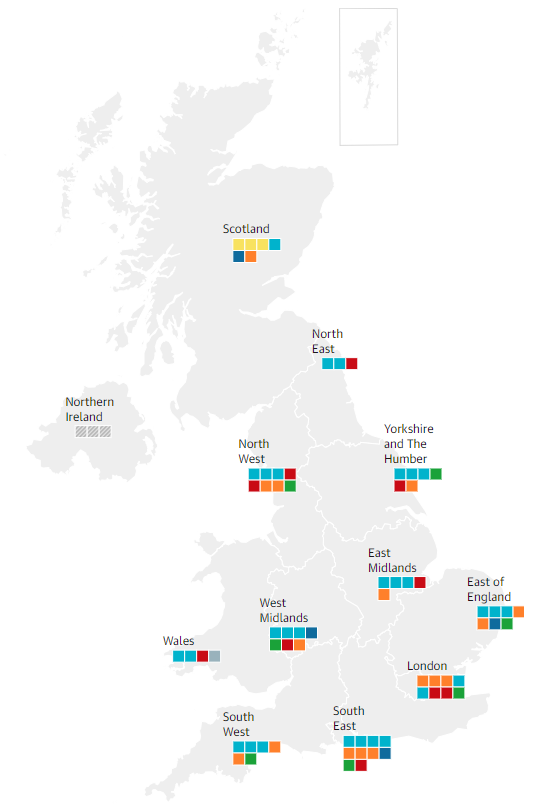
The distribution of the seats:
At Spiked, Brendan O’Neill says that despite the Brexit Party’s stunning results, the establishment is still determined to prevent Brexit and deny the democratically expressed wishes of British voters:
And still the establishment is in denial. Even following the stellar performance of a brand new party in the Euro elections, still the political establishment and its cheerleaders on social media are in a state of blinkered, fingers-in-ears denial about political feeling in the UK. How bad is their denial? Get this: the Brexit Party, barely six weeks old, soared to victory in the EU elections, decimated the Tories, conquered historic Labour-held territories like Bolsover and Hartlepool, and became the largest party in the entire European Parliament, and yet the No1 political trend on Twitter is… #RemainSurge.
Yes, these people, these inhabitants of the Brexitphobic echo chamber, have convinced themselves that this electoral revolt in which the Brexit Party steamrollered all the other parties is actually a victory for them. This takes self-delusion to giddy new heights.
“This is a really strong night for Remain”, said Caroline Lucas, like a real-life version of that meme showing a dog saying “This is fine” as his house burns down. “Tonight the Brexit Party wasn’t supported by around two-thirds of voters”, said Hilary Benn, perversely ignoring the millions of people who did vote for the Brexit Party, who vastly outnumber those who voted for his Labour Party. Alastair Campbell interpreted the election results as a mandate for a second referendum, which is almost as mad as saying Saddam Hussein had weapons of mass destruction that could be deployed within 45 minutes.
In the face of this colossal culture of denial among the political and media elites, let’s reiterate some basic facts. The Brexit Party battered Labour and the Tories. It won more than five million votes. It won 31.6 per cent of the vote, which is 8.4 per cent more than the Tories and Labour combined: the Tories got 9.1 per cent (fifth place) and Labour got 14.1 per cent (third place). The Brexit Party got 28 seats, making it the largest party in the European Parliament. It won in every single region in England apart from London, speaking profoundly to the massive political and moral divide separating the capital – the heart of the political establishment – from the rest of England. It also did spectacularly well in Wales, topping the poll and winning in 19 out of 22 council areas.
And yet myths are already taking hold, being feverishly promoted by pro-EU figures. The first is that the Brexit Party is “just” – why just? – picking up the old UKIP vote and therefore its victory isn’t all that significant. Actually, the Brexit Party has got almost 32 per cent of the vote share, which is five percentage points higher than UKIP got at its high point in the Euro elections of 2014. The other myths – that the Brexit Party is only successful because it is a shadily funded, demagogic outfit, whose new MEPs probably have Russian roubles stuffed in their pockets – is the usual conspiratorial and anti-democratic rubbish we’ve come to expect from the rattled defenders of the status quo.
As for the “Remain surge” idea. Get real. The two parties that are most explicitly anti-Brexit and have expressed their searingly anti-democratic intention to overthrow the mass vote of 2016 – the Lib Dems and the Greens – won a combined vote of 29.7 per cent. That’s two per cent less than the Brexit Party got. The most poisonously elitist anti-Brexit Party – Change UK – disappeared without a trace, winning 2.8 per cent of the vote. Remember how much Change UK was talked up by the liberal media? At one point the chattering classes really did see this party as the saviour of Britain from the horrors of Brexit and yet it won a pathetic, paltry level of electoral support – 600,000 votes to the Brexit Party’s five million.
RAF Phantom Pilot training – from (c) 1973
freddielaker2
Published on 30 May 2016From basic training to flying.
From the comments:
Michel Tangy
2 years ago
Love this. It’s like an Airfix-catalogue come alive
May 27, 2019
Victoria & Abdul, a film about “the brown John Brown”
Mark Steyn on the 2017 movie Victoria & Abdul:
As I mentioned on the radio yesterday, May 24th 2019 marks the bicentennial of Queen Victoria. So it would seem appropriate to have a bit of cinematic Victoriana for our Saturday movie date. Her Majesty was an important and consequential figure in almost every corner of the world, and once upon a time the biopics reflected that. But she was to a degree unknown and unknowable, which offers great opportunities to the contemporary biographical sensibility. And so the most notable films of the last two decades belong to a sub-genre of their own: the Queen-Empress and the men who caught the eye of a lonely and isolated woman in the long decades of her widowhood. John Madden’s Mrs Brown (1997) is about the Queen’s relationship with her ghillie; Stephen Frears’ Victoria & Abdul (exactly twenty years later, 2017) is about the Queen’s relationship with her munshi.
Queen Victoria (1819-1901) portrait by Bassano, 1882.
Photo via Wikimedia CommonsIf you don’t know what a ghillie is, well, it’s a Scots Gaelic word for a Highland chief’s attendant on a fishing or hunting trip. If you don’t know what a munshi is, hey, relax: Nobody in the Royal Household does either, and so they’re a little taken aback to find that a Hindu waiter brought over to add a bit of imperial exotica to the Golden Jubilee in 1887 has suddenly been promoted to the hitherto unknown position of “Munshi and Indian Clerk to the Queen-Empress”.
A court favorite is always resented by less-favored courtiers – for whatever reason suffices. In Mrs Brown (the below-stairs mocking name for her ghillie-smitten Majesty), the favorite, John Brown, is resented for being a big brawny bit of Highland rough. In Victoria & Abdul, which begins four years after the Highland fling’s sudden death, the new favorite, Abdul Karim, is resented because his insinuating Moghul and Persian airs are regarded as ludicrously above his station.
Yet they all get what’s going on: As one lady-in-waiting at Balmoral titters, Abdul is “the brown John Brown”.
To confirm that we are in the realm of sequel, the Queen in both films is played, splendidly and sympathetically, by Judi Dench, and the supporting characters are largely identical, too – from Henry Ponsonby, the Queen’s Private Secretary, to her long-serving Lady of the Bedchamber, Lady Churchill. As in Mrs Brown, the latter screenplay is disfigured by solecisms. In the earlier film, the script cannot quite decide whether the Private Secretary is “Sir Henry” or “Mr Ponsonby”. In the sequel, Judi Dench sighs that, “I have almost a billion citizens” – not a sentence she would ever have uttered: she had almost a billion subjects – and, as wily old Éamon de Valera would later remark in another context, the concept of “citizenship” was all but unknown in the British Empire. One of her last major legislative acts was to give Royal Assent to the Australian constitution – which she found to be in very poor taste, as the word “Commonwealth” reminded her of Oliver Cromwell.

QotD: The Green death cult
In keeping with all millenarian movements, the extinction-obsessed green cult reserves its priestly fury for ordinary people. Even when it is putting pressure on the government, it is really asking it to punish us. It wants tighter controls on car-driving, restrictions on flying, green taxes on meat. That these things would severely hit the pockets of ordinary people – but not the deep pockets of Emma Thompson and the double-barrelled eco-snobs who run Extinction Rebellion – is immaterial to the angry bourgeoisie. So convinced are they of their own goodness, and of our wickedness, that they think it is utterly acceptable for officialdom to make our lives harder in order to strongarm us into being more “green”. People complaining about Extinction Rebellion disrupting people’s lives in London over the past few days are missing the point – the entire point of the green movement is to disrupt ordinary people’s lives, and even to immiserate them. All in the jumped-up name of “saving the planet”.
And now the green cult has pushed Ms [Greta] Thunberg into the position of its global leader, its child-like saviour, the messiah of their miserabilist political creed. What they have done to Ms Thunberg is unforgivable. They have pumped her – and millions of other children – with the politics of fear. They have convinced the next generation that the planet is on the cusp of doom. They have injected dread into the youth. “I want you to panic”, said Ms Thunberg at Davos, and the billionaires and celebs and marauding NGOs that were in attendance all lapped it up. Because adult society loves nothing more than having its own fear and confusions obediently parroted back to it by teenagers. They celebrate Thunberg because she tells them how horrible they are: it is an entirely S&M relationship, speaking to the deep self-loathing of the 21st-century elites.
Brendan O’Neill, “The cult of Greta Thunberg: This young woman sounds increasingly like a millenarian weirdo”, Spiked, 2019-04-22.
May 26, 2019
History of England – The 100 Years War – Extra History – #1
Extra Credits
Published on 25 May 2019At stake on the English side was trade, the English role in Christendom, the king’s lands in France held by right for 150 years, and the reputation and honor of the king. On the French side, a unified country, national prestige, and the right of their monarch to his own throne.
Thanks again to David Crowther for writing AND narrating this series! https://thehistoryofengland.co.uk/pod…
Join us on Patreon! http://bit.ly/EHPatreon
The Allied Clusterf**k in France – WW2 – 039 – May 25 1940
World War Two
Published on 25 May 2019While the massive invasion of the Benelux countries and France was going down last week, things were also developing on the fronts in Norway and China. But this week, the German beast is let loose. After breaking through its cage at Sedan last week, nothing seems strong enough to block its way to the English Channel. And if one thing becomes clear, it is that the Allied command structure and the way they communicate is one big smoking mess…
Join us on Patreon: https://www.patreon.com/TimeGhostHistory
Or join The TimeGhost Army directly at: https://timeghost.tvFollow WW2 day by day on Instagram @World_war_two_realtime https://www.instagram.com/world_war_t…
Join our Discord Server: https://discord.gg/D6D2aYN.
Between 2 Wars: https://www.youtube.com/playlist?list…
Source list: http://bit.ly/WW2sourcesWritten and Hosted by: Indy Neidell
Produced and Directed by: Spartacus Olsson and Astrid Deinhard
Executive Producers: Bodo Rittenauer, Astrid Deinhard, Indy Neidell, Spartacus Olsson
Creative Producer: Joram Appel
Post-Production Director: Wieke Kapteijns
Research by: Indy Neidell
Edited by: Iryna Dulka
Map animations: EastoryColorisations by Joram Appel, Spartacus Olsson and Norman Stewart.
Eastory’s channel: https://www.youtube.com/channel/UCEly…
Archive by Screenocean/Reuters https://www.screenocean.com.Sources:
FDR Presidential Library & Museum
National Portrait Gallery
IWM: H 9218, F 4484, F 4613, F 4578, F 4743б (F 4339
MUSÉE DES ETOILES
Nationaal Archief
Sound effect: LittleRobotSoundFactoryA TimeGhost chronological documentary produced by OnLion Entertainment GmbH.


