The Greek myths […] could not tell us of the conquest of Death by Love, because they could not know it yet; but they did know what it was not. They — the Greeks with their legends — were not just pessimistic. They were heroic pessimists.
Orpheus descends into Hades to retrieve his bride, Eurydice. In the account we read in Virgil’s Georgics, the point of the tale is already slightly smoothed, blunted. Orpheus has made the mistake of looking back on her countenance, when he is almost home. He has emerged in the sun, but she is still in the shadows. As he looks back, she recedes, disappears; she is now lost forever. In modern “education” we used to weep for the tragedy. He almost succeeded. It is a tragedy, strictly in the Roman pagan sense.
But it was a tragedy in the Greek sense, first. If we go instead to Plato, and listen to the aristocratic Phaedrus in the Symposium, we learn that Orpheus was thoroughly in the wrong, in his attempt to retrieve Eurydice. He was bound to be punished. His mistake was not a technicality. His living descent into Hades was a challenge not only to the gods, but to nature, and to the truth of things. His love for Eurydice, so affecting in his mournful dirges — moving everyone to tears — was not true love. A coward, he would not die for it.
Hades has presented him with a wraith, in Eurydice’s outward form. Inevitably, this illusion would dissolve in the sunlight. And the fate of Orpheus was now set — the fate of an eloquent softie, who loves an imaginary woman — a woman he had created from the start. He will die at the hands of the real ones he rejected. He will be torn apart by the Maenads, as by wild beasts. His lyre will be destroyed. This is the fate of our shallow romantic star; the pretty boy whose lyre and whose voice had once been an enchantment.
Boethius deals with that backward gaze, in the Consolations of Philosophy. We who seek to lead into the light of the upper day — we triumphalist philosophers — are bound to look back into the Tartarean cave. And when we do, the clarity of our “vision” will be obscured; then ruined, totally. To guide we must be guided; or all will be lost.
David Warren, “A backward glance”, Essays in Idleness, 2021-02-09.
May 17, 2021
QotD: Orpheus and Eurydice
May 8, 2021
QotD: That time the global elites were against diversity
There was simply no debate back then [in the aftermath of the Great War] that a mass influx of European refugees to Africa would have been a conquest, not a “humanitarian crisis” that Africans, with their ample space and nutrient-rich soil, had some kind of responsibility to sit back and accept. And to be clear, many of the European refugees who would have trekked across Sörgel’s newly reclaimed land were genuinely in need. They were impoverished, homeless, destitute. And a lot of them were fleeing political violence. Those folks were as poor, wretched, and persecuted as any Honduran is today. But in fully rejecting Atlantropa as a goal to be pursued, the international community took the position that “it sucks that you’re impoverished and mistreated in your home country, but it ain’t Africa’s problem. Stay where you are.”
See, in those days, the elites believed in keeping people in their own damn land. Hard as that might be to fathom now, that used to be a mantra of the progressive internationalists. There was a die-hard belief that the key to world peace was the separation of people, the segregation of populations by race, religion, and ethnicity. That was the entire point of the Greek/Turkish population exchange of 1923, overseen by the League in the name of keeping Greek Christians and Turkish Muslims separated for the sake of peace. As UNC Chapel Hill history professor Sarah Shields wrote in her 2016 essay in the Journal of the History of International Law, the prevailing belief at that time was that “Muslims and non-Muslims could not live together peacefully, and modernity required rejecting a diverse past in favor of a nation-state along European (unmixed) lines.”
Separation was the future, diversity was the past. Damn near 1.6 million Greeks and Turks were sent from the land of their birth to the land where they could live with those of a similar faith. Many of the other population transfers and redrawn boundaries that followed World War I were based on that same concept of giving people their “own” homeland based on characteristics like religion or ethnicity. It was simply taken as fact back then that nations function better with some level of homogeneity. That was canon back then. By the time the U.N. came around, that notion was still very much a guiding principle, as the internationalists realized that a vision of a multireligious, multiethnic Palestine was unrealistic and unattainable. And the Jews and the Arabs realized that too, which is why they started slaughtering each other, because they couldn’t bear to live in a partitioned state. Being separate but equal was not enough. They wanted to be separate and separated.
David Cole, “When Refugees Were Conquerors”, Taki’s Magazine, 2018-10-29.
April 12, 2021
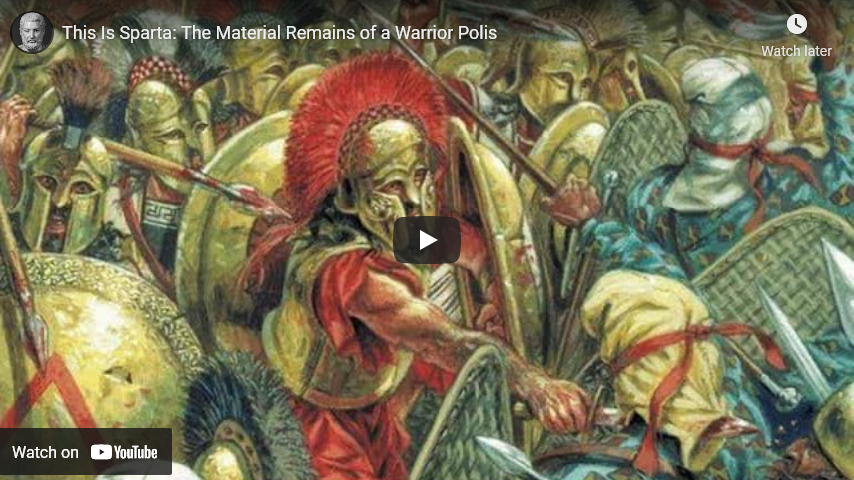
The Constitution of the Spartans
Historia Civilis
Published 11 Sep 2017Patreon | http://historiacivilis.com/patreon
Donate | http://historiacivilis.com/donate
Merch | http://historiacivilis.com/merch
Mailing List | http://historiacivilis.com/mailinglist
Twitter | http://historiacivilis.com/twitter
Website | http://historiacivilis.comSources:
The Constitution of the Spartans, by Xenophon: http://amzn.to/2j7JXTB
The Moralia, by Plutarch: http://amzn.to/2gNMYHU
Parallel Lives: The Life of Lycurgus, by Plutarch: http://amzn.to/2xS29nI
Politics, by Aristotle: http://amzn.to/2wMq5ss
Rhetoric, by Aristotle: http://amzn.to/2xS3niO
Laws, by Plato: http://amzn.to/2wLpsiN
On the Republic, by Cicero: http://amzn.to/2j7Flgg
The Histories, by Herodotus: http://amzn.to/2xdH4a7
The Spartan Regime, by Paul A. Rahe: http://amzn.to/2vPmRqS
Property and Wealth in Classical Sparta, by Stephen Hodkinson: http://amzn.to/2xdV7MS
The Rise of Athens, by Anthony Everitt: http://amzn.to/2j69uMS
Persian Fire, by Tom Holland: http://amzn.to/2vPyCxEWe are a participant in the Amazon Services LLC Associates Program, an affiliate advertising program designed to provide a means for us to earn fees by linking to Amazon.com and affiliated sites.
Music:
“Air Hockey Saloon,” by Chris Zabriskie
“Candlepower,” by Chris Zabriskie
“CGI Snake,” by Chris Zabriskie
“Heliograph,” by Chris Zabriskie
“Hallon,” by Christian Bjoerklund
From the comments:
Temporary Fakename
3 years ago
You know, i thought the Roman political system was pretty odd and arcane. But the Spartans have a dual monarchy that has absolute power, except when it doesn’t, an elected Senate that is chosen partially randomly that can pass whatever the hell they want with a public assembly and punish kings, except when an all-male aristocracy decided no, a female aristocracy that is overwhelmingly rich but can’t vote, and a population so terrified of its own slaves that it ritually committed atrocities against them. Compared to that Roman politics look simple and elegant.
I found the presentation quite interesting and informative, but I felt that some discussion of the differences between the terrible plight of the Helots and the not-quite-free status of the Perioikoi was merited. I also felt that the final segment on the eventual decline of Sparta missed a major factor — Spartan military defeats in the Battle of Leuctra in 371 BC and the Battle of Mantinea in 362 BC — but reading down in the comments, I saw someone else had already brought this up:
xelena
2 years ago (edited)
This is a good video, but is missing a super important point at the end: The cause for the decline of Spartan power was its defeat by Epaminondas of Thebes and his freeing of Messenia (the land of the Helots). He also founded Messene in Messenia and Megalopolis in Arcadia for the Helots, which became a powerful check to Sparta. Spartan power never recovered from this death blow to its slave economy and continued to wither away into the nothingness you describe.Epaminondas is mostly forgotten today, but he was one of the greatest men of antiquity. It was him and Pelopidas who put to bed the myth of Spartan invincibility and freed an entire people who had been enslaved for centuries. So in a way, the crippling blow did come from other Greeks, and the Helots did participate in it.
April 5, 2021
Did the Trojan War Really Happen?
Kings and Generals
Published 13 Aug 2020Kings and Generals’ historical animated documentary series continues with a video on the Trojan War, as we talk about the historicity of the conflict between Trojans and the Greeks depicted in the immortal Iliad of Homer. We also cover the Mycenaean and Hittite civilizations. How did this story come to be? Is it just a myth or is there historical proof that it happened? What does archeology tell us about the conflict at the end of the Bronze age? Were Hector, Achilles, Helen and Paris even real?
Support us on Patreon: http://www.patreon.com/KingsandGenerals or Paypal: http://paypal.me/kingsandgenerals We are grateful to our patrons and sponsors, who made this video possible: https://docs.google.com/document/d/1o…
Art and animation: Oğuz Tunç http://bit.ly/2H6oRjw
Script: Leo Stone
Narration: Officially Devin (https://www.youtube.com/user/OfficiallyDevin)✔ Merch store ► teespring.com/stores/kingsandgenerals
✔ Podcast ► Google Play: http://bit.ly/2QDF7y0 iTunes: https://apple.co/2QTuMNG
✔ Twitter ► https://twitter.com/KingsGenerals
✔ Instagram ► http://www.instagram.com/Kings_GeneralsProduction Music courtesy of Epidemic Sound: http://www.epidemicsound.com
#Documentary #Troy #Greece
March 26, 2021
QotD: The Furies
In Greek and Roman mythology, the Furies were female spirits of justice and vengeance. They were also called the Erinyes (angry ones). Known especially for pursuing people who had murdered family members, the Furies punished their victims by driving them mad. When not punishing wrongdoers on earth, they lived in the underworld and tortured the damned.
According to some stories, the Furies were sisters born from the blood of Uranus, the primaeval god of the sky, when he was wounded by his son Cronus*. In other stories, they were the children of Nyx (night). In either case, their primaeval origin set them apart from the other deities of the Greek and Roman pantheons.
Most tales mention three Furies: Alecto (endless), Tisiphone (punishment), and Megaera (jealous rage). Usually imagined as monstrous, foul-smelling hags, the sisters had bats’ wings, coal-black skin, and hair entwined with serpents. They carried torches, whips, and cups of venom with which to torment wrongdoers. The Furies could also appear as storm clouds or swarms of insects.
Jay Currie, “Character meets the Furies”, Jay Currie, 2018-10-08.
March 6, 2021
History-Makers: Sappho
Overly Sarcastic Productions
Published 5 Mar 2021It’s no use, dear algorithm, I cannot research, for Sappho has crushed me with longing for lost poetry!
SOURCES & Further Reading: Sappho: fragments by Jonathan Goldberg, “Girl, Interrupted: Who Was Sappho?” for The New Yorker by Daniel Mendelsohn (https://www.newyorker.com/magazine/20…), “Sappho” from The Poetry Foundation (https://www.poetryfoundation.org/poet…)
Our content is intended for teenage audiences and up.
PATREON: https://www.Patreon.com/OSP
PODCAST: https://overlysarcasticpodcast.transi…
DISCORD: https://discord.gg/osp
MERCH LINKS: http://rdbl.co/osp
OUR WEBSITE: https://www.OverlySarcasticProductions.com
Find us on Twitter https://www.Twitter.com/OSPYouTube
Find us on Reddit https://www.Reddit.com/r/OSP/
March 2, 2021
The Evolution of Shock Cavalry – From Antiquity to the Middle Ages
Invicta
Published 1 Mar 2021Learn about the evolution of shock cavalry from antiquity before the use of saddles and stirrups! Check out The Great Courses Plus to learn about shock cavalry in the campaigns of Alexander the Great: http://ow.ly/osex30rvhjf
In this history documentary we explore the topic of ancient cavalry. The basic idea is that these units often get depicted in media as performing glorious massed charges headlong into the enemy ranks as seen in such scenes as the Charge of the Rohirrim from the Battle of Pelenor Fields. In reality this would have been a very dangerous situation for cavalrymen even under the best circumstances. But to make matters worse, riders from antiquity fought without the use of either saddles or stirrups. So how on earth did they manage to dominate the battlefield with these handicaps. Let’s find out.
We begin by covering the history of cavalry with the first domestication of the horse and its introduction to warfare first as member of the baggage train and soon after as a part of chariot crews rather than as actual mounted forces. This was in large part due to the lack of riding experience and technology on behalf of the rider. Soon after the Bronze Age Collapse however cavalry began to rise to prominence across the armies of the Mediterranean. We speak about the various forms of equine practices which ranged from riding bareback into combat as with the Numidian Cavalry to the use of simple bridles and cloth seats as with Greek Cavalry and Persian Cavalry.
We then cover the techniques used by these cavalrymen to mount, ride, and fight. As a part of this discussion, we rely heavily on Xenophon’s Manual on Horsemanship which provides excellent first hand details from the period. We also show how these techniques were successfully used by shock cavalry of antiquity such as the Macedonian Companion Cavalry, the Saka Steppe Lancers, and the Persian Cataphracts to great effect even without the use of saddles and stirrups.
Finally we do pose the question of why they didn’t use the saddle and stirrup given its seemingly obvious advantages. To answer this question we look at the history of its development from late antiquity to the early Middle Ages.
Bibliography and Suggested Reading
On Horsemanship, by Xenophon
Adrian Goldsworthy, The Complete Roman Army
Adrian Goldsworthy, Roman Warfare
J.C. Coulston, Cavalry Equipment of the Roman Army in the First Century A.D.
George T. Dennis, Maurice’s Strategikon, p. 38.
Julius Caesar, Commentarii de Bello Civili
Russel H. Beaty, Saddles#History
#Documentary
#ShockCavalry
From the comments:
Invicta
13 hours ago
I was inspired by comments on our latest Units of History episode covering the Companion Cavalry which asked about how shock tactics worked in an age before the stirrup and saddle. I went down the rabbit hole finding answers and present to you my findings in this video! One awesome source we used was the Manual on Horsemanship by Xenophon which you can read for yourself here: http://www.gutenberg.org/files/1176/1176-h/1176-h.htm
March 1, 2021
Why the Bronze Age Collapse matters today. Dr. Eric Cline (If Civilization Collapsed Would We Know?)
Study of Antiquity and the Middle Ages
Published 13 Jun 2020Ladies and Gentlemen we arrive finally to the part of our series that you have all been waiting for! And that is the Bronze Age Collapse and here to guide us through it is none other than Dr. Eric Cline, the rock star archaeologist, historian and author of none other than 1177 BC!
He will give us an overview history of the collapse along with sharing his own personal views on the subject! Guiding us briefly through archaeology, trade, national politics, and contact in the ancient Mediterranean we will get a nice picture of the Bronze Age and how it all came crashing down in a perfect storm of events. But what is ever more awesome is he even gives us the inside scoop on why he wrote 1177 BC? And how he did it!
But at the end of this episode we come to our modern world and Dr. Cline explains why the Bronze Age Collapse matters today. What we need to look at when comparing it to our modern world and the current events and impacts affecting our world. Did the peoples living through the Bronze Age Collapse know they were living in a collapse? And he asks a delicate and intense question and that is if civilization collapsed today would we know?
Check out our new store! teespring.com/stores/the-history-shop
Support Dr. Eric Cline at the links below!
Personal web page: https://ehcline.com
Get all of his books here at his Amazon Author page:
https://www.amazon.com/s?i=stripbooks…GW pages:
https://cnelc.columbian.gwu.edu/eric-…https://anthropology.columbian.gwu.ed…
https://gwu.academia.edu/EricCline
Image credits: Manna Nader, Gabana Studios Cairo
Hittite 3D City and intro footage credits: 3D reconstruction of Imperial Hittite Karkemish by Giampaolo Luglio, Turco-Italian Archaeological Expedition to Karkemish directed by Nicolò Marchetti (University of Boologna)
KARKEMISH (Carchemish) 1300 BC (3D) – The Southern Capital of the Empire Hittite
Music Attribution: Herknungr – Megaliths | Dark Neolithic Meditive Shamanic Ambient Music https://youtu.be/oc8FQwNjPu0
February 19, 2021
Quislings! – Traitors of World War Two – WW2 Gallery 02
World War Two
Published 18 Feb 2021The name of Norwegian National Socialist Politician Vidkun Quisling became synonymous with “traitor” and “collaborator”. In this gallery episode, we’ll cover some of the most prominent Quislings in World War Two.
Join us on Patreon: https://www.patreon.com/TimeGhostHistory
Or join The TimeGhost Army directly at: https://timeghost.tvFollow WW2 day by day on Instagram @ww2_day_by_day – https://www.instagram.com/ww2_day_by_day
Between 2 Wars: https://www.youtube.com/playlist?list…
Source list: http://bit.ly/WW2sourcesHosted by: Indy Neidell
Written by: Joram Appel
Director: Astrid Deinhard
Producers: Astrid Deinhard and Spartacus Olsson
Executive Producers: Astrid Deinhard, Indy Neidell, Spartacus Olsson, Bodo Rittenauer
Creative Producer: Maria Kyhle
Post-Production Director: Wieke Kapteijns
Research by: Joram Appel
Edited by: Miki Cackowski
Sound design: Marek Kamiński
Map animations: Eastory (https://www.youtube.com/c/eastory)Colorizations by:
Norman Stewart – https://oldtimesincolor.blogspot.com/
Adrien Fillon – https://www.instagram.com/adrien.colo…
Jaris Almazani (Artistic Man) – https://instagram.com/artistic.man
Julius Jääskeläinen – https://www.facebook.com/JJcolorization/
Carlos Ortega Pereira, BlauColorizations – https://www.instagram.com/blaucolorizations
Dmitriy Vasilyev – https://commons.wikimedia.org/wiki/Fi…Sources:
USHMM
Narodowe Archiwum Cyfrowe
Bundesarchiv
efsyn.gr
Yad Vashem 85DO
Amsab Institute of Social History www.amsab.be
Picture of Mussert shaking hands with Hitler, courtesy of Beeldbankwo2 https://beeldbankwo2.nl/Soundtracks from the Epidemic Sound:
Johannes Bornlof – “The Inspector 4”
Philip Ayers – “Trapped in a Maze”
Cobby Costa – “Flight Path”
Rannar Sillard – “March Of The Brave 4”
Johan Hynynen – “Dark Beginning”
Farrell Wooten – “Blunt Object”
Reynard Seidel – “Deflection”
Yi Nantiro – “Watchman”
Hakan Eriksson – “Epic Adventure Theme 4”Archive by Screenocean/Reuters https://www.screenocean.com.
A TimeGhost chronological documentary produced by OnLion Entertainment GmbH.
February 13, 2021
Miscellaneous Myths: Hades and Persephone
Overly Sarcastic Productions
Published 12 Feb 2021You asked, I’ve answered! Today let’s discuss greek mythology’s most beloved AND most maligned relationship — but which reputation is truly deserved? You all know where *I* stand on the matter, but today I’ll do my best to justify my hot take that Hades And Persephone Is Romantic Actually.
Our content is intended for teenage audiences and up.
PARTIAL TRACKLIST: Hall of the Mountain King, Black Blade, Starfall, World Annihilation, Lacrimosa, Voice of Rushing Waters, Atlas, Breath and Life, Fire And Ice
PATREON: https://www.Patreon.com/OSP
PODCAST: https://overlysarcasticpodcast.transi…
DISCORD: https://discord.gg/osp
MERCH LINKS: http://rdbl.co/osp
OUR WEBSITE: https://www.OverlySarcasticProductions.com
Find us on Twitter https://www.Twitter.com/OSPYouTube
Find us on Reddit https://www.Reddit.com/r/OSP/
February 9, 2021
History Summarized: Alexander the Great
Overly Sarcastic Productions
Published 19 Sep 2017Linguistically speaking, Alexander means “Defender of Men” from the Greek “alexo“, defend, and “aner/ander“, man. I’ll never be able to not internally think of his name as just meaning “Alex-Man”.
Oh, yeah, also he conquered an empire or something? IDK. I stopped paying attention after his bland name.
PATREON: www.patreon.com/OSP
MERCH LINKS:
Shirts – https://overlysarcasticproducts.threa…
All the other stuff – http://www.cafepress.com/OverlySarcas…Find us on Twitter @OSPYouTube!
February 7, 2021
Roman legion vs Macedonian phalanx
Epimetheus
Published 13 Aug 2018Roman legion vs Macedonian phalanx (Macedonian wars)
Battle of Pydna 168 BC and battle of Cynoscephalae 197 BCSupport new videos from Epimetheus on Patreon! 😀
https://www.patreon.com/Epimetheus1776roman legion, roman legion tactics, macedonian phalanx, Macedonian phalanx tactics, Macedonian phalanx vs roman legion, ancient Macedonian army, ancient roman army, roman army, Roman legionary, rome vs Greece, Rome vs Macedon, roman army weapons, Roman army tactics, Macedonian wars, battle Cynoscephalae, battle of Pydna, republican Roman army, Roman maniple, Roman republic, documentary, ancient Rome documentary, ancient Greece documentary, rome documentary, battle of magnesia, rome selucid empire, Roman empire vs selucid empire, diadochi, ancient,
January 27, 2021
Misunderstood Moments in History – The Spartan Myth
Invicta
Published 27 Oct 2017Start your 30 day free trial here: http://ow.ly/eCd230fiZ7Q
The Spartans are immortalized in history as super soldiers bred for war. However most of what we think we know about them is a lie. Today we will unmask the truth behind the Spartan Myth.
The Great Courses Plus is currently available to watch through a web browser to almost anyone in the world and optimized for the US market. The Great Courses Plus is currently working to both optimize the product globally and accept credit card payments globally.
Documentary Credits:
Research: Dr Roel Konijnendijk
Script: Invicta
Artwork: Milek J
Editing: Invicta
Music: Total War OST, SoundnoteDocumentary Bibliography:
Paul Anthony Cartledge, The Spartans: The World of the Warrior-heroes of Ancient Greece
Nigel Kennell, Spartans: A New History (2010)
S. Hodkinson, Property and Wealth in Classical Sparta (2000)
J. Ducat, Spartan Education: Youth and Society in the Classical Period (2006)
S.M. Rusch, Sparta at War: Strategy, Tactics and Campaigns, 550-362 BC (2011)
E. Rawson, The Spartan Tradition in European Thought (1969)
S. Hodkinson & I.M. Morris (eds.), Sparta in Modern Thought (2012)
January 26, 2021
QotD: “A world organized around institutional mass slavery”
An example: We’ve discussed all the cool steampunk shit the Greeks could’ve had, if only Archimedes had … well, that’s just the thing, isn’t it? We look at the aeolipile and see a prototype steam engine; they looked at it and saw, as best we can tell, a party trick. Back when, I suggested, Marxist-style, that labor costs were a sufficient explanation for why nobody took the obvious-to-us next step of hooking the thing up to something productive and kicking off the Industrial Revolution. Machines are labor-saving devices; the ancient world had a gross excess of labor. Calling the aeolipile a steam engine, then, is a category error.
New hypothesis: It’s a category error, all right, but not because they didn’t think in terms of labor costs. It’s because they couldn’t think in terms of labor costs.
A world organized around institutional mass slavery is, in a very real sense, a timeless world. Herodotus (I think) actually says somewhere that nothing worth mentioning happened before him, and you can see echoes of this attitude even as late as the Antebellum South. You see their attitude described as “conservative,” but since that’s egghead shorthand for “evil” you can ignore it. They weren’t consciously backward-looking; rather, they were deeply rooted to their place and station. To the outsider, it looked like they were trying to hold time back, but to the insider, time — clock time, industrial time, the time of the Protestant work ethic — barely existed at all.
So with the Classical World. The Romans, for instance, are endlessly frustrating to their admirers (of which I am an ardent one). Their only economic fix, for instance, was debasing the currency, i.e. a primitive form of inflation. You guys could figure out how to hew an artificial harbor out of some desert rocks — a trick we’d have a hard time pulling off today — but you couldn’t figure out fiat currency? Or a better political system than the tetrarchy? Or that the forts-and-legions paradigm just isn’t cutting it? Or … etc.
Stuff like that is why Spengler said classical, Apollonian culture was fundamentally different from, and incompatible with, our Faustian culture. According to Spengler, the master metaphor for the Apollonian is the human body, which is beautiful but changeless (emphasis mine, not Spengler’s). You can improve your body somewhat, but only within certain tight limits, and the body’s fundamental form is always the same (we could time warp Julius Caesar into the Current Year and still recognize him as a fellow homo sap., no matter how different his mind might be).
The Faustian, though — that would be us — organizes his worldview around space, infinite space. Practically speaking, this results in our attitude of innovation-for-innovation’s sake. We send a man to the moon because we can, but such an idea would never occur to the Romans, for the same reason they didn’t apply all their awesome engineering knowledge to the problems of governance. Hacking a harbor out of the desert is a tremendous feat, but it’s a local feat — a one-shot deal, a very specific response to a very specific local problem, with no broader applications.
This, I suggest, is because the timeless world of institutional mass slavery naturally selects for the kind of man who is at home in the world of institutional mass slavery. It’s a world of very low future time orientation, because “time” hardly exists at all. Forget machinery for a sec; the Roman world was full of enormous problems that had teeny-tiny, head-slappingly obvious fixes. Julius Caesar, for instance, was considered some kind of prodigy because he could sight-read books. Which really was a noteworthy feat, because Romans didn’t even put spaces between their words, much less use any sort of punctuation marks. And they were radical innovators compared to the Ancient Egyptians, since at least Roman writing all ran left-to-right; hieroglyphics can be read in any direction, including vertically, and I’m pretty sure there are examples of them changing text orientations in the middle of the same inscription. It’s not hard to imagine some legion commander actually losing a battle because he had to stop and sound out an important communique from a subordinate …
… and yet the Romans, for all their technical skill, never even figured that tiny change out. See also: The Chinese doing fuck-all with movable type, vs. (Faustian) Europeans using it to conquer the world. China, too, was a timeless society. As Derb says somewhere, Classical Chinese isn’t even really writing; it’s more of an aide-memoire — designed to remind readers of stuff they already know, not to communicate new information.
Your post-Roman European, by contrast, lived in a world where high future time orientation was an absolute must. You don’t need hypotheses like the famous “lead in the drinking water pipes” to explain the seemingly bizarre things the Romans did, or didn’t do; all you need is time orientation, a fundamental attitude of “this is a variation on an old problem” vs. “this is an entirely new situation that requires a new response.” Life in the post-Roman world was solitary, poor, nasty, brutish, and short — every man for himself; think through the consequences of your actions very carefully before you do them, or die horribly. Those who failed to do so died. Bake that into the genetic cake for a few generations, and you get Renaissance Man, who’d see a million possible applications for the aeolipile.
Severian, “Bio-Marxism”, Rotten Chestnuts, 2020-09-24.
January 24, 2021
The Great Wine Blight
The History Guy: History Deserves to Be Remembered
Published 9 Sep 2020In the 19th century, the Great Wine Blight threatened the very existence of grapes. But the pestilence brought into Europe by American vines was eradicated by the use of those very same vines. The History Guy recalls how American indigenous vines saved the wine industry, and how you can help to preserve its future.
This is original content based on research by The History Guy. Images in the Public Domain are carefully selected and provide illustration. As very few images of the actual event are available in the Public Domain, images of similar objects and events are used for illustration.
Special thanks to Stone Hill Winery, Hermann, Missouri:
https://stonehillwinery.comYou can purchase the bow tie worn in this episode at The Tie Bar:
All events are portrayed in historical context and for educational purposes. No images or content are primarily intended to shock and disgust. Those who do not learn from history are doomed to repeat it. Non censuram.
Find The History Guy at:
Patreon: https://www.patreon.com/TheHistoryGuyThe History Guy: History Deserves to Be Remembered is the place to find short snippets of forgotten history from five to fifteen minutes long. If you like history too, this is the channel for you.
Awesome The History Guy merchandise is available at:
teespring.com/stores/the-history-guy
Script by CDH
#history #thehistoryguy #wine