As part of a multi-post series at A Collection of Unmitigated Pedantry on explaining (and debunking) the modern day mythology of classic-era Sparta, Bret Devereaux compiled a useful glossary of terms that will be of use as I’ll be excerpting several sections of his series for today’s and several future QotD entries. I’ve added a few entries that seem necessary and expanded some others, but these are enclosed in square brackets “[ ]” to show they’re not directly from Bret’s original post.
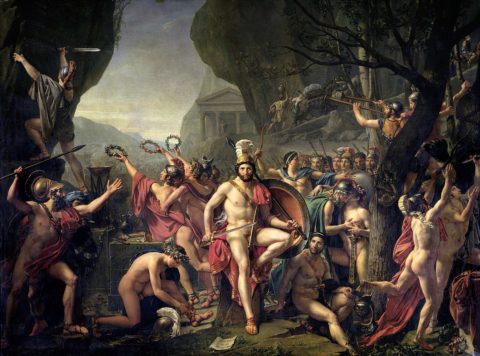
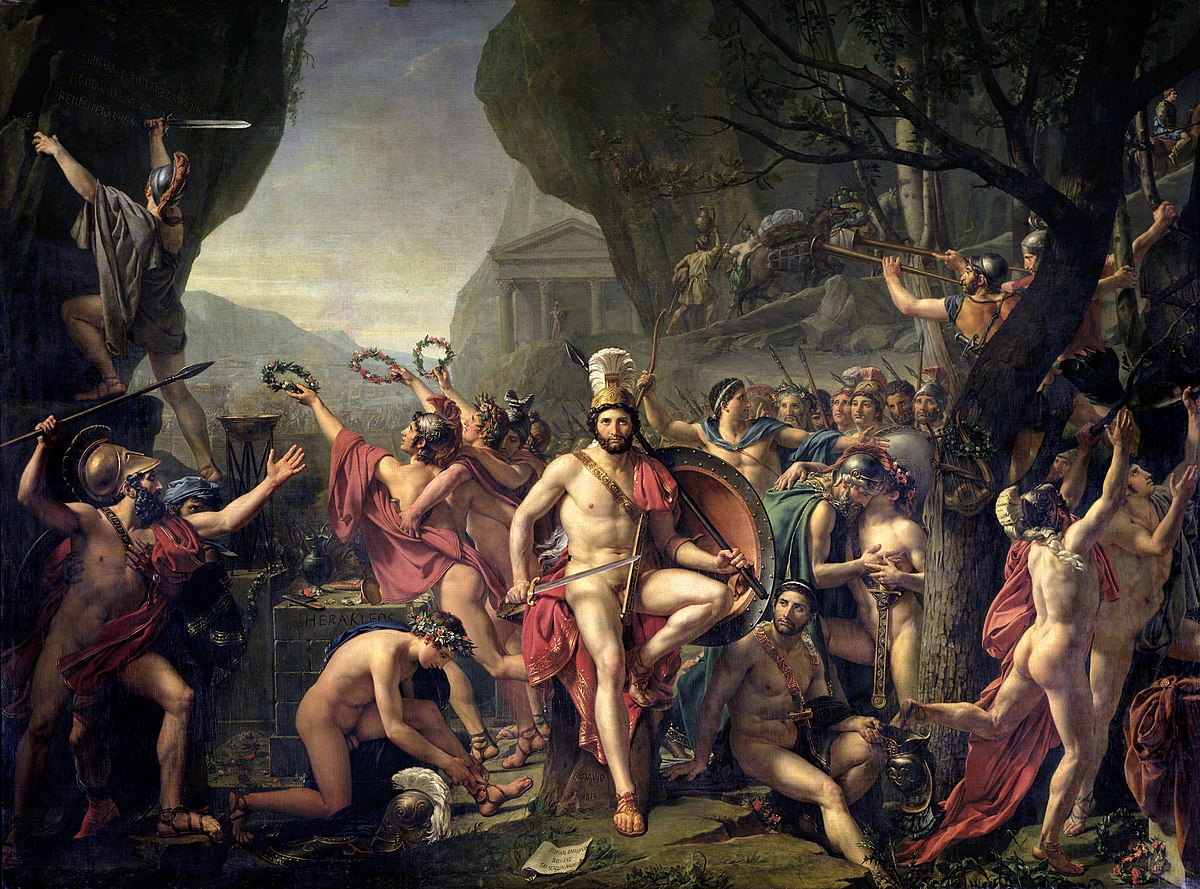
Leonidas at Thermopylae by Jacques-Louis David, 1814.
Wikimedia Commons.
Acclamation. A vote held by acclamation (sometimes called a “voice vote”) is a vote where, instead of getting an exact count of yes and no votes, the outcome is judged by the volume of people calling out yes or no. Obviously it would be very hard to tell who had really won a close vote. This is used in modern democracies only for very lopsided (typically unanimous) votes; in Classical Sparta, this was the only voting system, votes were never counted.
[Agoge. The Spartan education system for boys (ἀγωγή, pronounced ah-go-GAY). “Spartan boys were, at age seven, removed from their families and grouped into herds (agelai) under the supervision of a single adult male Spartan – except for the heirs to the two hereditary kings, who were exempt. Order was kept by allowing the older boys to beat and whip the younger boys (Xen. Lac. 2.2). The boys were intentionally underfed (Plut. Lyc. 17.4; Xen. Lac. 2.5-6). They were thus encouraged to steal in order to make up the difference, but severely beaten if caught (Plut. Lyc. 17.3-4; Xen. Lac. 2.6-9). … We are not told, but it seems unavoidable that in a system that intentionally under-feeds groups of boys to force them to steal, that the weakest and smallest boys will end up in a failure spiral where the lack of food leads to further weakness and further victimization at the hands of other boys. I should note that while ancient parenting and schooling was certainly more violent than what we do now – the Spartan system was recognized as abnormally violent towards these boys, even by the standards of the time.”]
Apella. The Apella was the popular assembly of Sparta, consisting of all adult male Spartiates over the age of thirty. The Apella was presided over by the Ephors and all votes were by acclamation. The Apella did not engage in debate, but could only vote “yes” or “no”. The Gerousia had the power to ignore the decisions of the Apella. [In most other Greek poleis the equivalent body would be called the ekklesia.]
Ephor. The Ephors were a board of five officials in Sparta, elected annually by the Apella (technically plus the two kings). The Ephors oversaw the two hereditary Spartan kings and could even bring a king up on charges before the Gerousia. In practice, the Ephors – not the kings – wielded the most political power in Sparta. The Ephors were also responsible for ritually declaring war on the helots every year. The institution as a whole is sometimes collectively referred to as the Ephorate.
Gerousia. The Gerousia – literally a council of old men (the members were “Gerontes” – literally “old men”) which consisted of thirty members, 28 elected (by acclamation in the Apella) plus the two hereditary kings. The elected members all had to be over the age of 60. Gerontes were elected for life. The Gerousia decided what motions could be voted on by the Apella and had the power to cancel any decision of the Apella. It also functioned as a court, with the power to try Spartiates and even the kings. In practice, with the Ephors, the Gerousia wielded the real political power in Sparta.
Helot. The subjugated slave class of Sparta, which made up the overwhelming majority of its residents, the Helots did the agricultural labor which kept the Spartan state running. Helots can be further subdivided into the Laconian helots (those living in Sparta proper) and the Messenian helots (the populace of Messenia which had been reduced to helotry after being conquered by Sparta in the 7th century B.C.). Helots often fought in Sparta’s armies, apparently as screening light-infantry forces (and also as camp followers and servants).
Homoioi. See: Spartiates.
Hoplite. Hoplites were Greek heavy infantry soldiers who fought with a heavy round shield (sometimes called a “hoplon” but more correctly an “aspis“) and a spear, typically in armor.
Hypomeiones. One of several sub-citizen underclasses in Sparta, the Hypomeiones (literally “the inferiors”) were former Spartiates who had fallen off the bottom of the Spartan social system, either through cowardice or (more likely) being unable to pay the contribution to the Syssitia. Though free, they had no role in government.
[Kings. Sparta had two royal lines and two kings at all times. The kings were drawn from the Agaids and the Eurypontid families. In theory, both kings had the same set of powers. The kings’ wealth was derived from lands allocated from territory taken from the perioikoi, and the eldest son of the current king in each line was the presumptive heir. On this basis, the kings were almost always the two wealthiest men in Sparta.]
[Kleroi (sing. kleros). The (theoretically) equal plots of land allocated to each Spartiate, worked on his behalf by Helots to generate the contributions to the individual Spartiate‘s Syssitia. Up to half of the production of the kleros had to be paid to the Spartiate by the Helots who worked that land. At some point, the kleroi became inheritable property, which facilitated the accumulation of wealth in fewer and fewer hands, contributing to the demographic collapse of the Spartiate class.]
Lycurgus. [The name of the (almost certainly) mythical founder figure of Sparta.] Lycurgus had been the younger brother of one of Sparta’s two kings, but had left Sparta to travel when his brother died, so that he would be no threat to his young nephew. After a time, the Spartans begged Lycurgus to come back and reorganize society, and Lycurgus – with the blessing of the Oracle at Delphi – radically remade Spartan society into the form it would have for the next 400 years. He did not merely change the government, but legislated every facet of life, from child-rearing to marriage, to the structure of households, the economic structure, everything. Once he had accomplished that, Lycurgus went back to Delphi, but before he left he made all the Spartans promise not to change his laws until he returned. Once the Oracle told him his laws were good, he committed suicide, so that he would never return to Sparta, thus preventing his laws from ever being over turned. So the Spartans never changed Lycurgus’ laws, which had been declared perfect by Apollo himself. Subsequently, the Spartans accorded Lycurgus divine honors, and within Sparta he was worshiped as a god.
Mothax. One of several sub-citizen underclasses in Sparta, the Mothakes were non-citizen men, generally thought to have been the children of Spartiate fathers and helot mothers, brought up alongside their full-citizen half-siblings. Mothakes fought in the Spartan army alongside spartiates, but had no role in government. A surprising number of innovative Spartan commanders – Gylippus and Lysander in particular – came from this class.
Neodamodes. One of several sub-citizen underclasses in Sparta, the Neodamodes were freed helots, granted disputed land on the border with Elis. Though they served in the Spartan army, the Neodamodes lacked any role in government. We might consider the helots who served in Brasidas’ army, the Brasideioi as a type of the Neodamodes (they did settle in the same place).
Peers: See: Spartiates.
Perioikoi (sing. Perioikos). The perioikoi (literally the “dwellers around”) were one of several sub-citizen underclasses in Sparta. The perioikoi were residents of communities which were subjected to the Spartan state, but not reduced to helotry. They lived in their own settlements under the control of the Spartan state, but with limited internal autonomy. The perioikoi seem to have included Sparta’s artisans, producing weapons, armor and tools; they were also made to fight in Sparta’s armies as hoplites.
Polis (pl. poleis). A complicated and effectively untranslatable term, polis most nearly means “community” and is often translated as “city-state”. However, there were poleis in Greece without cities (Sparta being one – a fact often concealed by translators rendering polis as city). Instead a polis consists of a body of citizens, their state, and the territory it controls (including smaller villages but not other subjugated poleis), usually but not always centered on a single urban center. Poleis are almost by definition independent and self-governing (that is, they have eleutheria and autonomia).
Skiritai. The Skiritai were one of several sub-citizen underclasses in Sparta. Dwellers in Skiritis, the mountains between Laconia and Arcadia, they were mostly rural people who were free, but subject to the Spartan state, similar to the perioikoi. The main difference between the two was that the Skiritai – perhaps because of their mountainous homes – served not as hoplites, but as an elite corps of light infantry in the Spartan army.
Spartiates, also called peers or homoioi. The citizen class at Sparta, the Spartiates were a closed ethnic aristocracy. Membership required both a Spartiate father and a Spartiate mother, as well as successful completion of the Agoge and membership in a Syssitia. Spartiate males over thirty were the only individuals in Sparta who could participate in government, although the political power of the average Spartiate was extremely limited.
Syssitia (sing. syssition). The Syssitia were the common mess-groups into which all adult Spartiates were divided. Each member of the Syssitia contributed a portion of the mess-group’s food; the contribution was a condition of citizenship. Spartiates who could not make the contribution lost citizenship and became Hypomeiones.