
World War Two
Published 5 Apr 2022Few things of the Second World War are more intimidating than the iconic German bunker. Made out of reinforced concrete with a thickness of up to 3.5 meters, these casemates and pillboxes were incredibly tough to destroy. Built to withstand shells and bombs, they provided shelter to troops and civilians alike. But there were also some even larger super-structures. From giant U-Boat shelters and fearsome Flak-Towers, to the ultimate Führerbunker, the Germans perfected the art of bunker building.
(more…)
April 6, 2022
How To Build a Nazi Fortress – WW2 Special
Comments Off on How To Build a Nazi Fortress – WW2 Special
April 4, 2022
The Congress of Vienna (Part 2) (1814 to 1815)
Historia Civilis
Published 2 Apr 2022Patreon | http://historiacivilis.com/patreon
Donate | http://historiacivilis.com/donate
Merch | historiacivilis.com/merch
Mailing List | http://historiacivilis.com/mailinglist
Twitter | http://historiacivilis.com/twitter
Website | http://historiacivilis.comSources:
Eric Hobsbawm, The Age of Revolution, 1789-1848
Adam Zamoyski, Rites of Peace: The Fall of Napoleon and the Congress of Vienna
Richard J. Evans, The Pursuit of Power: Europe 1815-1914
Wolfram Siemann, Metternich: Strategist and Visionary
A. Wess Mitchell, The Grand Strategy of the Habsburg Empire
Robert K. Massie, Dreadnought: Britain, Germany, and the Coming of the Great War
Adam Hochschild, Bury the Chains: Prophets and Rebels in the Fight to Free an Empire’s Slaves
Harry Dickinson, Public Opinion and the Abolition of the Slave Trade | https://bit.ly/2XRMLJC
The History of Parliament: The 5th Parliament of the United Kingdom | https://www.historyofparliamentonline…Music:
“Past,” by Nctrnm
“While She Sleeps (Morning Edit),” by The Lights Galaxia
“Mell’s Parade,” by Broke For Free
“Day Bird,” by Broke For Free
“Thomas Neutrality,” by Enrique Molano
“Infados,” by Kevin MacLeod
“The House Glows (With Almost No Help),” by Chris Zabriskie
“Hallon,” by Christian Bjoerklund
Comments Off on The Congress of Vienna (Part 2) (1814 to 1815)
April 3, 2022
Patton Has a Plan, and it’s Bad – WW2 – 188 – April 2, 1943
World War Two
Published 2 Apr 2022American attacks in Tunisia meet with local disaster, but in general the Axis forces are withdrawing there. The Allies learn about the German rocketry plans this week, and both sides are making plans for action in the Pacific.
(more…)
Comments Off on Patton Has a Plan, and it’s Bad – WW2 – 188 – April 2, 1943
April 1, 2022
Denazify the World. Resist Now. – WAH 055 – March 1943, Pt. 2
World War Two
Published 31 Mar 2022The Nazis and the Soviets discover each other’s atrocities, while resistance is on the rise, and a half-dormant conspiracy against Hitler comes back to life to take his life.
(more…)
Comments Off on Denazify the World. Resist Now. – WAH 055 – March 1943, Pt. 2
March 30, 2022
Combat Boots Save Lives – WW2 Special
World War Two
Published 29 Mar 2022Boots on the ground! Despite all the mobility provided by tanks, trucks and planes, the infantryman had to rely on his own two feet above all else. To march, run and fight, soldiers needed sturdy and comfortable footwear. Choosing between ankle-boots, service-shoes and jackboots, the warring nations were looking for the perfect combat-boot for their soldiers.
(more…)
Comments Off on Combat Boots Save Lives – WW2 Special
March 28, 2022
QotD: The evolution of tanks through World War 2
One interesting thing about tank evolution that never gets mentioned in America is just how good the Soviets were at making tanks. The Germans are always assumed to have been the great tank builders, followed by the Americans, but it was the Russians who dominated the field in the tank game. Russian tanks were fast, powerful and easy to operate by their crews. Most important, they were reliable in all weather. The Russians assumed they would be fighting in horrible conditions and built a tank for it.
The Germans, in contrast, made one error after another when it came to tank design and tank building. They were obsessed with coming up with the biggest, most powerful tank, rather than making lots of good enough tanks. The result was lots of innovative designs, but most were failures and there was never enough of them. The Panzer IV was a very good tank with a platform that was flexible, but the Germans kept trying to come up with a super tank, rather than make lots of these. That was a costly error.
The American tank, which was used by the British, was not a great tank, but they were cheap and reliable, which meant there were loads of them. It was also a flexible platform for all sorts of other uses. The Sherman tank was about using the two advantages the Americans had over the Germans. One was more industry and the other was more soldiers. The plan was to beat the Germans with volume. While it would take five Sherman tanks to take out a German tank, that was math that worked in favor of the Americans.
This conflict between the perfect and the good enough showed up in many places during the war. The Germans seemed to look at the whole thing as an engineering project. The first step was to accept the restraints and then solve for the variables. The Russian and American view was always to limit the constraints and thereby increase the number of possible right answers. The Germans had much better human capital, but their opponents always had many more choices. They also had numbers, which counts for a lot.
The Z Man, “Tanking It”, The Z Blog, 2019-03-01.
Comments Off on QotD: The evolution of tanks through World War 2
March 27, 2022
American Army Finally Does Something Right – WW2 – 187 – March 26, 1943
World War Two
Published 26 Mar 2021The British are attacking the Mareth Line in North Africa while the Americans hit the Axis flank, but the Allies are withdrawing in Burma. It’s the Germans who are pulling back in the USSR, though, and there is another attempt from within German Command to assassinate Adolf Hitler.
(more…)
Comments Off on American Army Finally Does Something Right – WW2 – 187 – March 26, 1943
March 22, 2022
West Germany’s Wirtschaftwunder — the staggering economic postwar recovery
Christian Monson debunks the common tale taught in western schools of reason for the amazing recovery of West Germany’s economy after World War Two:
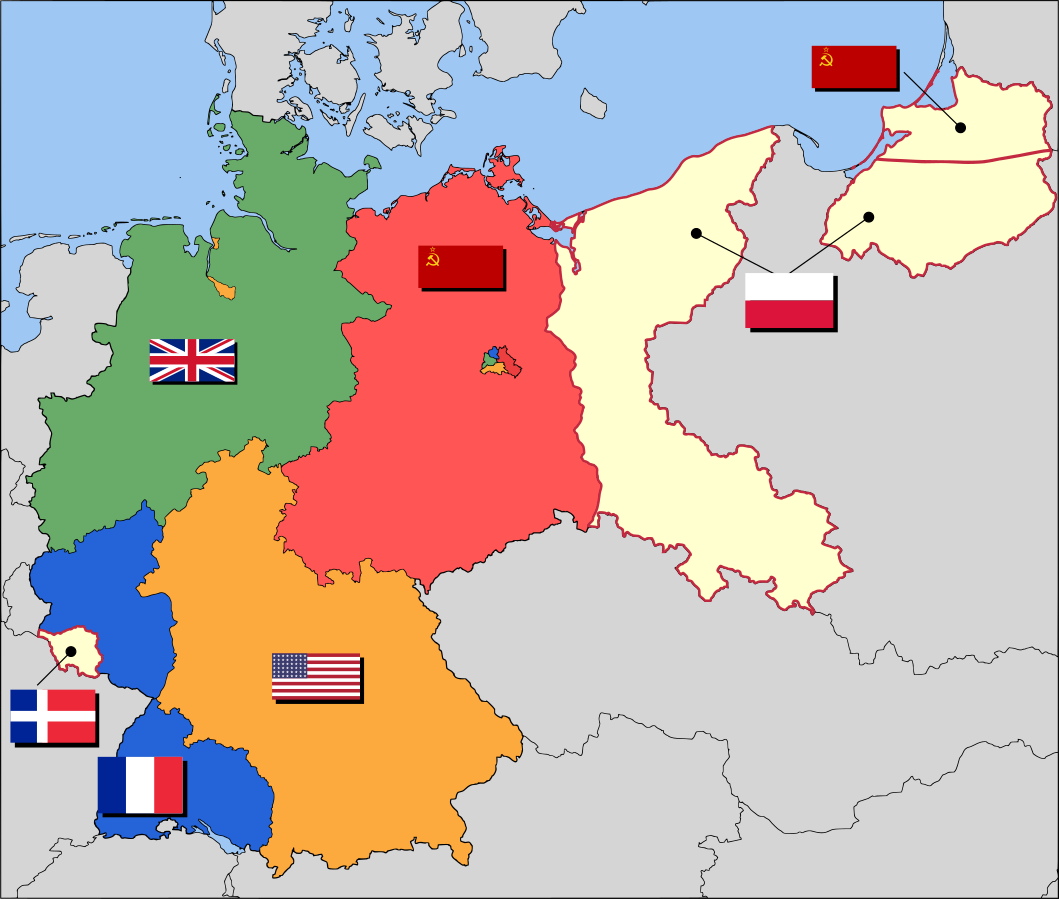
Occupation zone borders in Germany, 1947. The territories east of the Oder-Neisse line, under Polish and Soviet administration/annexation, are shown as cream as is the likewise detached Saar protectorate. Berlin is the multinational area within the Soviet zone.
Image based on map data of the IEG-Maps project (Andreas Kunz, B. Johnen, and Joachim Robert Moeschl of the University of Mainz) — www.ieg-maps.uni-mainz.de, via Wikimedia Commons.
This “economic miracle” is commonly referred to as die Wirtschaftswunder. But how did Germany go from rubble to riches in just a decade while neutral countries like Spain merely treaded economic water? If you ask your average American history student, they will say the Marshall Plan, of course!
Unfortunately, the ubiquity of the myth that the Marshall Plan rebuilt Germany is proof that state-controlled education favors propaganda over economic literacy. Despite the fact that most modern historians don’t give the Marshall Plan much credit at all for rebuilding Germany and attribute to it less than 5 percent of Germany’s national income during its implementation, standard history textbooks still place it at the forefront of the discussion about post-war reconstruction.
Consider this section from McDougal Littell’s World History (p. 968), the textbook I was given in high school:
This assistance program, called the Marshall Plan, would provide food, machinery, and other materials to rebuild Western Europe. As Congress debated the $12.5 billion program in 1948, the Communists seized power in Czechoslovakia. Congress immediately voted approval. The plan was a spectacular success.
Of course, the textbook makes no mention of the actual cause of the Wirtschaftwunder: sound economic policy. That’s because, for the state, the Marshall Plan makes great statist mythology.
Not only is it frequently brought up to justify the United States getting involved in foreign conflicts, but it simply gives support for central planning. Just look at the economic miracle the government was able to create with easy credit, they say.
And of course, admitting that the billions of dollars pumped into Germany after WWII accomplished next to nothing, especially when compared to something as simple as sound money, would be tantamount to admitting that the government spends most of its time making itself needed when it isn’t and thereby doing little besides getting in the way.
Credit for the turnaround should be accorded to Ludwig Erhard, according to Alasdair Macleod at the Cobden Centre:
Anyone who favours regulation needs to explain away Germany’s post-war success. Her economy had been destroyed, firstly by the Nazi war machine, and then by Allied bombing. We easily forget the state of ruin the country was in, with people in the towns and cities actually starving in the post-war aftermath. The joint British and American military solution was to extend and intensify war-time rationing and throw Marshall aid at the problem.
Then a man called Ludwig Erhard was appointed director of economics by the Bizonal Economic Council, in effect he became finance minister. He decided, against British and American misgivings, as well as opposition from the newly-recreated Social Democrats, to do away with price controls and rationing, which he did in 1948. These moves followed his currency reform that June, which contracted the money supply by about 90%. He also slashed income tax from 85% to 18% on annual incomes over Dm2,500 (US$595 equivalent).
Economists of the Austrian school would comprehend and recommend this strategy, but it goes wholly against the bureaucratic grain. General Lucius Clay, who was the military governor of the US Zone, and to whom Erhard reported, is said to have asked him, “Herr Erhard, my advisers tell me what you have done is a terrible mistake. What do you say to that?”
Erhard replied, “Herr General, pay no attention to them! My advisers tell me the same thing.”
About the same time, a US Colonel confronted Erhard: “How dare you relax our rationing system, when there is a widespread food shortage?”
Erhard replied, “I have not relaxed rationing, I have abolished it. Henceforth the only rationing ticket the people will need will be the deutschemarks. And they will work hard to get those deutschemarks, just wait and see.”
The US Colonel did not have to wait long. According to contemporary accounts, within days of Erhard’s currency reform, shops filled with goods as people realised the money they sold them for would retain its value. People no longer needed to forage for the basics in life, so absenteeism from work halved, and industrial output rose more than 50% in the second half of 1948 alone.
Comments Off on West Germany’s Wirtschaftwunder — the staggering economic postwar recovery
March 20, 2022
Kharkov Falls Once Again – WW2 – 186 – March 19, 1943
World War Two
Published 19 Mar 2022The British are attacking the Mareth Line in North Africa while the Americans hit the Axis flank, but the Allies are withdrawing in Burma. It’s the Germans who are pulling back in the USSR, though, and there is another attempt from within German command to assassinate Adolf Hitler.
(more…)
Comments Off on Kharkov Falls Once Again – WW2 – 186 – March 19, 1943
March 18, 2022
Schindler’s First Rescue Mission – WAH 054 – March 1943, Pt. 1
World War Two
Published 17 Mar 2022In the weeks after Goebbels’ Sportpalast speech, we realize that Total War might mean an apocalyptic end for Germany, with Hitler’s blessing. No wonder that some Germans are looking to end Hitler before he ends them, and what a blessing that at least one Nazi with influence on the fate of thousands of Jews turns out to have a heart and soul.
(more…)
Comments Off on Schindler’s First Rescue Mission – WAH 054 – March 1943, Pt. 1
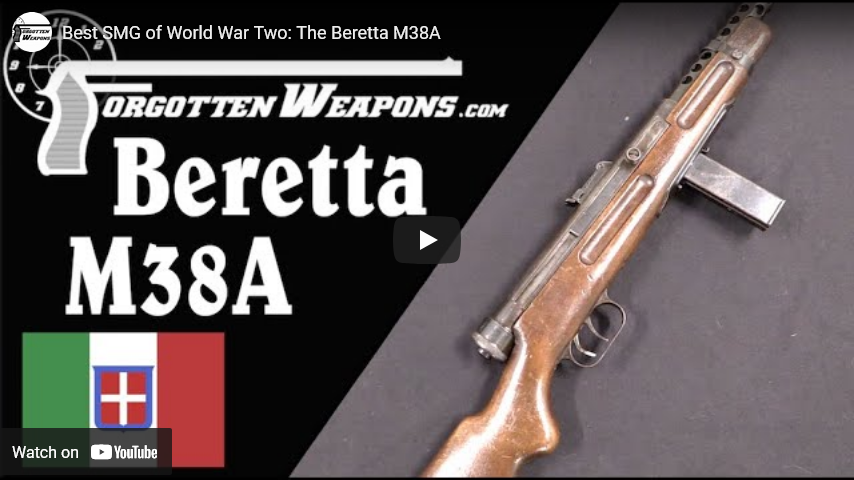
Best SMG of World War Two: The Beretta M38A
Forgotten Weapons
Published 15 Nov 2021http://www.patreon.com/ForgottenWeapons
https://www.floatplane.com/channel/Fo…
Cool Forgotten Weapons merch! http://shop.forgottenweapons.com
The Beretta Model 38A was one of the very best submachine guns of World War Two. Designed by veteran Beretta engineer Tullio Marengoni (who designed most of Beretta’s pistols as well as the Beretta M1918 SMG and 1918/30 carbine), it was the first Italian weapon to use a cartridge equivalent to 9x19mm Parabellum instead of 9mm Glisenti. Development began in 1935, and the final version entered production in January 1938.
The change from the Model 38 to 38A is unclear, but seem most likely to be the change from the top ejection of the prototypes to the left-side ejection of the production model. The 38A was formally adopted by the Italian Army in July 1938, but issue was delayed until 1940/41 because Beretta first produced a 20,000-unit order for the Romanian military.
By 1941, the basic design had been significantly simplified, and the Model 38/42 would significantly reduce production cost by removing the magazine well cover, barrel shroud, and removable firing pin. Simplified 38/42, 38/43, and 38/44 models would enter production, but original 38As were also manufactured until 1944 (this particular example is dated 1943). The gun was very popular with both Italian and German troops, and production continued under German occupation late in the war. Total numbers are unavailable, but are probably in excess of 500,000. The gun was so popular that Beretta was able to restart production after the war and continue selling them until the early 1960s.
Contact:
Forgotten Weapons
6281 N. Oracle 36270
Tucson, AZ 85740
Comments Off on Best SMG of World War Two: The Beretta M38A
March 13, 2022
Rommel Leaves Africa – WW2 – 185 – March 12, 1943
World War Two
Published 12 Mar 2022Erwin Rommel loses his command and leaves Tunisia, while change in American command there puts George Patton in charge. On the ground the Axis lose the Battle of Medenine, but in the Soviet Union, Axis forces are on the move and heading for Kharkov.
(more…)
Comments Off on Rommel Leaves Africa – WW2 – 185 – March 12, 1943
QotD: The Kaiser’s army and their Auftragstaktik innovations
They started developing it before WWI, but proof of concept was in the trenches, and it succeeded spectacularly. It’s hard to exaggerate just how outmanned and outgunned the Germans were in that conflict, and I don’t have the exact numbers to hand, but one especially fearsome measure was “artillery density”. On the German side, the preparatory barrage before an attack averaged, at best, something like 1 shell per square foot (this is from memory, so doubtless incorrect, but you get the idea). The Allies achieved something like one shell per square inch, and there you have it …
… or there you should’ve had it, if the Allies had anything close to German-level command-and-control. But they didn’t. British WW1 memoirs, especially, are full of the kinds of ludicrous fuckups that Joseph Heller wouldn’t dare put in his novels. Robert Graves (yeah, I know, not the world’s most trustworthy source) had an especially funny scene where his company got this elaborate set of orders to move to such-and-such coordinates, build an elaborate strongpoint (laid out in minute detail), then move on to some other coordinates and do something else, again spelled out to the nth degree.
Those coordinates were, of course, a mile and a half behind enemy lines.
Or consider that silly movie 1917. If you haven’t seen it, don’t. If you have, and you know a little bit about WWI, you’ll remember how ludicrous the premise was. You don’t need to send a squad, Saving Private Ryan-style, to get a message to a distant dugout where they’re waiting to jump off for an attack. For one thing, there’s this little gadget called a “radio”, and by 1917 they were portable enough to get there. But even if not, there’s this other gadget called a “telephone”, and any C-and-C bunker anywhere along the line would have one, no matter how fast the advance was moving. Finally, even if they didn’t have either of those, the supporting artillery park sure as hell would’ve — just ring them up and call off the preparatory barrage, and I promise you, none of those troops would’ve moved an inch, even if it meant shooting Colonel Sherlock Holmes right in his prissy, pencil-mustached mug.
If you know a bit more about WWI, that kind of ludicrous, plot-ruining stupidity seems like the most accurate thing in the movie, because that kind of bullshit happened all the time. Telephone wires were always getting cut by shellfire, for instance, and since none of the red tabs [staff officers] back at the base would dream of seeing the situation for themselves, field soldiers were always getting scads of contradictory orders, sent at bewildering times. More than one advance was held up by frontline troops having to send runners back to check the orders of other runners, which had been countermanded by yet other runners, coming up with telephone messages …
The guys in the opposing trenches, meanwhile, were just getting on with it. Graves again (and again, I know), quoting from memory, wondered what the High Command would’ve done had they known that for the better part of a year, the entire sector opposite the Royal Welch Fusiliers had been held by no one higher than a corporal.
Severian, “Auftragstaktik: Logic and Anti-Logic”, Founding Questions, 2021-11-18.
Comments Off on QotD: The Kaiser’s army and their Auftragstaktik innovations
March 12, 2022
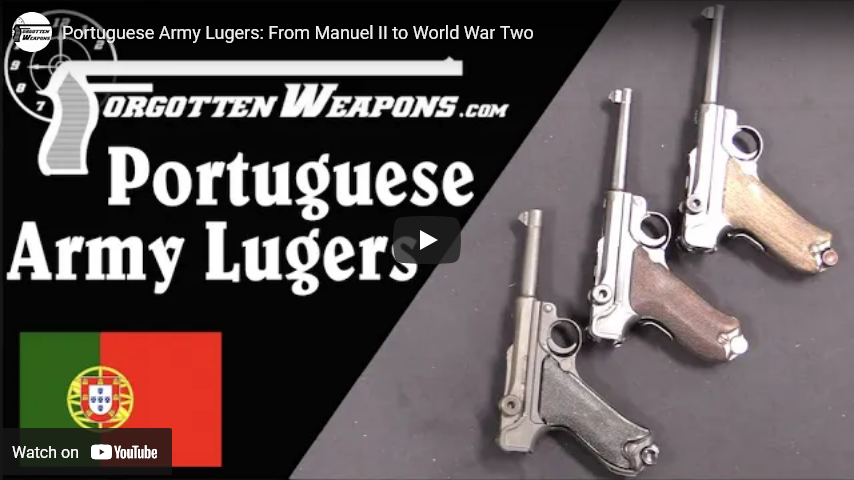
Portuguese Army Lugers: From Manuel II to World War Two
Forgotten Weapons
Published 10 Nov 2021http://www.patreon.com/ForgottenWeapons
https://www.floatplane.com/channel/Fo…
Cool Forgotten Weapons merch! http://shop.forgottenweapons.com
Portugal first tested the Luger pistol in 1901, and its commission on self-loading pistols recommended the design for adoption in 1904. No money was available at the time, but a second commission again recommended the Luger in 1907, and it was formally adopted and purchased in 1908. The initial batch was 5,000 pistols chambered for the 7.65mm Parabellum cartridge with 120mm (4.75″) barrels and “M2” crests for then-king Manuel II. They were designated m/908, and numbered from 1 to 5000.
These pistol would satisfy Portuguese Army needs until 1935, then the Guarda National Republicana ordered another 564 pistols in the same configuration. These came from Mauser at this point, and had “GNR” crests. These were taken from Mauser commercial production, and have serial numbers between 1900v and 2500v.
The final purchase of Portuguese Army Lugers came in 1943, another 4,578 guns from Mauser. Of course, Germany was deep into the Second World War by this time, and there was no option for Portugal to order its specific configuration. Instead, the Portuguese m/943 pattern was identical to the German standard P08, with the Portuguese guns coming right off the same production line — Waffenamt markings and all. They are numbered between 150m and 5330m.
Contact:
Forgotten Weapons
6281 N. Oracle 36270
Tucson, AZ 85740
Comments Off on Portuguese Army Lugers: From Manuel II to World War Two
March 11, 2022
A Life Between Shells and Shelter – On the Homefront 015
World War Two
Published 10 Mar 2022Right from the start of World War Two, there has been little distinction between combatant and civilian. While bombs keep falling, people in Great Britain and in Germany are sitting in bunkers, basements and underground tunnels. We are taking a look at life inside those shelters.
(more…)
Comments Off on A Life Between Shells and Shelter – On the Homefront 015


