
World War Two
Published 16 Apr 2024The final Soviet assault on Berlin begins today. The Soviets have two million men supported by tens of thousands of guns, tanks, and aircraft. Opposite them stand millions of men and boys of the German Wehrmacht, Waffen SS, Volkssturm, and Hitler Youth. The forces of Nazism are weakened and disorganised but determined to fight on as long as possible.
00:41 Roosevelt’s death
03:09 Preparations for the Soviet drive on Berlin
08:49 Zhukov’s Offensive
12:48 Konev’s Offensive
14:57 Summary & Conclusion
(more…)
April 17, 2024
Soviet Berlin Offensive Begins – WW2 – Week 294B – April 16, 1945
Comments Off on Soviet Berlin Offensive Begins – WW2 – Week 294B – April 16, 1945
April 16, 2024
For you, is no autobahn
eugyppius on the German federal government’s latest brainstorm to achieve their mandated emissions targets:
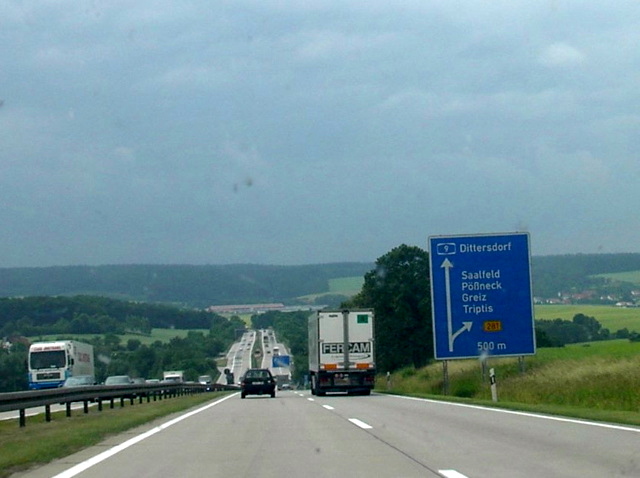
“Old Autobahn” by en:User:DF08 is licensed under CC BY-SA 3.0 

 .
.
… despite the headlines, they are not going to take away our cars. Amazingly, not even the Greens want to do that. For once the story is not about German authoritarianism, or woke insanity or anything like that. Rather, it’s about how nobody can really bring himself to care about the climate anymore – not even our forward-thinking, progressively minded, environmentally responsible political establishment.
For the backstory, we must go all the way back to the pre-Covid era, when aggressive climate legislation was popular even with centre-right CDU voters, and before the electorate had a taste of what Green policies like the draconian home heating ordinances really feel like on the ground.
Back in those halcyon days, when the child saint Greta Thunberg was cutting class to save the earth, Angela Merkel’s government passed the Climate Protection Act. The law mandates a 65% reduction in CO2 emissions compared to 1990 levels by 2030, an 88% reduction by 2040, and an utterly unrealisable carbon neutrality by 2045. In the near term, the Climate Protection Act also establishes maximum annual emissions levels for various economic sectors. Should a given sector exceed its maximum, the responsible Ministry must submit an ominous “action programme” to bring things back on target.
The Climate Protection Act is archetypal climate nonsense. Politicians like to take credit for Doing Something about the climate, but because Doing Something amounts to massive economic restrictions and drastic interventions in daily life, they would prefer not to Do that Something themselves. Far better is to pass legislation committing future governments to Do Something and let them deal with the mess. Then you can reap the short-term rewards of being tough on carbon emissions, without bearing direct responsibility for all the chaos that actually being tough on carbon emissions would unleash. Alas, time marches forwards at a steady pace. I am sure that 2030 sounded like an unimaginably distant date when it was floated at the Paris Accords in 2015, but now it is a mere six years away. That is becoming a big, big problem for the climatists.
You could say that Merkel’s Climate Protection Act bequeathed the hapless Scholz government a small collection of ticking time bombs, which they’ve developed a considerable interest in defusing. One way to do this, is to revise the Climate Protection Act and remove its strict sector-based emissions limits before anybody is forced to field a climate-saving “action programme”. In the meantime, they’ve been studiously ignoring the requirements, which is why our Minister of Economic Destruction Robert Habeck could be found complaining back in June that no cabinet ministers were complying with Climate Protection Act emissions limits.
Comments Off on For you, is no autobahn
April 14, 2024
Soviets Take Vienna and Königsberg – WW2 – Week 294 – April 13, 1945
World War Two
Published 13 Apr 2024The prizes of Vienna and Königsberg fall to the Soviets as they continue what seems an inexorable advance. In the West the Allies advance to the Elbe River, but there they are stopped by command. The big news in their national papers this week is the death of American President Franklin Roosevelt, which provokes rejoicing in Hitler’s bunker. The Allied fighting dash for Rangoon continues in Burma, as does the American advance on Okinawa, although Japanese resistance is stiffening and they are beginning counterattacks.
Chapters
00:32 Recap
01:05 Operation Grapeshot
01:57 Roosevelt Dies
06:01 Soviet Attack Plans for Berlin
12:45 Stalin’s Suspicions
14:31 The fall of Königsberg
17:02 The fall of Vienna
18:38 Japanese Resistance on Okinawa
20:34 The War in China
21:09 Burma and the Philippines
22:38 Summary
22:57 Conclusion
25:05 Memorial
(more…)
Comments Off on Soviets Take Vienna and Königsberg – WW2 – Week 294 – April 13, 1945
April 12, 2024
FURY – How a Museum with a Sherman Made a Movie
The Tank Museum
Published Jan 5, 2024If you enjoyed the 2014 movie FURY, watch this and get the inside scoop behind The Tank Museum’s role in David Ayer’s Hollywood production. Ten years on from its release, David Willey describes how one of The Tank Museum’s Shermans and Tiger 131 took starring roles alongside Brad Pitt, Shia LaBeouf, Logan Lerman, Michael Peña, and Jon Bernthal. From initial discussions to the red carpet, David reveals every inch of the process, the lessons learned and the impact it has had on The Tank Museum.
Let us know what you thought of FURY and our tank’s performance in it in the comments below… What else would you like to know?
00:00 | Intro
00:50 | Fury – The Beginning
02:48 | Tiger Inquiries
05:00 | Insurance & Contracts
08:06 | Hollywood in Dorset
09:51 | On Set & Filming
14:55 | Was it worth it?
16:34 | Fury’s Longevity
(more…)
Comments Off on FURY – How a Museum with a Sherman Made a Movie
April 9, 2024
US PT Boats of WW2 – Guide 369
Drachinifel
Published Jan 6, 2024The PT Boats, fast attack craft of the United States Navy, is today’s subject.
(more…)
Comments Off on US PT Boats of WW2 – Guide 369
April 8, 2024
The Battle of Okinawa Begins – WW2 – Week 293 – April 6, 1945
World War Two
Published Apr 6, 2024It’s the next step toward invading Japan’s Home Islands — invading Okinawa, and it begins April 1st. Advances are easy by land, but at sea the kamikaze menace is in full swing. In Burma, plans are made to liberate Rangoon; in the west hundreds of thousands of Germans are surrounded in the Ruhr; and in the east, the Soviets begin assaults on Königsberg and Vienna.
(more…)
Comments Off on The Battle of Okinawa Begins – WW2 – Week 293 – April 6, 1945
April 6, 2024
Italian Communists, the French in Indochina, and the fate of Italy’s army – WW2 – OOTF 34
World War Two
Published 5 Apr 2024What happened to Italian soldiers overseas after the fall of Mussolini? What about the French soldiers left over in Indochina after the Japanese “occupation by invitation”? And, what did the Allies think of the Italian Communist movement and its partisan forces?
(more…)
Comments Off on Italian Communists, the French in Indochina, and the fate of Italy’s army – WW2 – OOTF 34
April 4, 2024
See Inside Panther | Tank Chats Reloaded
The Tank Museum
Published Dec 29, 2023Chris Copson takes a detailed look inside and out, of arguably the most advanced German tank of WW2 … the Panther.
Is the Panther the formidable opponent that is was made out to be? Would the allies use such a vehicle and was it over engineered? Find out in today’s video.
00:00 Intro
00:54 Overview – Our Panther
02:41 War time variants & armour
06:06 Design
08:30 Weaponry
10:18 Crew, equipment and flaws – a look inside
17:53 Performance & conclusion
(more…)
Comments Off on See Inside Panther | Tank Chats Reloaded
March 31, 2024
Allies Charge Forward from the Rhine! – WW2 – Week 292 – March 30, 1945
World War Two
Published 30 Mar 2024All along the Western Front the Allies break out in force, invading German territory and receiving German surrenders by the thousands. In the east, the Soviets take Danzig and Gdynia, and rout the Germans in Hungary. There’s a new Japanese offensive in China, though the fight on Iwo Jima ends with a Japanese defeat.
Chapters
00:45 Recap
01:08 Big Advances all over the West
05:48 Soviets take Gdynia and Danzig
07:09 Zhukov’s forces take Kustrin
10:39 The War in China
12:21 Iwo Jima Ends
14:30 Preliminaries for Okinawa
18:46 More Landings in the Philippines
19:23 Slim focuses on Rangoon
20:12 Notes to end the week
20:48 Summary
21:28 Conclusion
24:47 Call To Action
(more…)
Comments Off on Allies Charge Forward from the Rhine! – WW2 – Week 292 – March 30, 1945
March 27, 2024
The Volkssturm – a Million men to save the Reich?
World War Two
Published 26 Mar 2024The Volkssturm is the last-ditch people’s army of the Third Reich. Sure, on paper, there are millions of old men and boys ready to defend Germany. But how will they be armed? Are they truly willing to die for Hitler? Will they make any difference at all?
(more…)
Comments Off on The Volkssturm – a Million men to save the Reich?
March 24, 2024
Chiang versus Mountbatten – WW2 – Week 291 – March 23, 1945
World War Two
Published 23 Mar 2024Chiang Kai-Shek is demanding his Chinese troops back from Burma, but this doesn’t fit well with Mountbatten’s plans for the region. In Burma, Bill Slim’s forces liberate Mandalay this week and make plans to head south for Rangoon. There’s also friction elsewhere in Allied command — between the Soviets and the Western Allies — over Italy. In the field in Europe, the Soviets advance all along the eastern front, and in the west, the Allies secure another Rhine crossing, and they also launch a double operation to send even more men across the river in force.
0:00 Intro
0:53 Recap
1:20 Iwo Jima
2:15 Plans for Okinawa
3:53 Mandalay liberated and plans for Burma
08:19 Allied Machinations about Italy
10:25 Soviet advances all along the Eastern Front
16:55 Plans for Operation Grapeshot
17:45 Four Allied Operations in the west
23:25 Summary + Conclusion
(more…)
Comments Off on Chiang versus Mountbatten – WW2 – Week 291 – March 23, 1945
March 23, 2024
The Roman Army’s Biggest Building Projects
toldinstone
Published Dec 15, 2023The greatest achievements of the Roman military engineers.
Chapters:
0:00 Introduction
0:38 Marching camps
1:36 Bridges
2:40 Siegeworks
3:26 PIA VPN
4:32 Permanent forts
5:49 Roads
6:24 Frontier defenses
7:41 Canals
8:21 Civilian projects
8:54 The aqueduct of Saldae
(more…)
Comments Off on The Roman Army’s Biggest Building Projects
March 22, 2024
Char B1 V Panzer III | Size doesn’t matter – it’s how you use it!
The Tank Museum
Published Dec 15, 2023Two tanks that fought against each other in the early part of World War Two. On one side, the heavily armoured French Char B1 … on the other, the mobile German Panzer III. On paper it’s no contest – but what actually happened when these two tanks fought it out in 1940?
00:00 | Intro
00:49 | Char B1 History
02:16 | Radio Communications
02:45 | Panzer III Crew
03:43 | Char B1 Crew
05:16 | Char B1 V Panzer III
(more…)
Comments Off on Char B1 V Panzer III | Size doesn’t matter – it’s how you use it!
March 17, 2024
Smiling Albert Takes Command – WW2 – Week 290 – March 16, 1945
World War Two
Published 16 Mar 2024After the Allies took a Rhine Bridge last week, Adolf Hitler has again shuffled his commanders, moving Kesselring to the west. Meanwhile, the German offensive in Hungary comes to its end — and it does not end well for the Germans. The Japanese are nearly defeated on Iwo Jima, are feeling a bit of desperation in Burma, but are far, far from defeated on Luzon.
01:02 Recap
01:33 Remagen Bridge and the Western Front
06:44 Army Group Courland and 3rd Belorussian Front
10:23 Konev’s new attacks
11:29 Operation Spring Awakening ends
15:00 A German surrender in Italy?
17:01 Japanese being ground down on Iwo Jima
18:12 The war in the Philippines
20:48 The war in Burma
23:07 Summary
23:36 Conclusion
(more…)
Comments Off on Smiling Albert Takes Command – WW2 – Week 290 – March 16, 1945
QotD: Imperial Japan and Nazi Germany never had a “long game” … but Stalin did
Though both the Germans and the Japanese had every intention of starting major wars, as everyone knows they seemingly put zero thought into what they’d do once they won. I know, I know, [Himmler] had his sweaty wet dreams about Wehrbauern on the vast Russian steppes, but all but the most rudimentary post-victory planning seems to have been beyond the Third Reich’s capacity — the Reich Resettlement Office, for instance, was tiny even when the war looked like it would be over by Christmas. The Japanese were, if anything, even dumber — they honestly seemed to believe they could run China, all of it, and even India Manchukuo-style.
The Russians, meanwhile, never stopped playing the long game. While Goebbels made a few token gestures at rapprochement with “the West” (yeah, they called it that), and to sell Nazism to ditto, his heart wasn’t in it, any more than the Japanese’s heart was in their “Greater East Asia Co-Prosperity Sphere” hooey. Stalin, by contrast, was always pimping Communism to the West — even in the deepest, darkest days of the war, when it looked like the Wehrmacht was about to march into Moscow, the propaganda directed at the West continued full blast.
Like the German and Japanese aircraft industries, the German propaganda industry was ideologically locked into its core mission: To sell Nazism to Germans. And they were aces at it, no doubt … but then the mission changed. The smart thing for the Germans (and Japanese) to have done with their conquered territories was, in the context of the war, to ease up on the Nazi shit for the duration. The Nazis could’ve had zillions of Ukrainians fighting for them in 1941 just as the Japanese probably could’ve waltzed into India in 1941 had they not been so … well, so Japanese, in the rest of the Pacific rim. Stalin would’ve done it in a heartbeat, had the situation been reversed, and to hell with “authentic” Marxism-Leninism. Win the war first; square the ideology later.
As this is running way long, one example should suffice. Goebbels approached the task of selling Nazism to Germans in the most German way possible: He created the Reich Culture Chamber, which controlled all newspapers, radio broadcasts, film distribution, etc. And it worked, as far as it went — Goebbels deserves his “evil genius” rep — but as we’ve seen, that locked the leadership into an ideological straightjacket. Telling the Wehrmacht to ignore the Commissar Order and buddy up with the Ukrainians would’ve been the smart thing to do, militarily, but it was culturally impossible. Goebbels did his job too well … and then the mission changed.
The Soviets had a similar problem inside the USSR, but — here’s Stalin’s evil genius — they had free reign in propagandizing the West. Goebbels hardly bothered, but the Soviets poured massive resources into it. Forget, as far as you can, everything you think you know about “Nazism” […]. Even if you look at it as objectively as possible, it still seems ridiculous, and there’s a simple explanation for that — it’s not for you. Unless you were a pure blooded Aryan, actually living in Germany (or within Germany’s potential military reach), [they] couldn’t care less about you. Which made being a “Nazi” in, say, America uniquely pointless — you just look like a bigot at best, a traitorous bigot at worst.
Being a “Communist”, though? That was universal. Indeed, that made you a Smart person, a very very smart person, and morally superior to boot. Why? Because you care so much that you’ve mastered this large body of deliberately esoteric doctrine, comrade … all straight out of the NKVD playbook. And if actual life as it was lived in the Soviet Union didn’t quite measure up to the promises, well, that’s because they didn’t have the right people — people like YOU — running things. It’s fucking brilliant — a totally ideologically closed, indeed brutal, system at home, presented as the most open-minded, enlightened, tolerant one possible abroad.
Which is why Joey G. needed a huge Reich Culture Chamber that never came close to justifying its budget, and Stalin needed, effectively, nothing. Being so very, very Smart, wannabe “elites” in the West were happy to spread Commie propaganda for free. The NKVD, let alone the Gestapo, ain’t got shit on the Junior Volunteer Thought Police of Twitter and Facebook …
… which forces us to confront the question: Which model of propaganda are our rulers using? Has the one morphed into the other? Is it real, or is it just “German efficiency”?
Severian, “The Myth of German Efficiency”, Rotten Chestnuts, 2021-05-26.
Comments Off on QotD: Imperial Japan and Nazi Germany never had a “long game” … but Stalin did


