
Tasting History with Max Miller
Published 27 Mar 2024Medieval stew with meat, spices, and verjuice, and thickened with egg yolks
City/Region: England
Time Period: 15th CenturySome medieval taverns may have had what is called a perpetual stew bubbling away. The idea is basically what it sounds like: as stew was taken out, more ingredients would be added in so that the stew kept on stewing. In southern France, there was a perpetual stew that was served from the 15th century (around when this recipe was written) all the way up until WWII, when they couldn’t get the right ingredients.
I have opted to not make this stew perpetual, but it is delicious. The medieval flavor of super tender meat with spices and saffron is so interesting, especially with the added acidity and sweetness from the verjuice.
A note on thickening with egg yolks: if you need to reheat your stew after adding the egg yolks, like I did, they may scramble a bit. The stew is still delicious, it’s just the texture that changes a little and it won’t be quite as thick.
Vele, Kede, or Henne in bokenade
Take Vele, Kyde, or Henne, an boyle hem in fayre Water, or ellys in freysshe brothe, and smyte hem in pecys, and pyke hem clene; an than draw the same brothe thorwe a straynoure, an caste there-to Percely, Swag, Ysope, Maces, Clowys, an let boyle tyl the flesshe be y-now; than sette it from the fyre, and alye it up with raw yolkys of eyroun, and caste ther-to pouder Gyngere, Veriows, Safroun, and Salt, and thanne serve it forth for a gode mete.
— Harleian Manuscript 279, 15th Century
July 9, 2024
What it was like to visit a Medieval Tavern
July 6, 2024
Why Germany Lost the Battle of Verdun
The Great War
Published Mar 8, 2024The Battle of Verdun represents the worst of trench warfare and the suffering of the soldiers in the minds of millions – and for many, the cruel futility of the First World War. But why did Germany decide to attack Verdun in the first place and why didn’t they stop after their initial attack failed?
(more…)
July 4, 2024
How the First Tanks CONQUERED the Trenches
The Tank Museum
Published Mar 16, 2024This is the story of the evolution of the tank during World War One. Notorious for its appalling human cost, the First World War was fought using the latest technology – and the tank was invented to overcome the brutally unique conditions of this conflict.
Arriving at the mid-point of the war, they would be built and used by the British Commonwealth, French and German armies – with the US Army using both British and French designs.
00:00 | Intro
01:17 | The Beginnings of WWI
02:13 | The Solution to Trench Warfare
03:47 | Initial Ideas
05:42 | How to Cross a Trench
08:08 | How Effective was the Tank?
15:40 | Battlefield Upgrades
17:09 | New Designs
24:32 | ConclusionThis video features archive footage courtesy of British Pathé.
#tankmuseum #evolution #tank #tanks #ww1 #technology
July 3, 2024
Tanks! – Allied tanks of WW2 – Sabaton History 127
Sabaton History
Published Mar 14, 2024Sabaton has written several songs about tanks — the boys are tank CRAZY! Songs like “Ghost Division” or “Panzerkampf” are about the German panzers and even the Soviet ones, but what about those of the Western Allies? Were they any good? And if so, how did they lose the Battle of France?
(more…)
July 2, 2024
Jonathan Kay on real Canadian history
Canadians have never really been encouraged to learn much about our own history. When I was in school, the history content skewed as far away from anything that might be stirring or exciting as it possibly could (we skipped over all the wars, for example), so that they could emphasize the legislative assemblies, the treaties and conferences, and the mix-and-match bearded and mustachioed “great and the good” of the time. If nothing else, you could catch up on your sleep for an hour. (I exaggerate a bit, but history in the primary grades at least covered the initial discovery and exploration of what would become Canada by French and English fur traders, adventurers, and scoundrels (some were all three). We even got a relatively unbiased (for the time) introduction to some of the First Nations, mostly in Ontario and Quebec.) These days, of course, kids learn that Canada is a genocidal colonialist white supremacist horror show that has no right to exist … hardly the kind of improvement one would hope for.
In the National Post Jonathan Kay suggests the only way to really understand Canadian history is to utterly ignore the politicians (and the bureaucrats) and learn it for yourself:
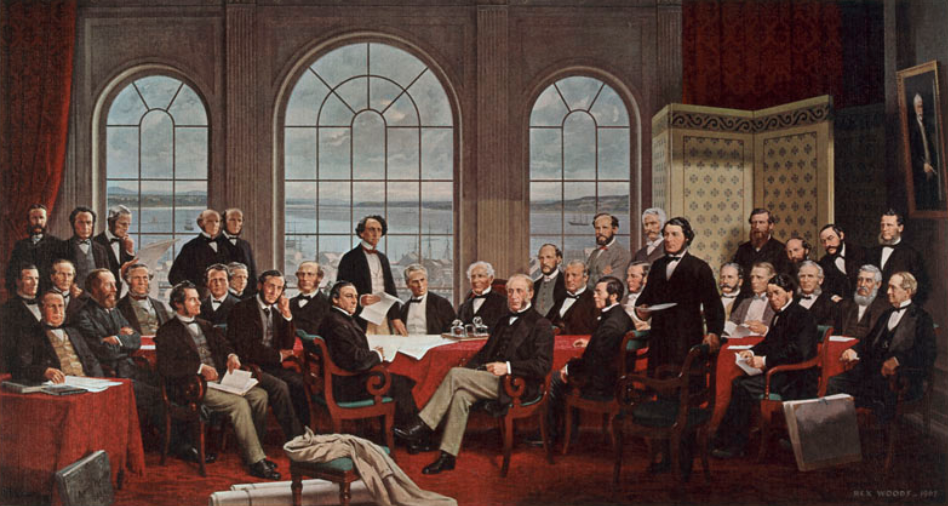
These guys are important, no question, but you need to go back a long way before them to really understand Canadian history. The nation didn’t burst fully formed from Sir John A.’s forehead, Athena-style.
Libraries and Archives Canada item ID number 3013194.
The surest way to make me treasure something is to take it away. So it was with Canada Day, whose annual appearance I’d once greeted with scarcely more excitement than the Ontario Civic Holiday and Aromantic Spectrum Awareness Week. Then came 2021, when the high priests of social justice demanded that we cancel Canada’s birthday celebrations, so that we might spend July 1 in morbid contemplation of our original sin. Not being one for rituals of confession and penitence, I instead began to think harder about why I love this country, despite its flaws — even if expressing such sentiments in public was now viewed as hate speech.
“This country was built on genocide”, ran one major-newspaper headline, amid the national meltdown following reports that hundreds of unmarked children’s graves had been found at former residential schools. Calgary dropped its fireworks program on the basis that (among other reasons) such scenes of celebration might hamper “truth and reconciliation”. Justin Trudeau, who’d come into office urging Canadians to “celebrate this amazing place we call home”, now took Canada Day as an occasion to instruct us that “the horrific findings of the remains of hundreds of children at the sites of former residential schools in British Columbia and Saskatchewan have rightfully pressed us to reflect on our country’s historical failures”.
The prime minister’s suggestion that children’s corpses were being plucked from the ground en masse turned out to be a reckless falsehood. Even the Tk̓emlúps te Secwépemc Nation, whose chief once claimed that “the remains of 215 children” had been found in Kamloops, now seems to be acknowledging that her original statements were wrong. While Canada has much to answer for when it comes to the legacy of residential schools, no graves or bodies were found at these locations in 2021. And none have been found since.
[…]
The unfortunate truth about Canada’s 19th-century origin story is that our country’s initial contours were sketched out by a group of middle-aged binge drinkers whose focus was less on life, liberty and the pursuit of happiness than on the mundane task of diffusing the high capital costs associated with rail construction and defending northern rivers and ports from rampaging Americans and Irishmen. (Yes, Irishmen: Visitors to Charlottetown’s Victoria Park will find a trio of ocean-facing nine-pounder guns that were installed in 1865 to guard against the Fenian Brotherhood, whose troops, many residents feared, were set to invade and conquer the island. But faith and begorrah, I do digress.) In this project, the Fathers of Confederation were successful. But the ensuing separation from Britain was a slow, bureaucratic affair that makes for dull reading (and duller television). I wish it were otherwise, fellow patriots. But alas, these are the facts.
Which is to say that if we’re looking to develop a compelling, historically accurate and, dare I say, inclusive, understanding of Canada’s national story, the story has to begin earlier. Specifically: the early 1600s — two and a half centuries before John A. Macdonald and his fellow Fathers of Confederation were knocking back the giggle juice in Charlottetown Harbour. As you might imagine, this means giving a starring role to Indigenous peoples — though not as the sacred martyrs and magical forest pixies of modern progressive imagination, but rather as the true-to-life diplomats, traders, craftsmen, hunters and soldiers that the first waves of Europeans knew them to be.
[…]
Toronto-born Greg Koabel spent most of his early academic career studying James I’s England (with a particular focus on the 1641 treason trial of the Earl of Strafford). And so, crucially, he approached the history of Canada laterally, through the prism of English and (primarily) French geopolitics. In telling the story of the first sustained European settlements in North America, he pays Indigenous populations the respect of examining them through this same geopolitical lens.
The resulting narrative, told in his brilliant Nations of Canada podcast, is so fascinating that you’ll have to keep reminding yourself he’s talking about Canada. This past week, Koabel hit a major milestone, releasing his 200th episode. And with his permission, I’ve been adapting his long-form audio chronology to written publication at Quillette. So far, we’ve published more than 100,000 words, and Samuel de Champlain hasn’t even left the stage yet.
I’m not much of a podcast listener, aside from The Rest is History and some Minnesota Vikings-specific sports podcasts, but the Quillette serializations of Koabel’s podcast episodes really are excellent and more than repay the effort to read them.
June 28, 2024
Ruling Medieval France
In Quillette, Charlotte Allen reviews House of Lilies: The Dynasty That Made Medieval France by Justine Firnhaber-Baker, a period of history I know mainly from the English point of view:
I’m a PhD medievalist, but the history of medieval French royalty was never my specialty, and my ignorance was vast.
I’d assumed, for example, that the French kings of the Middle Ages were mostly fainéants whose writ scarcely ran past the Île-de-France region (encompassing the city of Paris and its environs). The English monarchy across the Channel had been centralised since the days of Alfred the Great (849–899); but the French kings seemed to rule in a more symbolic capacity, being perpetually at the mercy of the powerful dukes and counts of autonomous French regions such as Normandy, Burgundy, Aquitaine, Anjou, Blois, Toulouse, and Languedoc. These regional rulers were technically royal vassals. But, in actuality, they saw themselves as absolute rulers in their own right, and so had no compunction against turning on the crown when they thought it would further their interests.
My impressions had been formed by accounts of the 17-year-old Joan of Arc’s having to personally drag the Dauphin (the future King Charles VII) to Reims for his coronation in 1429, and by Shakespeare’s historical plays, which portrayed the French as fops incapable of defending their territory against the robust and brotherly English during the Hundred Years’ War. Indeed, the whole point of that war (from the English perspective) was that, by dynastic right, large portions of France’s fractured political landscape actually belonged to England.
The one medieval French royal (by marriage) I did know something about, Eleanor of Aquitaine (c. 1122–1204), dumped her French husband, King Louis VII (1120–1180) after he bungled the Second Crusade, a costly and embarrassing adventure on which Eleanor had accompanied him on horseback. (“Never take your wife on a Crusade”, a medievalist friend of mine once sensibly quipped). To top off his disastrous final loss of his Crusader army in 1148 during an ill-considered attack on Damascus — which, although Muslim-ruled, was in fact an ally of Latin-Christian Jerusalem — Louis and Eleanor had failed to produce a son. No sooner was the ink dry on their divorce in 1152 (technically an annulment, since the two were Catholics), than she married Henry Plantagenet, son and heir of the duke of Anjou, who two years later became King Henry II of England. Henry quickly procreated five sons (among fourteen surviving children) with his new bride. Thus began the dynasty that would rule England for more than three centuries.
As everyone who has seen The Lion in Winter knows, Henry II’s relationship with Eleanor was far from tranquil, but two of their sons succeeded him to the English throne: Richard the Lionheart and King John (of Magna Carta fame or infamy, depending on your perspective). Henry was, besides king of England, duke of Normandy and count of Anjou, through his great-grandfather, William the Conqueror, and his mother, Matilda, who’d married Henry’s Anjevin father, Geoffrey, after her first husband, the Holy Roman Emperor Henry V, died in 1125.
Eleanor’s grounds for annulling her marriage to Louis had been that he was her fourth cousin, which violated the Catholic Church’s (selectively applied) consanguinity restrictions. But Henry was even closer kin, being her third cousin. The humiliated and (understandably) rankled Louis demanded that Henry, as his feudal vassal, explain why he’d failed to ask permission to marry (let alone marry his boss’s ex). Henry declined to reply, the feudal equivalent of declaring oneself in rebellion. Louis retaliated by invading Normandy — unsuccessfully — and trying to hold onto Eleanor’s Aquitaine on the claim that he’d become its duke by marriage (Henry II was meanwhile making the same claim) before giving up and remarrying himself in 1154.
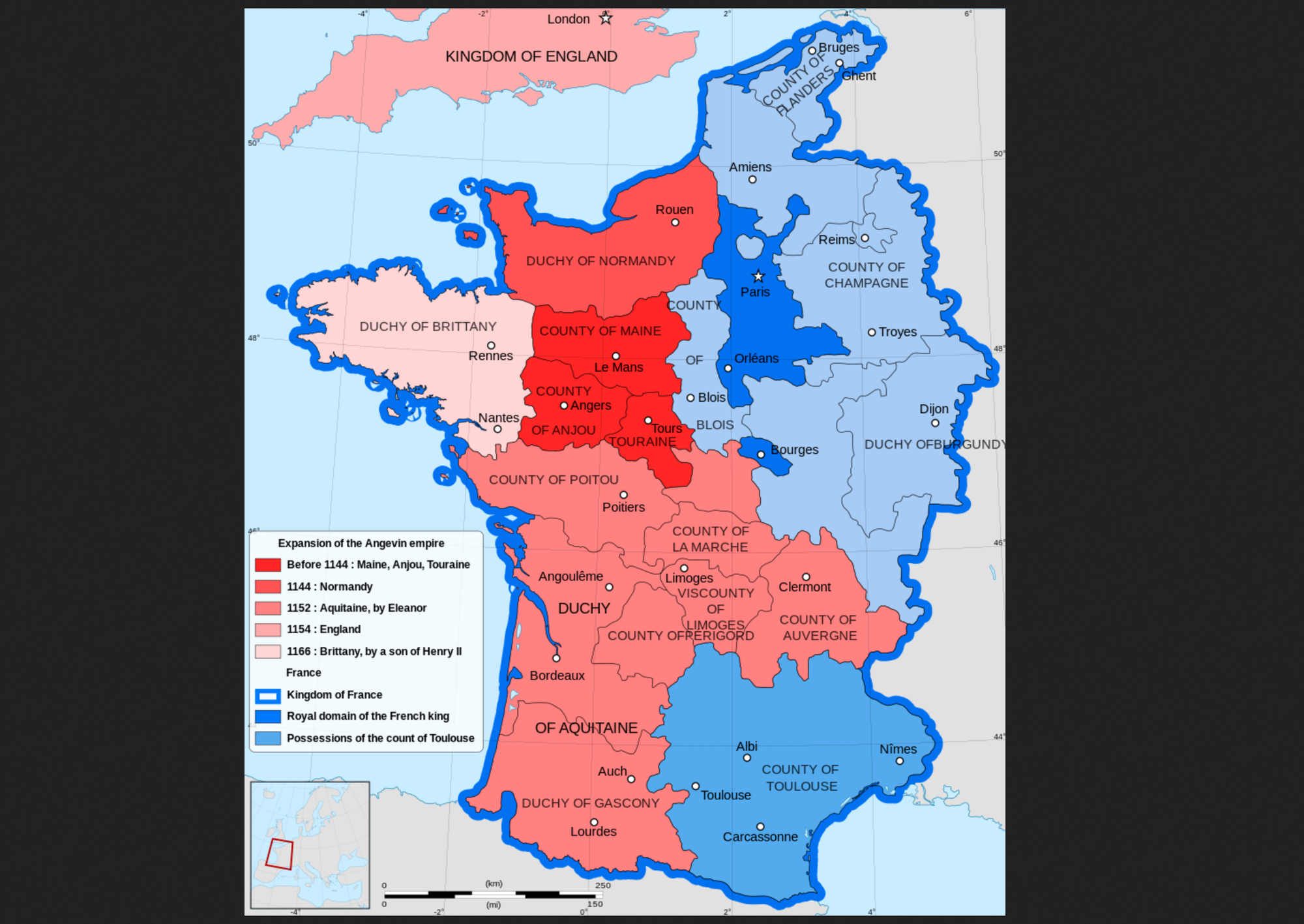
A colour-coded political map of France during the twelfth century, indicating the early expansion of the Angevin Empire — i.e., the territorial possessions of the House of Plantagenet — from the time of Geoffrey V of Anjou (1113–1151). The Plantagenets would rule in England, and parts of France, till the demise of Richard III of England (1452–1485).
I’d assumed that French kings wouldn’t hold much in the way of real royal power until the time of King Louis XIV (1638–1715), who declared (perhaps apocryphally), L’État, c’est moi, and forced French regional nobles to reside in his over-the-top palace at Versailles (where they’d dissipate their incomes via elaborate court ceremonies instead of making trouble from their provincial power bases).
But the scales have now been knocked from my eyes, thanks to Justine Firnhaber-Baker, a professor of French medieval history at the University of St Andrews. The subtitle of her new book, House of Lilies: The Dynasty That Made Medieval France, refers to the Capetian dynasty founded by Hugh Capet (c. 940–996), who took his royal title in 987 A.D. Every French monarch, from Hugh’s reign to the French Revolution and beyond, had Capetian blood running through his veins — including the aforementioned Louis VII, who was a direct descendant of Hugh, and the bookish, dithering King Louis XVI, who was not, but who nevertheless went to the guillotine in 1793 under the derisive sobriquet “Citizen Louis Capet”.
June 26, 2024
Why the Allies Lost The Battle of France
Real Time History
Published Mar 1, 2024In May 1940, Nazi Germany attacks in the West. The Allied armies of France, Britain, Belgium, and the Netherlands have more men, guns, and tanks than the Germans do – and the French army is considered the best in the world. But in just six weeks, German forces shock the world and smash the Allies. So how did Germany win so convincingly, so fast?
(more…)
June 22, 2024
QotD: The rise of post-modernism
Culture, like politics, is not immune to these billowing waves of combat. And we can look to the past to see that cultural repercussions usually follow from battles. The catalysts for modernism were Verdun, the Somme, and the general carnage of the First World War trenches. Out of those infernos spread the belief that the old foundations of staid manners, traditional genres of art and literature, unquestioning patriotism — dulce et decorum est pro patria moria — and national politics had somehow led to Europe’s millions being gassed and blown apart for years in the mud of the French countryside without either victory or defeat.
Perhaps the present brand of postmodernism was born primarily in France as well. After the humiliating drive of the Panzers through the Ardennes in May, 1940, the collapse of Europe’s largest army in six weeks, and the rescue by the Americans and the British in August, 1944, theories were easier to accept than facts. For a few elite but stunned postwar Frenchmen, fiction was more palatable than reality, text and discourse a refuge from a truth as unacceptable as it was bothersome.
Victor Davis Hanson, Ripples of Battle, 2003.
June 16, 2024
QotD: Napoleon Bonaparte – the great man?
Remember, the real Napoleon was so impressive he literally caused a crisis in 19th century philosophy! Everybody had carefully worked out their little theories, later exemplified by Tolstoy, about how human agency doesn’t matter in history and everything is just the operation of vast impersonal forces like the grinding of tectonic plates, and then boom this guy shows up and the debate springs to life again. You know it’s real when two guys as different as Nietzsche and Dostoevsky are both grappling with what we can learn from somebody’s existence. And I think Raskolnikov’s unhealthy Napoleon fanboyism was supposed to be a bit of a satire of some very real intellectual currents among the European and Russian intelligentsia.
So what do you think? Does Napoleon vindicate the great man theory of history? I’m still working out my own answer to this, which I briefly allude to in my review of Zhuchkovsky’s book. Basically, I think we can transcend the traditional dichotomy by constructing a political/military analogue of the Schumpeter/Kirzner theory of entrepreneurship. Vast, impersonal forces (such as technological progress or structural economic changes) can create opportunities — in fact they’re pretty much the only thing that can, because the force required to reconfigure society is usually far beyond what any person or group can manage.
But once the opportunity is there, it takes a lot less raw power to act on it, assuming you can recognize it. Imagine a process of continental drift that slowly, slowly raises a mountain-sized boulder out of the ground, and every year it’s inching closer to this precipice, until finally it teeters on the edge. A human being could never have done that, it would be far too heavy, but once it’s up there, there might be a narrow window, a few precious moments, when a solid shove by somebody sufficiently perceptive and motivated can direct and harness this unimaginable force.
So the question is: what made Europe so ripe for Disruption (TM) at that moment? Obviously the French Revolution, and there were some pretty important changes in the nature of warfare too. What else?
Jane: Well, you know what I’m going to say: it’s the Enlightenment, stupid.
I was going to compare Napoleon to, say, Odoacer, but I don’t think the analogy actually holds. The Goths were conquerors from outside; their approach, their whole worldview, was very different from the Romans’.1 But Napoleon is extremely inside. The people he comes from are not actually all that different from the ancien régime — they’re feuding hill clans, but they’re aristocratic feuding hill clans — and yet he’s so thoroughly a creature of Enlightenment modernity that even when he’s engaging in the time-honored feuding hill clan pastime of resisting integration by the metropole he’s doing it by writing pamphlets. He might be a Corsican nationalist but he’s been intellectually colonized by France. Or, more accurately, by the elements of French culture that are in the process of undermining and overthrowing it.
I think you’re right about political entrepreneurship. (So here we see the Psmiths wimp out and answer the great man/impersonal force dichotomy “yes”.) It’s perhaps more neatly summed up by that famous Napoleon quip: “I saw the crown of France lying on the ground, so I picked it up with my sword”. Which: based. But also, if we’re going to continue his metaphor, he didn’t knock the crown onto the ground. Everything was already irredeemably broken before he got there. And this, I think, distinguishes him from the Germanic conquerors, who found something teetering and gave it a final push. Caesar, similarly, came up in the old order but dealt it its death blow.
But back to the Enlightenment: the crown is on the ground because the culture that held it up has fallen apart, and it’s fallen apart because gestating in its innards was an entirely different culture that’s finally burst its skin like a parasitic wasp and emerged into the light of day. A lazy reading of history sees Napoleon with a crown giving people titles and building palaces and goes “ooh, look, he’s just like the ancien régime“, but this is dumb. Napoleon is obsessed with modernizing and streamlining. He wants to wipe away the accumulated cruft of a thousand years of European history and build something smarter and cleaner and more rational. He’s just better at organization and psychology than the revolutionaries were. The French Revolution (and the total failure of the Directory) created the material conditions, but the entire intellectual milieu that made the French Revolution possible also made it possible for people to look at Napoleon and go “whoa, nice”.
Jane and John Psmith, “JOINT REVIEW: Napoleon the Great, by Andrew Roberts”, Mr. and Mrs. Psmith’s Bookshelf, 2023-01-21.
1. There’s some very interesting stuff on this, and about later efforts from both cultures to bridge the gap, in Bryan Ward-Perkins’ The Fall of Rome: And the End of Civilization.
June 11, 2024
EUquake 2024
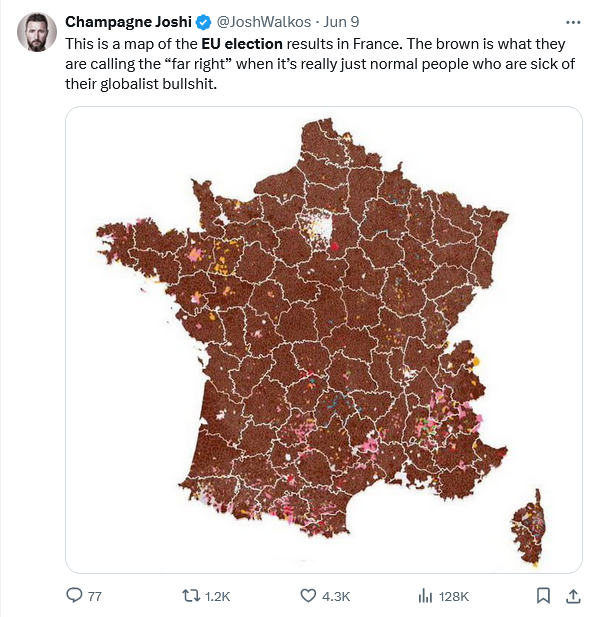
Although the European elites have managed to move as much as they can out of the reach of democratic institutions, they still have to allow the illusion that the few things ordinary people can vote for still kinda, sorta matter. Ordinary people seem to have noticed this:
“I cannot act as if nothing has happened”, said a weary, dejected Emmanuel Macron, in an unplanned address to his nation last night. The French president, bruised by an unprecedented showing for the right-wing populist National Rally (RN) on Sunday’s European Parliament elections, immediately dissolved the French parliament and announced snap legislative elections. The first round will take place in just three weeks’ time.
When Macron was elected president in 2017, he promised the French people that they will “no longer have a single reason to vote for the extremes”. Pro-EU centrists hailed his apparent defeat of nationalist, populist forces. Seven years later, RN is on course to achieve its best-ever result in an EU election. Marine Le Pen’s party is projected to win double the vote share of the president’s liberal, centrist Renaissance group. Clearly, the French feel that they have more reasons than ever to revolt against the mainstream.
The French are not alone in this. The hard-right Alternative for Germany (AfD), despite two of its leading MEP candidates being dogged by major scandals, came second behind the centre-right CDU. Crucially, it beat all three of the parties in Germany’s governing coalition. The Social Democrats (SPD), led by chancellor Olaf Scholz, suffered its worst result of any nationwide election since the 1940s. According to one pollster, around a million people who supported the left-leaning parties in the “traffic light” coalition have since defected to the AfD. Pressure is now mounting on Scholz to call his own snap election. In Italy, meanwhile, Giorgia Meloni and her Brothers of Italy topped the European polls, exceeding the vote share that swept her into power in 2022’s national elections. Populist, right-wing and hard-right parties, therefore, came in first or second place in all three of the major EU nations.
Even Belgium, at the epicentre of the EU empire, has been struck by the populist earthquake. Prime minister Alexander de Croo announced his resignation last night as his party was beaten to below 10 per cent in Sunday’s federal parliamentary elections and to around five per cent in the European elections – squeezed by Flemish separatist parties. Hard-right parties also came first in Austria and second in the Netherlands.
While Macron has been forced to react to the scale of his defeat, acknowledging euphemistically that these elections were “not a good result for the parties that defend Europe”, others in the Brussels oligarchy have tried to bury their heads in the sand. On Sunday evening, European Commission president Ursula von der Leyen declared – delusionally – that “the centre is holding”.
She is right in one, very narrow, sense. The centre-left Progressive Alliance of Socialists and Democrats (S&D), the centre-right European People’s Party (EPP) and the liberal Renew group have likely gained enough seats between them for business as usual to resume in the European Parliament. The two groupings to their right – the European Conservatives and Reformists (ECR) and Identity and Democracy (ID) – have not made enough gains, even when combined, to start throwing their weight around in Brussels. Von der Leyen’s own position as Commission president is likely secure, not least because her EPP is the single largest grouping in parliament. The new populist MEPs will likely be shut out of key decisions, including the vetting of new EU commissioners. The EU has never allowed the democratic wishes of the public to intrude on its affairs before, so it is unlikely to start now.
But Brussels cannot hide from reality forever. These elections clearly show that the EU and its boosters are failing to contain the public’s anger. European elites have pulled every trick in the book to try to put the brakes on the populist surge, seemingly to little avail.
How bad was the rejection of the kakistocrats in France? This bad:
June 8, 2024
Battlefield Normandy – The battles for Norrey, Bretteville & Putot
The AceDestroyer
Published Jun 27, 2019Hello, welcome to The AceDestroyer and welcome to the third and final episode of the Battlefield Normandy Series. In this episode we follow the Canadians defending Putot-en-Bessin, Bretteville-L’Orgueilleuse and Norrey-en-Bessin. In the two days of heavy combat with the 12th SS Hitlerjugend, the 7th Canadian Infantry brigade managed to hold on to all three towns. Find out how in this episode …
(more…)
June 7, 2024
Battlefield Normandy – The battle of Authie D-DAY + 1
The AceDestroyer
Published Dec 20, 2018June 7, also known as D-Day +1 marked the first battle between the Canadians and the 12th SS Panzer Division Hitlerjugend during the Normandy campaign. When the Canadians attacked Authie, the German 12th SS counterattacked and a large tank on tank battle commenced. The first encounter between the two divisions was immediately a bloody one. The battle unfortunately had a barbaric end as members of the SS murdered several Canadian POW’s in cold blood. Here’s the battle of Authie.
(more…)
June 6, 2024
The reason Germany failed on D-Day (Ft. Jonathan Ferguson)
Imperial War Museums
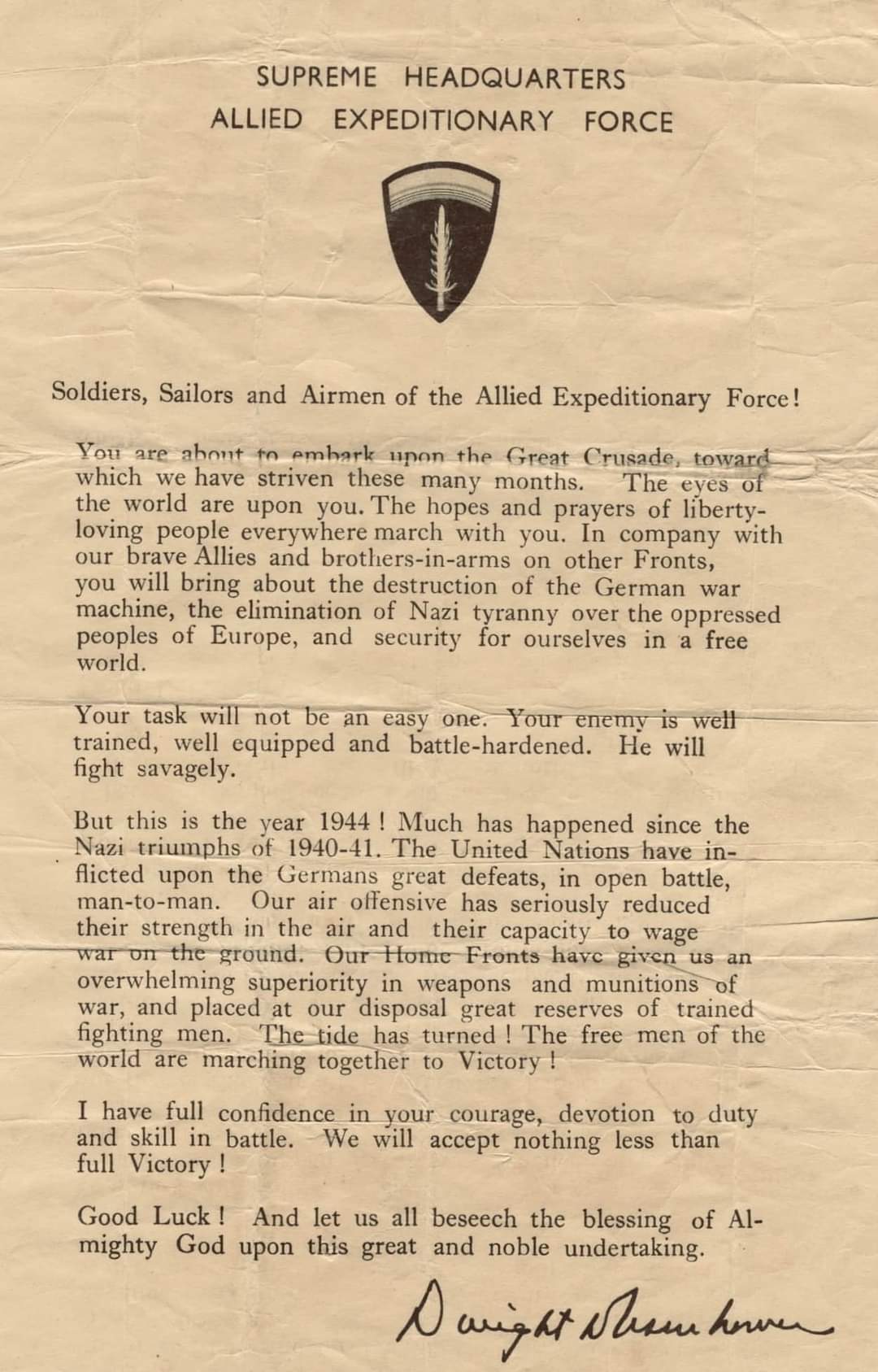
Published Jun 5, 2024Adolf Hitler was looking forward to D-Day. His plan was simple. Reinforce the western defences, launch a furious counterattack, and “throw the Allies back into the sea”. After that, he could turn his full strength against the Soviet Union and end the war. For Hitler, the outcome of this campaign would be decisive.
In the previous episode of our D-Day series we looked at the air battle for Normandy. This time IWM Curator Adrian Kerrison covers the fighting on land. Why were some beaches bloodier than others? Why did German counterattacks fail? And why did it take so long for the Allies to breakout?
To help us answer some of those questions we’ve brought in the Royal Armouries’ Jonathan Ferguson to look at some of the most important weapons of D-Day.
(more…)
Battlefield Normandy – The Battle of Juno Beach 6 June 1944
The AceDestroyer
Published Nov 18, 2018Hello and welcome to the first episode of my Battlefield Normandy series. This part is all about the landings at Juno beach on June 6 1944, and what happened on the first day of the Allied landings in Normandy. In this episode we will take a look at all the landing beaches and the subsequent fighting. You can find the maps on my Facebook page. The next episode will be about the battle of Authie on June 7, when the Canadians first met the 12th SS Hitlerjugend. I hope you’ll enjoy this video and find it helpful.
(more…)


