
… Twitter (etc.) are specifically set up in such a way as to discourage any real-world action. Basically it’s the faculty lounge writ large. If you’ve been to college in the last half-century, you surely noticed that the faculty are Very Very Concerned about all kinds of stuff … but that the stuff they’re Very Very Concerned about is always happening to some obscure group thousands of miles away.
Even when they’re pretending to Care Very Much about, say, “systemic racism” in “America”, it would never occur to them to go down to the ghetto that, in many notorious cases, is literally right next door to do anything about it. They could find out everything they ever wanted to know — and then some!! — about “the Black Experience” by driving down MLK Blvd. at three in the morning, but somehow they never do. The way you win at victim bingo in the ivory tower is you find the most obscure group, the furthest away, to chastise your peers for not caring enough about. If what you say could possibly have any real-world application in the lives of anyone anybody you know had even the possibility of ever meeting, you lose.
Such is Social Media, so it’s no surprise that the Twitterati all fall victim to the biggest Faculty Lounge Fallacy of them all: That saying something is the same as doing something. Or, in other words, and not to put too fine a point about it, they act like passive-aggressive little bitches, like cat ladies around the company water cooler. You could get Johnny from Accounting to stop leaving his half-eaten sandwich in the lunch room fridge by simply asking him to stop … or you can have daily hen parties about it for weeks, months, years, squawking about how some people need to get some common courtesy … and meanwhile Johnny from Accounting goes on doing it, oblivious.
The genius of Facebook, Twitter, etc. — and it IS genius; sick, evil, twisted genius — is that they figured out how to monetize this.
Severian, “Internet Tough Guys”, Rotten Chestnuts, 2021-05-10.
August 28, 2021
August 19, 2021
How much formal school time can kids miss before it impacts their long-term prospects?
Many years ago, when my son went to Kindergarten, I discovered that a lot of other parents were concerned that if their child missed much — if any — time in class, it would utterly destroy their chances of whatever hopes and dreams they may cherish for a fruitful and productive life in the working world. And by “concerned” I man “bat-shit insanely worried” that even a day or two would be enough to blight the child’s life forevermore. And remember, these were the parents of Kindergarten or Grade 1-3 children. In the time since then, I doubt very much that parents have become more relaxed in this regard, so the re-assurances from Scott Alexander are well-timed, but may still not reach the people who most need to hear them:

Illustration from Harvard Magazine via Twitter.
Back when the public schools were closed or online, someone I know burned themselves out working overtime to get the money to send their kid to a private school. They figured that all the other parents would do it, their kid would fall hopelessly behind, and then they’d be doomed to whatever sort of horrible fate awaits people who don’t get into the right colleges.
I hear this is happening again now, with more school closures, more frantic parents, and more people asking awful questions like “should I accept the risk of sending my immunocompromised kid to school, or should I accept him falling behind and never amounting to anything?”
(see also this story)
You can probably predict what side I’m on here. Like everyone else, I took a year of Spanish in middle school; like everyone else who did that, the sum total of what I remember is “no hablo Espanol” — and even there I’m pretty sure I forgot a curly thing over at least one of the letters. Like everyone else, I learned advanced math in high school; like everyone else, I can do up to basic algebra, the specific math I need for my job, and nothing else (my entire memory of Algebra II is that there is a thing called “Gaussian Elimination”, and even there, I’m not sure this wasn’t just the name of a video game). Like everyone else, I once knew the names and dates of many important Civil War battles; like everyone else — okay, fine, I remember all of these, but only because the Civil War is objectively fascinating.
And I think that’s the whole point. We learn lots of things in school. Then we forget everything except the things that our interests, jobs, and society give us constant exposure/practice to. If I lived in Spain, I would remember Spanish; if I worked in math, I would remember what Gaussian Elimination was. I think a lot of the stuff you’re exposed to and interested in, a sufficiently curious child would learn anyway; the stuff you’re not goes in one ear and out the other, hopefully spending just enough time in between to let you pass the standardized test.
Even beyond this, school is repetitive. I learned the same Civil War facts in fifth, eighth, and eleventh grade. I think I read The Giver in multiple English classes. And this is just the stuff it’s embarrassing to have repeated. The actually important skills — how to write essays, how to cite sources — get deliberately repeated year after year.
(I still have no idea how to cite a source properly, except a vague memory that something called “MLA Format” was very important, and that there might have been another thing called “Chicago Style” unless I am confusing it with pizza. When I actually need to cite something, I hit the “Cite” button on the top right of PubMed and do whatever it says.)
So my prediction is that an average student could miss a year or two of school without major long-term effects. Their standardized test score would be lower at the end of the two years they missed than some other student who had been in school the whole time. But after a short period they would equalize again. I don’t think you need to burn yourself out working overtime to send your kid to a private school, I don’t think you need to risk your immunocompromised kid’s health to send her to the classroom, I think you can just chill.
Parents who are concerned that the schools are spending too much time indoctrinating rather than teaching their students have a totally different set of concerns, which are outside the scope of this particular discussion.
August 16, 2021
L. Neil Smith – “Take your children out of school!”
In the latest Libertarian Enterprise, L. Neil Smith offers a useful bit of advice to parents concerned about their children being indoctrinated in state-run schools:

“Abandoned Schoolhouse and Wheat Field 3443 B” by jim.choate59 is licensed under CC BY-NC-ND 2.0


For quite a while now, the boob-tube has been filled with coverage of various Board of Education meetings around the country attended by parents murderously angry that their kids are being forcibly indoctrinated with utter claptrap like CRT, which apparently stands for Communist Racist Toxin, a new and poisonous religion where the color of your skin is an Original Sin for which you will be made to suffer no matter what you think, do, or say. My wife Cathy, passing by the TV set half a dozen times a day, invariably shouts, “Take your children out of school!” This essay is admiringly dedicated to her.
I suppose the Public Schools got started out of some sense of specialization. “You chip the flint, Og, Ogla cooks the mammoth, and we’ll teach the kids.” Evolution would have it the other way. The young have been learning from their parents for thousands of generations and it worked out pretty well until sinister figures like Horace Mann and John Dewey, equipped with the limitless power of the State, decided to use it to steal our children from us.
Take your children out of school!
It was perhaps, the stupidest thing that a people have ever done, and I’m pretty sure that Thomas Jefferson would have recognized it as the stupid thing it was, so it had to wait until he and those like him were safely dead. It isn’t brain science. It isn’t rocket surgery. Hand your offspring over to the State, and they will be taught every self-destructive thing the State wants them to be taught — and by now it should be clear, as it surely was to Jefferson, that the State is the enemy of everything decent and productive. Public education was probably responsible for both world wars.
Take your children out of school!
And if it was such a self-evidently good idea, then why did it have to be compulsory? The rows of desks in public schools are populated by conscription — no matter how many pleasant memories we may have of our school days. Public schools are financed by extortion and theft, two of the reasons we fought a revolution in the first place.
Take your children out of school!
It might be cynically observed that public schools are cheaper than paying for baby-sitting, but, given property taxes and the damage it does to the most important people in our lives, is it really? Idiots have whimpered for the last year that having your kids at home is inconvenient.
Public Schools are convenient for the State. They give government two incomes to tax, instead of only one. Take your children out of school!
August 12, 2021
The Canadian Historical Association’s “consensus” on genocide in Canada
In Quillette, Christopher Dummitt reports on last month’s declaration by the Canadian Historical Association that not only were past Canadian governments complicit in deliberate genocide against First Nations, but that such mass extermination efforts are current and ongoing:

Kamloops Indian Residential School, 1930.
Photo from Archives Deschâtelets-NDC, Richelieu via Wikimedia Commons.
Last month, the Canadian Historical Association (CHA) issued a public “Canada Day Statement” — described as having been “unanimously approved” by the group’s governing council — declaring that “existing historical scholarship” makes it “abundantly clear” that Canada’s treatment of Indigenous peoples amounts to “genocide”. The authors also claimed that there is a “broad consensus” among historians on the existence of Canadian “genocidal intent” (also described elsewhere in the statement as “genocidal policies” and “genocidal systems”) — an alleged consensus that is “evidenced by the unanimous vote of our governing Council to make this Canada Day Statement”.
The authors went further by arguing that both federal and provincial governments in Canada “have worked, and arguably still work, towards the elimination of Indigenous peoples as both a distinct culture and physical group” (my emphasis); thereby suggesting that there is “arguably” an ongoing genocide going on, to this day, on Canadian soil.
The idea that Canada is currently waging a campaign of mass extermination against Indigenous people may sound like something emitted by Russian social-media bots or Chinese state media. But no, this is an official statement from the CHA, a body that describes itself as “the only organization representing the interests of all historians in Canada” — presumably including me.
In fact, there is no “broad consensus” for the proposition that Canadian authorities committed genocide, let alone for the completely bizarre idea that a genocide is unfolding on Canadian soil even as you read these words. And while many of us have become used to such plainly dilatory claims being circulated by individual Canadian academics in recent years, the CHA’s use of its institutional stature in this way was so shocking that it caused dozens of historians to affix their names to a letter of protest.
Notwithstanding what this (or any other) official body claims, the question of whether Canada committed genocide is not a settled issue among scholars. Canada is a relatively small country, home to only a small number of professional historians. And so even this modest-seeming collection of names suffices to disprove the CHA’s claim that it speaks for the entire profession. Moreover, many of those who have signed the letter are senior scholars giving voice to younger colleagues who (rightly) fear that speaking out publicly will hurt their careers.
I am not writing here to defend the actions of Canadian governments toward Indigenous populations. As most Canadians have known for decades, the policy of forcing Indigenous children to attend residential schools led to horrendous cases of sexual and physical abuse. There was also a long history in many schools of refusing to let children speak their native languages or continue their cultural traditions. These were assimilatory, underfunded institutions created and run by people who typically believed that they were doing Indigenous people a favour by “civilizing” them.
What I am addressing, rather, is (a) the question of whether these actions are correctly described with the word “genocide”, and (b) the CHA’s false claim that there is “broad consensus” on the answer to that question. As the letter of protest states:
The recent discovery of graves near former Indigenous residential schools is tragic evidence of what the Truth and Reconciliation Commission (TRC) documented in Volume 4 of its final report — a report that we encourage all Canadians to read. We also encourage further research into gravesites across Canada and support the completion of a register of children who died at these schools. Our commitment to interrogate the historical and ongoing legacies of residential schools and other forms of attempted assimilation is unshaken. However, the CHA exists to represent professional historians and, as such, has a duty to represent the ethics and values of historical scholarship. In making an announcement in support of a particular interpretation of history, and in insisting that there is only one valid interpretation, the CHA’s current leadership has fundamentally broken the norms and expectations of professional scholarship. With this coercive tactic, the CHA Council is acting as an activist organization and not as a professional body of scholars. This turn is unacceptable to us.
Historians are taught to approach their study of the past with humility, on the understanding that the emergence of new documents and perspectives may require us to revise our assessments. Moreover, even if an individual scholar might have strong opinions about a particular historical subject — having become certain that his or her interpretation represents the truth — the community of historians exists in a state of debate and disagreement. We are always aware that two historians sifting through the same archival box of documents can develop very different theories about what those documents mean.
It is true that there are some areas of history that might be fairly labelled as definitively “settled”. But these are few. And even in these cases, consensus typically arises organically, through the accumulated weight of scholarship — not, as in the case of the CHA’s Canada Day stunt, through ideologically charged public statements that seek to intimidate dissenting academics into silence.
August 4, 2021
QotD: The Bell Curve of the benefits of (modern) education
On the far left of the curve is a newborn — who has learned literally nothing, knows nothing, and has received no benefit from education.
As we learn from our parents at home and our teachers at school, we progress along the curve with benefits accumulating along the way.
But something happens somewhere between sophomore year Vivisecting the Deconstructed Patriarchy 201 at Bleeding Heart College and achieving the dream of earning that Ph.D. from the University of Charging More Than a Mortgage for your dissertation on Imposing Ruthless Meaninglessness on Others.
Somewhere just on the right side of the bell curve, we devolve along the curve with detriments accumulating along the way.
By the time you’re as well educated as Dr. Swannie Jett, you’re so untethered from reality that you’re basically impervious to knowledge.
Stephen Green, “Insanity Wrap #198: Looted & Burned Target Store Puts Up Mural Celebrating Arson”, PJ Media, 2021-05-03.
July 27, 2021
John McWhorter on “antiracism” in theory and practice at the University of California
John McWhorter doesn’t just comment on this issue from mere distant concern, because he was working at UC Berkeley and watched it happen before his eyes:
John McWhorter’s Twitter thumbnail image
When I taught at UC Berkeley in the 1990s, it was an open secret that there was a two-tier undergraduate student body. Namely, black and Latino students tended to be considerably less prepared for the workload than white and Asian students.
No one talked about it openly, but plenty attested to it when they were sure the wall didn’t have ears, and to notice it was not racist – it was simple fact. Of course there were weak white and Asian students; of course there were excellent black and Latino students. But a tendency was unmistakable. It was painfully obvious that brown students were admitted according to very different standards than white and Asian ones.
Proposition 209 barred racial preferences of that kind in the UC system as of 1998, and of course, fewer brown students were admitted to the flagship schools Berkeley and UCLA after that. There were still plenty of brown students – the “resegregation” so many furiously predicted never happened. But not as many as before. And there has remained, for almost a quarter century now, a contingent who have never gotten over thinking UC would be better by going back to the way it was.
First there was the addition of a “hardship” bonus to the admissions procedure, with standards relaxed for applicants who could attest to having faced obstacles to achievement such as the death of a parent or serious illness. Formally this was supposed to apply to kids of all races. But immediately evaluators started weighting black and Latino hardship heavier than that suffered by white and Asian kids, as in rejecting an Asian applicant who had gone through the same kinds of hardship as a Latino one who was admitted.
I criticized this in the media, and will never forget when the suits assigned a kind, academically accomplished administrator to take me to lunch to “talk to me”. The poor man did his duty and … sat there lying to me. I genuinely felt sorry for him. But this showed how impenetrably committed to antiracism – or at least what they think is antiracism – these admissions officials are.
But even this kind of thing hasn’t been able to return Berkeley and UCLA to the good old days of having a “representative” number of brown students (apparently “representative” means in lockstep with their proportion of the state population). The problem is that pesky SAT, and at last, UC has gotten rid of it. The SAT will no longer be used to evaluate students for admission or even for scholarships.
A lot of people must have clinked their glasses of Pinot over this. But what they’ve done is not antiracist at all.
July 15, 2021
QotD: Macaulay’s prescription for ruling India
Macaulay was arguing that British Government should spend money on educating those it found under its rule. So it came to be as Britain ruled over the most heavily-populated and most valued part of its empire for another century.
Jawaharlal Nehru, the Prime Minister who led India to independence from Britain, studied at Trinity College, Cambridge, and at the Inner Temple, and was closely connected to the Fabian Society. Nehru’s rival, Muhammad Ali Jinnah, the founder of Pakistan, studied law at the Lincoln’s Inn, and was strongly influenced by English utilitarianism and French positivism. Nehru was an agnostic who requested a secular burial (this was denied him), while Jinnah was a gin-drinker whose religious attachments were more a matter of identity than belief.
Nehru and Jinnah led India and Pakistan to independence as the brown-skinned Westerners Thomas Macaulay had envisioned a century earlier. South Asian in appearance and pedigree, the leaders of these two nations nevertheless personified a fundamental truth about the Western orientation of the new Asian states. Pakistan was aligned with the United States, while socialist India was nominally non-aligned but clearly tilted toward the Soviet bloc. Though the populace of these nations were mostly illiterate, poor and detached from the cosmopolitan currents of the world, their elites were integrated among the English-speaking peoples. Nehru’s daughter, Indira Gandhi, attended Somerville College, Oxford. His grandson, Rahul Gandhi, whose mother is Italian, studied at Harvard and Trinity College.
Razib Khan, “Why the West lost India’s culture wars”, UnHerd, 2021-04-13.
July 14, 2021
Instead of economics, how about “humanomics”?
In City Journal, Allison Schrager reviews Bettering Humanomics: A New, and Old, Approach to Economic Science by Deirdre McCloskey:

I thoroughly enjoyed Deirdre McCloskey’s Bettering Humanomics, but I may be a glutton for feelings of intellectual inadequacy. Truth be told, I only understood about 60 percent of the book. It contains countless references to great works of the humanities, economics, and the history of economic thought. A casual reader cannot possibly be familiar with a fraction of them, even within his own field. But McCloskey expects you to know them.
At first this book frustrated and confused me. Then I suspected this reaction was by design. I am, after all, an economist myself: I have dedicated my life to learning my craft and benefited from many years of training at great institutions from important thinkers. But reading Humanomics, I became fully aware of how little I know. I now believe that becoming a fully formed economist requires that I stop watching trash TV in my free time and read the Theory of Moral Sentiments instead. McCloskey pulls no punches, whether on her intellectual opponents or on the reader. Here is one example, where she defends herself from a critic, philosopher Gerald Gaus:
Aside from these textual matters, I must say I find myself repelled by Gaus’s vision of people as cynical conformists: “we are such deeply social normative creatures, in the sense that we are so attuned to the normative expectations of others, that we can achieve a stable rule-based system of cooperation even when many are not enthusiastic about the moral attitudes and virtues that the rules express.” I invite him to reread Thucydides’s dialogue between the Athenian diplomats and the Melians, and repent.
McCloskey argues that economics would be better if we listened to people — in controlled experiments, chat rooms, meetings, surveys, and at the Rotary. We need to absorb the lessons from art and culture (perhaps trash TV has value, after all). She does not believe that economists need to ditch math and data, but our overreliance on these tools encourages us to view people as abstractions and leads us astray. Such tendencies also help explain the rise of behaviorism, which assumes that humans are flawed creatures who must be nudged by a wise bureaucrat into better choices; recent flirtations with industrial policy; and the belief that, if we just get our government and laws right, growth will follow.
We must consider how individuals see and experience the world around them, and we must recognize that humans are malleable in ways that we don’t account for. For example, McCloskey estimates a quarter of all income comes from “Sweet Talk” — not lies or trickery, but the ability to be persuasive and compelling, a crucial aspect of sales and advertising. It influences how we perceive the world and can be an important part of motivation.
We economists have lost our appreciation for the humanities, and that means that we underestimate the importance of human dignity. This is no small oversight. McCloskey spends about a third of her book arguing that understanding the humanity of the northwestern European population can explain why it industrialized first. Other countries around the world had wealth, strong institutions, and well-trained mathematicians and engineers (perhaps better ones), but industrialization happened in Britain first because it treated its people with dignity and empowered them with both rhetoric and knowledge.
July 1, 2021
QotD: Life at “Flyover State” in the 1990s
“Blandly utilitarian” was about the best that one could say about the least offensive campus architecture; “brutalist monstrosities” was closer to the truth for most of it. And as with the campus, so with the town — the off-campus housing was beautiful old Victorian houses ripped up and made into “efficiency” apartments, crammed cheek by jowl with poured-concrete boxes that looked like barracks for low-ranking Party members in the Pyongyang suburbs. The public parks were nicely landscaped, but each featured some publicly-subsidized “art” that made you want to gouge your eyeballs out. Every single space had wheelchair ramps, and was festooned with enough signs to give M. Night Shyamalan wood. It was hideous.
As with the built environment, so with human behavior. Everyone on the faculty looked like a refugee from 1968, but instead of toking righteous bud, they’d been taking sriracha enemas. The shopkeepers who catered to them were seemingly locked in a contest to out-obnoxious each other over their leftwing politics, and as for the few tradesmen who provided vital services, they had the warm and welcoming vibe of a DMV supervisor. Not that I blame them for this — I ended up hanging out with a lot of those guys at a townie bar, and trust me, being called out to work at a professor’s home is exactly the kind of experience you think it is. Hurry up and fix the leaky pipe, bigot, while I lecture you about your privilege … then try to stiff you on the bill. (Same thing in reverse for the students). So they came off like cops, assuming that everyone they met was a dyed-in-the-wool asshole until proven otherwise.
Life in a college town, then, is soulless, instrumentalist, transactionalist — everything’s for sale, but everything had best be spelled out, in writing, in triplicate. Nobody’s from there, nobody stays there, so everything is always on the arm. No one and nothing is ever on the level; everyone is always looking to chisel everyone else. And, ironically, the longer someone stays there, the more likely xzhey are to push this attitude to near-platonic perfection — eggheads all believe, with all their hearts and souls, that they deserve to be at Harvard, so when Harvard doesn’t come calling, the days and months and years become an intolerable insult. How dare they expect me to live like this, in a place designed to cater to my every whim, making only 100 large per year! It’s an outrage!!
Looking back on it, I see now why I hated the 1990s so much. Eggheads are incredibly conservative about everything but their politics, but in this one case, they really were as “progressive” as they fancy themselves. Before just about anyone else, they embraced the globohomo ethos of rootless piracy. Then as now, they all claimed to hate “sportsball” (if you’ll forgive an anachronism for clarity’s sake) with the heat of a thousand suns, but they could’ve given LeBron James lessons on how to be a backstabbing, glory-hogging, money-chasing, utterly mercenary douchebag. As early as the late 1980s, they found the idea of remaining loyally in one institution, building it up as a service to the community, as laughable as modern sportsballers find sticking in one city in order to be a role model. Fuck that, give me mine!!!
Severian, “Everything Is Ugly New”, Rotten Chestnuts, 2021-02-15.
June 28, 2021
QotD: Urbanization
Stewart Brand, “Environmental Heresies”, Technology Review, 2005-05
June 21, 2021
“… the GOP needs an inflammatory issue to rile their racist base, and so this entire foofaraw is really just an astro-turfed, ginned-up partisan gambit about nothing”
An excerpt from Andrew Sullivan’s most recent Weekly Dish looks at the burgeoning fight over the use of Critical Race Theory in public schools:
The stories in the mainstream media this past week about the broadening campaign to ban critical race theory in public schools have been fascinating — and particularly in how they describe what CRT is. Here’s the Atlantic‘s benign summary of CRT: “recent reexaminations of the role that slavery and segregation have played in American history and the attempts to redress those historical offenses.” NBC News calls it the “academic study of racism’s pervasive impact.” NPR calls CRT: “teaching about the effects of racism.” The New York Times calls it, with a straight face, “classroom discussion of race, racism” and goes on to describe it as a “framework used to look at how racism is woven into seemingly neutral laws and institutions.”
How on earth could merely teaching students about the history of racism and its pervasiveness in the United States provoke such a fuss? No wonder Charles Blow is mystified. But don’t worry. The MSM have a ready explanation: the GOP needs an inflammatory issue to rile their racist base, and so this entire foofaraw is really just an astro-turfed, ginned-up partisan gambit about nothing. The MSM get particular pleasure in ridiculing parents who use the term “critical race theory” as shorthand for things that just, well, make them uncomfortable — when the parents obviously have no idea what CRT really is.
When pushed to describe it themselves, elite journalists refer to the legal theories Derrick Bell came up with, in the 1970s — obscure, esoteric and nothing really to do with high-school teaching. “If your kid is learning CRT, your kid is in law/grad school,” snarked one. Marc Lamont Hill even tried to pull off some strained references to Gramsci to prove his Marxian intellectual cred, and to condescend to his opponents.
This rubric achieves several things at once. It denies that there is anything really radical or new about CRT; it flatters the half-educated; it blames the controversy entirely on Republican opportunism; and it urges all fair-minded people to defend intellectual freedom and racial sensitivity against these ugly white supremacists.
What could be more convenient? NBC News “reporter”, Brandy Zadrozny, even decried parents’ attempts to discover through FOIA requests just what their children are being taught — and argued this week that, “for longtime ultra conservative activists, CRT is the opportunity of a lifetime.” CRT, she explains, is not a threat at all, and there is no proof that it is even being taught. It’s “just a catch-all term repurposed as a conservative boogeyman.” She goes on: “it harnesses pushback against 2020’s racial justice movement, covid denialism, and depends on a base still energized by Trump and misinformation, looking for political power.”
I’m sure the MSM will continue to push this narrative indefinitely. They are still insisting, after all, that “white supremacy” is behind hateful attacks on Asian-Americans, and that soaring murder rates are purely a function of Covid19. And you can see why: this dismissive take is extremely helpful in avoiding what is actually happening. It diverts attention from the stories and leaks and documents that keep popping up all over the place about extraordinary indoctrination sessions that have become mandatory for children as early as kindergarten.
QotD: The young Richard Nixon
The Orthogonians’ base was among Whittier’s athletes. On the surface, jocks seem natural Franklins, the Big Men on Campus. But Nixon always had a gift for looking under social surfaces to see and exploit the subterranean truths that roiled underneath. It was an eminently Nixonian insight: that on every sports team there are only a couple of stars, and that if you want to win the loyalty of the team for yourself, the surest, if least glamorous, strategy is to concentrate on the nonspectacular — silent — majority. The ones who labor quietly, sometimes resentfully, in the quarterback’s shadow: the linemen, the guards, the punter. Nixon himself was exemplarily nonspectacular: the 150-pounder was the team’s tackle dummy, kept on squad by a loving, tough, and fatherly coach who appreciated Nixon’s unceasing grit and team spirit — nursing hurt players, cheering on the listless, even organizing his own team dinners, entertaining the guests on the piano, perhaps favoring them with the Orthogonian theme song. It was his own composition.
Nixon beat a Franklin for student body president. Looking back later, acquaintances marveled at the feat of this awkward, skinny kid the yearbook called “a rather quiet chap about campus,” dour and brooding, who couldn’t even win a girlfriend, who attracted enemies, who seemed, a schoolmate recalled, “the man least likely to succeed in politics.” They hadn’t learned what Nixon was learning. Being hated by the right people was no impediment to political success. The unpolished, after all, were everywhere in the majority.
Rick Perlstein, Nixonland: The Rise of a President and the Fracturing of America, 2008.
June 20, 2021
QotD: Cargo cult thinking in education
The problem of course is that college is not the cause of prosperity, but a marker (with prosperity) of other traits — focus on long-term goals, discipline, hard work, and yes knowing 2+2=4. This sort of woke BS just makes it worse, because it attacks the real roots of prosperity. There are real barriers to poor blacks achieving prosperity — eg how do you focus on long-term goals when you don’t know where you are sleeping tonight or when you have no role models who do so — but the purity and objectivity of math is not among these.
This sort of cargo cult thinking can be seen all the time in Progressive economic proscriptions. The government push for home ownership is another — middle class people own homes so if low income people owned homes they would become middle class. Now, this has a bit of accuracy in that, like the stock market, the elite have goosed the housing market to always go up. But leaving that aside for a moment, owning a home vs renting is a terrible decision for many people — it piles on a lot of financial risk but perhaps more importantly it limits geographic mobility which used to be critical to lower-income people improving their lot.
Warren Meyer, “Are the Woke a False Flag Operation of White Supremacists?”, Coyote Blog, 2021-02-16.
June 11, 2021
Latin and Greek are the next sacrifices to the great god Antiracism
In the latest edition of It Bears Mentioning, John McWhorter considers the Princeton University classics department decision to get rid of the requirement for students to read classic texts in the original languages:
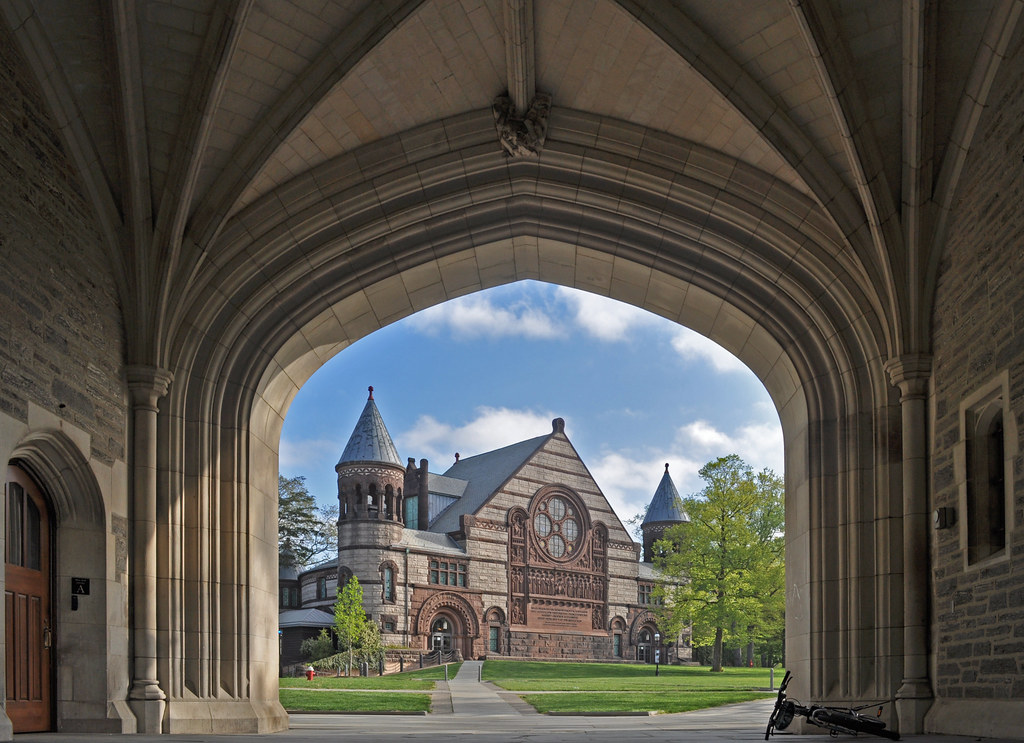
“USA – New Jersey – Princeton” by Harshil.Shah is licensed under CC BY-ND 2.0
I have written recently about the Princeton classics department’s decision to eliminate the requirement that students engaging closely with Latin and Greek texts be able to … read them in Latin and Greek. The new idea is that the department will attract more majors by opening up to ideas from students who may be full of beans but just not inclined to tackle complex, ancient languages. And sub rosa, the idea is clearly – as we can see from words in the official statement like underrepresented, perspectives, and experiences – that of especial interest will be black students, especially in light of today’s racial reckoning which the department openly acknowledges was the primary spur for this change.
My disappointment with this decision is because it is part of a tradition of arguments that we do black people a favor by exempting them from certain kinds of faceless, put-up-or-shut-up challenges to entry. Back in the aughts, the classic example was brilliant, fierce black lawyers confidently arguing that because black firefighter applicants don’t do as well on the entrance exams required for the job, the exams are racist and should be eliminated. More recently there has been the idea that if black kids are rare at top-ranked public schools in New York City like Stuyvesant because few excel on the standardized test one must ace to be admitted, then the solution is to eliminate the test as “racist”. The Princeton decision is a variation: to get black kids into classics, it’s supposedly immoral to expect them to master the intricacies of Latin and Greek, languages which I suppose we can see as foreign, “white” to them as well. Rather, they must be admitted in shining expectation that their class comments will be bracingly “diverse” in good old English.
My Atlantic colleague Graeme Wood is more sanguine about the Princeton decision. He argues sagely that a certain kind of student happens to enjoy working their way through languages like Latin as a kind of puzzle (I openly admit being that type), but that there are others who don’t go in for that particular task and yet are itching and well-equipped to engage and analyze classical texts regardless. Graeme notes that we do not consider it an educational tragedy that specialists in English history are not required to be able to read Old English. (Although I wonder if this analogy would hold if the idea were someone specializing in England of the first millennium, where all of the relevant linguistic matter was in Old English [and Latin].)
I can go with him here to an extent. On the one hand, as I have argued here, to engage work only in translation is, of course, to lose a lot. Yet, in making that argument here, I was referring to my own reading War and Peace in English, as I myself was not inclined to hack through it in Russian (although my being black was not the reason for this disinclination [couldn’t help it!]). The question is how important we consider that loss to be.
Having no facility in languages myself, I’m more sympathetic to the students’ viewpoint than I might otherwise be, but depending on someone else’s translation of the text being studied has unexpected risks, as Sarah Hoyt explained from her own translation studies:
The discussion […] reminded me of when I was sixteen and embarked on a class called “Techniques of Translation”.
Although I had studied French and English and German, the translations I’d done so far were of the “I took the pen of my neighbor” variety. I thought the class would teach me to smooth out the sentence to “I took my neighbor’s pen” and that would be that.
I was wrong. Oh, it taught that also, but that was a minor portion of it. The class mostly hinged on the moral, ethical and — most of all — professional dilemmas of being a translator. I know any number of you are translators, formal or informal, but any number of you are also not. So, for the ones who are not, let me break the news with my usual gentleness:
There is no such thing as translation.
The French have a proverb “to translate is to betray a little” — or at least that’s the closest meaning in English. It’s fairly close to the true meaning, but slightly askew, of course. Every language is slightly askew to other languages.
The idea that there exists in every language a word that is exactly the equivalent of other languages is sort of like assuming that aliens will — of course — live in houses, go to school, ride buses, understand Rebecca Black’s “Friday”. [This was originally written in 2011.]
Language is how we organize our thoughts, and each word, no matter how simple, carries with it the cultural freight and experience of the specific language. Oh, “mother” will generally mean “the one who gave birth to” — except for some tribal, insular cultures where it might mean “the one who calls me by her name” or “my father’s principal wife” — but the “feel” behind it will be different, depending on the images associated with “mother” in the culture.
So, when you translate, you’re actually performing a function as a bridge. Translation is not the straightforward affair it seems to be but a dialogue between the original language and the language you translate into. If you’re lucky, you meet halfway. Sometimes that’s not possible, and you feel really guilty about “lying” to the people receiving the translation. When on top of language you need to integrate different cultures and living systems (which you do when translating anything even an ad) you feel even more guilty, because you’re going to betray, no matter how much you try. At one point, a while back, I had my dad on one phone, my husband on the other, and I was doing rapid-fire translation about a relatively straight forward matter. And even that caused me pangs in conscience, because my dad simply doesn’t understand how things are done here. I had to approach his experience and explain our experience in a way he wouldn’t think I was insane or explaining badly. That meant a thousand minor lies.
June 7, 2021
Why is the belated discovery of (potentially hundreds of) unmarked graves at a former residential school surprising?
The weekly wrap-up post at The Line considers the recent revelation of possibly hundreds of unmarked graves of First Nations children at the site of a former Catholic-run residential school in BC. Despite being Canadian, my interest in Canadian history centres mostly on economic, naval, and military aspects, but I was certainly aware that the residential school system was a black mark on Canada’s historical dealings with First Nations and that the general outline of events — if not the gruesome details — had been known for many years. The first time I found out about it was in middle school, through what we’d now call a “Young Adult” novel about a young First Nations boy escaping from the residential school he’d been sent to and his attempts to travel hundreds of miles to get home. I read it in the early 70s and it may have been published up to a decade before then (I no longer remember the author’s name or the title of the book, unfortunately).
If I, as a schoolchild, knew something of this fifty years ago, why have people younger than me been shocked and appalled to be hearing about this widespread tragedy for the first time now?
Kamloops Indian Residential School, 1930.
Photo from Archives Deschâtelets-NDC, Richelieu via Wikimedia Commons.
We like to start our dispatches with something pithy or casual, but it’s been a heavy week. The discovery of what appears to be a burial site containing the bodies of more than 200 children at the site of a former residential school in B.C. has shaken Canadians. Of course it has. There are two outrages here — the outrageous reality of the generations of combined abuses inflicted on Indigenous Canadians, of which the residential school system was but a part. Also, the outrage that most Canadians are only learning about this now.
Your Line editors are not experts on Indigenous affairs or history, but we dare say we’re better read than most on Canadian history in a general sense. We do not say this in any way with snark or derision, but to our fellow Canadians — this should not be surprising to you. The Catholics who ran most of these schools under the sanction of the state had a long history of trying to save souls at the expense of the bodies in which they inhabited. Religious institutions were slow to recognize and stop the spread of disease in their own institutions. Most disturbingly, their ideology glorified, even sanctified, physical suffering. It still does.
Mass graves have been uncovered in Ireland, at the site of Catholic-run homes once devoted to the care of unwed mothers and children. “Saint” Mother Teresa’s hospitals in India were altars to the needless suffering of impoverished people who could not afford to die in peace and dignity. Her hospitals were dirty, poorly run facilities where children were reportedly tied to beds, and terminal patients were given little more than aspirin.
One of the great lessons of history that we consistently fail to accept is that many of our most evil actions are rooted not in self-evidently evil impulses, but rather in our desire to “save” others. Hubris and paternalism, these are the sins we cannot seem to shake. Residential schools, Catholic or otherwise, were the disastrous result of marrying a poisonous and righteous ideology with the authority and resources of a centralized state.
The Truth and Reconciliation report laid out much of this in detail in its final report in 2015, which also spelled out that graves like the ones we’re now mourning in Kamloops are likely to be far more prevalent and common than we now understand. Everyone here deserves the truth.
Update: I’m delighted to see that David Warren continues to improve from his recent health issues and he has rather a different view on Canada’s residential school system and its place in the lives of the First Nations children who attended the schools:
Ryerson was also a figure in the development of Canada’s “residential schools”, which took Indians from (mostly) dysfunctional homes and gave them an education with priests, nuns, and respectable Protestants. Not all denizens of an orphanage are happy, and by attaching the word “colonialism”, and giving simplified accounts, full of libels, “progressive” Canadian politicians have made this period of Canadian history into a scandal. Those who know better have been silenced.
Some years ago I tried to defend the “residential schools”, more or less alone in the Canadian “meejah”. I received many, many letters from former students of them, who said their memories were happy. They had been inspired by teachers of real Christian faith and conviction, and had been equipped with the rudiments of sound learning. “They saved my life,” was a frequent comment.
I could understand the residential schools because I am familiar with Canadian education before it was taken over by barbaric hordes; and also because I am myself partly a product of “British colonial” private schools in Asia, decades ago. They were brutal towards their boys, sometimes. I was myself beaten, and their teachers were sometimes tyrannical.
As a young man I thought this was the way of the world. Now that I am old, I look back on the teaching I received with great pride. It was vastly better than what I would receive in a Canadian high school; and that was much better than what we get today.


