It is, or at least used to be, a truth universally acknowledged, that the Athletic Department was the only bastion of sanity left in higher “education”. I love watching Marxists squirm, so the start of football season was always my favorite time back in my professin’ days. Every year, the doofus Marxoid faculty would write their annual complaint about sportsball — “not germane to the purpose of a university”; “takes away too many resources from academics”; “toxic masculinity” and so forth — and every year, the President and Board of Trustees would tell the eggheads to go pound sand.
NOT, I hasten to add, because the Prez and the Trustees (hereafter: The Administration) were some kind of normal folks. Oh God no — quite the opposite, in fact. No open conservative has been hired to any position in academia for the past thirty, forty years; to make it into the ranks of The Administration, you have to be #woker than #woke. Rather, it was because The Administration were among the few mortals privy to the college’s balance sheet. Seriously, those things are more closely guarded than our nuclear launch codes … but The Administration sees them, and draws the only possible conclusion: Without sportsball, the whole university system is toast.
But alas for the bottom line, Intersectionality is a jealous god, and xzhey will have none before xzhem. The Administration knows — they must know, they can’t not know — that all the stuff that makes big league college football go comes from “boosters”, i.e. rich idiots with way more money than sense, and their corporations. But since The Administration is full of even dumber Marxists than the faculty — yeah yeah, I know, I didn’t think it was possible either — they’ve apparently decided to assume, in true Leftist style, that since the money has always just kinda, you know, been there, it will continue to, you know, somehow, someway, continue to be there.
I mean, what are those rich oilmen from Texas gonna do, not watch football?
Severian, “Ludicrous Speed Update: The NCAA”, Rotten Chestnuts, 2021-04-14.
November 22, 2023
QotD: American universities, “sportsball”, and wealthy alumni
November 18, 2023
QotD: Teaching Marx’s Labour Theory of Value in university
The Labor Theory of Value makes intuitive sense, especially to college kids, who consider themselves both idealists and socially sophisticated. So, I’d tell them, we all agree: Nike’s sneakers cost $2 to make, but sell for $200; therefore, the other $198 must be capitalist exploitation, right? In a socially-just world, sneakers would never cost more than $2, since that’s the amount of “socially useful” labor that went into making them.
To really get them thinking, at that point I’d offer to trade them my shoes, which were of course the butt-ugliest things I could find, bought special at the local Salvation Army just for that purpose. “These cost $2,” I’d tell them. “They’re my social justice shoes. Who’s willing to trade? Oh, nobody? Why ever not?” Or I’d come to class in a plain Wal-Mart t-shirt, on which I’d written “I Heart [This University]” in Magic Marker. Same deal, I’d tell them. “The stuff you guys are wearing sends the same message, but I’ve been in the bookstore, I know for a fact that the hoodie you’re wearing [pointing to the most dolled-up Basic Becky I could find] costs $75. My shirt only cost $2. We’re both telling the world that we love [this university], but yours cost a whole lot more. You, Becky, are taking like $73 out of the mouths of poor people by wearing that … right?”
Repeat as often as needed, until they get the idea that “price” isn’t the same thing as “cost”. This isn’t physics class, I’d tell them, where we can assume away important real-world stuff like friction. Out here in the real world, we have to take stuff like “overhead” and “taxes” into account, such that even if those ugly sneakers or that crappy college-logo t-shirt only “cost” $2 at the point of manufacture, getting them onto the shelves at the the store here in College Town adds a whole bunch more. And then there’s demand, which we’ve already covered. I offered to trade y’all my shoes. Hell, I offered to give away my homemade t-shirt, and nobody took me up on it. You might change your tune if you were naked – and here we will note that this was the kind of situation Karl Marx was putatively addressing – but if you have any choice at all you’ll stick with what you have, because nobody in his right mind wants to wander around campus in a homemade t-shirt …
In short, I’d tell them, price is information. Done right – in an absolutely free market, the capital-L Libertarian paradise, which is of course as bong-addled a fantasy as Marx’s – price is perfect information. Nike’s sneakers don’t sell for $200 because that’s what it cost to make them. The $200 is the aggregate of all those costs we talked about before – cost of materials, labor, transportation, taxes, and, as we’ve seen by the fact that y’all still won’t trade me shoes, the most important piece of information, demand.
Severian, “Velocity of Information (I)”, Founding Questions, 2020-12-26.
November 13, 2023
Carefully trained and shaped hollow people
At Ricochet, David Foster talks about how today’s university students have become … hollow:
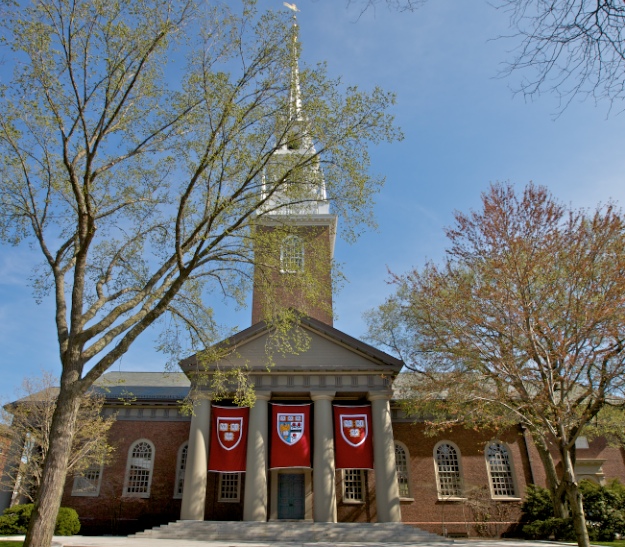
Harvard University Memorial Church.
Photo by Crimson400 via Wikimedia Commons.
I’ve been writing for years about the rise of toxic ideologies on America’s college campuses – totalitarian, anti-Israel, outright anti-Semitic – but still have been surprised by what has happened in these places since October 7. We need to discuss the reasons why it’s gotten so bad.
A few days ago, someone republished an essay, written in 2016, by a professor who has taught at several “elite” colleges. Excerpt:
My students are know-nothings. They are exceedingly nice, pleasant, trustworthy, mostly honest, well-intentioned, and utterly decent. But their brains are largely empty, devoid of any substantial knowledge that might be the fruits of an education in an inheritance and a gift of a previous generation. They are the culmination of western civilization, a civilization that has forgotten nearly everything about itself, and as a result, has achieved near-perfect indifference to its own culture. It’s difficult to gain admissions to the schools where I’ve taught – Princeton, Georgetown, and now Notre Dame. Students at these institutions have done what has been demanded of them: they are superb test-takers, they know exactly what is needed to get an A in every class (meaning that they rarely allow themselves to become passionate and invested in any one subject); they build superb resumes. They are respectful and cordial to their elders, though easy-going if crude with their peers. They respect diversity (without having the slightest clue what diversity is) and they are experts in the arts of non-judgmentalism (at least publically). They are the cream of their generation, the masters of the universe, a generation-in-waiting to run America and the world.
And when someone has devoted the first 18 years of their lives in large part to jumping through hoops in hopes of making a good impression on some future college admissions officers … and then, in many cases, having to get good ratings from professors whose criteria are largely subjective … that someone is unlikely to develop into a person with a strong internal gyroscope. Quite likely, they are likely to be subject to social pressures and mass movements.
Someone at X said that the Cornell student arrested for making threats against Jewish students was probably just trying too hard to fit in and win approval of his peers and took it a step too far. My view is that there’s no just about it … the desire to fit in and win approval is very often the reason why people commit evil acts. I’m reminded of something CS Lewis said: “Of all the passions, the passion for the Inner Ring is most skillful in making a man who is not yet a very bad man do very bad things“.
The above sentence is from a talk that Lewis gave at King’s College in 1944. Also from that address:
And the prophecy I make is this. To nine out of ten of you the choice which could lead to scoundrelism will come, when it does come, in no very dramatic colours. Obviously bad men, obviously threatening or bribing, will almost certainly not appear. Over a drink, or a cup of coffee, disguised as triviality and sandwiched between two jokes, from the lips of a man, or woman, whom you have recently been getting to know rather better and whom you hope to know better still — just at the moment when you are most anxious not to appear crude, or naïf or a prig — the hint will come. It will be the hint of something which the public, the ignorant, romantic public, would never understand: something which even the outsiders in your own profession are apt to make a fuss about: but something, says your new friend, which “we” — and at the word “we” you try not to blush for mere pleasure — something “we always do”.
And you will be drawn in, if you are drawn in, not by desire for gain or ease, but simply because at that moment, when the cup was so near your lips, you cannot bear to be thrust back again into the cold outer world. It would be so terrible to see the other man’s face — that genial, confidential, delightfully sophisticated face — turn suddenly cold and contemptuous, to know that you had been tried for the Inner Ring and rejected. And then, if you are drawn in, next week it will be something a little further from the rules, and next year something further still, but all in the jolliest, friendliest spirit. It may end in a crash, a scandal, and penal servitude; it may end in millions, a peerage and giving the prizes at your old school. But you will be a scoundrel.
So yes, the passion for approval has always existed. But I feel sure it is much stronger, or at least has fewer countervailing forces, among people who experience today’s college admissions race and its eventual fulfillment.
The students about whom the professor wrote in the essay linked above have not only been encouraged to devote their time to hoop-jumping, they have also been told again and again that their country and their society are evil – that their ancestors were evil, and their parents are probably evil as well. And that practically all aspects of culture more than five years old, whether traditional songs and folktales or classic movies, are harmful and certainly unworthy of study except for purposes of deconstructing their bad examples. And, of course, relatively few of these students are influenced by or have seriously studied any traditional religion.
November 7, 2023
Potentially killing off Quebec’s English-language universities isn’t a bug, it’s a feature
Chris Selley on the Quebec government’s vindictive decision to massively hike tuition rates for out-of-province students of the province’s three English-language universities:

“McGill University Montreal 3” by Laslovarga is licensed under CC BY-SA 3.0 

 .
.
McGill, Concordia and Bishop’s universities have begun to budget for the nightmare Quebec Premier François Legault’s government has imposed on the English-language schools by doubling out-of-province tuition fees — a way to keep socially corrosive anglophones out of Montreal, the premier has said in so many words.
In an open letter Thursday, McGill principal and vice-chancellor Deep Saini suggested the policy might lead to a $94-million annual shortfall in revenue, necessitating the layoff of 700 staff and closure of certain programs (notably the Schulich School of Music) and fewer athletics teams. It depends how many international students they can recruit to replace out-of-province Canadians unwilling to splash out $17,000 a year. (Yes, those international students would also speak English. No, Legault’s plan doesn’t make any sense whatsoever.)
Concordia president Graham Carr said much the same in an internal university memo on Tuesday, estimating the Coalition Avenir Québec’s latest attack on English could cost it 10 per cent of its total budget. As for Bishop’s, a small 180-year-old liberal-arts college near Sherbrooke: “I don’t believe that Bishop’s can survive under this policy,” former university principal Michael Goldbloom said bluntly this week.
Premier François Legault says he’s willing to meet with officials from all three universities. So they’ve got that going for them, which is nice. The provincial Liberals, what’s left of them, have spoken out against the tuition grab, as has Montreal Mayor Valérie Plante.
But opposition to this in Ottawa remains utterly pathetic. “Quebec makes its own decisions, but I don’t necessarily think this is the best one,” is still the best Pablo Rodriguez, the prime minister’s Quebec lieutenant, has managed to muster. Liberal Francis Scarpaleggia, who represents a riding on Montreal’s West Island, is the only MP to have mentioned it in the House of Commons, calling it “an improvised and populist policy that is not justified.”
November 6, 2023
“But here’s the catch, if you actually try to put this philosophy into practice, you might sell your granny to sex traffickers”
Ted Gioia explains why (people like) Sam Bankman-Fried drove him away from his formal studies in Philosophy at Oxford:
I abandoned philosophy because of Sam Bankman-Fried, the crypto scammer.
Well, that’s not entirely true. I abandoned my formal study of philosophy because of people like Bankman-Fried.
Unfortunately, they were my professors at the time.
Where do I even begin in telling this?
It’s not easy. That’s why I’ve never given a full account of my years as a philosophy student at Oxford — despite some readers requesting this. I don’t talk about it because the story is complicated.
But Sam Bankman-Fried gives me the excuse — or even the necessity — of digging into this gnarly matter. That’s because the crypto scammer was deeply involved in a philosophical movement that originated at Oxford. It draws on the same tenets I was taught in those distant days.
My teachers didn’t run crypto exchanges, and (to my knowledge) never embezzled anything more valuable than a bottle of port from the common room. Even so, there’s a direct connection between them and Mr. Bankman-Fried.
They were erudite and devoted teachers, but I was disillusioned by what they taught. It eventually chased me away from philosophy, specifically analytic philosophy of the Anglo-American variety.
I had no idea that their worldview would come back to life as a popular movement promoted by the biggest scam artist of the digital age. But I’m not really surprised — because it’s a dangerous worldview with potential to do damage on the largest scale.
The philosophy is nowadays called Effective Altruism. It even has a web site with recruiting videos — there’s a warning sign right there! — where it brags about its origins at Oxford.
But here’s the catch, if you actually try to put this philosophy into practice, you might sell your granny to sex traffickers.
You think I’m joking?
In fact, that’s exactly what you would do. Effective altruists don’t look at the actual actions at hand or their consequences today — hah, that would be too obvious. They only think about long-term holistic results, and hope to maximize pleasure and good feelings in the aggregate:
So it stands to reason that:
- Granny is old and doesn’t have long to live, so she can’t experience much pleasure even under the best circumstances.
- But the sex traffickers could use Granny to increase the pleasure of many of their customers.
- Hence …
I’m not going to spell it out for you, but you can guess where this is heading.
You just better hope that, if you’re ever a grandparent, your progeny aren’t Effective Altruists.

November 4, 2023
QotD: The munificent benefits of big government
This is the argument that government should run more of the economy of course.
No, don’t laugh, it is. Because these things are rising in price is exactly why, so the argument goes, government must regulate and control more, so as to lower the price.
Tim Worstall, “Ain’t Capitalism Great? Price Changes Over The Last 20 Years”, Continental Telegraph, 2019-07-13.
November 1, 2023
They don’t actually offer post-grad studies in anti-semitism … formally, anyway
Glenn Reynolds on the somehow surprising-to-academics discovery that western universities are hotbeds of antisemitism:
UC Berkeley Law School Dean Erwin Chemerinsky is shocked, shocked at the amount of antisemitism present throughout elite academia.
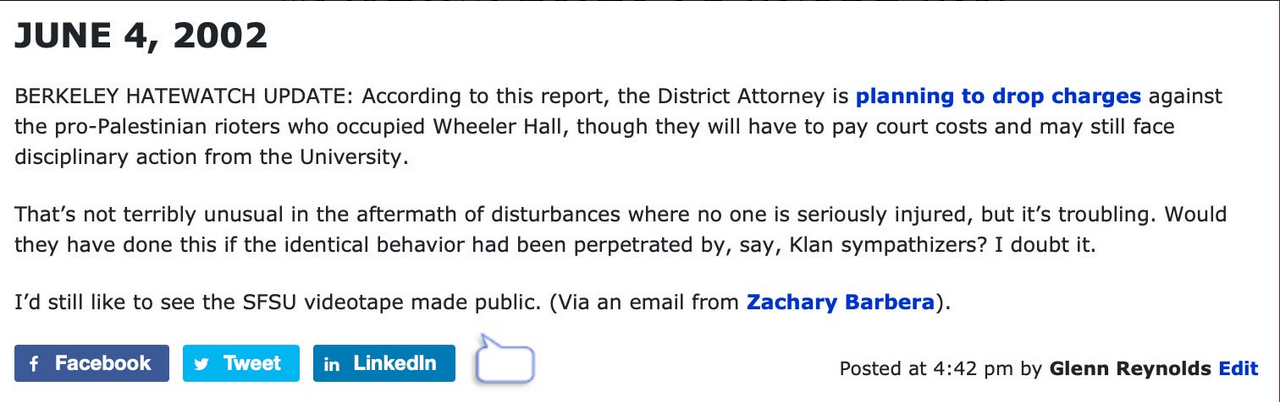
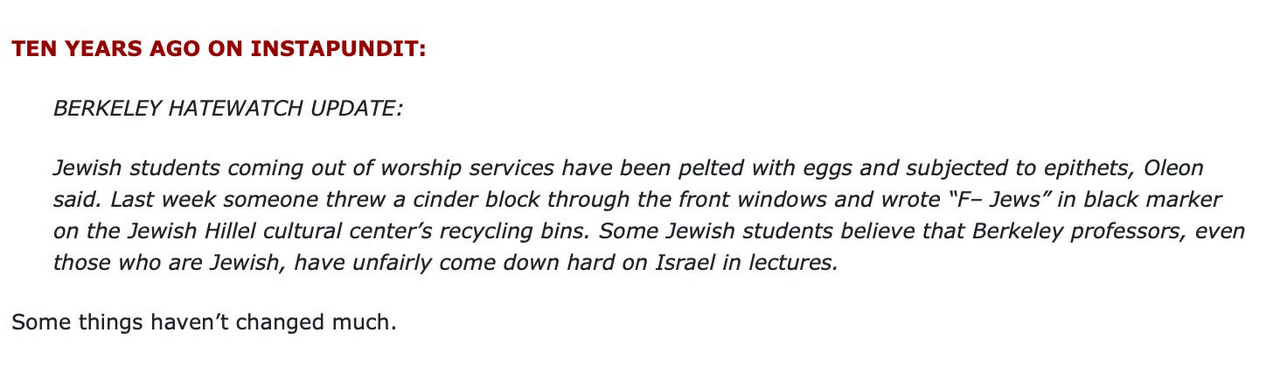
Obviously, he hasn’t been reading my blog. Over 20 years ago I was running a series of posts tagged “Berkeley Hatewatch Update”, tracking hateful and antisemitic behavior at UC Berkeley.
Like this one:
Or this one:
To be fair, Erwin wasn’t Dean at Berkeley Law back then, when it was still called Boalt Hall.
[…]
So even in Chemerinsky’s own backyard, the signs have been there continuously for basically the entire 21st Century to date. If Chemerinsky read my blog, he’d have known about happenings there, and elsewhere throughout the higher education world, that apparently are news to him.
Well, to be fair, deans have more important things to do than read blogs. On the other hand, well, welcome to the party, pal. Pointing out the flourishing, toleration, and even encouragement of antisemitism in the higher education sector has largely been the function of “right wing” outlets. Mainstream and left-wing media (but I repeat myself) have had little desire to air the dirty laundry in public. And, anyway, they’re increasingly staffed with recent graduates from elite schools, steeped in Critical Race Theory, “decolonization” talk, and the like, who see this antisemitism (along with prejudice against Asians and “whiteness”) as natural and laudable, instead of as what it is, which is evil and un-American. The truth is that support for antisemitism and mass murder isn’t an aberration for the far left that dominates American campuses now. As Ilya Somin notes, it’s baked in: “It’s rooted in a long history of defending horrific mass murder and other atrocities”.
October 30, 2023
QotD: Study military history in hopes of avoiding future conflicts
Bret Devereaux, “Collections: Why Military History?”, A Collection of Unmitigated Pedantry, 2020-11-13.
October 29, 2023
“Citizens of the World, Unite! You have nothing to lose but your illusions!”
Sarah Hoyt addresses the people who think of themselves not as Americans, Canadians, Brits, or Germans, but as “Citizens of the world”:

One of the funniest conceit of our age has to be the idea that the sophisticated and “bien pensant” are “citizens of the world”.
I was profoundly amused that Alvin Toffler fell for his in his last book I read sometime in the 90s. Keep in mind that, despite everything else, I believe his Future Shock is brilliant and explains a lot of life in the US in the last fifty years. (Note in the US. I’m not sure about the rest of the world. And I could explain why, but it would sidetrack us a lot more than this.) However the book about how the most powerful were the ones who had the most information (arguable) also pushed the “citizens of the world, not a country” thing as being the one for most powerful people.
I was amused because, though I agree this is the CONCEIT of most self-styled international elites, it is also in practicality, a load of stinking Hooey. (Or as we call it around here, #2 son’s pre-school teacher. Yes, that really was her last name.)
Part of the reason the “elites” believe themselves multinational or “citizens of the world” is oikophobia. They believe themselves to have risen above their co-citizens in their lands of origin, who are … well, in their minds, stupid and uneducated, which is a way to say “less rich” than the “elites”.
Therefore, in the same way that the nobility of old had more in common with other nobility from other lands than with their own country, they think they are a caste set aside and by reason of existing or having money inherently superior to all those who are loyal in and interested in their homelands.
Part of it is the belief that “nationalism” is bad and it led to WWI and WWII. Having been taught that (at this point it, drank it with mother’s milk) the richest and “best” (Most expensively) educated want to get as far away from that as possible, and be at a level when they’re free from that irrational passion, since it’s their conceit that they can rule “impartially” and from above for the good of all.
The problem with it is that not only is none of it true, but they are in fact both more provincial and less well educated than their countrymen. And also that what they aspire to is not only impossible, but really easy to manipulate.
So, the long war of the 20th century was not because of nationalism. In fact, the only explanation I have found for its being assumed to be so is that the international socialists who dominated intellectual discourse for the rest of the century despised the fact that, against their theory, workers of the world didn’t unite, but rather rallied to defend their homeland.
However, if you do a deep dive into the reasons for the first war, ignoring the opinions of those writing about it — which I did, because I was profoundly unsatisfied with the reasons given and none of it made sense — the war’s causation was attempts at internationalism. yes, the internationalism wasn’t of the “supra-national, pseudo worldwide” type (Actually the mask worn by Russian national imperialism) but of the “extended noble family trying to grab the entire world” type. But it was still internationalism, with all the problems of internationalism. (More on that later.)
And the current elites are not “better educated” and don’t rise above much of anything. In fact the world-renowned establishments most of them attend take so many “legacy” and “endowed an entire specialty” students, not to mention “admitted because diversity of skin color or origin” that their meritocratic requirements (I.E. knows or gives a damn about the subject), might be lower than your average state university. Also, once admitted, these people are guaranteed to graduate. Or at least will, barring some particularly egregious violation of code of “everybody knows”.
[…]
But more importantly, these “Citizens of the world” have no clue how their country is constituted, nor how many miles of miles and miles with the occasional house there are in this country. Or that each state has a different culture. Or –
In fact, these people who by and large don’t mix with local populations have a vague idea that the country has a lot more cities/apartments than it does, and that people act more compliant than they do. Because like Europeans, what they know about America is what they see in movies, not realizing movies are made by people like them and are feeding their assumptions back to them.
They also have a vague idea most of the country is easily led, because of course the only reason to disagree with them is that we’re being lied to by extremely persuasive evil people. (That it never occurs to them this might be happening to them, is a measure of [their] lack of self awareness.) Hence their reason to try to get Trump. Because without his evil persuasion, we’d be fully on board with their crazy-cakes insanity.
As for the European elites, I don’t know. I used to hobnob with them, in the sense that I tended to hobnob with the over-educated which were, definitionally, better off than I, but it’s been a minute. However, judging from that and what I see now, my belief is they’re not really “citizens of the world” so much as citizens of their homeland which they secretly believe should rule all nations due to the “nationality” — race/breed being obviously superior.
What I do know is that there is no such a thing as a citizen of the world, no matter the level of self delusion that induces people to believe they are such.
We are all members of our culture. While we can believe everything about our culture is bad and evil, we still project it on everything else we see. Therefore, you know, well to do Americans keep believing criminals and terrorists don’t really exist, and must be decent people driven to extremes by need or oppression. (The results of these beliefs would be hilarious, if they didn’t more or less break everything.) Heck, they keep believing the LAZY or lacking ambition don’t exist, and if people aren’t working hard to succeed it must be because of a terrible condition. (Look up “Bee sting” theory of poverty sometime.)
When the various international elites meet abroad, they each read in the other what they themselves would do, but don’t actually understand each other beyond vague fashion sense, and spending money like water.Ultimately their entire attempt to be “international” seems to consist of an idea that if they just become the people of the song “Imagine” and don’t believe in or care about anything, they can lead people better.
They are wrong because it’s not only impossible to divest yourself of all passion and interest (well, without offing yourself or doing a lot of drugs) but also because it’s impossible to totally divest yourself of your basic culture. (You can acculturate, but that involves a lot of work, and ACQUIRING another culture, which defeats their purpose. The “citizen of the world” culture doesn’t exist, beyond some shibboleths like “humans are killing the Earth” and “The proles are really stupid, eh?”). MORE IMPORTANTLY, even if they managed it, that wouldn’t make them impartial or able to lead anyone to utopia. What it would make them is very, very people-stupid and unable to realize why certain people do certain things, and others don’t. Or why certain countries are the way they are.
In fact, to the extent they’ve managed to shed their culture and replace it with Marxism, all they’ve done is become an unreasoning cult, unable to realize the population isn’t in fact exploding — because people lie in census, and so do nations — but also that there is not only no necessity but no benefit in “eating bugs”.
October 24, 2023
QotD: Nihilism of the left
Leftism is acid. It destroys everything it touches. Leftism enables people to be as evil as they want to be – to do anything, to anyone, at any time – because it teaches that there’s nothing in this world but power, and – crucially – he who recognizes this fact is the smartest, therefore best, persyn of all.
That’s how they win. Ever seen that old tv show The Sopranos? The Mob guys in that show were, for the most part, singularly unimpressive physical specimens – either junkie-skinny or grossly fat, no muscle tone in either case, and goofy-looking to boot. They didn’t win because they were good at fighting; they won because while you were still trying to process the fact that they were making a veiled threat, they started bashing your face in with brass knuckles. They’d get all-the-way violent before normal people realized violence was even a remote possibility.
And they did it with clean consciences. So do Leftists. If Hobbes really was right about the “state of nature” – the war of all against all – then we’ll see soon enough once the Left take over in earnest. As Hobbes put it:
Whatsoever therefore is consequent to a time of war, where every man is enemy to every man, the same consequent to the time wherein men live without other security than what their own strength and their own invention shall furnish them withal. In such condition there is no place for industry … no knowledge of the face of the earth; no account of time; no arts; no letters; no society; and which is worst of all, continual fear, and danger of violent death; and the life of man, solitary, poor, nasty, brutish, and short.
We call them the Nihilists around here for a reason, y’all. This is what they want.
Severian, “Acid”, Founding Questions, 2020-12-17.
October 22, 2023
A lawyer in “deep blue” Pennsylvania discovers that elected bodies don’t have to listen to the voters
Chris Bray on the details of a case from Pennsylvania where an active and involved parent tried to get answers from the elected school board on how they justified imposing masking requirements without a shred of legal power to do so:
In December of 2021, the Pennsylvania Supreme Court ruled that officials in that state had implemented mask mandates that they had no legal authority to impose. The decision in Corman v. Beam is not written in stirring language, and makes no bold declarations about truth, freedom, and the American way; it’s a workmanlike examination of statutory language, quite dull to read. Test me on that characterization, if you want. But the court concluded, importantly, that the mandate had been invalid ab initio — not from the moment the court struck it down, but rather from the moment it was issued. Mask mandates had never been enforceable in Pennsylvania.
In an affluent, deep blue community in the Philadelphia suburbs, a lawyer and parent named Chad Williams took the ruling as vindication. With four children in the local schools, he’d been telling school officials — clearly and often — that they had no legal authority to require masks on campus. To say that they hadn’t listened would be an understatement.
In August of 2020, during a Zoom meeting to decide on in-person school for the soon-to-begin school year, the nine-member Unionville-Chadds Ford school board muted Williams when he asked about the legal basis for the choice.
Repeating the performance, school board members cut the microphones and walked out of one of their own subsequent meetings, in August of 2021, to avoid listening to Williams when he didn’t stop speaking at the three-minute mark during their public comment session. Other parents concerned about forced masking for children received a similarly warm reception. The school board voted unanimously that same night to again impose a mask mandate on their campuses for the new school year.
For Williams, the repeated experience was a shock. He was an experienced lawyer, a parent, an established member of the community, and a volunteer coach at the high school — and he couldn’t get anyone to listen to a reasonable question. He asked his school board to explain the legal basis for a new policy, and “the school board president just cut me off.” Officials were acting in lockstep, without apparent authority, and refusing to explain their choices. “They just wouldn’t answer,” Williams says. Many of us have had this experience.
The school district finally dropped its mask mandate in March of 2022, after the decision from the state Supreme Court. And that was the end — except for one thing. A formal policy of the Unionville-Chadds Ford School District, Policy 906, establishes “a fair and impartial method” for the examination of parent complaints. You can find that policy here, in the section labeled “Community”. The policy is detailed and unambiguous, and starts requiring written reports after the failure of early and informal stages of resolution:
Third Level – If a satisfactory solution is not achieved by discussion with the building principal or immediate supervisor, a conference shall be scheduled with the Superintendent or designee. The principal or supervisor shall provide to the Superintendent or designee a report that includes the specific nature of the complaint, brief statement of relevant facts, how the complainant has been affected adversely, the action requested, and the reasons why such action should be taken or not taken.
Fourth Level – Should the matter not be resolved by the Superintendent or designee or is beyond his/her authority and requires Board action, the Superintendent or designee shall provide the Board with a complete report.
Final Level – After reviewing all information relative to the complaint, the Board shall provide the complainant with its written decision and may grant a hearing before the Board or a committee of the Board.
Williams used Policy 906 to ask the school board to think about what it had done, conducting an independent review of its policy decisions during the pandemic. Why had school officials implemented policies they had no legal authority to impose? Why had they refused to discuss or address parent questions? Why had they stonewalled requests for documents and information — not only from parents, but from a state senator who took an interest in the matter? Williams asked for an apology and “changes in oversight” to prevent a recurrence of unlawful and unexplained policy decisions, using formal school district policy that requires the district to act on complaints.
They haven’t bothered. The Unionville-Chadds Ford School District continues to ignore Williams, not responding to his complaints or opening the inquiry their own policy requires them to pursue. He’s had one sort-of response: In an exchange over the handling of the complaint, the district’s lawyers, at a private law firm, threatened him with legal action — a threat they so far haven’t made good. But from school district officials, the only response to three years of questions is unbroken silence.

October 18, 2023
The greatest sin of Twit-, er, I mean “X” is that it allowed us hoi polloi to peek behind the curtains of governments, universities, and major corporations
The latest book review at Mr. and Mrs. Psmith’s Bookshelf begins with a brilliant explanation for the coming fall of western civilization at the hands of Twit-, er, I mean “X”:

The greatest gift bestowed by admittance to elite institutions is that you stop being overawed by them. For instance, there was a time when upon hearing “so-and-so is a Rhodes Scholar”, I would have assumed that so-and-so was a very impressive person indeed. Nowadays I know quite a lot of former Rhodes Scholars, and have seen firsthand that some of them are extremely mediocre individuals, so meeting a new one doesn’t phase me much. My own cursus honorum through America’s centers of prestige has been slow and circuitous, which means I’ve gotten to enjoy progressive disenchantment with the centers of power. Trust me, you folks aren’t missing much.
I have a theory that this is why Twitter has been so destabilizing to so many societies, and why it may yet be the end of ours. Twitter offers a peek behind the curtain — not just to a lucky few,1 but to everybody. We’re used to elected officials acting like buffoons, but on Twitter you can see our real rulers humiliating themselves. Tech moguls, four-star generals, cultural tastemakers, foundation trustees, former heads of spy agencies, all of them behaving like insane idiots, posting their most vapid thoughts, and getting in petty fights with “VapeGroyper420.” There’s a reason most monarchies have made lèse-majesté a crime, there’s a level at which no regime can survive unless everybody pretends that the rulers are demigods. To have the kings be revealed as mere men who bleed, panic, and have tawdry love affairs is to rock the monarchic regime at its foundations. But Twitter is worse than that, it’s like a hidden camera in the king’s bedroom, but they do it to themselves. Moreover it seems likely that regimes like ours which legitimate themselves with a meritocratic justification are especially fragile to this form of disenchantment.
This is also why the COVID pandemic was so damaging to our government’s legitimacy. I’ve been inside elite institutions of many different sorts, and discovered the horrible truth that most of the people in them are just ordinary people making it up as they go along, but one place I hadn’t quite made it yet was the top of our disease control agencies.2 So in a bit of naïveté analogous to Gell-Mann amnesia, I just assumed that there was some secret wing of the Centers for Disease Control which housed men-in-black who would rappel out of helicopters and summarily execute everybody in Wuhan who had ever touched a bat. And I was genuinely a little bit surprised and disappointed when instead they were caught with their pants down, and a bunch of weirdos on the internet turned out to be the real experts (the silver lining to this is that now we all get to be amateur scientists).
So much for public health. But if there’s one institution which still manages to shroud itself in mystery while secretly pulling all the strings, surely it’s the Federal Reserve. You can tell people take it seriously because of all the conspiracy theories that surround it (conspiracy theories are the highest form of flattery). And there’s a lot to get conspiratorial about — the Fed manages to combine two things that rarely go together but which both impress people: technocratic mastery and arcane ritual. The Fed employs a research staff of thousands which meticulously gather and analyze data about every aspect of the economy, and they have an Open Market Committee whose meeting minutes are laden with nuanced double-meanings that would make a Ming dynasty courtier blush, and which are accordingly parsed with an attention to detail once reserved for Politburo speeches.
And they also control all of our money! Is it any wonder that people go a little bit crazy whenever they think about the Fed? I can’t think of a more natural target for the recurring cycles of ineffectual populist ire that characterize American politics. So it is with great regret that I’m here to report that they, too, are making it all up as they go along.
1. And that lucky few have much to gain by maintaining the charade. A stable ruling class is one that has much to offer potential class traitors, so they don’t get any ideas. It’s when the goodies dry up, whether due to elite overproduction or to a real reduction in the spoils available, that things fall apart.
2. That’s not quite true: I did once attend an invite-only conference at the United States Army Medical Research Institute of Infectious Diseases. The food was awful, and I wasn’t even able to find the lab where they created crack cocaine, HIV, and Lyme disease.
October 15, 2023
Training and educating for unseriousness
Theophilus Chilton on the many ways our education and entertainment industries inculcate trivial and easily distracted habits in both children and young adults:

Any thinking American has surely observed that our culture and society are growing more and more immature, childish, and unthinking with each passing year. In previous articles, I’ve noted this immaturity, as well as the tendency (neither coincidental, nor accidental) to make Americans more and more dependent upon the Regime for even the most basic needs of life. There are several interrelated cultural and political agendas at work which have systematically worked to create this state of affairs among the American people – and these are largely the work of social and political “progressivism”, the handiwork of the Left. Let’s face it – it is to the benefit of left-wingers to cause as many people as they possibly can to be dumb, distracted, and therefore destitute of the ability to think for themselves or to successfully reason their way into informed opinions about complex social and economic issues.
One of the major ways in which the Left dumbs down the American population is through the public education system. What people need to understand is that progressives are not genuinely interested in our children receiving a thorough and useful education, no matter how much they may squawk about “funding” and whatnot. For the Left, publik skoolz are merely a means by which to propagandize children to a progressive worldview while simultaneously rendering them unable to question the unreality they have been taught. At the same time, additional funding “for schools” is basically just a way for personnel in the managerial superstructure to divide the spoils. The Left has absolutely no desire for children to grow up into college students, and then into full-fledged adults, who can think for themselves, using logic and reason to assess what they see and hear and to come to their own conclusions.
Along these lines, I was reminded of Pascal-Emmanuel Gobry’s article from 2014 in Forbes magazine about the need to put the liberal arts back into the centre of American educational curricula. By this, he means the restoration of the great books of Western civilization, the accumulated wisdom in the sciences and humanities that our culture has built, and the ideological underpinnings upon which Western notions of citizenship, responsibility, and the rule of law are based. In other words, all of the things that the cultural Marxists have spent the last five decades systematically expunging from the American educational system, from top to bottom. Things like Cicero, Plato, the Church Fathers, Shakespeare, Herodotus, Montesquieu, the Founding Fathers, and so much more that I could not possibly list in full. No – these have been purged, replaced by Heather Has Two Mommies and Why Are the Ice Caps Melting?: The Dangers of Global Warming. Progressives want young people (who will then grow up to be old people) who are in the dark about the whats, hows, and whys of our cultural underpinnings and what they all mean for our heritage and traditions. They want your kids to be more interested in emasculating themselves with hormones than they are in reading dusty old books about their own history and heritage. This explains why progressives are so irate about the proposals such as those which remove diversity and LGBT propaganda from classrooms, just to give a couple of examples.
However, I don’t believe we can place the blame solely on the educational system. It surely has not escaped the attention of intelligent Americans that most of what constitutes our entertainment and media establishment is, shall we say, less than cerebral. In fact, much of what is on television, in the movies, and on the radio waves is downright stupid and distracting. It is literally distracting. The content of these media, as well as the advertising regimen by which television viewers are presented with five minutes of show, then three minutes of ads, then another five minutes of show, then another three minutes of ads … it is all designed to train people toward short attention spans that are easily distracted by shiny baubles and other mindlessness. A person who has their brain trained by modern television programming is going to be someone who will not have the patience to sit down with a book and read it. They’ll literally be uneducable beyond simple repetition and mindless obedience.
The state of American journalism is no better. This is illustrated by Gobry’s article above, in which he addressed the attacks upon Republican congressman (nominee at the time it was written) Dave Brat of Virginia, an economics professor who overturned Eric Cantor in the 2014 GOP primary, and who is a genuine constitutionally-minded intellectual who stands on the fundamental principles of our society and constitutional system (meaning, of course, that he’s still a turbonormie but at least his heart’s in the right place). In the course of some statements he made, Brat remarked that government has “a monopoly on the use of force”. For this, he was attacked by nimrods in the news media as some kind of crazy, wacko extremist. There’s just one problem, as Gobry points out,
What’s wrong with this picture, America, is that the concept of the state having “a monopoly on the [legitimate] use of force” is a quotation from the highly reputed and important German sociologist Max Weber, and is a concept that is absolutely basic to our modern understanding of the State. Anyone who has taken polisci 101 or sociology 101 or political philosophy 101 or history of ideas 101 ought to have encountered the phrase. It is about as offensive as saying that donuts have holes …
In other words, journalists – who are supposed to be educated, and who, if they are dealing with the political circuit, should have at least some sort of basic education in political science to go with their typewriting skills – had no clue what Brat was talking about. They didn’t recognize Weber’s (very commonly quoted) dictum; most of them probably don’t even know who Max Weber was. All they saw was what they thought was an opportunity to play the “Tea Party wacko extremist” card because somebody used the words “force” and “government” in the same sentence.
The sad part is that it probably worked with a lot of the low-information voters out there.
A paper in the Journal of Pediatrics by Peter Gray, David F. Lancy, and David F. Bjorklund points to the ever-declining ability of children and teens to engage in independent activity away from direct adult supervision from a very early age:
It is no secret that rates of anxiety and depression among school-aged children and teens in the US are at an alltime high. Recognizing this, the American Academy of Pediatrics, American Academy of Child and Adolescent Psychiatry, and Children’s Hospital Association issued, in 2021, a joint statement to the Biden administration that child and adolescent mental health be declared a “national emergency.”
Although most current discussions of the decline in youth mental health emphasize that which has occurred over the past 10-15 years, research indicates that the decline has been continuous over at least the last 5 or 6 decades. Although a variety of causes of this decline have been proposed by researchers and practitioners (some discussed near the end of this Commentary), our focus herein is on a possible cause that we believe has been insufficiently researched, discussed, and taken into account by health practitioners and policy makers.
Our thesis is that a primary cause of the rise in mental disorders is a decline over decades in opportunities for children and teens to play, roam, and engage in other activities independent of direct oversight and control by adults. Such independent activities may promote mental well-being through both immediate effects, as a direct source of satisfaction, and long-term effects, by building mental characteristics that provide a foundation for dealing effectively with the stresses of life.
With few, if any, opportunities to explore and engage with the world away from parental supervision, it isn’t a surprise that young adults today suffer much higher rates of mental illness, especially anxiety-related afflictions.
October 12, 2023
QotD: America before identity politics
Pick even minor items of their catechism (if so all-encompassing a creed as Leftism can be said to have “minor” items). It’s an article of the One True Faith, for instance, that seven out of every five college girls are raped the minute they set foot on campus. And yet … free college! Yeah, Bernie, let’s march a whole bunch of new rape victims straight into the frat house, on the taxpayer’s dime. Makes sense. And speaking of free college, y’all know how you love to wave your degrees around, because that’s how you win at Internet? How’s that going to work, now that everyone has a Gender Studies degree?
Yeah, ok, I know, if they could see the obvious consequences of their actions, they wouldn’t be Liberals in the first place. But still — all of this is so obvious, so determinedly cattywampus to reality, that it has to be by design. T.S. Eliot was right — it’s “gesture without motion”, but I’ll be damned if I can figure out how they pull that off. Which is why I suspect it’s actual, neurological changes in their brains, brought about by too much soy.
Severian, “The Hollow Men”, Rotten Chestnuts, 2020-12-19.
1. Gosh, wasn’t The America That Was a hoot? If you’re under 35 you’ll just have to trust me on this, but there was a point in American history when homosexuals didn’t have to be 1000% gay all the time, to the exclusion of everything else. I know, I know, and it gets weirder – back then, you could even be friends with a homosexual and not have homosexuality come up for days, weeks, even months at a time! You and Steve went to different bars on Saturday night, but other than that, you pretty much just carried on treating each other like, you know, people. And I know this sounds crazy, but even when talking about relationships it wasn’t a big deal. “Hey, Sev, how are things with Becky?” “Pretty good, man, how’s it going with Todd?” And … that was pretty much it. Sounds like life on Mars now, but I swear to you, it happened.
October 10, 2023
Sarah Hoyt – “Shut your Kumbaya”
Sarah Hoyt isn’t normally one to mince her words or conceal her true feelings, and she certainly doesn’t do that here:
The world is full of pretty lies. And normally, I’m able to scroll past them and go “oh, idiocy, more idiocy”.
Today is not that day. No, listen to me. Today is not that day.
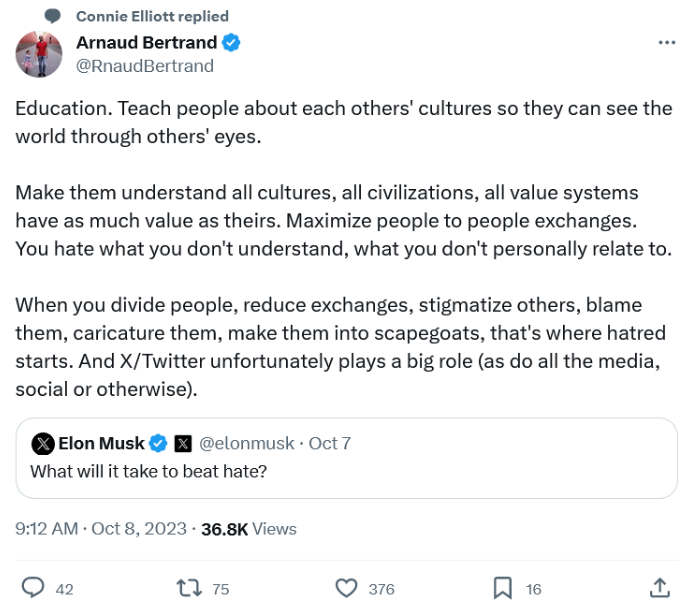
I was scrolling through twitter looking for an update on the war in Israel, and I came across this:
And I stopped. And I read that post. Every single word of it is a lie. A lot of it are pernicious lies. And they’re told by well-intentioned people who can’t or won’t look at the world without the rose-colored glasses.
It’s not just these things are lies. It’s “they’ve been proven to be lies, over and over again”. But a lot of, perhaps the majority of “educated” people in the west piously believe them. Because they want them to be true.
Start therefore with that “Education” — education can be many things, but some of the best educated people in the world at the time led World War I. And while on that, do you realize the cultures fighting knew each other very, very well. Heck, most of the nobility was related to each other across Europe. Which did not stand in the way of turning Europe into one vast abattoir.
In fact, most of the vicious wars were civil, or between neighboring countries that knew each other’s cultures intimately. So this “Get to know the other culture better” is utter and complete poppycock. Or as the British say “Bollocks”. And smelly bollocks, at that.
As for all cultures, all systems, all value systems being equally worthy of respect?
Oh, really? So, a culture that enslaves women is the same as one that values women? A culture that protects and takes care of the weak is the same as one that tortures and kills them? A culture that welcomes difference is the same as one that pounds down the nail that sticks up? A system where — as in all communist systems — a small elite lives very well while others starve is the same as one where private property allows even the poor to suffer from obesity? And a culture that doesn’t believe it has to exterminate its neighbors is the same as one that does?
Don’t be ridiculous.
And as for not stigmatizing, dividing, etc? Pernicious bullshit. Pernicious bullshit on stilts. The horrible savages who kidnapped innocent people at a rave and raped women to death are not the same as people who are breaking themselves trying to spare the innocent. There is no comparison.