
A Canadian Broadcasting [Corporation] program also debuted a new term this past week: “non-straight cisgender people.” This is the newly approved newspeak for gay people, parsed through the language of critical queer studies. The proponents of this new language seem eager to retire familiar terms like “gay men” or “lesbians” — perhaps because they suggest that the homosexual experience is rooted in basic human nature and can exist outside the parameters of structural oppression. So they find ways to define us in terms of queer theory, insisting there are only oppressed LGBTQ+ people. That’s also why, for example, so many on the left insist that gay white men had very little to do with Stonewall, which was led, we’re told, by trans women of color, subsequently betrayed by white men, who stole the movement from them. That this is untrue is irrelevant. It’s a narrative which serves to dismantle structures of oppression. And that’s all that matters.
Leading progressive maternity and doula organizations now deploy and encourage a whole array of “gender-neutral language” with respect to sex, birth, labor, and parenting. And so we now have the terms “chest-feeding,” “persons who menstruate,” “persons who produce sperm,” and “birthing person” for breastfeeding, women, men, and mothers, respectively. And instead of a butthole, we have a “back-hole”; instead of a vagina, we have a “front hole.” “Ovaries” and “uterus” are now rendered as “internal organs,” which may strike you as somewhat vague. These may sound completely absurd now, but given the choke hold critical gender theory has on almost all elite organizations, you can be sure you’ll hear them soon enough. They’ll likely be mandatory if you want to prove you’re not a transphobe. It was an objection to one of these terms — “people who menstruate” — that got J.K. Rowling tarred again as a bigot.
Those of us who oppose this abuse of the English language, who try to abide by Orwell’s dictum to use the simplest, clearest Anglo-Saxon words to describe reality, are now instantly suspect. Given the fear of losing your job for resisting this madness, most people will submit to this linguistic distortion. As you can see everywhere, the stigma of being called a bigot sweeps away all objects before it. But the further this goes — and there is no limiting principle in critical theory at all — the less able we are to describe reality. Which is, of course, the point. Narratives, only narratives, exist. And power, only power, matters.
Andrew Sullivan, “China Is a Genocidal Menace”, New York, 2020-07-03.
October 5, 2020
QotD: Language changes to accord with critical studies theory
October 1, 2020
Far from being in trouble, Canadian film and TV investment has nearly doubled in the last 10 years
The Canadian government — particularly Canadian Heritage minister Steven Guilbeault — is eager to pass legislation to “get money from the web giants” and their primary justification is the claim that Canadian TV and movie funding has been shrinking. As Michael Geist explains, that’s a pants-on-fire lie:

CMPA Profile – Financing, Sources: CMPA Profile 2019, 2016, 2013
Canadian Heritage Minister Steven Guilbeault has said that his top legislative priority is to “get money from web giants.” While much of the attention has focused on his ill-advised plan to require Facebook to obtain licences for linking to news articles, his first legislative step is likely to target Internet streamers such as Netflix, Amazon and Disney with new requirements to fund Canadian content and to increase its “discoverability” by making it more prominent for subscribers. Based on his comments at several town halls, Guilbeault is likely to also create new incentives for supporting indigenous and persons of colour in the sector with a bonus for those investments (potentially treating $1 of investment as $1.50 for the purposes of meeting Cancon spending requirements). Much of the actual implementation will fall to the CRTC, which will be granted significant new regulatory powers and targeted with a policy direction.
Guilbeault’s case for establishing new mandated payments is premised on the claim that support for the film and television sector is declining due to the emergence of Internet streaming services, which have resulted in decreased revenues for the conventional broadcast sector and therefore lower contributions to Cancon creation. In fact, Guilbeault recently told Le Devoir that without taking action there would be a billion dollar deficit in support in the next three years. He says that his objective is to actually generate a few hundred million more per year in local production by the Internet streamers. In other words, he’s expecting roughly $2 billion in new investment over three years in Cancon from U.S. entities due to his planned regulations (moving from a billion dollar deficit to a billion dollars in extra spending).
While Guilbeault frames these regulatory requirements as a matter of fairness and “rebalancing”, industry data over the past decade tell a much different story. Indeed, there has been record setting film and television production in recent years, much of it supported by companies such as Netflix. CRTC chair Ian Scott last year said that Netflix is “probably the biggest single contributor to the [Canadian] production sector today.” While that is not entirely true – the data suggests that Canadian taxpayers are the biggest contributor with federal and provincial tax credits consistently the largest source of financing – the claim that there is a billion dollar deficit coming or that foreign streamers do not contribute to film and television production in Canada without a regulatory requirement is simply false.
September 30, 2020
The feds go trampling all over provincial responsibilities again
Ted Campbell suggests that even a cursory reading of the constitution does not give the federal government the power to trespass (again) in what is clearly, legally, a provincial government area of responsibility:
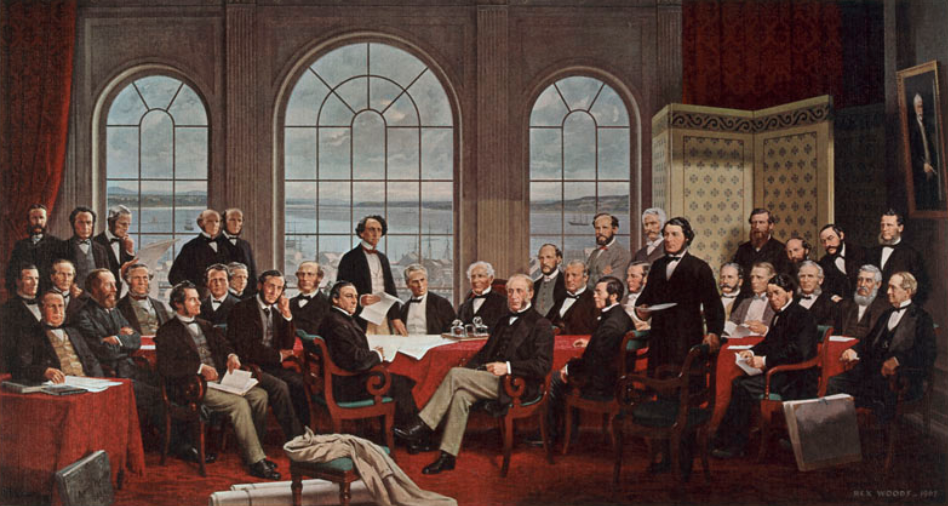
“The Fathers of Confederation”
The original painting by Robert Harris (1884) was destroyed in the 1916 Parliament Building fire, and this image for the “Gallery of Canadian History” series of lithographs by Confederation Life Insurance Company is based on a photograph by James Ashfield (1885).
Libraries and Archives Canada item ID number 3013194. http://central.bac-lac.gc.ca/.redirect?app=fonandcol&id=3013194&lang=eng
[T]he Parliament of Canada should look to §91. Here is what the Constitution says are the areas of national government’s concern: The Public Debt and Property; The Regulation of Trade and Commerce; Unemployment insurance; The raising of Money by any Mode or System of Taxation; The borrowing of Money on the Public Credit; Postal Service; The Census and Statistics; Militia, Military and Naval Service, and Defence; The fixing of and providing for the Salaries and Allowances of Civil and other Officers of the Government of Canada; Beacons, Buoys, Lighthouses, and Sable Island; Navigation and Shipping; Quarantine and the Establishment and Maintenance of Marine Hospitals; Sea Coast and Inland Fisheries; Ferries between a Province and any British or Foreign Country or between Two Provinces; Currency and Coinage; Banking, Incorporation of Banks, and the Issue of Paper Money; Savings Banks; Weights and Measures; Bills of Exchange and Promissory Notes; Interest; Legal Tender; Bankruptcy and Insolvency; Patents of Invention and Discovery; Copyrights; Indians, and Lands reserved for the Indians; Naturalization and Aliens; Marriage and Divorce; The Criminal Law, except the Constitution of Courts of Criminal Jurisdiction, but including the Procedure in Criminal Matters; The Establishment, Maintenance, and Management of Penitentiaries; and Such Classes of Subjects as are expressly excepted in the Enumeration of the Classes of Subjects by this Act assigned exclusively to the Legislatures of the Provinces.
In that looooong list I can find more than adequate justifications for ministers and government departments that are responsible for: finance and revenue; industry, trade, and commerce; defence; foreign affairs; transport; fisheries and oceans; citizenship and immigration; health; and for independent agencies like the Bank of Canada, Canada Post and Statistics Canada. I cannot find anything that says we need a Minister for Women and Gender Equality, nor one for Diversity, Inclusion and Youth nor, especially, Ministers for Canadian Heritage and Middle Class Prosperity.
A lot of things have changed since 1867; the telegraph was still fairly new and innovative, a practical telephone wouldn’t be invented until ten years after confederation and the first useful long-haul radio transmission and reception, from Britain to Signal Hill in St John’s didn’t come until the dawn of the 20th century, thus ideas like the CBC, the Internet, Netflix, air traffic control and the North Warning System were far beyond the imagination of the men ~ they were pretty much all men, working in government, back in the 1860s, weren’t they? ~ who drafted the Canadian Constitution.
What was clear to them, based on the United States experiences, was that §90 to §95 which spell out “who does what to whom” were important to the functioning of a federal state, especially to one in which traditional provincial rights and diverse cultures were well established. Now, it is important to remember that in Canada’s long and rich history there were instances, especially during great wars, when the provinces agreed to federal intrusions into their areas of responsibility; this is not one long story of federal bullying. But what seems perfectly clear to me ~ and I suspect to e.g. John Horgan, Jason Kenney, Doug Ford, François Legault and the other premiers is that last week’s Throne Speech marks another major and quite unjustified federal assault on their jurisdictions. What’s happened, according to Manitoba Premier Brian Pallister, is that the provinces have all the health care delivery problems but, thanks, in some part, to tax decisions made in 1942, the feds have all the money. The solution is blindingly obvious: transfer tax “points” as some experts call them, to the provinces so that they, not Justin Trudeau, who have the problems of too few physicians, too few nurses and too few hospital beds also have the money to solve them.
September 25, 2020
From Normandy To The Rhine – Jesse’s Grandfather in WW2 I RHINELAND 45
The Great War
Published 23 Sep 2020Back Rhineland 45: https://realtimehistory.net/rhineland45
Jesse shares the service history of his grandfather James who fought in the Canadian Army.
Contains licensed material by getty images
All rights reserved – Real Time History GmbH 2020

September 23, 2020
Federal minister admits the Libranos’ plan is a shakedown to “get money from web giants”
Michael Geist on a rare moment of honesty from Canadian Heritage Minister Steven Guilbeault on the federal government’s atrocity of an internet regulation plan:
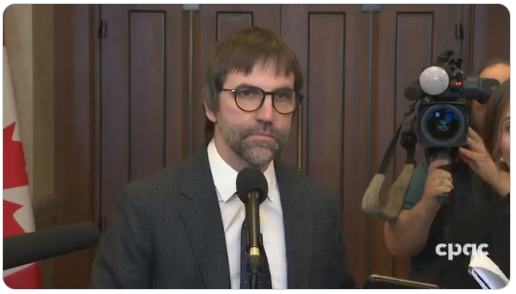
Canadian Heritage Minister Steven Guilbeault, 3 February 2020.
Screencapture from CPAC video.
As Canadian Heritage Minister Steven Guilbeault prepares an Internet regulation plan that features the prospect of licences for linking, undermining net neutrality, and trade sanctions, he has typically argued that “it’s about fairness”, suggesting that foreign companies unfairly benefit from the Canadian market at the expense of domestic companies. Yet when Guilbeault appeared at a production sector town hall last week, he was far more candid. Guilbeault told the sector that in a minority government situation, his department had to choose between a massive bill changing “everything under the sun” or to slice it up into smaller pieces. Having chosen the piecemeal approach, Guilbeault pointed to his top priority: get money from the foreign Internet companies (his exact words at 47:58 were “the most pressing thing we needed to do was to get oxygen into the system, which is money. And go and get that money where that money is. Which is web giants.”)
In certain respects, the acknowledgement that this amounts to little more than a shakedown makes sense. CRTC Chair Ian Scott has said that Netflix is now probably the largest contributor to film and television production in Canada and the sector enjoyed record production numbers pre-COVID-19, so the data simply does not support claims that the streamers are hurting the industry. As for the news sector, the Minister has failed to deliver millions in promised tax credits and seemingly now wants an alternative that involves creating a licensing regime for linking to content.
Yet if the goal is simply a matter of wanting more money from Internet companies that can be used to support Canadian cultural policies, it is not clear why this is a matter for the Heritage Minister. Everyone wants more money from the Internet companies and countries around the world have a credible argument that the huge global Internet revenues should be more equitably apportioned among them. In other words, the way to “get money from web giants” is for Finance Minister Chrystia Freeland to tax them on their revenues. Those tax revenues would go into general tax revenues and can be spent in an transparent manner without the need for specialized subsidy programs. This isn’t easy. The U.S. unsurprisingly objects to a potential reduction in its tax revenues, which means that Canada must find allies with other countries in seeking global solutions on tax. Further, Guilbeault candidly recently told a publisher town hall that changes to the tax code is far more difficult than direct program spending.
The problem with Guilbeault’s preference for direct program spending subsidized by Internet companies is that it raises a host of complications and negative effects. For example, mandated Canadian content spending for companies such as Netflix could require the companies to pay into a fund that supports Canadian content production. However, the current rules make it challenging for those same companies to access those funds for their own productions. That leads to either a trade challenge (and the possibility of tariffs against key Canadian sectors such as dairy and steel) for being forced to pay into a system that is inaccessible to foreign providers or a reform to the system that would open things up to foreign providers and in the process undermine the competitiveness of domestic producers and broadcasters who are more reliant on tax credits and funding programs.
September 20, 2020
The CBC’s latest bit of “mission creep”
At The Line, Jen Gerson wonders what the hell the CBC thinks it’s doing with this move:

Let us take a moment to leverage a little credibility under the CBC’s ass.
What the fuck is the CBC playing at, here? The corporation receives a cool $1 billion in public funding per year and it’s using taxpayer funds to, yet again, horn into the revenue streams of private communications outlets. No one — literally not a single Canadian taxpayer who isn’t already employed by the CBC — wants to throw money at a public broadcaster so that it can: “Help Canada’s strongest brands shape and share inspiring stories across our platforms and across the country.” Vomit.
No one asked for a taxpayer-funded advertising firm, you goddamn loons.
This is yet another classic example of one of the most dysfunctional habits of the MotherCorp: mission creep. A massive and rudderless operation unfettered from the practical limitations of profit-seeking has proven itself unable to restrain its own boneheaded impulses.
We, at The Line, can hear the pitiable defences already: “Oh, but they’re already underfunded. Of course they need to, uh, use their incredible taxpayer-funded competitive advantage to eat into the dwindling revenue streams of failing private media outlets just to survive!”
No. No. No they do not.
When faced with a dysfunctional hydra-headed cultural behemoth that is demonstrably incapable of keeping its mandate in its pants, the first impulse should not be to shovel ever-more taxpayer funds into the ever-widening maw. The CBC could respond to *cough* “inadequate funding” by narrowing its scope and focus to the things that make it most necessary to the Canadian public that it serves — radio, news, documentary, serving regions and topics that the private sector cannot adequately penetrate. Instead it goes off and does weird shit like this, and CBC Comedy, and CBC Music.
CBC. Guys.
You cannot be everything to everyone. You shouldn’t be everything to everyone. Canadians are not well served by a monopolistic government-funded one-stop #content communications shop. Figure out what you do best and stick to it. Focus on supplementing — rather than crushing — private-sector journalism. Maybe even consider ways to support private-sector start ups and independents, especially in local markets. “Revenue generation” is not the place where a public broadcaster should demonstrate self-defeating, industry-following innovation.
September 19, 2020
QotD: Dictatorship of the Cancel Culture proletariat
While not the most important, the first of these points is the most relevant on a day-to-day basis. Without endorsing these behaviours, the plain fact is that the huge majority of people have probably at some point told an ethnic or regional joke, sent a pornographic or un-PC snap, had sex while intoxicated, used a slur tied to sexual orientation / race / gender online or in the lockerroom, worn a St Paddy’s Day or Cinco de Mayo outfit they would really prefer a mulligan on, or committed other Cardinal Sins against Wokeness. As a result of this, many young people are intently aware that Twitter and Facebook wars involving the unearthing of old content generally end with egg on the face of everyone involved. Caucasian NBA point guard Donte DeVincenzo was humiliated in late 2018 by the revelation that – at age 14 – he had described his hoops handle as “ballin’ on these nig*as like I’m Derrick Rose”. He ended up deleting his entire social-media presence. The point of monitoring this sort of thing, for the many people and organisations that do so, is not punishing the tiny minority of real racists and abusers out there so much as keeping normal citizens too terrified by the potential unearthing of past indiscretions to comment lustily on the issues of the day.
The fact that virtually anyone could in fact “legitimately” be cancelled leads into extreme partisan hypocrisy. While anyone who attended church as a lad might correctly suspect that the hard right is capable of similar behaviour, cancellers today are overwhelmingly concentrated on the “social justice” left – and they are, at least occasionally, reluctant to eat their own. This often results in remarkable and hilarious double standards. In February 2018, for example, liberal Virginia governor Ralph Northam – nicknamed “Coonman” – escaped any serious censure after he was revealed to have apparently appeared in a mid-1980s high-school yearbook photo wearing shoe-polish blackface.
To be fully fair to Northam, the same photo included a student dressed in full white robes as a Ku Klux Klansman, and CNN has noted that Northam has never actually said “whether he was wearing the Ku Klux Klan outfit or [the] blackface”. Oh, fair enough. At any rate, he serves as governor of Virginia today. Not to be outdone by any of his neighbors to the south, Canadian prime minister Justin Trudeau was revealed that same year to have worn black- and brown-face several times, and as late as 2001, once apparently painting his entire body to appear in costume as Aladdin at an Arabian Nights revue! He, too, remains solidly entrenched in office today.
Wilfred Reilly, “They can’t cancel all of us”, Spiked, 2020-06-17.
September 16, 2020
The Canadian echo chamber on American political issues
Ben Woodfinden’s latest for The Dominion looks at the weird effects political passions in the United States have on political stances in Canada:

Restricted and prohibited weapons seized by Toronto police in a 2012 operation. None of the people from whom these weapons were taken was legally allowed to possess them.
Screen capture from a CTV News report.
Participatory media increasingly defines and shapes our discourse. It submerges us in a broader reality but only does so by filtering it into a digital reality that offers a distorted reflection rather than picture of the real world. This has been going on for at least a decade now, but the pandemic has accelerated this transformation of our discourse and politics. By locking us in our homes the pandemic forces us to view the world through a digital lens even more than we already did, and in a world where we’re all viewing everything through our screens that digital reality becomes closer and closer to our primary reality.
One of the specific, and most pernicious effects of this, as I lamented in The Critic is that it turns us all into online Americans participating in their politics through the digital medium, rendering us virtual participants and not just foreign observers. I won’t repeat myself too much, I’d recommend just reading the piece [link], but the online realm is American, and what digital politics does is make politics everywhere more American. We participate in it as a game and a form of entertainment. This bleeds back into our own politics.
Americanized Discourse
Gun politics is one particular political issue where Americanized discourse is most pronounced. It captures perfectly how Americanization plays out. Every time there is some sort of tragic shooting or discussion of gun violence in Canada the debates play out in depressingly predictable ways. Progressives and Liberals paint a picture in which Canada suffers from the kind of rampant gun violence and mass proliferation of firearms as in America. This is the framing used to justify often highly symbolic or ineffective new gun laws and restrictions that, while often not all that effective, make the Liberals and progressives seem like the party for gun control in the face of this rampant violence. But only if you pretend we live in America.
And it’s not just the Liberals and progressives who play this game. Listen to some of the more vocal advocates of “gun rights” in Canada and you’d think we have a second amendment in the Charter. One side wants to make it seem like Canadians are walking around with and easily able to acquire assault weapons, the other side wishes it were so! The reality of course lies somewhere in between. Gun possession is heavily regulated, but lawful citizens can still buy firearms if they want to, and there is no explicit right in the Charter that prevents the government from regulating and restricting firearms. Talking about gun “rights” in Canada is itself quite a foreign and imported concept. At the same time we don’t have an epidemic of gun violence, and while we have experienced some horrific mass shootings, like the recent Nova Scotia tragedy, gun violence in Canada pales in comparison to the United States.
But because both sides are essentially happy to help paint a phantasmic picture of gun violence and/or gun regulations in Canada, we end up with a surreal politics around guns. Sensible debates around guns are made harder by this because debates take place on top of a framing and narrative that draws explicitly on American political culture more than it does Canada’s. Both sides want to take on American roles and are happy to contribute to this framing.
Gun politics is just one example, and there are so many others. Our discourse is so often built around framings that make it seem as if the issues and political cleavages here are indistinguishable from American ones, but it only happens because we import American framing and narratives into our own discourse and then build are arguments around these phantasms. We, like many other countries around the world, are in the middle of a moment of racial reckoning, or whatever you want to call it, because of something that happened in Minneapolis, not in Canada.
Racism is a real thing in Canada, no honest person should deny this, because there is racism in absolutely every country and society. But in the wake of George Floyd’s killing we ended up having a conversation about racism that reflected the particular ways racism works in America.
Lockdown justification theories
In the most recent Libertarian Enterprise, Sean Gabb reports on a demonstration last month in London organized by Piers Corbyn which resulted in Corbyn being almost instantly fined £10,000 despite other, larger and more violent demonstrations not drawing any kind of judicial sanctions:

David Icke about to speak at Piers Corbyn’s 20 August anti-masking demonstration in Trafalgar Square.
Screencap from YouTube video – https://www.youtube.com/watch?v=DOZQ58uTWdw
The consensus at the demonstration appears to have been that the Coronavirus is some kind of fraud, and that the laws to stop its spread are really intended to carry us into a nightmarish New World Order tyranny. I disagree with this view. I believe instead that, looking back from one or two years, the Coronavirus Panic will be seen as a disaster for at least the British ruling class, and as somewhere between a blessing and nothing very bad for the majority of everyone else.
For the avoidance of doubt, I have no belief in the goodness of our ruling class. The Labour Party represents a new and hegemonic Establishment. The project of this Establishment is to bring about changes that are meant to be fatal to the traditional peoples of my country, and that will not be to the advantage of the groups they are supposed to raise up. Whether this project is evil or deluded is beside my present point, though it is probably something of both. There are two possible views of the Conservative Party. It may be worth supporting because, though willing to see it roll forward of its own momentum, the leaders do not want to hurry the project forward, but are mainly interested in personal enrichment. Or it may be a Potemkin opposition — gathering votes from the discontented, while self-consciously making sure those votes are wasted. Again, the exact truth is beside my present point. What does matter is that we go into every election less free and less at home in our country than at the previous election.
This being admitted, there is a loose connection between me and the speakers and attendees at Mr Corbyn’s demonstration. At the same time, there is a difference between cynicism and paranoia. As a cynic, I do not believe that everything untoward that happens is there to hurry the project of change. I do not believe that our ruling class is in charge of everything. I do not believe that it understands everything. Whatever its origin, the Coronavirus appears to have driven our various rulers into a genuine panic. Yes, Boris Johnson is a fool, and there is an army of the powerful who wanted an excuse to stop our final departure from the European Union. Yes, the Democrats were looking to upstage Donald Trump in time for the next American election. But this has not been a panic in just two countries. The Japanese cancelled their Olympic Games — losing them for the second time in eighty years. The Chinese brought four decades of economic growth to an end. The Indians and South Africans panicked. So did most of the Europeans. The panic was joined by ruling classes with no visible interest in putting the dreams of the Frankfurt School into practice.
Focussing on my own country, what ruling class institution has benefitted from the Coronavirus Panic? Look beyond the propaganda, and it is plain that the response of the National Health Service was a disgrace. Myriads of diagnoses and treatments were cancelled without good reason. We still have no dentistry. The public sector as a whole went on paid leave for six months. The schools closed and the teachers vanished — no great loss there, of course. Even if none goes bankrupt, dozens of universities will need to downsize — no loss there either. The police behaved throughout like fascist goons. Every institution set up or adapted to advance the project of change has emerged from the past six months revealed as broken and covered in ridicule. What sort of a planned crisis is it that ends in magnified cynicism and in paranoia that can fill Trafalgar Square on a Bank Holiday weekend? The general mood in this country is approaching what you see at the end of a lost war.
Or what associated commercial interests have benefitted? The politicised entertainment media is flat on its back. The commercial property sector is entering a melt-down. House prices in all the nice parts of London are going into a downward spiral. Public finances will be squeezed for years to come; and, given a choice between projects of change and a liveable dole, the electors are likely to make their wishes undeniable. Globalised patterns of trade have been disrupted, raising question marks over all the presiding global institutions. The last thing financial services needed was another big shock. As for the commercial beneficiaries, these are libertarian by default. For all that can be said against them, Jeff Bezos and Mark Zuckerberg have opened the media to anyone who knows how to use a computer keyboard. Their turn to corporate censorship has, at every step, been a response to outside pressure. Every one of these turns has been half-hearted and driven by a natural, if not always creditable, desire to continue growing richer. There is no particular benefit for the American and British ruling classes if Mr Bezos becomes a trillionaire and Richard Branson ceases to be a billionaire.
On a related note, Jay Currie points out that the media’s current laser-intense focus on reporting Wuhan Coronavirus cases allows the narrative to continue relatively undisturbed and which might be totally overthrown if they reported instead on deaths from the Chinese Batflu (H/T to David Warren for that useful epithet):
In the UK, France, Ontario and various other jurisdictions COVID case counts have risen at an alarming rate in the past few weeks. Unfortunately, mandatory masking and strict lockdowns seem to be the only tools governments feel they have in the face of case count surges.
It can be argued that the increasing case counts may be an artifact of more testing. Or a product of the sensitivity of the tests themselves; but the actual case numbers keep going up.
Our media, God bless them, at a national level seem to be entirely focused on case counts to the point where, in this CBC story on Ontario’s numbers, there is simply no mention of the “death count”.
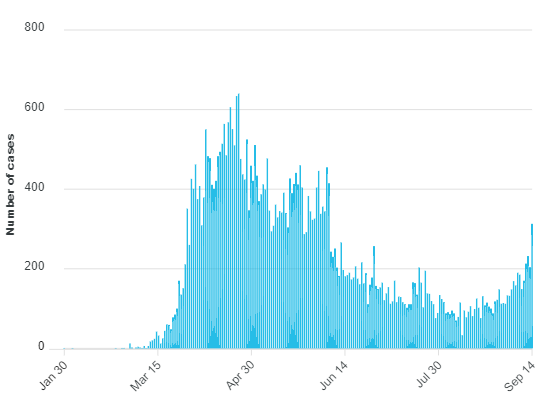
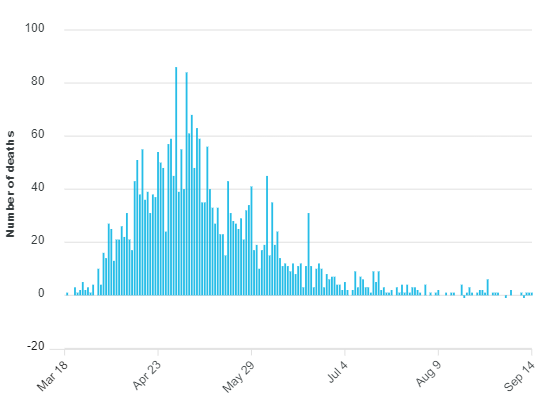
Why could this be? Well, take a look at these two graphs from Ontario:
If you look at the top graph the sky is falling and masks, social distance, lockdowns, school closures and “stay at home” all make a lot of sense. If you look at the bottom graph, COVID is over.
In Montreal over this last weekend up to 100,000 people marched against mandatory masks. The mainstream media downplayed the turnout and suggested that there were all sorts of conspiracy theorists, Qanon believers, far right and Trump supporters marching. There probably were. But I suspect the vast majority of the marchers were responding to the disproportionate response of the Quebec government to graphs which look very much like Ontario’s.
People are more than willing to go along with governmental measures they can see the point of. “14 days to flatten the curve and prevent hospitals from being overwhelmed” made sense back in April. And the measures taken then may well have worked. But it is mid-September and the hospitals and their ICUs are not even slightly overtaxed.
September 13, 2020
Are the Kielburgers fleeing before the real story breaks?
Ted Campbell listened to an Evan Solomon radio report recently and spells out the key points:
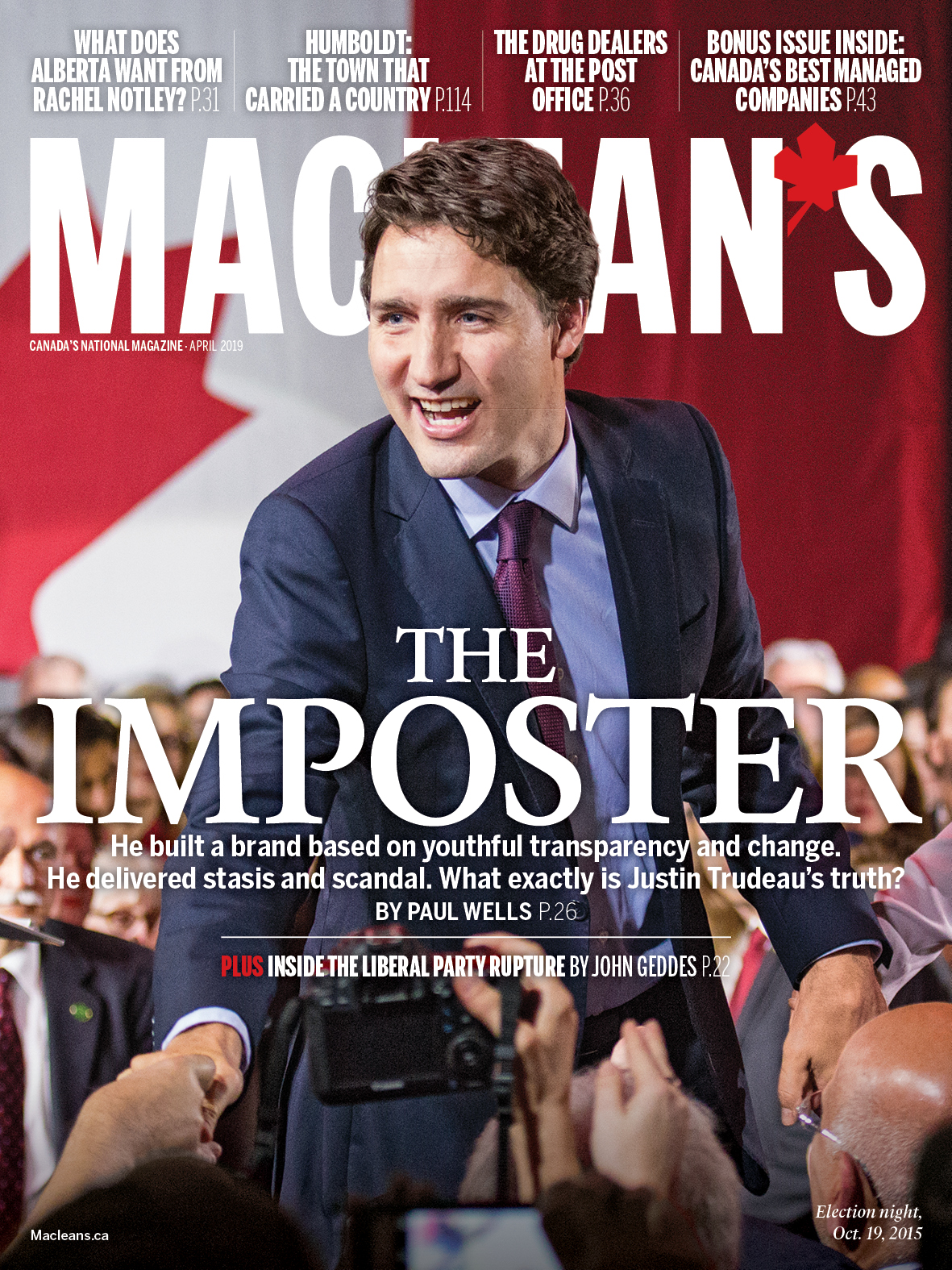
The Kielburgers, he notes are neither newcomers nor naifs. Mark Kielburger is a Rhodes Scholar and Craig Kielburger has, he say, “been rubbing shoulders with politicians since he was 12 years old.” They have, Mr Solomon says, been selling the “halo effect” to politicians and other celebrities, a list which he tells us includes Justin Trudeau, Barack Obama, Oprah Winfrey and Erin O’Toole and the “halo effect” says, in effect, if you come out and make us look good then we, being a famous, big-league charity will make you look good, too. It’s all part of an astute marketing plan.
But then Evan Solomon gets to the real question: if Tylenol, he says, can survive a scandal in which people died then why are the Kielburgers reacting so dramatically to what is, really, on the surface, a minor league scandal? So the Kielburgers paid Margaret Trudeau a few hundred thousand dollars to make a few charity appearances, is that such a big deal? I mean the Trudeaus are wealthy, aren’t they? They can’t be bought, can they? Well, most if us don’t have million dollar plus trust funds and most of us didn’t earn $450,000 in speaking fees in a year, but the Trudeau family is unlikely to have just forgotten about $250,000 in speaking fees paid to Margaret Trudeau. Bill Morneau may have forgotten about owning a villa in France, but unlike the Trudeaus, Mr Morneau is rich … really rich. So are the Kielburgers. The commercial property part of their WE empire, alone, is worth $50 Million. Could a few thousands dollars per appearance (she made 28 over four years, about one every couple of months) paid to Margaret Trudeau really threaten the entire WE empire?
[…]
My guess, and that’s all it is, is that there is real fear in the WE boardrooms and in WE’s legal department that Prime Minister Trudeau might be guilty of something more than just conflict of interest. Someone like Pierre Poilievre or the Lobbying Commissioner, for example, might think that further, deeper investigations are needed and those questions might lead investigators to look more deeply into why and how Justin Trudeau and the Kielburger brothers, themselves, cooked up the idea of WE Charity running a multi-hundred-million-dollar government programme and then trying to cover-up the whole thing.
Might those questions be enough to bring Justin Trudeau down?
Might those questions be enough to threaten the Kielburgers’ fortunes, even their freedom?
“Systemic racism” in Canada
At The Line, a useful examination of what is meant in the Canadian context by the term “systemic racism”:
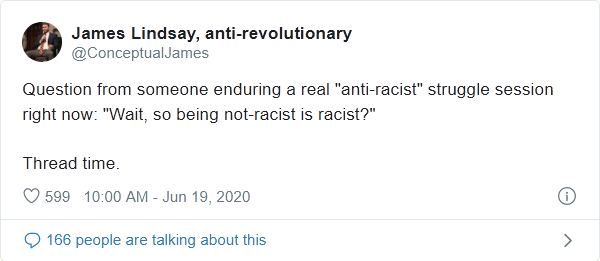
Can we go back one step? “Systemic racism.” Let’s start there: which system? The legal system? Our social welfare system? The policing system? The media? Our corporations? All of human society? Are we talking about Canadian society, or North American society as whole? Are there geographic limits to the systems we’re talking about? Is China systemically racist?
Let’s break this down further: what definition of “racism” are we using? Are we using the old definition whereby any bigotry based on skin colour is “racist”? Or are we engaging the new definition, where “racism” is an expression of structural power — and, therefore, only white people can be racist because only they hold structural power?
It’s impossible to fix a problem if we can’t come to a common understanding about plain meanings of the terms we are using. Vague in, vague out.
There are many statements of “systemic racism” that we, at The Line, would have no qualms agreeing with, i.e.; “The Indian Act is a clear example of systemic racism in Canadian law.” That isn’t a controversial position — but it also isn’t an unclear one. Asserting a belief in “systemic racism” sounds like a broadly agreeable thing to do, but the term is loaded with meaning and ideological baggage that is not immediately apparent.
Take, for example, a claim that Canadian society is systemically racist because it is structured at all levels to favour white dominance — and that any disparity of outcome between racial groups is proof of that fact. Well, that’s a much more all-encompassing ideological position, isn’t it? There’s a perfectly legitimate framework for critique in here, but there’s also a lot to unpack.
It’s easy to find legitimate examples of systemic racism while leaving the actual meaning and implications of the term both vague and tautological. But if we’re going to use statement of belief in “systemic racism” as some kind of litmus test for political acceptability, the clear meaning of the term matters.
In the absence of that clarity, using it as a gotcha question and backing people in public life into reciting this stuff as if it were some kind of statement of faith comes off as not a little creepy.
September 11, 2020
Canadian government heading toward “the worst of all worlds on Internet regulation”
Michael Geist on the bull-headed determination of the Canadian federal government — and specifically Heritage Minister Steven Guilbeault — to “solve” a problem by introducing savagely anti-consumer internet regulations:
Canadian Heritage Minister Steven Guilbeault, 3 February 2020.
Screencapure from CPAC video.
The harm that will come from these policy choices is difficult to overstate. By focusing the tax burden on sales taxes rather than technology company revenues, consumer costs will go up and the company profits will be left untouched. The CRTC powers will lead to years of hearings and follow-on litigation, yielding few tangible benefits for creators. The mandated Cancon contributions will spark trade wars and make Canada a less attractive market for new services leading to fewer choices and less competition, while the link licensing requirement will result in blocked sharing of news articles on social media sites that hurts both Canadians and media organizations. All the while, the issues that really matter – privacy, anti-competitive behaviour, online hate, misinformation, a fair share of tech corporate profits – are left largely untouched.
How did the government end up with the worst of all worlds on Internet regulation?
The starting point was the 2015 election in which it committed to no new Netflix taxes (prompted by a Conservative pledge on the issue) and subsequent consultations on everything from copyright to digital cultural policy. The result was then-Heritage Minister Melanie Joly struggling to honour the no-tax commitment, while satisfying increasingly vocal demands from some stakeholders for one. Those calls increased after the results of her cultural policy consultation were released, which largely focused on a rejection of new Internet taxes and support for net neutrality.
In the aftermath of the Cambridge Analytica scandal, worries about Russian election interference, and Christchurch massacre broadcast live online, the policy winds shifted and the government was clearly looking to become more active on the Internet regulation file. That led to Election Act provisions that were generally viewed as successful. It also paved the way for a 2019 election platform that was far aggressive on social media and the Internet, with commitments to address everything from privacy to hate speech online.
[…]
If the government were to address the real concerns, there would be long-overdue privacy reforms, a more aggressive approach on competition issues, measures to address online hate and misinformation, and pursuit of a global agreement on fair taxation of technology company revenues. If it wants to support increased film production from indigenous groups or help the news sector, it can make those policy choices and use general tax revenues without creating a massive regulatory infrastructure.
Instead, it is turning to the harmful policies noted above that raise consumer costs (digital sales taxes), regulate online Cancon with mandated spending requirements (even though the industry has record production led by Netflix), dispense with any pretense of maintaining net neutrality, lead to blocked sharing of news articles (mandated licence for social media sites merely for linking to news content), and result in services avoiding the Canadian market (market interference in payments from services such as Spotify). Much of this will be overseen by the newly empowered CRTC, leading to lengthy hearings that primarily benefit lawyers. After having badly mishandled Canadian digital policy, the government now seems content to take a pass on the important issues and leave the controversial non-issues to the regulator and the courts.
September 7, 2020
Public compliance with masking rules
David Warren on the temptation for public health officials to treat the citizenry as slightly dim children who need direct supervision by enlightened public health officials:

“Covid 19 Masks” by baldeaglebluff is licensed under CC BY-SA 2.0


The present danger — the Red Chinese Wuhan Laboratory Batflu — is visible everywhere thanks to state-mandated muzzles or batmasks. We are now in the sixth month of “fifteen days to flatten the curve,” and I’ve noticed that these filthy mouth-pieces have become another urban environmental blight, on a scale even worse than the sidewalk basketball bouncers I recently decried. I spotted four discarded Batflu-spreaders on the sidewalk during a walk of less than one city block yesterday, to a deadbeat “supermarket” to fetch milk for my tea.
I’m sure these cloth garottes are choking our Blanding’s Turtles — already considered endangered by our provincial bureaucracy because less than one in a thousand of their eggs ever hatch, and then the adults try to cross country roads. Call up a picture of one on the Internet, and gentle reader will see that they are all apparently wearing yellow batmasks on their chins, in compliance with guvmint regulations. For if they took them off, they would risk being confused with another turtle species that might not be Protected.
But while my affection for Blanding’s Turtles, and empathy in light of their persecution by Ontario motorists, is of long standing — a friend proposes that we found a Blanding Lives Movement — I am even more concerned about the fate of our children. The Batflu has been discouragement enough, to those who may never reach maturity, but the spectacular success of the Nanny State effort to keep them socially atomized and in muzzles, portends innumerable (fake) “pandemics” to come. For what faceless time-server, “dressed in a little authority,” can resist an opportunity to treat the general population as if they were retarded children? Especially now, that the general population has shown it will comply?
According to an item that somehow slipped into the New York Times, only a tiny fraction of the much-publicized Batflu deaths were attributed to the Batflu alone, on death certificates sampled from across the Natted States. By this focus, the “pandemic” toll is reduced from the official number of 187,777 (I just checked this morning), to about 9,200. Of course, the commie and never-Trumper meejah have gone splenetic to “cancel” this interesting fact. It is as bad as the French study which showed that your one-in-ten-thousand chance of dying with the Batflu in that country is cut a further five times if you happen to smoke. Or the Hydroxychloroquine scandal, in which Mister Trump suggested (correctly) that a simple anti-malaria drug, already mass-produced and dirt cheap because long out of patent, can cut it by a few times more.
Who Was Leif Erikson?
Atun-Shei Films
Published 9 Oct 2019Happy Leif Erikson Day! Allow me to regale you with the saga of the daring Viking who sailed to North America five hundred years before Columbus (that hack) and called it Vinland. We all know his name and his famous deeds – but what sort of man was Leif Erikson?
Support Atun-Shei Films on Patreon ► https://www.patreon.com/atunsheifilms
#LeifErikson #Viking #History
Watch our film ALIEN, BABY! free with Prime ► http://a.co/d/3QjqOWv
Reddit ► https://www.reddit.com/r/atunsheifilms
Twitter ► https://twitter.com/alienbabymovie
Instagram ► https://www.instagram.com/atunsheifilms
Merch ► https://atun-sheifilms.bandcamp.com

September 5, 2020
Kareem Shaheen on the shame of mask-shaming
In The Line, Kareem Shaheen — who is a mask-wearer and was one before they were made mandatory — explains why shaming anti-maskers is a terrible way to encourage compliance, but a great way to virtue-signal:
“Covid 19 Masks” by baldeaglebluff is licensed under CC BY-SA 2.0
The mask shaming mirrors the way social media has warped our culture. The Twitter and ‘gram “in crowd” flaunt its mask use to demonstrate an ostensibly superior grasp of morals and science — and to bully those who don’t follow its cues. Those who perceive themselves to be on the outside of this circle can’t help but cringe at the manipulation and grandstanding behind these seemingly well-intentioned gestures.
Mask resistance, then, becomes a virtue signal of its own.
And, of course, Twitter itself has been a cesspool of counter-productive shame. Back in July, the hashtag #NoMasks trended, which gave the illusion of a groundswell of opposition against mandatory masking laws. But an analysis by First Draft, a nonprofit based in the United Kingdom, examined 8,000 Twitter accounts that used the hashtag. It found that the majority of people who tweeted #NoMasks were actually pro-mask. Their condemnation of the supposed anti-mask contingent actually boosted #NoMasks, bringing more people in contact with related conspiracy theories and arguments against wearing masks.
The moralizing is all the more galling because our own governments were forced to do an embarrassing about-face on their efficacy.
In the early weeks of the pandemic, health agencies in Canada and the United States recommended against wearing masks because there was insufficient evidence that they could prevent the spread of the virus, remember? They said that masks would provide a sense of false security, and suggested that we were all too dumb to know how to wear them properly.
This despite widespread use of masks in Asia, and while there was a growing consensus in hard-hit parts of Europe that they were effective and necessary.
With so much confused messaging, it’s no mystery that so many people are now skeptical about wearing masks. Sure, some of the most ardent mask-haters are also Q-Anon-spouting, anti-vaxxer crystal-healing masks-are-fascism conspiracy theorist kooks. But not all them fit that description.
And the problem with all of this is that if you’re actually trying to convince people to wear masks — as opposed to merely demonstrating your own superior morality via the veil — shame is one of the least effective methods of persuasion.


