
I’ve told before the story of how my husband and I went car shopping and took along our best friends, both taller, blue eyed, and one of them blond. Inevitably, at whichever dealership we landed in (this was a lazy Saturday pursuit. You know what I mean) the salesman gravitated towards our friends who a) weren’t shopping for a car. b) were far less financially solvent than we were.
Racism? Oh, heck no, heuristics. Dan might or might not be as white as advertised, but outwardly he’s all white (nickname Count Dracula due to his inability to tan.) (Well, maybe the eyes give some clue to other genetic origins as in Portugal everyone assumes he’s from Macau and some level of cross breed. Meh.) And I can pass provided I haven’t been outside in a couple of weeks and don’t open my mouth. So, racism was highly unlikely. But we’re both short, overweight, dark haired, and were dressed almost terminally relaxed. Our friends fit the “double income” couple look better than we did, so salesmen gravitated to them.
Privilege? No. We got the chance to poke around at cars while our friends distracted pushy salespeople. BUT prejudice? You bet. Even though the two couples were superficially “white” you bet the sales people had an image of what “affluent” or relatively affluent (it was used dealerships) looked like, and it wasn’t Dan or I.
Sarah Hoyt, “The Privilege Of Not Caring”, According to Hoyt, 2015-05-17.
January 30, 2017
QotD: Everyone has prejudices
January 25, 2017
Protectionism can save jobs … at the cost of even more jobs than it “saves”
Mark Perry provides some context to the claim that protectionist policies can save American jobs:
According to Team Trump’s website, we’re told that “blue-collar towns and cities have watched their factories close and good-paying jobs move overseas, while Americans face a mounting trade deficit and a devastated manufacturing base. By fighting for fair but tough trade deals, we can bring jobs back to America’s shores, increase wages, and support U.S. manufacturing.”
Actually, it’s been capital investments in labor-saving technologies like robotics and increasing worker productivity that have led to the large majority of US factory job losses, not trade or outsourcing, as I documented recently here. And there’s been no devastation of America’s manufacturing base; to the contrary, real US manufacturing output has reached all-time high levels in recent quarters.
What’s Trump’s solution to the loss of US manufacturing jobs? America’s “first authentic protectionist to win the White House since the 1920s” has outlined a series of protectionist trade measures including tariffs (30-40-50%), “tougher trade deals” (likely trade deals to protect US manufacturers from foreign competition), “Buy American” policies, and border adjustment taxes, among other strategies to “save American jobs.”
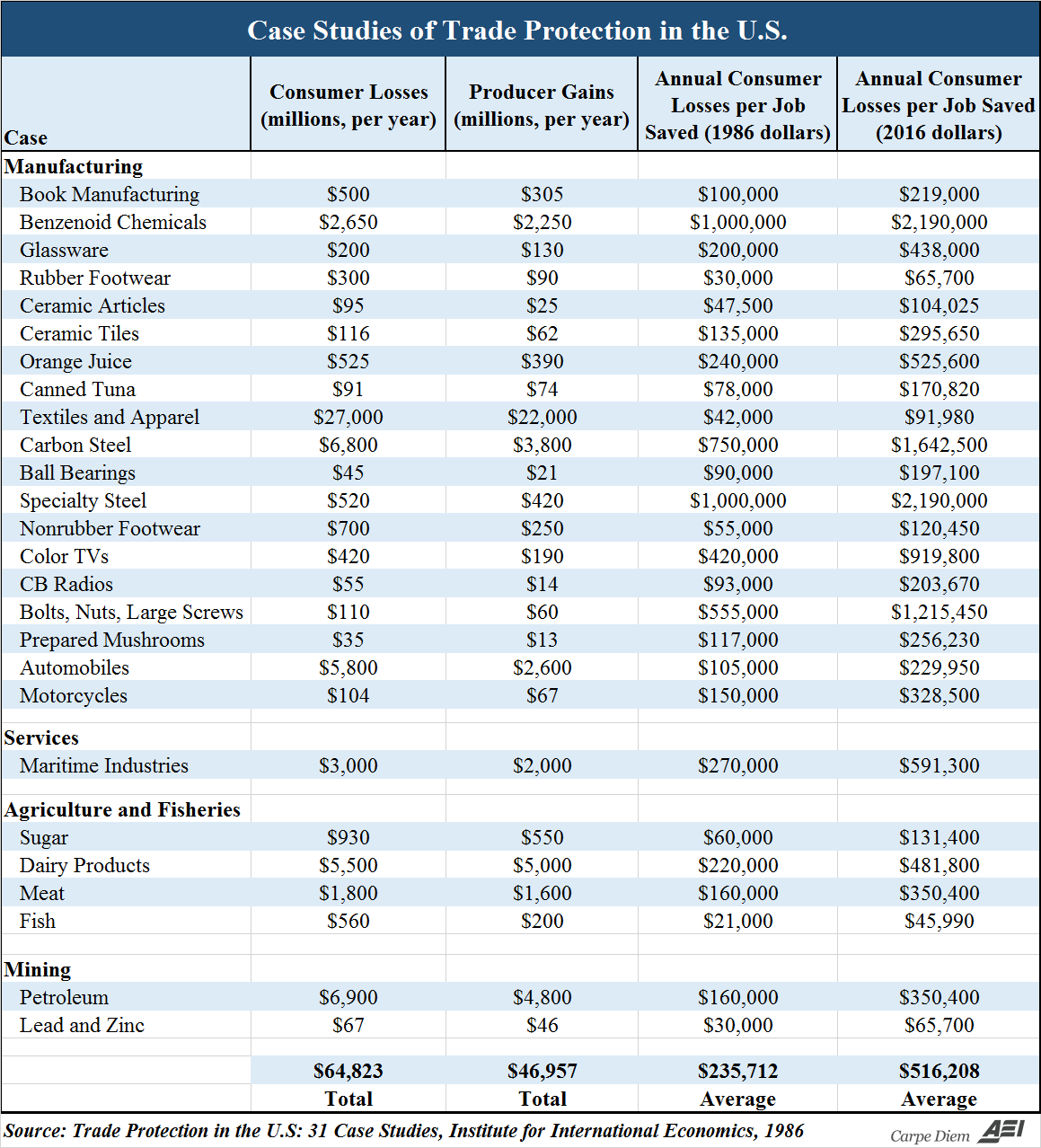
Here’s a relevant question to ask: How have protectionist trade policies in the past worked out for the US economy and how expensive is it to save American jobs with the protectionist trade policies Trump is proposing? We can find some answers to those questions in a Federal Reserve Bank of St. Louis research article published in 1988 by three economists “Protectionist Trade Policies: A Survey of Theory, Evidence and Rationale,” which presented a summary of the empirical evidence on trade protectionism from the 1986 book published by the Institute for International Economics Trade Protection in the United States: 31 Case Studies. Even though the research and empirical results are from the 1980s, this article and book provide useful empirical evidence on the costs of protectionism to bring some much-needed sanity to the debate on trade policy to counterbalance the favorable treatment being given to protectionism these days.
Click to see full-size table.
The “right to repair” gets a boost in three states
Cory Doctorow reports on a hopeful sign that we might be able to get rid of one of the more pernicious aspects of the DMCA rules:
Section 1201 of the 1998 Digital Millennium Copyright Act makes it both a crime and a civil offense to tamper with software locks that control access to copyrighted works — more commonly known as “Digital Rights Management” or DRM. As the number of products with software in them has exploded, the manufacturers of these products have figured out that they can force their customers to use their own property in ways that benefit the company’s shareholders, not the products’ owners — all they have to do is design those products so that using them in other ways requires breaking some DRM.
The conversion of companies’ commercial preferences into legally enforceable rights has been especially devastating to the repair sector, a huge slice of the US economy, as much as 4% of GDP, composed mostly of small mom-n-pop storefront operations that create jobs right in local communities, because repair is a local business. No one wants to send their car, or even their phone, to China or India for servicing.
[…]
Three states are considering “Right to Repair” bills that would override the DMCA’s provisions, making it legal to break DRM to effect repairs, ending the bizarre situation where cat litter boxes are given the same copyright protection as the DVD of Sleeping Beauty. Grassroots campaigns in Nebraska, Minnesota, and New York prompted the introduction of these bills and there’s more on the way. EFF and the Right to Repair coalition are pushing for national legislation too, in the form of the Unlocking Technology Act.
January 24, 2017
QotD: Token ownership to game government mandates
I was researching energy shorts and had a ton of discussions with former regulatory types in the U.S. I was stunned to discover that there was widespread acknowledgement on the regulatory side that many regulations were impossible to comply with and so “compliance trump cards” were built into the system.
For instance, in Illinois you get favorable treatment as a potential government contractor if you “comply” with all sorts of insane progressive policy strictures. “Woman or minority owned business” or “small business owner”, as an example. Even a small advantage in the contracting process for (for example) the State of Illinois puts you over the edge. Competitors without (for instance) the Woman or Minority Owned Business certification would have to underbid a certified applicant by 10-15% (it’s all a complex points system) to just break even. It got so bad so quickly that the regs were revised to permit a de minimis ownership (1%). Of course, several regulatory lawyers quickly made a business out of offering minority or women equity “owners” who would take 1% for a fee (just absorb how backwards it is to be paying a fee to have a 1% equity partner) with very restrictive shareholder agreements. Then it became obvious that you’d get points for the “women” and “minority” categories BOTH if you had a black woman as a proxy 1% “owner.” There was one woman who was a 1% owner of 320 firms.
The proprietor of the Finem Respice blog, quoted by Warren Meyer, “Diesel Emissions Cheating, Regulation, and the Crony State”, Coyote Blog, 2017-01-14.
January 11, 2017
Colby Cosh boldly speaks out for a tiny minority of Canadians
For some reason, Colby Cosh has decided to drag out Rocinante to defend the rights of Canadian broadcasters to continue substituting the same fricking commercials they play all year during the Super Bowl:
I am here today to speak for the voiceless. To embolden the powerless. To raise awareness of the nation that lives unseen among us. I am referring, of course, to the invisible SimSub race: Canadian Super Bowl viewers who may actually prefer to have Canadian commercials broadcast on TV along with the football game.
For years we have remained in the shadows while opponents of “simultaneous substitution” dominated the conversation. The antis won a great victory in 2015 when our federal broadcast regulator, the CRTC, ruled that the Super Bowl was a unique TV event — one in which the expensive ads on the originating American broadcast were conceptually inseparable from the rest of the show. The Super Bowl ads, the CRTC said, ought not to be obscured by boring, artless commercials for Canadian tire stores and investment accounts.
The first Super Bowl broadcast to be non-simsubbed by CRTC fiat is scheduled for Feb. 5. But Bell Media, which bought the Super Bowl TV rights expecting to be able to show bad Canadian commercials to Canadian viewers, is joining up with other threatened interests to ask the Liberal government for an extreme, last-minute ministerial intervention in favour of another year of simsubbing. I am trying very hard not to describe this as a “Hail Mary pass”, but, well, there is a reason that metaphor is popular. And Hail Mary passes sometimes work.
I am kidding about the existence of a pro-simsub constituency — kind of. The CRTC made its decision partly because everyone agrees that the substituted advertising is always disappointing. It gave the commission the opportunity to do something populist that would reverse its own political reputation as a force-feeder of dismal CanCon, a drearifier of Canadian media.
January 10, 2017
Gentrification hit the BDSM community years back
In Salon, Annalee Newitz wrote about a quaint little San Francisco B&B that offered specialized services to the BDSM community before George W. Bush was inaugurated:
In a quiet San Francisco neighborhood, surrounded by views of tree-covered hills, a quaint little B&B welcomes visitors from across the country. Guests can choose from four well-appointed rooms in this refurbished turn-of-the-century house, all personally decorated by Elizabeth, the proprietor. While they’re staying at Elizabeth’s B&B — called Differences — guests are also welcome to use all the amenities of the house: an extensive dungeon in the basement, metal hooks tucked into lacy corners and the genuine antique bondage devices adorning the rooms. Of course, guests will also need to make their own pancakes — B&B stands for bed and bondage here. Elizabeth doesn’t do breakfast.
Like other renegade subcultures, S/M is gradually becoming gentrified. This is partly economic — getting flogged on a Friday night isn’t as cheap as it used to be. Dozens of exclusive sex stores have popped up, peddling high-end toys, devices and leatherware. A typical private “play party” runs each guest as much as $30 (this is a site cost — you pay for the space, not the sex). Certain clubs even enforce a pricey dress code: If you aren’t all gussied up in latex or leather, you don’t get in the door.
This isn’t the kind of gentrification one sees in urban landscapes where yuppies suck up all the warehouse spaces and formerly low-income housing. Nor can one locate some previous version of the S/M community that was less wealthy. Indeed, tracing S/M’s origins back to its Founding Daddies — the Marquis de Sade and Leopold von Sacher-Masoch — one finds that S/M’s earliest class connections are purely aristocratic.
[…]
Odder still to an outsider would be the experience of attending an S/M seminar at QSM’s San Francisco warehouse, where a room full of well-dressed people in orderly rows of folding chairs watch politely as a well-known “dominant” demonstrates how to torture nipples correctly and why it’s important to employ bondage devices that won’t cause nerve damage. To avoid appearing “unsafe,” players plan their taboo violations and transgressions to a ‘T.’ It can be too much — Joe, a member of the coordinating committee for the Third Annual Leather Leadership Conference, notes ruefully that “the S/M community is, at times, overwhelmingly geeky. Players will spend hours and days debating finer points of flogging safety instead of just getting together and having fun.”
Given the lack of law-breaking and general air of wholesomeness in the S/M scene, it’s no wonder that Jack and Jill Suburb have come to join the fun. The question is, what gets lost in the translation when S/M values begin to percolate into the white-picket-fence world of middle America?
H/T to “SG” for the link.
January 9, 2017
QotD: The wider effects of raising the minimum wage
When the minimum wage goes up, owners do not en masse shut down their restaurants or lay off their staff. What is more likely to happen is that prices will rise, sales will fall off somewhat, and owner profits will be somewhat reduced. People who were looking at opening a fast food or retail or low-wage manufacturing concern will run the numbers and decide that the potential profits can’t justify the risk of some operations. Some folks who have been in the business for a while will conclude that with reduced profits, it’s no longer worth putting their hours into the business, so they’ll close the business and retire or do something else. Businesses that were not very profitable with the earlier minimum wage will slip into the red, and they will miss their franchise payments or loan installments and be forced out of business. Many owners who stay in business will look to invest in labor saving technology that can reduce their headcount, like touch-screen ordering or soda stations that let you fill your own drinks.
These sorts of decisions take a while to make. They still add up, in the end, to deadweight loss — that is, along with a net transfer of money from owners and customers to employees, there will also simply be fewer employees in some businesses. The workers who are dropped have effectively gone from $9 an hour to $0 an hour. This hardly benefits those employees. Or the employee’s landlord, grocer, etc.
There are secondary effects beyond the employment market too. Proponents of a higher wage are claiming that this will boost the local economy by putting more money into the pockets of workers. This is the same sort of argument you frequently hear for the construction of massive new sports complexes. But of course, the money has to come from someone else’s pocket — the customer and the employer. What were those people doing with it? If the answer is “buying stuff from Amazon,” then maybe diverting more money to wages is a net gain for the Los Angeles economy. But if the answer is mostly “buying stuff produced in LA” — for example, paying rent, or buying services performed by low-wage workers — then this is like trying to get rich by picking your own pocket.
There’s no question that the wage increase will transfer money around within the economy — out of the pockets of commercial landlords, for example, and into the pockets of folks who own real estate in low-rent districts. But little evidence has so far been offered that any boost in local spending will cancel out the deadweight loss, much less exceed it.
Megan McArdle, “$15 Minimum Wage Will Hurt Workers”, Bloomberg View, 2015-05-20.
January 5, 2017
Canada’s military-industrial complex
Ted Campbell briefly outlines the three tiers of military logistics then discusses the most controversial tier, the national industrial base, in more detail:
Behind it all, unseen, misunderstood, unloved and, in fact, often actively disliked is the national defence industrial base.
There are a great many people, including many in uniform, who object to the cost ~ fiscal and political ~ of having a defence industrial base. Many people suggest that a free and open market should be sufficient to equip all friendly, and the neutral and even some not so friendly military forces.
They forget, first of all, that the defence industries of e.g. America, Britain, France, Germany and Israel are ALL heavily supported by their government and, equally, heavily regulated. It is not clear that we will always be in full political accord with those upon whom we rely for military hardware? What if one country wanted, just for example, to gain an advantage in a trade negotiation? Do you think they might not “decide” that since the government (a minister of the crown) has threatened to use military force against First Nations who protest against pipelines that they will not sell us certain much needed military hardware or licence its use in Canada?
It is always troubling when we see the costs of military hardware increase at double or even triple the general rate of inflation for, say, cars or TV sets or food and heating fuel, but that is not the fault of the Canadian defence industries … it is, in fact, the “fault” of too little competition in the global defence industry market: too few Australian, Brazilian Canadian and Danish defence producers, too many aerospace and defence contractors merged into too few conglomerates that control too much of the market. A robust Canadian defence industrial base, supported by extensive government R&D programmes and by a steady stream of Canadian contracts would help Canada and our allies.
[…]
I am opposed to government supported featherbedding by Canadian unions and companies but we do need to pay some price for having a functioning defence industrial base … the costs of our new warships, for example, are, without a doubt, higher than they would be if we had bought equivalent ships from certain foreign yards, but we need to be willing to pay some price for having Canadians yards that are ready and able to build modern warships when needed; ditto for aircraft, armoured vehicles, radio and electronics, rifles and machine guns, cargo trucks and boots and bullets and beans, too. AND, we need a government that will, aggressively, support that defence industrial base with well funded R&D programmes and by “selling” Canadian made military equipment around the world.
It’s one thing to accept that you’ll need to pay a premium over market cost for built-in-Canada equipment that can’t also be sold to other customers. What is disturbing is discovering that the premium can be up to 100% of the cost for equivalent non-domestic items. For example, this was reported in a CBC article in 2014:
Britain, for example, opted to build its four new naval supply ships much more cheaply, at the Daewoo shipyard in South Korea. The contract is for roughly $1.1 billion Cdn. That’s for all four. By contrast, Canada plans to build just two ships, in Vancouver, for $1.3 billion each. So Canada’s ships will be roughly five times more costly than the British ones.
But there’s a twist. Canada’s supply ships will also carry less fuel and other supplies, because they’ll be smaller — about 20,000 tonnes. The U.K. ships are nearly twice as big — 37,000 tonnes. Canadians will lay out a lot more cash for a lot less ship.
Everything is more expensive to build domestically if you don’t already have a competitive market for that item. The federal government’s long-standing habit of drawing out the procurement process makes the situation worse, as the costs increase over time (but the budget generally does not), so we end up with fewer ships, planes, tanks or other military hardware items that arrive much later than originally planned.
December 27, 2016
QotD: The economics of price gouging
Soaring prices after a natural disaster or during extreme weather are simply, economists would say, the market’s response to changing supply and demand, as disruptions make it harder to get some things just as demand spikes (for instance, for generators, gasoline, bottled water, first aid supplies). The price increase helps cut down on marginal uses (taking a bath with your bottled water), while drawing new supply in from unaffected regions, because people there now have a strong incentive to load up supplies and go sell them in the affected area — quickly. The market is working. But the optics are terrible. Humans intuitively see price gougers as bad agents, exploiting the suffering of others. So even in the absence of price-gouging laws, businesses try to avoid raising prices under extreme conditions. Whatever they could gain in immediate revenue, they would lose more in future sales as disgusted customers walk away.
Megan McArdle, “The Price Is Right, or Uber Will Raise It”, Bloomberg View, 2015-05-19.
December 23, 2016
A tribute to the real hero of It’s a Wonderful Life – Old Man Potter
Tom Mullen explains why Mr. Potter is the hero, rather than the villain, in the traditional Christmas-time movie, It’s a Wonderful Life:
December is upon us and that means plentiful opportunities to watch the enduring classic, It’s a Wonderful Life. Unfortunately, the overwhelming majority of viewers completely misinterpret Frank Capra’s dystopian nightmare as a heartwarming Christmas tale.
The emotional appeal of angels getting their wings is undeniable. Crying out for correction, however, are the vicious slanders regarding the film’s real hero, Henry Potter.
We first hear of Potter from George Bailey’s father, Peter Bailey, who badmouths Potter with the usual falsehoods about businessmen. But during Bailey’s envious rant, we learn something important: Henry Potter is a board member of the building and loan. We later learn Potter is, in fact, a stockholder.
That puts a somewhat different light on his subsequent motion to liquidate the business upon Peter Bailey’s death. Yes, we hear George Bailey repeating the familiar socialist tropes his father did: that Potter only wants to close the building and loan because he “can’t get his hands on it” and considers the little people cattle, etc.
But Potter responds with some rather inconvenient facts: the building and loan has been making bad business decisions, providing what we’d now call subprime loans to people who can’t pay them back.
December 22, 2016
“Merry Christmas” versus “Happy Holidays” versus “Happy Midwinter Break”
L. Neil Smith on the joy-sucking use of terms like “Happy Midwinter Break” to avoid antagonizing the non-religious among us at this time of year:
Conservatives have long whimpered about corporate and government policies forbidding employees who make contact with the public to wish said members “Merry Christmas!” at the appropriate time of the year, out of a moronic and purely irrational fear of offending members of the public who don’t happen to be Christian, but are Jewish, Muslim, Hindu, Buddhist, Sikh, Jain, Rastafarian, Ba’hai, Cthuluites, Wiccans, worshippers of the Flying Spaghetti Monster, or None of the Above. The politically correct benediction, these employees are instructed, is “Happy Holidays”.
Feh.
As a lifelong atheist, I never take “Merry Christmas” as anything but a cheerful and sincere desire to share the spirit of the happiest time of the year. I enjoy Christmas as the ultimate capitalist celebration. It’s a multiple-usage occasion and has been so since the dawn of history. I wish them “Merry Christmas” right back, and I mean it.
Unless I wish them a “Happy Zagmuk”, sharing the oldest midwinter festival in our culture I can find any trace of. It’s Babylonian, and celebrates the victory of the god-king Marduk over the forces of Chaos.
But as anybody with the merest understanding of history and human nature could have predicted, if you give the Political Correctness Zombies (Good King Marduk needs to get back to work again) an Angstrom unit, they’ll demand a parsec. It now appears that for the past couple of years, as soon as the Merry Christmases and Happy Holidayses start getting slung around, a certain professor (not of Liberal Arts, so he should know better) at a nearby university (to remain unnamed) sends out what he hopes are intimidating e-mails, scolding careless well-wishers, and asserting that these are not holidays (“holy days”) to everyone, and that the only politically acceptable greeting is “Happy Midwinter Break”. He signs this exercise in stupidity “A Jewish Faculty Member”.
Double feh.
Two responses come immediately to mind, both of them derived from good, basic Anglo-Saxon, which is not originally a Christian language. As soon as the almost overwhelming temptation to use them has been successfully resisted, there are some other matters for profound consideration…
December 5, 2016
QotD: Wine merchants using alarmist tactics to sell wine
I’m a mom of three young kids. That means I like to have a glass of wine
with breakfast, lunch, and dinnernow and then. And since my kids seem to grow out of their clothes and shoes seconds after I’ve purchased them, I like to get a good deal on aboxbottle or two. Luckily for me, there is stiff competition in the wine industry, which means I can get wines from around the world at prices I can afford.Yet with competition comes increased need to attract customers. And some companies are resorting to a new strategy: Alarmism.
Consider the recent suggestion by some wine companies that some corks are not just inferior, but dangerous. That might seem silly to some or just a lousy marketing stunt to others, but it’s a familiar and all-too-effective tactic used on moms who are constantly encouraged to police their homes for threats to their families.
Julie Gunlock, “Wine Alarmists Should Stick a Cork In It: Stop whining about the non-existent dangers of certain wine corks, and start drinking”, The Federalist, 2015-05-19.
November 27, 2016
America’s craft beer revolution
Jerry Weinberger reviews The United States of Beer: A Freewheeling History of the All-American Drink by Dane Huckelbridge:
In rich and full detail, Huckelbridge tells the story of America’s love affair with beer. Even before Europeans set foot on the new continent, Native Americans made beer for fun and religious purposes from a wide variety of vegetable matter. Our Dutch and English forbears brought their beer — and their beer preferences — with them. In 1620, the Mayflower landed in Plymouth, at least in part for want of enough beer for both passengers and crew. When the Arbella sailed into Boston Harbor in 1630, it was laden not just with Puritans but also with 10,000 gallons of beer and 120 hogsheads of malt. The English in New England drank dark and cloudy ales made from fire-roasted malt and top-fermenting yeast. The Dutch in New Netherlands preferred drafts lighter in body and mouthfeel; they added rye, wheat, and oats to the barley. The English put an end to New Netherlands in 1664, but that didn’t end the war — as it would eventually prove to become — between the light and the dark worlds of beer. Huckelbridge approaches his subject from a regional point of view. National tastes sprang from regional ones. Beer tides flowed North to South, turned westward to California, and then doubled back East in the late twentieth century.
Our English forbears came relatively late to the use of hops in beer, as was done on the European Continent in the ninth century. As late as the early sixteenth century, hops were thought of in England as “a wicked and pernicious weed.” In Europe, brewing was done by large, organized monasteries, while in England it remained largely a household craft. The larger European producers had to worry more about consistency and spoilage than did the home-brewing English; the hop, though essential to the taste of beer as we know it, was originally used as a preservative, with the appreciation of bitterness following on the utility of anti-sepsis. As English brewing took on a more industrial tone, the uses of the hop became clear, and so the Pilgrims aboard the Mayflower could drink safe beer rather than brackish and polluted water. By the time of the revolutionary crisis, English economic policy and regulation had increased the price of barley and hops so much that cider and rum began to edge out beer as the preferred drink of New Englanders. The Sons of Liberty — including Samuel Adams and John Hancock — rebelled for beer as much as for independence.
[…]
When American beer recovered, it did so in the Midwest, and in a new form: lager. What we now think of as American beer (Budweiser, Busch, Pabst, Miller, etc.) sprang from the habits and tastes of German immigrants in Midwestern cities. Their lager beers were rich and full-flavored, but were somewhat lighter and milder than “the darker and more fragrant British-style” ales they eventually displaced. Huckelbridge describes in some detail the history of German brewing from Roman times through the sixteenth century, when lager yeast was discovered as an alternative to ale yeast. This new yeast strain originated in the cold forests of Patagonia and made its way by accident to Europe — and especially to Bavaria.
And how American beer got its (well-deserved at the time) reputation for blandness:
In the decades surrounding the turn of the twentieth century, two forces converged to transform our national drink: technological innovation and Prohibition. Before the Volstead Act went into effect in January 1920, technological and economic changes had been at work degrading the quality of American beer. New kiln technology made it possible to roast malts with no direct contact with the heat, which made for fewer notes of smoke and slag. Likewise, temperature controls made it possible to make lighter and “crispier” brews. The use of American six-row barley, which is higher in enzymes than German two-row barley, enabled brewers to employ cheaper, adjunct grains such as corn, wheat, and rice—all of which made for a sweeter and flimsier beer. Pasteurization increased shelf life, lessening the need for preservative alcohol and hops. Artificial carbonation replaced the traditional practice of adding live yeast to the finished brew, which improved taste but was less consistent than artificial carbonation. Add to this the advent of advertising and refrigerated rail transportation, and we were on the verge of becoming the United States of Bland Beer. Prohibition delivered the death blow.
After the Volstead Act’s repeal, America was in the grip of the Great Depression. Beer drinkers—and brewers—focused on the cheap and not the good. The result was a pale and watery brew “served up in cans across the county … and the final product bore only a passing resemblance to the rich and hoppy lagers that German immigrants had first brought to this country.” Prohibition ruined the beer industry nationwide and drove alcohol underground, producing a significant change in American tastes: speakeasies learned to disguise low-quality whiskey and gin in sweet “cocktails.” As a result, a generation of Americans came of age with sweet-tooth tongues allergic to the bitter hop or the malty malt. By the 1950s, America was the land of the macrobrew: thin and flaccid sweet suds, distinguishable only by the brand names on the can.
November 24, 2016
The Ontario government’s anti-Midas touch in energy projects
All governments at every level waste money. It’s one of the things that governments do far better than the private sector. Yet the Ontario provincial government takes wasting money to a state of near perfection in their Wolfe Island offshore wind farm dealings:

A few years ago, I took this photo of some of the onshore wind turbines on Wolfe Island. I don’t have any photos of the offshore installations, because they haven’t been built.
In 2010, the government of Ontario, keen to jumpstart its green energy sector, signed a 20-year deal to buy 300 megawatts of electricity from turbines that the New York investors behind Windstream agreed to erect.
Things got messy mere months later in February 2011 when the provincial Liberals, fearing they would lose an election, slapped a moratorium on offshore wind projects, none of which had ever been built. Around the same time, Ontario cancelled two unpopular natural gas power plants, a move that cost provincial taxpayers about $1 billion.
After waiting five years to get approval to build their wind turbines, Mars and his group lost their patience.
“I have a group of very high-net-worth individuals who invest across energy and technology,” Mars said in a series of interviews from his office in Manhattan. “The contract remains in force. We would like to either build it or come up with an amicable solution. We have gotten many mixed messages on this.”
They complained to the Permanent Court of Arbitration under Chapter 11 of the North American Free Trade Agreement. A panel of three arbitrators heard the case in Toronto last February.
“The claimant’s claim that the respondent has failed to accord the claimant’s investments fair and equitable treatment in accordance with international law, contrary to Article 1105 of NAFTA, is granted,” the panel ruled last month.
Police are now apparently probing whether Ontario government employees broke the law when they deleted documents related to the offshore wind project. A source told the Financial Post that Mars will answer police questions in Toronto next week.
So, a billion dollars to cancel two natural gas power plants, then a paltry $28 million that the federal has to pay, as it’s the NAFTA signatory (and the total bill could go up to $568 million or more, with nothing actually being built). As the old saying has it, pretty soon you’re talking real money.
H/T to Ken Mcgregor for the link.
November 23, 2016
When is an American Indian artist not American Indian?
Answer: when federal bureaucratic rules interact unhappily with state-level bureaucratic rules. Eric Boehm explains why an artist is not legally allowed to market her beadwork as “American Indian-made”:
Peggy Fontenot is an American Indian artist, of that there can be no doubt.
She’s a member of the Patawomeck tribe. She’s taught traditional American Indian beading classes in Native American schools and cultural centers in several states. Her work has been featured in the Smithsonian’s National Museum of the Native American.
In Oklahoma, though, she’s forbidden from calling her art what it plainly is: American Indian-made.
A state law, passed earlier this year, forbids artists from marketing their products in Oklahoma as being “American Indian-made” unless the artist is a member of a tribe recognized by the U.S. Bureau of Indian Affairs.
The Patawomeck tribe is recognized by the state of Virginia, but not by the federal government. Fontenot says she can trace her Native American heritage back to the 16th Century, when the tribe was one of the first to welcome settlers from Europe who landed on the east coast of Virginia. She’s been working as an artist since 1983, doing photography, beading, and making jewelry.
[…]
According to PLF [Pacific Legal Foundation], Oklahoma’s law could affect as many as two-thirds of all artists who are defined American Indians under federal law. The state law also violates the U.S. Constitution’s Commerce Clause by restricting the interstate American Indian art market, the lawsuit contends.


