
The story of MSG is a true tragedy. The negativity associated with this delicious amino acid is due to a spurious study from 1968 that linked MSG with the “Chinese Restaurant Syndrome.” This study connected that gut-bomb feeling you sometimes get after eating Chinese food to MSG, despite the fact that the typically cheap Chinese food prepared in American restaurants is fatty and served in large portions, and (like any restaurant), the food can be spoiled. My mom theorizes that lots of MSG was used to cover up the fact that, say, shrimp was a day past its prime, and that the sick feeling was due to the food but got blamed on the MSG. There’s never been a scientifically rigorous study that’s linked MSG with any negative effects. MSG should be used frequently and added to anything that needs the flavor drawn out, especially soups. But it enhances virtually anything it touches: Once, eating pizza at home, a friend scanned my spice rack and saw a jar with white powder whose label, in my grandfather’s messy scrawl, read what looked like “MS6.” He sprinkled it on his pizza and came to find me, telling me that whatever MS6 was, it was the most amazing thing he’d ever tasted. Yes, MSG makes even pizza better.
Caitlin PenzeyMoog, “Salt grinders are bullshit, and other lessons from growing up in the spice trade”, The A.V. Club, 2017-04-06.
April 5, 2019
QotD: Debunking the “MSG is harmful” myth
April 4, 2019
Ingram M10 & M11 SMGs: The Originals from Powder Springs
Forgotten Weapons
Published on 3 Apr 2019These SMGs are lots 1069 (M10/45), 1070 (M10/9), and 1067 (M11) at Morphy’s April 2019 auction:
https://www.forgottenweapons.com/ingr…After the commercial failure of Gordon Ingram’s M6 submachine gun in the early 50s, he would radically change the layout of his designs. Instead of a Thompson-lookalike Ingram’s M10 (the M7, M8, and M9 doing experimental prototypes only) would be a boxy and compact affair with a Czech-style telescoping bolt. It found little interest until a meeting between Gordon Ingram and Mitch WerBell resulted in WerBell demonstrating it to excited military audiences in Vietnam in 1969.
WerBell was an ex-OSS man who had started a company called Sionics, selling suppressors to the US military. He thought the combination of Ingram’s submachine gun and his suppressor would be a fantastic package, and he found plenty of interest among special operations personnel in Vietnam. He would create the Military Armament Corporation based at his farm in Powder Springs, GA and entice Ingram to join as his chief engineer. The result would be the .45ACP M10, a 9mm version of the M10 (made for use with subsonic 9mm ammunition), and a scaled-down .380 ACP M11 submachine gun.
MAC would have a short life, with all its assets sold at a bankruptcy auction in April 1976 – but it had plenty of time to create what would become an iconic gun – the Big MAC. Many imitations and copies would follow, but Powder Springs was the home of true original Ingram M10 and M11 submachine guns!
http://www.patreon.com/ForgottenWeapons
Cool Forgotten Weapons merch! http://shop.bbtv.com/collections/forg…
Contact:
Forgotten Weapons
PO Box 87647
Tucson, AZ 85754
March 30, 2019
The EU’s copyright regulation is a stalking horse for online censorship and control
To the amazement of many non-EU observers, the European Parliament passed blatantly authoritarian and corporatist changes to the rules on copyrights that will have potentially vast impact on the internet across the world, not just inside the EU. At City A.M., Kate Andrews explains why this is such bad news for all internet users:
The two most controversial points in the law – Article 11 and Article 13 – are almost certain to stifle digital activity, and interfere with the free way that people currently use online platforms.
Article 11, known as the “link tax”, would make online platforms compensate press publishers for links and article content posted on their sites.
As my colleague Victoria Hewson highlighted in her latest briefing, this approach has been “widely criticised as a distortive measure that seeks to prop up a declining industry”.
As many local and national newspapers decline in readership and revenue, governments have become increasingly protectionist in their attempts to “rebalance” the sector, by cracking down on online platforms.
The link tax has little merit, even if rebalancing is the goal. News outlets which require payment for readership already have logins and paywalls to protect their content from free access.
[…]
Article 13 will also be distortive to the market, as it makes online platforms increasingly liable for copyright infringement.
As Hewson’s briefing notes, major online platforms already have routine screening processes for content that violates copyright law or their own rules. But the new regulations “remove the protection for platforms previously available if they removed violating content promptly on receiving notice of it, and contravene fundamental rights such as free expression and freedom from monitoring”.
The Directive claims that safeguards – including pastiche, parody, and quotations – will be protected, and that meme content has been excluded.
But the algorithms which these platforms will have to implement to adhere to Article 13 are going to struggle to see the difference between infringement and fair use when comparing uploads to content that is registered as copyrighted.
QotD: Organic spices are a racket
There’s a whole other piece to be written about organic spices, but the short version is that demanding organic spices is never going to be good for the farmers growing them. The U.S. standards for organic products amounts to ridiculously expensive and oftentimes unnecessary practices for small farmers who just don’t have the resources to do it. There are plenty of ways to arrive at ethical treatment of animals and land that are not part of our complicated organic laws. And that’s not to mention the people who demand organic products but will also freak out at the sight of a bug or won’t buy something that’s even a little bit misshapen or with a tiny brown spot on it. You can have pesticides or you can have pests.
Caitlin PenzeyMoog, “Salt grinders are bullshit, and other lessons from growing up in the spice trade”, The A.V. Club, 2017-04-06.
March 22, 2019
Understanding the Great Depression
Marginal Revolution University
Published on 23 May 2017In this video, we examine the causes behind the Great Depression with the help of the aggregate demand-aggregate supply model.
In 1929, the stock market crashed and an air of pessimism swept across America — making bank depositors nervous. What would you do if you thought your money might not be safe with the bank? You’d probably want it back in your own hands. What happened next? A run on the banks.
Along with the Stock Market Crash of 1929, it’s one of the iconic moments of the early days of Great Depression. However, the Great Depression was an incredibly complex downturn in which the economy experienced a series of aggregate demand shocks. By the end of this video, you’ll walk away with a better understanding of the many factors behind the Great Depression and how to apply the AD-AS model to a real-world scenario.
March 20, 2019
A Supreme Court case that created huge sales tax problems for online firms
Eric Boehm explains why an obscure US Supreme Court ruling is making life extremely complicated for thousands and thousands of online businesses:
… Until last year, that meant Heitman was responsible for collecting and paying sales taxes to exactly one place: the Wisconsin Department of Revenue. But thanks to an under-the-radar ruling from the U.S. Supreme Court in June, he’s now receiving letters, phone calls, and emails from revenue officials across the country, each wanting a piece of his business.
The source of Heitman’s frustrations is Wayfair v. South Dakota, which allowed states to collect sales taxes from online businesses located beyond their borders. Many states view the Wayfair ruling as a potential tax revenue windfall in which the taxes are paid by non-residents who can’t vote against them. That’s why businesses like Heitman’s are now facing the chilling prospect of owing taxes in dozens, and possibly hundreds, of different jurisdictions — while being hounded by out-of-state tax collectors.
Since the Supreme Court issued its ruling in June, Heitman has been scrambling to become compliant with tax commissions and revenue departments from coast to coast. He’s spent thousands of dollars on new software to help navigate the complexities of state sales tax law, but that’s only been so much help. “It almost seems like I have another full time job dumped on me with this sales tax thing,” he says. “It’s burning me out.”
As the 2019 tax season begins, states are ramping up efforts to squeeze extra revenue out of remote retailers like Heitman, putting an expensive new burden on businesses that have found broad customer bases online. The burden is particularly large in the five U.S. states that charge no sales tax, where entrepreneurs could now be charged with paying a tax they have never had to pay before, to a government over which they have no voice. And while Congress could clean up the Supreme Court’s mess, it’s far from certain that it will.
Warren Meyer points out that it’s not just the individual states who are taking advantage of this windfall opportunity to collect taxes from non-residents:
Like most writers, Mr. Boehm actually understates the problem. Because the potential exists not to have 50 new taxing authorities for every sales, but thousands. I have to deal with this every day. I wrote a while back:
Take Arizona, which seems from my experience to be roughly average. The sales tax rate table is 18 pages long in a small font. There are 29 separate rate categories which each have different rates in each of Arizona’s 15 counties. My business is in 6 counties and we have 3 rate categories that apply, or 4 if you consider items with no tax as another rate category. This is 24 different state/county sales tax rates we charge. But that is the easy part. Because then there are, in addition to county taxes, 92 different towns and cities that have their own rate tables with up to 29 different rate categories that add to the base state/county rate. Other states such as Washington (rule of thumb — if the state has no income tax then it has a LABYRINTHIAN sales and business tax systems) have additional overlay taxes such as for transit and stadium districts.
When my company opens a new location, we have to spend hours on the Internet and with maps trying to figure out what sales taxes to collect, and even with good due diligence we sometimes get it wrong and find in an audit we are actually just inside or outside some line where the rate changes (we once had a location 30 miles outside of Seattle on a long dirt road where we found we had to collect the Seattle Rapid Transit tax). Thatcher, AZ is a town of like 4000 people but has its own special sales tax rates — do you know where the town line is? Well neither do they, because last time I checked they did not have any sort of online lookup system to tell one automatically if the address is inside or outside the town and its sales tax district…
But even after registering in all 50 states, you are STILL not done, because many states don’t have a fully unified sales tax collection system. In Arizona, for example, the larger cities require their own registration and monthly reporting.
Meyer is operating a company that has physical assets and employees in each of the states and lesser jurisdictions to which taxes are due. Internet businesses generally only have physical assets in a single state, yet an expansive reading of the Wayfair ruling (the type of reading most jurisdictions will prefer) makes them liable for taxes almost everywhere.
March 15, 2019
Big business and the rise of Hitler and the Nazi party
Alec Stapp reviews a new book by Tim Wu which contends that big business in the US is going to enable the rise of fascism just as it did in Germany in the 1930s … except that wasn’t how it happened in the Weimar Republic:
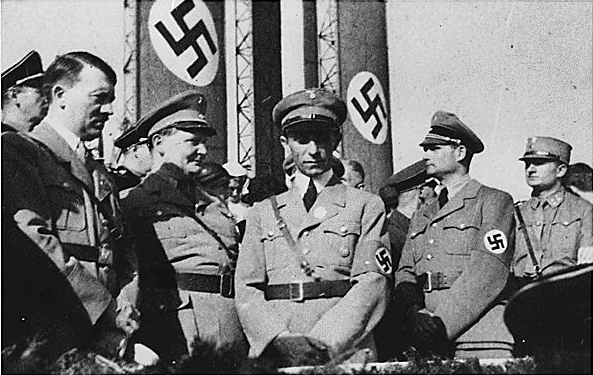
Hitler, Göring, Goebbels and Hess.
Photo via Wikimedia Commons.
The recent increase in economic concentration and monopoly power make the United States “ripe for dictatorship,” claims Columbia law professor Tim Wu in his new book, The Curse of Bigness. With the release of Senator Elizabeth Warren’s proposal to “break up” technology companies like Amazon and Google, fear of bigness is clearly on the rise. Professor Wu’s book adds a new dimension to that fear, arguing that cooperation between political and economic power are “closely linked to the rise of fascism” because “the monopolist and the dictator tend to have overlapping interests.” Economist Hal Singer calls this the book’s “biggest innovation.”
The argument is provocative, but wrong. As I show below, the claim that big business contributed to the rise of the Nazi Party is simply inconsistent with the consensus among German historians. While there is some evidence industrial concentration contributed in Hitler’s ability to consolidate power after he was appointed chancellor in 1933, there is no evidence monopolists financed Hitler’s rise to power, and ample evidence showing industry leaders opposed his ascent.
Thomas Childers, a professor of history at the University of Pennsylvania, calls the idea that Hitler was bankrolled by big corporate donors a “persistent myth.” This, among myriad other reasons, should give us pause before comparing 1930s Germany to the present-day United States. If fascism does come to the United States, big business won’t be to blame.
[…]
In the run-up to the presidential election in the spring of 1932, Hitler gave a speech to “a gathering of some 650 members of the Düsseldorf Industry Club in the grand ballroom of Düsseldorf’s Park Hotel.” British historian Sir Ian Kershaw recounts the event in Hitler: A Biography (p. 224):
Hitler’s much publicized address … did nothing, despite the later claims of Nazi propaganda, to alter the skeptical stance of big business. The response to his speech was mixed. But many were disappointed that he had nothing new to say, avoiding all detailed economic issues by taking refuge in his well-trodden political panacea for all ills. And there were indications that workers in the party were not altogether happy at their leader fraternizing with industrial leaders. Intensified anti-capitalist rhetoric, which Hitler was powerless to quell, worried the business community as much as ever. During the presidential campaigns of spring 1932, most business leaders stayed firmly behind Hindenburg, and did not favour Hitler … The NSDAP’s funding continued before the ‘seizure of power’ to come overwhelmingly from the dues of its own members and the entrance fees to party meetings. Such financing as came from fellow-travellers in big business accrued more to the benefit of individual Nazi leaders than the party as a whole. Göring, needing a vast income to cater for his outsized appetite for high living and material luxury, quite especially benefited from such largesse. Thyssen in particular gave him generous subsidies, which Göring — given to greeting visitors to his splendrously adorned Berlin apartment dressed in a red toga and pointed slippers, looking like a sultan in a harem — found no difficulty in spending on a lavish lifestyle.
As Ralph Raico, a professor of history at Buffalo State College, points out, the aim of these “relatively minor subsidies” to particular Nazis “was to assure (the donors) of ‘friends’ in positions of power, should the Nazis enter the state apparatus.” In Hitler: Ascent, 1889-1939, German historian and journalist Volker Ullrich details the extent of the industrialists’ support for center-right parties during the time of the Düsseldorf speech (p. 292):
[T]he American historian Henry A. Turner and others following in his footsteps have corrected this outmoded narrative about the relationship between National Socialism and major German industry. By no means had the entire economic elite of the Ruhr Valley attended Hitler’s speech… The crowd’s reaction to Hitler was also by no means as positive as (Nazi Press Chief Otto) Dietrich’s report had its readers believe. When Thyssen concluded his short word of thanks with the words “Heil, Herr Hitler,” most of those in attendance found the gesture embarrassing. Hitler’s speech also did little to increase major industrialists’ generosity when it came to party donations. Even Dietrich himself admitted as much in his far more sober memoirs from 1955: “At the ballroom’s exit, we asked for donations, but all we got were some well-meant but insignificant sums. Above and beyond that there can be no talk of ‘big business’ or ‘heavy industry’ significantly supporting, to say nothing of financing, Hitler’s political struggle.” On the contrary, in the spring 1932 Reich presidential elections, prominent representatives of industry like Krupp and Duisberg came out in support of Hindenburg and donated several million marks to his campaign.
The period immediately following Hitler’s speech to the Düsseldorf Industry Club was similarly fruitless for fundraising, as Richard J. Evans, a professor of history at the University of Cambridge, describes in The Coming of the Third Reich (p. 245):
Neither Hitler nor anyone else followed up the occasion with a fund-raising campaign amongst the captains of industry. Indeed, parts of the Nazi press continued to attack trusts and monopolies after the event, while other Nazis attempted to win votes in another quarter by championing workers’ rights. When the Communist Party’s newspapers portrayed the meeting in conspiratorial terms, as a demonstration of the fact that Nazism was the creature of big business, the Nazis went out of their way to deny this, printing sections of the speech as proof of Hitler’s independence from capital. The result of all this was that business proved not much more willing to finance the Nazi Party than it had been before.
Hitler lost the spring 1932 presidential election to Hindenburg. But the Nazi party achieved a plurality of seats in parliament for the first time in the July 1932 elections. Unable to form a government without Nazi cooperation after yet another round of elections in November 1932, Hindenburg appointed Hitler chancellor on January 30, 1933. With Hitler now in power, things changed.
In a 2014 review, Larry Schweikart wrote:
Still, more than a few voices critical of such historical hanky-panky have been raised. Perhaps the most influential is that of Henry A. Turner, Jr., who has provided an accurate and verifiable history of the Weimar period in his German Big Business and the Rise of Hitler. Turner sensibly avoids class struggle as a theme and simply asks if big business liked Hitler. Did business leaders support him? Did they give him money? Turner concludes that they did not. Only “through gross distortion can big business be accorded a crucial, or even major, role in the downfall of the Republic” (p. 340). Turner claims that bias “appears over and over again in treatments of the political role of big business even by otherwise scrupulous historians” (p. 350).
In his own examination of the evidence, Turner looked at the correspondence of German business leaders, minutes of their meetings, and their contributions. While it might be reassuring for some to think that Hitler came to power through the financial support of a few evil businessmen, the facts are that most of the Nazis’ money came from the German people. Turner carefully discusses Hitler’s policy stances toward business. Hitler was always wary of alienating the businessmen, but his failure to present a clear, procapitalistic economic program made the corporate leaders all the more leery of him. Modern Marxists, quite naturally, would like to implicate capitalism in the Holocaust. But, of course, Hitler’s themes were those of Stalin and, in our own day, Gorbachev. Nazism, as Turner suggests but never makes sufficiently clear, resembled Marxism in many ways, including Jew-hatred and hostility to the individual. In any case, Turner’s book has completely refuted the accepted notions that German corporations supported Hitler.
H/T to Colby Cosh for the initial link.
March 11, 2019
QotD: The purpose of language
But back to the mystics in general. I refuse to be swallowed up by their bullshit, nor do I allow myself to feel in any way inferior to their apparent greater knowledge. I once listened to some consultant describe a proposed change, and the description was filled with consultant-jargon — oh yes, they too have to impress clients with their insider language — and when he was done, I said, as succinctly as I could: “I didn’t understand a single thing you just said. Could you restate it, but in plain English this time?”
“Oh,” he stammered, “I simply meant that we need to streamline the process to shorten our product’s time-to-market.”
“You mean, the time between the thing’s production and its appearance on the retailer’s shelf?”
“Yes.”
“Then why didn’t you just say that, instead of having me waste both our time by getting you to explain it to me?”Roger Moore put it best, I think: “The point of language is to communicate your thoughts in the shortest possible time and in the clearest possible way.” My corollary to that excellent sentiment is, “And if somebody is not doing that, he’s pursuing a different agenda or has something he wishes to disguise.”
And finally, I should point out that Moore’s “clarity” does not equal “simplistic” (I nearly wrote simplisme, but you guys would have chased me from the room, and justifiably so).
Semper claritas should be your guiding principle.
Kim du Toit, “Mystics”, Splendid Isolation, 2017-03-28.
March 10, 2019
There’s something bigger at stake in the SNC-Lavalin affair than Trudeau’s career
Chris Selley explains why SNC-Lavalin is an example of Canada’s less-than-stellar record of holding corporations to account:

… University of Michigan law professor David Uhlmann argues in a 2016 paper, “criminal prosecution of corporations upholds the rule of law, validates the choices of law-abiding companies, and promotes accountability. … When corporations face no consequences for their criminal behavior, we minimize their lawlessness, and increase cynicism about the outsized influence of corporations.”
No kidding. And in a country like Canada, not to say a province like Quebec, it’s safe to say these lines of accountability and trust get severely tangled. Once a government deems any company “too big to fail,” whether it’s because of political donations or connections, or because its pension plan is heavily invested, or because it has acquired a creepy semi-sacred status among otherwise normal people — or indeed, because of an alleged 9,000 jobs — all these nice theories about the rule of law break down. That’s what we’ve been witnessing.
But there’s an even bigger breakdown going on that’s received far less attention. Employees allegedly behind Lavalin’s Libyan capers were criminally charged as well. Between them, former vice-president Sami Bebawi and former controller Stéphane Roy faced charges including defrauding the Libyan state, money laundering, violating UN sanctions, bribing Saadi Gadhafi — Moammar’s soccer-playing, Montreal-enjoying third son — and trying to extract him from Libya once it all kicked off in 2011.
Those charges were laid in February 2014. Last month, some against Bebawi and all against Roy were dismissed because the Crown didn’t manage to bring them to trial in five blessed years. In a scathing decision, judge Patricia Compagnone characterized the Crown’s behaviour as a perfect illustration of the “culture of complacency” and the “culture of delays” the Supreme Court had assailed in its landmark 2016 Jordan decision, which established empirical standards for the Charter right “to be tried within a reasonable time.”
It is an ever-more-curious mystery that Canada’s comprehensively screwed-up justice system never rises to the level of political crisis. In the first year after the Jordan decision alone, some 200 cases were thrown out on grounds of excessive delays. Some of the accused make the Friends of Moammar look like saints. They include alleged murderers, child molesters and drunk drivers.
The charges against SNC-Lavalin were laid in February 2015. More than four years later, we’re still fighting over whether to pursue them — and not, it must be said, in a way that makes us look like a terribly serious country. How nauseatingly fitting it would be if a court threw the case out before the feds even got a chance to decide what to do with it.
March 4, 2019
March 3, 2019
QotD: Four ways to corporate monopoly
1. Proprietary technology. This one is straightforward. If you invent the best technology, and then you patent it, nobody else can compete with you. Thiel provocatively says that your technology must be 10x better than anyone else’s to have a chance of working. If you’re only twice as good, you’re still competing. You may have a slight competitive advantage, but you’re still competing and your life will be nasty and brutish and so on just like every other company’s. Nobody has any memory of whether Lycos’ search engine was a little better than AltaVista’s or vice versa; everybody remembers that Google’s search engine was orders of magnitude above either. Lycos and AltaVista competed; Google took over the space and became a monopoly.
2. Network effects. Immortalized by Facebook. It doesn’t matter if someone invents a social network with more features than Facebook. Facebook will be better than their just by having all your friends on it. Network effects are hard because no business will have them when it first starts. Thiel answers that businesses should aim to be monopolies from the very beginning – they should start by monopolizing a tiny market, then moving up. Facebook started by monopolizing the pool of Harvard students. Then it scaled up to the pool of all college students. Now it’s scaled up to the whole world, and everyone suspects Zuckerberg has somebody working on ansible technology so he can monopolize the Virgo Supercluster. Similarly, Amazon started out as a bookstore, gained a near-monopoly on books, and used all of the money and infrastructure and distribution it won from that effort to feed its effort to monopolize everything else. Thiel describes how his own company PayPal identified eBay power sellers as its first market, became indispensible in that tiny pool, and spread from there.
3. Economies of scale. Also pretty straightforward, and especially obvious for software companies. Since the marginal cost of a unit of software is near-zero, your cost per unit is the cost of building the software divided by the number of customers. If you have twice as many customers as your nearest competitor, you can charge half as much money (or make twice as much profit), and so keep gathering more customers in a virtuous cycle.
4. Branding. Apple is famous enough that it can charge more for its phones than Amalgamated Cell Phones Inc, even for comparable products. Partly this is because non-experts don’t know how to compare cell phones, and might not trust Consumer Reports style evaluations; Apple’s reputation is an unfakeable sign that their products are pretty good. And partly it’s just people paying extra for the right to say “I have an iPhone, so I’m cooler than you”. Another company that wants Apple’s reputation would need years of successful advertising and immense good luck, so Apple’s brand separates it from the competition and from the economic state of nature.
Scott Alexander, “Book Review: Zero to One”, Slate Star Codex, 2019-01-31.
March 2, 2019
Mark Steyn – Trudeaupia on the Waterfront
Mark Steyn on the “nothing to see here, let’s just move on” SNC-Lavalin affair:
Speaking as someone who gets sued a lot, I account Jody Wilson-Raybould as a killer exemplar of what every litigant dreads the other side coming up with – a credible witness. In a riveting performance, the former Attorney General of Canada laid out calmly and without overheated rhetorical flourish a campaign by the most powerful figures in the government to get their cronies at SNC-Lavalin off the hook of a criminal prosecution for bribing (Libyan) government officials. Ms Wilson-Raybould identified just shy of a dozen Liberal Party bruisers who leaned on her, including the most senior chaps in the Prime Minister’s Office, the Privy Council Office and the Ministry of Finance – and ultimately the PM himself.
But, in a competitive field, perhaps the behavior of Michael Wernick, Clerk of the Privy Council, a career civil servant and the highest-ranking in Canada, is the most outrageous. In a three-man meeting – the Clerk, the Attorney General and the PM – Mr Wernick acted not as an impartial public servant but as a gung-ho party hack demanding political interference in a criminal prosecution in order to help Justin’s pals beat the rap:
The PM again cited potential loss of jobs and SNC moving. Then to my surprise – the Clerk started to make the case for the need to have a DPA – he said “there is a board meeting on Thursday (Sept 20) with stock holders” … “they will likely be moving to London if this happens”… “and there is an election in Quebec soon”…
At that point the PM jumped in stressing that there is an election in Quebec and that “and I am an MP in Quebec – the member for Papineau”.
I was quite taken aback. My response – and I remember this vividly – was to ask the PM a direct question while looking him in the eye – I asked: “Are you politically interfering with my role / my decision as the AG? I would strongly advise against it.” The Prime Minister said “No, No, No – we just need to find a solution.”
When Ms Wilson-Raybould held firm against Justin’s pressure to lean on the Crown’s prosecution of a serious criminal case, he arranged a Cabinet reshuffle to remove her as Attorney General.
This is a protection racket: Underneath the LGBTQWERTY Ramadan socks and the Bollywood bridesmaid outfits for his passage through India, Justin Trudeau turns out to be Lee J Cobb in On the Waterfront. My old friend Paul Wells calls this a “moral catastrophe” for Justin. Not quite: He is who he is. It’s a moral catastrophe for Canada if those who dote on the Dauphin make the rest of us go along with it.
February 27, 2019
Toronto’s transit cheat epidemic
I knew the Toronto Transit Commission (TTC) had an issue with fare evasion, but I had no idea it was as prevalent as this:

Anyone who has ever sat through a Toronto Transportation Commission meeting has likely heard anecdotal evidence that fare evasion on the transit system is utterly rampant, if not a mockery of Western civilization itself. Traditionally, such people tended to be treated as harmless cranks. TTC staff would placate them with various internal audits conducted over the years that found roughly two-per-cent fare loss. As recently as 2017, the TTC was claiming just 1.8 per cent of passengers on streetcars — where it’s easiest not to pay — weren’t ponying up.
Well, so much for that. In a convincing report issued last week based on 136 hours of in-person observation and 38 hours of security footage, city auditor-general Beverly Romeo-Beehler estimates fare evasion rates at 15.2 per cent on streetcars, 5.1 per cent on buses and 3.7 per cent on subways, for a total weighted average of 5.4 per cent— around $61 million a year, plus roughly $3.4 million thanks to malfunctioning Presto card equipment owned by Metrolinx.
To put that in perspective, last year’s average 3.2-per-cent fare increase was projected to add $17 million to TTC coffers. If the AG is right, commuters are paying something like 12 cents per trip to subsidize free riders. And the problems underlying the issue are nothing short of jaw-dropping. For one thing, the auditor-general’s team observed scores of adults — and precisely zero children — using child Presto cards to ride for free.
QotD: When progressives took over SF publishing
When I sold my first novel in the late 90s. Most Americans might not be that sensitive to the “climate” but I was. I had after all grown up in a socialist (at best, during the better times) country where to graduate you had to present the proper progressive front. I knew the signs and the hints and social positioning of “further left than thou.” For instance, my first SF cons, as an author, in the green room, I became aware that “a conservative” was a suitable, laughter inducing punchline for any joke; that all of them believed the Reagan years had set us on course to total dystopia; that the US was less enlightened/capable/free than anywhere else; that your average Republican or even non-Democrat voter was the equivalent of the Taliban.
As for Libertarians, I will to my dying day cherish the dinner I had with my then editor to whom I was describing a funny incident at MileHi where for reasons known only to Bob, I found myself in an argument with someone who wanted to ban the internal combustion engine. My editor perked up and (I swear I’m not making this up) said “Oh, a Libertarian.” At which point my husband squeezed my thigh hard enough to stop me answering. But yeah. That was a not uncommon idea of a libertarian. If it was completely insane and involved banning something, then it was a libertarian.
I once overheard the same editor talking to a colleague and saying that if she got submissions across her desk and they were – dropped and horrified voice – somewhat conservative she recommended they try Baen.
Which the other editor (from a different house) agreed with, because after all, they weren’t in the business of publishing conservative works.
This immediately put me on notice that in the field if you were a conservative (I presume libertarians were worse, or at least they seemed to induce more mouth foaming. And though I was solidly libertarian and – at the time – might have qualified as a Libertarian, I suspect if faced with my real positions they would have classed me as conservative, because my positions were self-obviously not left and that’s all it took.) there was only one house that would take you, and if what you wrote/wanted to write wasn’t accepted by then, then you were out of luck.
After that I lived in a state of fear
I imagine it was similar to living in one of the more unsavory periods of the Soviet Union. You saw these purges happen. Whisper-purges. You got the word that someone was “not quite the thing” or that they associated with so and so who associated with so and so who was a – dropped voice – conservative. Suddenly that person’s books weren’t being bought and somehow people would clear a circle around them, because, well, you know, if you’re seen with a – dropped voice – conservative they might think you’re one too. And then it’s off to Never-Never with you.
I found a few other conservatives/libertarians (frankly, mostly libertarians) in the field, all living in the same state of gut clenching fear.
We did such a dance to test both the reliability and discretion of the other before revealing ourselves that we might as well have developed a hanky code. [Blue for true blue Conservative, white for pure Libertarian, red for the blood of our heroes, brown for OWL (older, wiser libertarian), purple for squishy conservative, powder blue for Brad Torgersen. (The powder blue care bear, with the bleeding heart… and the flame thrower.)]
Conventions were nerve wracking because I watched myself ALL the TIME. And you never knew how much you had to watch yourself. Suddenly, out of the blue, at a World Fantasy the speaker, a well known SF/F writer went on about Dean Howard, our next president. The room erupted in applause, some people stood to clap, and I sat there, frozen, unable to actually fake it to that point but too shocked to even put a complaisant expression on my face.
Sarah Hoyt, “Say Goodbye To The State Of Fear”, According to Hoyt, 2017-03-11.


