World War Two
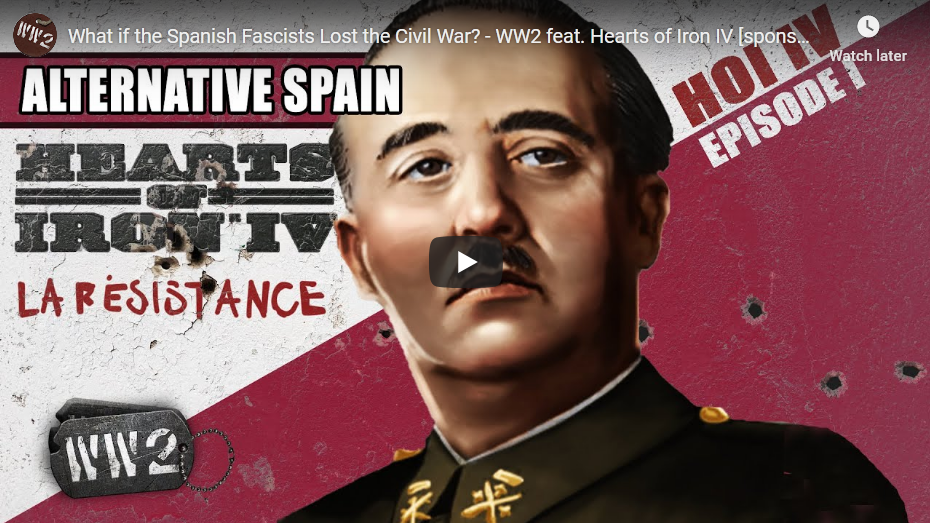
Published 20 Feb 2020This video is sponsored by Paradox Interactive. Indy shares his thoughts on what he thinks would have happened if the Spanish Revolution would have happened differently.
You can create your own alternate history in the grand strategy game Hearts of Iron IV! Discover it here: https://pdxint.at/37Po039
Watch our Between Two Wars episode on the Spanish Civil War here: https://youtu.be/ncUkPavahCU
Follow WW2 day by day on Instagram @World_war_two_realtime https://www.instagram.com/world_war_t…
Join our Discord Server: https://discord.gg/D6D2aYN.
Between 2 Wars: https://www.youtube.com/playlist?list…
Source list: http://bit.ly/WW2sourcesWritten and Hosted by: Indy Neidell
Produced by: Spartacus Olsson and Astrid Deinhard
Directed by: Wieke Kapteijns
Executive Producers: Bodo Rittenauer, Astrid Deinhard, Indy Neidell, Spartacus Olsson
Creative Producer: Joram Appel
Post-Production Director: Wieke Kapteijns
Research by: Indy Neidell
Edited by: Guido Becker
Gameplay scenes by: Sietse Kenter
Sound mix: Marek KamińskiColorizations by:
Dememorabilia – https://www.instagram.com/dememorabilia/
Julius Jääskeläinen – https://www.facebook.com/JJcolorization/
Adrien Fillon – https://www.instagram.com/adrien.colo…
Daniel WeissArchive by Screenocean/Reuters https://www.screenocean.com.
A TimeGhost chronological documentary produced by OnLion Entertainment GmbH.
February 21, 2020
What if the Spanish Fascists Lost the Civil War? – WW2 feat. Hearts of Iron IV
February 16, 2020
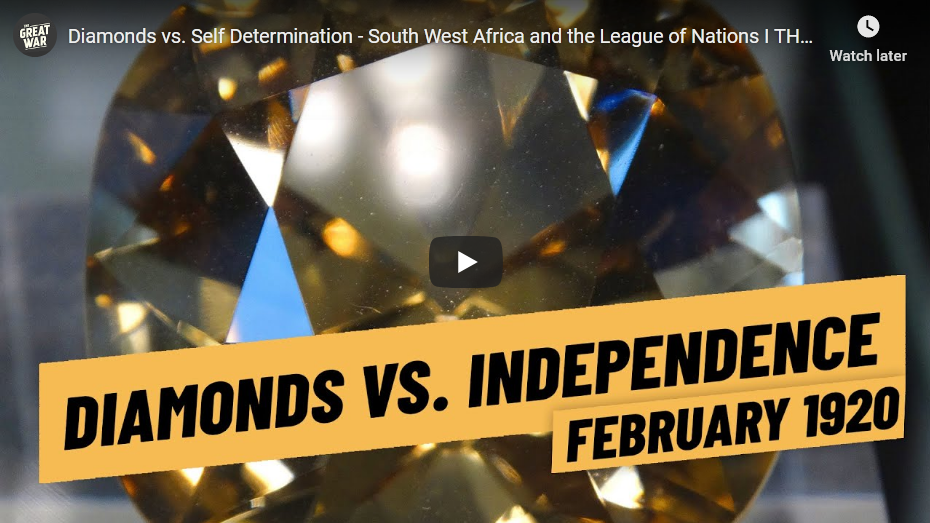
Diamonds vs. Self Determination – South West Africa and the League of Nations I THE GREAT WAR 1920
The Great War
Published 15 Feb 2020Sign up for Curiosity Stream and Nebula: https://curiositystream.com/thegreatwar
Woodrow Wilson’s 14 Points and their idea of self-determination didn’t go unnoticed in the former German colonies like German Southwest Africa. But especially South Africa had other ideas at the Paris Peace Conference and lobbied to take control over future Namibia and its lucrative diamond mines.
» SUPPORT THE CHANNEL
Patreon: https://www.patreon.com/thegreatwar
Merchandise: https://shop.spreadshirt.de/thegreatwar/» SOURCES
Emmett, Tony. 1999. Popular Resistance and the Roots of Nationalism in Namibia, 1915-1966. Basel, Switzerland: P. Schlettwein Publishing.
Olusoga, David, and Casper W. Erichsen. 2011. The Kaiser’s Holocaust: Germany’s Forgotten Genocide and the Colonial Roots of Nazism. London, UK: Faber and Faber.
Onselen, Charles van. 1980. Chibaro: African mine labour in Southern Rhodesia 1900-1933. London, UK: Pluto Pr.
Pirio, Gregory. 1988. “The Role of Garveyism in the Making of Namibian Nationalism.” In Namibia 1884-1984: Readings on Namibia’s History and Society: Selected Papers and Proceedings of the International Conference on “Namibia 1884-1984: 100 Years of Foreign Occupation; 100 Years of Struggle”, London 10-13 September, 1984, Organised by the Namibia Support Committee in Co-Operation with the SWAPO Department of Information and Publicity, edited by International Conference on “Namibia 1884-1984: 100 Years of Foreign Occupation; 100 Years of Struggle,” Brian Wood, Namibia Support Committee, United Nations Institute for Namibia, SWAPO, and Department of Information and Publicity. London: The Committee in cooperation with United Nations Institute for Namibia.
“Report on the Natives of South-West Africa and Their Treatment by Germany.” 1918. 1918. https://ufdc.ufl.edu/UF00072665/00001/1j.
Silvester, Jeremy, and Jan-Bart Gewald, eds. 2003. Words Cannot Be Found: German Colonial Rule in Namibia: An Annotated Reprint of the 1918 Blue Book. Sources for African History, v. 1. Leiden, NL ; Boston, USA: Brill.
Smith, Iain R. 1999. “Jan Smuts and the South African War.” South African Historical Journal 41 (1): 172–95. https://doi.org/10.1080/0258247990867….
Vinson, Robert Trent. 2012. Americans Are Coming! Dreams of African American Liberation in Segregationist South Africa. Athens: Ohio University Press. http://public.eblib.com/choice/public….
Wallace, Marion, and John Kinahan. 2013. A History of Namibia from the Beginning to 1990. Oxford, UK: Oxford University Press.
William Blakemore Lyon. 2015. “The South West Africa Company and Anglo-German Relations, 1892-1914.” Master’s thesis, Cambridge University.
Zimmerer, Jürgen, and Joachim Zeller. 2008. Genocide in German South-West Africa. Monmouth, UK: Merlin Press.
Michell, Lewis (1910). The Life and Times of the Right Honourable Cecil John Rhodes 1853-1902, Volume 2. New York and London: Mitchell Kennerly
Rhodes, Cecil, (1902) “The Last Will and Testament of Cecil John Rhodes: With Elucidatory Notes to Which Are Added Some Chapters Describing the Political and Religious Ideas of the Testator”, London: “Review of Reviews” Office
Cecil Rhodes, “Confession of Faith”, 1877 https://pages.uoregon.edu/kimball/Rho…» SOCIAL MEDIA
Instagram: https://instagram.com/the_great_war
Twitter: https://twitter.com/WW1_Series
Reddit: https://reddit.com/r/TheGreatWarChannel»CREDITS
Presented by: Jesse Alexander
Written by: Jesse Alexander
Director: Toni Steller & Florian Wittig
Director of Photography: Toni Steller
Sound: Toni Steller
Editing: Toni Steller
Mixing, Mastering & Sound Design: http://above-zero.com
Maps: Daniel Kogosov (https://www.patreon.com/Zalezsky)
Research by: Jesse Alexander
Fact checking: Florian WittigChannel Design: Alexander Clark
Original Logo: David van StepholdA Mediakraft Networks Original Channel
Contains licensed material by getty images
All rights reserved – Real Time History GmbH 2020

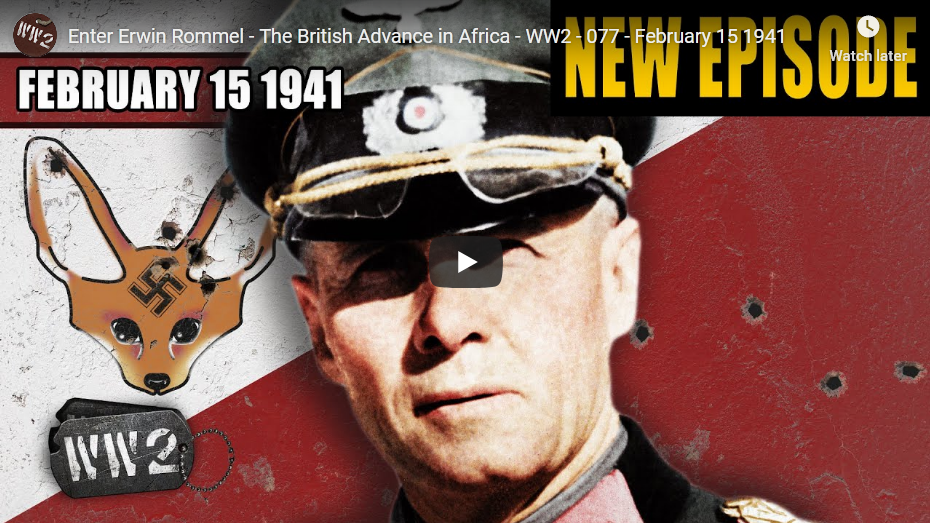
Enter Erwin Rommel – The British Advance in Africa – WW2 – 077 – February 15 1941
World War Two
Published 15 Feb 2020While the Germans send one of their best generals to North Africa to bail out the Italians, Great Britain switches focus from Libya to Greece, but make symbolically important gains in East Africa.
Join us on Patreon: https://www.patreon.com/TimeGhostHistory
Or join The TimeGhost Army directly at: https://timeghost.tvFollow WW2 day by day on Instagram @World_war_two_realtime https://www.instagram.com/world_war_t…
Join our Discord Server: https://discord.gg/D6D2aYN
Between 2 Wars: https://www.youtube.com/playlist?list…
Source list: http://bit.ly/WW2sourcesWritten and Hosted by: Indy Neidell
Produced and Directed by: Spartacus Olsson and Astrid Deinhard
Executive Producers: Bodo Rittenauer, Astrid Deinhard, Indy Neidell, Spartacus Olsson
Creative Producer: Joram Appel
Post-Production Director: Wieke Kapteijns
Research by: Indy Neidell
Edited by: Iryna Dulka
Map animations: Eastory (https://www.youtube.com/c/eastory)Colorizations by:
– Julius Jääskeläinen – https://www.facebook.com/JJcolorization/
– Norman Stewart – https://oldtimesincolor.blogspot.com/Sources:
– Bundesarchiv
– A German soldier poses atop a tank, photo credit: United States Holocaust Memorial Museum, courtesy of Perquimans County Library
– US National Archive
– IWM: A 4035, HU 39482Archive by Screenocean/Reuters https://www.screenocean.com.
A TimeGhost chronological documentary produced by OnLion Entertainment GmbH.
From the comments:
World War Two
2 days ago
When you know the story going forward it’s fascinating to see how the decisions unfold this week — the reshuffling of command both on the Axis and Allied side might seem like innocuous administrative decisions when you don’t know the future. But if you have a crystal ball, you’ll know that not just Rommel arriving in North Africa, but also the decisions on the British side this week will have momentous impact on the war in total. That’s one of the things we discovered early-on with a chronological narrative, it suddenly puts things in a new perspective. The relationship between events changes, and things that might seem too boring, or undramatic to include in a “great story” take on a whole new meaning, increasing our understanding of cause and effect of the “greater” events that will come. On a different note, we just finished shooting a new batch of videos today and we’ll be announcing some fascinating developments on our program in the coming weeks. Stay tuned, and stay awesome, you all are by far the best community on YouTube!
February 9, 2020
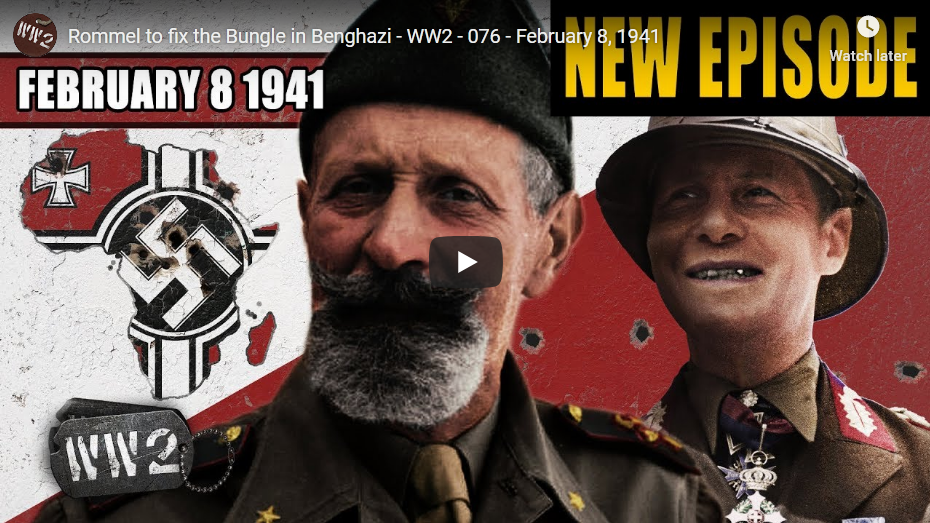
Rommel to fix the Bungle in Benghazi – WW2 – 076 – February 8, 1941
World War Two
Published 8 Feb 2020As the Italian campaigns in Africa collapse, Hitler considers his options and then chooses Erwin Rommel to rescue their Italian allies.
Join us on Patreon: https://www.patreon.com/TimeGhostHistory
Or join The TimeGhost Army directly at: https://timeghost.tvFollow WW2 day by day on Instagram @World_war_two_realtime https://www.instagram.com/world_war_t…
Join our Discord Server: https://discord.gg/D6D2aYN.
Between 2 Wars: https://www.youtube.com/playlist?list…
Source list: http://bit.ly/WW2sourcesWritten and Hosted by: Indy Neidell
Produced and Directed by: Spartacus Olsson and Astrid Deinhard
Executive Producers: Bodo Rittenauer, Astrid Deinhard, Indy Neidell, Spartacus Olsson
Creative Producer: Joram Appel
Post-Production Director: Wieke Kapteijns
Research by: Indy Neidell
Edited by: Mikołaj Cackowski
Map animations: Eastory (https://www.youtube.com/c/eastory)
Additional animations: Ryan WeatherbyColorizations by:
Adrien Fillon – https://www.instagram.com/adrien.colo…
Julius Jääskeläinen – https://www.facebook.com/JJcolorization/
Dememorabilia – https://www.instagram.com/dememorabilia/Sources:
Narodowe Archiwum Cyfrowe
Artillery by Creative Mania from the Noun ProjectSoundtracks from the Epidemic Sound:
Johannes Bornlof – “Last Man Standing 3”
Hakan Eriksson – “Epic Adventure Theme 3”
Phoenix Tail – “At the Front”
Gunnar Johnsen – “Not Safe Yet”
Johan Hynynen – “Dark Beginning”
Yi Nantiro – “Watchmen”
Rannar Sillard – “March Of The Brave 10”Archive by Screenocean/Reuters https://www.screenocean.com.
A TimeGhost chronological documentary produced by OnLion Entertainment GmbH.
February 7, 2020
QotD: The negative economic and human value of foreign aid
I’d like nothing better than to be proven wrong, but I’m gloomily confident that my prediction of failure will be verified. History and sound economics both warn that foreign aid is far more likely to harm than to help economies.
During the past four decades, Western governments have lavished on Africa nearly a half-trillion dollars in aid. But to no good effect. Everyone agrees that Africans remain desperately poor.
Academic studies confirm aid’s ineffectiveness. In his celebrated 2001 book, The Elusive Quest for Growth, former World Bank economist William Easterly carefully reviews aid’s history and concludes that it is one of abject failure.
Indeed, many studies find that aid harms economies. For example, University of Regina economist Tomi Ovaska, writing in the Cato Journal, finds that “a 1 percent increase in aid as a percent of GDP (gross domestic product) decreased annual real GDP per capita growth by 3.65 percent.”
The reasons for this dismal record should be plain to anyone with a rudimentary understanding of economics. Failure of economies to develop is not because of lack of resources. Instead, it’s because of overbearing and corrupt governments, as well as to the dysfunctional social and cultural institutions that keep such governments in power and that are themselves fostered by such governments.
As long as a country is cursed by a malignant government and dysfunctional institutions, no amount of foreign aid will help it.
Don Boudreaux, “Faulty Band-Aid”, Pittsburgh Tribune-Review, 2005-06-18.
February 6, 2020
The rise of the Saadi Empire of Morocco
In the latest Age of Invention newsletter, Anton Howes outlines the rise of a Morocco-based Islamic empire that beat the Portuguese and established a thriving smuggling network with England:
In 1500 you would have thought that Morocco’s golden ages were firmly in the past. The Portuguese in 1415 had conquered Ceuta, on the southern side of the Straits of Gibraltar, with minimal resistance. Over the next century they had then spread their influence across the Moroccan coastline, building forts, establishing small trading colonies, and interfering in local politics. Faced with constant raids, coastal towns like Safi, Massa, and Azammur submitted themselves to Portuguese vassalage in exchange for protection. And when local rulers failed to please them, the Portuguese installed new ones or even took direct control. A disunited Morocco was at the mercy of Portuguese colonial ambition — a source of grain destined for Portugal’s population, and of horses and patterned cloths for it to exchange in sub-Saharan Africa for gold and slaves.
In the 1510s, however, a new dynasty arose in Sus, in the south-west of the country, claiming direct descent from the Prophet Muhammad. These sharifs, the Saadi dynasty, began to fill the vacuum left by ineffective leadership from the sultans in Fez and Marrakech. And to address the massive power imbalance between themselves and the Portuguese, they began to cultivate sugar, selling it to other Europeans — Spanish, French, Genoese, Dutch, and English — in exchange for gunpowder weapons.
The English were especially expert smugglers, frequently able to sneak past the Portuguese fleets to where they could trade directly with the Saadis. Merchants from the Hanseatic league even approached the English government about using English mariners to get iron shot to Morocco. Their request was denied — Elizabeth I and her ministers were always careful never to explicitly allow the munitions trade, even in private letters, and often publicly disavowed it — but it was common knowledge among London’s merchants that the government supported the smuggling. This was partly about having a supply of sugar independent of Portuguese and Spanish control, but it was also a matter of national security. Because hidden among the sugar, marmalade, candied fruits, and almonds that the English transported from Morocco, were also copper and saltpetre — crucial materials for England’s own gunpowder weapons (I still haven’t quite worked out why England needed to import copper, given it had its own deposits in Cornwall, but it seems to have been important and a secure supply of saltpetre was definitely essential).
Both sides benefited from the arrangement. By the mid-1540s, the Saadis had bought the firearms and artillery necessary to take Marrakech and Fez, effectively unifying the country, and had earned sufficient wealth to buy the allegiance of the Moroccan population, providing grain during periods of intense famine. With that allegiance, they began isolating the Portuguese forts along the coastline, denying them access to food, workers, and trade. From the perspective of the Portuguese crown, the forts thus lost their economic value, while becoming increasingly expensive to maintain. Rather than providing Portugal with Moroccan grain, the forts increasingly needed grain from Portugal. With the added pressure of Saadi sieges, now aided by massive artillery, Portugal began to lose their footholds, abandoning many of the rest. Thus, in the space of a few decades, the export of sugar (and saltpetre) by the Saadis had put the mighty Portuguese empire on the back foot.
Rifles of Emperor Menelik II: Ethiopian Gewehr 88 and Karabiner 88
Forgotten Weapons
Published 5 Feb 2020http://www.patreon.com/ForgottenWeapons
https://www.floatplane.com/channel/Fo…
Cool Forgotten Weapons merch! http://shop.bbtv.com/collections/forg…
In 1889, Emperor Menelik II ascended to power in Ethiopia, and would rule for 20 years, moving Ethiopia (aka Abyssinia) forward into the modern age. He brought railways, sewer systems, telegraph lines, and other modern amenities to the country, particularly the capital of Addis Ababa. In addition, Menelik II was a very capable logistician and military strategist, and decisively defeated an Italian colonial invasion at the Battle of Adwa in 1896. This victory was made possible by Ethiopian acquisition of modern arms of many types. Early support came from Orthodox Russia in the form of Berdan rifles, but other arms would flow into the country as well, including Gewehr 88 and Karabiner 88 rifles and carbines. These two are marked in Amharic as Menelik’s property, and are a part of what allowed Ethiopia to be the only major African nation not colonized by Europe.
Thanks to InterOrdnance for giving me access to these rifles to bring to you!
Contact:
Forgotten Weapons
6281 N. Oracle #36270
Tucson, AZ 85740
February 2, 2020
Africa, the Axis’ Achilles Heel – The Allied African Campaigns – WW2 – 075 – February 1, 1941
World War Two
Published 1 Feb 2020Greek Prime Minister Ioannis Metaxas dies this week as Italy is still uncomfortably wrapped up in the Albanian Mountains. Italy also finds itself in a pickle on other fronts, as Allied troops in Africa move into Italian territory with three offensives this week.
Join us on Patreon: https://www.patreon.com/TimeGhostHistory
Or join The TimeGhost Army directly at: https://timeghost.tvFollow WW2 day by day on Instagram @World_war_two_realtime https://www.instagram.com/world_war_t…
Join our Discord Server: https://discord.gg/D6D2aYN.
Between 2 Wars: https://www.youtube.com/playlist?list…
Source list: http://bit.ly/WW2sourcesWritten and Hosted by: Indy Neidell
Produced and Directed by: Spartacus Olsson and Astrid Deinhard
Executive Producers: Bodo Rittenauer, Astrid Deinhard, Indy Neidell, Spartacus Olsson
Creative Producer: Joram Appel
Post-Production Director: Wieke Kapteijns
Research by: Indy Neidell
Edited by: Mikołaj Cackowski
Map animations: Eastory (https://www.youtube.com/c/eastory)Colorizations by:
Dememorabilia – https://www.instagram.com/dememorabilia/
Adrien Fillon – https://www.instagram.com/adrien.colo…
Julius Jääskeläinen – https://www.facebook.com/JJcolorization/Sources:
IWM (IND 883); (IND 2405); (E 3661); (E6661)
Vatican by Made by Made from the Noun Project
king crown by ProSymbols from the Noun Project
tick by akash k from the Noun Project
Artillery by Creative Mania from the Noun ProjectSoundtrack from the Epidemic Sound:
Christian Andersen – “Disciples of Sun Tzu”
Reynard Seidel – “Deflection”
Fabien Tell – “Last Point of Safe Return”
Johan Hynynen – “Dark Beginning”
Bonnie Grace – “Imperious”
Johannes Bornlof – “Last Man Standing 3”Archive by Screenocean/Reuters https://www.screenocean.com.
A TimeGhost chronological documentary produced by OnLion Entertainment GmbH.
January 26, 2020
When Anti-Semites Infight, Jews Still Die – Pogroms in Romania – WW2 – 074 – January 25, 1941
World War Two
Published 25 Jan 2020The British offensive in East-Africa takes off with some rapid advances. Meanwhile in Eastern-Europe, Romania is the stage of fierce anti-semitism, but also infighting between two of the groups causing the anti-semitism.
Join us on Patreon: https://www.patreon.com/TimeGhostHistory
Or join The TimeGhost Army directly at: https://timeghost.tvFollow WW2 day by day on Instagram @World_war_two_realtime https://www.instagram.com/world_war_t…
Join our Discord Server: https://discord.gg/D6D2aYN.
Between 2 Wars: https://www.youtube.com/playlist?list…
Source list: http://bit.ly/WW2sourcesWritten and Hosted by: Indy Neidell
Produced and Directed by: Spartacus Olsson and Astrid Deinhard
Executive Producers: Bodo Rittenauer, Astrid Deinhard, Indy Neidell, Spartacus Olsson
Creative Producer: Joram Appel
Post-Production Director: Wieke Kapteijns
Research by: Indy Neidell
Edited by: Mikołaj Cackowski
Map animations: Eastory (https://www.youtube.com/c/eastory)
Additional animations: Ryan WeatherbyColorizations by:
Adrien Fillon – https://www.instagram.com/adrien.colo…
Julius Jääskeläinen – https://www.facebook.com/JJcolorization/
Dememorabilia – https://www.instagram.com/dememorabilia/
Daniel WeissSources:
IWM (B 10600)
Narodowe Archiwum Cyfrowe
freemason by Kyle Tezak from the Noun Project
Letter by Mochammad Kafi from the Noun Project
ETH-Bibliothek Zürich, Bildarchiv / Fotograf: Wehrli, Leo / Dia_247-08618
Private collection of Riggio family https://commons.wikimedia.org/wiki/Fi…Soundtracks from the Epidemic Sound:
Philip Ayers – “The Unexplored”
Max Anson – “Ancient Saga”
Hakan Erikson – “Epic Adventure Theme 4”
Andreas Jamsheree – “Guilty Shadows 4”
Johannes Bornlof – “Last Man Standing 3”Archive by Screenocean/Reuters https://www.screenocean.com.
A TimeGhost chronological documentary produced by OnLion Entertainment GmbH.
From the comments:
World War Two
2 days ago
Thank you all so much for reaching 400.000 subscribers! Thanks to all of your support and enthusiasm, more and more people get to see more and better content. In fact, from mid-February onwards, we are going to publish three WW2 videos a week, including Out of the Foxholes, Biographies, Special Episodes, War Against Humanity and a new series on the Homefronts. Not only that, we are also going to start a new series on the TimeGhost History Channel (http://www.youtube.com/c/timeghost). Our Patreons get to vote on what we’ll do next! So don’t miss out and change history here -> https://www.patreon.com/posts/what-timeghost-33300161
Cheers, Joram
January 21, 2020
Punic Wars | 3 Minute History
January 16, 2020
Book Review: The Ministry of Ungentlemanly Warfare by Damien Lewis
Forgotten Weapons
Published 24 Sep 2017Get your copy on Amazon: http://amzn.to/2xwfDZ8
I ordered a copy of Damien Lewis’ book on the exploits of British SOE in WWII expecting to find an overview of, well, what SOE had done during the war. That’s not quite what this book is. Instead, Lewis has given us essentially a first-person view of SOE’s work through the eyes of Danish commando Anders Lassen (VC, MC with two bars). Don’t be fooled by the cover image; the North African LRDG is never mentioned. However, what Lassen was involved in was equally impressive and probably less well known.
Lassen was part of the crew for the first real SOE operation, the theft of a pair of German and Italian supply ships from the neutral Spanish port at Fernando Po. In an exploit that could be straight out of Hollywood, a band of commandoes sailed a pair of tugboats into the harbor at night while the ships’ officers were ashore at a raucous party. They blew the anchor chains with explosive charges, locked the crews below deck, and sailed the ships out to sea where they could be legally captured by a British destroyer. And they did it without a single death on either side.
The exploits only became bigger and bolder after that, with Lassen and his comrades making regular raids across the English Channel and running a freewheeling campaign of both hit-and-run raids and occupation of Greek islands in the Aegean. These were the quintessential independent Special Forces fighters, operating outside regular military command structures and supply chains, fighting as they saw fit. Lassen eventually became the commanding officer of a large group, and by the end of the war had been awarded the Military Cross three times. His last operation in Italy — where his men were hit with a shattering defeat when pushed into the role of spearheading a conventional offensive — would result in him posthumously receiving the Victoria Cross for his heroism.
I ended up reading the book almost entirely in a single sitting, and found it riveting and fascinating — far more so than the typical academic history. It offers a humbling and motivating example of what men can do when they are skilled and motivated. At the same time, it also left me a bit melancholy, as by the end we can see Lassen consumed by his combat experiences and slowly becoming removed from society. Nobody can say how Lassen would have coped had he survived the war, but one suspects he would have led a troubled life. Perhaps that is the price one must pay to become, as Churchill described, “a hand of steel which plucks the German sentries from their posts with growing efficiency.”
http://www.patreon.com/ForgottenWeapons
Cool Forgotten Weapons merchandise! http://shop.bbtv.com/collections/forg…
If you enjoy Forgotten Weapons, check out its sister channel, InRangeTV! http://www.youtube.com/InRangeTVShow
January 14, 2020
The Desert Fox | Rommel’s FIRST Battle in the North African Campaign | BATTLESTORM
TIK
Published 17 May 2016Erwin Rommel faces the might of the British Empire. In 3D animation, we’ll see the units, the battlefield and the tactics The Desert Fox uses to overcome the British and Australian forces at Mersa Brega and throw them out of Italian Libya. Except for Tobruk of course! The video covers Erwin Rommel’s arrival in Italian Libya up to the beginning part of the Battle of Tobruk 1941.
This video is Part 2 of the Western Desert Campaign – Part 1 (Operation Compass) is in the link below
https://www.youtube.com/watch?v=b71kd…Bibliography
Battistelli, Pier Paolo. Erwin Rommel (Command). Osprey Publishing, 2010.
Beckett, Ian F. Rommel: A Reappraisal. Great Britain, 2013.
Beevor, Antony. The Second World War. Phoenix, 2014.
Bickers, Richard Townshend. The Desert Air War: 1939-1945. Endeavour Press Ltd, 2015.
Butler, Daniel Allen. Field Mashal: the Life and Death of Erwin Rommel. Casemate Publishers, 2015.
Dimbleby, Jonathan. Destiny in the Desert: The Road to El Alamein – the Battle that Turned the Tide. Great Britain, 2012.
Liddell Hart, B.H. A History of the Second World War. Pan Books, 2015.
Hastings, Max. All Hell Let Loose: The World at War 1939-1945. HarperPress, 2011.
Jorgensen, Christer. Afrika Korps: Rommel’s 1941 Offensive (Rapid Reads). Brown Bear Books, 2014.
LaFace, Major Jeffrey L. Tactical Victory Leading to Operational Failure: Rommel in North Africa. Pickle Partners Publishing, 2014.
Lyman R. The Longest Siege: Tobruk – The Battle That Saved North Africa. Pan Books, 2011.
Moorehead, Alan. The Desert War: the Classic Trilogy on the North Africa Campaign 1940-43. CPI Group, 2012.
Nash, N. Strafer Desert General: The Life and Killing of Lieutenant General WHE Gott. Pen and Sword Books Ltd, 2013.
Neillands, Robert. The Desert Rats: 7th Armoured Division 1940-45. UK, 2005.
Neillands, Robert. Eighth Army: From the Western Desert to the Alps, 1939-1945. John Murray Publishers, 2004.
Pitt, Barrie. The Crucible of War: Volume 1: Wavell’s Command. Cassell & Co, 2001.
Playfair, Major-General I.S.O. The Mediterranean and Middle East, Volume II, “The Germans come to the help of their Ally” (1941). The Naval & Military Press Ltd, 2004.
Raugh, H. Wavell in the Middle East 1939-1941: A Study in Generalship. USA, 2013.
Reuth, Ralf Georg. Rommel: The End of a Legend. Haus Publishing, 2005.
Thompson, Dennis H. Discarded Victory – North Africa, 1940-1941. Pickle Partners, 2014.
Williamson, Gordon. Afrikakorps 1941-43 (Elite). Osprey Publishing, 2009.
January 12, 2020
Fighting Far Away From Home – Allied Advance in Africa – WW2 – 072 – January 11 1941
World War Two
Published 11 Jan 2020Action in Albania. Action in North-Africa. Action in East-Africa. Action in China and action on the Mediterranean. It looks like every belligerent party is amping up its efforts to get a foothold wherever they are. And if your enemy is gaining ground? You just throw more material and men at them.
Join us on Patreon: https://www.patreon.com/TimeGhostHistory
Or join The TimeGhost Army directly at: https://timeghost.tvFollow WW2 day by day on Instagram @World_war_two_realtime https://www.instagram.com/world_war_t…
Join our Discord Server: https://discord.gg/D6D2aYN.
Between 2 Wars: https://www.youtube.com/playlist?list…
Source list: http://bit.ly/WW2sourcesWritten and Hosted by: Indy Neidell
Produced and Directed by: Spartacus Olsson and Astrid Deinhard
Executive Producers: Bodo Rittenauer, Astrid Deinhard, Indy Neidell, Spartacus Olsson
Creative Producer: Joram Appel
Post-Production Director: Wieke Kapteijns
Research by: Indy Neidell
Edited by: Daniel Weiss
Map animations: Eastory (https://www.youtube.com/c/eastory)Colorizations by:
– Dememorabilia – https://www.instagram.com/dememorabilia/
– Julius Jääskeläinen – https://www.facebook.com/JJcolorization/Sources:
IWM (A 4161), (E 872), (A 4162), (A 9793), (A 13509).
Division Coat of Arms by Noclador
oil barrel by BomSymbols from the Noun Project
can by Anniken & Andreas from the Noun ProjectSoundtracks from Epidemic Sound:
– “Arriving in Ancient Rome” – Kikoru
– “Easy Target” – Rannar Sillard
– “Split Decision” – Rannar Sillard
– “Road To Tibet 5” – Rannar Sillard
– “Death And Glory 1” – Johannes Bornlöf
– “The Inspector 4” – Johannes Bornlöf
– “Not Safe Yet” – Gunnar JohnsenArchive by Screenocean/Reuters https://www.screenocean.com.
A TimeGhost chronological documentary produced by OnLion Entertainment GmbH.
From the comments:
World War Two
3 days ago (edited)
It looks like all fronts are heating up this week. And that the German reaction to the British offensive in North-Africa and the Greek progress in Albania is to move more German troops southward. This week already shows how that potentially threatens Britains position in the Mediterranean. Well, just like the British and Germans, we hope to increase our manpower in 1941. Do your part and expand our community of loyal supporters and history buffs by joining the TimeGhost Army on https://www.patreon.com/timeghosthistory and https://timeghost.tv. The war effort needs you!
Cheers, Joram
January 10, 2020
One more Scramble in Africa – The Second Italo-Abyssinian War | BETWEEN 2 WARS I 1935 Part 4 of 4
TimeGhost History
Published 9 Jan 2020After European Empires were done scrambling for Africa, not much of the African continent was left to be ruled by its native people, or to be colonised for other colony-hungry European powers. However, the Kingdom of Abyssinia is one of the countries that made it through the scramble alive. That is, until Benito Mussolini shifts the Italian focus to East-Africa once more.
Join us on Patreon: https://www.patreon.com/TimeGhostHistory
Hosted by: Indy Neidell
Written by: Joram Appel, Spartacus Olsson and Naman Habtom
Directed by: Spartacus Olsson and Astrid Deinhard
Executive Producers: Bodo Rittenauer, Astrid Deinhard, Indy Neidell, Spartacus Olsson
Creative Producer: Joram Appel
Post-Production Director: Wieke Kapteijns
Research by: Naman Habtom
Edited by: Daniel Weiss
Sound design: Marek KaminskiSources:
Diploma by Alena from the Noun Project
Teacher by b farias from the Noun Project
guns by Cards Against Humanity from the Noun Project
Curved path by Allie Tate from the Noun Project
Labor Day by H Alberto Gongora from the Noun Project
train tracks by Prasad from the Noun ProjectColorizations by:
– Dememorabilia – https://www.instagram.com/dememorabilia/
– Julius Jääskeläinen – https://www.facebook.com/JJcolorization/A TimeGhost chronological documentary produced by OnLion Entertainment GmbH.
January 9, 2020
Operation Compass 1940-41 | BATTLESTORM North African Campaign Documentary
TIK
Published 21 Dec 2015The most in-depth look at Operation Compass out there! Using animations and detailed maps, let’s find out what happened in one of the greatest British (and Commonwealth) victories of the war and who was responsible for the destruction of the Italian 10th Army. This video covers the start of the North African Campaign up to the Battle of Beda Fomm.
Sources:
Barnett, C. The Desert Generals. Weidenfeld & Nicolson, 2011.
Bierwirth, J. Beda Fomm: An Operational Analysis. Pickle Partners, 1994.
Christie H. Fallen Eagles: The Italian 10th Army in the Opening Campaign in the Western Desert, June 1940. Pickle Partners 1999.
Dimbleby, J. Destiny in the Desert. Britain 2013.
Moorehead, A. The Desert War: The Classic Trilogy on the North Africa Campaign 1940-43. Aurum Press, 2014.
Playfair, I.S.O. The Mediterranean and Middle East Volume 1: Early Successes against Italy [to May 1941]. 1954.
Wahlert, G. The Western Desert Campaign. Australia, 2011.Music is my own!