
Published on 30 May 2013
Documentary looking at the much-loved sitcom from its first transmission in 1983. The programme features an exclusive in-depth interview with Edmund Blackadder himself, Rowan Atkinson, the first time he has agreed to talk about his experiences making the show. Also reflecting on their time on the show are other key members of the team, including Stephen Fry, Hugh Laurie, Tony Robinson, Rik Mayall, Ben Elton and Richard Curtis.
December 3, 2013
Blackadder Rides Again
Comments Off on Blackadder Rides Again
November 27, 2013
Some awkward questions about the Brixton “slaves”
Brendan O’Neill goes through the “half-truths and wild claims” of the recent modern slavery story in Britain:
It was presented to us as another Fritzl-like horror, involving three ‘enslaved women’, at least one of whom had ‘spent her whole life in captivity’ and had ‘never seen the outside world’. Or it was Britain’s own version of the recent Cleveland, Ohio case, in which Ariel Castro kidnapped three women from the streets and shackled them to immoveable objects in his house where he abused them for 10 years. In fact, it was worse than Cleveland, suggested the Mirror, because where those American women only suffered for a decade, these British-based women went through a ‘30-year nightmare of captivity, servitude and unimaginable brutality’. It was, in a nutshell, the worst-ever case of hidden human enslavement, the papers told us. ‘No known victims have spent so long in captivity being brainwashed, beaten, manipulated and terrorised’, one said.
We now know that these claims about the so-called ‘Brixton slaves’ are, to use the only term that will suffice, bullshit. Everything that has subsequently come to light, everything that has unfolded in the six days since these ‘slaves’ were ‘rescued’ from some kind of one-time Maoist commune, has called into question the initial claims made by the police, the highly dramatised narrative imposed on these events by the media, and the hyperbolic descriptions of the case by politicians desperate to appear as modern-day William Wilberforces combatting the evils of ‘slavery’. Indeed, the key question that must now be asked is not ‘How did three women end up in a grim commune?’ (let’s leave that to the police), but rather: ‘Why did the entire British media and the political class, along with campaigners and the Twitterati, so willingly and gullibly buy a horror story that was not true?’
[…]
So almost everything we were told about the Brixton case has turned out either to be untrue or to have been wildly exaggerated or dramatised. These were not slaves. They were not held captive. They were not denied contact with the outside world. Rather, what we seem to be dealing with is, quite simply, a very, very eccentric household, in which various people came together, did and believed very strange things, developed an obsession with Mao and conspiracy theories about the British ‘fascist state’, and then ended up regretting it all — well, three of women seem to have regretted it. And so they left. Voluntarily. Without a struggle. It sounds like it was all very unpleasant; it seems clear emotional manipulation was involved and possibly physical force too (but let’s allow the courts to decide that). But slavery? Fritzl-style abuse? Hell, horror, unimaginable brutality? There is nothing remotely resembling evidence to show that anything like that occurred.
So why did the media, politicians, feminists and campaigners lap up this half-cooked, shrill, mostly baseless fantasy about slaves stuck in suburban jails in London? Because it spoke to their already existing prejudices; because it seemed to confirm the darker thoughts that lurk in their heads, about wicked men, vulnerable women, and the unspeakable things that happen in ‘ordinary houses on ordinary streets’; because it allowed them to feel, temporarily, like history-making moral crusaders against evil, and to hell with anything so pesky as a fact. Aneeta Prem, head of the Freedom Charity that assisted the women and drove much of the dramatic talk about ‘domestic servitude’ and ‘rescue’, yesterday said there was too much media frenzy around the case and ‘the more information there is that comes into the public domain, the more it will hamper [the women’s] recovery’. So there’s a problem with having too much information about this case? Why? Might it be because the information so dramatically contradicts the fantasy put about by Prem and others about a group of slaves having been held captive in London for three decades?
Comments Off on Some awkward questions about the Brixton “slaves”
November 18, 2013
Toronto’s punchline mayor
I no longer live in Toronto, so the question of who occupies the Mayor’s seat on council isn’t of direct concern to me, but I do find the worldwide attention to Rob Ford’s antics to be amusing … the great and the good of downtown Toronto always wanted to be internationally known, but not like this. Richard Anderson wonders how the Rob Ford problem can be solved:
There are other conservatives on City Council, quite a few actually. The impression that Toronto is run by crazy Leftists is an exaggeration. Most of the former suburbs, such as North York and Etobicoke, send fairly right-leaning pols to Council. The Lefty nutters are mostly concentrated in the downtown area. There is something about high urban density that allows such beings to exists. In free open spaces they would likely die from lack of WiFi.
The more polished conservatives are too polite to say what needs to be said, too afraid of offending some crucial though obscure voting block. Their personalities are too cautious, too constrained to genuinely connect with the voters. Their language too careful to say anything clear. They censor themselves until nothing remains except a moderate with a slight rightward limp.
With Rob Ford there is only Rob Ford. This vulgar beast of a man who is what he is. There is no artifice. His frequent lies have a childlike obviousness that defies satire and even compels pity. An awkward Falstaff stumbling through the life of a city that, well within living memory, was called Toronto the Good. Yet there he is. A very sick, very brave man who tried hard to do his best. A tormented man who served his city well until he destroyed himself. The MSM often criticizes those on the Right for their alleged callousness toward the flawed and weak, yet they have shown no mercy to this man. Had his politics been different they would have hailed him as a hero.
What comes after? Someone smoother, more polished in their deceits, yet ultimately a timorous non-entity or a craven power luster. Rob Ford must go. Yet there is no one better to replace him.
The Toronto Star and the usual selection of community activists have been gunning for Ford since the start of the last election, but it’s taken Ford’s own errors of judgement and amazing lack of self-control to give them their best opportunities to attack. Each time he appeared to be finished, and each time he somehow managed to come back. I don’t know if he’ll be able to come back from his latest set of self-inflicted wounds, but if there’s any way to survive, Ford might do it. His opponents must feel they’re fighting a modern hydra-headed monster…
Update: Rick Mercer doesn’t like Rob Ford at all, but he recognizes why Ford got to be Mayor in the first place.
Update, the second: Camille Paglia was asked about the Rob Ford situation:
Once you have become the centre of a conflict in a complex governmental enterprise you have the obligation to resign. Why are all the energies of one of the world’s great cities being absorbed in the psychodrama of an adolescent personality? I think an honourable man would resign. It’s like a reality show. I think it’s terrible for the city of Toronto and Canada. I’ve heard some anti-Canadian things [in the States], some mocking things about Canada. I don’t think people are saying, ‘oh what a wonderful rollicking place! What a fun place!’ There’s a sense of ‘how is this happening in a major city’? It seems like chaos, like a reductive lowering. It’s very debasing.
Comments Off on Toronto’s punchline mayor
November 6, 2013
“…the only real Doctor was William Hartnell”
In the Telegraph, Tim Stanley discusses the original Doctor Who:
Everybody has a favourite Doctor, but the only real Doctor was William Hartnell. No one else came close to matching his authority and scariness. He was genuinely alien.
Hartnell the man was born in poverty to a single mother in 1908. His career took off in the 1940s, playing hard men and soldiers in cop shows and sitcoms. He was spotted by producer Verity Lambert playing a rugby talent scout in This Sporting Life and offered a part in a new sci-fi show called Doctor Who in 1963. Bill was reluctant at first to work on a mere kids programme — but it turned out to be rather more special than that.
The genius of that early series was that it was pitched perfectly between children and adults; it’s a testament to how much more “adult” children were treated back then. The real focus of the plot were two teachers, Ian and Barbara, who follow a precocious pupil home and find that she’s living in a police box. The police box turns out to be a time ship (rather roomier on the inside than out) and her “grandfather” — the Doctor — is less than thrilled to meet them. In fact, he’s so furious that he shuts the doors, presses a button and kidnaps them. Compare that with present-day Who where the Doctor only ever meets young women with regional accents who he instantly wants to bed but can’t because — I don’t know — he’s impotent or something. Everything about 60s Who was way more mature and sinister.
To be honest, Hartnell’s stories can be tough to re-watch. Each serial ran for upwards of 12 episodes a time, some of the scripts were plodding (I challenge you to sit through The Space Museum without slipping into a coma) and the effects shockingly poor. The Web Planet featured a cast of gay butterflies on strings, dancing ants and grubs on rollers that occasionally crashed into the camera. Bill sometimes let the side down by fluffing his lines (When invited to climb a hill: “My dear, I’m not a mountain goat and I prefer walking to any day.” Awkward pause. “And I hate climbing”). There are moments when he looks lost and helpless before the cameras, the line on the tip of his tongue but he can’t remember if it’s “Daleks” or “cabbages”.
Comments Off on “…the only real Doctor was William Hartnell”
October 26, 2013
October 12, 2013
Not quite as I remember it (from hiding behind the settee in the living room)
Published on 10 Oct 2013
Trailer for the newly-recovered and remastered Patrick Troughton Doctor Who episode The Enemy of the World. Unseen in the UK for 45 years, and formerly considered missing, The Enemy of the World sees Troughton play the dual-role of the Doctor and also Salamander – the “saviour of the world”. Or is he… Also starring Frazer Hines as Jamie and Deborah Watling as Victoria.
Comments Off on Not quite as I remember it (from hiding behind the settee in the living room)
October 11, 2013
Jonah Goldberg on Scooby Doo
For this week’s Goldberg File email, Jonah Goldberg ran an old piece from some time in the last few years, talking about the cultural implications of the TV show Scooby Doo:
So my daughter and I have been talking about Scooby Doo a lot. She thinks the show, in all its myriad incarnations, is riveting. She will interrupt conversations with “Oh, Daddy, did you know …” and I will expect to hear about something from school or from her daily life, and she will commence to tell me something about Shaggy or Velma or Scooby.
The show has gone through a lot of changes over the years (the Wikipedia entry is disturbingly interesting; one of these days I must remember to carve it into a great chain of toilet seats). In case you didn’t know, the show now features real monsters and ghosts quite often. Not always, but often enough. For decades, the monsters weren’t real, merely the attempts of hucksters and con men. Now the makers of the show teach little kids that there really are vampires and witches.
At first, I thought this scandalous. I always thought the point of the show was to teach little kids not to be scared of things that go bump in the night.
But this is actually the least offensive thing about the show. Bear with me.
Recently, I caught the tail end of one of the newer episodes, and I was dismayed to discover that the perpetrator of the scary hoax was not the bad guy. He was something of an environmentalist/historic preservationist who wanted to keep some greedy corporate fat cats from developing some land. It seemed like something close to an endorsement of ecoterrorism.
Obviously, I was going to turn this revelation into an NR cover story. But as I pondered it, I thought more deeply about the original series. The show starts in 1969. The kids of Mystery Inc., who seem to have absolutely no parental supervision, are clearly counter-cultural. Freddie may not be gay, but he wears an ascot, and, for anyone under the age of 60, that alone is an invitation to a beating. And given that the show was launched in 1969, he may just be dressing that way to duck the draft. (Indeed, why the heck aren’t Fred and Shaggy knee-deep in some rice paddy somewhere?) Velma, meanwhile, certainly looks like she runs a pottery shop in Burlington, Vt., if you know what I mean.
And Shaggy, well, he’s a filthy hippy who always has the munchies. ‘Nuff said.
Comments Off on Jonah Goldberg on Scooby Doo
QotD: Political memoirs
Any statement in a politician’s memoirs can represent one of six different levels of reality:
a. What happened.
b. What he believed happened.
c. What he would have liked to have happened.
d. What he wants to believe happened.
e. What he wants other people to believe happened.
f. What he wants other people to believe he believed happened.Jonathan Lynn, “Yes Minister Series: Quotes from the dialogue”, JonathanLynn.com
Comments Off on QotD: Political memoirs
October 7, 2013
Harsanyi – Better openly partisan than “impartial” media
David Harsanyi thinks the political scene would be better if more media outlets were up-front about their partisan stance rather than pretending to be objective and impartial:
As much as it pains me, let me take a few moments to defend MSNBC. Last week’s much-talked about testy exchange between anchor Thomas Roberts and Republican National Committee Chair Reince Priebus has been predictably negative. Media bias is a perpetual grievance of the Right — for obvious reasons. But maybe the only way to improve on the situation is to champion more openly ideologically driven political journalism? By any measure, it’s a lot less destructive than what we had for decades: a media feigning impartiality.
[…]
It can be uncomfortable watching a head-on collision of hackery, but the truth is the entire exchange is weirdly honest, entertaining and informative. It’s not often a TV anchor admits to viewers that he’s reading “directly from what the president just gave us.” Roberts is standing in for the president. Perfect. It’s not as if Reince Priebus was on MSNBC to offer his dispassionate impression of the situation, either. He should be challenged. And though the table-setting question is preposterously biased, it’s exactly the kind of question Priebus should be able to deflect. And he gets to do it in front of an audience that generally detests Republicans. I saw many people on Twitter wondering why Priebus does it to himself. They should be wondering why he doesn’t do it more often.
We all know where MSNBC or FOX News stand. It’s establishment media masquerading as impartial that has the real impact. This bias is rooted in insularity, showing a lack curiosity about the other side’s worldview — the ignorance about religion, guns or free-market economic ideas are the most glaring example — and, even worse, a lack of skepticism towards its own conceptions about how things work.
To the untrained eye, the Obamacare rollout may seem like an unmitigated disaster. But editors at Reuters (“Web traffic, glitches slow Obamacare exchanges launch”) or the Associate Press (“Rollout of ‘historic’ Obamacare in California hits some snags”) will try to dissuade people of this notion. Bias doesn’t only manifest in what you write but what you don’t, in what goes above the fold and what sort of delicate nouns and adjectives you sprinkle in your headlines.
Comments Off on Harsanyi – Better openly partisan than “impartial” media
October 6, 2013
Nostalgic Doctor Who fans rejoice
According to a report in the Mirror, over 100 lost Doctor Who episodes have turned up in the most unlikely spot:
A group of dedicated Doctor Who fans tracked down at least 100 long-lost episodes of the show gathering dust more than 3,000 miles away in Ethiopia.
It was feared the BBC programmes from the 1960s — featuring the first two doctors William Hartnell and Patrick Troughton — had vanished for all time after the Beeb flogged off a load of old footage.
But after months of detective work the tapes have been unearthed at the Ethiopian Radio and Television Agency.
A television insider said: “It is a triumph and fans everywhere will be thrilled.
“This is a really big deal for the BBC and is set to make them millions from the sale of the DVDs.”
H/T to Tabatha Southey for the link.
Comments Off on Nostalgic Doctor Who fans rejoice
September 28, 2013
QotD: Sir Humphrey Appleby on discrediting an expert report
Sir Humphrey: There is a well established Government procedure for suppress… deciding not to publish reports.
Jim Hacker: Really?
Sir Humphrey: You simply discredit them.
Jim Hacker: Good heavens… how?
Sir Humphrey: Stage one, you give your reasons in terms of the public interest. You hint at security considerations — the report could be used to put pressure on government and could be misinterpreted.
Jim Hacker: Anything could be misinterpreted. The Sermon on the Mount could be misinterpreted!
Sir Humphrey: Indeed — it could be argued that the Sermon on the Mount, had it been a government report, would almost certainly not have been published. A most irresponsible document. All that stuff about the meek inheriting the earth could do irreparable damage to the defence budget.
Sir Humphrey: In stage two you go on to discredit the information you’re not publishing.
Jim Hacker: How, if you’re not publishing it?
Sir Humphrey: It’s much easier if it’s not published. You do it by press leaks. Say it leaves some important questions unanswered, that much of the evidence is inconclusive, that the figures are open to other interpretations, that certain findings are contradictory and that some of the main conclusions have been questioned.
Jim Hacker: Suppose they haven’t?
Sir Humphrey: Then question them. Then they have.
Jim Hacker: But to make accusations like that you’d have to go through it with a fine-toothed comb.
Sir Humphrey: Nonsense — you can say all that without reading it. There are always some questions unanswered.
Jim Hacker: Such as?
Sir Humphrey: The ones that weren’t asked.Antony Jay and Jonathan Lynn, “The Greasy Pole”, Yes, Minister, 1981-03-16
Comments Off on QotD: Sir Humphrey Appleby on discrediting an expert report
September 23, 2013
The inevitable late-night infomercial of the very near future
Zero Hedge peeks just a short distance into your insomniac TV watching future:
(A middle-aged man in an military uniform, loaded with medals, four stars on his epaulets, is sitting in a futuristic office setting on a chair occupying a command position. He puts down a folder he is reading and looks up at the camera.)
Do you know me? Well, I know you.
(He wags his finger as if counting)
Each and every one of you.
I know everything there is to know about you. But enough about that. I’m here today to tell you about a special offer, a first time offer never before available to the general public.
(Man assumes a more relaxed mien, stands and walks slowly toward camera)
Hi, I’m General Keith Alexander, coming to you from the flight deck of the starship… well, it’s just my office, but it’s The Bomb, no? Hey, don’t you repeat that or you might get some unwanted attention. I want to tell you today about something we call simply: The NSA Tapes. This is the greatest and most complete collection of audio and video recordings every assembled anywhere in one place. You cannot buy this in stores, or over the internet. Only here, at the NSA, does the technology exist to capture at this level and at this quality.
The Prism Collection, our basic model, has everything you’d expect in a surreptitious data grab. It has “Phone Sex America: The Connoisseur Series”. It has “Hollywood Sex-ting Kittens”.
(He pauses, looks over the top of his reading glasses, and speaks.)
And let me tell you, if you enjoyed Miley Cyrus twerking, you are going to love what she tells Liam Hemsworth about things he can do to that little booty of hers.
It also has one of my favorites, and I’m sure it will be a favorite of yours, too. Yes, from the Instagram Album we have “Buck Naked Coed Selfies of the Ivy League”. If you’re like me, you’ll know where you’d like to cram for that upcoming exam.
[…]
And if you order in the next ten minutes, we’ll also throw in, just to say thanks, a one year supply of bathroom tissue, each sheet embossed with the Fourth Amendment of the Constitution of this once great nation.
(Another voice breaks in and speaks rapidly)
Shipping and handling $4.95 per item, $7.95 by black van, and rush orders $11.95 by drone.)
(Alexander speaks again)
Call now. Our operators are already listening.
Comments Off on The inevitable late-night infomercial of the very near future
September 19, 2013
Easterbrook – The NFL should be called the “Nonprofit Football League”
In The Atlantic, an excerpt from Gregg Easterbrook’s new book The King of Sports: Football’s Impact on America, talks about the fantastic legal and financial advantages enjoyed by the National Football League:
In his office at 345 Park Avenue in Manhattan, NFL Commissioner Roger Goodell must smile when Texas exempts the Cowboys’ stadium from taxes, or the governor of Minnesota bows low to kiss the feet of the NFL. The National Football League is about two things: producing high-quality sports entertainment, which it does very well, and exploiting taxpayers, which it also does very well. Goodell should know — his pay, about $30 million in 2011, flows from an organization that does not pay corporate taxes.
That’s right — extremely profitable and one of the most subsidized organizations in American history, the NFL also enjoys tax-exempt status. On paper, it is the Nonprofit Football League.
This situation came into being in the 1960s, when Congress granted antitrust waivers to what were then the National Football League and the American Football League, allowing them to merge, conduct a common draft, and jointly auction television rights. The merger was good for the sport, stabilizing pro football while ensuring quality of competition. But Congress gave away the store to the NFL while getting almost nothing for the public in return.
The 1961 Sports Broadcasting Act was the first piece of gift-wrapped legislation, granting the leagues legal permission to conduct television-broadcast negotiations in a way that otherwise would have been price collusion. Then, in 1966, Congress enacted Public Law 89‑800, which broadened the limited antitrust exemptions of the 1961 law. Essentially, the 1966 statute said that if the two pro-football leagues of that era merged — they would complete such a merger four years later, forming the current NFL — the new entity could act as a monopoly regarding television rights. Apple or ExxonMobil can only dream of legal permission to function as a monopoly: the 1966 law was effectively a license for NFL owners to print money. Yet this sweetheart deal was offered to the NFL in exchange only for its promise not to schedule games on Friday nights or Saturdays in autumn, when many high schools and colleges play football.
Public Law 89-800 had no name — unlike, say, the catchy USA Patriot Act or the Patient Protection and Affordable Care Act. Congress presumably wanted the bill to be low-profile, given that its effect was to increase NFL owners’ wealth at the expense of average people.
While Public Law 89-800 was being negotiated with congressional leaders, NFL lobbyists tossed in the sort of obscure provision that is the essence of the lobbyist’s art. The phrase or professional football leagues was added to Section 501(c)6 of 26 U.S.C., the Internal Revenue Code. Previously, a sentence in Section 501(c)6 had granted not-for-profit status to “business leagues, chambers of commerce, real-estate boards, or boards of trade.” Since 1966, the code has read: “business leagues, chambers of commerce, real-estate boards, boards of trade, or professional football leagues.”
The insertion of professional football leagues into the definition of not-for-profit organizations was a transparent sellout of public interest. This decision has saved the NFL uncounted millions in tax obligations, which means that ordinary people must pay higher taxes, public spending must decline, or the national debt must increase to make up for the shortfall. Nonprofit status applies to the NFL’s headquarters, which administers the league and its all-important television contracts. Individual teams are for-profit and presumably pay income taxes — though because all except the Green Bay Packers are privately held and do not disclose their finances, it’s impossible to be sure.
Comments Off on Easterbrook – The NFL should be called the “Nonprofit Football League”
Latest online piracy study shows the problem is Hollywood
Techdirt‘s Mike Masnick shows that the data in the most recent study of online piracy (funded by NBC Universal) clearly shows that the real reason for piracy is Hollywood’s unwillingness or inability to learn:
While we already discussed the MPAA’s questionable new study trying to pin the blame for infringement on Google, MPAA member NBC Universal has released its “Digital Piracy Universe” study as well. This study was done by NetNames, the company formerly known as Envisional, which basically released a very similar study two and a half years ago. Matt Schruers, over at CCIA, does a nice job explaining some of the more questionable aspects of the methodology. However, we’d like to focus on something a bit more basic: the study’s own numbers don’t seem to support what NBC Universal seems to think it does. More specifically, as we noted with the last study, the results actually suggest piracy is Hollywood’s own damn fault. This isn’t just our interpretation either. The guy who wrote both studies, David Price, basically said the same thing right before SOPA died (he argued that the bills were a bad idea).
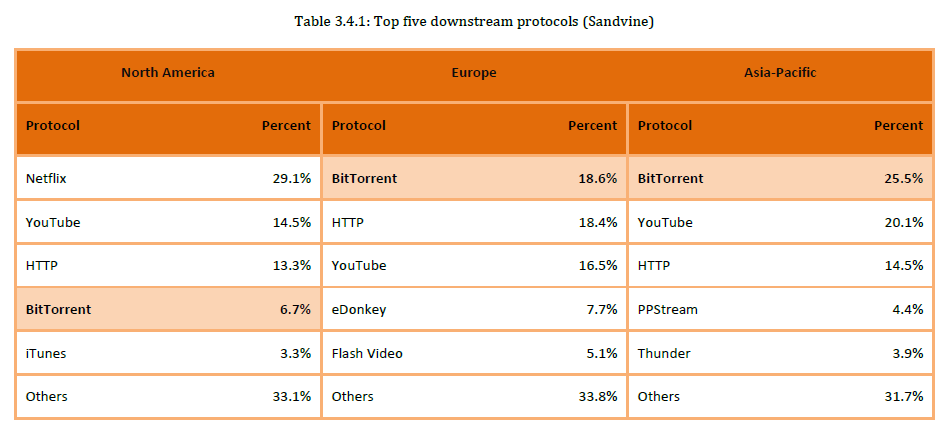
Once again, it’s not difficult to see why the problem is Hollywood’s with one simple chart:
Basically, in the US, where Netflix has come up with a model that many people find to be reasonably priced and convenient enough, the rate of things like BitTorrent usage falls in comparison.
Comments Off on Latest online piracy study shows the problem is Hollywood
September 16, 2013
Speed Kills … Your Pocketbook
Does speed really kill? Sometimes, yes, but when the speed limits are set artificially low, and enforcement is targeted to those areas where the limit is far below traffic speed, then all the speed kills campaign does is keep drivers complacent about paying fines that don’t improve safety.
In this video, I investigate the culture and science surrounding speed enforcement in BC, coupled with my trademark Simpsons, Supertroopers, and Family Guy references.
Comments Off on Speed Kills … Your Pocketbook


