
Such a system could not work without price control. In 301, Diocletian and his colleagues issued an Edictum de pretiis, dictating maximum legal prices or wages for all important articles or services in the Empire. Its preamble attacks monopolists who, in an “economy of scarcity”, had kept goods from the market to raise prices:
Who is … so devoid of human feeling as not to see that immoderate prices are widespread in the markets of our cities, and that the passion for gain is lessened neither by plentiful supplies nor by fruitful years? — so that … evil men reckon it their loss if abundance comes. There are men whose aim it is to restrain general prosperity … to seek usurious and ruinous returns. … Avarice rages throughout the world. … Wherever our armies are compelled to go for the common safety, profiteers extort prices not merely four or eight times the normal, but beyond any words to describe. Sometimes the soldier must exhaust his salary and his bonus in one purchase, so that the contributions of the whole world to support the armies fall to the abominable profits of thieves.
The Edict was, until our time, the most famous example of an attempt to replace economic laws by governmental decrees. Its failure was rapid and complete. Tradesmen concealed their commodities, scarcities became more acute than before, Diocletian himself was accused of conniving at a rise in prices, riots occurred, and the Edict had to be relaxed to restore production and distribution. It was finally revoked by Constantine.
The weakness of this managed economy lay in its administrative cost. The required bureaucracy was so extensive that Lactantius, doubtless with political license, estimated it at half the population. The bureaucrats found their task too great for human integrity, their surveillance too sporadic for the evasive ingenuity of men. To support the bureaucracy, the court, the army, the building program, and the dole, taxation rose to unprecedented peaks of ubiquitous continuity.
As the state had not yet discovered the plan of public borrowing to conceal its wastefulness and postpone its reckoning, the cost of each year’s operations had to be met from each year’s revenue. To avoid returns in depreciating currencies, Diocletian directed that, where possible, taxes should be collected in kind: taxpayers were required to transport their tax quotas to governmental warehouses, and a laborious organization was built up to get the goods thence to their final destination. In each municipality, the decuriones, or municipal officials, were held financially responsible for any shortage in the payment of the taxes assessed upon their communities.
Since every taxpayer sought to evade taxes, the state organized a special force of revenue police to examine every man’s property and income; torture was used upon wives, children, and slaves to make them reveal the hidden wealth or earnings of the household; and severe penalties were enacted for evasion. Towards the end of the 3rd century, and still more in the 4th, flight from taxes became almost epidemic in the Empire. The well-to-do concealed their riches, local aristocrats had themselves reclassified as humiliores to escape election to municipal office, artisans deserted their trades, peasant proprietors left their overtaxed holdings to become hired men, many villages and some towns (e.g., Tiberias in Palestine) were abandoned because of high assessments; at last, in the 4th century, thousands of citizens fled over the border to seek refuge among the barbarians.
It was probably to check this costly mobility, to ensure a proper flow of food to armies and cities, and of taxes to the state, that Diocletian resorted to measures that, in effect, established serfdom in fields, factories, and guilds. Having made the landowner responsible through tax quotas in kind for the productivity of his tenants, the government ruled that a tenant must remain on his land till his arrears of debt or tithes should be paid.
We do not know the date of this historic decree; but in 332, a law of Constantine assumed and confirmed it, and made the tenant adscriptitius, “bound in writing”, to the soil he tilled; he could not leave it without the consent of the owner; and when it was sold, he and his household were sold with it. He made no protest that has come down to us; perhaps the law was presented to him as a guarantee of security, as in Germany today. In this and other ways, agriculture passed in the 3rd century from slavery through freedom to serfdom and entered the Middle Ages.
Similar means of compelling stability were used in industry. Labor was “frozen” to its job, forbidden to pass from one shop to another without governmental consent. Each collegium or guild was bound to its trade and its assigned task, and no man might leave the guild in which he had been enrolled. Membership in one guild or another was made compulsory on all persons engaged in commerce and industry, and the son was required to follow the trade of his father. When any man wished to leave his place or occupation for another, the state reminded him that Italy was in a state of siege by the barbarians and that every man must stay at his post.
Will Durant, The Story of Civilization, Volume 3: Caesar and Christ, 1944.
April 16, 2022
QotD: The Edict of Diocletian
March 14, 2022
“Mister, we could use a man like Herbert Hoover Warren Harding again …”
Kind words for the oft-maligned 29th president of the United States? Daniel J. Mitchell is all over it:
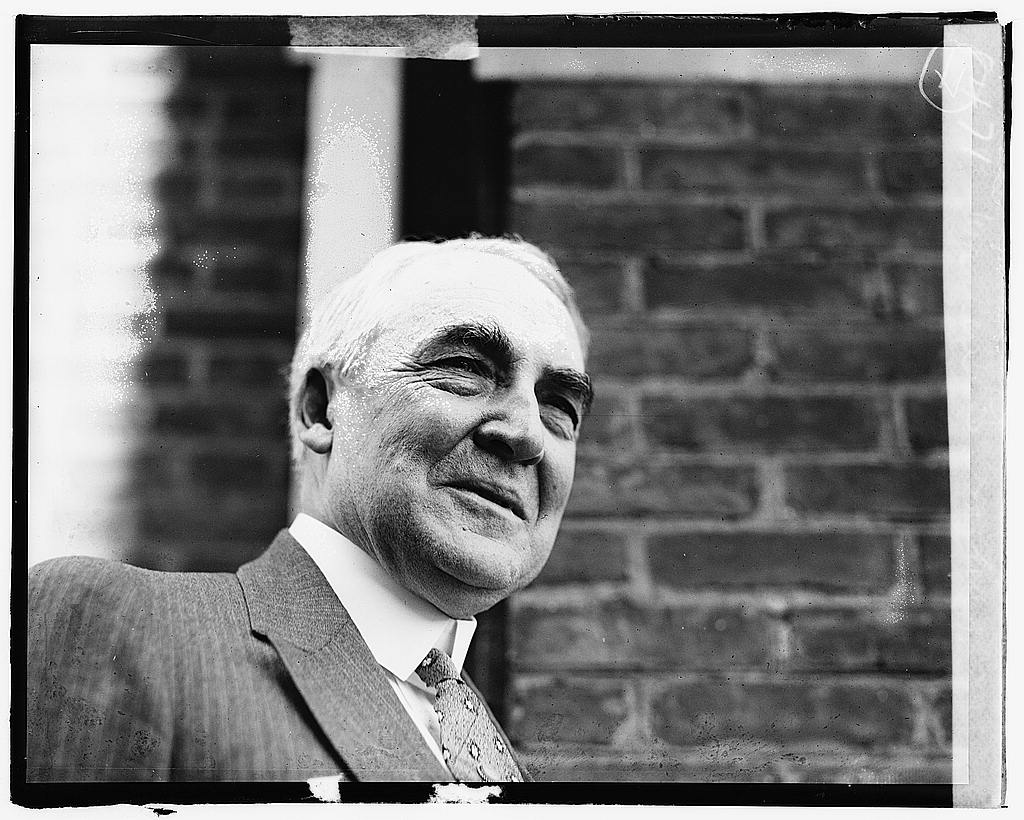
Warren G. Harding, 14 June 1920.
Library of Congress control number 2016828156
Today, we’re going to celebrate the fiscal achievements of Warren Harding.
Most notably, as illustrated by this chart based on OMB data, he presided over a period of remarkable spending discipline.
Harding also launched very big — and very effective — reductions in tax rates.
And his agenda of less government and lower tax rates helped bring about a quick end to a massive economic downturn (unlike the big-government policies of Hoover and Roosevelt, which deepened and lengthened the Great Depression).
In an article for National Review last year, Kyle Smith praised President Harding’s economic stewardship.
In a moment of national crisis, Warren G. Harding restored the economic health of the United States … America in 1921 was in a state of crisis, reeling from the worst recession in half a century, the most severe deflationary spiral on record … Unemployment, it is now estimated, stood somewhere between 8.7 and 11.7 percent as returning soldiers inflated the size of the working-age population.
Between 1919 and August of 1921 the Dow Jones average plummeted 47 percent. Harding’s response to this emergency was largely to let the cycle play out … The recession ended in mid-year, and boom times followed. Harding and Congress cut federal spending nearly in half, from 6.5 percent of GDP to 3.5 percent. The top tax rate came down from 73 percent to 25, and the tax base broadened. Unemployment came down to an estimated 2 to 4 percent … Harding was a smashing success in a historically important role as the anti-Wilson: He restored a classically liberal, rights-focused, limited government, and deserves immense credit for the economic boom that kicked off in his first year and continued throughout the rest of the 1920s.
Smith’s article also praises Harding for reversing some of Woodrow Wilson’s most odious policies, such as racial discrimination and imprisoning political opponents (Wilson also had a terrible record on economic issues).
Of course, Harding’s term is much more often remembered for the scandals, and as most modern historians are far more interested in Woodrow Wilson’s bold progressivism they almost always decry Harding and then Coolidge for dismantling a lot of Wilson’s more enthusiastic progressive projects. Even H.L. Mencken — very much not a Wilson fan — found Harding to be not to his taste in turn:
On the question of the logical content of Dr. Harding’s harangue of last Friday, I do not presume to have views … But when it comes to the style of the great man’s discourse, I can speak with … somewhat more competence, for I have earned most of my livelihood for twenty years past by translating the bad English of a multitude of authors into measurably better English. Thus qualified professionally, I rise to pay my small tribute to Dr. Harding. Setting aside a college professor or two and half a dozen dipsomaniacal newspaper reporters, he takes the first place in my Valhalla of literati. That is, he writes the worst English that I have ever encountered. It reminds me of a string of wet sponges; it reminds me of tattered washing on the line; it reminds me of stale bean soup, of college yells, of dogs barking idiotically through endless nights. It is so bad that a sort of grandeur creeps into it. It drags itself out of the dark abysm … of pish, and crawls insanely up to the topmost pinnacle of posh. It is rumble and bumble. It is flap and doodle. It is balder and dash.
February 26, 2022
“The [House of] Commons of 1621 would get completely out of control — all thanks to beer”
In the latest Age of Invention newsletter from Anton Howes, we’re still back in the reign of King James I of England (also at the same time King James VI of Scotland), and the king has a financial woe that has forced him once again to try getting Parliament to vote him the funds he needs to wage war:
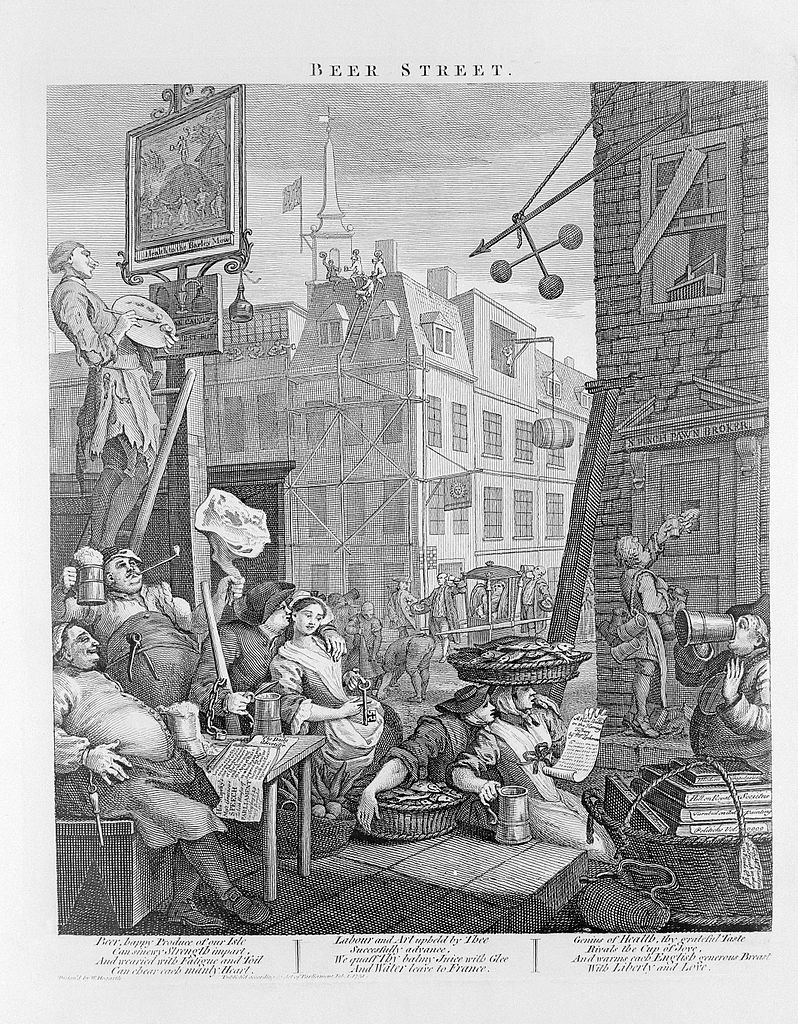
Beer Street, from Beer Street and Gin Lane by William Hogarth. The picture is a counterpoint to the more powerful Gin Lane — Hogarth intended Beer Street to be viewed first to make Gin Lane more shocking — but it is also a celebration of Englishness and depicts of the benefits of being nourished by the native beer.
Wikimedia Commons.
1620 was a dramatic year for England. As I mentioned last time, the rashness of the king’s son-in-law threatened to pull the country into a major European conflict. Religion, honour, and family — James I’s grandchildren were set to lose their inheritance, the Palatinate of the Rhine — dictated that the king should break his decades-long habit of peace. But war was hugely expensive, and the king already heavily in debt. He was forced to summon Parliament so that it could vote him the taxes he would need to wage war.
Parliament was already a major source of annoyance to James I. After 1610, he had done everything in his power to rule without its aid, at one point even comparing its lower house, the Commons, to a “House of Hell”. Yet the MPs of 1610 would come to seem almost angelic compared to those who assembled in Westminster in 1621. The Commons of 1621 would get completely out of control — all thanks to beer.
Beer (and ale, made without hops) was the most important source of calories after bread, and the first choice for hydration — cheaper than wine and safer than water, with coffee, tea, and spirits only becoming popular much later. It financially supported inns, the crucial infrastructure for travellers. Alehouses also provided a major focal point for socialising. If you controlled beer, you controlled society — second only, perhaps, to religion.
If beer was too strong, it could lead to drunkenness and unrest. If inns went unpoliced, they could become havens for criminals, heretics, sinners, and rebels. If brewers used too much malt, made from grains like barley, they could drive up the price of bread and cause famine. If beer-brewers demanded too many hops — used as both a preservative and a source of bitterness compared to sweeter ale — they could also put pressure on otherwise scarce land for food. Regulating the drinks industry correctly was thus a major priority for those in charge.
The making and selling of ale had originally been dominated by brewsters — that is, by female brewers. (Compare with the more persistent word spinster, to mean a woman who spins thread. Spinning remained women’s work long after the brewsters had been driven out of their industry. Only later, because of the independence that earning one’s own money brought, did spinster gain the more general meaning of a woman who was unmarried.) Meanwhile, hopped beer had been the preserve of immigrants. As one popular ditty put it, “Hops, Reformation, baize, and beer, Came into England all in one year”, though it had actually happened more gradually over the course of the late fifteenth and early sixteenth centuries.
Yet with population growth, and the dramatic expansion of London in particular, the drinks market became larger and more concentrated, while hop-less ale gave ground to the rise of beer. Male, English ale-brewers seized an opportunity to suppress their competition. London’s Ale Brewers’ Guild, for example, abandoned the use of hucksters — predominantly female ale-sellers — and then in 1556 absorbed the Beer-Brewers’ Guild, which had largely consisted of immigrants. The newly-amalgamated Worshipful Company of Brewers then barred immigrants from becoming members, while the English ale-brewers switched to producing beer. In 1574, they even successfully lobbied for the city to bar foreigners from being members of any guilds at all, including even second-generation immigrants born in England. The bigger the business, the more ruthless it became.
February 11, 2022
QotD: “By their proposals, shall ye know them”
That is why the proposal that the IRS should have access to the data of all bank accounts from which or into which more than $600 a year are paid (hardly a king’s ransom) is so important, despite the fact that it has not been enacted. The very fact that someone wanted to enact it, and thought it right that it should be enacted, is highly significant — and sinister — in itself, for the proposal demonstrates a totalitarian mindset.
The ostensible purpose of the proposal, of course, is the elimination of tax evasion. (Incidentally, I have noticed recently an increasing tendency, in the press and elsewhere, for the term tax avoidance to be used interchangeably with that of tax evasion, as if the difference between legality and illegality were of no real importance. This conflation is itself indicative of a totalitarian attitude, according to which a governmental end may be reached without the necessity for any law.)
The people who proposed that, in effect, every bank account should be routinely available for examination by the IRS, without any specific warrant for such an examination, thereby revealed that they thought that the gathering of tax so important that it superseded all other considerations.
Psalm 24 begins: “The earth is the Lord’s, and the fulness thereof, the world and they that dwell therein. For he hath founded it upon the seas, and established it upon the floods.”
A better version, according to the proposers, would be: Money is the government’s, and the fulness thereof, money and they that have any. For it hath founded it upon the printing press, and established it as legal tender.
I do not go as far as some economists of my acquaintance, who believe that tax evasion is a citizen’s civic duty: at least it is not in the circumstances prevailing in any western country, however unsatisfactory they may be. In my own case, I do not evade taxes and even my attempts to avoid them are rather feeble, for unfortunately there is so little at stake.
But I reject completely the idea that, morally, the first call on anyone’s money is the government’s, which in effect has the right to leave you pocket money by its grace and favor after you have paid your taxes at any rate that it likes. This is the very tyranny that the founders of America feared in majoritarian democracy, untempered by inalienable rights — inalienable even, or especially, by or to the government.
Theodore Dalrymple, “Monitoring Bank Accounts Would Make the People of the Government, Not the Government of the People”, The Iconoclast, 2021-11-01.
January 16, 2022
QotD: Once “discovered”, colonization of the Americas was inevitable
This is not a joke. Political reality has a way of crashing in on the pipe dreams of liberal academics. The reality is, if the English had not colonised, then the French or the Dutch would have. If the Spanish had not colonised, the Portuguese would have. This would have shifted the balance of power at home, and any European country which had not colonised, would have been relegated to secondary status. And it is easy to overestimate the amount of control that European governments actually had. As soon as the New World was discovered, many fisherman and traders sailed across the Atlantic on their own, in hopes of circumventing tax authorities and scoring a fortune. Long before colonies were established in most regions, the New World was crawling with Europeans whose superior technology gave them an edge in combat. Nonetheless, it was extremely dangerous for Europeans to provoke fights with Native Americans, and most of them tried to avoid this when possible. In retrospect, one could in theory be impressed that so many European governments showed a genuine concern to rein in the worst excesses of their subjects, with an express eye to protecting the Indians from depredation. The logic was simple: they attempted to protect their subjects at home, in order to secure good order and a better tax base. So they would do the same to their subjects in the New World. For a long time, few Europeans harboured any master plan of pushing the Native Americans out of their own lands. In more densely populated regions such as Mexico, such an idea must have seemed an absurdity. Reality tends to occur ad hoc. Boundaries often took generations to move, and would have seemed fixed at the time. For several centuries, many Europeans assumed that they would long be a minority on the North American continent. In Mexico and Peru, they always have been.
Population density mattered, a lot, when it came to pre-modern global migrations. China and India were “safe” from excessive European colonisation because they had the densest populations in the world, and they were likewise largely immune to any diseases brought by Europeans. SubSaharan Africa had a lower population density depleted by slave raiding, but they still outnumbered European colonists by a large margin throughout the colonial era — again because European contact did not decimate their numbers through disease the way it did in the Americas. It is worth noting that no one claims that Europeans committed genocide in India, Asia or even Africa, although their technological advantages gave them every opportunity had they actually been of a genocidal mindset (as were for example the Mongols). In fact, the European track record shows them to be almost shockingly un-genocidal, given their clear technological advantages over the rest of the world for a period of several centuries. Few other civilisations, given similar power over so much of the world’s people, would have behaved in a less reprehensible manner. This is not to give Europeans a pat on the back. Rather it is to point out that Europeans are regularly painted as the very worst society on Earth, when in fact they had the power to do far, far more evil than they actually did. Let us at least acknowledge this fact.
Jeff Fynn-Paul, “The myth of the ‘stolen century'”, Spectator Magazine, 2020-09-26.
December 29, 2021
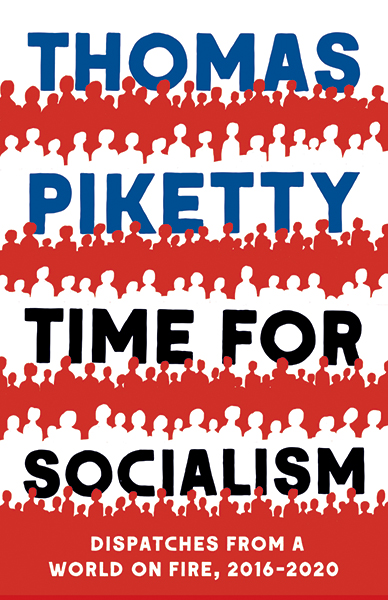
Theodore Dalrymple reviews the latest work from Thomas Piketty, Time for Socialism
Thomas Piketty has been a big name among progressives since his first book hit the bestseller lists, so the release of his latest work calls for some consideration from Theodore Dalrymple:
Piketty still writes clearly, though without much imaginative verve, and he has obviously consulted a lot of data. He is intelligent, knowledgeable, and decent, with a very firm grasp of unreality. He believes in a world in which economic levers act frictionlessly, or to borrow the description a doctor of my acquaintance has used with regard to his own medico-legal reports: “You turn the handle and the sausage comes out.”
There is no difference in his world between investment and expenditure. Thus, when he correctly ascribes low productivity in Britain to the low educational level of the general population (such that, in a predominantly service economy, much of it is unable even to answer the telephone properly or with reasonable courtesy), he ascribes it to lack of expenditure on education. If only this were the case! But lack of expenditure cannot possibly explain why about a fifth of children leave school barely literate. Incidentally, France seems to be progressing, if that is quite the word, in this direction.
We read that “Research in the social sciences, of which economics is an integral part, whatever some may think, is and always will be hesitant and imperfect. It is not designed to produce ready-made certainties … we have to examine patiently to endeavour to draw some provisional and uncertain lessons.” Amen to that! But modesty or tentativeness is not Professor Piketty’s main characteristic, nor does prudence once enter into his proposals.
There is no awareness that deterioration is possible as well as improvement, or of the fragility of things. Nothing counts for him but equality. He is to taxation policy what Le Corbusier was to architecture: he wants to prescribe (and proscribe) for the whole world. Above all, no variation! He would tell us how much we may possess, how much we may leave to our descendants or receive from our ancestors, how much we may earn in a year.
As an egalitarian and firm anti-nationalist, he does not explain why redistribution should stop at national borders. But try telling the average Frenchman that from now on he must forgo half his wealth in order to raise up Somalia or South Sudan! The book sometimes reads as if it were written by an electoral propagandist for Éric Zemmour, acting as an agent provocateur.
Uniformity is for him the price of unity (his countryman, Frédéric Bastiat, did not make the same mistake). He has little regard for, or even awareness of, the potential political consequences of some of his proposals. In his European Assembly, for example, which would have real power (unlike the current European Parliament), France, Spain, and Italy could and probably would outvote Germany with regard to economic policy. It does not occur to him that there could be few better ways of arousing dormant German nationalism than this. Nothing is certain, but much is possible; and while he mentions the internationalism of Jean-Luc Mélanchon, the left-wing French politician, he might also have mentioned that M. Mélenchon wrote a book about Germany and Germans that could easily have been written by a patriotic Frenchman in 1916.
Piketty is a strong believer in taxes as tools to make people more equal, and objects to the elimination of the wealth tax by the French government recently. Were he given the power, he would not only re-implement it, but vastly expand the taxes demanded of the wealthy.
[…] To all this, Professor Piketty has one sovereign remedy: tax the rich.
He thinks this is democratic because many, perhaps a majority, would vote for it. He has no problems with majoritarian democracy (provided the majority agrees with him): How can democracy be tyrannous? Thus, he sees no drawbacks in Senator Warren’s proposal to set a wealth tax and to provide — provide! — “an exit tax equal to 40% of total wealth for those who choose to leave the country and relinquish American citizenship.” Moreover, “the tax would apply to all assets, with no exemptions, with dissuasive sanctions for persons and governments who do not transmit appropriate information on assets held abroad.” Not only is this tyrannous with regard to individuals, but it is tyrannous with regard to international relations, providing a justification for American jurisdiction over the whole world. Needless to say, China, Russia, and India would never accept this, and might find allies. Conflict could become endless.
The answer to this little problem is obvious to Professor Piketty: a wealth tax worldwide, such that there would be nowhere for anyone to hide. There might be a few little teething problems with implementation — for example, who is to oversee it all — but think of the benefits: lie back and think of England! Professor Piketty has found the elixir of life, and it is taxation.
December 23, 2021
Cheshire and Durham in the English Parliament
In his end-of-the-year Age of Invention newsletter, Anton Howes looks at two of the historic counties of England that lacked Parliamentary representation until surprisingly late dates:
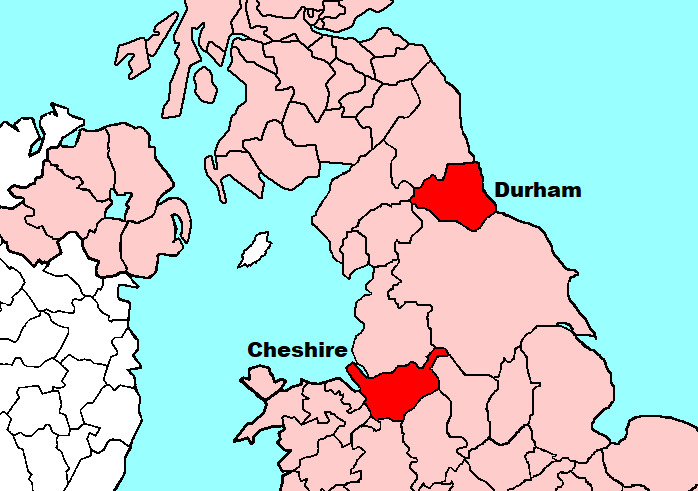
Cheshire and Durham (post-medieval boundaries: English county boundaries have varied wildly over the centuries).
Base map by Hogweard at Wikimedia Commons.
England, compared to other parts of Europe, is often said to have been remarkably centralised early on. France, for example, in the late eighteenth century had some thirteen or so regional parliaments, while Britain just had the one. Scotland’s separate parliament was famously dissolved in 1707, with the official union of Scotland with England. Wales gained representation at the English parliament at Westminster from 1536. So far so expected.
But less well-known is that the county of Cheshire — some of it now disappeared under Greater Manchester — used to have an entirely separate parliament of its own, and was not represented at Westminster until 1543. Arguably, it has about as much historical claim to a national assembly today as Wales. Rule of Cheshire was even, very briefly, included among the various titles of the monarch. Richard II, as well as being king of England, was in 1397-99 also styled “Prince of Chester”. He drew his personal bodyguard from among the men of Cheshire too. So whatever happened to Cheshire nationalism?
On a related note: the mantra “no taxation without representation” looms large in the history of American independence. But parts of England itself had gone unrepresented for decades too. County Durham, traditionally ruled by its prince-bishop, was not represented by any MPs in the House of Commons at all until 1654. And as it only gained representation under the revolutionary Protectorate, this was undone upon the restoration of the monarchy in 1660. The county would not be represented again until 1675.
Why? One might argue that the bishop of Durham, who sat in the House of Lords, could be considered its parliamentary representative. But he was not elected, and most importantly had little say over the matter of parliamentary taxation, which was controlled by the Commons. Before 1603 this was not much of an issue, as county Durham was exempt from various taxes because it was near the hostile Scottish border. But the accession of James VI of Scotland to become king of England meant that the hostile border suddenly disappeared. County Durham thus became subject to parliamentary taxation without having any say over those taxes at all — a situation that they then had to bear for over sixty years! Where were the Durham revolutionaries?
December 18, 2021
King James and the search for ready cash
In the latest Age of Invention newsletter, Anton Howes outlines how and why England’s new Stuart king found himself in desperate financial straits very early in his reign:
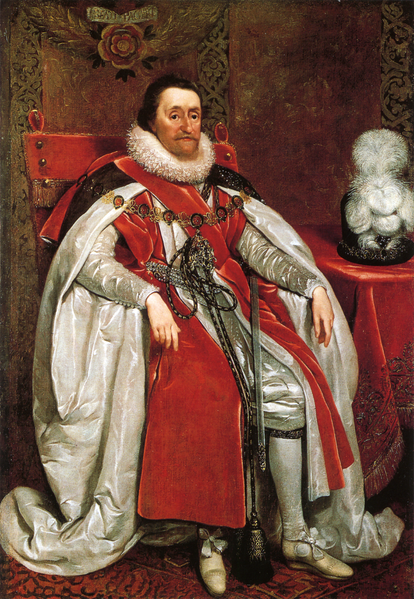
King James I (of England) and VI (of Scotland)
Portrait by Daniel Myrtens, 1621 from the National Portrait Gallery via Wikimedia Commons.
… after a generous honeymoon period of about a year, he and his government soon discovered that they were leaking cash. Despite eliminating the costly wars in Spain and in Ireland, James still had to pay off the debts that his predecessor Elizabeth I had incurred in fighting them. And he had a more extensive, and expensive, royal family to support. He traded the one-off expenses of war for the ongoing expenses of a profligate court.
This may sound like a good deal. James effectively stopped the English Crown splashing out money on really big but infrequent expenses, while increasing its ongoing expenditure — like refraining from buying a new car every few years, while spending a lot more each month eating out at restaurants.
But the Crown’s sources of revenue were ill-suited to this change. The funding for wars had been voted to Elizabeth by Parliament, usually as and when the need arose. Such expenditures were matters of national interest, and she otherwise just relied on other sources of income — ongoing taxes like customs duties, or simply the rent from her lands. When the one-off “subsidies” granted to her by Parliament had not quite been sufficient to cover the costs of the wars, Elizabeth had made up the difference by keeping her own ongoing expenses as low as possible, and took out loans to fill any gaps. It also helped that in the years before crises, Elizabeth had tried to run a surplus, building up a war-chest of cash to dip into.
So switching to the new pattern of expenditure was not straightforward. To increase the Crown’s ongoing expenses, it would have to find more sources of ongoing income, especially as it was already in deficit and had loans to pay off. It was politically impossible for James to ask Parliament for extra one-off subsidies to help him bridge the gap, as some of Elizabeth’s subsidies from 1601 had yet to even be collected. He did actually test the waters about what would happen if he did ask, just in case, but when the matter was raised by some would-be sycophants, it was met with outrage. As one member of Parliament angrily put it, “we have no sheep that yields two fleeces in the year.”
The country was already feeling over-taxed, there were no looming crises to justify such extra taxation, and even if there were, such one-off measures would be unsustainable. James needed to find revenue streams to match his spending leak — and ideally, to even exceed it. His ministers fretted about getting the Crown back into surplus again, to build up another war-chest. Who knew when the next war or rebellion might arise.
So when James called his first Parliament in 1604, it was not really to ask for one-off subsidies as Elizabeth had so often done. Instead, he and his ministers focused on outlining a series of financial deals.
November 27, 2021
King James I and his hatred of tobacco smoking — “so vile and stinking a custom”
Anton Howes recounts some stories he uncovered while researching English patent and monopoly policies during the Elizabethan and Stuart eras:
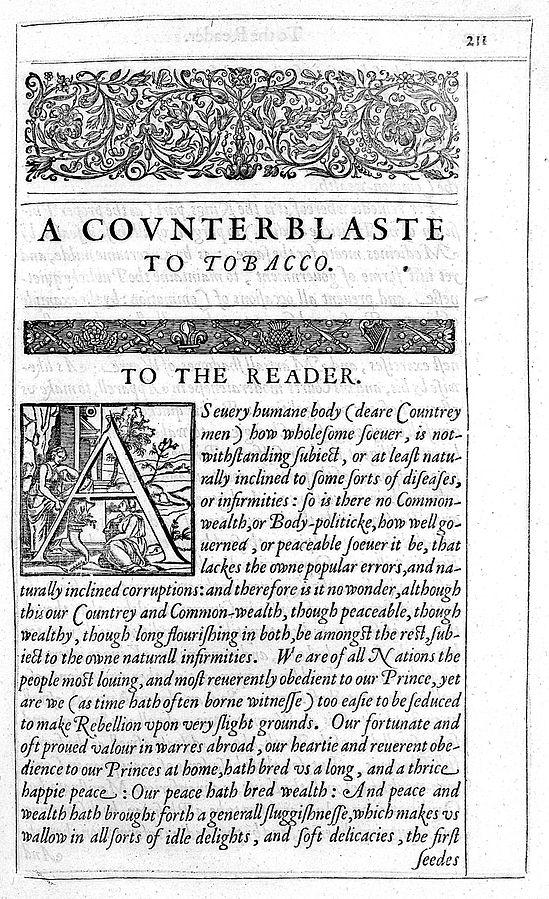
… some of the most interesting proclamations to catch my eye were about tobacco. Whereas tobacco was famously a New World crop, it is actually very easy to grow in England. Yet what the proclamations reveal is that the planting of tobacco in England and Wales was purposefully suppressed, and for some very interesting reasons.
James I was an anti-tobacco king. He even published his own tract on the subject, A Counterblaste to Tobacco, just a year after his succession to the English throne. Yet as a result of his hatred of “so vile and stinking a custom”, imports of tobacco were heavily taxed and became a major source of revenue. Somewhat ironically, the cash-strapped king became increasingly financially dependent on the weed he never smoked. The emergence of a domestic growth of tobacco was thus not only offensive to the king on the grounds that he thought it a horrid, stinking, and unhealthy habit — it was also a threat to his income.
What I was most surprised to see, however, was just how explicitly the king admitted this. It’s usual, when reading official proclamations, to have to read between the lines, or to have to track down the more private correspondence of his ministers. Very often James’s proclamations would have an official justification for the public good, while in the background you’ll find it originated in a proposal from an official about how much money it was likely to raise. There was money to be made in making things illegal and then collecting the fines.
Yet the 1619 proclamation against growing tobacco in England and Wales had both. The legendary Francis Bacon, by this stage Lord High Chancellor, privately noted that the policy might raise an additional £3,000 per year in customs revenue. And the proclamation itself noted that growing tobacco in England “does manifestly tend to the diminution of our customs”. Although the proclamation notes that the loss of customs revenue was not usually a grounds for banning things, as manufactures and necessary commodities were better made at home than abroad, “yet where it shall be taken from us, and no good but rather hurt thereby redound to our people, we have reason to preserve”. Fair enough.
And that’s not all. James in his proclamation expressed all sorts of other worries about domestic tobacco. Imported tobacco, he claimed, was at least only a vice restricted to the richer city sorts, where it was already an apparent source of unrest (presumably because people liked to smoke socially, gathering into what seemed like disorderly crowds). With tobacco being grown domestically, however, it was “begun to be taken in every mean village, even amongst the basest people” — an even greater apparent threat to social order. James certainly wasn’t wrong about this wider adoption. Just a few decades later, a Dutch visitor to England reported that even in relatively far-flung Cornwall “everyone, men and women, young and old, puffing tobacco, which is here so common that the young children get it in the morning instead of breakfast, and almost prefer it to bread.”
[…]
Indeed, policymakers thought that the domestic production of tobacco would actively harm one of their key economic projects: the development of the colonies of Virginia and the Somers Isles (today known as Bermuda). Although James I hoped that their growth of tobacco would be only a temporary economic stop-gap, “until our said colonies may grow to yield better and more solid commodities”, he believed that without tobacco the nascent colonial economies would never survive. Banning the domestic growth of tobacco thus became an essential part of official colonial policy — one that was continued by James’s successors, who did not always share his more general hatred of smoking. Although the other justifications for banning domestic tobacco would soon fall away, that of maintaining the colonies — backed by an increasingly wealthy colonial lobby — was the one that prevailed.
November 4, 2021
QotD: The “Righteousness Fallacy”, California style
The Righteousness Fallacy (also known as the fallacy of good intentions) is described by author Dr. Bo Bennett as the idea that one is correct because their intentions are pure.
It recently occurred to me that California is a perfect example of this fallacy. Consider these three facts about the Golden State:
- California spends about $98.5 billion annually on welfare — the most in the US — but has the highest poverty rate in America.
- California has the highest income tax rate in the US, at 13.3 percent, but the fourth greatest income inequality of the 50 states.
- California has one of the most regulated housing markets in America, yet it has the highest homeless population in American and ranks 49th (per capita) in housing supply.
That politicians would persist with harmful policies should come as little surprise. The Nobel Prize-winning economist Milton Friedman once observed the uncanny proclivity of politicians “to judge policies and programs by their intentions rather than their results”.
In his book Capitalism and Freedom, Friedman described the danger of such thinking.
[The threat comes] from men of good intentions and good will who wish to reform us. Impatient with the slowness of persuasion and example to achieve the great social changes they envision, they’re anxious to use the power of the state to achieve their ends and confident in their ability to do so. Yet … Concentrated power is not rendered harmless by the good intentions of those who create it.
Jon Miltimore, “Data Show California Is a Living Example of the Good Intentions Fallacy”, Foundation for Economic Education, 2019-01-09.
October 16, 2021
Alberta’s Equalization referendum is “political theatre, and it’s poorly timed political theatre at that”
The province of Alberta is unhappy with the current federal-provincial equalization arrangement. This is not new … it’s been the case off-and-on for most of my life, but this year the province is undertaking a formal referendum on the issue, as Jen Gerson explains in The Line:

Let’s start with all the usual but necessary rigmarole about the Alberta referendum on equalization: a “yes” vote won’t peel equalization from the constitution; even a resounding victory may not actually force the federal government to sit with the province of Alberta to discuss the matter. I mean, it might: this was Ted Morton’s idea, and his argument. That Alberta can force Ottawa and the provinces to engage in some kind of open-hearted exchange by piggybacking on the Quebec Secession Reference is not totally impossible, I guess.
As this Fraser Institute bulletin by Rainer Knopff points out, that reference is specific to questions of, well, secession and probably can’t be re-applied willy nilly to any old provincial grievance. However, Knopff goes on to note that the referendum is necessary to create a provincial legislative resolution on the matter, which would allegedly trigger some kind of duty to negotiate — although certainly no duty to come to an agreement that Alberta would find acceptable.
Most credible individuals begin to handwave furiously when asked to nail the technical legal details about how we’re going to make Ottawa cede a damn thing. Even Morton had to point out that the referendum’s greatest power lies in granting Alberta “moral force” on the question.
In other words, it’s political theatre, and it’s poorly timed political theatre at that.
Equalization is a perennial complaint in Alberta, and not one totally without merit. Although the province doesn’t cut Ottawa some kind of novelty-sized equalization cheque at tax time, we are a comparatively wealthy province, which means the province traditionally sends more money to the federal government through its income and business tax remittances than it receives in rebates and services. There is a sense of injustice, here, which notes that equalization-receiving provinces offer services like cheap daycare, and are now racking up rainy day funds as Alberta falls ever deeper into debt. Meanwhile, we can’t seem to get a pipeline built to transport the very product that provides so much of this national bounty and wealth because other provinces oppose them.
QotD: Social security
Julian Sanchez, “Social Security’s Progressive Paradox: Retirement ‘insurance’ as a Rube Goldberg machine”, Reason, 2005-05-02.
October 12, 2021
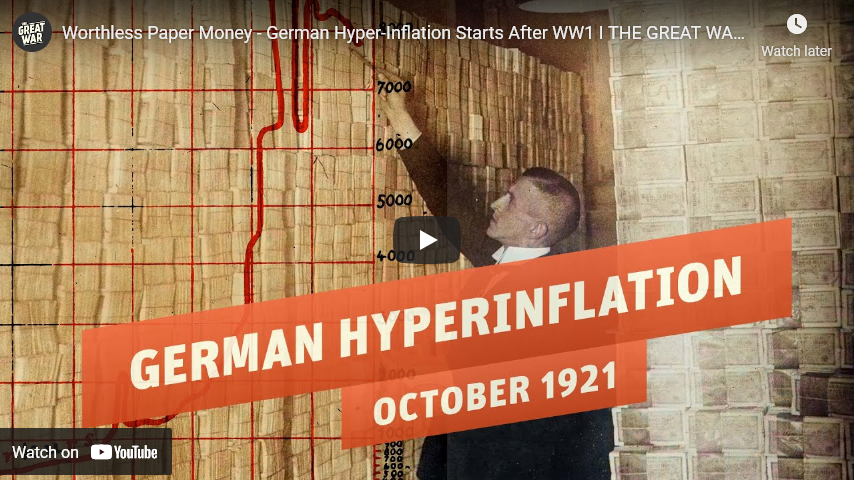
Worthless Paper Money – German Hyper-Inflation Starts After WW1 I THE GREAT WAR 1921
The Great War
Published 8 Oct 2021Sign up for Curiosity Stream and get Nebula bundled in and SAVE 26%: https://curiositystream.com/thegreatwar
The German post-WW1 economy was under pressure: the loss of territory, the war bonds issued during the war and the reparations under the Treaty of Versailles. All this lead to a downward spiral of rising inflation and living costs for German citizens.
» SUPPORT THE CHANNEL
Patreon: https://www.patreon.com/thegreatwar
Shop: https://www.realtimehistory.net» OUR PODCAST
https://realtimehistory.net/podcast – interviews with World War 1 historians and background info for the show.» BUY OUR SOURCES IN OUR AMAZON STORES
https://realtimehistory.net/amazon *
*Buying via this link supports The Great War (Affiliate-Link)» SOURCES
Feldman, Gerald: Vom Weltkrieg zur Weltwirtschaftskrise. Studien zur deutschen Wirtschafts-und Sozialgeschichte 1914-1932. 1984.Fergusson, Adam: Das Ende des Geldes. Hyperinflation und ihre Folgen für die Menschen am Beispiel der Weimarer Republik, 1975.
Grosch, Waldemar: Deutsche und polnische Propaganda während der Volksabstimmung in Oberschlesien 1919-1921. 2002.
Lewek, Peter: Arbeitslosigkeit und Arbeitslosenversicherung in der Weimarer republik 1918-1927. 1989.
Michalczyk, Andrezej: Celebrating the nation: the case of Upper Silesia after the plebiscite in 1921.
Neubach, Helmut: Die Abstimmung in Oberschlesien am 20. März 1921. 2002.
» MORE THE GREAT WAR
Website: https://realtimehistory.net
Instagram: https://instagram.com/the_great_war
Twitter: https://twitter.com/WW1_Series
Reddit: https://reddit.com/r/TheGreatWarChannel»CREDITS
Presented by: Jesse Alexander
Written by: Jesse Alexander
Director: Toni Steller & Florian Wittig
Director of Photography: Toni Steller
Sound: Toni Steller
Editing: Jose Gamez
Motion Design: Philipp Appelt
Mixing, Mastering & Sound Design: http://above-zero.com
Maps: Daniel Kogosov (https://www.patreon.com/Zalezsky)
Research by: Jesse Alexander
Fact checking: Florian WittigChannel Design: Yves Thimian
Contains licensed material by getty images
All rights reserved – Real Time History GmbH 2021
October 3, 2021
QotD: Taxes
If you don’t pay taxes, you’ll be fined.
If you don’t pay the fine, you’ll be jailed.
If you try to escape from jail, you’ll be shot.
Thus I — in my role as citizen and voter — am going to shoot you — in your role as taxpayer and ripe suck — if you don’t pay your fair share of the national tab.
Therefore, every time the government spends money on anything, you have to ask yourself, “Would I kill my kindly, gray-haired mother for this?”P.J. O’Rourke
August 23, 2021
QotD: Leaving money in the hands of individuals
People do things with that money. And even if all they do is buy stuff (thereby allowing someone else to accumulate wealth) or invest it, that money gets aggregated and finds things to do, as it were. Wealth goes to work on things that seem interesting, might be interesting, or are otherwise likely to make money for the individuals who hold the wealth.
Individuals have money to start new businesses that would never have existed if they’d paid that money in taxes. Or they “invest” in free time and a really nice garden, which in turn lifts the spirits of people who invent something because they feel better than they would otherwise.
The left insists that if they leave money in individual hands, it will just be “wasted”. (Because, you know, no money spent on a vast apparatus, most of it a jobs program for useless paper pushers or power-hungry martinets is ever wasted.)
How do they know? Have they tried leaving enough money in the hands of those who earn it to make a difference?
Not in the twentieth century. Though we can infer from the fact that the most sclerotic, dying countries are the highest taxed ones, that perhaps what government considers “best” and what we consider “best” are not the same.
Not just taxes, but regulations too weigh heavily on possibilities. Sure, the left sees “lands saved” (or created. oop) when say, regulations curtail oil drilling. But what I see is energy taking up an excessive amount of every family’s money, wealth that would otherwise be freed for other investments, for starting businesses, even “just” for fun.
The problem we have is that leftists lack utterly in imagination. They see the “pristine” plots of land, or the things government does with our money and they find it good.
But they’re mind’s-eye blind. They can’t see the wealth that has been consumed for almost 100 years now say on the war on poverty to create chronic poverty having instead been used by individuals to create, to invest, to build, so that, in that parallel world in which money stayed in individual hands, we now have interplanetary travel, colonies all over the solar system, and squid farms on Mars that feed all of humanity.
Their lack of vision, their killing of possibilities without the slightest thought to them: That is a tragedy.
Sara Hoyt, “The Tragedy of the Squid Farms on Mars”, Libertarian Enterprise, 2018-12-05.


