
For the first time since the Brits grew exhausted with the Hurricane of Fists they were getting from the 13 colonies, the British parliament voted against the government on an issue of war. Obviously, this was not directly Barack Obama’s fault. But he’s hardly blameless either. This mess is part of the larger mess he created. Obama follows polls and acts like it’s courage. He mocks and belittles American leadership and then is shocked when no one wants to follow America. We were supposed to be in an era of renewed global cooperation and engagement. Instead, Obama can’t hold the support of our closest ally — because the British Left balked. Forget forging new alliances with “former” enemies — as Obama promised would happen once it dawned on the Arab street that his middle name is “Hussein” and they realized he’s black; Obama can’t even maintain historic alliances with longstanding friends.
Oh, and thank goodness Hillary Clinton gave the Russians a big toy button with the word “overcharge” on it. We’re really reaping the payoff on that now.
Part of the problem stems from the simple fact that Obama can’t sell anything but himself. Even when he tried — and he really tried — he couldn’t sell Obamacare to the American people. When it comes to the Syria intervention — which, if done right, I am in favor of — he’s not even trying to sell. His body language in that PBS interview was that of a husband forced to explain to his wife how he got the clap. He talked like a teenager looking at the floor while telling his parents that he doesn’t know how their car ended up in the neighbor’s swimming pool. The only thing his “shot across the bow” talk did for him was convince everyone that he’s not wagging the dog to boost his poll numbers. A war-mongering charlatan would at least fake commitment better.
And that goes for his entire national-security team. To listen to this sorry bunch try to explain why they’re doing everything right while doing everything they once criticized is painful, like watching Helen Keller give a whirl at karaoke. I am perfectly willing to concede that this is a very complicated situation with few clear right answers. But this crowd insisted that everything was simple if you were smart like them. And now that the smarty-pants brigade got us into this mess, they still talk like anyone who disagrees with them is a moron. I mean, as bad a salesman as Barack Obama is, Jay Carney is worse. If he ran a massage parlor he couldn’t sell a happy ending to a drunk sailor during Fleet Week in Bangkok.
Jonah Golberg, “The Goldberg File”, 2013-08-30
August 31, 2013
August 29, 2013
British parliament defeats government motion on Syria
Twitter just lit up with the news that Prime Minister David Cameron’s motion to allow military action against Syria has been soundly defeated in parliament. The reported voting line was 272 in favour and 285 against. This was not a confidence motion — the government will not be forced to resign over this vote, but it’s a strong slap in the face to Clegg and Cameron.
House of Commons votes against the Government motion on #Syria by 285 votes to 272
— House of Commons (@HouseofCommons) August 29, 2013
"I believe in respecting the will of the House of Commons. The British people do not want to see military action. I get that," Cameron.
— Tom Newton Dunn (@tnewtondunn) August 29, 2013
Dignified, decent, democratic response by the PM. A truly stunning shift in power from executive to legislature.
— Daniel Hannan (@DanHannanMEP) August 29, 2013
The US Navy’s overstretch
Sir Humphrey points out that the Syrian situation actually shows how thin the US Navy’s resources have become:
This crisis has been dominated by impressive images of US warships firing cruise missiles, and maps showing large warships steaming menacingly in the Eastern Med. Publicly we know that four USN escorts are currently in the region, each armed with a significant quantity of missiles. What is so striking though is how this illustrates just how thinly stretched the USN is these days. Until the end of the Cold War, the Med was practically a British, then US lake. Dominated by naval bases, and home to large numbers of carriers, escorts and other vessels, any crisis would quickly have seen an almost overwhelming concentration of US firepower.
Today, the 6th Fleet has no permanently assigned escorts, and is instead reliant on other vessels transiting the area. At present it seems that three US vessels were in the area (although it is unclear I they were taken off other tasks) and one more has joined them. This is the totality of the US escort fleet in the Med (and quite possibly Europe as a whole). It is telling that there is no carrier deployed in the AOR, and that the next nearest escorts and Carrier are deployed in the Gulf. Although they could move, this would leave the Arabian Gulf without a carrier, and it is questionable whether any commander would be willing to see a CVN conduct a Suez transit right now, particularly if strikes against Syria are occurring. Partly this is a result of fewer ships, and also an impact of sequestration, where planned deployments were cancelled. The harsh reality though is that US naval power has been heavily emasculated — claims of the Med being a US lake are simply no longer true.
The worry is that this problem is only going to get worse with time; the USN faces a major challenge in keeping hull numbers up, and more importantly maintained to a reasonable level. The challenge of handling major budget cuts is that this sort of presence will inevitably be reduced. So, perhaps closer attention should be paid to how the US is meeting the response, as this is likely to be the sort of thing we’ll see in future — not overwhelming numbers of ships and aircraft, but a small number of escorts, taken off other tasks in order to do the job. One lesson is clear — the USN remains an immensely potent navy, but its ability to project the sort of power that the world is used to is perhaps far less than many realise.
August 28, 2013
Military deployments near Syria
Zero Hedge passes on a bit of analysis from Stratfor:
In the event of a punitive strike or a limited operation to reduce Syrian President Bashar al Assad’s chemical weapons delivery capability — for instance, by targeting key command and control facilities, main air bases and known artillery sites — the United States already has enough forces positioned to commence operations.
Four Arleigh Burke-class destroyers — and probably a nuclear-powered cruise missile submarine — are already within Tomahawk cruise missile range of Syrian targets. In addition, the United States can call upon strategic bombers based in the continental United States as well as B-1 bombers from Al Udeid Air Base in Qatar. In such an operation, the United States would be able to carry out standoff attacks beyond the range of Syrian air defenses, while B-2 bombers could stealthily penetrate the Syrian air defense network to drop bunker-busting bombs with minimal risk.
Considering that al Assad’s forces have a number of ways to deliver chemical weapons, ranging from air power to basic tube and rocket artillery, an operation that seeks to degrade the regime’s ability to launch chemical weapons would necessarily be far wider in scope and scale. This means tactical aviation would have to play a key role in such a campaign, which in turn would entail the deployment of significant enabler aircraft such as aerial refueling tankers and intelligence, surveillance and reconnaissance assets.
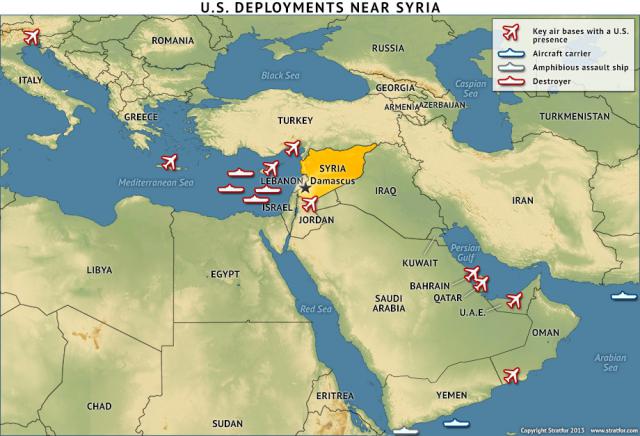
In addition, as reported the other day, the French carrier Charles de Gaulle has been ordered to move east from Toulon and the British are reported to have a nuclear submarine in the region as well.
Update: The Iranian Farsnews site says the US military will be in for a serious defeat if they attack Syria.
Syria’s supersonic and anti-ship missiles as well as the Lebanese Hezbollah movement will inflict astonishing damage on any invading force, specially the US Navy’s giant warships, an expert said, adding that the missile capability is working as a deterrent to a US naval attack on Syria.
“The supersonic and long-range anti-ship Yakhont missiles of the Syrian army and the Lebanese Hezbollah (resistance movement) are serious deterrents to a US naval attack by its warships in the Mediterranean Sea,” Dr. Mostafa Zahra, a military analyst and strategic studies expert, told FNA on Monday.
He said that Syria’s Iskandar high-precision ballistic missiles and its anti-ship Scud missiles will also target the US warships in case of a US naval invasion of Syria, reminding that the American military vessels are not equipped with any weapons system to intercept or divert the Syrian anti-ship missiles.
Did you hear that, Great Satan? “Astonishing damage“. You’d better back off now, infidel.
August 26, 2013
Suddenly of greater interest to the media – where are the carriers now?
Zero Hedge pulled a quick summary of US, French, and British naval units in light of the rumours of some kind of attack on Syria:
- A U.S. military source said on Friday the U.S. Navy was increasing its number of cruise missile-carrying destroyers in the Mediterranean to four from three by delaying the return to the United States of the Arleigh Burke class destroyer USS Mahan.
- The aircraft carrier USS Harry S Truman, by far the most powerful warship in the region, left the Mediterranean last weekend, passing through the Suez Canal into the Red Sea.
- Defence experts say the carrier could still strike Syria from south of Suez. As well as the strike aircraft carried by the Truman, several of her escort ships are also capable of firing Tomahawk land attack cruise missiles.
- Since earlier this year, the United States has also had F-16 jets in Jordan, where they remained after a major military exercise this year at the request of the Jordanian government. It also has a major air base at Incirlik in Turkey that could easily house multiple aircraft as part of a wider military campaign.
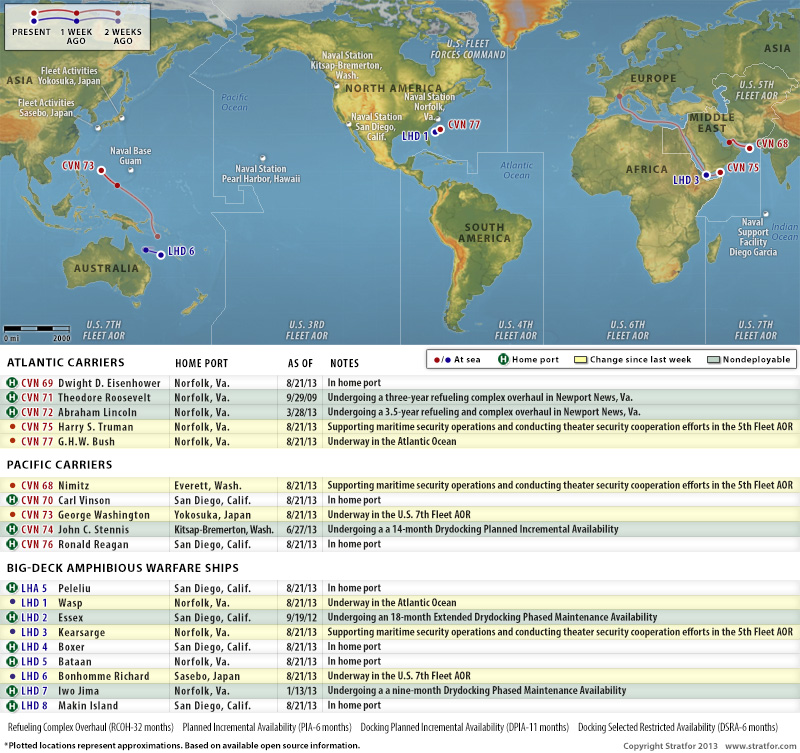
The French aircraft carrier Charles de Gaulle is still in or near Toulon, while the Royal Navy is said to have at least one Trafalgar or Astute class submarines in the Mediterranian. The RN no longer has in-service aircraft carriers, so any British air support would have to be from the RAF, possibly based in Cyprus (but subject to local government approval).
Update: This report says that the USS Ramage is also being retained in the Mediterranean along with the USS Mahan.
Update, 27 August: It was just mentioned (no link) that the Charles de Gaulle has been ordered to leave port, bound for the Eastern Mediterranean.
June 18, 2013
“Call it Jihadi sushi”
The difficulty of choosing the right side in the Syrian civil war is that there may not be one:
At his awkward press conference with David Cameron on Sunday, Vladimir Putin made an astonishing claim — the Syrian rebels eat people. It happens to be true. Putin was presumably referring to Abu Sakkar, a rebel leader who videoed himself eating a combatant’s lung. Sakkar explained that he did it in revenge for footage he found on the dead man’s phone of the government soldier raping women. “I swear to God we will eat your hearts and your livers, you soldiers of Bashar the dog!” cried Sakkar. For some Islamists, dedicating such an act to God is not as sacrilegious as it sounds. Students at Al Ahzar University in Cairo — an educational institution once graced by Obama’s presence — have access to a textbook that teaches it’s okay to eat apostates so long as the meat is not cooked. Call it Jihadi sushi.
The story underlines how difficult it is to choose the side of good in Syria: Assad’s men are rapists, the rebels are cannibals. When deciding what to do, the West has to avoid two templates of disaster. We don’t want another Rwanda, when the West stood aside and tolerated a genocide and we don’t want another Iraq, when the West got involved and stayed involved almost for a decade.
What Britain, France and America have decided to do is something in-between. Ignore the hyperbole about intervention from some in the press: at this stage all the alliance is threatening is to give logistical support to the rebels through non-military aid and a no-fly zone. Of course, this could escalate. But no Western leader wants to put boots on the ground and the goal of the sabre-rattling is actually to prod Russia into dragging Assad to the negotiating table at the proposed conference in Geneva (by the way, Putin might deliver on that but it’s far less likely that we’ll get the rebels to play ball on our side). We are deliberately internationalising the conflict, turning it into a giant game of chicken between America and Russia in the hope that they will resolve the war on behalf of the Syrian combatants.
June 5, 2013
May 4, 2013
Israeli air attack on missile shipment in Syria
It’s almost anti-climactic to report that the Israeli defence ministry is confirming that an air strike was launched against Syria yesterday. The unexpected part of the news is that the attack was on a shipment of missiles, not a chemical weapons depot:
Israeli officials said the shipment was not of chemical arms, but of “game changing” weapons bound for the Lebanese militant group. The airstrike took place early on Friday, but did not say where it took place.
American officials earlier told the Associated Press of an airstrike. One report had suggested the strike was on a chemical weapons facility.
Benjamin Netanyahu, the Israeli prime minister, has repeatedly warned in recent weeks that Israel would be prepared to take military action if chemical weapons or other arms were to reach Hizbollah.
Lebanon’s army said pairs of Israeli airplanes entered Lebanese airspace on three occasions overnight between Thursday and Friday.
The move will raise tensions in the Middle East and comes amid mounting pressure over the alleged use of chemical weapons by president Bashar Assad’s regime.
May 1, 2013
Syrian use of nerve gas
Strategy Page outlines what we think we know about the use of nerve gas in Syria:
In Syria the rebels have been accusing the government of using nerve gas shells and bombs. Israel is convinced this is so and the U.S. is inclined to agree with them. The known incidents occurred in the northern city of Aleppo where government forces are taking a beating. Syria insists that no nerve gas was used, but the nerve gas may have been ordered as a desperate measure to halt the advancing rebels, with instructions that “this never happened”. Israel insists it has definitive proof and apparently that is convincing many NATO members, including the United States. Moreover a Syrian general defected in late April and said he was ordered to use chemical weapons against rebels in the southwest recently, but fired shells with harmless chemicals instead. The general offered to reveal where he had buried the actual chemical shells.
Syrian nerve gas is stored at some fifty locations all over the country. A large number of troops are devoted to defending these stockpiles and some chemical weapons have been moved to avoid capture by the rebels. Officially Syria has no nerve gas, but the Assad government has recently made statements indicating that it is abandoning that fiction. Syria has maintained stocks of chemical weapons for decades as a last ditch weapon for any future war with Israel (which few Syrians believe could be won). Israel has prepared accordingly. Recently Syria announced that it never had any intention of using nerve gas against Israel. This all gets even stranger as Israel has recently advised the United States to stay out of Syria, even if nerve gas is being used. That’s apparently because Israel wants to take care of this problem itself, as its Israeli civilians who are likely to die if Syrian nerve gas is captured by Islamic terrorists (who still want to use nerve gas against Israel).
Photos of dead civilians the rebels claim were nerve gas victims do show signs of nerve gas in use (foaming at the mouth and contracted pupils). The only way to obtain conclusive evidence is for someone to bring out the bodies of victims (or blood samples) and soil samples from the area where the nerve gas was used. If the rebels want to prove their accusations of nerve gas use they just have to collect these samples and get them out of the country. Apparently that has been done, at least to the satisfaction of Israeli intelligence. The U.S. said it would intervene militarily if Syria used chemical weapons and demands conclusive proof (blood and soil samples) before deciding and acting. Now the U.S. has apparently been shown evidence of Syrian use of chemical and is debating what to do about it.
January 7, 2013
Paul Wells examines the (virtual) entrails
In Maclean’s, Paul Wells looks deeply into the hidden meanings of the Prime Minister’s rare interview utterances:
The Prime Minister’s year-end interviews are always worth close reading. Partly because he gives few interviews. Partly because those interviews, widely spaced, show how his thinking changes as circumstances do. This year the changes are stark.
The part I’ve just quoted came when Friesen asked Harper about the possibility that Bashar al-Assad might use chemical weapons against Syrian opponents of his regime.
Would NATO intervene? “Well, I don’t want to speculate.”
Is the use of what we used to call weapons of mass destruction a “red line,” as the Obama administration has called it? That was the question that got Harper talking about risks and caution. “What we can continue to do, as I say, is try to work with elements of the opposition and others to try to push that country to a better solution and try to avoid further escalation of this conflict.”
This is what being Prime Minister does to you. A decade ago, when conversation turned to the use of chemical or biological weapons and the theatre was Iraq, it was Jean Chrétien talking about risks and caution and Harper urging red lines. I dare hope we’ll never get to test the hypothetical in Syria, but it was not only when it came to Assad that this year’s Harper was notably less cocky than previous years’. Chastened, one might say, by a year when the world turned out to be more complex than advertised.
August 4, 2012
George Jonas: Israel is essential … to keeping Arab regimes in power
George Jonas in the National Post explains that Israel is essential to the dictators, strongmen, and demagogues of the many Arab and Muslim states that surround it:
An increase in hostility was predictable. Hatred against Israel, kept on a low boil, is the organizing principle of the Middle East. It’s the region’s main fuel of governance; often its only fuel. Some ruling regimes — kings, dictators, whatever — may have oil wells and sandy beaches, but other than hating Israel (and looking after their families and tribes) they have few if any ideas. If they do, chances are it’s to hate some other group in addition to Israel.
In the Middle East a country’s national purpose often amounts to little more than a list of its enemies. A feeling of being ill-done by dominates the consciousness of groups and individuals. Since it’s a self-fulfilling prophecy, it’s not necessarily baseless: The easiest way to have an enemy is to be one.
The centrality of hatred to the culture is remarkable. The Cartesian idea is “I hate, therefore I am.” Self-righteousness is overwhelming: each desire thwarted becomes an example of justice denied. It’s not a pretty place, but millions call it home.
[. . .]
We won’t understand much about the Arab Spring as long as we persist in looking at it through Western eyes. We see popular uprisings against dictatorships as moves in the direction of Western-style democracy. If they happened here, they probably would be. Where they’re actually happening they’re taking their societies in the opposite direction.
The Arab Spring is an attempt to return the region to its roots. It’s not to Westernize the Middle East and make it more democratic; it’s to Easternize it and make it more Islamic. If the early 20th century was about the East trying to join what it couldn’t lick, the early 21st may be about the East trying to lick what it hasn’t been able to join.
June 17, 2012
The only justifications for armed intervention
George Jonas on the arguments being trotted out for military intervention in Syria and other hotspots:
Repeating for the record what I’ve written many times before, I think only three things justify resorting to arms: (A) self-defence, (B) treaty obligations, and (C) defending vital national interests, defined as interests that properly mandated governments on reasonable grounds honestly believe cannot be safeguarded or secured in other ways.
As far as I can see, nothing compels or even excuses belligerency except national defence obligations. Humanitarian components are icing on the cake. “Responsibility to protect” strikes me a slogan of liberal imperialism; the battle cry of post-modern civilization’s missionaries, the casus belli of self-appointed knights errant with an unquenchable thirst for running the world. Disguised as academics, adventurers, mercenaries, bureaucrats, bien-pensants and do-gooders, these 21st-century Don Quixotes consider themselves the new global aristocracy. They’re the enlightened ones, expecting to become the anointed ones before long, and rule as functionaries of various supranational bodies — governmental, non-governmental, or merely mental — in what no doubt many believe is humanity’s best interest.
[. . .]
Anyway, my main point was that the West’s moment of going off the rails in foreign policy didn’t come in the turbulent and error-prone 1960s, but in the seemingly level-headed 1950s, under the presidency of the popular wartime commander “Ike” Eisenhower. Instead of letting America’s allies, Britain, France and Israel, finish the job Egypt’s military dictator, Colonel Nasser, started when he arbitrarily nationalized the Suez Canal in 1956, Eisenhower’s America, aided by Lester B. Pearson’s Canada, rescued the aggressive nationalist. As Westerners, Eisenhower and Pearson may have expected credit; what they got was contempt.
“Weren’t they allies? Westerners are people whose enmity is preferable to their friendship,” was how a Libyan I interviewed commented some years later. I don’t think we learned much since.
March 22, 2012
Syria is a “nation made up of little pieces, and they all are about to fall to the floor”
Geoffrey Clarfield on the history of Syria and the possible future of the region:
From outside Syria, it appears that a government is waging war against citizens who are demanding change and democracy. That is certainly how many media outlets are reporting the ongoing violence in that country. But as many Syrians know, this war is about something else entirely. Something much larger.
A century ago, Syria was still part of the Ottoman Empire. Although the administrative sub-districts of what is now called Syria changed many times under the Turks, by the early 20th century they comprised a number of distinct administrative units that centred around key cities, such as Damascus and Aleppo. Beginning in 1874, they also included the areas around Jerusalem (which had a Jewish majority). The British called the area “the Levant.”
The area was, and still is, made up of a number of occasionally co-operating, occasionally competing ethnic groups: Sunni Arabs, Maronite Christians, Arabic-speaking Greek Orthodox Christians, Aramaic-speaking Christians, Arabic-speaking Alawis, Muslim Gypsies, Armenians, Jews, Yezidis, Kurdish-speaking Sunnis and nomadic Sunni Bedouin — each with their own distinctive history, loyalties and competing interests.
[. . .]
As the Sunni Arab elites of Aleppo and Damascus clamoured for independence from the French, they became enamored with three overlapping ideologies. The first was that of Pan-Islam, which many rejected because it was seen as too similar as that of the defunct and discredited Ottoman Empire. The second was Pan Arabism, which held that the Arab world was once one country, and was destined to become one again. (This school of thought would survive until Nasser’s era in the 1950s and 1960s, but no one talks about it anymore.)
The third was “Greater Syria.” This theory held that the peoples of the eastern Mediterranean were all members of one unit — including present-day Syria, Lebanon, Jordan, Israel and southwestern Turkey. Extreme versions of the “Greater Syria” ideology include Cyprus and the Sinai desert. In none of these worldviews is there any room for an independent Jewish homeland, a Christian Lebanon or, in the masimalist cases, even a Greek Orthodox Cyprus. Unlike Pan Arabism, the ideology of Greater Syria still has some resonance in the region.
March 12, 2012
The role of narcissism in calls for military intervention in Syria
Brendan O’Neill says that one of the driving factors for those demanding military action in Syria is narcissism:
Failed Canadian politician Michael Ignatieff recently made waves with an op-ed in the Financial Times calling for Western intervention in Syria. Revisiting some of the themes of his 1990s writings (Ignatieff made a living championing ‘humanitarian interventionism’ before he led Canada’s Liberal Party to its worst electoral defeat ever), Igantieff said the West should impose a ‘comprehensive quarantine of Syria’ in order to ‘force [Assad] from power’.
Yet the most startling thing about his piece was not its extreme short-term historical amnesia, its ignorance of the disasters unleashed in Iraq and Afghanistan following Western meddling, but rather its exhibition of self-regard and self-concern, even of that most malignant form of self-love: narcissism. Ignatieff mentioned his own feelings about what is happening in Homs six times and the possible feelings of the people of Homs themselves only three times. His short op-ed mainly focused on the ‘guilt’ and ‘shame’ felt by people like Igantieff — that is, Western observers possessed of a good, caring, Sarajevo-informed ‘international conscience’ — while the ‘fear’ and ‘desperation’ of the people of Homs were given far briefer treatment.
This ratio of 2:1 between Ignatieff’s feelings of guilt and Syrians’ feelings of desperation not only suggests that modern Western interventionists are two times more obsessed with themselves than they are with the victims of foreign conflicts they claim to care so much about — it also reveals that what is really motoring the demands for Western intervention in Syria are the emotional needs of Western observers rather than the practical needs of Syrians. This kind of narcissism is now widespread among those who desperately want the ‘international community’ to intervene in Syria. These people are so amazingly vain that they see the bombing of Syria as a kind of balm for their guilt-ridden consciences, a physical act that might help to make their own emotional turmoil that bit more bearable. Their rallying cry should be: ‘Bomb Syria so that I can sleep at night.’
June 15, 2011
The “Amina Arraf” hoax
Brendan O’Neill on how easily the hoaxer’s blog became “a go-to place for liberal hacks, bloggers and tweeters who wanted to know ‘the truth’ about life in Syria.”
The revelation that the Gay Girl in Damascus is actually a stubbly bloke in Edinburgh has sent shockwaves through the media. ‘How could he have done this?’, journalists are demanding of Tom MacMaster, the American self-confessed nerd based in Scotland who for six months pretended to be a dissident dyke in Syria. ‘Doesn’t he know the damage he has done to gay people in the Middle East and to the reputation of political blogging?’
These are the wrong questions. Because the most striking thing about this blogging hoax is not its potential impact over there, but what it reveals about culture, politics and journalism over here. The thing that ought to cause jaws to drop and eyebrows to rise is not Mr MacMaster’s deceitfulness — he isn’t the first mundane man to masquerade as something sexier on the world wide web — but rather the ease with which he planted himself in the cultural consciousness. It is the manipulability of the modern media, their wide-eyed openness to unchecked foreign stories that seem to confirm their prejudices, which should really be in the spotlight.
[. . .]
The media’s current focus on the clever nature of the gay-girl hoax (‘it is an elaborate hoax’, says a track-covering Guardian), overlooks what is easily the most important dynamic in this story: not MacMaster’s alleged powers of persuasion, but the media’s susceptibility to delusion. However well-written or seemingly authentic MacMaster’s blog was — and as it happens, some Syrians have said it was unconvincing — the fact is that it was just a blog; just a self-started website with various bits of personal writing and nothing to suggest that any of it was accurate or authoritative. Those complaining about being duped, Scooby Doo-style, by the apparent master of disguise that is Tom MacMaster need to have a word with themselves: it was their openness to being duped, their embrace of the seemingly made-in-heaven ‘gay girl in Damascus’ narrative with its achingly right-on contrast between a morally sensitive LGBT gal and a male-dominated regime, which really blew this blog out of all proportion.


