Quotulatiousness

July 24, 2021

History Hijinks: Rome’s Crisis of the Third Century

Overly Sarcastic Productions
Published 23 Jul 2021

Local Empire Too Stubborn To Die — Field Historian Blue is here at the scene of Ancient Rome with more on the Crisis of the Third Century.

SOURCES & Further Reading
https://www.britannica.com/place/anci… + Aurelian, Postumus, Zenobia
The Great Courses The Roman Empire: From Augustus to The Fall of Rome lectures 13 14 and 15, “From Commodus to Caracalla”, “The Crisis of the Third Century” and “Diocletian and Late Third-Century Reforms”, by Gregory Aldrete
The Enemies of Rome Chapter 20 “Parthia, Persia, Palmyra” by Stephen Kershaw

Partial Tracklist: “Scheming Weasel”, Sneaky Snitch”, “Marty Gots A Plan” Kevin MacLeod (incompetech.com)Licensed under Creative Commons: By Attribution 4.0 License
http://creativecommons.org/licenses/b…

Content is intended for teenage audiences and up.

PATREON: https://www.Patreon.com/OSP

PODCAST: https://overlysarcasticpodcast.transi…

DISCORD: https://discord.gg/osp

MERCH LINKS: http://rdbl.co/osp

OUR WEBSITE: https://www.OverlySarcasticProductions.com
Find us on Twitter https://www.Twitter.com/OSPYouTube
Find us on Reddit https://www.Reddit.com/r/OSP/

From the comments:

Facundo Cadaa
2 hours ago
Thumbnail: “Rome’s big crisis”

Do you have any idea how little that narrows it down?

June 28, 2021

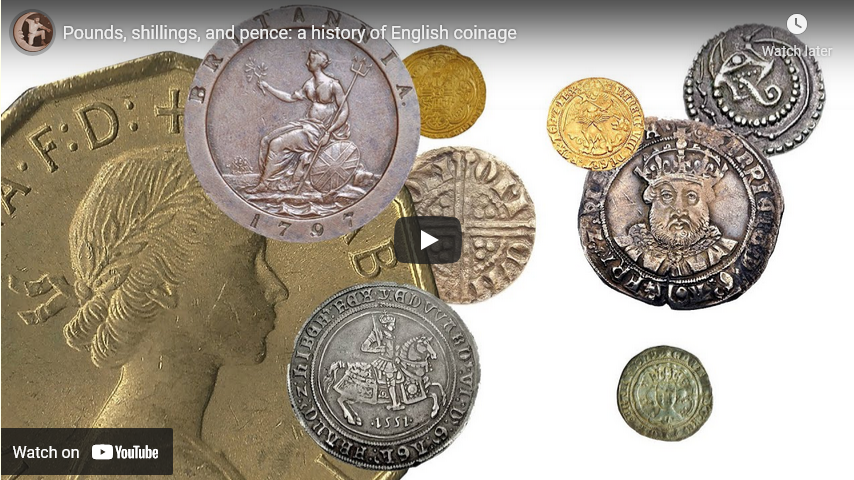
Pounds, shillings, and pence: a history of English coinage

Filed under: Britain, Economics, History — Tags: , , , , , , — Nicholas @ 04:00

Lindybeige
Published 18 Dec 2020

I talk for a bit the history of English coinage, and the problems of maintaining a good currency. Once or twice I might stray off topic, but I end with an explanation of why the system worked so well.

Picture credits:
40 librae weight
Martinvl, CC BY-SA 3.0 https://creativecommons.org/licenses/…, via Wikimedia Commons

Sceat K series, and others
By Classical Numismatic Group, Inc. http://www.cngcoins.com, CC BY-SA 3.0, https://commons.wikimedia.org/w/index…

William I penny, and Charles II crown
The Portable Antiquities Scheme/ The Trustees of the British Museum, CC BY-SA 2.0 https://creativecommons.org/licenses/…, via Wikimedia Commons

Bust of Charlemagne
By Beckstet – Own work, CC BY-SA 3.0, https://commons.wikimedia.org/w/index…

Edward VI crown
By CNG – http://www.cngcoins.com/Coin.aspx?Coi…, CC BY-SA 3.0, https://commons.wikimedia.org/w/index…

Charles II guinea
Gregory Edmund, CC BY-SA 4.0 https://creativecommons.org/licenses/…, via Wikimedia Commons

Support me on Patreon: https://www.patreon.com/Lindybeige

Buy the music – the music played at the end of my videos is now available here: https://lindybeige.bandcamp.com/track…

Buy tat (merch):
https://outloudmerch.com/collections/…

Lindybeige: a channel of archaeology, ancient and medieval warfare, rants, swing dance, travelogues, evolution, and whatever else occurs to me to make.

▼ Follow me…

Twitter: https://twitter.com/Lindybeige I may have some drivel to contribute to the Twittersphere, plus you get notice of uploads.

My website:
http://www.LloydianAspects.co.uk

June 18, 2021

Innovation was minimal in the Roman Empire, because slave societies think they don’t need new inventions

Filed under: Economics, Europe, History — Tags: , , , — Nicholas @ 05:00

Mark Koyama writes for the Foundation for Economic Education on the similarities and differences of the economy of the Roman Empire at its second-century peak and the booming European economies of the 17th and early 18th centuries:

“The Consummation of Empire” from the painting series “The Course of the Empire” by Thomas Cole (1801-1848).
New York HIstorical Society collection via Wikimedia Commons.

The most obvious institutional difference between the ancient world and the modern was slavery. Recently historians have tried to elevate slavery and labor coercion as a crucial causal mechanism in explaining the industrial revolution. These attempts are unconvincing […] but slavery certainly did dominate the ancient economy.

In its attempt to draw together the various strands through which slavery permeated the ancient economy, [Aldo] Schiavone’s chapter “Slaves, Nature, Machines” [in The End of the Past] is a tour de force. At once he captures the ubiquity of slavery in the ancient economy, its unremitting brutality — for instance, private firms that specialized in branding, retrieving, and punishing runaway slaves — and, at the same time, touches the central economic questions raised by ancient slavery: to what extent was slavery crucial to the economic expansion of the period between 200 BCE and 150 AD? And did the prevalence of slavery impede innovation?

It is impossible to do justice to the argument in a single post. Suffice to say that after much discussion, and many fascinating interludes, Schiavone suggests that ultimately the economic stagnation of the ancient world was due to a peculiar equilibrium that centered around slavery.

One can think of this equilibrium as resting on two legs. The first is the observation that the apparent modernity of the ancient economy — its manufacturing, trade, and commerce rested largely on slave labor. The expansion of trade and commerce in the Mediterranean after 200 BC both rested on and drove the expansion of slavery. Here Schiavone notes that the ancient reliance on slaves as human automatons — machines with souls — removed or at least weakened, the incentive to develop machines for productive purposes.

The existence of slavery, however, was not the only reason for the neglect of productive innovation. There was also a specific cultural attitude that formed the second leg of the equilibrium:

    None of the great engineers and architects, none of the incomparable builders of bridges, roads, and aqueducts, none of the experts in the employment of the apparatus of war, and none of their customers, either in the public administration or in the large landowning families, understood that the most advantageous arena for the use and improvement of machines — devices that were either already in use or easily created by association, or that could be designed to meet existing needs — would have been farms and workshops

The relevance of slavery colored ancient attitudes towards almost all forms of manual work or craftsmanship. The dominant cultural meme was as follows: since such work was usually done by the unfree, it must be lowly, dirty and demeaning:

    technology, cooperative production, the various kinds of manual labor that were different from the solitary exertion of the peasants on his land — could not but end up socially and intellectually abandoned to the lowliest members of the community, in direct contact with the exploitation of the slaves, for whom the necessity and demand increased out of all proportion … the labor of slaves was in symmetry with and concealed behind (so to speak) the freedom of the aristocratic thought, while this in turn was in symmetry with the flight from a mechanical and quantitative vision of nature

Thus this attitude also manifests itself in the disdain the ancients had for practical mechanics:

    Similar condescension was shown to small businessmen and to most trade (only truly large-scale trade was free from this taint). The ancient world does not seem to have produced self-reproducing mercantile elites. Plausible this was in part because of the cultural dominance of the landowning aristocracy.

The phenomenon coined by Fernand Braudel, the “Betrayal of the Bourgeois”, was particularly powerful in ancient Rome. Great merchants flourished, but “in order to be truly valued, they eventually had to become rentiers, as Cicero affirmed without hesitation: ‘Nay, it even seems to deserve the highest respect, if those who are engaged in it [trade], satiated, or rather, I should say, satisfied with the fortunes they have made, make their way from port to a country estate, as they have often made it from the sea into port. But of all the occupations by which gain is secured, none is better than agriculture, none more delightful, none more becoming to a freeman'” (Schiavone, 2000, 103).

Such a cultural argument fits perfectly with Deirdre McCloskey’s claim in her recent trilogy that it was the adoption of bourgeois cultural norms and specifically bourgeois rhetoric that distinguished and caused the rise of north-western Europe after 1650.

June 15, 2021

History Summarized: Persistence of Judaism

Overly Sarcastic Productions
Published 7 Apr 2017

Gooooood morning everybody! Today, Blue finishes the trilogy of Abrahamic religions with a video summarizing the history of the Hebrew people and the Jewish faith. There’s a lot of ground to cover, so fasten your seatbelts for a twenty-minute rundown of the facts, the theories, and the ever-so-popular misconceptions!

Look forward to next time, when Blue brings it all together to talk about Religious Wars and Religious Philosophy!

PATREON: www.patreon.com/user?u=4664797

MERCH LINKS:
Shirts – https://overlysarcasticproducts.threa…​
All the other stuff – http://www.cafepress.com/OverlySarcas…​

Find us on Twitter @OSPYouTube!

QotD: The destruction of the Great Library of Alexandria

The dramatic force of the New Atheist moral fable of the Great Library of Alexandria not only comes from the Library’s supposed size and unique nature, but also from its supposed cataclysmic and fiery end. The moral of this story has added impact if the Great Library ends in a violent catastrophe, so this is the story that tends to get told by those who use the tale as a stick with which to beat Christianity. The fact is, however, that libraries are delicate institutions and most decline slowly rather than ending in a sudden disaster, or – as in the Great Library’s case – decline slowly while suffering a series of disasters. Anyone who works in library services will tell you that the main enemy of a library’s continuation is a lack of funding. Ancient libraries in particular needed constant financial patronage from their founders and sponsors to survive. Papyrus scrolls decayed and fell apart from use, suffered damage from mice and other vermin and, in a period where artificial light tended to be from open oil lamps, were in constant danger from fires, great and small. The Mouseion, like all ancient libraries, needed a large staff to undertake the constant and unending task of repairing, replacing and recopying books and these staffs, even when made up of slaves, were expensive to maintain.

During the Mouseion‘s heyday in the third and second centuries BC the funding for this labour and the upkeep of the institution generally would have been regular and reliable. The Mouseion was, after all, one of the jewels in the crown of the Ptolemaic kingdom and it sat in the Broucheion or Royal Quarter where the Ptolemies themselves lived. By the first century BC, however, there is some indication that the prestige of the institution had begun to decline. In its first two centuries the Mouseion‘s directors were famous scholars, renowned for their intellects throughout the Greek-speaking world. By the time of the later Ptolemies, however, we find administrators, court favourites and even a former commander of the palace guard taking up the role, which seems to have become, as Lionel Casson puts it, “a political plum” to be awarded to flunkies rather than scholars. This continued under the Romans in the first century AD, with Tiberius Claudius Balbilus being awarded the post by Claudius, though he at least was something of a scholar if not a leading intellect. It is likely that the later Ptolemies began to neglect the institution and Roman imperial patronage of it was probably even less reliable.

But war has always been one of the main destroyers of libraries down the ages and the Great Library’s slow decline was marked by several sacks of the Broucheion which eventually led to the end of the Mouseion. The first and probably the most significant came in 47 BC when Julius Caesar took the side of Cleopatra in her claim on the Ptolemy’s throne and besieged her younger brother, the boy king Ptolemy XIII, in Alexandria. Caesar’s own account mentions that he burned a fleet in the docks of the city, but makes no mention of this fire destroying anything else (Civil Wars, III.11). His account was continued by his lieutenant Aulus Hirtius in his Alexandrine War and he too makes no mention of any fire damaging the city, but he does go out of his way to say “Alexandria is well-nigh fire-proof, because its buildings contain no wooden joinery and are held together by an arched construction and are roofed with rough-cast or tiling” (Alexandrine War, I.1) which could be read as an attempt at a defence against accusations of damage through fire, given his role in the siege. The earliest account of Caesar’s siege damaging Alexandria comes from a lost work by Livy via an epitome by Florus (Florus, II.13) which describes Caesar burning the area around the docks to deprive enemy archers of a position on which to fire on his troops, and this is echoed by Lucan (The Civil War, X.24). It is Plutarch who first depicts this fire destroying the Great Library in an almost casual mention that perhaps assumes this as common knowledge:

    In this war, to begin with, Caesar encountered the peril of being shut off from water, since the canals were dammed up by the enemy; in the second place, when the enemy tried to cut off his fleet, he was forced to repel the danger by using fire, and this spread from the dockyards and destroyed the Great Library, and thirdly, when a battle arose at Pharos, he sprang from the mole into a small boat and tried to go to the aid of his men in their struggle, but the Egyptians sailed up against him from every side, so that he threw himself into the sea and with great difficulty escaped by swimming. (Plutarch, Caesar, 49)

Aulus Gellius’ mention of the Great Library says that the collection numbered “nearly seven hundred thousand volumes” and then adds “but these were all burned during the sack of the city in our first war with Alexandria”, referring to Caesar’s siege (Gellius, Attic Nights, VII.17). Dio Cassius gives a slightly longer account:

    After this many battles occurred between the two forces both by day and by night, and many places were set on fire, with the result that the docks and the storehouses of grain among other buildings were burned, and also the library, whose volumes, it is said, were of the greatest number and excellence. (Dio Cassius, Roman History, XLII.36)

There is some debate about how literally we can take the reports that the whole Great Library was destroyed, especially given that the docks area of Alexandria were some distance from the Mouseion‘s likely location. The fact that so many writers agree that Caesar’s fire destroyed the Great Library simply can’t be ignored, however, and at the very least the fire seems to have destroyed a substantial portion of the book collection, probably stored in warehouses on the docks. It is clear that the losses were huge, as Plutarch also tells the (probably apocryphal) story of Mark Antony confiscating the whole collection of the Great Library of Pergamon and giving them to Cleopatra to replace the books lost in the fire (Plutarch, Antony, 58). While this was not the end of the Mouseion and not the end of its whole collection, writers from around the end of the reign of Caesar’s dynasty onwards tend to refer to the Great Library in the past tense and any surviving collection was probably greatly reduced after 47 BC.

Scholarship continued in the Mouseion, however, and the Roman emperors seem to have continued its funding under their patronage when the Ptolemaic dynasty came to an end with the death of Cleopatra. Claudius built a new wing or annex to the Mouseion, which was to house his works of history and see the public reading of them twice a year. But it was the calamitous third century AD that saw a succession of military disasters in Alexandria and seems to have seen the final end of the Mouseion.

In 215 AD Caracalla punished Alexandria for mockery of him with a wholesale massacre of its young men, after which his troops plundered parts of the city. It is not known if the Mouseion was sacked in this action, but John Malas records that its funding was stopped by Caracalla at this time (Delia, p. 1463). The real end probably came in 272 AD when Aurelian stormed the Broucheion with Ammianus noting “[Alexandria’s] walls were destroyed and she lost the greater part of the district called Bruchion.” (Ammianus, History, XII.15). If that sack didn’t mean the death blow for the institution, Diocletian probably finished the job when he too sacked the city in 295 AD, and it was later devastated by a major earthquake in 365 AD. The only mention of the Mouseion after this is found in a late source, the tenth century Byzantine encyclopaedia called the Suda, which describes the fourth century philosopher Theon as “the man from the Mouseion“, though it is hard to tell exactly what this means. Given that the Mouseion was most likely long gone by Theon’s time, it could be that some other successor “Mouseion” had been established and Theon studied there or it could be that “the man from the Mouseion” is stylised honorific or even a personal nickname – meaning “a scholar like one from the old days”.

The Mouseion and its library were almost certainly a memory by the late third century, destroyed in a series of calamities after a long period of decline. But what is missing from all this evidence is any howling, pyromaniacal Christian mob. If the Great Library ceased to exist in the century before Chrisitanity came to power in the Empire, how did Christians get stuck with the charge of destroying it? The answer lies not in the evidence about the Great Library, but in the history of its daughter library and annex in the Serapeum.

Tim O’Neill, “The Great Myths 5: The Destruction Of The Great Library Of Alexandria”, History for Atheists, 2017-07-02.

May 25, 2021

536 AD – Worst Year in History

Kings and Generals
Published 11 May 2021

Start speaking a new language in 3 weeks with Babbel 🎉 Get 6 months FREE when you sign up for 6 months! ➡️ HERE: https://go.babbel.com/6plus6-youtube-…

Kings and Generals’ historical animated documentary series on the history of Ancient Civilizations continues with a video on the year 536 AD, which many historians consider the worst year in history, as plague, famine, volcanic eruption, and extreme weather patterns changed the fate of the millions, especially influencing Sassanid and Eastern Roman Empires.

Support us on Patreon: http://www.patreon.com/KingsandGenerals or Paypal: http://paypal.me/kingsandgenerals We are grateful to our patrons and sponsors, who made this video possible: https://docs.google.com/document/d/1o…

Art and animation: Haley Castel Branco
Narration: Officially Devin (https://www.youtube.com/user/OfficiallyDevin)
Script: Matt Hollis

✔ Merch store ► teespring.com/stores/kingsandgenerals
✔ Podcast ► Google Play: http://bit.ly/2QDF7y0 iTunes: https://apple.co/2QTuMNG
✔ Twitter ► https://twitter.com/KingsGenerals
✔ Instagram ► http://www.instagram.com/Kings_Generals

Production Music courtesy of EpidemicSound

#Documentary #WorstYearInHistory #536

May 9, 2021

Why Siege Towers are Wrong – History and Evolution

Invicta
Published 1 Feb 2021

The depiction of siege towers as massed, glorified troop elevators in most modern media is completely a-historic. In this video let’s reveal the true history of the Siege Tower.

Check out The Great Courses Plus to learn about daily life in the past: http://ow.ly/DWyz30rsjSX

In this video we explore the history of siege warfare and in particular the siege tower. This begins with our earliest civilizations in the Fertile Crescent. It is here in ancient Mesopotamia that people like the Assyrians began to experiment with new siege technology such as the siege tower. We look specifically at the best example of Assyrian Warfare and the Assyrian army with the Siege of Lachish. From here, siege technology would spread to nearby Egypt and across the Mediterranean. The Greeks picked it up and helped push the technology forward with great application in the campaigns of Alexander the Great. The Roman Army then adopted the Siege Tower and worked to perfect its application. We then finally turn to the use of the Siege Tower in the middle ages. Along the way we cover lots of specific examples like The Siege of Alesia, The Siege of Jerusalem, the Siege of Masada and much more.

#History
#Documentary

May 6, 2021

Il Duce and the Fascist Abuse of History | B2W: ZEITGEIST! I E.17 – Harvest 1922

TimeGhost History
Published 5 May 2021

The modern age is an age of modern things. But it is also an age when people yearn for times past. One of the main men to weaponize this yearning is Benito Mussolini, and this season, he moves to recreate the Roman Empire in his fascist image.

Get your own Indy Neidell Tie here: https://www.youtube.com/channel/UC4Mi…

Join us on Patreon: https://www.patreon.com/TimeGhostHistory​

Hosted by: Indy Neidell
Written by: Francis van Berkel
Director: Astrid Deinhard
Producers: Astrid Deinhard and Spartacus Olsson
Executive Producers: Astrid Deinhard, Indy Neidell, Spartacus Olsson, Bodo Rittenauer
Creative Producer: Maria Kyhle
Post-Production Director: Wieke Kapteijns
Research by: Francis van Berkel and Timothy Smith
Image Research by: Lucas Aimo
Edited by: Lucas Aimo
Sound design: Marek Kamiński

Colorizations:
– Daniel Weiss
– Mikołaj Uchman

Archive by Screenocean/Reuters https://www.screenocean.com​.

A TimeGhost chronological documentary produced by OnLion Entertainment GmbH.

From the comments:

TimeGhost History
2 days ago (edited)
The only thing more interesting than learning about history is learning about how people in history learned about history.

For starters, it is just interesting in itself. Anyone with a passion for history will want to hear about the circumstances of how a new discovery was made or how certain historical narratives were preserved over time. But more analytically, looking at how a society understood its history can tell you a lot about that society understood itself and the contemporary world around it. That second point is particularly true of the modern age. Ironically, it is a very modern “thing” to be so aware of history. Indeed, the modern age saw the birth of the museum, of nationalist histories, and even the concept of what “History” itself was (note the capital H).

It’s such a massive topic and one that perhaps isn’t suited to a single pinned comment. Interested in learning more? Maybe we’ll do another video on it someday. In the meantime, you can read up the works of Reinhart Koselleck … that should keep you occupied.

May 3, 2021

QotD: Marcus Aurelius and the “Mandate of Heaven”

A much more interesting scenario happens when seemingly legitimate, competent rulers find themselves at the helm during a major crisis. Marcus Aurelius has an overinflated rep among the laity, but he was decent at his job … until he wasn’t, thanks to things like the Antonine Plague. This, and a large barbarian invasion, brought all the Empire’s long-term structural problems into sharp focus. Yeah, Marcus is overrated, but it’s no knock on him that he didn’t fix these problems, or cure the plague; those were probably beyond the skill of even the most extraordinary man. His reaction, though, and the reaction of his subjects, is instructive.

Marcus faced no rebellion; no one sought to usurp him. For one thing, Marcus won his wars — no mean feat, considering the plague etc. But for another, it’s hard to blame Marcus for the plague, the weakness of the army staffing system, the structural weakness of the currency. And that’s where it gets interesting, because even though you can’t consciously blame Marcus for this, all those things create excessive anxiety among the people, and that anxiety has to go somewhere

… so they persecuted Christians.

“The extent to which Marcus Aurelius himself directed, encouraged, or was aware of these persecutions is unclear and much debated by historians,” Wiki informs us, but it doesn’t matter if he had a hand in them or not. The important thing is that the Christians were the perfect target for free-floating anxiety, since plagues etc. were supernatural events and the Christians were ostentatiously opposed to the official belief system. Perhaps Marcus didn’t lose the Mandate of Heaven; perhaps it was stripped from him. Burn the unbelievers, and maybe the world gets back into focus.

This is the pattern whenever the Powers That Be find themselves trying to ride out a massive, structural sea-change — one where it’s obvious to the stressed-out public that something HAS to change, but a mere change in leadership won’t cut it. You’ll have to trust me on this, I guess, unless you’re up on your Chinese history, but almost all their “rebellions” had this mystical character — widespread banditry was assumed, in itself, to be a sign that the Emperor had lost the Mandate of Heaven, and the bandit groups usually ended up looking like the White Lotus sect, who caused endless trouble for something like 300 years. And then there’s the Taiping Rebellion — led by Jesus Christ’s brother! — and by now I’m sure y’all take my point. You can’t really blame the Qing for everyone’s opium addiction, or getting stomped by the British, but you’ve got to blame someone – hence the mystical character of pretty much all Chinese rebellions, certainly including the Maoist.

Severian, “Witch Trial Syndrome”, Rotten Chestnuts, 2021-01-27.

April 10, 2021

Galen of Pergamon

Filed under: Europe, Health, History, Science — Tags: , , — Nicholas @ 03:00

Scott Alexander asked some of his readers to submit book reviews that he’ll be publishing anonymously to allow the rest of the readership to vote on. Friday’s submission was a review of the work of Galen of Pergamon … to help determine if he deserves all the kicks he’s received from other writers over the last two millennia:

Portrait of Galen from The Lancet.
Engraving by Georg Paul Busch via Wikimedia Commons.

Aelius Galenus or Claudius Galenus (henceforth “Galen”) was born in Pergamon, a town in modern-day Turkey, in 129 CE. At the time, it was a part of the Roman empire, and a major intellectual center. Galen’s father was an architect; while rich, he was not considered to be particularly high status. Since there was little pressure for his son to go into a traditional career, instead of the “safe” subjects of literature and rhetoric that most Romans studied, Galen got an unusual education in mathematics and geometry.

(His father’s patient encouragement has its foil in his mother, who “flew into rages and bit her servants, a practice of which Galen disapproved.”)

When Galen was a teenager, however, his father had a dream where the god of medicine appeared and told him that his son should study medicine, so Galen started training as a doctor.

During this training Galen became familiar with the writings of Hippocrates, who had lived about 600 years earlier. Hippocrates had introduced the idea of the four humors to medicine — four fluids that congeal together to form our flesh and organs, and which co-mingle in our veins in their liquid form. Hippocrates came up with this system, but Galen would be the one to make it world-famous.

I could try to describe the theory myself, but actually Hippocrates does a great job on his own:

    The Human body contains blood, phlegm, yellow bile and black bile. These are the things that make up its constitution and cause its pains and health. Health is primarily that state in which these constituent substances are in the correct proportion to each other, both in strength and quantity, and are well mixed. Pain occurs when one of the substances presents either a deficiency or an excess, or is separated in the body and not mixed with others.

All disease and illness, in this system, were the result of an imbalance in the four humors. From this perspective, treatments like bloodletting make perfect sense. By opening up the veins, the excessive humors drain away, leaving the patient more balanced — in better humors.

Long-term trends towards any of the humors were responsible for what we would call personality. Hence the terms sanguine, phlegmatic, melancholy and so on for different personal traits and emotional conditions.

This is the theory that he would put his weight behind, and which he would eventually be responsible for bringing to the majority of the western world.

When Galen was 19, his father died, leaving him independently wealthy. Hippocrates wrote that a good doctor should travel, so Galen ended up spending a decade studying with medical experts from various schools in cities all around the Mediterranean, including Alexandria.

After this, he came back to Pergamon where he got a job as the doctor treating the gladiators of the city. This was an unusual step for someone of his wealth and education, because despite their popularity as a form of entertainment, gladiators at the time were considered extremely low-class.

It’s not clear why he took this job, but it seems likely that it influenced how he thought about medicine. Spending long hours stitching gladiators back together gave him a detailed knowledge of human anatomy, which other doctors of the time lacked. It sounds like he did a great job, too, because only five of the gladiators died during his time there — compared to 60 under the guy who had the job before.

Eventually all roads lead to Rome, of course, and Galen arrived in 162 CE. His lectures and demonstrations made such an impression, and ruffled so many feathers, that he was afraid of getting poisoned by the Roman doctors and eventually left to save his life. In 169 CE, however, a great plague (probably smallpox) broke out, and Marcus Aurelius summoned him back to Rome to serve as court physician. Marcus Aurelius died the next year (according to some sources, of the plague), but Galen ended up with a longterm post in Rome as physician to the new Emperor, Commodus.

Galen himself died some time between 199 and 216 CE, at the the ripe old age of between 70 and 87.

March 20, 2021

History RE-Summarized: The Age of Augustus

Overly Sarcastic Productions
Published 19 Mar 2021

Many Romans had conquered the Republic, but nobody could keep it, until Augustus. In the half century after the assassination of Caesar, his adoptive son would fundamentally transform the Roman state: expanding it, reforming it, and bringing it under the control of one man. The Age of Augustus found Rome a Republic and left it an Empire.

This video is a Remastered, Definitive Edition of three previous videos from this channel — History Summarized: “Augustus Versus The Assassins”, “Augustus Versus Antony”, and “How Augustus Made An Empire”. This video combines them all into one narrative, fully upgrading all of the visuals and audio. If you want more Histories to be Re-Summarized, please comment and let me know!

SOURCES & Further Reading: The Age of Augustus by Werner Eck, Augustus and the Creation of the Roman Empire by Ronald Mellor, Cleopatra: A Life by Stacy Schiff, Virgil’s Aeneid, Polybius’ Histories, Livy’s Ab Urbe Condita, Plutarch’s Parallel Lives, SPQR by Mary Beard, Rome: A History in Seven Sackings by Matt Kneale, (and also my degree in Classical Studies).

SECTION TIME-CODES:
0:00​​ 1 — Octavian V. the Assassins
07:40​​ 2 — Octavian V. Antony
17:36​​ 3 — Augustus as Emperor

Our content is intended for teenage audiences and up.

PATREON: https://www.Patreon.com/OSP​

PODCAST: https://overlysarcasticpodcast.transi…​

DISCORD: https://discord.gg/osp​

MERCH LINKS: http://rdbl.co/osp​

OUR WEBSITE: https://www.OverlySarcasticProductions.com
Find us on Twitter https://www.Twitter.com/OSPYouTube​
Find us on Reddit https://www.Reddit.com/r/OSP/

March 18, 2021

QotD: Leftists are generally rebelling against the man … even when they’re in charge

Filed under: History, Politics, Quotations, Religion — Tags: , , , , , — Nicholas @ 01:00

Leftism is, and always has been, an oppositional identity. “Rebelling” against “the Man” isn’t a bug, it’s a feature, and despite a half-century of practice, Liberals haven’t figured out how to handle the situation when they, themselves, are The Man. It doesn’t compute. Hence the strange spectacle of modern life, where Lefty controls everything but carries on like he’s a tiny, persecuted minority …

That’s where religion really comes in handy, and it’s no surprise that Leftism has so rapidly curdled into a chiliastic suicide cult. Not to tell guys like Max Müller their jobs, but it’s wrong to call Christianity an “Abrahamic” faith. Yes, it sprang from Judaism in its externals, but its orientation is totally inward. Judiasm, and Islam (which IS an “Abrahamic” faith) are outwardly oriented, communitarian. They’re ideally suited for small, tight-knit communities. So are Taoism, Confucianism, Shinto, Hinduism, and so forth. All of these are best described as ethnic religions — one doesn’t convert to Judaism or Hinduism; one must be adopted into the group.

Christianity and Buddhism, by contrast, are renunciant religions. From the very beginning they were urban faiths. Their ideal figure is the hermit or stylite, but in practice these men are supported by a small, tight-knit community … as opposed, as ostentatiously as possible, to the hustle and bustle of the big city. (That Europe in the “Christian centuries” was overwhelmingly rural is incidental. Christianity took root in the only place it could — the teeming metropolises of the Roman Empire. It spread out from its urban core, such that it was well established in the hinterland by the time the Empire fell). Christians are specifically commanded to be IN the world, but not OF the world, while the whole point of Buddhism is to escape the world while still somehow being physically in it.

It should come as no surprise, then, that what I call Lifestyle Leftists — those groovy folks who aren’t really political, who only mouth the slogans because they’re still trying to live like college kids well into middle age — all adopted some vague Buddhist-flavored “spirituality” back when. They want to make a big show of being against the dominant culture, but they lack the discipline for any real religious commitment, so they, you know, meditate on their, like, auras, man. Lots of nominally Christian denominations got in on the act, too, and hey, look at that

Despite the professional musicians and the light shows, people couldn’t be arsed to go to church, because why would they? Better to, you know, just kinda, like, do your own thing, man, I’m spiritual but not religious.

Alas for them, they forgot the basic thing we noted, above — renunciant doesn’t mean “doing your own individual thing;” it means “retreating into a monastic community.” The sangha is one of the pillars of Buddhism, and the only reason anyone has heard of the Desert Fathers is because those supposed hermits had large communities built up around them. You simply can’t be a solitary Christian or Buddhist, pursuing your own individual enlightenment without reference to the wider world. It doesn’t work like that.

Severian, “Alienation II”, Rotten Chestnuts, 2020-10-30.

March 4, 2021

How the Roman Army Became the Byzantine Army

Kings and Generals
Published 2 Mar 2021

Video is Sponsored by Ridge Wallet: https://www.ridge.com/KINGSANDGENERALS​ Use Code “KINGSANDGENERALS” for 10% off your order!

The Kings and Generals animated historical documentary series on the evolution of the Roman Army continues with the first episode of the series on the Army of the Eastern Roman Empire — the Byzantine Empire. In this episode, we’ll mainly focus on how the Roman army was transformed into the Byzantine army and talk about the armies of Justinian and Belisarius described by Procopius.

Support us on Patreon: http://www.patreon.com/KingsandGenerals​ or Paypal: http://paypal.me/kingsandgenerals​.​ We are grateful to our patrons and sponsors, who made this video possible: https://docs.google.com/document/d/1o…

The video was made by our Arb Paninken http://bit.ly/2Ow3oC8​, while the script was developed by Leo Stone. This video was narrated by Officially Devin (https://www.youtube.com/user/OfficiallyDevin​)

✔ Merch store ► teespring.com/stores/kingsandgenerals​
✔ Podcast ► Google Play: http://bit.ly/2QDF7y0​ iTunes: https://apple.co/2QTuMNG​
✔ Twitter ► https://twitter.com/KingsGenerals
✔ Instagram ► http://www.instagram.com/Kings_Generals

Production Music courtesy of Epidemic Sound: http://www.epidemicsound.com​

#Documentary​ #Byzantines​ #Romans

March 2, 2021

The Evolution of Shock Cavalry – From Antiquity to the Middle Ages

Invicta
Published 1 Mar 2021

Learn about the evolution of shock cavalry from antiquity before the use of saddles and stirrups! Check out The Great Courses Plus to learn about shock cavalry in the campaigns of Alexander the Great: http://ow.ly/osex30rvhjf​

In this history documentary we explore the topic of ancient cavalry. The basic idea is that these units often get depicted in media as performing glorious massed charges headlong into the enemy ranks as seen in such scenes as the Charge of the Rohirrim from the Battle of Pelenor Fields. In reality this would have been a very dangerous situation for cavalrymen even under the best circumstances. But to make matters worse, riders from antiquity fought without the use of either saddles or stirrups. So how on earth did they manage to dominate the battlefield with these handicaps. Let’s find out.

We begin by covering the history of cavalry with the first domestication of the horse and its introduction to warfare first as member of the baggage train and soon after as a part of chariot crews rather than as actual mounted forces. This was in large part due to the lack of riding experience and technology on behalf of the rider. Soon after the Bronze Age Collapse however cavalry began to rise to prominence across the armies of the Mediterranean. We speak about the various forms of equine practices which ranged from riding bareback into combat as with the Numidian Cavalry to the use of simple bridles and cloth seats as with Greek Cavalry and Persian Cavalry.

We then cover the techniques used by these cavalrymen to mount, ride, and fight. As a part of this discussion, we rely heavily on Xenophon’s Manual on Horsemanship which provides excellent first hand details from the period. We also show how these techniques were successfully used by shock cavalry of antiquity such as the Macedonian Companion Cavalry, the Saka Steppe Lancers, and the Persian Cataphracts to great effect even without the use of saddles and stirrups.

Finally we do pose the question of why they didn’t use the saddle and stirrup given its seemingly obvious advantages. To answer this question we look at the history of its development from late antiquity to the early Middle Ages.

Bibliography and Suggested Reading
On Horsemanship, by Xenophon
Adrian Goldsworthy, The Complete Roman Army
Adrian Goldsworthy, Roman Warfare
J.C. Coulston, Cavalry Equipment of the Roman Army in the First Century A.D.
George T. Dennis, Maurice’s Strategikon, p. 38.
Julius Caesar, Commentarii de Bello Civili
Russel H. Beaty, Saddles

#History​
#Documentary​
#ShockCavalry

From the comments:

Invicta
13 hours ago
I was inspired by comments on our latest Units of History episode covering the Companion Cavalry which asked about how shock tactics worked in an age before the stirrup and saddle. I went down the rabbit hole finding answers and present to you my findings in this video! One awesome source we used was the Manual on Horsemanship by Xenophon which you can read for yourself here: http://www.gutenberg.org/files/1176/1176-h/1176-h.htm

February 26, 2021

QotD: “What have the Romans ever done for us?”

Filed under: History, Humour, Media, Middle East, Quotations — Tags: , , , , — Nicholas @ 01:00

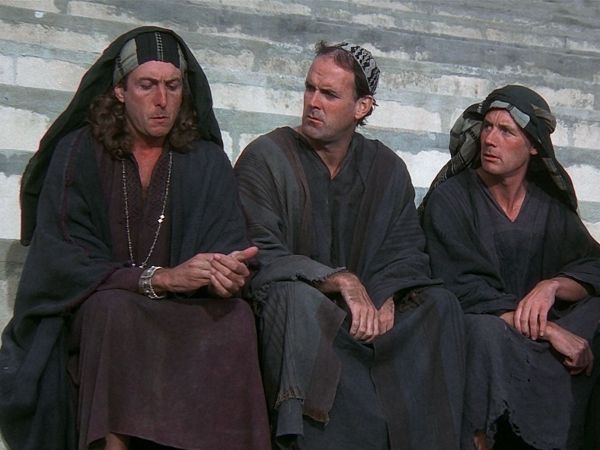
REG: They’ve bled us white, the bastards. They’ve taken everything we had, and not just from us, from our fathers, and from our fathers’ fathers.

LORETTA: And from our fathers’ fathers’ fathers.

REG: Yeah.

LORETTA: And from our fathers’ fathers’ fathers’ fathers.

REG: Yeah. All right, Stan. Don’t labour the point. And what have they ever given us in return?!

XERXES: The aqueduct?

REG: What?

XERXES: The aqueduct.

REG: Oh. Yeah, yeah. They did give us that. Uh, that’s true. Yeah.

COMMANDO #3: And the sanitation.

LORETTA: Oh, yeah, the sanitation, Reg. Remember what the city used to be like?

REG: Yeah. All right. I’ll grant you the aqueduct and the sanitation are two things that the Romans have done.

MATTHIAS: And the roads.

REG: Well, yeah. Obviously the roads. I mean, the roads go without saying, don’t they? But apart from the sanitation, the aqueduct, and the roads–

COMMANDO: Irrigation.

XERXES: Medicine.

COMMANDOS: Huh? Heh? Huh…

COMMANDO #2: Education.

COMMANDOS: Ohh…

REG: Yeah, yeah. All right. Fair enough.

COMMANDO #1: And the wine.

COMMANDOS: Oh, yes. Yeah…

FRANCIS: Yeah. Yeah, that’s something we’d really miss, Reg, if the Romans left. Huh.

COMMANDO: Public baths.

LORETTA: And it’s safe to walk in the streets at night now, Reg.

FRANCIS: Yeah, they certainly know how to keep order. Let’s face it. They’re the only ones who could in a place like this.

COMMANDOS: Hehh, heh. Heh heh heh heh heh heh heh.

REG: All right, but apart from the sanitation, the medicine, education, wine, public order, irrigation, roads, a fresh water system, and public health, what have the Romans ever done for us?

XERXES: Brought peace.

REG: Oh. Peace? Shut up!

Monty Python’s Life of Brian, 1979.

« Newer PostsOlder Posts »

Powered by WordPress