Quotulatiousness

January 26, 2021

QotD: “A world organized around institutional mass slavery”

Filed under: China, Economics, Europe, Greece, History, Quotations — Tags: , , , , , — Nicholas @ 01:00

An example: We’ve discussed all the cool steampunk shit the Greeks could’ve had, if only Archimedes had … well, that’s just the thing, isn’t it? We look at the aeolipile and see a prototype steam engine; they looked at it and saw, as best we can tell, a party trick. Back when, I suggested, Marxist-style, that labor costs were a sufficient explanation for why nobody took the obvious-to-us next step of hooking the thing up to something productive and kicking off the Industrial Revolution. Machines are labor-saving devices; the ancient world had a gross excess of labor. Calling the aeolipile a steam engine, then, is a category error.

New hypothesis: It’s a category error, all right, but not because they didn’t think in terms of labor costs. It’s because they couldn’t think in terms of labor costs.

A world organized around institutional mass slavery is, in a very real sense, a timeless world. Herodotus (I think) actually says somewhere that nothing worth mentioning happened before him, and you can see echoes of this attitude even as late as the Antebellum South. You see their attitude described as “conservative,” but since that’s egghead shorthand for “evil” you can ignore it. They weren’t consciously backward-looking; rather, they were deeply rooted to their place and station. To the outsider, it looked like they were trying to hold time back, but to the insider, time — clock time, industrial time, the time of the Protestant work ethic — barely existed at all.

So with the Classical World. The Romans, for instance, are endlessly frustrating to their admirers (of which I am an ardent one). Their only economic fix, for instance, was debasing the currency, i.e. a primitive form of inflation. You guys could figure out how to hew an artificial harbor out of some desert rocks — a trick we’d have a hard time pulling off today — but you couldn’t figure out fiat currency? Or a better political system than the tetrarchy? Or that the forts-and-legions paradigm just isn’t cutting it? Or … etc.

Stuff like that is why Spengler said classical, Apollonian culture was fundamentally different from, and incompatible with, our Faustian culture. According to Spengler, the master metaphor for the Apollonian is the human body, which is beautiful but changeless (emphasis mine, not Spengler’s). You can improve your body somewhat, but only within certain tight limits, and the body’s fundamental form is always the same (we could time warp Julius Caesar into the Current Year and still recognize him as a fellow homo sap., no matter how different his mind might be).

The Faustian, though — that would be us — organizes his worldview around space, infinite space. Practically speaking, this results in our attitude of innovation-for-innovation’s sake. We send a man to the moon because we can, but such an idea would never occur to the Romans, for the same reason they didn’t apply all their awesome engineering knowledge to the problems of governance. Hacking a harbor out of the desert is a tremendous feat, but it’s a local feat — a one-shot deal, a very specific response to a very specific local problem, with no broader applications.

This, I suggest, is because the timeless world of institutional mass slavery naturally selects for the kind of man who is at home in the world of institutional mass slavery. It’s a world of very low future time orientation, because “time” hardly exists at all. Forget machinery for a sec; the Roman world was full of enormous problems that had teeny-tiny, head-slappingly obvious fixes. Julius Caesar, for instance, was considered some kind of prodigy because he could sight-read books. Which really was a noteworthy feat, because Romans didn’t even put spaces between their words, much less use any sort of punctuation marks. And they were radical innovators compared to the Ancient Egyptians, since at least Roman writing all ran left-to-right; hieroglyphics can be read in any direction, including vertically, and I’m pretty sure there are examples of them changing text orientations in the middle of the same inscription. It’s not hard to imagine some legion commander actually losing a battle because he had to stop and sound out an important communique from a subordinate …

… and yet the Romans, for all their technical skill, never even figured that tiny change out. See also: The Chinese doing fuck-all with movable type, vs. (Faustian) Europeans using it to conquer the world. China, too, was a timeless society. As Derb says somewhere, Classical Chinese isn’t even really writing; it’s more of an aide-memoire — designed to remind readers of stuff they already know, not to communicate new information.

Your post-Roman European, by contrast, lived in a world where high future time orientation was an absolute must. You don’t need hypotheses like the famous “lead in the drinking water pipes” to explain the seemingly bizarre things the Romans did, or didn’t do; all you need is time orientation, a fundamental attitude of “this is a variation on an old problem” vs. “this is an entirely new situation that requires a new response.” Life in the post-Roman world was solitary, poor, nasty, brutish, and short — every man for himself; think through the consequences of your actions very carefully before you do them, or die horribly. Those who failed to do so died. Bake that into the genetic cake for a few generations, and you get Renaissance Man, who’d see a million possible applications for the aeolipile.

Severian, “Bio-Marxism”, Rotten Chestnuts, 2020-09-24.

December 24, 2020

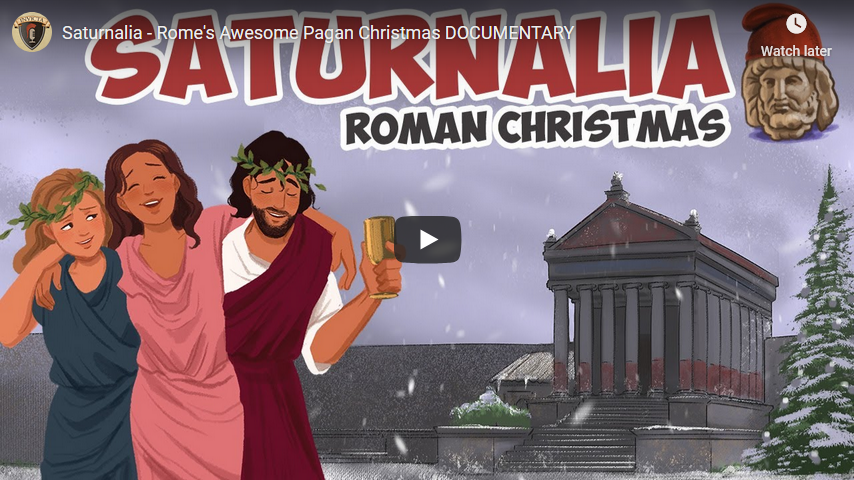
Saturnalia – Rome’s Awesome Pagan Christmas

Filed under: Europe, History, Religion — Tags: , , , , , — Nicholas @ 04:00

Invicta
Published 23 Dec 2020

Celebrate an awesome pagan Christmas with the Roman Saturnalia! The first 100 people to go to https://www.blinkist.com/invicta are going to get unlimited access for 1 week to try it out. You’ll also get 25% off if you want the full membership.

In this history documentary we cover a very special Roman Holiday, the Saturnalia. It was a hugely popular winter festival which dominated the ancient world and in many ways created the Christmas that we celebrate today!

We begin the episode with a discussion about the origins of Saturnalia as a harvest festival. In these early years it was celebrated whenever the last of the crops was brought with a special thanks being offered to the God of harvest, Saturn. The Romans did so at the temple of Saturn by offering a procession of bulls and hosting a grand feast. Over the years however the traditions would grow by importing Greek customs, pinning the date to December 17th and extending the holiday to a full week!

We then cover the history of Saturnalia at its full glory by recreating the experience. This begins with the traditional parade and feast on the first day after which all work was banned. The following days were filled with endless parties and feasts. These featured all kinds of familiar staples of Christmas like gift giving, hat wearing, and singing. However there were many more, wilder traditions as well. IO SATURNALIA!!!

We finally conclude with the rise of Christianity and the history of Christmas which coopted this popular pagan holiday. Stay tuned for more How They Did It episodes on the history of daily life in the past.

Bibliography and Suggested Reading:
Daily Life in the Roman City by Gregory Aldrete
Popular Culture in Ancient Rome by Jerry Toner
As the Romans Did by Jo-Ann Shelton
Festivals and Ceremonies of the Roman Republic by H. H. Scullard
The Roman Community at Table During the Principate by John Donahue

#Saturnalia
#Rome
#History

December 15, 2020

History Summarized: Spread of Christianity

Overly Sarcastic Productions
Published 10 Jan 2017

Things I learned when making this video: 1) when your script goes beyond 4 single-spaced pages, you’re heading into the danger zone 2) Gregorian Chants are awesome and you should totally listen to them, 3) editing always takes longer than you’d hope 4) self care is huffing frankincense for breakfast lunch and dinner and single-handedly sacking a levantine city!

Have a question about something I mentioned, or maybe something I might have left out? Leave it down below and I’ll do my best to respond!

PATREON: https://www.patreon.com/OSP

MERCH LINKS:
Shirts – https://overlysarcasticproducts.threa…
All the other stuff – http://www.cafepress.com/OverlySarcas…

Find us on Twitter @OSPYouTube!
twitter.com/OSPyoutube

December 2, 2020

The History of the Colosseum (In LEGO!)

Filed under: Architecture, Europe, History, Humour — Tags: , , , , — Nicholas @ 04:00

Overly Sarcastic Productions
Published 1 Dec 2020

This video is sponsored by the LEGO Group. Learn more about the LEGO Colosseum here: https://lego.build/OSP

We’d like to thank our friends at LEGO for giving us this magnificent excuse to gush over some of the most beautiful architecture in history. This type of architectural-deep-dive is a little bit out of the ordinary for us, but it was lots of fun, so please do let us know if you found it interesting, as we’d be thrilled to do more!

Our content is intended for teenage audiences and up.

PATREON: https://www.Patreon.com/OSP

PODCAST: https://overlysarcasticpodcast.transi…

DISCORD: https://discord.gg/osp

MERCH LINKS: http://rdbl.co/osp

OUR WEBSITE: https://www.OverlySarcasticProductions.com
Find us on Twitter https://www.Twitter.com/OSPYouTube
Find us on Reddit https://www.Reddit.com/r/OSP/

September 11, 2020

Without the Battle of the Teutoburg Forest, European history would have been radically different

Filed under: Europe, Germany, History, Military — Tags: , — Nicholas @ 03:00

The folks at UnHerd are starting a series of “alt histories” to help explore the inflection points of history that may have led to a very different world, like the outcome of the Imperial Roman disaster in Germany’s Teutoburger Wald in 9AD:

Map showing a tactical overview of the Battle of Teutoburg Forest including troop movement.
Map by Cristiano64 originally for a non-English Wikipedia page, which explains the weird translated captioning.

If history teaches us anything it’s that we should expect the unexpected. But history, unlike the news, is something that’s already happened. Historians, unlike journalists, see events in the rearview mirror. As a result, they’re rather prone to deterministic explanations. For instance, there’s the Whig view of history with its narratives of ever-increasing freedom. Marxists, meanwhile, situate historical events within an overarching process of class struggle. Indeed, from millenarians to environmentalists to the friends and foes of the Anglosphere, everyone’s trying to bend the arc of history.

[…]

For instance, why didn’t the Roman Empire conquer the German lands beyond the Rhine? A determinist might reach for some geographical explanation — the territory was inhospitable and the locals scary. And yet similar obstacles didn’t stop the the Romans from assimilating Britannia, so why not Germania too?

Well, because three Roman legions were wiped out at the Battle of the Teutoburg Forest, that’s why — and there was nothing pre-determined about that catastrophe. It required the mother of all ambushes, made possible by the extreme cunning of the German chieftain Arminius and the extreme gullibility of the Roman commander Varus. It could easily not have happened – and thus, untraumatised by such an unexpected and total defeat, the Romans might have extended the northern frontier to the Elbe or beyond.

What would a Romanised Germania have meant for the rest of history? It’s impossible to say, but we can imagine an unRomanised Gaul. The existence of France (and the French language) as we know it today depends on the fact that, two thousand years ago, the Romans conquered Gaul, but not Germania. Had things gone differently, French (and therefore British and therefore American) history would have developed along a very different path.

What this example also tells us is just how much of history depends on the character, abilities and decisions of particular individuals (contrast the ruthless brilliance of Julius Caesar in the case of Gaul with the trusting foolishness of Varus in the case of Germania). There’s something called the great man theory of history. It was a 19th Century idea and deeply unfashionable today, but while the individuals who change the course of history aren’t necessarily “great” or, indeed, men — there’s no doubting their existence.

They don’t have to be heroes or villains. In fact, they don’t have to have much authority of any kind. Their impact doesn’t even have to be the result of a deliberate decision. They just have to do the right (wrong) thing in the right (wrong) place at the right (wrong) time. For instance, someone, somewhere, did something that introduced the Covid-19 virus to the human population. Whether that was eating a bowl of bat soup or dropping a test tube in a laboratory we’ll probably never know; but whatever it was, it made all the difference.

That’s why we can’t leave alt history to the historians alone. While some of them might see merit in exploring counterfactuals, their commitment to academic rigour acts as a constraint upon their speculations. Quite right too, but there’s also a case for letting our imaginations run riot — and for that we need story-tellers.

August 25, 2020

How we used to “dine out” (and someday might be able to again)

Filed under: Books, Britain, Business, Europe, Food, France, History — Tags: , , , , , — Nicholas @ 03:00

In The Critic, Alexander Larman reviews The Restaurant: A history of eating out by William Sitwell:

The recent enforced lockdown closure was a potential death blow to the entire [restaurant] industry. Which makes William Sitwell’s luxurious book both a celebration and an unintentional requiem for what may be a bygone time.

His central thesis is clear: the history of dining out is also a social history of evolving cultures and tastes. This means that the subjects he writes about range from ancient Pompeii to the growth of the sushi conveyor belt restaurant, encompassing everything from medieval taverns and the French Revolution to the rise of Anglo-Indian cuisine.

It is a broad and impressive spectrum, but perhaps Sitwell has, like some of the less fortunate people he describes, bitten off more than he can chew. His opening chapter about Pompeii is rich in surprising detail (graffiti uncovered outside one tavern when it was excavated ranged from the poetic — “Lovers are like bees in that they lead a honeyed life” — to the crude — “I screwed the barmaid”) and an insightful evocation of the dining culture in Ancient Rome.

He is then, unfortunately, faced with the insurmountable difficulty that the restaurant, as we know it today, did not exist until the late eighteenth century, meaning that his definition of “eating out” has to do some extremely heavy lifting.

There is as much padding in the early chapters as there is around some of his subjects’ waistlines. Much of what he writes is very interesting and often amusing, such as the way in which coffee, first drunk in London around the time of the Restoration, became associated both with health-giving properties and reportedly making men impotent, withered “cock-sparrows”. Yet there are also lengthy sections that have little or nothing to do with restaurants, such as a potted history of the Industrial Revolution.

Nevertheless, when Sitwell finally gets into his stride and begins to write about eateries proper, his authority and enthusiasm are palpable. He describes the dawn of fine dining in Paris in the nineteenth century evocatively. London lagged behind, although gentlemen’s clubs such as the Athenaeum and Reform offered some delights for the wealthy thanks to chefs (French, naturally) such as Alexis Soyer who implemented what one biographer called “the most famous and influential working kitchen in Europe” in 1841, complete with gas-fired stoves, butcher’s rooms and a fireplace devoted to the roasting of game and poultry.

August 2, 2020

Was Roman Concrete Better?

Filed under: Economics, History, Technology — Tags: , , , — Nicholas @ 02:00

Practical Engineering
Published 29 Oct 2018

Comparing modern concrete to that of the western Roman empire.

In this video, I discuss a few modern techniques that help improve design life of concrete, including roller compacted concrete (RCC) and water reducing admixtures (superplasticizers). There are a whole host of differences between modern concrete and that of the western Roman empire that I didn’t have time to go into, including freeze/thaw damage. This is such an interesting topic, so here are some references if you’d like to learn more:
http://www.romanconcrete.com/
https://www.usbr.gov/tsc/techreferenc…
https://en.wikipedia.org/wiki/Roman_c…

-Patreon: http://patreon.com/PracticalEngineering
-Website: http://practical.engineering

Tonic and Energy by Elexive is licensed under a Creative Commons Attribution License
Source: https://www.youtube.com/watch?v=U6fBP…

July 28, 2020

Roman kit: featuring armour, swords, spears, artillery, rations, deckchairs, and of course shoes

Lindybeige
Published 27 Jul 2020

Go to https://expressvpn.com/lindybeige and find out how you can get three months free.

A video of re-enactors and their Roman kit. Sorry about the wind noise.

Support me on Patreon: https://www.patreon.com/Lindybeige

Here’s a link to the Ermine Street Guard – Britain’s foremost imperial Roman re-enactment group: http://www.erminestreetguard.co.uk

Was your re-enactment group featured? Ask for a link here!

Buy the music – the music played at the end of my videos is now available here: https://lindybeige.bandcamp.com/track…

Buy tat (merch):
https://outloudmerch.com/collections/…

Lindybeige: a channel of archaeology, ancient and medieval warfare, rants, swing dance, travelogues, evolution, and whatever else occurs to me to make.

▼ Follow me…

Twitter: https://twitter.com/Lindybeige I may have some drivel to contribute to the Twittersphere, plus you get notice of uploads.

My website:
http://www.LloydianAspects.co.uk

July 27, 2020

Food in Ancient Rome – Garum, Puls, Bread, and Moretum

Filed under: Europe, Food, History — Tags: , , , — Nicholas @ 02:00

SandRhoman History
Published 7 Jul 2019

Food in ancient Rome – the cuisine of ancient Rome is probably not everybody’s cup of tea. Food in ancient Rome was consumed at the mensa, the dining table of the ancient Romans. A usual ancient Roman meal for the upper classes could look like this: puls, one of the main ancient Roman meals. This was essentially a form of porridge, along with that they might have eaten bread, refined with olives and figs. Bread was often eaten with moretum, a spread, made of sheep cheese, a lot of garlic and herbs. Most Roman meals would have been spiced with garum, a fermented fish sauce, to go along with such a meal, the Romans drank water or wine. Beer, called cervisia, in contrast would have been considered barbaric. The wine was usually diluted with water and sometimes spiced with herbs and vinegar. Water with vinegar was called posca, another variant was mulsum, wine spiced with honey.

Ancient Roman food had even more variety, but for now we just made the recipes below. We might make some more ancient Roman food in the future though.

Ancient Roman recipes:

First off: Put garum into everything. That’s actually what the Romans used, usually instead of salt and/or other condiments. [Consider it the ketchup of the ancient world.]

Garum recipe
– 1000 g small fish (sardines, anchovies or similar, fresh or frozen but uncooked)
– 500 g sea salt
– 2 1∕2 tbsp. dried oregano
– 1 tbsp. dried mint
– 1,5 litres water
– 5 tbsp. honey
Put everything in a pot and cook it until the fish falls apart (ca. 15 minutes). Pestle it with a spoon or similar and reduce this broth for at least 20 minutes. Then strain it, let it cool and strain it again. Additionally, you can pour it through a filter cone to refine the garum even further. Keep the garum in the fridge and throw it away if it gets dreggy.

Moretum recipe
– 300 g of ricotta
– 100 g pecorino (or similar hard sheep cheese)
– 3 tbsp. white wine vinegar
– 3 tbsp. sea salt
– 3 cloves of garlic
– a bunch of thyme
– a bunch of rosemary
– a bunch of estragon [tarragon]
– a bunch of coriander
garum
Press the garlic, grind the pecorino and stir all the ingredients until you get a consistent mass. Done!
Pro tip: You might want to be careful with the amount of salt and especially garlic you add. Three cloves make it very intense.

Puls recipe
– 500 g rolled oats
– 1.5 litres of water
– 1 tbsp. olive oil
– 100 g pecorino (or similar hard sheep cheese)
– 1 onion
– 2 carrots
– 150 g mushrooms
– 100 g streaked pork
garum
Chop all the vegetables and cut the pork into strips. Then roast it gently in a bit of olive oil and put it aside. Cook the rolled oats with some water and add continuously as it disperses until you get a porridge-like consistency. Then add the prepared vegetables and meat and fold in the ground pecorino.
If you want to stay somewhat authentic to the Roman recipe use white, violet or yellow carrots: orange ones weren’t known in the occident until the Middle Ages.

Panis militaris castrensis (Roman bread) recipe
Ingredients for one loaf (4 – 6P):
– 500 g spelt flour (whole grain)
– ½ tsp. of salt
– olives
– figs
– 3 tbsp. olive oil
– 1 tsp. honey
– 3 dl water (hand-hot)
– 15 g yeast (or one package of dry yeast)

Mix everything up and knead it for at least 15 minutes. Then let it rise for an hour in a bowl covered with a towel (preferably in a warm spot). Form a loaf, cut six pieces (halfway through) and bake it for 35 minutes at 180°C.

Pro tip: take big olives and lots of them because the whole grain flour will be so dense that they kind of disappear.

Those recipes are taken from a cookbook which has been written about 2,000 years ago. Taking this into account you should be rather careful applying these cooking techniques. We are not to be held responsible for any damage resulting, neither for smelly apartments, nor for health issues.

#food #ancientrome #history #ancienthistory #rome

Twitter: https://twitter.com/Sandrhoman

July 26, 2020

Hagia Sophia

Lars Brownworth (author of the excellent Lost to the West: The Forgotten Byzantine Empire That Rescued Western Civilization) on the building of the Hagia Sophia by Eastern Roman Emperor Justinian in Constantinople:

Illustration of the Hagia Sophia from European History: An outline of its development by George Burton Adams, 1899.
Wikimedia Commons

The Hagia Sophia was the brainchild of a unique figure in history. At birth, Justinian was a nobody among nobodies in a grindingly poor part of what is today North Macedonia. By his mid-40s, he was a Byzantine emperor. His appetites were large, his dreams larger. The man who knew what it was like to have nothing gave new meaning to the idea of luxury. For one memorable celebration, he spent almost two tons of gold on decorations.

Justinian had no time for small things. By the second year of his reign, he had decided to codify all of Roman law, founded several new cities, and had started construction on at least eight new churches.

The money for all these projects inevitably came from the public. And by the fifth year of his reign, his subjects had had enough. Already upset by rampant corruption, an inefficient bureaucracy, and crushing taxes, they hit the boiling point when Justinian severely restricted public games. A mob tore through the streets, overwhelming the unprepared police forces. Several stores were set on fire, and the wind quickly spread the flames to a nearby hospital, which burned down with its patients inside. An inferno raged. For five long days, Constantinople burned.

By the time Justinian reasserted control, more than 30,000 citizens were dead, and perhaps a third of the city was a blackened shell. It looked as if some barbarian horde had sacked the capital. The fact that its own people had inflicted such a wound hovered like a black cloud over the streets.

Characteristically, Justinian saw a perfect opportunity within the ashes. This was a blank canvas on which to create a new city in his image. The transformation would begin with the cathedral. The original building, known simply as the Magna Ecclesia — the Great Church — had been built by a son of Constantine the Great in the fourth century, but had burned down a few decades later. Since it was a standard Roman basilica — a large hall with square walls and angled wooden roof — it had been fairly easy to rebuild along the same lines.

But of course, Justinian had no intention of following the tired plans of an earlier age. This was a chance to remake the cathedral on a new scale, something worthy of the ages. It was to be nothing short of a revolution, equal parts art and architecture, the enduring grandeur of the emperor himself frozen in physical form.

Everything about this project was audacious, including his selection of architects. Instead of choosing a traditional builder, he picked two teachers who — like himself — had more vision than practical experience. This was a lifelong pattern with Justinian. He had a habit of plucking genius out of the common crush; his wife was a reformed prostitute, and his greatest generals were an elderly eunuch and a former bodyguard.

The emperor’s instructions to Isidore of Miletus, a physics teacher, and Anthemius of Tralles, a mathematician, should have terrified them. They merely had to design and successfully build a church unlike anything else the world had seen. Sheer scale wasn’t enough — the empire was full of grand monuments and immense sculpture. This had to be something different, something fitting for the new golden age that was dawning. Expense wasn’t an issue, but speed was. Justinian was already in his 50s, and he didn’t intend to have some successor apply the final coat of paint and claim the project as his own.

Hagia Sophia in the Faith district of Istanbul, 18 November 2004.
Photo by Robert Raderschatt via Wikimedia Commons.

July 24, 2020

QotD: A death in the Roman Empire

Filed under: Europe, History, Middle East, Quotations, Religion — Tags: , , , , — Nicholas @ 01:00

The women who came to tend the tomb in the garden had no doubt that their Lord was dead. They had personally arrayed his body in shining white vestments, and then, when all was ready, laid his physical remains to rest. Rejected as he had been by his own people, legally condemned as an enemy of Rome, brought to a squalid and ignominious end, his defeat had seemed total. What victory could there possibly be in the wake of such a death?

Yet then something miraculous happened. Spreading from east to west across the Mediterranean, travelling along the great network of roads and shipping lanes that constituted the arteries of the Roman Empire, news began to spread that this man whose mortal remains supposedly lay entombed in the grave had been seen alive. Most people, of course, scoffed at such reports — but there were some, small communities of believers, who did not. These, even as the decades passed, kept the faith: the conviction that their saviour would come again, that he would reign, in the words of a widely circulated prophecy, as “the king of Jerusalem”, that he would bring to groaning humanity a universal peace.

In the event, Nero did not come again. Despite the various imposters who appeared in the wake of his death in AD 68, and the fact that, centuries later, there were cities in the eastern reaches of the Roman Empire that still honoured his memory, his fate was to be commemorated, not as a saviour, but as a monster. And so, in numerous ways, he was. His readiness to have members of his own family — mother, brother, wife — put to death ensured that when he himself died the dynasty of the Caesars perished with him.

His sex games were notorious. He was darkly rumoured to have set fire to Rome. By the time that Suetonius, half a century after his death, came to write his biography, the details of his life could be structured almost entirely as a catalogue of deviancies and crimes. “Insolence, an uninhibited sexual appetite, dissipation, greed, cruelty: these were the vices which, to begin with — because he gave expression to them only secretly and incrementally — might well have been chalked up as the excesses of youth, had it not been manifest to everyone even at the time that they were failings, not of age, but of character.”

Nero’s rule had become one protracted blasphemy against the customs of the Roman state. These, hallowed by the centuries, enabled the people of a city that had conquered most of the known world to feel a sense of communion still with the mos maiorum: the customs of their distant ancestors. To no class of society was this more important than the Senate, which still, despite the collapse of Rome’s venerable republican order and its replacement by the autocracy of the Caesars, cherished its time-honoured role as the guardians of tradition.

Tom Holland, “When Christ conquered Caesar”, UnHerd, 2020-04-10.

July 20, 2020

How They Did It – Baby Names in Ancient Rome (Tria Nomina)

Filed under: Europe, History — Tags: , , — Nicholas @ 02:00

Invicta
Published 9 Apr 2016

The Romans took great pride in setting themselves apart from foreigners and even themselves. The tria nomina naming convention was one such way of achieving this and can tell us much about an individual.

Literary Sources:
Caesar: Life of a Colossus by Adrian Goldsworthy
Who’s Who in the Roman World by John Hazel

Game Engine:
Total War: Rome II

Music:
Cinematic Music – “Beneath the Sun”
Cinematic Music – “Fade Away”

July 10, 2020

QotD: Marcus Aurelius for the incel demographic

We all know that barren cat ladies of both sexes and all 57+ genders are the poz’s storm troopers. As I’ve written here probably ad nauseam, you can’t beat Trigglypuff, because — and only because — she has more free time than you do. You have a life, a job, a family, hobbies, interests. She doesn’t. Hell, you have to sleep sometime. She doesn’t, because the Trigglypuffs of the world are by definition jacked up on powerful prescription psychotropics. You just can’t beat that.

You just can’t beat it. But […] Our Thing has lots of potential Trigglypuffs. They’re called “incels,” I’m informed, but whatever the nomenclature, there are a lot of young single dudes out there who while away their pointless hours with video games and porn. Those are our potential storm troopers (it’s a metaphor, FBI goons). Why haven’t we weaponized them? (again: metaphor).

It’s probably as simple as giving them a role model. It goes without saying that your “incel” (or whatever) was raised by women. Even if there was a biological male living in the house during his childhood, it’s a thousand to one he was just that: a cohabiting male. Certainly not a father. And even if by some miracle he was, the poor guy can only do so much. You’ve got to let your sons out of the house sometime … where they’ll immediately be snapped up by the sour, shrieking cat ladies that control our educational system, our media, our professions, our culture. Both the son and his father have to be very, very hard-headed, and not a little lucky, to escape a poz infection …

… and that’s the best-case scenario. For the worst, look around — you’ll find incel and his soy-enfeebled twerp of a “male” parent cowering under the bed, scrubbing their hands and faces with Lysol, while Mommy scolds and caterwauls on Facebook.

There are role models out there, y’all. Stoicism in general, and Marcus Aurelius in particular, have seen a real upswing in popularity, especially on “Game” sites. This doesn’t represent a return to a Classical education; it’s that Marcus seems to be — Marcus is — a worthwhile role model for a fatherless boy. Strip out the “credits” at the start of book one and a few of the denser, more philosophical passages, and you could subtitle Meditations “how to drop your nuts on the carpet and act like a fucking man for once.” Loosely translated, of course.

Severian, “Be a Centurion!”, Rotten Chestnuts, 2020-04-07.

June 2, 2020

The Fall Of The Roman Empire With Tom Holland | History Hit LIVE on Timeline

Filed under: Europe, History, Middle East — Tags: , , , , — Nicholas @ 04:00

Timeline – World History Documentaries
Published 29 May 2020

The Roman Empire remains one of the most enduring and prolific civilisations of written history. Yet it, like all great civilisations, would eventually come to an end. Join Dan Snow as he speaks to historian Tom Holland about the many contributing factors that would bring this seismic and seemingly invincible empire to its knees.

#StayHome #WithMe #FallOfRome

May 3, 2020

Slaying Gladiator

Filed under: Europe, History, Humour, Media — Tags: , , , , — Nicholas @ 05:00

Over at Steyn Online, Kathy Shaidle tag-teamed someone else on staff (it probably rhymes with Dark Time) to put the caligulae to Ridley Scott’s Gladiator with Russell Crowe in the leading role:

Germania, 180 AD. Rome is at war with the, er, Germaniacs, who stand around in the Black Forest grunting like Brits on the piss who’ve nutted themselves in one pub fight too many. You need a cool head to take on the Roman Army, and the only one the barbarians have belongs to Caesar’s emissary, whom they thoughtfully decapitated before sending back. They wave the old noggin around like a treasured footie ball, grunting, “Ug Eugh Blug” or, translated from the original gibberish, “Over ‘ere, mate.” It’s a scene that rings oddly contemporary in the age of Isis, although when I first saw it, a year before 9/11, it gave me the giggles. But then barbarians always seem funny from a distance, don’t they? Here they scratch their pelts and grunt some more, seemingly unconcerned by the fact that the Roman legions are lighting up their blazing arrows and fireballs, the smart bombs of the day. The ensuing battle, whose outcome would seem never to be in doubt, is apparently the final bloody act in a twelve-year war.

Despite having had twelve years to get there, the Emperor’s son nevertheless shows up late. “Did I miss it?” he simpers. “Did I miss the battle?” The son’s name is Commodus. No, not Commodus, but Commodus, which sounds like he dates back to a Mel Brooks sketch circa 1962 but in fact goes all the way back to the real Roman Empire. Commodus is that old stand-by of the dynastic drama, the disappointing son. His father, Marcus Aurelius, is a noble philosopher-king, but Commodus is no chip off the old block. We can tell that from the moment we first glimpse Commodus, sprawled in his commodious caravan, but just in case we miss the point Joaquin Phoenix lays on the mincing like a trowel, and the make-up, too. He’s weak, vain, decadent, and has the hots for his sister Lucilla (Connie Nielsen). Even the Bushes would think twice before running this guy for emperor.

Having spent 25 years waging war for the glory of Rome, Marcus Aurelius (Richard Harris) senses there’s not much point leaving it in the hands of an emperor who’d be queen for a day. So he tells Commodus he will not succeed him. Instead, he is going to make his brave general Maximus a “trustee” until Rome is ready to become a republic again. Maximus (Russell Crowe) is a Colin Powell type of general: a nice fellow everyone respects who supposedly has no public ambitions. Commodus, though, has other ideas, and suffocates his father. As the old showbiz saying has it, dying is easy, Commodus is hard. The effete decadent mincer becomes emperor, and promptly orders the death of Maximus and the crucifixion of the general’s wife and child back in Spain.

But Maximus escapes, and what follows in Gladiator is the story of how he takes his revenge and becomes the eponymous Gladiator lui-même. It’s payback time, and, under Ridley Scott’s lean direction, that means there’s no room for sub-plots. Somewhere in pre-production, the archers lobbed their flaming shafts at the script and laid it as bare as those Germanic forests. Not only are there no sub-plots, there’s barely any plot for any sub-plot to be sub-. Once the wife and kid are dead, there’s nothing very emotional at stake. There’s no romantic interest, unless you count Commodus trying to get it on with sis. There’s a hint of backstory at the Senate, where the massed ranks of British Equity have gathered for a vast toga party (the Toga Party having a majority in the Senate at that time). But there’s no dialogue worth speaking of, except statements of the obvious. When the mob is being fickle, as mobs are wont to be, the Emperor is told: “The mob is fickle, sire.” All the lines have been pre-tested in earlier toga romps, and the only one that seems to have been specially written for this picture is Oliver Reed’s complaint that some crook dealer has sold him a pair of homosexual giraffes.

But none of that matters because Ridley Scott photographs the film so brilliantly and mesmerically that they could all be speaking Germaniac and it wouldn’t impair the storytelling. It helps that almost everyone in the movie is a pre-designated great actor, so you tend to assume there’s a lot of great acting going on, even though most of it’s just thoughtful reaction shots. The mob bays for blood. Cut to Derek Jacobi looking thoughtful. They bay some more. Cut to Connie Nielsen looking pensive from atop her fabulous neck. They stop baying. Cut to Russell Crowe looking thoughtful. What are they thinking so pensively? “Hmm. I wish I’d got the gay giraffe line”?

« Newer PostsOlder Posts »

Powered by WordPress