
We pick up in an improbably mud-soaked clearing with a title card informing us that we’re in “Germania”, which is correct in a very broad sense that this is the Second Marcomannic War and the enemies here are the Marcomanni and Quadi, who are Germani (Germanic-language speakers), but the army here isn’t operating out of the Roman provinces of Germania (superior and inferior) which are on the Rhine, but rather on the Danube, from the provinces of Noricum and Pannonia (Superior). But in the sense that we’re in Germania magna, the greater zone of Germanic cultural influence, sure, fine.
In the process of Maximus riding up, the failure of negotiations and Maximus riding to join his cavalry, we get something of an overview of the Roman army and its position and both are wrong. Let’s start with the soldiers: we see a very clear distinction between two kinds of soldiers, the mail-clad auxilia, all archers, and the legionaries wearing the lorica segmentata and there appear to be about the same number of both groups. And here is where we first see the clear influence of the Column of Trajan (and to an unfortunately lesser degree, the far more appropriate Column of Marcus Aurelius) on the depiction, because this use of armor to distinctly signal the Roman citizen legionaries and non-citizen auxilia is straight from the Column of Trajan, completed probably around 113 and commemorating Trajan’s two Dacian Wars (101-102, 105-106).
What this sequence gets correct is that the Roman army was divided into those two groups, they were roughly equal in number (by this period, the auxilia probably modestly outnumber the legions in total manpower)1 and Trajan’s Column does use that visual signifier to distinguish them. This component is the crux of the verisimilitude that leads people to trust the rest of this sequence.
The problems start almost immediately from there. Roman auxilia were far more varied than what we see here in terms of equipment and tactics and only very few of them were archers. So let’s break down Roman auxiliary contingents. With all due caveats about the limits of our evidence, infantry auxilia outnumber cavalry by about 2:1 in attested auxilia units (auxilia were grouped into cavalry alae and infantry cohortes, generally of 480 men (sometimes around 800), but unlike for legionary citizen-infantry, these cohorts were not grouped into larger legions).2 So we ought to expect about a third of our auxilia to be cavalry, which is important because the cavalry detachments of Roman legions were very small (and mostly for scouting and messenger duties). Auxilia cavalry ranged in equipment and could include horse archers and even ultra-heavy cataphract cavalry, but most were mailed shock cavalry, equipped quite a lot like how Gallic or Germanic warrior-aristocrats or Roman legionary cavalry would be.
Of the remainder, the most common kind of infantry auxilia by far seem to have been heavy infantry, fighting in fairly heavy armor. These fellows get depicted in Roman artwork generally in mail armor, with flat oval shields (as opposed to the curved, rectangular imperial-period Roman scutum), spears and swords. These fellows, totally absent in this sequence are all over the Column of Trajan, with their flat oval shields being frequently seen (although one must distinguish them from Dacians who carry the same shield; the auxilia stick out for their mail and helmets). A bit less than 10% of auxilia units are attested as cohortes sagittariorum (“cohort of archers”). We also know the Romans used slingers within the auxilia, but as far as we can tell, not in specialized units; they may have been brigaded in with other auxilia cohorts. In either case, they appear in fairly small numbers. Finally, we also see on things like the Column of Trajan Roman allied or auxiliary units that are substantially lighter infantry: on the Column of Trajan, these are local troops shown wielding large clubs and stripped to the waist, presumably representing troops local to the Danube region, fighting in local (unarmored, with heavy two-handed weapons) style.
So whereas the army we see is a nearly even split between legionary heavy infantry and auxilia archers (with a small amount of legionary cavalry waiting for Maximus to show up to lead them), in practice a typical Roman field army would have far fewer archers, indeed around ten times fewer: not almost 50% of the force, but in fact probably a bit less than 5% of the force (since they’re less than 10% of the auxilia who would make up around half of a Roman field army). Meanwhile we’re simply missing the – by far – two most common sorts of auxilia cohorts, those of heavy infantry or heavy cavalry. This mangling of the structure of a Roman army is going to have implications when we get to Maximus’ overall plan for the battle as well.
Meanwhile, the legionary infantry are also much too uniform, literally. This is easily the most pardonable error, because what has happened here is that director Ridley Scott has copied the Column of Trajan but far too uncritically. After all, the Column of Trajan is not a photograph and thus has space for the artists producing it to take liberties, particularly in the name of imperial ideology and propaganda. In this case, showing large numbers of identically equipped soldiers, often moving in unified formation, serves the same rhetorical purpose in antiquity as it does today, suggesting an impressive, inhumanly uniformed and disciplined source. Moreover, the segmented Roman body armor, which we call the lorica segmentata (we don’t know what the Romans called it), was very distinctive to the legions, as it was the one armor that it seems like the auxilia probably (the evidence here can be tricky) didn’t share. And keeping the legions distinct from the auxilia also matters, as the legionary soldiers are higher status citizens who thus get “higher billing” in the imagery, as it were, than the auxilia. So showing all of the legions equipped neatly with this armor makes them seem distinct, impressive and uniform.
In short, it served Trajan’s image (and thus the artists aim) to suggest that all of his legions wore this armor.
Archaeology tells us quite clearly it was not so. Indeed, the lorica segmentata, so iconic because of its use in this way on the Column of Trajan, was probably the least common of the three major types of Roman legionary body armor in this period. The most common armor of the Roman legions was almost certainly still – as it had been in the Late Republic – mail, exactly the same as we see the auxilia wearing. We find fragments of Roman mail in legionary sites in all corners of the Empire and it remained common everywhere. To head off a standard question: no, it does not seem that the Romans ever got the idea to layer other defenses over mail, so when it was worn, it was the “primary” armor (worn over a padded textile defense called a subarmalis, but not under any other armor).3 We also see mail represented in Roman artwork, including on very high status soldiers, like senior centurions.
The next most common armor was probably scale armor, which we find very frequently in the East (that is, on the frontier with the Parthians/Sassanids) and often enough (if less frequently) in the West (that is, the Rhine/Danube frontier). We also know that some auxilia units wore this armor too and we see quite a bit of scale armor – wholly absent in this sequence – on the Column of – wait for it – Marcus Aurelius (completed c. 193). That’s the column that commemorates this war. Contemporary with this fictional battle. But it is less famous and somewhat less well-preserved than 70-years-earlier Column of Trajan, which they pretty evidently used quite a bit more of.
The lorica segmentata shows up the least often and – to my knowledge – effectively exclusively in the west on the Rhine/Danube frontier, where it is still probably not the most common (although it may have been more common than scale on that frontier). So what we ought to see in this army are legionaries who are marked out by their large scuta (the big Roman shield, by this period distinctly rectangular and also (as in the republic) curved), but in a range of mail, scale and lorica segmentata (with mail and segmentata being the most common, because we are on the Danube frontier, but scale hardly rare), along with auxilia divided into specialist cohorts (480 man units) each with different sets of armor and weapons: a few missile cohorts (archers, slingers), a lot more heavy infantry cohorts with spears and long shields, some lighter troops, and so on. The auxilia ought to be wearing basically every armor under the sun except for the lorica segmentata (which to my knowledge we’ve only ever found in sites associated with the legions).
Finally, these units are backed up by a whole load of catapults. We see two kinds, dual-arm arrow-throwing machines (which most folks would casually call ballistae) and single-armed pot-throwing machines (which most folks would casually call catapults), all of them in stationary mounts. Now on the one hand, “the Romans use lots of torsion-based catapults as artillery” is a true statement about the Roman army of this period, but on the other hand once again beyond that basic idea, most of this is wrong. Once again there’s an issue of verisimilitude here: the appearance of strange catapults and the true fact that the Romans used a lot of unusual catapults is likely to lead the viewer to assume some research has been done here and thus that these are the right catapults. For the most part, they are not.
We can start with the easy one, the larger single-armed pot-throwers. These are onagers, a late-Roman simplified single-arm torsion catapult, named for their fearsome “kick” (like an ass, an onager). These are popular favorites for Roman artillery, for instance showing up in both Rome: Total War and Total War: Rome II (both of which have main campaigns set during the Late Republic). There’s only one problem, which is that Gladiator (much less the even earlier Total War games) is set substantially too early for an onager to appear. Our first attestation of the onager is in Ammianus Marcellinus, writing in the last two decades of the 300s AD about the events of 353-378 (his work was broader than this, but only the back end survives). Vegetius, writing roughly contemporary with Ammianus also mentions them. But before the late fourth century, we don’t have any evidence for this design and it doesn’t show up on the Columns of Trajan or Marcus. So this isn’t just a little bit too early for these catapults but, given the evidence we have, around 150 years too early, the equivalent of having a line of M1 Abrams show up in a film about the Battle of Gettysburg.
What we do have are a number of twin-armed bolt or arrow-throwing machines and the Romans certainly had those, though what we see doesn’t match up well with what the Romans used. What we see is a single size of fairly large arrow-throwing engines, aimed upward to fire in fairly high arcs and built with large metal cases containing the torsion springs (generally made of hair or sinew, tightly coiled up; it is the coiling of these springs which stores the energy of the machine).
These two-armed torsion catapults came in a wide range of sizes and could be designed to throw either arrows/bolts or stones (the latter carved into spheres of rather precise caliber for specific machines). And we ought to see a pretty wide range of sizes here, from massive one-talent engines, which threw a 1 talent (26kg) stone and stood about three times the height of a man, to much smaller anti-personnel weapons (scorpiones) that were more like a “crew served” weapon than a large artillery piece. By Trajan’s time, the Romans had even taken to mounting these smaller crew-served engines on mule-drawn carts (called carroballistae) to allow them to be rapidly repositioned, something like early modern “horse artillery” (they were not meant to fire on the move; when we see them on Trajan’s Column, at least one of the operators is usually standing on the ground outside of the cart to winch the machine). These smaller machines, which would have made up the bulk of those deployed in a field battle, seem mostly absent in the sequence.
The result of all of this is that the Roman army presented in the opening moments of Gladiator manages to strike a remarkably unhappy balance: having just enough of the appearance of accuracy to decisively influence two decades of subsequent depictions of the Roman army without actually being particularly correct about anything beyond a very surface level. But subsequent pop-culture (again, I think Rome: Total War played a significant role here) would codify this vision of the Roman army – fire-throwing onagers, lots of auxilia archers, legionary rather than auxiliary cavalry, uniform use of the lorica segmentata – as the dominant model for quite some time.
But the army isn’t the only thing that’s wrong.
Bret Devereaux, “Collections: Nitpicking Gladiator’s Iconic Opening Battle, Part I”, A Collection of Unmitigated Pedantry, 2025-06-06.
- See figures in P. Holder, Auxiliary Deployment in the Reign of Hadrian (2003).
- There’s some complexity here because some infantry auxilia cohorts had small attached cavalry contingents too.
- I suppose I should note that is an odd exception for a type of very fine armor sometimes called lorica plumata (“feathered armor”) by modern writers where metal scales were mounted on mail armor (typically with extremely fine, small rings), rather than on a textile backing. This armor type seems to have been rare and must have been very expensive.
January 29, 2026
QotD: Nitpicking the Roman army in Gladiator (2000)
January 24, 2026
Modern biochemistry through a trio of Nora Ephron movies
Not being a movie fan, I was only vaguely aware of the author Nora Ephron’s work being turned into movies, but Unbekoming uses three of them (When Harry Met Sally, Sleepless in Seattle, and You’ve Got Mail) to help illustrate one of the major reasons why so many relationships go sour:

I think this shows stills from Nora Ephron romantic comedies.
The films show what was delivered. But neither fully explains why the delivery was so effective — why millions of women watched these films repeatedly, quoted them to friends, absorbed their vocabulary of magic and clockwork as though it described something they already knew.
The films resonated because they did describe something these women already knew. They just misnamed its source.
The Altered Audience
By the time When Harry Met Sally appeared in 1989, hormonal contraception had been widely available for nearly three decades. The women watching Ephron’s films in theaters — women in their twenties and thirties, the target demographic — were largely women who had been on the pill since adolescence. Many had never experienced an adult month with their natural hormonal cycles intact.
This matters because the pill doesn’t merely prevent pregnancy. It alters brain chemistry, affects mood, suppresses libido, and — most remarkably — changes who women are attracted to.
Research has documented that women on hormonal contraception prefer different types of men than women who are cycling naturally. The pill disrupts the normal attraction toward genetic diversity, causing women to prefer men with similar immune markers rather than complementary ones. Women who meet their partners while on the pill often experience a dramatic shift in attraction when they stop taking it. The man who felt right becomes somehow wrong. The spark disappears. The relationship that seemed stable reveals itself as empty.
The films gave this experience a name: settling. They told women that the absence of “magic” meant they were with the wrong partner — not that they were chemically disconnected from their own desire.
The Misnamed Feeling
Consider what a woman on hormonal contraception might actually be experiencing:
Suppressed libido — the pill is documented to reduce sexual desire, sometimes dramatically. A woman with chemically suppressed desire might experience her stable relationship as passionless, as “clockwork”, without recognizing that the suppression is pharmaceutical rather than relational.
Altered mood — studies show significantly elevated rates of depression and anxiety among pill users. A woman experiencing low-grade, chemically-induced depression might feel that something essential is missing from her life, that she’s “settling”, that the right partner would make her feel alive again.
Disrupted attraction — if the pill alters who women are attracted to, then a woman who chose her partner while on hormonal contraception may genuinely feel reduced attraction to him. The films told her this meant he was the wrong partner. The chemistry told a different story.
Ephron’s films offered a romantic explanation for what was partly a pharmaceutical experience. The vocabulary of “magic” versus “clockwork”, of transformation versus settling, gave women language for feelings they couldn’t otherwise explain. Of course the stable partner feels insufficient. Of course you’re still searching. Of course something is missing. The films validated the dissatisfaction and pointed toward a romantic solution: find the right partner, and the feeling will resolve.
But if the dissatisfaction was partly chemical — induced by years of synthetic hormones disrupting natural mood, desire, and attraction — then finding the right partner couldn’t resolve it. The search would continue indefinitely, the “magic” always receding, the next partner eventually revealing himself as another disappointment.
The Perfect Delivery Mechanism
This is why the films worked so well as cultural programming. They didn’t need to persuade women to feel dissatisfied; the pill had already accomplished that. They only needed to provide a framework that directed that dissatisfaction toward romantic optimization rather than pharmaceutical questioning.
A woman who felt disconnected from her partner, experienced low desire, struggled with mood, and sensed that something fundamental was missing had two possible interpretations:
- Something is wrong with this relationship — I need to find someone who makes me feel alive
- Something is wrong with my body — I need to understand what these hormones are doing to me
The films relentlessly promoted the first interpretation. They never acknowledged the second. They couldn’t — the entire romantic comedy structure depends on the premise that the right partner resolves the longing. If the longing is chemical, the genre collapses.
So millions of women absorbed the lesson: the problem is the partner, not the pill. Keep searching. The magic is out there. When you find him, you’ll know.
And they searched, and the years passed, and the window narrowed, and many of them discovered too late that what they were searching for couldn’t be found in another person — because what they had lost was connection to themselves.
Update: Fixed missing URL.
January 7, 2026
Red Star: The Dawn of Soviet Sci-Fi
Feral Historian
Published 15 Aug 2025Soviet science fiction is a long winding road and it starts with Alexander Bogdanov’s Red Star. Let’s start down that road.
00:00 Intro
03:15 Introducing Martian Socialism
06:35 Tektology
10:03 Crafting Communism
15:08 Mars Has Problems
19:06 Old Man of the Mountain
20:32 The Engineer Menni
(more…)
January 5, 2026
QotD: Nitpicking the opening battle in Gladiator (2000)
The iconic opening battle, set in the Marcomannic Wars (166-180) during the reign of Marcus Aurelius (r. 161-180) dominates the pop-cultural reference points for the Roman army in battle and you can see its heavy influence in things like how the Total War series presents Roman armies (particularly in trailers and other promotional material). Students and enthusiasts alike will often cite this sequence as the thing which sparked their interest in the Roman army. It is hard to overstate how pervasive its influence is in the public imagination of what the Roman army, particularly of the imperial period, was like, especially as its style is imitated by later pop culture works.
Which is why it is so unfortunate that it is such a deceptive historical mess. This sequence in particular is a banner example of what I’ve termed elsewhere the “perils of historical verisimilitude“, the habit of historically based popular-culture works including what we might think of as fake signifiers of research, things that seem historically grounded rather than being historically grounded, as a way to cheaply cash in on the cachet that an actually grounded representation gets.
Gladiator actually provides a perfect metaphor for this: its main character’s name. Russell Crowe proudly informs us he is, “Maximus Decimus Meridius”, a name that certainly sounds suitably Roman, picking up the three-part name with that standard second declension -us ending. It sounds like it could be a real name – if you didn’t know Latin you would probably assume that it could be a real Roman name. But, as we’ve noted, it isn’t a Roman name and in fact gets nearly all of the Roman naming conventions wrong: Roman names are ordered as praenomen, nomen and cognomen, with the nomen indicating one’s gens (“clan” more or less) and the praenomen selected from just a couple dozen common personal names. Decimus is one of those two-dozen common praenomina (which also means it is never going to show up as the name of a gens), so it ought to go first as it is actually his personal name. Meanwhile Maximus (“the greatest”) is very much not one of those roughly two-dozen praenomina, instead being always cognomen (essentially a nickname). Finally Meridius isn’t a Latin word at all (so it can’t be a praenomen personal name nor a cognomen nickname),2 meaning it has to be the nomen (referencing a fictive gens Meridia). Every part of his name is wrong and it should read Decimus Meridius Maximus.
It sounds just right enough to fool your average viewer, while being entirely wrong. It is “truthy” rather than true – verisimilitudinous (like truth), rather than veristic (realistic, true).
In the case of Gladiator‘s opening battle scene, the attention is on creating verisimilitude (without fidelity, as we’ll see) in the visual elements of the sequence and only the visual elements. The visual representation of a Roman army – the equipment in particular – is heavily based on the Column of Trajan (including replicating the Column’s own deceptions) and since that is the one thing a viewer can easily check, that verisimilitude leads a lot of viewers to conclude that the entire sequence is much more historically grounded than it is. They take their cues from the one thing they can judge – “do these fellows wear that strange armor I saw on that picture of a Roman column?” – and assume everything is about as well researched, when in fact none of it is.
Instead, apart from the equipment – which has its own deep flaws – this is a sequence that bears almost no resemblance to the way Roman armies fought and expected to win their battles. The Roman army in this sequence has the wrong composition, is deployed incorrectly, uses the wrong tactics, has the wrong theory of victory and employs the wrong weapons and then employs them incorrectly. Perhaps most importantly the sequence suggests an oddly cavalry-and-archer focused Roman army which is simply not how the Romans in this period expected to win their battles.
Now I want to be clear here that this isn’t a review of the film Gladiator (2000) or my opinion in general on the film. To be honest, unlike the recent sequel, I enjoy Gladiator even though it is historical gibberish. So I am not telling you that you aren’t “allowed” to like Gladiator, but rather simply that, despite appearances, it is historical gibberish, particularly this opening scene, which I often find folks who are aware the rest of the film is historical gibberish nevertheless assume this opening scene is at least somewhat grounded. It is not.
Bret Devereaux, “Collections: Nitpicking Gladiator’s Iconic Opening Battle, Part I”, A Collection of Unmitigated Pedantry, 2025-06-06.
- I’d think its only real rival for prominence would be Spartacus (1960).
- If you are wondering, “but then were does our word “meridian” come from, the answer is from Latin meridies, meaning “midday”.
January 3, 2026
Is The Matrix a Right-Wing Story?
Feral Historian
Published 2 Jan 2026This is gonna be one of those crazy comment feed vids … The film has made its mark on American political discourse, not only with the adopting of some of its terminology but with opposing sides claiming the story as their own. The Matrix resonates for reasons far beyond authorial intent or individual pieces of inspiration, it has transcended that. And yet, as much as it resonates with the Right, perhaps it shouldn’t when we get to the core of it.
This one really has to be considered in its entirety. Trying to argue about individual sentences in isolation on this one is to miss the point entirely.
(more…)
December 27, 2025
Production Hell – The Wizard Of Oz
The Critical Drinker
Published 1 Sept 2025Toxic makeup, deadly pyrotechnics, abusive directors, drugged-up child actors and horny midgets — The Wizard Of Oz had it all, and much more. Join me as I recount the insane production of the 1939 classic.
December 26, 2025
The Pinnacle of Movie ⚔️Swordfights⚔️
Jill Bearup
Published 8 Sept 2025Scaramouche had, until recently, the longest swordfight in cinema history. It’s still regarded as one of the best. Why? Let’s talk about it.
December 23, 2025
Vagabond by Tim Curry
Andrew Doyle reviews Tim Curry’s new autobiography Vagabond:
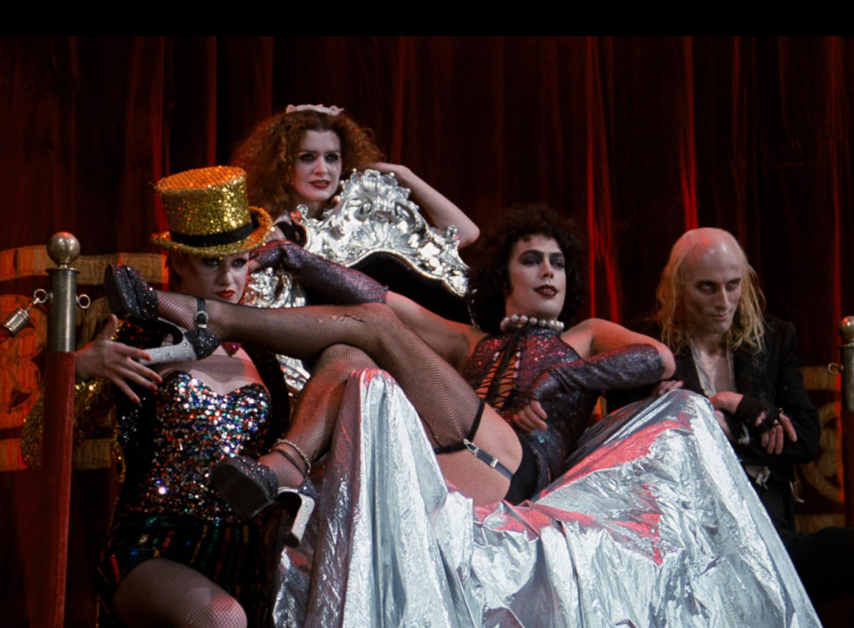
Tim Curry, Nell Campbell, Richard O’Brien and Patricia Quinn in The Rocky Horror Picture Show (1975)
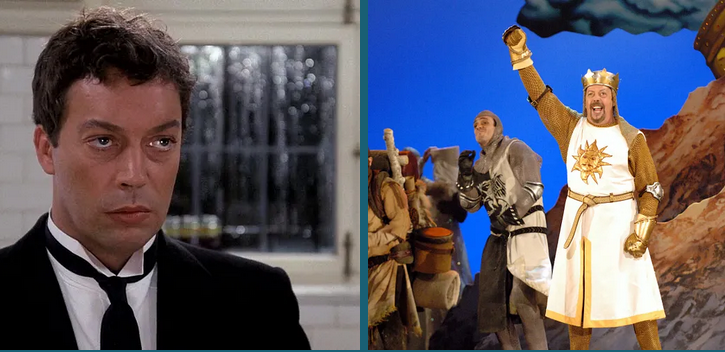
Tim Curry is a shapeshifter. I have a childhood memory of the moment I learned that the demon in Legend (1985), the villain in Annie (1982), the butler in Clue (1985) and the cross-dressing alien scientist in The Rocky Horror Picture Show (1975) were all played by the same man. It was quite the revelation.
Curry’s protean talents have meant that as a personality he has forever remained mysterious. He rarely gives interviews – only grudgingly whenever there is a movie to promote – and fans have therefore tended to project onto this reclusive figure the persona that best fits their expectations or desires. When more insistent fans have formed an emotional bond with the Tim Curry of their imaginations, he has on occasion been forced to put them right. “I’m just a person,” he says, “and I’m not your person”.
Fans will therefore be delighted at the publication of Curry’s memoir, Vagabond, which offers fascinating snapshots from his life. The approach is episodic, with chapters devoted to particular projects in his career. As such, Curry offers us morsels in lieu of a meal. Those who are hoping for salacious anecdotes about his love life will be disappointed, because – as he rightly points out – “specifics about my affairs of the heart or the bedroom are – respectfully – none of your fucking business”. Instead, we have a wonderfully compelling account of Curry’s origins and how his philosophy of life has informed his craft.
Tim Curry as Wadsworth in Clue and King Arthur in Spamalot
His vagabond status has been well earned. As the child of a military father, he was forever on the move, and it is easy to see how these early experiences shaped his capacity to embody such a wide breadth of humanity. His first accolade came early when he was awarded the prize for the “Most Beautiful Baby in Hong Kong”. His family relocated roughly every eighteen months for the first eleven years of his life, which is why he tells us that “mutability felt like a part of my DNA”. It was the ideal apprenticeship for his future vocation.
Writing in 1817, William Hazlitt called actors the “motley representatives of human nature” who “show us all that we are, all that we wish to be, and all that we dread to be”. For his part, Curry sees the actor as the vagabond of his book’s title. “How can you trust somebody, or truly know somebody, who appears as a king one day and a jester the next? What does it mean when neither role is the true identity of the person, and when that very person might be gone the next day?” In this, he could be paraphrasing Hazlitt’s description of actors as “today kings, tomorrow beggars”, and how “it is only when they are themselves, that they are nothing”.
December 19, 2025
QotD: “1998 was the official start of the Girlboss Era”
Paltrow seemed to arrive on the scene having everything and wanting for nothing.
Funny, that’s also the most accurate description of an AWFL ever penned. Who the hell are they, and where did they come from? How do they have the free time and endless disposable cash to do literally every single thing they do?
In 2001, she promoted Shallow Hal — in which she played Rosemary, an obese woman whose “inner beauty” is only visible to Hal (Jack Black) — by talking about doing practice runs in her character’s fat suit. “I got a real sense of what it would be like to be that overweight, and every pretty girl should be forced to do that.”
Wait, this is supposed to be a hit piece? Because that might be the most sensible thing I have ever heard a woman say. Yes, definitely they should be forced to do that, if not the full Norah Vincent. If you’re halfway presentable, ladies — hell, if you’re not grossly deformed — you’re playing life on “God mode”. Look at all the simps in your social media feeds, and tell me I’m wrong. Being forced to go around in a fat suit for a week or two is a necessary corrective.
Paltrow’s first big trip on the Hollywood hater-go-round was 1998, the year she won the Best Actress Oscar for Shakespeare in Love and gave a memorably messy, genuinely emotional acceptance speech. (Days after her win, Salon was among many outlets eviscerating her.) What viewers didn’t see, Odell notes, is the amount of effort by Miramax head Harvey Weinstein to make Shakespeare a winner, raise the profile of his still-independent studio, and solidify his belief that Paltrow belonged to him.
I’m going to stop here, because there’s really no point. I just wanted everyone to remember Shakespeare in Love. You do remember Shakespeare in Love, don’t you?
Of course you don’t; it was silly and forgettable at the time, and now is remembered, if at all, as a bizarre footnote — it’s the movie that won Best Picture over Saving Private Ryan. From the perspective of 2025, then, it sure looks like 1998 was the official start of the Girlboss Era.
Severian, “Kvetching Up With Karen: DC Edition”, Founding Questions, 2025-08-14.
December 5, 2025
Star Wars and Aliens: A Look at Interstellar Communications
Feral Historian
Published 2 Feb 2024I’ve said before that Star Wars originally appears to not have real-time interstellar communications. Many have disputed that, with several good points. Here I finally explain my reasoning with a solution that fits everything we observe in the film without requiring convoluted excuses for why they have to fly an Astromech droid around. Think of this as off-week bonus content.
00:00 Intro
00:53 Taking It Seriously
02:10 Dantooine
03:43 They Tell Two Ships …
06:56 Is the Falcon Really that Fast?
07:50 Delegation🔹 Patreon | patreon.com/FeralHistorian
🔹 Ko-Fi | ko-fi.com/feralhistorian
November 29, 2025
The Manhattan Project (1986 film) and Deterrence
Feral Historian
Published 8 Sept 2023This film reminds me of several topics from nuclear deterrence to the impact of social media to that kid I went to high school with who tried to build a reactor in his mom’s shed. Yeah, this is a rambly one.
00:00 Intro
01:02 Summary
02:25 Social Media
04:35 Deterrence
06:51 Radioactive Boy Scout
09:50 Modern Security State🔹 Patreon | patreon.com/FeralHistorian
🔹 Ko-Fi | ko-fi.com/feralhistorian
November 25, 2025
You might as well watch Guru Nanak Jahaz, since you’ve already paid for it
The Canadian government loves handing out money — they hand out a lot of money — so it shouldn’t be surprising to find out that Canadian taxpayers funded the creation of a movie about a Sikh terrorist who assassinated a Canadian official … or that the assassin is the hero of the movie. After all, isn’t that the heart and soul of multiculturalism? Celebrating other cultures and traditions as being superior to those of ordinary Canadians? The feds seem to believe it.
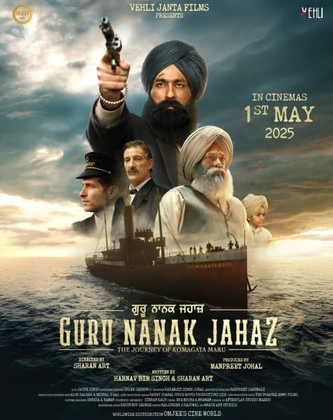
If you can find a way to watch the recently released Khalistani propaganda film Guru Nanak Jahaz, you might as well watch it. You paid for it, after all.
The film, which depicts the assassination of a Canadian civil servant by a Sikh terrorist as a heroic act of justice, has a “Funded by the Government of Canada” credit at the end. It was also supported by the B.C. government and gives special thanks to Conservative MP Tim Uppal and Liberal MP Sukh Dhaliwal. While the Liberals didn’t return a request for comment, a spokesperson for Uppal told me that he was not involved in the film and that the filmmakers did not communicate with him about the credit at any point.
Set in 1914, the plot follows the assassin, who you likely never heard about, and the voyage of the more familiar Komagata Maru, a ship which carried nearly 400 Indian passengers from Hong Kong to Vancouver, only to be denied entry to Canada. It was screened in some Cineplex theatres earlier this year.
The official narrative that you’ll find on government websites explains that this was purely a matter of baseless Canadian racism, and it’s been wholeheartedly adopted by politicians today: as prime minister, Justin Trudeau apologized for the incident in 2016, and the Conservative party releases annual statements commemorating the event, praising the bravery of the passengers and their craving for freedom.
That’s the whitewashed version, however. It leaves out that the Komagata Maru voyage was organized by the Indian Ghadar movement — the word literally means “revolution” — which advocated for violent resistance against the British Empire. (India was a British possession at that time and would continue to be until 1947). Its members were primarily Sikhs who lived in North America. And while they did experience racism, and while changes to Canada’s immigration laws in 1908 indirectly restricted Indian immigration, there were also reasons for the Canadian government to be apprehensive.
Ghadar members dreamed of a return to India, but wanted to rid that land of the British first. They remembered the Indian Mutiny of 1857 with regret — that bloody event saw many British-Indian regiments unsuccessfully take up arms against the Empire; Sikh Punjabis were among the exceptions, largely siding with the British. Decades later, the mostly Sikh Punjabi Ghadarites proposed another 1857-like uprising while applauding anti-British terrorism.
When rumblings of war with Germany began to brew in 1914, the Ghadarites grew excited — now was the time to strike. In August 1914, after the war broke out, the movement’s newspaper advocated, “Go to India and incite the native troops. Preach mutiny openly. Take arms from the troops of the native states and wherever you see the British, kill them. … There is hope that Germany will help you.” Expats in the Orient organized ships to return home and revolt.
The Komagata Maru was part of this movement. Organized by Ghadarites before the breakout of the First World War, it attempted to bring more movement adherents into Vancouver to settle. Canada was right not to let it dock because the entire envoy was a security threat.

The S.S. Komagata Maru was at the centre of an attempt to bring 400 Sikh revolutionaries into Canada to agitate for the destruction of British rule in India in 1914.
November 13, 2025
I, Robot: The Ellison Script
Feral Historian
Published 4 Jul 2025Harlan Ellison’s screenplay adaptation of Isaac Asimov’s I, Robot is arguably the best sci-fi movie never made. Let’s take a look at the script itself, why the film was never made, and how it might have altered science fiction cinema in the wake of Star Wars.
00:00 Intro
01:59 Robbie
04:32 A Little Detour
06:18 A Lifetime and a Galaxy
12:12 Liar
14:06 A New Theory
16:29 The Rapid Rise of the Federation
21:01 Obstacles and Ellison
(more…)
November 4, 2025
The Great Feminization isn’t catching on in the culture, despite its power in our institutions
Lorenzo Warby provides a bit of hopeful news that despite the ever-expanding march of feminization through our various organizations and institutions, the culture is displaying strong resistance and effective:
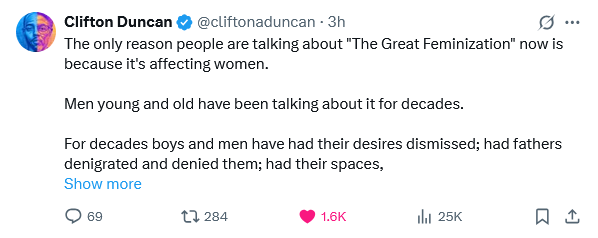
Western culture is not feminising. How can I tell? The travails of Disney. Disney spent billions buying male-centric franchises — Star Wars, the Marvel Cinematic Universe, Indiana Jones … It then proceeded to so alienate the fan bases of those franchises that it is now reduced to openly discussing how to appeal to male audiences that it spent billions acquiring and further billions alienating.
If Western culture was feminising, then Disney should have had no trouble with its feminised products. Clearly, it has had problems. Meanwhile, the Top Gun: Maverick sequel to a 1986 movie can do excellent box office ($1.5bn) precisely because it knows what it is about.
The question then becomes, how and why did Disney so alienate those male-dominated fanbases it spent billions acquiring entree to? A simple answer would be that Disney was a Princess-story factory and it turned its new acquisitions into Princess-stories — stories not necessarily with literal princesses, but with female protagonists.
There is certainly a fair bit of that. A recent study found that Disney has tended, over time, to feminise male characters in its animated movies.
For it was not only that the Disney turned those franchises into launch pads for new Princess stories. Yes, Rey in the Star Wars sequels is an obvious example of doing precisely that. Nevertheless, there was rather more going on.
We can tell this from the Mulan live-action remake. The original 1998 Disney animated Mulan — despite controversy at the time of its cinematic release — acquired some popularity in China. It was seen as an engaging adaptation of the original story: a story deeply familiar to Chinese audiences. Worldwide, the film was a box office success.
The 2020 live-action Mulan remake was not a box office success. It was not for many reasons, but it was also emblematic of the problems of what YouTube critic Critical Drinker calls our post-creativity era.
2020 Mulan turned a female-protagonist story into a “woke” great-because-girl female-protagonist story. It turned a story of filial piety — a girl disguising herself as a boy to train and become a soldier in place of her disabled father, and struggling to overcome the limitations inherent in that — into something rather different.
Animated Mulan becomes accepted into the team of soldiers and triumphs through cleverness and teamwork. What makes the story resonate so well is there is nothing special about Mulan. She takes what she has and works hard at becoming better and succeeds in, and through, doing so. There is no hint of great-because-girl: rather it is fine being girl. Being a girl imposes limitations on her that she has to deal with and overcome: which she does — but not without genuine struggles — by sheer persistence and being clever, a problem-solver.
The key difference between a traditional Disney Princess story and contemporary Disney “woke” Princess story is the injection of great-because-girl. Live-action Mulan is a prodigy warrior with extra qi (or chi) who can do what the boys can do, but better. This is a cinematic version of a classic failing of feminism — by taking a blank slate view of humans, turning what men do into the standard for women. Women are great because they can do everything men can do, but even better. Feminist antipathy for stay-at-home mothers expresses this valorisation of matching men.
Live action Mulan is also much more politically conformist, even retrograde, in its denounement of Mulan celebrating service to the Emperor and going off to be a soldier. Animated Mulan rejecting a job as imperial advisor, and returning to her beloved father, is much less deferential to public authority.
The live-action film virtue-signals at the expense of story and understanding. It sacrifices clever cultural engagement for much flatter message-signalling.
If you want to watch a story set in China about women warriors, then the recent Chinese drama (C-drama) hits of Legend of the Female General and Shadow Love are available. These are smart, character-driven stories with the pervasive professionalism and sense of beauty—anchored in the cultural confidence—that one expects from contemporary costumed C-dramas, which are very much not based on trashing cultural heritage or we-know-better disrespect for source material.
Costumed C-dramas regulary have strong female lead characters while also having strong male lead characters. (As it happens, the male lead characters in both the aforementioned dramas are played by Cheng Lei; the female leads by Zhou Ye and Song Yi respectively.)

Update, 5 November: Welcome, Instapundit readers! Please do have a look around at some of my other posts you may find of interest. I send out a daily summary of posts here through my Substack – https://substack.com/@nicholasrusson that you can subscribe to if you’d like to be informed of new posts in the future.
October 26, 2025
Biggs and the “End of History”
Feral Historian
Published 30 May 2025The “Biggs Edit” isn’t just a contentious question of Star Wars arcana, but an example of some of the problems historians face trying to reconstruct the past. Problems that are only going to get worse in the age of AI.
00:00 Intro
01:12 Not So Easy
05:02 A Slim Hope
05:50 Not Equal Claims
06:46 Memory and AI🔹 Patreon | patreon.com/FeralHistorian
🔹 Ko-Fi | ko-fi.com/feralhistorian


