Quotulatiousness

August 17, 2019

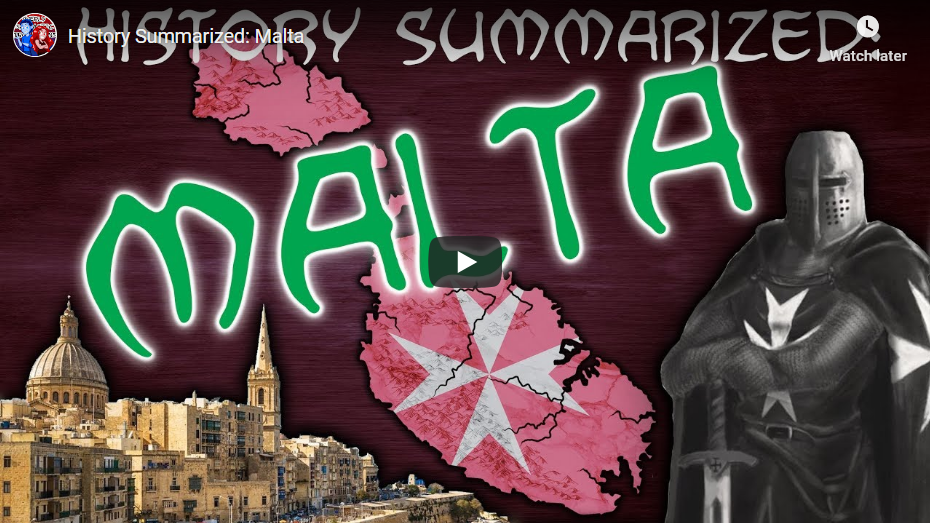
History Summarized: Malta

Overly Sarcastic Productions
Published on 16 Aug 2019

Go to https://NordVPN.com/overlysarcastic and and use code OVERLYSARCASTIC to get 75% off a 3 year plan and an extra month for free. Protect yourself online today!

Malta, the Island of A Dozen Empires, chilling in the middle of the Mediterranean Sea, is one of the most social butterflies in History. Having played host to or fought against every major power in the Mediterranean, this island bears a gorgeous architectural and linguistic record of its past, and is still a treasure to behold in the modern day. I’ve covered a lot of nations and empires in my time here, but between the rich cultural blends, the overflowing artistic treasures, and the Still-In-One-Piece-ness of it all, Malta may have one of the strongest claims to being the Winner of History in my book. What’s so special about Malta? Watch and find out!

NOTE on 7:00 – 7:08 — I’m cheating the time-scales a little here. This church, the Rotunda of Mosta, was actually built mid 1800s. Malta’s lavish church construction continued nearly unabated from C. 1565 to the modern day, so I use this example here — but St Paul’s Co-Cathedral in Valletta, shown from 6:27-6:33 is a better example of pure original Baroque construction. Honestly, all of the churches in Malta deserve a look if you’re curious.

PATREON: https://www.Patreon.com/OSP

DISCORD: https://discord.gg/sS5K4R3

August 9, 2019

What’s happening in Jammu and Kashmir?

Filed under: Government, History, India, Law, Religion — Tags: , , , , , — Nicholas @ 03:00

Pieter J. Friedrich reports on recent events concerning the unique constitutional status of Jammu and Kashmir within the Republic of India:

CIA map of the Kashmir Region in 2004.
Via Wikimedia Commons. Click image to see full-sized map.

Terror grips the most militarized zone in the world after India’s Central Government terminated Jammu and Kashmir’s 70-year-old “special status” as the first step towards stripping the disputed region of statehood entirely.

Internationally infamous as the world’s hottest potential nuclear flashpoint, J&K originally acceded to India in 1947 only on the condition that the newly-formed country be restricted from interfering in the domestic affairs of the mountainous northern region. The agreement was sealed between the last king of J&K, Maharaja Hari Singh Dogra, and the representative of the British crown, Governor-General Lord Mountbatten. In 1949, when passage of the constitution formed the Republic of India, the Maharaja’s conditions for accession were enshrined in Article 370.

The crux of the article – in combination with Article 35A of 1954 – was that, while J&K accepted India’s handling of issues like defense and foreign policy, the state otherwise reserved the right to autonomy in handling its domestic affairs. Kashmiris, thus, lived under their own distinct laws. Notably, citizens of other parts of India were prohibited from settling permanently or owning property in Kashmir. In the eyes of many Kashmiris, this prevented settler colonialism. On August 5, 2019, the President of India abolished this “special status” by decree.

Simultaneously, Home Minister Amit Shah – charged with India’s internal security – introduced a bill in the upper house of parliament to strip J&K of statehood, downgrade it to a “Union Territory,” and partition the region.

As Shah did this, the Central Government shut down Kashmir. It imposed a virtual curfew, banning movement of the public, shuttering educational institutions, and barring all public assemblies or meetings. It severed communications, cutting off phone and internet access. And it conducted arrests of mainstream Kashmiri political leaders – such as former chief ministers Mehbooba Mufti and Omar Abdullah – on unknown charges.

India’s ruling Bharatiya Janata Party, which was just re-elected in May, campaigned on promises to scrap J&K’s “special status.” The BJP’s manifesto alleged that it was “an obstacle in the development of the state,” while Shah insisted it stood in the way of of Kashmir becoming an “integral party of India permanently” and was necessary for “national security.” Indeed, the tumultuous region has suffered a significant influx in violence in recent years.

Since 2014, when Prime Minister Modi’s regime first came to power, terrorist incidents in J&K have nearly tripled and security forces deaths have nearly doubled. According to a July 2019 UN report, independent bodies documented 159 security forces deaths in 2018 – a figure comparable to US troop fatalities in Iraq in 2009. The latest round of escalating tensions traces back to at least 2010, when mass protests erupted over an “encounter killing” of three civilians by Indian Army troops. Protests again erupted in 2016. During suppression efforts, security forces killed hundreds of protesters.

The Central Government has responded by flooding J&K with more and more soldiers. The small region – slightly smaller than the United Kingdom – is already occupied by a bare minimum of 500,000 troops. Since late July 2019, India has deployed nearly another 50,000.

Delhi has additionally responded by repeatedly dissolving J&K’s elected state government, imposing direct rule three times since 2015. The last time was in June 2018, after India’s ruling BJP withdrew from a coalition with then J&K Chief Minister Mufti – apparently because she advocated “reconciliation” instead of a “muscular security policy” as the most effective solution to the Kashmir conflict. Elections have not been allowed since 2014.

The ongoing occupation as well as the long-term use of direct rule – imposed for approximately ten of the past 42 years – contribute to the perception of Kashmiris that they are nothing more than vassals within the Republic of India.

August 5, 2019

QotD: Depictions of Heaven

Filed under: Books, Quotations, Religion — Tags: , , , , — Nicholas @ 01:00

Orwell’s press card portrait, 1943

Attempts at describing a definitely other-worldly happiness have been no more successful. Heaven is as great a flop as Utopia though Hell occupies a respectable place in literature, and has often been described most minutely and convincingly.

It is a commonplace that the Christian Heaven, as usually portrayed, would attract nobody. Almost all Christian writers dealing with Heaven either say frankly that it is indescribable or conjure up a vague picture of gold, precious stones, and the endless singing of hymns. This has, it is true, inspired some of the best poems in the world:

    Thy walls are of chalcedony,
    Thy bulwarks diamonds square,
    Thy gates are of right orient pearl
    Exceeding rich and rare!

But what it could not do was to describe a condition in which the ordinary human being actively wanted to be. Many a revivalist minister, many a Jesuit priest (see, for instance, the terrific sermon in James Joyce’s Portrait of the Artist) has frightened his congregation almost out of their skins with his word-pictures of Hell. But as soon as it comes to Heaven, there is a prompt falling-back on words like ‘ecstasy’ and ‘bliss’, with little attempt to say what they consist in. Perhaps the most vital bit of writing on this subject is the famous passage in which Tertullian explains that one of the chief joys of Heaven is watching the tortures of the damned.

The pagan versions of Paradise are little better, if at all. One has the feeling it is always twilight in the Elysian fields. Olympus, where the gods lived, with their nectar and ambrosia, and their nymphs and Hebes, the ‘immortal tarts’ as D.H. Lawrence called them, might be a bit more homelike than the Christian Heaven, but you would not want to spend a long time there. As for the Muslim Paradise, with its 77 houris per man, all presumably clamouring for attention at the same moment, it is just a nightmare. Nor are the spiritualists, though constantly assuring us that ‘all is bright and beautiful’, able to describe any next-world activity which a thinking person would find endurable, let alone attractive.

George Orwell (writing as “John Freeman”), “Can Socialists Be Happy?”, Tribune, 1943-12-20.

July 20, 2019

“Boris Johnson is the only man alive who could convincingly turn The Emperor’s New Clothes into a one-man play”

Filed under: Britain, History, Media, Politics, Religion — Tags: , , , — Nicholas @ 05:00

In Spiked, Alaa al-Ameri says that Boris Johnson actually does have a valid point in his criticism of Islam:

Boris Johnson, Secretary of State for Foreign and Commonwealth Affairs at an informal meeting of the Foreign Affairs Council on 15 February 2018.
Photo by Velislav Nikolov via Wikimedia Commons.

Boris Johnson is the only man alive who could convincingly turn The Emperor’s New Clothes into a one-man play. He’s perfect for every role – the pompous, bumbling, vain emperor; the barefaced conmen trafficking in audacious whoppers; and, most importantly, the little boy, unable to keep from blurting out the obvious, especially when everyone around him is busy parroting the convenient lie of the day.

Not for the first time, Johnson has offended polite society by suggesting that there might be something less than perfectly laudable about some aspects of Islam. Perish the thought. In particular, offence-miners at the Guardian have discovered that Johnson once wrote that Islam has held Muslim countries back by “centuries”.

A cursory look around the world is enough to conclude that there may be something to Johnson’s argument. A deeper look at Arab and Muslim history – both ancient and recent – might at least confirm the possibility that such a statement is something other than flat-out bigotry. Or so you might have thought, if you had recently awoken from a 30-year coma. In 2019, however, such thoughts are unthinkable.

We can moralise all day long about the evils of European colonialism. But it was a historical blink of an eye in comparison to the centuries of Arab and Muslim colonialism that produced the cultures to which Johnson was referring. We can wring our hands over the influence of literalist Christianity on American politics. But this is a drop in the ocean compared to the cultural and political leverage of Islam across the globe. We can lament the potential harm to Indian democracy posed by militant Hindu nationalism. But there is nothing questionable about entertaining the notion that centuries of Muslim global imperialism – which ended less than 100 years ago – might have left behind a less than a gleaming legacy.

June 22, 2019

QotD: Militant Islam and the arts

Filed under: History, Media, Quotations, Religion — Tags: , , , , , — Nicholas @ 01:00

What I’ve learned since 9/11 is that the small pleasures — music, theatre, film — have to be earned. In the Muslim world, there is no music. In Libya they destroyed all the musical instruments — music was considered an abomination. When the demography changes, there will be no concert halls. Artists who take a multicultural view should be aware of this. Count the number of covered women in London’s West End. In Birmingham, where I went to high school, you have a provincial symphony orchestra in a Muslim city — I’m not sure it will survive. All art, all popular culture, is endangered by Islam, because there’s no room for it. It’s considered libertinism. And I’m not even talking about Miley Cyrus twerking at the music awards. What turned Sayyid Qutb against the morality of the West is that he attended a church dance in Greeley, Colorado, which was a dry town in 1948, and he heard the song “Baby, It’s Cold Outside”. He thought it was evil. And now things are getting a lot worse. Ugly things are happening.

Mark Steyn, interviewed by John Bloom, “Mark Steyn, Cole Porter and Free Speech”, Quadrant, 2017-05-11.

June 12, 2019

QotD: Militant Islam and the Western media

Filed under: Europe, Media, Quotations, Religion — Tags: , , , , — Nicholas @ 01:00

Mark Steyn is a brave man. He doesn’t talk about his death threats or his security measures, but his public life speaks for itself. For the fifth anniversary of the Muhammad cartoon controversy, he stood on a stage in Copenhagen with the Danes who were not yet in hiding along with Lars Vilks, the Swedish cartoonist who had survived physical attacks, arson, at least three assassination plots, and an Al Qaeda hit list. Steyn returned for the tenth anniversary observance, a few months after the Charlie Hebdo massacre, but by then no cartoonists were left — they were all in hiding, including Vilks, after yet another attempt on his life.

“I’m always willing to stand with the guys in Denmark,” says Steyn. “But the reason all these left-wing Europeans end up on a stage with an eccentric right-wing Canadian like me is that no real A-list stars will agree to be there. At the tenth anniversary both the American State Department and the British Foreign Office even issued official warnings to their citizens to stay away from the Danish Parliament, where we were holding the ceremony. What kind of signal does that send? Why don’t the artists show up for these things? Why aren’t the movie stars there? When Theo Van Gogh was assassinated, no one at the Oscars had a word to say about it. They didn’t even put him in the obituary montage. And yet they congratulate themselves on their moral courage. George Clooney wears a Je suis Charlie Hebdo pin. Helen Mirren wears a brooch. But they were not with Charlie. Those guys died alone. This is gesture politics. No one would stand with them. I honour the genuine courage of Ayaan Hirsi Ali. Ayaan’s point is absolutely right — in the end you have to share the risk. Charlie Hebdo supported the Danish cartoonists, but the rest of the world didn’t. If every newspaper had published those cartoons, there would have been no point in killing anyone because there would have been too many people to kill. Instead, nobody stands with them, and so the small publication that does ends up massacred. The writer of the comic strip Doonesbury in America [Garry Trudeau] attacked the decision of PEN to honour Charlie Hebdo. Well, they were lying on the floor, bleeding and dying. I don’t think they noticed.”

The Danish cartoon controversy was actually the first moment the American press had been challenged by Islam and could do something in response — and their reaction was a spectacular failure of will and principle. In several countries around the world, it was actually against the law to publish the Danish cartoons, but many editors stepped up, published them anyway, and suffered the civil and criminal consequences. In the United States — where there was no such law — no major publication would print them.

Mark Steyn, interviewed by John Bloom, “Mark Steyn, Cole Porter and Free Speech”, Quadrant, 2017-05-11.

May 30, 2019

QotD: Wahhabism and the West

Filed under: Europe, History, Quotations, Religion — Tags: , , , — Nicholas @ 01:00

“You’re right,” he says, “it shouldn’t be different for Islam, but we make it different. Muslims fought for king and empire in both world wars. Muslims were the backbone of the Indian army. Ataturk’s Turkey was an example of Muslims functioning perfectly well in a modern democratic society — but Ataturk’s Turkey is going away. We don’t have that trust any more. It was a Wahhabi who assassinated the chief justice in British India, and that is more or less the only brand of Islam exported today — extremist Saudi-style Wahhabism. All these giant mosques you see going up in cities all over the world are not paid for locally, they’re paid for by Saudi Arabia. They’re trying to make it one-size-fits-all Islam, and a type of Islam that regards the West as its enemy, instead of the mom-and-pop Islam of the past.”

So you’re saying the problem is not Islam, the problem is Wahhabism?

No! Wahhabism is the symptom. The problem is us. We don’t defend ourselves. If you are a woman living alone in a Muslim community in Europe, you do not venture out after 6 p.m. If there are sexual assaults by Muslims, and the allegations are made public by the victims, the accuser is inevitably accused of racism. Nobody disputes that it happened, but they’re held to a different standard because the victims are Swedes or Danes and the accused is from a Muslim country. It’s believed that it’s unreasonable to expect decent behaviour from an Afghan or an Iraqi — which is racist. You’re denying the humanity of these people. And so you surrender incrementally. You live in a citadel. You make ridiculous changes to your own culture. In Britain the banks don’t give piggy banks to children any more, because the “piggy” might be offensive. There’s a fetishisation of the burka, which should be regarded as what it is — a prison for women. Why should we abandon our own heritage to barbarism? I’m a nineteenth-century imperialist a hundred years past my sell-by date.”

Mark Steyn, interviewed by John Bloom, “Mark Steyn, Cole Porter and Free Speech”, Quadrant, 2017-05-11.

May 19, 2019

Siege of Vienna & Queen Nzinga – Lies – Extra History

Filed under: Africa, Europe, History, Religion — Tags: , , , , , , — Nicholas @ 06:00

Extra Credits
Published on 18 May 2019

Writer Rob Rath talks about all the cool stories and facts we didn’t get to cover in our two special short series on the Siege of Vienna, and the life of Queen Nzinga.
Join us on Patreon! http://bit.ly/EHPatreon

From the comments:

Extra Credits
Timestamps:
2:00 – Demonetization sucks. THANK YOU PATRONS!
7:15 – Istanbul was Constantinople now it’s Istanbul not Constantinople been a long time gone oh Constantinople
11:07 – the arrival of the Winged Hussars wasn’t exactly the same as Rohan answering Gondor’s call for aid
16:20 – Nzinga’s controversial role in slavery
19:25 – what’s next on Extra History?
21:02 – SIX DEGREES OF WALPOLE

Recommended reading:
The Enemy at the Gate: Habsburgs, Ottomans, and the Battle for Europe by Andrew Wheatcroft
The Siege of Vienna: The Last Great Trial Between Cross & Crescent by John Stoye
Hispanics and the Civil War: From Battlefield to Homefront by the National Park Service

Music videos:
Queen Nzinga: https://www.youtube.com/watch?v=N94H6F0WObc

Siege of Vienna: https://www.youtube.com/watch?v=jQ_HV57cgbg

May 17, 2019

QotD: Mark Steyn and the “Human” “Rights” Tribunals

Filed under: Cancon, Law, Liberty, Quotations, Religion — Tags: , , , , — Nicholas @ 01:00

It’s statements like these that have landed Steyn on various hit lists, including, most famously, those of the Canadian Human Rights Commission, the British Columbia Human Rights Tribunal and the Ontario Human Rights Commission, which are strange quasi-judicial bodies that were stirred to action a decade ago by the Canadian Islamic Congress. Between 2005 and 2007 the weekly news magazine Maclean’s published eighteen articles by Steyn, including an excerpt from America Alone, that were all deemed “Islamophobic” by the human rights tsars. Without going into excruciating detail about the various legal jockeying that took place — who knew one country could have this many commissions and tribunals that could all attack simultaneously? — Steyn and Maclean’s were charged with inciting hatred against Muslims, setting in motion an endless process of discovery and hearings.

“We were trying to lose,” said Steyn. “We wanted them to find us guilty so that we could appeal to a real court, hopefully the Supreme Court, and prove that these hate-speech laws are more absurd than any laws outside North Korea. Before I came along, these human rights tribunals had a 100 per cent conviction rate! The fact that we fought back meant that I became an albatross around their neck. The Thought Police were exposed to massive unrelenting publicity for the first time, and they didn’t expect that. They didn’t expect us to push back. But free speech is on the retreat, and this was not a time for a faint-hearted defence.”

The Canadian Human Rights Commission eventually bowed out of their part in the imbroglio, saying the articles were “polemical, colourful and emphatic” but failed to satisfy the definition of writings “of an extreme nature” as defined by the Supreme Court. But the British Columbia Human Rights Tribunal was not so sure, holding a five-day hearing during which the Canadian Islamic Congress presented evidence that twenty articles in Maclean’s presented Islam as a violent religion and Muslims as violent people, with the Islamist lawyer using words like racist, hateful, contemptuous, Islamophobic and irresponsible. Mahmoud Ayoub, a Harvard historian of religion, testified that Steyn didn’t understand the meaning of the word jihad and that, of the 1.5 billion Muslims in the world, less than a million interpreted jihad to justify violence against non-believers. (I don’t know of any other religion in the world that has merely a million devotees willing to kill, but that’s what the man said.)

Mark Steyn, interviewed by John Bloom, “Mark Steyn, Cole Porter and Free Speech”, Quadrant, 2017-05-11.

April 9, 2019

Siege of Vienna – Opening Bombardment – Extra History – #1

Filed under: Europe, History, Middle East, Military, Religion — Tags: , , , , — Nicholas @ 04:00

Extra Credits
Published on 6 Apr 2019

Mehmed IV wanted to live up to, and even surpass, the legacy of his forefather Mehmed II, who had secured the Ottomans’ inheritance to the Roman Empire through his conquest of Constantinople. So the current Mehmed decided to target Vienna — but Emperor Leopold dismissed these threats…

Over a hundred thousand Ottoman troops are heading for Vienna. Only 15,000 men defend the walls. They have only six days to prepare the city. How long can they hold?

Join us on Patreon! http://bit.ly/EHPatreon

March 29, 2019

Barbara Kay on Islamophobia

Filed under: Law, Liberty — Tags: , , , , , — Nicholas @ 03:00

Is all hate speech the same?

One of my favourite Seinfeld episodes had Kramer joining an AIDS walk. But he refuses to “wear the ribbon.” People keep urging him to take it, and he keeps politely refusing. They become more importunate. He won’t budge. Finally, they get ugly and turn on him with menace: “Who doesn’t want to wear the ribbon?” one walker yells accusingly, as others press in on him.

The scene is, of course, played for laughs, but it nevertheless reveals a dark truth about ritualized compassion. If your sympathy for a good cause has to meet a “compelled speech” standard to be considered sincere, then who is the more admirable character? In this parody of bullying virtue-signallers (not a trope in use at the time), we see that often those “wearing the ribbon” are more concerned about showcasing the “correct” public expression of their sympathy than the plight of the actual victims they are marching for. Bullying those who eschew conforming symbols thus provokes contempt for the bullies and respect for the genuine sincerity of the non-conformist.

I was reminded of this episode last weekend, after a talk I gave as part of a panel at the Manning Conference in Ottawa. My subject was the normalization of anti-Semitism in the progressive playbook. Afterward, Reyhana Patel, Head of Government and External Relations for Islamic Relief Canada came up to the stage with a few companions to interrogate me (and I use the word advisedly). Every one of their questions struck me as — politically — more than the sum of its parts, and delivered with an undertone of menace that was not the least bit funny.

The first question (the gist, not having recorded the exchange): “Your talk was about hatred. Why did you not mention Islamophobia?” My response: “My talk was not about hatred in general; it was about a very specific form of hatred, anti-Semitism.”

My answer did not please them, I could see, and they asked the question a few more times with different wordings. They really didn’t get it: Even though most people today have internalized the “correct” notion that one cannot mention anti-Semitism without “wearing the ribbon” of Islamophobia, ages-old anti-Semitism and the newly coined Islamophobia are apples and oranges.

Many people actively dislike Islam tenets, and a whole lot of people are uncomfortable with the cultural norms in Islam-ruled regions, especially with regard to women’s and gay rights, but hatred of Muslims for being Muslims has simply not been a systemic form of hatred in the west. By contrast, few people actively dislike Judaic tenets, but millions of people, even those who have never met a Jew, hate Jews. Would it have annoyed Ms. Patel & co if I had added that nowhere is Jew hatred more pronounced or vicious than in Islam-dominated societies?

March 28, 2019

QotD: Sharia law

Filed under: History, Law, Middle East, Quotations, Religion — Tags: , — Nicholas @ 01:00

In order of importance, [Sharia] has four sources. First, there is the Koran, which is the record of what was revealed to Mohammed by God, speaking through the Archangel Gabriel, Its injunctions are absolutely binding on the faithful. Second, there is the sunna, or the practice of Mohammed, as understood from the hadith, or traditional stories of his sayings and doings. These are less holy than the Koran, being only what was observed of a particularly honoured man, and not the direct Word of God given at third hand. Also, there are nearly two million of them, and they often contradict one another. But they count, once any consistent doctrine can be divined from them on a particular issue, as reliable guides. Third, there is the ijima or consensus of opinion among the ulema, or learned Moslems. Fourth, there is qiyas, or a process of analogical reasoning by which, in the absence of any rule or precedent, a case is to be decided in a manner consistent with the existing body of law. In addition to these, we can be fairly certain that much law has been inherited from pre-Islamic Arabian custom, and from the near eastern societies that subsequently became Moslem.

The main development of Islamic law came to an end in the eighth century with the Foundation of what remain the four traditional schools of legal interpretation. The task of all succeeding jurists was seen increasingly to consist as no more than the application and development of principles already laid down. Then, some time during the tenth century, there came what is known as “The Closure of the Gate of Interpretation ”. Since then, the exercise of itjihad — or independent judgment — has not, in theory, been permitted at all.

Islamic law differs from our own not only in its derivation, but also in its content. With us, despite what remains from the old regimes, and despite a great mass of socialist legislation during the present century, law is a means largely of protecting life and property. Among the Islamic lawyers, this has been an end only incidental to the main one, of ensuring conformity to the will of God. “The sacred law of Islam…” according to the great western scholar of the subject, Joseph Schacht, “is an all-embracing body of religious duties, the totality of Allah’s commands that regulate the life of every Muslim in all its aspects”. Not surprisingly, any country where the government takes Islam seriously is invariably, in western terms, an exceptionally gloomy and repressive place.

Let us look at Saudi Arabia. Within the bounds set by Islamic law, the country is an absolute monarchy. It lacks even the pretence of representative institutions and freedom of the press. All public officers are appointed by the King, and are responsible in the final instance to him alone. No religion other than Islam is tolerated in public — not even the sale of crosses being allowed — and anyone who is not a Moslem is made a victim of official discrimination. All publications are subject to a searching, and what often strikes westerners as a frivolous, censorship. On the 13th of March, 1989, The Times was allowed on sale only after the censors had snipped out the relevant part of a photograph in which a lady was showing more of herself than was thought decent. Women, indeed, are treated as inferior beings, and this treatment goes far beyond the close regulation of their dress by the police. They can be divorced at will. The range of employments open to them is restricted by law, and they can take none that involves contact with any man not related to them. They cannot drive cars. They cannot travel unaccompanied by a male relative. Adultery and certain other sexual acts carry the death penalty. The drinking of alcohol, while not absolutely prohibited, is discouraged. Tobacco is only grudgingly allowed. Gambling is forbidden. Music and dance are frowned on.

Sean Gabb, “‘The Challenge of Islam: Can We Face It?’ A paper prepared for the post-graduate seminar Dr Dennis O’Keeffe presiding at the Polytechnic of North London Tuesday the 16th January 1990” republished as “Flirting with the Neocons in 1990”, Libertarian Enterprise, 2019-02-24.

March 17, 2019

Apologizing for the Crusades

Filed under: History, Middle East, Religion — Tags: , , — Nicholas @ 05:00

Perhaps our media-seeking politicians and activists are running out of other things to apologize for, so next on the apology tour may well be the Crusades:

Wherever one looks, the historic crusades against Islam are demonized and distorted in ways designed to exonerate jihadi terror. “Unless we get on our high horse,” Barack Obama once chided Americans who were overly critical of Islamic terror, “and think this [beheadings, sex-slavery, crucifixion, roasting humans] is unique to some other place, remember that during the Crusades and the Inquisition, people committed terrible deeds in the name of Christ.”

Others, primarily academics and self-professed “experts,” insist that the crusades are one of the main reasons modern day Muslims are still angry. According to Georgetown University’s John Esposito, “[f]ive centuries of peaceful coexistence [between Islam and Christendom] elapsed before political events and an imperial-papal power play led to [a] centuries-long series of so-called holy wars that pitted Christendom against Islam and left an enduring legacy of misunderstanding and distrust.”

Nor is this characterization limited to abstract theorizing; it continues to have a profound impact on the psyche of Westerners everywhere. Thus in 1999 and to mark the 900th anniversary of the crusader conquest of Jerusalem, hundreds of devout Protestants participated in a so-called “reconciliation walk” that began in Germany and ended in the holy city. Along the way, they wore T-shirts bearing the message “I apologize” in Arabic. Their official statement:

    Nine hundred years ago, our forefathers carried the name of Jesus Christ in battle across the Middle East. Fueled by fear, greed and hatred … the Crusaders lifted the banner of the Cross above your people … On the anniversary of the first Crusade, we … wish to retrace the footsteps of the Crusaders in apology for their deeds … We deeply regret the atrocities committed in the name of Christ by our predecessors. We renounce greed, hatred and fear, and condemn all violence done in the name of Jesus Christ.

After outlining the Western concept of “Just War” in contrast to the Islamic concept of “Jihad”, Raymond Ibrahim puts the Crusades into historical context:

From the very start, at Clermont in 1095, Pope Urban never offered forgiveness of sins (but rather remission of the penances for sins to which crusaders had already confessed). Those who took the cross were required to be sincerely penitent.

This is a far cry from what Muslims were (and are) taught about fighting and dying in jihad: Every sin they ever committed is instantly forgiven, and the highest level of paradise is theirs. “Lining up for battle in the path of Allah,” Muhammad had decreed in a canonical hadith, “is worthier than 60 years of worship.” Muhammad also said, “I cannot find anything” as meritorious as jihad, which he further likened to “praying ceaselessly and fasting continuously.” As for the “martyr” — the shahid — he “is special to Allah,” announced the prophet. “He is forgiven from the first drop of blood [he sheds]. He sees his throne in paradise. … Fixed atop his head will be a crown of honor, a ruby that is greater than the world and all it contains. And he will copulate with seventy-two Houris.” (The houris are supernatural, celestial women — “wide-eyed” and “big-bosomed,” says the Koran — created by Allah for the express purpose of gratifying his favorites in perpetuity.)

Crusader motives also had to be sincere: “Whoever shall set forth to liberate the church of God at Jerusalem for the sake of devotion alone and not to obtain honor or money will be able to substitute that journey for all penance,” Urban had said. Similarly, Spanish Prince Juan Manuel (d. 1348) explained that “all those who go to war against the Moors in true repentance and with a right intention … and die are without any doubt holy and rightful martyrs, and they have no other punishment than the death they suffer.”

In this, Christian war significantly departed from Islamic jihad. Allah and his prophet never asked for or required sincere hearts from those flocking to the jihad; as long as they proclaimed the shahada — thereby pledging allegiance to Islam — and nominally fought for and obeyed the caliph or sultan, men could invade, plunder, rape and enslave infidels to their hearts’ content.

The cold, businesslike language of the Koran makes this clear. Whoever wages jihad makes a “fine loan to Allah,” which the latter guarantees to pay back “many times over” in booty and bliss either in the here or hereafter (e.g., Koran 2:245, 4:95, 9:111). “I guarantee him [the jihadi] either admission to Paradise,” said Muhammad, “or return to whence he set out with a reward or booty.”

In short, fighting in Islam’s service — with the risk of dying — is all the proof of piety needed. Indeed, sometimes fighting has precedence over piety: Many dispensations, including not upholding prayers and fasting, are granted those who participate in jihad. Ottoman sultans were actually forbidden from going on pilgrimage to Mecca — an otherwise individual obligation for Muslims, especially those who can afford it, such as the sultan — simply because doing so could jeopardize the prosecution of the jihad.

Little wonder that, whereas there was never a shortage of Muslims willing to participate in a jihad, “85-90 percent of the Frankish knights did not respond to the pope’s call to the Crusade,” explains Tony Stark, and “those [10-15 percent] who went were motivated primarily by pious idealism.”

Little wonder that there are still countless jihadis today but no crusaders.

March 7, 2019

Anti-semitism in Europe

Filed under: Europe, History, Religion — Tags: , , , , — Nicholas @ 03:00

Mark Steyn discusses the unexpected result of a few generations of Europeans feeling guilt for allowing the Holocaust to happen: renewed feelings of anti-semitism all around.

As Laura Rosen Cohen likes to say, everyone meets at Jew-Hate Junction: excitable young Mohammedans, secular polytechnic Euro-lefties, anti-globalist conspiracy theorists… It’s getting pretty crowded over there. As I wrote almost exactly a decade ago about the Ismalization of Europe:

    There are already many points of cultural friction — from British banks’ abolition of children’s ‘piggy banks’ to the enjoining of public doughnut consumption by Brussels police during Ramadan. And yet on one issue there is remarkable comity between the aging ethnic Europeans and their young surging Muslim populations…

…Jews.

Young Muslims do not like Jews: that is a simple fact, and it’s a waste of everybody’s time denying it. Where Muslims predominate, Jews vanish – as in Molenbeek, across the canal from downtown Brussels. I remember from my childhood the main drag, the Chaussée de Gand (or Steenweg op Gent, if you’re Flemish, as my mum was), as a bustling strip with many Jewish businesses. But in the first decade of the 21st century they all disappeared, and their former owners chose to remain silent – because it was easier that way.

One hairdresser, for example, had “DIRTY KIKE” sprayed on his window and was punched in the face by a gang of half-a-dozen “youths”. So he went to the police and filed a complaint. One hour later, the “youths” returned and smashed all his hairdressing mirrors. His clients didn’t want to come after that, and so a 35-year business closed its doors.

Now they’re all gone.

Ethnic Continentals, on the other hand, do not like Muslims, and they see where this is headed, and it’s easy to blame Jews. The logic is not difficult: ‘Tween-wars Europeans would never have entertained for a moment the construction of mosques in every corner of their countries. But then the Holocaust happened, and “nationalism” got blamed, and mass immigration was instituted as a form of penance, and in one of history’s blacker jests the principal beneficiary of Holocaust guilt was Islam. So, in the newest variant of the oldest hatred, Jews get hated for the Islamization of Europe.

And then there’s simply the crude arithmetic of day-by-day remorseless demographic transformation in democratic societies: Muslims are where the votes are, and Jews aren’t. Which is why Jeremy Corbyn’s Labour Party is happy to while away the hours on such vital debates as the question of whether Hitler was a Zionist.

February 28, 2019

First Crusade Part 2 of 2

Filed under: Europe, History, Middle East, Military, Religion — Tags: , , , , , — Nicholas @ 02:00

Epic History TV
Published on 31 Mar 2017

Part 2 of Epic History TV’s story of the First Crusade continues with the Siege of Antioch. The Crusaders endure immense hardships outside the city walls, but finally take Antioch thanks to a ruse by Bohemond of Taranto. Against the odds, and inspired by their recent discovery of a relic believed to be the ‘Holy Lance’, the Crusaders then defeat the Seljuk army of Kur Burgha. After disagreements within the Crusader camp, the army finally moves on to Jerusalem in the spring of 1099. During a full-scale assault of the city walls, Godfrey of Bouillon’s troops gain a foothold in the defences, and Crusader troops pour into the city. A bloodbath follows. Victory results in the creation of four Crusader states, but their existence is precarious, surrounded by hostile Muslim powers, who will one day return with a vengeance.

Produced in partnership with Osprey Publishing
https://ospreypublishing.com/

Campaign: The First Crusade 1096–99
https://ospreypublishing.com/the-firs…

Essential Histories: The Crusades
https://ospreypublishing.com/the-crus…

The Armies of Islam 7th–11th Centuries
https://ospreypublishing.com/the-armi…

Armies of the Crusades
https://ospreypublishing.com/armies-o…

Music with thanks to Filmstro: https://www.filmstro.com/
Get 20% off an annual license! Use our exclusive coupon code: EPICHISTORYTV_ANN

Image credits – via Flickr under Creative Commons CC-BY-SA 2.0
Sky – Anyul Rivas
Wooded Hills – Alexander Annenkov
Dramatic Fields – Antonio Caiazzo
Twin peaks of Mount Ararat – Adam Jones

Please help me make more videos at Patreon: https://www.patreon.com/EpicHistoryTV

« Newer PostsOlder Posts »

Powered by WordPress