Born into a Shia mercantile family, Jinnah left for England after high school, where he studied law and acquired a love for parliamentary procedure. Thoroughly and poshly anglicized (200 Savile Row suits were found in his closet after his death), he returned to India before the First World War, armed with a fearsome reputation as a barrister so brilliant judges tried to avoid him, and committed to Hindu-Muslim unity. His English was exquisite, but he spoke no Urdu. Completely secular, Jinnah was so indifferent to his religion — he drank and ate pork — that he planned Pakistan’s inauguration-day banquet as a luncheon, unaware it was Ramadan (they changed it to dinner).
Jinnah’s political intentions are hotly contested. According to New York Times Pakistan expert, Jane Perlez, many Pakistan researchers contend Jinnah had no interest in an Islam-dominated state, but “used the idea of Pakistan as a mere bargaining chip for Muslim majority rights within a loosely united post-colonial India.” With no autobiography or recollections from close friendships for our guidance, Jinnah remains a shadowy historical player, a political loner with an indeterminate goal beside Nehru, Gandhi and Viceroy Lord Mountbatten.
It is quite possible, for example, that Jinnah created the Muslim League and employed the rhetoric of Islam (slogan: “Islam in Danger”) and started wearing native clothes to harness religious fervour to political ambitions never fully articulated. But we can’t ever know, as a lifetime of chain smoking caught up with Jinnah, and he died before the first (bloody) year of Pakistan’s existence was out.
In Jinnah’s first speech to his newly minted country, though, we have this strong intentional clue: “You are free. You are free to go to your temples, you are free to go to your mosques or to any other place of worship in this state of Pakistan. You may belong to any religion or caste or creed — that has nothing to do with the business of the state.”
Barbara Kay, “A celebrated figure today could well be the condemned sinner of tomorrow”, National Post, 2018-06-05.
September 4, 2020
QotD: Muhammad Ali Jinnah
August 17, 2020
Dateline Ayodhya, Uttar Pradesh, 5 August 2020
That’s a significant date, as Tom Holland explains at UnHerd:
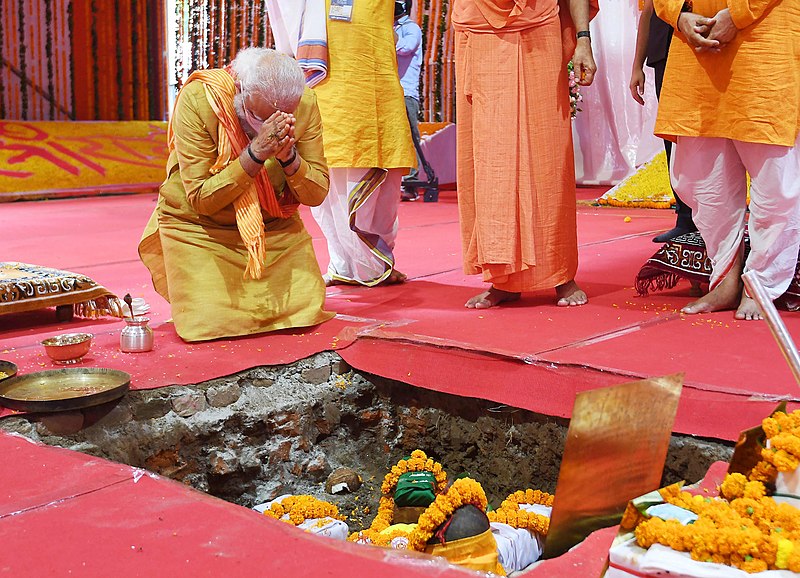
Indian Prime Minister Narendra Modi performing Bhoomi Pujan at Shree Ram Janmabhoomi Mandir, in Ayodhya, Uttar Pradesh on August 05, 2020.
Photo released by the Press Information Bureau on behalf of the Prime Minister’s Office, (ID 90071) via Wikimedia Commons.
Last week, on 5 August, the Prime Minister of India laid a foundation stone and helped bury a distinctive period in global history. Narendra Modi had travelled to Ayodhya, a city long identified by Hindus with one of their most beloved gods. Lord Rama — avatar of Vishnu and hero of the Sanskrit epic, the Ramayana — was said to have ruled within its walls as the very model of those who uphold truth and justice. Like Camelot, the court of Rama glimmers tantalisingly in the imaginings of those who fall beneath its spell: the reminder of a vanished golden age, the hope that it might come again.
In recent decades, the mingled regret and yearning that the memory of Rama’s capital can inspire among Hindus had come to be focused on one particular location in the modern city of Ayodhya: the Ram Janmabhoomi, the “birthplace of Rama”. At the moment, nothing serves to mark the sacred spot. But soon enough that will change. A great complex of buildings will rise. As Modi, officially declaring the process of construction begun, put it: “A great temple will now be built for our Lord Rama.”
A fortnight earlier, the President of Turkey had celebrated a similar reconsecration. In 1453, when the Christian capital of Constantinople fell to the Ottomans, its most stupefying building, the great cathedral of Hagia Sophia, had been converted into a mosque, and duly served for almost half a millennium as a monument to the triumph of Islam over a defeated and superceded order. Then, in 1935, a decade and more after the collapse of the Ottoman Empire and its replacement within its heartlands by a Turkish republic, the mosque of Ayasofya was turned into a museum. So, for decades, it remained. Then, this summer, the museum once again became a mosque. On 24 July, Hagia Sophia opened for Friday prayers. “It is breaking away from its chains of captivity,” President Erdogan declared rhapsodically. “It was the greatest dream of our youth. It was the yearning of our people and it has been accomplished.”
The synchronicity between Modi’s trip to Ayodhya and Erdogan’s to Hagia Sophia is striking, and only flimsily obscured by the fact that the Prime Minister of India is trampling the legacy of an Islamic empire much as the President of Turkey has trampled the legacy of a Christian one. In the early sixteenth century, shortly after the Moghul conquest of the lands that once, so Hindus believed, had constituted the Ram Rajya, the “realm of Rama”, a mosque was built in Ayodhya. By the twentieth century, large numbers of Hindus had come to believe that this same mosque, the Babri Masjid, stood directly on the site of the Ram Janmabhoomi. In the 1980s, the BJP — the party to which Modi belongs — began a campaign to demolish it. In 1992 a mob duly tore it down. Communal riots exploded. Thousands died.
Last November, even as the site was formally granted to Hindus, the Supreme Court of India condemned the demolition of the mosque as a crime. But a crime by whose standards? Not, it would seem, by Modi’s. Just as Erdogan justified the conversion of Hagia Sophia to a mosque by “right of conquest”, so the Prime Minister of India, hailing the opportunity to build a temple on the site where the Babri Masjid had stood, invoked the ancient traditions of his country. It was, he declared, “a unique gift from law-abiding India to truth, non-violence, faith and sacrifice.” History as well as justice stood on his side.
August 14, 2020
From protests to riots to …
In the Claremount Review of Books, Angelo M. Codevilla looks at historical patterns that may prefigure what is going on in major urban areas today:
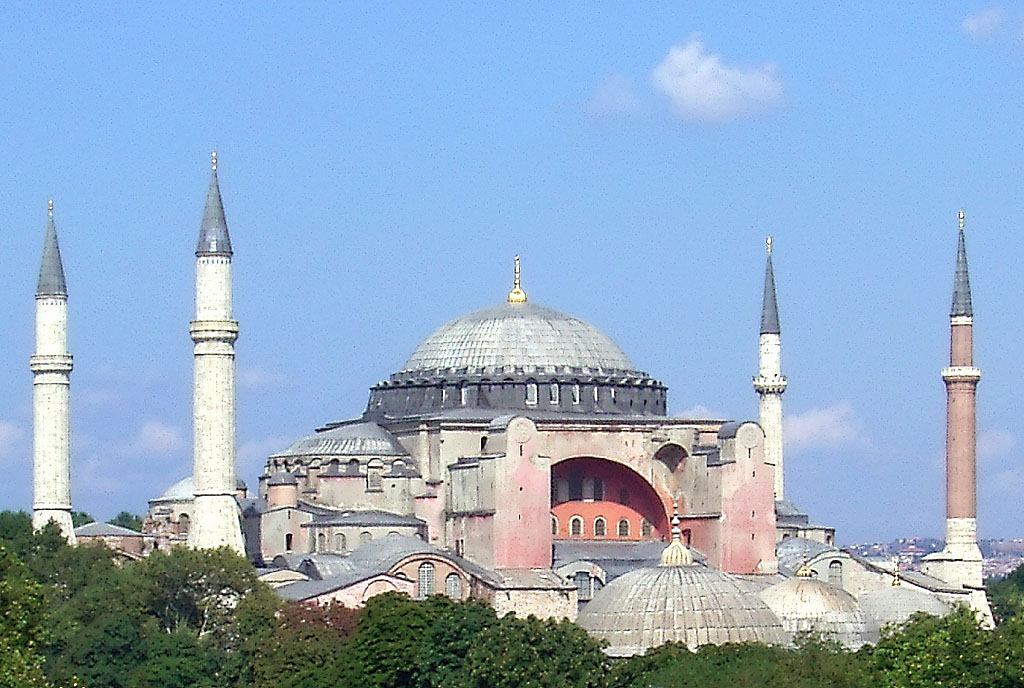
Hagia Sophia in the Faith district of Istanbul, 18 November 2004.
Photo by Robert Raderschatt via Wikimedia Commons.
The Americans who confess other people’s racism absolve themselves inexpensively by a moral mechanism common to humanity: the more I profess to hate evil, the more I showcase my own goodness. Such confessions, however, have a particular history of tragedy in Christian civilization. Again and again over the centuries, persons who have imagined themselves cleansed by ritual confessions have believed themselves elevated above the rest of humanity and, hence, entitled to oppress or even annihilate those around them. Today’s self-purifiers, arms outstretched in supine submission, who then countenance violence against persons, property, and cultural symbols, are mostly unwitting protagonists in yet another chapter of a hoary history.
Although Judeo-Christianity teaches that perfection is not of this world, nevertheless the Old Testament (see the Book of Daniel) and the New (Revelation, chapter 20) refer tangentially to a final state in human affairs in which all evil will have been defeated and the virtuous will have triumphed over their enemies. In the Book of Revelation, this final stage is to last for a thousand years. Jesus Christ’s warnings notwithstanding, people have hearkened periodically to “false prophets” who brandish the prospect of ultimate vengeance over evil. Between the 11th and 16th centuries, any number of movements of this sort used ritual confessions to cleanse themselves, and energized the mobs that waged Europe’s bloodiest wars of that age. Thereafter, though such movements secularized their terms, they fit into the same moral and intellectual categories. Now as ever, they are about destroying civilization in the name of altering the human condition.
But whereas revolutionary movements from the Middle Ages to roughly the middle of the 20th century opposed the ruling classes wholeheartedly and found no friends among them, this generation’s movements have intense, problematic relations with those classes, about which more below.
Today we see scenes of monuments which had stood for decades, now destroyed and defaced, as well as the forceful cancellation of names from circulation. Smashing others’ idols was, and remains, a staple of tribal warfare. The Old Testament recalls the divine command to destroy idols, and the clashes between Christian and Muslim armies always aimed as much at symbols as at people. The Song of Roland contains a lyrical account of Charlemagne’s iconoclasm in his campaign against the Saracens. In the 6th century, Emperor Justinian made Constantinople’s Hagia Sophia cathedral the Christian world’s biggest and most important church. The Muslims who added that city to the Ottoman Empire in 1453 killed its priests, toppled its statues, and made it into the principal mosque of the Muslim caliphate at war with Christendom. In 1923, Kemal Atatürk, Turkey’s modernizer, turned the building into a museum in order to end that war. But in July 2020 Turkey’s Islamist president Recep Erdogan, consistent with his hostility to Judeo-Christian civilization, turned it into a mosque again and began covering up what remain of the Christian frescoes on its walls. Destroying symbols, however, has had no place within Christian civilization. As the equivalent of torturing dead men, it has always been the work of cowards likelier to run from living enemies. On the other hand, war against statues, paintings, books, biographies, etc., has been a defining feature of civilization’s revolutionary enemies, consistent with their chosen identities as alien tribes.
What follows is a glance at the bloody history of this little-known flaw. It is a tale whose cautionary moral Aleksandr Solzhenitsyn best expressed: the line between good and evil runs not between persons — never mind between parties, classes, or races — but down the middle of every human heart. That is central to our civilization.
H/T to David Warren for the link.
August 6, 2020
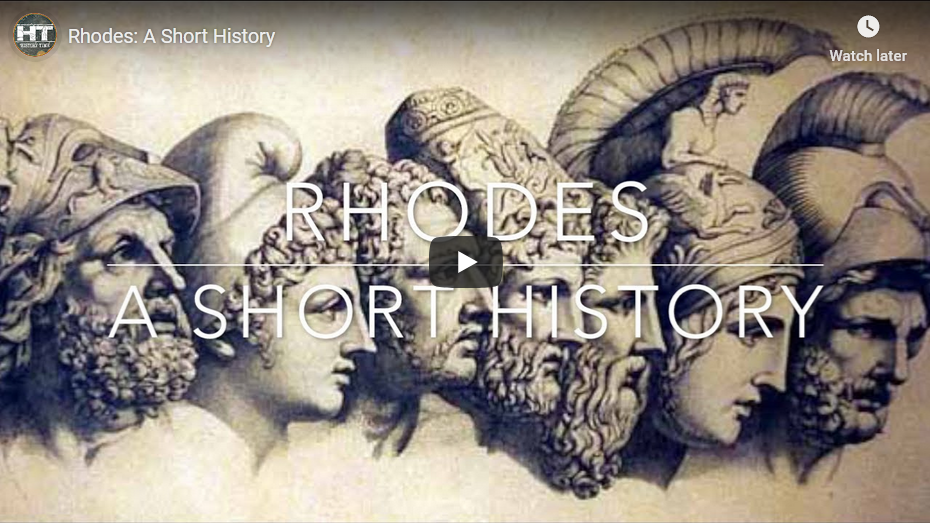
Rhodes: A Short History
History Time
Published 2 Mar 2017*****This was one of the first videos I ever made.
******Subscribe for much better narration on the newer videos and tons more historical awesomeness*****Situated at a crossroads between East and West, in a strategic location between the Aegean and the Mediterranean, Rhodes has long been fought over by the surrounding powers. As a result, Rhodes is one of the most historic sites on Earth.
If you liked this video and have as little as a dollar to spare then please consider supporting me on Patreon for more and better content in the future:- http://www.patreon.com/historytimeUK
Are you a budding artist, illustrator, cartographer, or music producer? Send me a message! No matter how professional you are or even if you’re just starting out, I can always use new music and images in my videos. Get in touch! I’d love to hear from you.
I’ve also compiled a reading list of my favourite history books via the Amazon influencer program. If you do choose to purchase any of these incredible sources of information, many of which form the basis of my videos, then Amazon will send me a tiny fraction of the earnings (as long as you do it through the link) (this means more and better content in the future) I’ll keep adding to and updating the list as time goes on:-
https://www.amazon.com/shop/historytimeI try to use copyright free images at all times. However if I have used any of your artwork or maps then please don’t hesitate to contact me and I’ll be more than happy to give the appropriate credit.
—Join the History Time community on social media:-
Instagram:-
https://www.instagram.com/historytime…
Twitter:-
https://twitter.com/HistoryTimePete
July 31, 2020
Xi Jinping and the “Chinese dream”
Zineb Riboua outlines possible ways for the West to counter ongoing Chinese economic espionage:
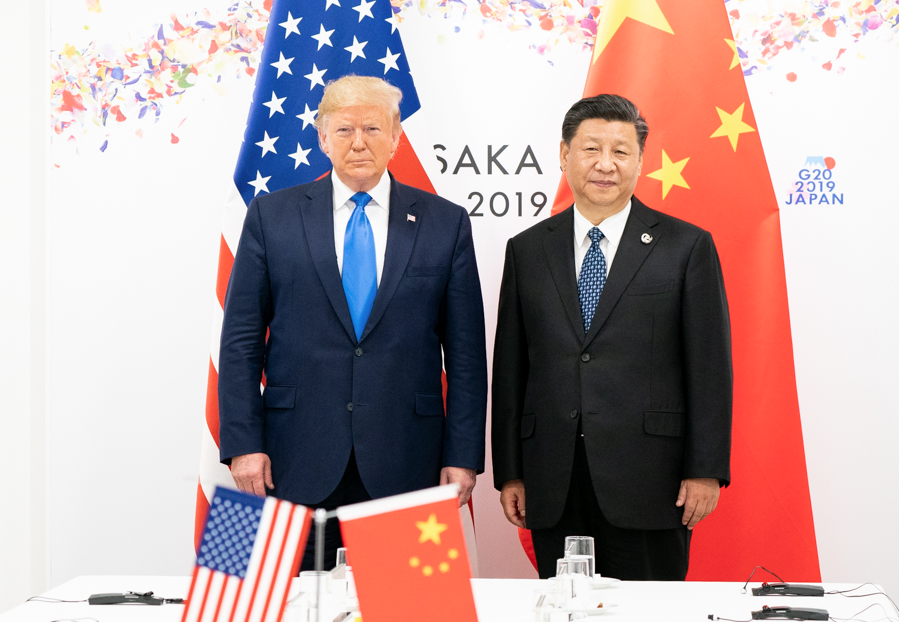
President Donald Trump and PRC President Xi Jinping at the G20 Japan Summit in Osaka, 29 June, 2019.
Cropped from an official White House photo by Shealah Craighead via Wikimedia Commons.
Since 2012, Chinese President Xi Jinping’s favourite catchphrase has been “the Chinese dream”. In stark contrast to the evil, capitalistic American dream, Xi’s alternative vision of progress teaches that the only route to prosperity is through rigid adherence to collectivist ideology.
The Chinese state embodies a very particular ideology. Over the last few decades, it has aggressively ramped up its economic and political capital through business and enterprise, inextricably tying itself to the economic fortunes of both developed and developing countries. It is now seeking to use the economic capital it has accumulated to force its political agenda into reality.
That is why the role of private companies in China is unparalleled. Milton Friedman defined corporate social responsibility in terms of private companies’ sole duty to make a profit, and then increase that profit. Chinese companies appear to be exempt from this rule because they interact with the state in a unique and troubling way.
The current state of the Chinese political and economic landscape is no accident. When Deng Xiaoping spoke in the 1980s of building a “socialism with Chinese characteristics”, this is probably exactly what he had in mind. The Chinese Communist party has succeeded in weaponising local market forces in such a way that it now holds all the cards in its nation’s dealings with the outside world, both political and economic, because the line between the public and the private is non-existent.
This strategy has not gone unnoticed. Thanks to the Chinese Communist party’s recent conduct – unprecedented aggression in Hong Kong, the appalling genocide of the Uyghur people and a costly unwillingness to share information relating to the coronavirus outbreak – the state of its internal affairs has come into sharp focus on the international stage.
Unsurprisingly, the hawkish US has placed itself at the forefront of counter-Chinese rhetoric. Secretary of state Mike Pompeo said recently: “We gave the Chinese Communist party and the regime itself special economic treatment, only to see the CCP insist on silence over its human rights abuses as the price of admission for Western companies entering China.”
July 5, 2020
Andrew Sullivan – “There is no doubt at this point that communist China is a genocidal state”
In his latest column, Andrew Sullivan discusses China’s latest outrages against groups within China:
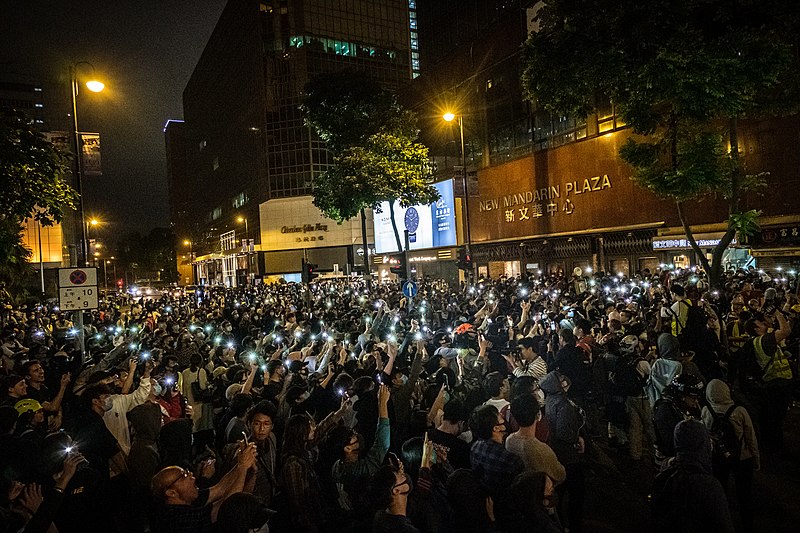
Protest against the Chinese government in Hong Kong, 25 November 2019.
Photo by Studio Incendo via Wikimedia Commons
Genocide is not measured simply by the number of human beings in a demographic group who have been killed. Such numbers vary. The pogroms in Europe of the 14th century killed far, far fewer Jews than died in the 20th-century Holocaust, but it would be crazy not to see a very similar eliminationist impulse. It’s the genocidal intent that defines a genocide. The United States Holocaust Memorial Museum defines it as “the intent to destroy, in whole or in part, a national, ethnic, racial, or religious group.” Their definition includes the following five categories:
- Killing members of the group.
- Causing serious bodily or mental harm to members of the group.
- Deliberately inflicting on the group conditions of life calculated to bring about its physical destruction in whole or in part.
- Imposing measures intended to prevent births within the group.
- Forcibly transferring children of the group to another group.
There is no doubt at this point that communist China is a genocidal state. The regime is determined to coerce, kill, reeducate, and segregate its Uighur Muslim population, and to pursue eugenicist policies to winnow their ability to sustain themselves. The Associated Press just published an exhaustive and chilling account of the extent of the campaign, which was reportedly supported and seconded by the president of the United States when speaking with President-for-life Xi.
We already know about the reeducation camps. We found out this week the grisly detail that China may even have been exporting human-hair products taken from Uighur political prisoners in those camps. What the AP helps us better understand is how the regime is forcibly sterilizing Uighur women inside and outside the camps, attempting to control the Uighur population by assaulting basic reproductive freedom. Uighur families with multiple children are now in danger of being sent to camps for the crime of bringing Uighur kids into the world: “Time in a camp — what the government calls ‘education and training’ — for parents with too many children is written policy in at least three counties, notices found by [scholar Adrian] Zenz confirmed. In 2017, the Xinjiang government also tripled the already hefty fines for violating family planning laws for even the poorest residents — to at least three times the annual disposable income of the county.”
And the campaign of terror is working: “Birth rates in the mostly Uighur regions of Hotan and Kashgar plunged by more than 60% from 2015 to 2018, the latest year available in government statistics. Across the Xinjiang region, birth rates continue to plummet, falling nearly 24% last year alone — compared to just 4.2% nationwide, statistics show.” In the Uighur city of Hotan, over a third of all married women of childbearing age were sterilized in 2019 alone. And this is taking place in the context of a new campaign to increase the fertility and offspring of the majority Han Chinese. This is pure racial social engineering.
This genocidal dictatorship also took this past week to stomp all over what’s left of freedom in Hong Kong. Just before the anniversary of the end of British rule in Hong Kong, Beijing has introduced a new security law that all but eviscerates any freedom for dissent in the former British colony. It renders a variety of offenses that involve pro-democracy activism and criticism of the regime punishable by up to a lifetime in jail. The law is deliberately vague, was passed with no input from Hong Kong’s own government before its details were revealed, and criminalizes offenses such as “secession, subversion against the central Chinese government, terrorism, and colluding with foreign forces.”
The effect has been immediate: Key members of a leading dissident group, Demosisto, resigned, and the party has been disbanded. Throughout Hong Kong, businesses that had posted messages of support for the pro-democracy forces are swiftly removing them. People are deleting their social-media accounts for fear of imprisonment. A BBC reporter notes the immediate impact: “One contact of mine, a lawyer and human-rights activist, sent me a message shortly after the law was passed. ‘Please delete everything on this chat,’ he wrote.”
History Summarized: Colonial India
Overly Sarcastic Productions
Published 4 Jul 2020Start your free trial at http://squarespace.com/overlysarcastic and use code
OVERLYSARCASTICto get 10% off your first purchase.Indian History has always been a story of peoples coming and going, but the subcontinent’s modern history takes that up to 11, with the arrival of Central Asian Mughals and boatloads of Europeans. See how India transforms from Medieval to Modern in this final act of our History of India.
SOURCES & Further Reading: The Discovery of India by Jawaharlal Nehru, A History of India by Michael H. Fisher (a lecture series by The Great Courses).
This video was edited by Sophia Ricciardi AKA “Indigo”. https://www.sophiakricci.com/
Our content is intended for teenage audiences and up.Special thanks to Varda Alighieri for coaching me through my (hopefully serviceable) pronunciations!
PATREON: https://www.Patreon.com/OSP
MERCH LINKS: https://www.redbubble.com/people/OSPY…
OUR WEBSITE: https://www.OverlySarcasticProductions.com
Find us on Twitter https://www.Twitter.com/OSPYouTube
Find us on Reddit https://www.Reddit.com/r/OSP/
June 4, 2020
QotD: Islamofascism
Dislike of George Bush’s foreign policy has led to an automatic support of those perceived to be his enemies. Paradoxically, this leaves the left defending people who hold beliefs that condone what the left has long fought against: misogyny, homophobia, capital punishment, suppression of freedom of speech. The recent reaffirmation by Iran’s Ayatollah Khamenei of the fatwa against Salman Rushdie has been met by virtual silence; as has the torture and murder in Iraq of a man who would be presumed to be one of the left’s own — Hadi Salih, the international officer of the Iraqi Federation of Trade Unions. The hard left these days is soft on fascism, or at least Islamofascism.
The religious right in America would, if it could, wind back access to abortion and some other women’s rights. But as far as I am aware, no Christian fundamentalist in the US has suggested banning women from driving cars, or travelling without their husbands’ permission, or forcing them to cover their faces. Contrary to popular opinion, one is not the same as the other.
Pamela Bone, “The silence of the feminists”, The Age, 2005-02-04
May 3, 2020
QotD: Tragic cultural misunderstandings
It’s one of those cultural traps which I have read about and which are tragic.
I think I’ve spoken before of the tragic encounter between Zulu and Boers in South Africa. Zulus were doing what they did that had won them Africa (they came from central Africa shortly before the whites arrived): Commit incredibly scary atrocities so the enemy runs/avoids combat/submits. The whites were in their head just another tribe. They could not understand the idea of a “tribe” that was starting to span the globe and which would self-identify as “tribe” in the face of a savage. So their savagery made the Europeans MORE determined to wipe them out.
We’re seeing something like that, again. Islamic CULTURES are big on bragging, exaggeration of force and intimidation of the enemy. This is functional in a desert where there’s always a lot of low-level “war.” Some atrocities, scare “the enemy” and you keep your patch, and you go on. They have a fine tuned ear for this. When the other tribe isn’t committing atrocities against YOU and particularly when they’re being appeasing/accommodating, you have them over a barrel. If you strike with showy force you can take their stuff and enslave them. NOTE most of the attacks are designed to be showy.
TWO things they don’t get: Our elites are appeasing because the elites think they’re SO powerful they can’t be touched and are oikophobes who hate their own people. AND our PEOPLE is pissed, really pissed.
You know the old joke? There are no Muslims in Star Trek because it’s set in the future.
This is unfortunately the likely outcome of the cultures meeting. At some point (already happening) the elites will have to fight or be replaced. And when we go to war, our power is incalculable compared to them. They think we exaggerate our strength, while, culturally, we underplay it. They don’t understand we’re holding back.
The result will be a horrific destruction of guilty and innocent alike and even people like me who look Arab/Mediterranean in a bad light will be at risk.
And they will be the victims of genocide.
Sarah Hoyt, “Cross-Culture”, According to Hoyt, 2017-03-23.
April 27, 2020
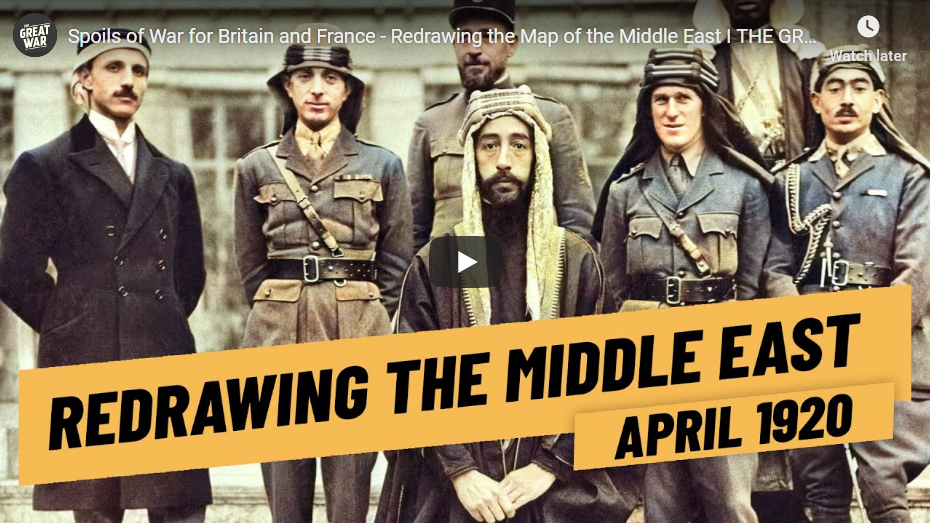
Spoils of War for Britain and France – Redrawing the Map of the Middle East I THE GREAT WAR 1920
The Great War
Published 25 Apr 2020Sign up for Curiosity Stream and Nebula – and get 40% off annual plans right now: https://curiositystream.com/thegreatwar
100 years ago at the conference of San Remo, one thing became clear: Great Britain and France wanted control over the Middle East. Justified by the fighting in the previous years and painted as “liberators” of the Middle Eastern minorities, the new map of the Middle East emerged – under the cover of the League of Nations Mandate system.
» SUPPORT THE CHANNEL
Patreon: https://www.patreon.com/thegreatwar
Merchandise: https://shop.spreadshirt.de/thegreatwar/» SOURCES
Karsh, Efraim & Karsh, Inari, Empires of the Sand: The Struggle for Mastery in the Middle East 1789-1923, (Cambridge, MA : Harvard University Press, 1999)“Dans Le Levant” Le Temps, August 31, 1919 issue, https://gallica.bnf.fr/ark:/12148/bpt…
Lloyd George, David, Memoirs of the Peace Conference, (New Haven : Yale University Press, 1939) vol. 2
“Mounted Rifles Units” New Zealand History, https://nzhistory.govt.nz/war/aucklan…
Paris, Timothy J. Britain, The Hashemites and Arab Rule 1920-1925, (London : Frank Cass, 2003)
Provence, Michael, The Last Ottoman Generation and the Making of the Modern Middle East, (Cambridge : Cambridge University Press, 2017)
O’Neill, Robert, Official History of Australia in the War of 1914–1918, Volume VII – The Australian Imperial Force in Sinai and Palestine, 1914–1918, (Australian War Memorial, 1941)
“King-Crane Commission Digital Collection” Oberlin College Library. http://dcollections.oberlin.edu/cdm/s…
» SOCIAL MEDIA
Instagram: https://instagram.com/the_great_war
Twitter: https://twitter.com/WW1_Series
Reddit: https://reddit.com/r/TheGreatWarChannel»CREDITS
Presented by: Jesse Alexander
Written by: Jesse Alexander
Director: Toni Steller & Florian Wittig
Director of Photography: Toni Steller
Sound: Toni Steller
Editing: Toni Steller
Mixing, Mastering & Sound Design: http://above-zero.com
Maps: Daniel Kogosov (https://www.patreon.com/Zalezsky)
Research by: Jesse Alexander
Fact checking: Florian WittigChannel Design: Alexander Clark
Original Logo: David van StepholdA Mediakraft Networks Original Channel
Contains licensed material by getty images
All rights reserved – Real Time History GmbH 2020
April 9, 2020
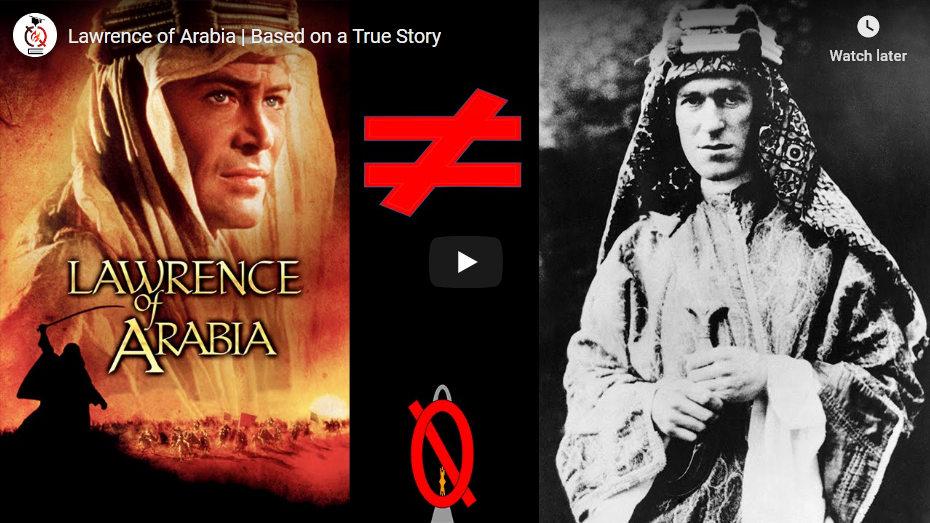
Lawrence of Arabia | Based on a True Story
The Cynical Historian
Published 6 Nov 2015The classic film Lawrence of Arabia, is one of the most beautiful movies of all time, but it has its flaws.
————————————————————
references:
https://en.wikipedia.org/wiki/Lawrenc…http://www.wordandfilm.com/2013/08/wh…
http://www.pri.org/stories/2013-12-16…
most beautiful movies list:
https://www.youtube.com/watch?v=kj73a…
————————————————————LET’S CONNECT:
https://twitter.com/Cynical_History
————————————————————
wiki:
Lawrence of Arabia is a 1962 epic historical drama film based on the life of T. E. Lawrence. It was directed by David Lean and produced by Sam Spiegel through his British company Horizon Pictures, with the screenplay by Robert Bolt and Michael Wilson. The film stars Peter O’Toole in the title role. It is widely considered one of the greatest and most influential films in the history of cinema. The dramatic score by Maurice Jarre and the Super Panavision 70 cinematography by Freddie Young are also highly acclaimed.
The film was nominated for ten Oscars at the 35th Academy Awards in 1963; it won seven in total: Best Picture, Best Director, Best Original Score, Best Cinematography (Color), Best Art Direction (Color), Best Film Editing and Best Sound Mixing. It also won the Golden Globe Award for Best Motion Picture – Drama and the BAFTA Awards for Best Film and Outstanding British Film.The film depicts Lawrence’s experiences in the Arabian Peninsula during World War I, in particular his attacks on Aqaba and Damascus and his involvement in the Arab National Council. Its themes include Lawrence’s emotional struggles with the personal violence inherent in war, his own identity, and his divided allegiance between his native Britain and its army and his new-found comrades within the Arabian desert tribes. As well as O’Toole, the film stars Alec Guinness, Jack Hawkins, Anthony Quinn, Omar Sharif, Anthony Quayle, Claude Rains and Arthur Kennedy.
————————————————————
Hashtags: #History #LawrenceOfArabia #WWI #Review #BasedOnATrueStory
March 31, 2020
Third Crusade | 3 Minute History
Jabzy
Published 25 Jul 2015Thanks to Xios, Alan Haskayne, Lachlan Lindenmayer, William Crabb, Derpvic, Seth Reeves and all my other Patrons. If you want to help out – https://www.patreon.com/Jabzy?ty=h
March 19, 2020
Second Crusade | 3 Minute History
Jabzy
Published 14 May 2015Thanks for the 5,000 subs
March 14, 2020
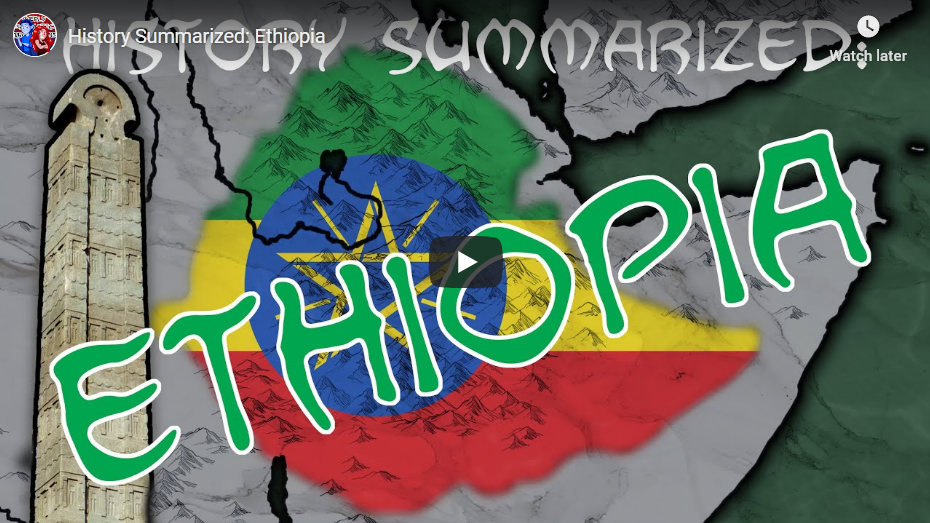
History Summarized: Ethiopia
Overly Sarcastic Productions
Published 13 Mar 2020Ethiopian History gets started early and just keeps on going. From the dawn of humanity itself through the medieval period and into the modern day, the history of the kingdom at the end of the Blue Nile is full of surprises.
SOURCES & Further Reading: Harold Marcus A History of Ethiopia and John Jackson’s Ethiopia and the Origins of Civilization, see also Kenneth Vickery’s lecture “Ethiopia: Outpost of Christianity” and William Cook’s lecture “The Rock-Hewn Churches of Ethiopia” via The Great Courses.
This video was edited by Sophia Ricciardi AKA “Indigo”. https://www.sophiakricci.com/
Our content is intended for teenage audiences and up.
PATREON: https://www.Patreon.com/OSP
DISCORD: https://discord.gg/h3AqJPe
MERCH LINKS: https://www.redbubble.com/people/OSPY…
OUR WEBSITE: https://www.OverlySarcasticProductions.com
Find us on Twitter https://www.Twitter.com/OSPYouTube
Find us on Reddit https://www.Reddit.com/r/OSP/
March 5, 2020
First Crusade | 3 Minute History
Jabzy
Published 20 Mar 2015I will try and cover the other Crusades soon