Quotulatiousness

February 27, 2019

First Crusade Part 1 of 2

Filed under: Europe, History, Middle East, Military, Religion — Tags: , , , , — Nicholas @ 02:00

Epic History TV
Published on 13 Jan 2017

The First Crusade was one of the most extraordinary, bloody and significant episodes in medieval history. It began with an appeal for aid from the Christian Byzantine Empire, threatened by the rising power of the Muslim Seljuk Turks. But when Pope Urban II preached a sermon at Clermont in 1095, the result was unlike anything ever seen before. The Pope offered spiritual salvation to those willing to go east to aid their fellow Christians in a holy war, and help liberate Jerusalem from Muslim rule. Knights and peasants alike signed up in their thousands, leading to the disastrous People’s, or Peasants’, Crusade, then to a much more organised and powerful Princes’ Crusade. Their forces gathered at Constantinople, where they made an uneasy alliance with Byzantine Emperor Alexius I Comnenus. Entering Anatolia, they helped to win back the city of Nicaea, then won a decisive but hard-fought victory at Dorlyaeum, before marching on the great city of Antioch…

Produced in partnership with Osprey Publishing
https://ospreypublishing.com/

Campaign: The First Crusade 1096–99
https://ospreypublishing.com/the-firs…

Essential Histories: The Crusades
https://ospreypublishing.com/the-crus…

The Armies of Islam 7th–11th Centuries
https://ospreypublishing.com/the-armi…

Armies of the Crusades
https://ospreypublishing.com/armies-o…

Music with thanks to Filmstro: https://www.filmstro.com/
Get 20% off an annual license! Use our exclusive coupon code: EPICHISTORYTV_ANN

Image credits – via Flickr under Creative Commons CC-BY-SA 2.0
Sky – Anyul Rivas
Wooded Hills – Alexander Annenkov
Dramatic Fields – Antonio Caiazzo
Twin peaks of Mount Ararat – Adam Jones

Please help me make more videos at Patreon: https://www.patreon.com/EpicHistoryTV

February 16, 2019

QotD: The attraction of Islam to would-be converts

Filed under: Quotations, Religion — Tags: , , — Nicholas @ 01:00

… humans are hierarchical apes who crave rules. The astonishing number of western converts to Islam (astonishing considering what Islam is as a way of life) particularly the women shows the craving for rules, spoken and unspoken is far stronger than rationality. And the fact that young men aren’t converting en masse to Islam (which gives them a much greater power than any western culture) means some traces of Noblesse Oblige remain. The idea of keeping your women imprisoned and veiled for their protection; the idea that those other men will of course rape them and hurt them; the idea that strange women are fair game, are still revolting and repulsive to men who were told “never hit a girl. Never, ever, ever” as little boys.

Sarah Hoyt, “Noblesse Oblige and Mare’s Nests”, According to Hoyt, 2015-05-05.

January 25, 2019

The Greco-Turkish War and Legalisation of Ethnic Cleaning | Between 2 Wars | 1922 Part 2 of 2

TimeGhost History
Published on 24 Jan 2019

When the Ottoman empire is torn apart by the Treaty of Sevres, ethnic conflicts in the old empire that have been boiling for almost a century lead to war between Greece and the parts of the Empire that will soon become the Republic of Turkey. A war that will have lasting effect on the world as both sides proceed to carry out stunning actions of ethnic violence, which is shockingly also sanctioned by international treaty after the fact.

Special thanks to Jonas Yazo Srouji and Valantis Athanasiou, who helped us with the research and image research for this episode. This behemoth of an episode is with 27 minutes the longest Between Two Wars episode yet. We really wanted to do the events justice. To deliver an unbiased, full telling of this eventful and controversial part of history, we couldn’t and didn’t want to make it any shorter.

An important note about the difference between ‘nationality’ and ‘ethnicity’: While ‘nationality’ is merely the relationship between an individual person and a state, someones ‘ethnicity’ depends on the racial, cultural, or religious group that a person is part of or identifies with. While these can overlap, they don’t necessarily have to.

Extra note: we recorded this way back in 2018, when our sound was not optimized. We apologise for the varying audio quality.

Cheers, Joram.

Join us on Patreon: https://www.patreon.com/TimeGhostHistory

Hosted by: Indy Neidell
Directed by: Spartacus Olsson
Written by: Spartacus Olsson
Produced by: Astrid Deinhard
Executive Producers: Bodo Rittenauer, Astrid Deinhard, Indy Neidell, Spartacus Olsson
Creative Producer: Joram Appel
Edited by: Wieke Kapteijns
Research by: Spartacus Olsson and Jonas Yazo Srouji and Valantis Athanasiou.

Thumbnail depicts Ataturk colorised by Olga Shirnina aka Klimbim.

Colorized Pictures by Olga Shirnina and Norman Stewart

Olga’s pictures: https://klimbim2014.wordpress.com
Norman’s pictures https://oldtimesincolor.blogspot.com/

Video Archive by Screenocean/Reuters http://www.screenocean.com

A TimeGhost chronological documentary produced by OnLion Entertainment GmbH

December 21, 2018

QotD: “Baby, it’s cold outside”

Filed under: History, Humour, Media, Middle East, Quotations, Religion, USA — Tags: , , , , — Nicholas @ 01:00

Speaking of immorality, MGM’s censors cut the wrong song. A few decades back, a young middle-class Egyptian spending some time in the US had the misfortune to be invited to a dance one weekend and was horrified at what he witnessed:

    The room convulsed with the feverish music from the gramophone. Dancing naked legs filled the hall, arms draped around the waists, chests met chests, lips met lips …

Where was this den of debauchery? Studio 54 in the 1970s? Haight-Ashbury in the summer of love? No, the throbbing pulsating sewer of sin was Greeley, Colorado, in 1949. As it happens, Greeley, Colorado, in 1949 was a dry town. The dance was a church social. And the feverish music was “Baby, It’s Cold Outside,” as introduced by Esther Williams in Neptune’s Daughter. Revolted by the experience, Sayyid Qutb decided that America (and modernity in general) was an abomination, returned to Egypt, became the leading intellectual muscle in the Muslim Brotherhood, and set off a chain that led from Qutb to Zawahiri to bin Laden to the Hindu Kush to the Balkans to 9/11 to the brief Muslim Brotherhood takeover of Egypt to the Islamic State marching across Syria and Iraq. Indeed, Qutb’s view of the West is the merest extension of “Baby, It’s Cold Outside” — America as the ultimate seducer, the Great Satan.

I’m a reasonable chap, and I’d be willing to meet the Muslim Brotherhood chaps halfway on a lot of the peripheral stuff like beheadings, stonings, clitoridectomies and whatnot. But you’ll have to pry “Baby, It’s Cold Outside” from my cold dead hands and my dancing naked legs. A world without “Baby, It’s Cold Outside” would be very cold indeed.

Mark Steyn, “Baby, It’s Cold Outside”, Steyn Online, 2014-12-01.

November 27, 2018

QotD: Gandhi’s view of India as a nation

Filed under: Africa, History, India, Quotations, Religion — Tags: , , , — Nicholas @ 01:00

No one questions that the formative period for Gandhi as a political leader was his time in South Africa. Throughout history Indians, divided into 1,500 language and dialect groups (India today has 15 official languages), had little sense of themselves as a nation. Muslim Indians and Hindu Indians felt about as close as Christians and Moors during their 700 years of cohabitation in Spain. In addition to which, the Hindus were divided into thousands of castes and sub-castes, and there were also Parsees, Sikhs, Jains. But in South Africa officials had thrown them all in together, and in the mind of Gandhi (another one of those examples of nationalism being born in exile) grew the idea of India as a nation, and Muslim-Hindu friendship became one of the few positions on which he never really reversed himself. So Gandhi — ignoring Arabs and Turks — became an adamant supporter of the Khilafat [Caliphate] movement out of strident Indian nationalism. He had become a national figure in India for having unified 13,000 Indians of all faiths in South Africa, and now he was determined to reach new heights by unifying hundreds of millions of Indians of all faiths in India itself. But this nationalism did not please everyone, particularly Tolstoy, who in his last years carried on a curious correspondence with the new Indian leader. For Tolstoy, Gandhi’s Indian nationalism “spoils everything.”

Richard Grenier, “The Gandhi Nobody Knows”, Commentary, 1983-03-01.

November 13, 2018

General Sir Charles Napier lived in vain

Filed under: Asia, Britain, Law, Liberty, Religion — Tags: , , , — Nicholas @ 03:00

Douglas Murray on the Asia Bibi case:

All of this is to say that the latest news from the U.K. is both thoroughly predictable and deeply disturbing. Readers of National Review will be familiar with the case of Asia Bibi. She is the Christian woman from Pakistan who has been in prison on death row for the last eight years. Her “crime” is that a neighbor accused her of “blasphemy.” […]

Her case has had ramifications throughout Pakistani society in the years since. For instance, it provoked the statement by the brave governor of Punjab, Salman Taseer, which led to his own murder by one of his own bodyguards. In the days since her release from jail, there have been mass protests in Pakistan where thousands of enraged fanatics have called, literally, for Asia Bibi’s head. The case has amply demonstrated the type of country that Pakistan is these days. But who would have guessed that her case would also throw so much light on the type of country Britain now is?

There are clearly international efforts underway to get Bibi out of Pakistan. If anybody in the world deserves asylum it is her. And any civilized country should be queuing up to give asylum to her and her family. Among those reported to have done so is the Netherlands.

But today there are reports that the British government has said that it will not offer asylum to Asia Bibi. The reason being “security concerns” — that weasel term now used by all officialdom whenever it needs one last reason to avoid doing the right thing. According to this report, the government is concerned that if the U.K. offered asylum to Bibi it could cause “unrest among certain sections of the community.” And which sections would that be? Would it be Anglicans or atheists who would be furious that an impoverished and severely traumatized woman should be given shelter in their country? Of course not. The “community” that the British government will be scared of is the community that comes from the same country that has tortured Asia Bibi for the last eight years.

So what’s the tie-in with General Sir Charles Napier? He was the governor of Sindh from 1843 to 1847. During his time in that office, he had opportunity to challenge certain long-established barbaric cultural practices:

Napier opposed suttee, or sati. This was the custom of burning a widow alive on the funeral pyre of her husband. Sati was rare in Sindh during the time Napier stayed in this region. Napier judged that the immolation was motivated by profits for the priests, and when told of an actual Sati about to take place, he informed those involved that he would stop the sacrifice. The priests complained to him that this was a customary religious rite, and that customs of a nation should be respected. As recounted by his brother William, he replied:

    “Be it so. This burning of widows is your custom; prepare the funeral pile. But my nation has also a custom. When men burn women alive we hang them, and confiscate all their property. My carpenters shall therefore erect gibbets on which to hang all concerned when the widow is consumed. Let us all act according to national customs.”

Britain could use another General Napier.

November 7, 2018

QotD: Gandhi and the fall of the Caliphate

Filed under: History, India, Quotations, Religion, WW1 — Tags: , , , , — Nicholas @ 01:00

… it should not be thought for one second that Gandhi’s finally full-blown desire to detach India from the British empire gave him the slightest sympathy with other colonial peoples pursuing similar objectives. Throughout his entire life Gandhi displayed the most spectacular inability to understand or even really take in people unlike himself — a trait which V.S. Naipaul considers specifically Hindu, and I am inclined to agree. Just as Gandhi had been totally unconcerned with the situation of South Africa’s blacks (he hardly noticed they were there until they rebelled), so now he was totally unconcerned with other Asians or Africans. In fact, he was adamantly opposed to certain Arab movements within the Ottoman empire for reasons of internal Indian politics.

At the close of World War I, the Muslims of India were deeply absorbed in what they called the “Khilafat” movement — “Khilafat” being their corruption of “Caliphate,” the Caliph in question being the Ottoman Sultan. In addition to his temporal powers, the Sultan of the Ottoman empire held the spiritual position of Caliph, supreme leader of the world’s Muslims and successor to the Prophet Muhammad. At the defeat of the Central Powers (Germany, Austria, Turkey), the Sultan was a prisoner in his palace in Constantinople, shorn of his religious as well as his political authority, and the Muslims of India were incensed. It so happened that the former subject peoples of the Ottoman empire, principally Arabs, were perfectly happy to be rid of this Caliph, and even the Turks were glad to be rid of him, but this made no impression at all on the Muslims of India, for whom the issue was essentially a club with which to beat the British. Until this odd historical moment, Indian Muslims had felt little real allegiance to the Ottoman Sultan either, but now that he had fallen, the British had done it! The British had taken away their Khilafat! And one of the most ardent supporters of this Indian Muslim movement was the new Hindu leader, Gandhi.

Richard Grenier, “The Gandhi Nobody Knows”, Commentary, 1983-03-01.

October 9, 2018

Kingdom of Majapahit – Changing Winds – Extra History – #5

Filed under: Asia, China, History, Religion — Tags: , , , , , — Nicholas @ 04:00

Extra Credits
Published on 6 Oct 2018

When Islam arrived in Indonesia, life changed — except within Majapahit, where court drama kept them focused on themselves and unaware of the visits and alliances between Admiral Zheng He and the Sultanate of Malacca — forming new powers in the southern seas.

Support us on Patreon! http://bit.ly/EHPatreon

As we finished this episode, an even more devastating earthquake and tsunami struck the island of Sulawesi. Once again we’ve linked two fundraising efforts—one international aid organization, and another for a local effort. Any help would be deeply appreciated.
https://secure2.oxfamamerica.org/page…
https://kopernik.info/en/donate/palu-…

September 27, 2018

“Oops” indeed!

Filed under: Asia, Cancon, Politics, Religion — Tags: , , , , — Nicholas @ 06:00

Colby Cosh has a bit of good-natured fun-poking at the great and the good of the Canadian Establishment as an honorary Canadian turns out to be presiding over something that might be described as genocide:

President Barack Obama and Aung San Suu Kyi in 2014
Photo via Wikimedia Commons

Sometimes I am convinced that Canada is a name that will endure through the ages and travel with mankind throughout the galaxy. Sometimes I am convinced that we should be considered exclusively as a subject for absurdist fairy tales, a real-life Ruritania or Grand Fenwick. I guess it goes about 50-50. But I am afraid the emerging controversy over Aung San Suu Kyi’s honorary Canadian citizenship puts us firmly in kooky Zembla territory.

The present State Counsellor of Burma was the fourth person ever to receive this distinction. Now we are talking about withdrawing her honorary citizenship because, as first minister of Burma, she has been heavily implicated in massacres and ethnic cleansing of the Muslim Rohingya people of the country’s Rakhine state.

One in four: not such a great batting average, is it? Our political class devised the highest and most permanent form of honour that could be envisioned for a foreign do-gooder, and literally the fourth person on the entire surface of the planet who was deemed to have met the criteria went and became CEO of a genocide. What does this suggest about the collective judgment of Canada’s elite? You don’t suppose anyone is going to lose a job over this, do you?

[…]

Our prime minister is now spitballing the idea of having Aung San Suu Kyi’s honorary citizenship withdrawn, and one supposes that if this might help save innocent lives, it ought to be considered, even at the price of turning this concocted showpiece institution of “honorary citizenship” into garbage. One of the essential meanings of citizenship is that it cannot be withdrawn, even with due process, even when a citizen has perpetrated unspeakable crimes. “Honorary citizenship” does not confer the legal rights of the real thing, but surely it is at least supposed to resemble the real thing — to represent a commitment of analogous significance and irreversibility as that which we enter into with immigrants taking the oath and joining the club over at the courthouse.

Since honorary citizenship is not conferred by Parliament, it is not clear that it could be revoked by Parliament. Probably an Order-in-Council would do (because, again, no enforceable rights are at stake). If this is done in the case of Aung San Suu Kyi, it seems obvious that we should just put the institution in abeyance for a century or so. Let later generations see if they can manage not to screw up this honorary citizenship thing so thoroughly.

September 16, 2018

Early Arab Conquests | 3 Minute History

Filed under: History, Middle East, Military, Religion — Tags: , , , , — Nicholas @ 02:00

Jabzy
Published on 13 Dec 2015

Covering the conquests during the Rashidun Caliphate. I will probably do a separate video on the First Fitna.

Thanks for the 15,000 subs. And thanks to Xios, Alan Haskayne, Lachlan Lindenmayer, Derpvic, Seth Reeves and all my other Patrons. If you want to help out – https://www.patreon.com/Jabzy?ty=h

August 31, 2018

How did Britain Conquer India? | Animated History

Filed under: Britain, History, India, Religion — Tags: , , , — Nicholas @ 02:00

The Armchair Historian
Published on 10 Aug 2018

Check out History With Hilbert: https://www.youtube.com/watch?v=Hs1sw…

Our Patreon: https://www.patreon.com/armchairhistory

Our Twitter: https://twitter.com/ArmchairHist

Sources:
https://dailyhistory.org/Why_was_Brit…
1857 Indian War of Independence: 1857 Indian Sepoys’ Mutiny, Shahid Hussain Raja
The East India Company, Brian Gardner
The Corporation that Changed the World: How the East India Company Shaped the Modern Multinational, Nick Robins
A History of India, Peter Robb

August 13, 2018

Blasphemy in modern Britain

Filed under: Britain, Law, Liberty, Religion — Tags: , , , , , — Nicholas @ 05:00

Once upon a time, blasphemy was prosecuted by the Crown as an attack on the very basis of English law: “[blasphemy] law is needed to uphold the national law, which is based on Christianity. Thus, targeting Christianity is targeting the very foundation of England.” The last successful prosecution was in 1977. Modern prosecutions for blasphemy do not get filed under the old law, but the mechanism of the police, the courts, and the media are directed against those who dare to insult one particular faith:

Religious freedom is one of the core principles of any modern liberal society. As a secularist, I defend the right of religious people to send their children to faith schools, have their children circumcised, or wear the burqa. This does not mean I approve of any of these practices; they should be permissible but not protected from criticism. We should be free to ridicule, lampoon, chastise, critique, etc. every aspect of religious belief that we tolerate.

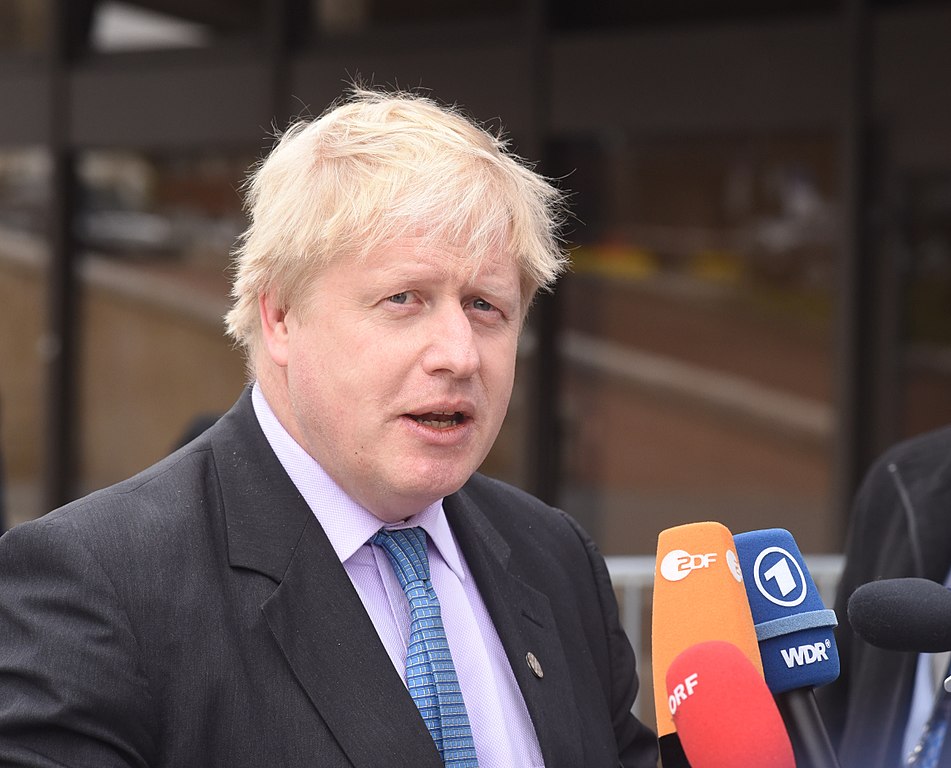
This is, more or less, what the U.K.’s former Conservative Foreign Secretary Boris Johnson wrote in his now infamous newspaper column in the Telegraph last week. Yet all hell has broken loose. It was greeted by near-hysterical outrage and shrill denunciations of Johnson’s alleged dog whistle racism; reports of civil war in the Tory Party over the matter; the now ubiquitous demands for an apology for causing offence (or else), which was backed in this instance by the Prime Minister. Boris’s is now the subject of an internal Party inquiry. It’s worth untangling this sorry tale as a snap-shot of today’s offence culture and how chilling it can be to a free society.

Johnson has been ‘called out’ as Islamophobic for arguing against – yes against – a ban on the burqa and for defending – yes defending – the right of any “free-born adult woman” to wear what she wants “in a public place, when she is simply minding her own business”. His column is predominantly an excoriating critique of Denmark’s betrayal of its own “spirit of liberty” and “the spirit of Viking individualism” by its decision to impose a state ban on the burqa or niqab (although he is not being indicted for caricaturing Danish culture). He rightly notes that being opposed to a ban should not be interpreted as approval and goes on to say – albeit in a somewhat crass manner – that “Muslim head-gear that obscures the female face… looking like letterboxes… like a bank robber…is absolutely ridiculous”.

As similes go, no doubt Boris could have been more tactful. I am no fan of BoJo-style private school wit. Indeed, I can understand that veil-wearing Muslim women – whom myriad journalists throughout the country have stopped on streets to ask if they like being compared to criminals or inanimate objects – would find the analogy offensive. But should all political comment on religion have to pass an offense test to be allowed? I am pretty sure that my two aunts – who are Catholic nuns – would be pretty offended if they heard my atheist mates’ denouncing as backward mumbo-jumbo a religion that believes the host and wine is literally the body and blood of Christ. But that’s the deal – a free society affords religious tolerance for nuns, imams, rabbis; and conversely liberty for others to stick the metaphorical boot into their beliefs.

Are Boris’s critics demanding respect for all religious practices regardless of whether they consider them backward, wrong-headed, or oppressive? Should we bite our lip in case we offend? We seem to have forgotten that we once all declared #JeSuisCharlie – a brief but inspiringly unapologetic defense of free speech after cartoonists for the satirical magazine Charlie Hebdo were brutally butchered in Paris for daring to publish cartoons deemed offensive to Islam. Should they have shut up until they learned to become more tactful?

Naturally, cheap sectarian Tory-bashing has driven some of the outrage. Supporters of the Labour Party, recently afflicted by an anti-Semitism scandal that is still rumbling on, were quick to denounce the “gross Islamophobia” in the article, even though criticism of the burqa has been commonplace in Labour and feminist ranks over the years. Emily Thornberry, Labour’s Shadow Secretary of State for Foreign and Commonwealth Affairs (and Boris’s shadow until his recent resignation), declared on BBC’s Question Time in 2013 that “I wouldn’t want my four-year-old looked after by somebody wearing a burka. I wouldn’t want my elderly mum looked after by somebody wearing a burka. They need to be able to show their face. I wouldn’t mind if they worked in records in the hospital.”

August 7, 2018

QotD: Sailing past Byzantium

Filed under: Europe, History, Middle East, Quotations — Tags: , , , , — Nicholas @ 01:00

To those who know nothing about the mediaeval, “byzantine” East of Christendom (and what do I know about anything?) a book by the respectable Oxford scholar, Averil Cameron, is worth mentioning. It is a short survey of developments in her academic field, entitled, Byzantine Matters (2014). It poses five basic questions on which our common assumptions are mostly wrong, and provides succinct directions for thinking again.

Mediaeval Greece, the Byzantine dynasties, and Orthodox Christianity: these are far from interchangeable concepts. Moreover, “Byzantine art” — the focus of enthusiasm in the anglosphere through the last century or so — is misunderstood. The term “Byzantine” itself — conceived from late antiquity as a deprecation — persists in the academy as an intelligence neutralizer. The vanity of “the West” gets in the way of appreciating a parallel Christian realm, which flourished for more than a thousand years, and never succumbed to the Arabs. (It finally succumbed to the Turks.) We disdain what amounts to an alternative universe of Christian witness and high culture, of great variety and depth, even more obtusely than we disdain our own Middle Ages.

We are narrowed and prejudiced by the attitudinizing of Edward Gibbon, and the inheritance (or disinheritance) of our Western “Enlightenment,” to view as backward a civilization in most ways superior to our “modern” own, from pride in the tinsel of technology. From AD 330 (the founding of Constantine’s capital) to 1453 (when it fell into Ottoman hands), we see only a continuous story of “decline.” But there were many declines over this vast period, and in the intervals between them, many recoveries.

David Warren, “Sailing past Byzantium”, Essays in Idleness, 2016-11-07.

July 13, 2018

Lee Kuan Yew and the Muslim minority in Singapore

Filed under: Asia, Politics, Religion — Tags: , , — Nicholas @ 03:00

I must admit that I know very little about Singapore’s late long-serving Prime Minister, or that he’d been quite outspoken in his views on Islam and how Muslims must fit in to Singapore’s future (and not the other way around):

Singapore has been in the news for other reasons recently, but its appearance on the world stage, however brief, may provide us with an excuse to consider the views on Islam of the founding father of Singapore, and its longest-serving Prime Minister, Lee Kuan Yew, who died in 2015. Lee Kuan Yew lived in a multicultural city, with a Chinese majority and Indian and Muslim Malay minorities. All his political life, Lee Kuan Yew was aware of the need to keep the Muslim population in check. The laws he had passed, the regulations he enforced, were directed in large part to that end. He knew about Muslim efforts to convert others, and he made sure that any convert had to immediately register with the government, so such efforts could be monitored, and then countered, by the government. A study of all the ways that Lee Kuan Yew dealt with Muslims, and took careful note of, and combated, their natural aggressiveness and political machinations in tiny Singapore, an island of mostly Unbelievers — 3/4 of whom are Chinese — in a Muslim sea, should be instructive for Western leaders, who have the same problem and as yet only timid and confused ideas as to how to solve it.

Wikileaks revealed that Lee Kuan Yew had called Islam “a venomous religion.” He made sure to limit the numbers of Muslims in Singapore’s armed forces, suggesting their religion made them a possible danger to their non-Muslim fellow soldiers. In his “The Malays in Singapore,” he wrote that “if, for instance, you put in a Malay officer who’s very religious and who has family ties in Malaysia in charge of a machine gun unit, that’s a very tricky business.” It was under his leadership that the government instituted a ban on hijabs and other Muslim headscarves in both the police forces and nursing jobs. Lee Kuan Yew also substantially reduced government funding for madrasas, while increasing support for secular education. His government carefully monitored the mosques, both for the content of the imam’s sermons, and for any foreign (especially Saudi) sources of financial support that might lead to a mosque being “radicalized.” Clearly he understood the danger of Islam.

Lee Kuan Yew had, after all, originally declared Singapore’s independence from Malaysia because the Muslim Malays rejected meritocracy, and insisted on giving economic advantage to themselves. All Malays were required to be counted as Muslims (even if some were not), and all Muslims benefited from a disguised jizyah tax on non-Muslims which is called the “Bumiputra.” Although the word means “sons of the soil,” it is not the indigenous Malaysian tribes that benefit from the “Bumiputra” policy, but Malay Muslims alone.

Singapore has been an economic miracle since independence, but it has been ruled with an authoritarian iron hand in many ways.

July 3, 2018

French North Africa in World War 1 I THE GREAT WAR Special

Filed under: Africa, France, History, Military, WW1 — Tags: , , , , , , — Nicholas @ 04:00

The Great War
Published on 2 Jul 2018

Algeria, Tunisia and Morocco were all part of French North Africa before and during World War 1. They all contributed in material and men to the war effort and the French colonial soldiers were praised for their bravery.

« Newer PostsOlder Posts »

Powered by WordPress