
Forgotten Weapons
Published 1 Jul 2022Historically speaking, the AutoMag 180 pistol has been a reaper of investors. Between 1971 and 1982, no fewer than six different companies went bankrupt trying to make a profit building Auto Mags. However, we may have finally reached the end of that streak …
In 2015, all the existing tools, parts, and IP related to the Auto Mag was sold to a new company (Auto Mag Ltd). Similar to the previous companies lured in by the glamour of this massive handgun, these new owners saw the list of existing parts (including several hundred frames) and figured they could assemble and sell a few hundred guns and make a nice return. Also similar to previous companies, they completed the deal and then discovered that those existing parts had major problems. Fundamentally, the Model 180 was simply not a mature design.
Where the new company has taken a new path is that they have spent the past 7 years reengineering the whole gun to fix its shortcomings. They have made a couple dozen design changes, although without changing anything fundamental in the appearance or operating principles of the gun. They have done things like lighten the firing pin, strengthen the locking lugs, tweak the magazine geometry, and so on — the changes that should have been make back in 1971 before the first example was ever shipped.
I came into this review with pretty low expectations — so many people have tried and failed to make a proper Automag that I really didn’t think Auto Mag Ltd would be able to pull it off. And yet to my happy surprise, it seems that they actually have. The gun ran flawlessly for me and was actually a lot of fun to shoot.
(more…)
November 3, 2022
Is the AutoMag Curse Over? The New Auto Mag 180-D
October 30, 2022
Jatimatic: Finland’s Least Successful PDW
Forgotten Weapons
Published 24 Jun 2022The Jatimatic was a stockless PDW designed by Jari Timari, who co-owned Tampereen Asepaja Oy, a firearms company in Tampere Finland. The firm was founded in the early 1920s, making .22 biathlon rifles, sporterizing military surplus, and other gunsmithing work. In the late 70s he got the idea for a compact 9mm PDW with some unique climb-reducing features, and in 1980 it was introduced as the Jatimatic (JAli TImari). Only about 400 were made, as it was not adopted or purchased in large quantities by anyone (although it was tested by many, including the Finnish Border Guards).
The Jatimatic was made without a stock, instead using a shooting sling for stabilization. It used standard Swedish K magazines, and has a distinctly off-angle appearance. This was done to counteract muzzle climb, as the line of the barrel points directly back into the shooter’s hand. It also has an interesting safety built into the folding front grip – if the grip is closed, the bolt is locked in place.
Production ended in the late 1980s after “permit irregularities” and a robbery of a bunch of Jatimatics from the company premises. The rights to the design were sold to a new company called Golden Gun in 1994, and they attempted to reintroduce it as the GG-95 with a few improvements, but it was a rather complete flop. Its best achievement was getting into several major movies, including Cobra and Red Dawn.
(more…)
October 27, 2022
Tamara Keel reviews the new FN High Power pistol
These days, thanks to both financial and legal limitations, there’s no chance I’ll ever own either an original Browning Hi Power or the new FN High Power, but I can still dream about ’em:
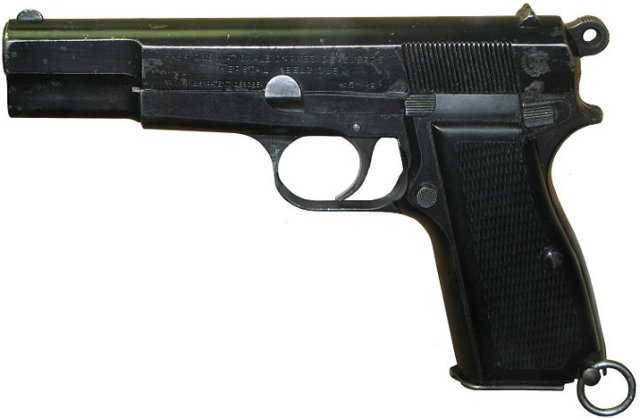
Browning High Power 9mm, the standard side-arm of the Canadian army from WW2 until its replacements start to arrive some time in 2023.
Let me state this up front: I’m a proud American. I love baseball and apple pie. If you cut me, I bleed red, white and blue. Whichever Detroit automaker you think is best, I think they are, too. And, therefore, I am a loyal fan of John Moses Browning’s M1911.
But, with that out of the way, it pains me to admit that the 1911 wasn’t Browning’s most important or influential pistol design. The 1911 is largely an American obsession, and when the rest of the world thinks about JMB’s martial handguns, the one that springs to mind is the Fabrique Nationale GP35, better known as the FN Hi Power.
Actually the result of a collaboration between Browning and his successor at FN, the great Dieudonné Saive, the Hi Power is one of the most prolific service pistols ever created, being used by the militaries of half a hundred countries.
Though it had some features that made it cheaper and easier to produce than the M1911, such as the fixed, under-barrel cam that replaced the swinging link on the older design, the Hi Power was still expensive to produce compared to newer designs. Even the change to a simpler external extractor in the 1960s wasn’t enough to keep it competitive, cost-wise, for budget-conscious militaries, and its double-stack, 13-round mag — a revelation in the 1930s — was by now commonplace.
Browning (an FN subsidiary) finally ended production a few years ago, but it turned out that demand for the Hi Power still existed.
EAA began selling a Turkish-made clone recently, and Springfield Armory upped the ante with the SA-35, which offered some minor tweaks to the original design.
Early this year, though, FN America went nuclear on the Hi Power market by offering the all-new, American-made High Power.
Note the spelling change, because this isn’t your granddad’s Hi Power.
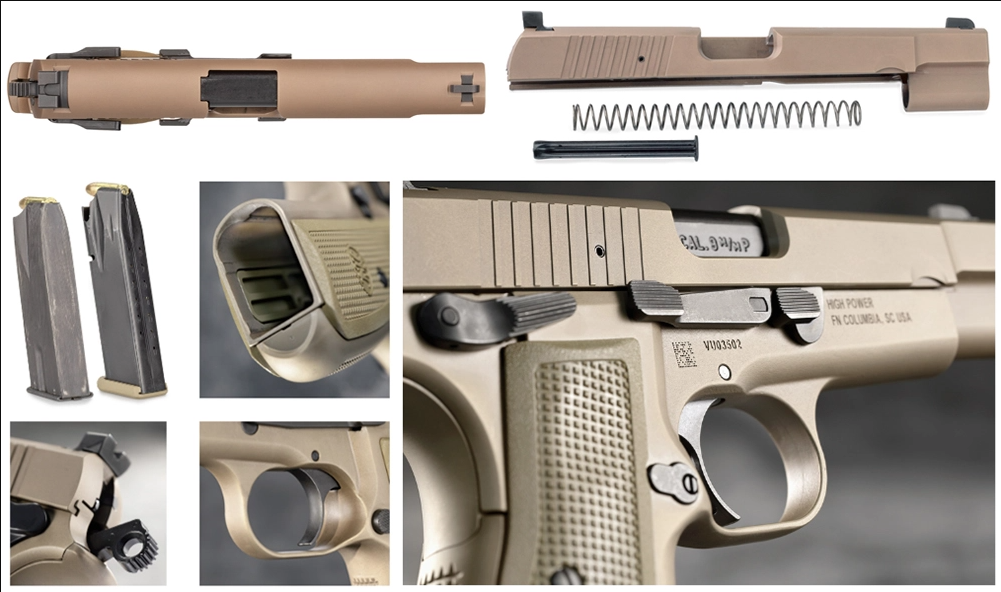
“Controls are ambidextrous. A thumb-safety lever and a slide-stop lever can be found on either side of the new High Power, and the magazine release is reversible • While not interchangeable with the older unit on the left, the new magazines are more capacious • The mag well is expectedly wide and promotes fast reloads • The topstrap is smooth, but the semi-matte PVD finish prevents glare • The trigger is a great improvement over the original, thanks in part to the absence of a magazine-disconnect safety • Removing the slide is simple, but you have to control it against the tension of the recoil spring.”
Photos from Shooting Illustrated, most likely by Tamara Keel.
MPi-81: Steyr Basically Makes the Uzi
Forgotten Weapons
Published 17 Jun 2022
(more…)
October 24, 2022
The Beretta AR70
Forgotten Weapons
Published 2 May 2017After failing to acquire a license to produce the M16 rifle, Beretta worked with SIG from 1963 through 1968 to develop 5.56mm infantry rifles. When the companies parted ways, SIG went on to produce the SIG-540 and Beretta developed the AR-70. It was introduced on the market in 1972, and was adopted by the militaries of Jordan and Malaysia, as well as Italian special forces units (the Italian Army at large would adopt the 70/90 version in 1990).
The AR-70 takes several cues from the AK series of rifles, including the rock-in magazine with large rear paddle release and a two lug rotating bolt. In a somewhat unorthodox choice, the rifle uses a coil spring in tension for its mainspring, located around the gas piston and in front of the bolt. While this would likely cause heat-related problems in a light machine gun, it appears to have been acceptable in a rifle, as the improved 70/90 version maintain the same system. It does also allow simple use of folding or collapsing stocks, as there are no working parts in the stock.
Only a relatively small number of commercial AR70/223 rifles came into the United States in the 1980s, and they are a relatively unknown member of the black rifle family.
(more…)
October 20, 2022
Canadian firearms law – as deliberately opaque and confusing as the human mind can concoct
In The Line, Tim Thurley peels back the covers and provides a glimpse of the inanities, stupidities, and political opportunism that shape Canadian firearms legislation:
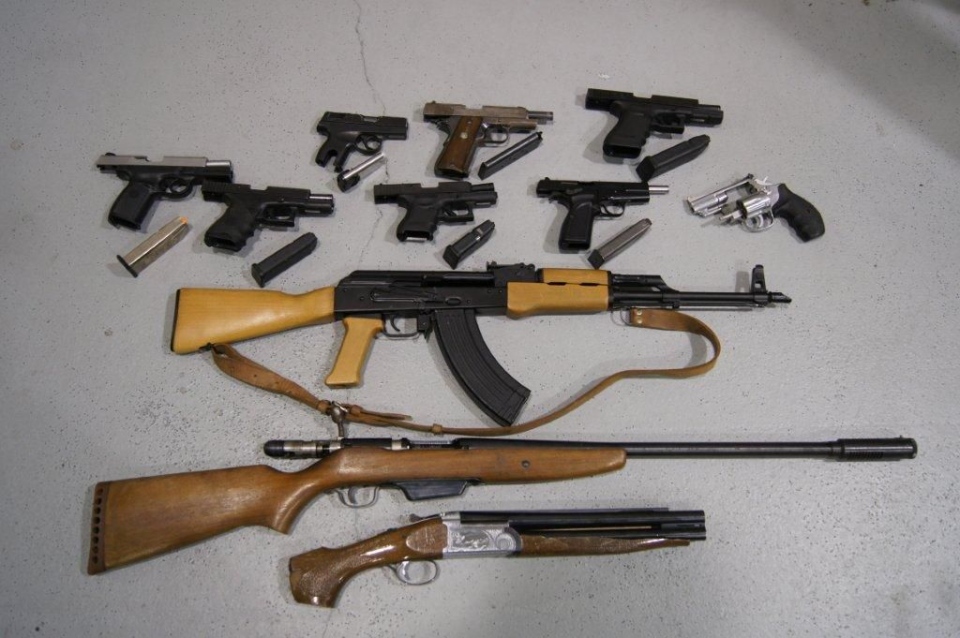
A typical arrangement of guns seized by Toronto Police back in 2012. Most of these weapons would be in the “restricted” or “prohibited” categories under the Firearms Act, and pretty much by definition not typically available to the majority of Canadians.
Canadians often assume our government is doing its best. Not the politicians, sure, but there is a broad assumption that at least the bureaucrats tirelessly working behind the scenes to implement political decisions must have a grasp on the facts and exhibit some consistency in decision-making. In few places is there a larger discrepancy between this perception and the grimmer reality than in how the government classifies firearms.
I’ve long had an interest in firearms policy. Those familiar with it will know how onerous the Access to Information process is and wonder why I partake on my own time and dime; I can answer only that a graduate M.Sc. thesis on legislative impacts on firearm homicide and time working in politics and government have made me a glutton for punishment. More seriously, it’s a fascinating field, and I have some insight into political and policy processes. And as any specialist in a hot-button policy area knows, there is nothing more frustrating than seeing bad policy enacted in your field again, and again, and again.
Firearms are classified into three categories under the Firearms Act: non-restricted, restricted, and prohibited. All three require a separate level of licence, obtained with escalating difficulty after multiple courses and checks. (Prohibited licences are no longer issued to the regular public, but some Canadians hold them as part of a grandfathering in of prior licence holders.) Each category is primarily determined by firearm design. A simple overview: restricted firearms are some rifles and most pistols, prohibited firearms are shorter-barrelled pistols or fully automatic (or converted to another mechanism therefrom), and non-restricted firearms are anything else meeting the legal definition of a firearm, typically meaning typical hunting rifles and shotguns.
That’s a simplified version, but that’s the system.
In theory.
In practice, as my requested documents confirmed, firearm classification in Canada is an opaque and byzantine nightmare. A messy plethora of firearms which meet the functional criteria for being non-restricted, subject to the least stringent oversight and controls, are prescribed by regulation as either restricted or prohibited, and therefore subject to more controls or outright banned. Since functional differences are accounted for by law and did not apply in these cases, the deviations must have another explanation.
In short, politics.
Take the 2020 Nova Scotia attacks. Despite the unlicensed murderer smuggling his firearms from the United States, the Liberals took the opportunity to issue an executive Order-in-Council that banned a bunch of legally owned Canadian guns mostly because it was an easy wedge for the next election. The facts of the case were irrelevant, as was the fact that the banned firearms were responsible for a minuscule fraction of Canadian homicides. The government did not even bother writing the ban by how the firearms functioned, which while unhelpful from a homicide-reduction perspective, would have at least been a coherent position. The order, among other things, simply identified a few well-known guns by name and banned those.
This is where the concept of “variants” matters. When a firearm is designated by regulation as restricted or prohibited, the designation includes all variants of the firearm, which then receive the same classification. This makes sense. Ridiculous as classifying firearms by name over function already is, it would be yet more ridiculous if a mere renaming by a manufacturer, for instance, was sufficient to evade a legal classification.
Most ridiculous of all is that the public does not and cannot know what constitutes a “variant”. The Firearms Act does not define it. The Canadian government does not define it. Nor do its agencies, even the one responsible for determining variants: the Royal Canadian Mounted Police.
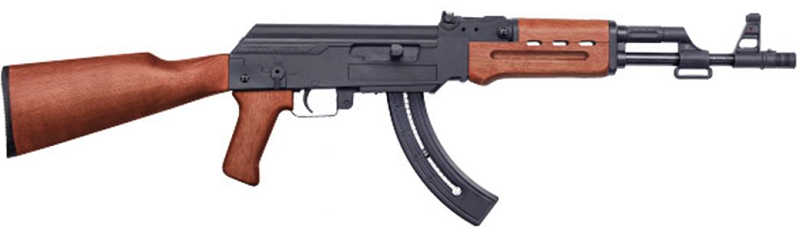
The Mossberg Blaze 47 saga is illustrative of this problem. It is uncontroversial to assume that a precise mechanical copy of an original Russian AK-47 with a different name and slight design changes is still an AK-47. But when Mossberg, the manufacturer, slapped a plastic frame bearing some resemblance to Kalashnikov’s famous design on its Blaze rifle — a cheap, non-restricted, rimfire rifle suitable for, at worst, a particularly aggressive colony of rabbits — that new gun, dubbed the Blaze 47, somehow transformed from an unthreatening small-game rifle to a dangerous AK-47 variant prohibited under Former Prohibited Weapons Order No. 13.
The amazing transformation of a simple .22LR plinker into a facsimile of a dangerous “black fully semi-automatic murder machine”.
These head-scratching decisions have confused firearm owners and manufacturers, who wasted decades trying to understand how the government decides to classify their guns. It all seemed very random.
Surprise! It is!
French C6 Long-Recoil Prototype Semiauto Rifle
Forgotten Weapons
Published 18 Nov 2016France began working on developing military self-loading rifles virtually as soon as the 1886 Lebel was adopted, and they would pursue a pretty elaborate series of trials right up to World War I. One series was developed by Etienne Meunier at the Artillery Technical Section using gas operated mechanisms, and designated the A series. The B series was the work of M. Rossignol at the Musketry School, using mostly direct gas impingement systems. The C series was designed by Louis Chauchat and M. Sutter at the Puteaux Arsenal, and these were long-recoil actions. Trials commenced in 1911 and 1912 on the latest rifles from each series, and ultimately none was judged really ready for military service — although the A6 Meunier would be produced in small numbers (about a thousand) and issued in 1916.
This particular rifle is a C6, from Chauchat and Sutter. The C7 was in the formal testing, and this C6 is a very similar rifle. It uses a long recoil action, a unique locking system with two pivoting locking lugs somewhat similar to the Kjellman system, and a remarkably powerful 7mm rimless cartridge fed from 6-round Mannlicher-type clips. It was deemed too complicated at trial, not surprisingly.
(more…)
October 16, 2022
An Israeli LMG, Part II: The 8mm Dror
Forgotten Weapons
Published 8 Jun 2022
(more…)
October 15, 2022
An Israeli LMG, Part I: The .303 Dror
Forgotten Weapons
Published 6 Jun 2022
(more…)
October 12, 2022
Walther P38 Development
Forgotten Weapons
Published 13 Apr 2016The Walther P38 was adopted by Germany in 1938 as a replacement for the P08 Luger — not because the Luger was a bad pistol, but because it was an expensive pistol. Walther began development of its replacement in 1932 with two different development tracks — one was a scaled-up Model PP blowback in 9x19mm and the other was the locked-breech design that would become the P38.
The initial prototypes look externally quite similar to the final P38, although the locking system went through several changes and the controls did as well. Several of the early developmental models used shrouded hammers.
In this video I will take a look at both initial “MP” pistols (the blowback and the locked breech), then the Armee Pistole (aka the AP) in its standard configuration and also a long barreled model with a shoulder stock, then the second Model MP, and finally the HP which was the commercial model of the final P38. In addition, I will check out a sheet metal prototype of the locked breech model form the very beginning of the development program.
(more…)
October 9, 2022
SIG M5 Spear Deep Dive: Is This a Good US Army Rifle?
Forgotten Weapons
Published 3 Jun 2022The NGSW (Next Generation Squad Weapon) program began in 2017 to find a replacement for the M4, M249, and the 5.56mm cartridge. It came to a conclusion in April 2022 with the formula acceptance of the SIG M5 rifle, M250 machine gun, Vortex M157 optic, and the 6.8x51mm cartridge. SIG released a handful of civilian semiauto M5 / Spear rifles and thanks to Illumin Arms I have one to examine.
The rifle (Spear is its commercial designation; M5 is the military one) is an evolution of the SIG MCX, which is in turn an evolution of the AR-15 and AR-18 systems. The MCX moved the recoil spring assembly into the top of the upper receiver, allowing the use of a folding stock. It also had very easily swapped barrels and a suite of fully ambidextrous controls. Scaled up to AR-10 size and chambered for 6.8x51mm, the MCX became the Spear.
That new cartridge (commercial designated .277 SIG Fury) is designed to produce high muzzle velocities out of a short barrel (the M5 has a 13 inch barrel). It does this by boosting the operating pressure up to an eye-watering 80,000psi, which required the development of hybrid case using a stainless steel case head. This allows the case to handle those pressures safely. The currently available commercial ammunition is loaded to lower pressure, however. Much of the military and civilian use of this rifle will be done with downloaded training ammunition, which uses a conventional all-brass case.
Both the M5 and M250 were ordered by the Army with suppressors on every weapon, a significant advancement in Army policy. The can is another SIG development, entirely made using additive manufacturing and designed specifically to prevent gas blowback into shooters’ faces (which is succeeds at wonderfully).
Overall, I believe the M5 / Spear is an excellent rifle — soft shooting, reliable, and very accurate. However, that does not mean it is the right rifle for the Army. Will its ability to defeat modern body armor prove worth the tradeoff in extra soldier combat load weight and reduced ammunition capacity? Only time will tell…
(more…)
October 6, 2022
Carl Gustav m/42: A 20mm Recoilless Antitank Rifle
Forgotten Weapons
Published 21 Apr 2017The Swedish Pansarvärnsgevär fm/42 made by the Carl Gustav company was an interesting early hybrid antitank weapon — a recoilless rifle firing solid armor-piercing projectiles. It used a 20x180mm case, propelling the 108g (1650gr) bullet at 950 m/s (3150 fps). This was capable of perforating 40mm of perpendicular armor plate at 100m (a high explosive projectile was also made). This was on the high end of armor penetration for anti-tank rifles, and the m/42 was able to do this with a weapon weighing just 11.7kg (25 lb) — less than a quarter of a comparable 20mm conventional rifle.
This was possible because of its recoilless design — upon firing, the rear end of the cartridge case would blow out and vent out the back of the weapon, instead of being firmly sealed like a conventional rifle. This created a counter balancing recoil impulse which prevented the gun and shooter from having to absorb the full recoil energy produced by a heavy bullet launching off at high velocity. The tradeoff was that much of the potential energy of firing was wasted venting out the back instead of pushing the bullet forward, which is why the cartridge case was so oversized.
About a thousand of the guns were made by the end of World War 2, at which time even it had been made quite thoroughly obsolete by the rapidly increasing thickness of tank armor. It would, however, be the stepping-stone to the m/48 Carl Gustav 84mm recoilless rifle, which used a shaped charge warhead to perforate armor with a stream of molten metal instead of relying on velocity of a hardened projectile.
(more…)
October 3, 2022
France in the Cold War: AA52 Replaces the Hotchkiss
Forgotten Weapons
Published 27 May 2022
(more…)
September 30, 2022
M1C Sniper Garand
Forgotten Weapons
Published 18 Sep 2016The M1C was an M1 Garand with a telescopic sight, using a mounting system developed by the Griffin & Howe company of New York. It utilized a rail pinned and screwed to the left side of the receiver, coupled with a quick-release scope on top. The rails had to be installed prior to heat treating the receivers, which had the unfortunately consequence of preventing rifles form being chosen for sniper conversion based on their mechanical accuracy. Instead, accuracy would be tested only after rifles were complete, leading to a 60% rejection rate.
The scope was offset to the left of the receiver so as not to interfere with the Garand’s clip loading, and issued with a leather cheek pad to give the shooter’s cheek weld a matching offset to the left. The scope used with the M1C was the M73B1, later replaced with the M81 and M82 scopes — all military versions of the 2.5x Lyman Alaskan hunting scope (which was a very good piece of equipment despite its low magnification)
The M1C was adopted in 1944, but production and quality control delays would prevent it from seeing any action in WWII. It was in use during the Korean War, however, before being replaced by the M1D.
(more…)
September 27, 2022
The War That Made Germany Prussian – Austro-Prussian War 1866
Real Time History
Published 23 Sep 2022After settling the Schleswig-Holstein question in 1864, Austria and Prussia are uneasy allies. Both are the biggest players in the German confederation. In Bismarck’s dream of a united Germany, he sees Prussia as the only leader and wants to force the so called “small German solution” without Austria. And so, in 1866 a war between Austria and Prussia (plus other German states like Bavaria, Baden, Württemberg, Saxony, Hanover) breaks out to settle this question once and for all.
(more…)


