
Forgotten Weapons
Published 30 Aug 2022During my visit to Slovenia, I had a chance to tour the AREX Defense factory in Šentjernej. I came away really impressed by the quality and the breadth of operations that the factory performs in-house. They have only been making their own handgun designs for about 5 years, but they have been a subcontractor making parts for other big-name companies (like FN) for decades.
(more…)
December 31, 2022
Tour of the AREX Defense Factory in Slovenia
Comments Off on Tour of the AREX Defense Factory in Slovenia
December 18, 2022
Belgian GP-35: Pre-War Browning High Power Complete Rig
Forgotten Weapons
Published 17 Aug 2022The Browning High Power (“Grande Puissance“, aka GP-35) was developed by Fabrique National in Belgium, designed primarily by John Browning’s apprentice Dieudonné Saive. It began in the very early 1920s as a pistol designed for a new French Army requirement, but eventually split into two separate development tracks. By the early 1930s the French procurement process was still ongoing, but FN felt that the current iteration of their pistol (the Grand Rendement) was sufficiently mature to be a viable military sidearm. They began offering it for sale, and the Belgian Army quickly took an interest. One thousand were purchased for Belgian field trials in 1933, and with a few minor changes it was adopted by Belgium as the GP-35 in 1935.
The first guns are delivered in May of 1935, and the first troops to receive them were troops like machine gun crews, tank crews, messengers and other men who needed a weapon, but not a full-length rifle. By 1938 enough have been delivered that the specialty troops and NCOs have been fully equipped, and guns begin to go to officers, replacing things like the FN Model 1900. By the time of the German invasion in May 1940, some 30,000 — 35,000 High Powers had been delivered to the Belgian Army. In addition to this, several other military contracts were made by FN, selling the pistol to Estonia, Lithuania, Paraguay, China, and Finland. However, the Belgian orders account for the significant majority of all pre-war made High Powers.
Note that in the US, original pre-war High Powers with original stocks, 500-meter tangent sights, and serial numbers below 47,000 (no prefix) are exempted from the NFA, and are not legally considered short-barreled rifles.
(more…)
Comments Off on Belgian GP-35: Pre-War Browning High Power Complete Rig
December 15, 2022
Kraut Space Magic: the H&K G11
Forgotten Weapons
Published 25 Dec 2018I have been waiting for a long time to have a chance to make this video — the Heckler & Koch G11! Specifically, a G11K2, the final version approved for use by the West German Bundeswehr, before being cancelled for political and economic reasons.
The G11 was a combined effort by H&K and Dynamit Nobel to produce a new rifle for the German military with truly new technology. The core of the system was the use of a caseless cartridge developed in the late 60s and early 70s by Dynamit Nobel, which then allowed H&K to design a magnificently complex action which could fire three rounds in a hyper-fast (~2000 rpm) burst and have all three bullets leave the barrel before the weapon moved in recoil.
Remarkably, the idea went through enough development to pass German trials and actually be accepted for service in the late 1980s (after a funding shutdown when it proved incapable of winning NATO cartridge selection trials a decade earlier). However, the reunification with East Germany presented a reduced strategic threat, a new surplus of East German combat rifles (AK74s), and a huge new economic burden to the combined nations and this led to the cancellation of the program. The US Advanced Combat Rifle program gave the G11 one last grasp at a future, but it was not deemed a sufficient improvement in practical use over the M16 platform to justify a replacement of all US weapons in service.
The G11 lives on, however, as an icon of German engineering prowess often referred to as “Kraut Space Magic” (in an entirely complimentary take on the old pejorative). That it could be so complex and yet still run reliably in legitimate military trials is a tremendous feat by H&K’s design engineers, and yet one must consider that the Bundeswehr may just have dodged a bullet when it ended up not actually adopting the rifle.
Many thanks to H&K USA for giving me access to the G11 rifles in their Grey Room for this video!
(more…)
Comments Off on Kraut Space Magic: the H&K G11
December 12, 2022
Before the High Power was the FN Grand Rendement
Forgotten Weapons
Published 8 Aug 2022The Browning High Power story begins with a French 1921 request for a new military pistol. FN engineer Dieudonné Saive developed a double stack, single feed magazine and John Browning adapted a Browning 1903 pistol to use it, and this was sent to France for consideration. This pistol worked well enough, but the French trials board requested changes … and they would continue requesting changes and more trials for the next decade.
By 1931, FN felt that the current iteration of the pistol — while still not meeting all the French requirements — was good enough to stand on its own as a service pistol for the Belgian Army and other clients. They named it the “Grand Rendement” (High Efficiency) and began marketing it. The Belgian Army showed a definite interest, and bought 1,000 pistols for field trials, based on the prototype example we have in today’s video. These would become the Grande Puissance, aka the High Power.
For more details on this and other FN Browning pistols, I highly recommend Anthony Vanderlinden’s FN Browning Pistols, soon to be released in its third edition:
Comments Off on Before the High Power was the FN Grand Rendement
December 9, 2022
Rod Bayonet Springfield 1903 (w/ Royalties and Heat Treat)
Forgotten Weapons
Published 20 Nov 2016(Note: I misspoke regarding Roosevelt’s letter; he was President at the time and writing to the Secretary of War)
The US military adopted the Model 1903 Springfield rifle in 1903, replacing the short-lived Krag-Jorgenson rifle. However, the 1903 would undergo some pretty substantial changes in 1905 and 1906 before becoming the rifle we recognize today. The piece in today’s video is an original Springfield produced in 1904, before any of these changes took place.
The most notable difference is the use of the rod bayonet. When the 1903 was in development, the Ordnance Department opined that the bayonet was largely obsolete, and that it was unnecessary to encumber soldiers with a long blade hanging from the belt. Instead, the new rifle would have a retractable spike bayonet that could double as cleaning rod and would be stored in the rifle stock, unobtrusive to the soldier. This ended in 1905 with a critical letter from Theodore Roosevelt (who was Secretary of War at the time). As the rod bayonet was replaced with a traditional blade bayonet, the cartridge would also be improved to a new style spitzer projectile at higher velocity, and the rifles’ stocks, hand guards, and sights were redesigned.
In this video I also discuss two often misunderstood elements of the Springfield’s history: heat treating and patent royalties. Are low serial number 1903 Springfields safe to shoot, and why or why not? And did the US government actually pay royalties to Germany for copying Mauser elements in the 1903?
(more…)
Comments Off on Rod Bayonet Springfield 1903 (w/ Royalties and Heat Treat)
December 8, 2022
Meta (the artist formerly known as Facebook) moves to clamp down on political discussions in the workplace
Tom Knighton on an uncharacteristic corporate move by the artist formerly known as Facebook:

My favourite reaction to Facebook rebranding as “Meta”.
It seems there are certain words employees aren’t really supposed to bring up in the workplace.
Meta (formerly Facebook) has reportedly told its employees not to discuss sensitive issues like abortion, gun control, pending legislation and vaccine efficacy at workplace.
According to a report in Fortune, citing a leaked internal memo, Meta has banned employees from discussing “very disruptive” topics, including abortion, gun rights, and vaccines as part of new “community engagement expectations”.
“As Mark mentioned recently, we need to make a number of cultural shifts to help us deliver against our priorities,” read the company memo.
“We’re doing this to ensure that internal discussions remain respectful, productive, and allow us to focus. This comes with the trade-off that we’ll no longer allow for every type of expression at work, but we think this is the right thing to do for the long-term health of our internal community,” it added.
Unfortunately for Meta, employees hammered them on the fact that they could talk about Black Lives Matter, immigration, and trans rights.
Now, they’re not really wrong to call out the hypocrisy, but this sounds like just a first move, and it’s a step in the right direction.
What would have been a better move is simply prohibiting discussing politics with your coworkers unless it directly pertains to your job. For example, if you are responsible for content moderation and a new bill will impact how you conduct that moderation, that’s one thing.
But topics ranging from Black Lives Matter to gun control are all contentious issues, and while Meta might have allowed that discussion in the past, they probably won’t indefinitely.
This is interesting to me, in part because we’ve seen the woke in the technology sector essentially bully employers into following along with the left’s agenda. Yet when they tried that with Netflix, the streaming giant basically told them to suck it up.
That was in May, but it may have triggered companies to realize that they didn’t have to play the woke game.
Last week, in the weekly wrap-up, I included this story about how Disney’s returning CEO Bob Iger is trying to have the company step back from the political ledge. Iger is far from a conservative, mind you, but he’s come to realize that his personal political agenda isn’t going to sell.
Granted, he started them along that path, but he’s recognized it’s not a great road to go down.
Now, we have Meta that may be venturing on a similar path to Netflix, setting the stage for what’s appropriate and what isn’t.
Comments Off on Meta (the artist formerly known as Facebook) moves to clamp down on political discussions in the workplace
December 5, 2022
“… when confronted, our self-proclaimed warriors against fake news and misinformation are just lying about what they’re doing”
From the free-to-cheapskates excerpt from this weekend’s dispatch from The Line:
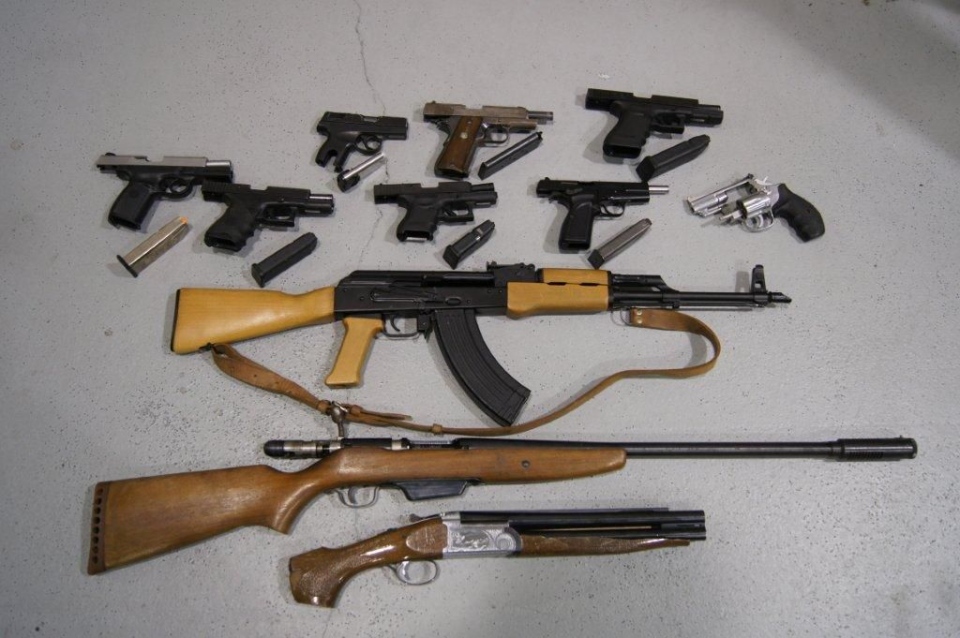
A typical haul of weapons confiscated by Toronto Police Services in 2012. Most of these guns are in the “restricted” or “prohibited” category of Canadian firearms and would not be available for legal purchase by anyone who had not gone through a rigorous RCMP background check and passed multiple training courses. Almost certainly none of them came from a legal owner.
We hate this as much as you do, but we must discuss guns with you again. We think the Liberals have screwed up, and we aren’t sure yet they realize it. (But they’re probably clueing in.)
You know why we’re suspicious? The Liberals are extremely good at marketing. A depressing amount of the time, it’s all they’ve got. They can take the smallest morsel of accomplishment and make it the centrepiece of a coordinated nation-wide grassroots mobilization campaign and fundraising drive. They have memes and other social shareables ready to go. Cabinet ministers release cringe videos captured by staffers who probably realize, in the very moment of their filming, that they’ve wasted their God-given potential on … this.
Outcomes? The hell with those. Let’s talk about those inputs, baby! In both official languages.
But this time? When the Liberals have actually embarked on what would be the most significant overhaul of our firearms laws in a generation? Not only have they not said boo. They’re going out of their way to deny that they’ve done anything. Or, when confronted, our self-proclaimed warriors against fake news and misinformation are just lying about what they’re doing.
So either they don’t know what they’re doing (very possible), regret what they’ve done (also very possible) or it’s a confused mix of both (our working theory).
But let us explain. And forgive us, but things will get a bit technical. (We’ll keep it as simple as possible, but guns are complicated.)
Canadian firearms policy has generally tried to classify firearms by their technical specifications. Three broad categories were created by the major reforms of the 1990s. “Prohibited” firearms essentially were machine guns, automatic assault rifles of the kind used by modern militaries, and easily concealed short-barrelled handguns; prohibited licences were issued in the 1990s to a relatively small number of individuals who already owned such firearms and their immediate descendants (to cover family heirlooms), but prohibited firearms otherwise are not available to the public. “Non-restricted” firearms were the very common rifles and shotguns suited (and frequently used) for hunting or target shooting sports, and require the least onerous level of licensing (but still, you do need a licence that involves background checks and vetting). In the middle we had “restricted” firearms — mostly handguns — that require a special licence beyond the normal licence, requiring extra training and conditions.
These broad categories do not always reflect the reality of how the laws actually shaped up. The prohibited and restricted categories were often stretched by meddling politicians to apply more broadly than they ought to have, so that politicians (mainly Liberals) could claim to be “tough on guns” in particular instances. But these three categories have been generally stable for a generation, and functioned well, more or less. Perfectly? No. But our gun-control laws worked for the public at large, which is why violent gun crime by licensed individuals is rare despite a relatively high rate of firearms ownership in Canada.
You wouldn’t think it given all the political controversy, but Canadian gun control has been a fundamentally successful public-policy program, for decades. The very real problem we have with gun violence in this country is overwhelmingly committed with illegal guns smuggled in from the United States, and fall outside the scope of our gun-control system, which works well doing what it is supposed to do: licensing lawful gun owners, regulating the legal uses of guns and regulating, as well, the lawful hunting and shooting sports industry.
For all its success as public policy, though, the system didn’t work for the Liberals politically. So they decided to get cute. And that’s where their problems began.

Comments Off on “… when confronted, our self-proclaimed warriors against fake news and misinformation are just lying about what they’re doing”
December 4, 2022
L39A1: British Service Target Rifle Before the L42A1
Forgotten Weapons
Published 5 Aug 2022The story of the conversion of the Lee Enfield to 7.62mm NATO would not be complete without the L39A1. This is essentially the civilian competition version of what would become the L42A1. It was actually in British service as a target rifle — not intended for combat. It followed the L8 (the first British military attempts at a 7.62mm precision version of the Enfield) and the L42A1. It was basically a copy of the conversions done by civilian competition shooters in the British NRA.
Sights were made by several different companies, as the rifles were not issued with sights — they were obtained by the unit they went to, whatever particular model that unit preferred. This example has Parker Hale diopter sights. The L39A1 also used a .303 caliber magazine, as they were intended for slow-fire, single-loaded competition but the magazine was used as a loading tray. The .303 magazine will not reliably hold 7.62mm cartridges, but 7.62mm conversion magazines can be put in the L39A1 and will then work just fine. They also sometimes are fitted with .303 extractors. The stock here has a semi-pistol grip a bit less substantial than the L8 .22 rifle, although most had standard No4 stocks.
The original sights were removed, and remarked as L39A1. They were made in 1969, 1970, and 1972, with a single serial number range used for the L39A1, the pretrial trials examples of the L39, and the “7.62 Conv” rifles. A total of 1,213 L39A1 rifles were made, with the other types accounting for about 28 additional rifles.
(more…)
Comments Off on L39A1: British Service Target Rifle Before the L42A1
November 30, 2022
The St Etienne Mle 1907: France’s Domestic Heavy Machine Gun
Forgotten Weapons
Published 19 Oct 2017When the French first began testing machine guns in the late 1890s, they were one of the few countries that did not purchase quantities of Maxim guns. One of the reasons was that in France’s North African colonies, transporting water for guns was considered an unnecessary liability. Instead, France purchased a number of air-cooled Hotchkiss machine guns for its colonial forces. For the French Metropolitan Army, it wanted a gun designed and produced by its own arsenal system. And so, the Puteaux Arsenal developed the Modele 1905 gun.
This was a gas-trap style of action, pulling an operating rod forward with each shot. The gun was adopted and put into service, and as with every other military user of gas trap guns, the French quickly found the system to be seriously flawed. The St Etienne Arsenal set about improving it, and came up with the Modele 1907, which retained the forward-moving operating rod but used a gas piston instead of a gas trap. This would be the machine gun which France would enter World War One with, and more than 40,000 would be manufactured by 1917.
The Modele 1907 St Etienne gun is a magnificently Victorian machine gun, with a downright Swiss-like rack-and-pinion system running its action. It would have been truly at home on a Napoleonic battlefield — but not a World War One battlefield. The gun was not well-suited to the muddy hell of trench warfare, despite its beautiful machining and quality. Looking for both a lot more guns and also a more field-reliable system, the French began buying a great many Modele 1914 Hotchkiss machine guns, and they would replace the Modele 1907 by the end of the war.
One cannot fault the French for this change, and yet it still seems sad to see such a gorgeous piece of metal fabrication be sidelined — complete with its hydraulically adjustable rate of fire, its fine toothed feed spool, its sights with the spring and lever system to accommodate heat-induced change of aim and its magnificently extravagant flash hider.
(more…)
Comments Off on The St Etienne Mle 1907: France’s Domestic Heavy Machine Gun
November 26, 2022
The Volcanic: Smith & Wesson’s First Pistol
Forgotten Weapons
Published 18 Aug 2017The deep beginnings of the Volcanic go back to Walter Hunt’s Volitional Repeater, which became the Jennings repeating rifle, which then became the Smith-Jennings repeating rifle when Horace Smith was brought in to improve it. Smith was able to make it more commercially viable than the Jennings had been, but he recognized that the system needed significant changes to really become successful. He had met a fellow gun designer who had similar ideas, by the name of Daniel Wesson, and the two would spend a couple years developing and refining the system. In 1854 they thought it was ready for production, and formed the Smith & Wesson Company.
Included in the original company was a man named Courtland Palmer, who owned the patent rights to the Jennings system. Smith & Wesson’s system would probably have been deemed an infringement of Palmer’s patents, and by bringing him into the company they avoided legal trouble. The fact that he was a relatively wealthy financier of the new company certainly didn’t hurt!
The pistol that S&W started producing was a manually repeating one with a tubular magazine under the barrel holding either 6 or 10 rounds. It was available in the .41 caliber Navy model (note: not actually adopted by the Navy) and the .31 caliber pocket version. In this first iteration, both used iron frames, which were all engraved lightly. The prices were pretty steep, and the guns suffered from some reliability problems and a fundamental problem of underpowered ammunition (the .41 caliber had a muzzle velocity of just 260 fps / 79 m/s). However, they did offer a much greater level of rapid repeating firepower than the muzzle loading revolvers of the period, and gained some loyal fans. In total, just 1700 of the guns were produced before the company went bankrupt, about a year after forming.
To recover from that setback, they reformed the company into the new Volcanic Repeating Arms Company, and sold stock in the new company to generate a new supply of capital. This allowed them to get back into production, and the Volcanic company would make another 3000 pistols, all .41 caliber Navy types, before also running out of money 19 months later in 1856.
At this point, Smith and Wesson decide to move in another direction, and one of the main creditors of the Volcanic company was able to acquire all of its assets and put the guns into production a third time. The name of this creditor? None other than Oliver Winchester. Winchester puts a new infusion of his own money into the company under the name New Haven Arms Company. This company produces another 3300 guns, both large and small frame by 1861. The New Haven company comes very near to bankruptcy itself before finally changing the design to create the Henry repeating rifle. The Henry’s rimfire ammunition finally solved the reliability and power problems of the Volcanic, and became the starting point for Winchester to become one of the predominant American arms making companies.
(more…)
Comments Off on The Volcanic: Smith & Wesson’s First Pistol
November 22, 2022
W+F Bern P43: A Swiss Take on the Browning High Power
Forgotten Weapons
Published 22 Jul 2017In 1940, Switzerland began a series of trials to replace their Luger service pistols with something equally high quality, but more economical. They had squeezed as much simplification out of the Luger as they could in 1929, and by this time the guns just needed to be replaced. The first 1940 trial had only two entrants (a Petter prototype from SIG and an Astra 900), but a second trial in 1941 included a large assortment of modern handguns, including a French 1935A, a Polish Vis-35, and prototypes from both SIG and W+F Bern.
One of the most tenacious competitors (aside form the winning SIG/Petter design) was the Bern factory’s series of Browning High Power copies. In this video, we will be looking at three progressive versions of this gun as they were modified through the course of the trials (which would last until 1949). While they are all mechanically very similar to the High Power, they will get progressively less visually similar as the trials progressed. In addition, we will see features like the slide lock, manual safety, and magazine release evolve and change.
(more…)
Comments Off on W+F Bern P43: A Swiss Take on the Browning High Power
November 18, 2022
The Model SS41 – A Czech Bullpup Anti-Tank Rifle for the SS
Forgotten Weapons
Published 23 Jun 2017The SS41 was a bullpup, bolt-action antitank rifle manufactured in small numbers by CZ for the SS. Contrary to common assumption, the SS were not a part of the standard German military arms procurement system, and were forced to scrounge for their weapons from other sources. Czech factories were one of the more popular sources, as smaller production lines could escape being integrated into Wehrmacht oversight and were able to contract privately with groups like the SS (the ZK383 as used by the SS is another example of this).
The Model 41 had been in development by the Czech military when the Germans occupied, and it was adapted to the German Patrone 318 cartridge for this production run. That cartridge was also used in the PzB-39, and fired a 220 grain tungsten-cored bullet at 4000 fps — although even this extremely high velocity only allowed it to defeat 30mm of vertical armor at 100m. As with the other antitank rifles of WW2, it would obsolete almost as soon as it was introduced, although it did remain useful for attacking emplaced positions and light armored vehicles (much like the Soviet PTRD and PTRS rifles).
Only a few thousand of the SS41 were manufactured, and they served primarily on the Eastern Front. As a result very few exist in American collections, and this is a particularly excellent example. Thanks to the Institute of Military Technology for allowing me to have access to this very cool AT rifle and bring it to you! Check them out at:
Comments Off on The Model SS41 – A Czech Bullpup Anti-Tank Rifle for the SS
November 14, 2022
Two Variants of the French RSC 1917 Semiauto WW1 Rifle
Forgotten Weapons
Published 2 Apr 2017The RSC 1917, aka FSA1917, has the distinction of being the only true semiautomatic service rifle to see significant frontline infantry use during World War One. It was introduced in 1917 as a long rifle, and about 75,000 were made in that configuration. An improved carbine model was developed in in 1918 right at the end of the war, with only a few thousand of those made. However, what we are looking at today are a pair of 1917 rifles which show a couple of differences.
One of these is a standard RSC 1917 as originally produced, and the other has been updated to a 1918 standard in two ways: the bolt handle/disassembly and the bolt holdopen mechanism. I do not know if these changes were actually implemented during the war, or in the years afterward, but they make the rifles substantially easier to field strip.
If you know of details relevant to these changes, please let me know in the comments!
(more…)
Comments Off on Two Variants of the French RSC 1917 Semiauto WW1 Rifle
November 10, 2022
USMC Winchester 70 Sniper – Vietnam Era
Forgotten Weapons
Published 24 Sep 2016This Winchester M70 was a rifle owned by the captain of the Camp Pendleton rifle team, and as such it is an excellent authentic example of the US sniper rifle of the early Vietnam era. It is chambered for the .30-06 cartridge, with a Winchester heavy target barrel and shorter stock. The scope is a 14x Unertl — quite high magnification, considering that the most recent official issue sniper rifle at the time was the M1D with a 2.2x scope. These rifles were used in a quasi-official capacity in Vietnam, and would ultimately evolving into the official M40 and M40A1 sniper rifles.
(more…)
Comments Off on USMC Winchester 70 Sniper – Vietnam Era
November 7, 2022
Ask Ian: Single Feed vs Double Feed Pistols
Forgotten Weapons
Published 5 Jul 2022Asked by Tyler on Patreon: “Why are there so few double stack/double feed handguns? I can only think of a couple off the top of my head. It makes the worst part of handgun shooting (loading the magazines) a complete non-issue.”
There are a series of interacting considerations when choosing between single feed and double feed.
Single Feed:
– Magazines are less reliable; constricting from two columns to one adds friction (this is magnified as capacity increases)
– Firearms are easier to design; the cartridge is always presented in the same place
– Pistol slides may be slightly narrowerDouble Feed:
– Magazines are more reliable (also less susceptible to a bit of dirt fouling them)
– Guns are harder to design; must accommodate two different feed positions
– Guns must be a bit wider (immaterial in rifles)These elements taken together lead to predominantly single feed magazines in pistols and double feed magazines in rifles, although exceptions exist to both.
(more…)
Comments Off on Ask Ian: Single Feed vs Double Feed Pistols


