
Forgotten Weapons
Published 27 Oct 2022In 1942, the US Navy adopted the Mk22 Pedestal mount, which fitted a pair of water-cooled Browning M2 machine guns (one left-hand feed and one right-hand). It was used for antiaircraft use primarily, and was also adopted by the Army as the M46 in 1943. The mount was an update to the previous single-gun MK21.
The gunner was protected by a 3/8″ (9.5mm) hardened steel shield, and the mount could rotate a full 360 degrees, with elevation from -10 degrees to 80 degrees. They were produced by the Heintz Manufacturing company (no relation to the Heinz company that makes ketchup) of Pittsburgh from 1942 until 1945.
(more…)
February 10, 2023
Water-Cooled .50s: The US Navy Mk22 Pedestal Mount
Comments Off on Water-Cooled .50s: The US Navy Mk22 Pedestal Mount
February 7, 2023
Making Canada’s gun laws more illogical, but appealing to urban Liberal voters, regardless of the political cost elsewhere
In The Line, Matt Gurney recounts the federal government’s political gyrations over their attempt to ban vast numbers of rifles and shotguns owned by law-abiding Canadians:
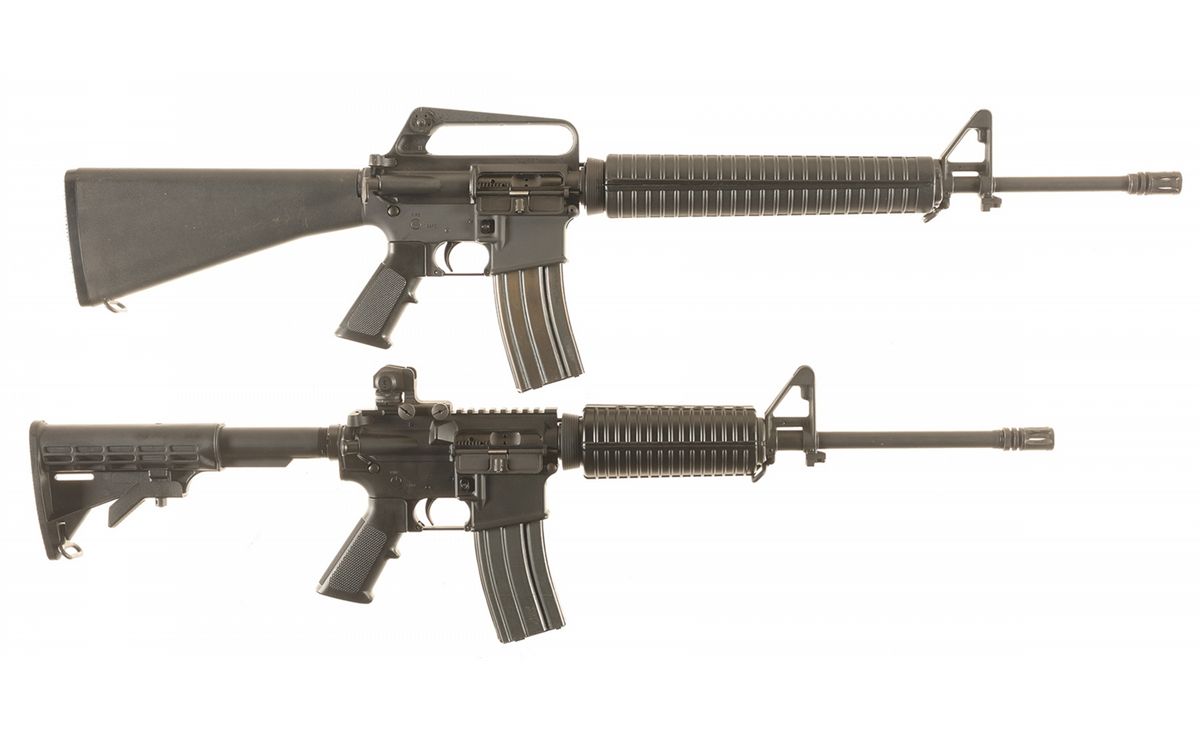
Classifying guns is complicated. There are a lot of ways to do it. You can do it by the “action”: is it a pump action? A lever action? Is it semi-automatic, or even fully automatic? You can do it by the length of the total firearm, or the length of just the barrel. You can do it by the caliber of the ammunition. You can do it by the type of magazine the firearm uses, and what its capacity is (the magazine is the compartment, which can be removable or integrated with the firearm, that holds the ammunition). You can try and be targeted with your definitions, or you can just go across the board and say “All rifles are allowed but all handguns are banned.” The point here isn’t to argue what the policy should be, but simply to note that whatever your policy is, you have to be able to define it in a way that makes sense.
Canada’s current gun laws date, more or less, to the 1990s. They’ve been changed a bunch of times since, for better or worse, but that’s when the current overall system of firearms legislation began. We came up with three broad categories of firearm then. There are “non-restricted” firearms, which you must be licensed to own, and mostly mean very typical rifles and shotguns, of which millions of licensed Canadians own many millions. There’s also the “restricted” category, which basically meant handguns — either semi-automatic pistols or revolvers. These require extra licensing, more background checks and training, and are subject to much stricter conditions for storage and use. And then there’s the very rare “prohibited” firearms, which are mostly either very compact handguns, or fully automatic weapons, including machine guns, which were owned by Canadians already when the new laws came in almost 30 years ago. These owners were given a special and highly limited rights to retain the firearms they already owned, but not to transfer them to others, except to someone else with a rare prohibited licence, or to a direct descendent. (That last bit was to cover family heirlooms.)
None of the above is as simple as I’ve just described it. Weird absurdities have been part of the system from the outset. The reason for these absurdities was always political. Back in the 1990s, the Liberals, under then-prime minister Jean Chrétien, realized that the categories above would result in certain kinds of rifle (including the AR-15) being classified as non-restricted, and subject to the least onerous controls. Unhappy with the optics of that, and other similar examples, they wrote in exceptions to the way some firearms are categorized. A firearm would be categorized by its technical specifications unless the government specifically ordered it classified as something else, is probably the easiest way to summarize a complicated policy.
Using the AR-15 again, according to the “evergreen” technical definitions we settled on in the 1990s, that’s a non-restricted gun. To avoid awkward political questions, the then-Liberals deemed it a “restricted” firearm, and therefore subject to tighter controls.
There were other similar examples, and they resulted, as noted above, in a lot of absurdities, with very similar guns categorized differently, but since only a relatively small number of firearms were so specially categorized, the system more or less functioned reasonably well for decades. The absurdities were limited enough to be broadly known and adapted to, and the overall system made enough sense to function coherently enough to do a reasonably good job regulating the sale, ownership and use of firearms in Canada. And very successfully: gun crime by licensed gun owners in Canada is, as is well known, quite rare. The system basically worked, and was working.
[…]
But hey, then politics happened. The sunny ways days ended. Liberal fortunes waned. Scandals and baggage and awkward photos of the PM in his younger days accumulated. And suddenly, the Liberals were talking a lot about banning assault rifles. They talked about it even more after the 2019 election reduced them to a parliamentary minority, leaving them dependent on a cluster of urban and suburban ridings in Quebec and Greater Toronto where support for just about any half-coherent sounding gun-control measure is typically high. The Liberals didn’t do much of anything — mostly just talk, as is their style. Then, in early 2020, there was the horrific massacre in Nova Scotia, and within days, the Liberals announced they were banning 1,500 models of assault rifle. (It was actually far fewer — closer to 20 — but the Liberals counted each different version and brand as an entirely different rifle to get to a more-impressive sounding figure. Those fierce opponents of disinformation at work again!)
Anything even close to meeting a broadly shared definition of “assault rifle” was already banned in Canada, of course — it had been classified “prohibited” back in the 1990s. There’s no universally agreed upon definition of an “assault rifle”, but those who know guns could agree in broad terms what it would mean — and in Canada, they were all banned, and had been for decades. So the Liberals, keen to have their lookin’-tough-and-bold moment, started talking about “assault-style” rifles.
Appending “-style” to anything is a gigantic red flag for bullshit, as I’ve noted here before. That somehow failed to deter them, alas, setting the stage for their current woes.
Comments Off on Making Canada’s gun laws more illogical, but appealing to urban Liberal voters, regardless of the political cost elsewhere
The Soviet Union Adopts an SMG: Degtyarev’s PPD-34/38
Forgotten Weapons
Published 21 Oct 2022The Soviet Union adopted its first submachine gun in 1935 after trials of some 14 different design in 1932/33. The winner of the trials was Vasily Degtyarev, once of the Soviet Union’s most prolific firearms designers. His model 1934 was a simple blowback gun reminiscent of the MP-28,II albeit with different trigger and magazine systems. The PPD34 used a 25-round box magazine, chambered for 7.62x25mm Tokarev. It was put into slow production, with just 3,300 or so produced by the end of 1938. During that time, Degtyarev made a number of small improvements to the gun, smoothing out the teething problems that are always found in new production systems. This improved version was designated the PPD34-38.
During the time, the submachine gun was not considered a priority by the Red Army. The leading generals did not see the value in the class of arms, and actually pulled all the PPDs from service in 1939 and had them put into storage. Only a few months later, the Red Army would be given a grim demonstration of SMG effectiveness when they closed the border into Finland and encountered determined Finnish resistance with kp/31 Suomi SMGs.
Some Suomis were captured by Soviet troops, and were very well liked — for obvious reasons. The inevitable inquiry into why the Red Army did not have such a weapon led to a frantic re-issuing of PPDs and production of as many as possible. At Stalin’s direction, the Suomi drum magazine was copied and adapted to the PPD34-38 as well. This required the addition of a short feed tower to fit the magazine well initially deigned for a standard box magazine. While PPD34-38 production continued, the PPD40 was quickly designed and put into production alongside the older model. Eventually, both were replaced in service by the PPSh-41, which was truly designed for mass industrial production.
(more…)
Comments Off on The Soviet Union Adopts an SMG: Degtyarev’s PPD-34/38
February 2, 2023
MAC Model 1947 Prototype SMGs
Forgotten Weapons
Published 12 Oct 2022Immediately upon the liberation of France in 1944, the French military began a process of developing a whole new suite of small arms. As it applied to SMGs, the desire was for a design in 9mm Parabellum (no more 7.65mm French Long), with an emphasis on something light, handy, and foldable. All three of the French state arsenals (MAC, MAS, and MAT) developed designs to meet the requirement, and today we are looking at the first pair of offerings from Chatellerault (MAC). These are the 1947 pattern, a very light lever-delayed system with (frankly) terrible ergonomics.
Many thanks to the French IRCGN (Criminal Research Institute of the National Gendarmerie) for generously giving me access to film these unique specimens for you!
Today’s video — and many others — have been made possible in part by my friend Shéhérazade (Shazzi) Samimi-Hoflack. She is a real estate agent in Paris who specializes in working with English-speakers, and she has helped me arrange places to stay while I’m filming in France. I know that exchange rates make this a good time for Americans to invest in Europe, and if you are interested in Parisian real estate I would highly recommend her. She can be reached at: samimiconsulting@gmail.com
(Note: she did not pay for this endorsement)
(more…)
Comments Off on MAC Model 1947 Prototype SMGs
January 29, 2023
France’s Ultimate WW1 Selfloading Rifle: The RSC-1918
Forgotten Weapons
Published 14 Sept 2017The French RSC-1917 semiauto rifle was a major step forward in arms technology during World War One, offering a reliable and effective self-loading rifle for issue to squad leaders, expert marksmen, and other particularly experienced and effective troops. No other military was able to field a semiauto combat shoulder rifle during this was in anything but very limited numbers. However, the RSC-1917 definitely had some shortcomings:
– It was just too long, at the same size as the Lebel
– The specialized clip was a logistical problem
– The gas system was fragile and difficult to clean or disassemble
– The magazine cover was easily damagedThese issues were all addressed in the Model 1918 upgrade of the rifle, although it was too late to see active service in the Great War. The new pattern was substantially shorter (both the stock and barrel), it used the standard Berthier 5-round clip, it had a substantially strengthened magazine cover, and a much improved gas system.
Today, we will compare the various features of the 1917 and 1918 rifles, and disassemble the 1918 gas system to show how it worked.
(more…)
Comments Off on France’s Ultimate WW1 Selfloading Rifle: The RSC-1918
January 26, 2023
Indigenous Weapons and Tactics of King Philip’s War
Atun-Shei Films
Published 20 Jan 2023Native American living historians Drew Shuptar-Rayvis and Dylan Smith help me explore the military history of King Philip’s War from the indigenous perspective.
(more…)
Comments Off on Indigenous Weapons and Tactics of King Philip’s War
January 24, 2023
What Would Browning Do: FN’s New High Power
Forgotten Weapons
Published 30 Sept 2022It seems like everyone is making a copy of the Browning High Power these days, and FN themselves have jumped into the arena as well. What FN is making isn’t just a clone of the original pistol, though — they have built something largely new, taking inspiration and design cues from the original BHP to create a gun more suited to 2022 than 1935.
While the original High Power (or Hi Power, depending on what era you are looking at) is lovingly romanticized by many — and I totally understand why — it has a number of significant shortcomings by today’s standards. It doesn’t feed hollow points well. The triggers are often bad, in part because of the magazine safety. The sights are tiny. The capacity is underwhelming. And most significantly to me, they tend to have bloody hammer bite, forcing you to take a low grip or just suffer through.
The new FN High Power looks to have fixed all of that. It’s a bigger pistol, but it offers a much more comfortable grip, modern style sights, a very nice single action trigger, and 17 round capacity (it does not interchange magazines with the original BHP). Let’s take a closer look at what FN did, and why …
(more…)
Comments Off on What Would Browning Do: FN’s New High Power
January 21, 2023
Ask Ian: Liberators or Cobray Terminators for the Elbonian Resistance?
Forgotten Weapons
Published 29 Sept 2022From Jon on Patreon:
“Elbonia has been occupied by an enemy force. Do you sabotage their resistance by airdropping them Liberator pistols or Cobray Terminators?”To my mind, the Liberator is a substantially more useful resistance weapons, so I would supply Elbonia with lots of crates of Cobray Terminators. Why?
First, the Liberator is concealable. Historically, lots of resistance action requires hiding a small weapons. It’s not all forest encampments and ambushes.
Second, the Liberator is more effective. It uses a .45ACP pistol cartridge. The smooth barrel and atrocious sights certainly limit its utility, but if you actually hit someone with it, it will do the job. Most of the shotgun ammunition available to a resistance organization will be the most common sort of sporting ammunition, which is birdshot. Birdshot is very ineffective against people at anything but absolutely point-blank range.
Third, it is much simpler to fabricate a single-shot shotgun than a compact pistol. The Elbonian Resistance wouldn’t have much trouble making something like a Richardson Guerrilla Gun, so supplying them with Terminators doesn’t actually give them much that they couldn’t get already.
(more…)
Comments Off on Ask Ian: Liberators or Cobray Terminators for the Elbonian Resistance?
January 18, 2023
Ask Ian: Why No German WW2 50-Cal Machine Guns? (feat. Nick Moran)
Forgotten Weapons
Published 20 Sep 2022From Nathaniel on Patreon:
“Why didn’t Germany or Axis powers have a machine gun similar to the American M2?”Basically, because everyone faced the choice of a .50 caliber machine gun or 20mm (or larger) cannons for anti-aircraft use, and most people chose the cannons — including Germany. There were some .50 caliber machine guns adopted by Axis powers, most notably the Hotchkiss 1930, a magazine-fed 13.2mm gun that was used by both Italy and Japan (among others). However, the use of the .50 caliber M2 by the US was really a logistical holdover form the interwar period. The M2 remained in production because it was adopted by US Coastal Artillery as a water-cooled anti-aircraft gun, and commercial sales by Colt were slim but sufficient to keep the gun in development through the 20s and 30s. It was used as a main armament in early American armor, but obsolete in this role when the war broke out.
However, with the gun in production and no obvious domestic 20mm design, the US chose to simply make an astounding number of M2s and just dump them everywhere, from Jeeps to trucks to halftracks to tanks to self-propelled guns. And that’s not considering the 75% of production that went to coaxial and aircraft versions …
Anyway, back to the question. The German choice for antiaircraft use was the 20mm and 37mm Flak systems, and not a .50 MG on every tank turret. And so, there was really no motive to develop such a gun. The Soviets did choose to go the US route, though, and developed the DShK-38 for the same role as the US M2 — although it was made in only a tiny fraction of the quantity of the M2.
(more…)
Comments Off on Ask Ian: Why No German WW2 50-Cal Machine Guns? (feat. Nick Moran)
January 14, 2023
Star Megastar: Spain’s Massive 10mm Autopistol
Forgotten Weapons
Published 19 Sep 2022In the late 1980s, the Spanish gun maker Star decided to join the new hot trend of 10mm semiauto pistols. The cartridge was getting a lot of press, and Star saw this as an opportunity to ride the wave and also the get a pistol on the market that would attract IPSC competitors. Unlike some companies adapting existing .45ACP designs to 10mm, Star decided to start from scratch to build a pistol that was massive and durable; able to handle the power of the cartridge without any worries.
Star engineer Eduardo Zamacola (who had previously designed the M38/30/31 series for Star) had the first prototypes ready in 1990, in both 10mm Auto and .45 ACP. The design took cues from the Petter designs of France and SIG, with full-length internal slide rails and a removable modular fire control system. It offered 12 round capacity in .45 and 14 rounds in 10mm.
The pistol was quite massive and heavy (1.4kg / 3.1 lb), and failed to sell well from the start. The 10mm craze flared out rather quickly — it remains a niche cartridge to this day, despite periodic releases of new 10mm pistols (the SIG 320 in 10mm being the most recent). What really killed the Megastar, though, was the 1994 Assault Weapons Ban in the US. This prohibited new magazines holding more than 10 rounds, and the whole point of the bulk of the Megastar was to allow larger double-stack magazines. With those no longer available, there was really not much reason to get a Megastar instead of something like a 1911. In total, just 978 were made in 10mm and 5,424 in .45ACP, with production ending in 1995.
(more…)
Comments Off on Star Megastar: Spain’s Massive 10mm Autopistol
January 11, 2023
“The PM and the public safety minister were lying to the public. That should matter.”
The editors of The Line regretfully return from holidays to start a new year, and the federal government’s gun confiscation bill (not called that, of course) gets both barrels:
The first item worth mentioning: remember how back in November and December the prime minister and the public safety minister, Messrs. Trudeau and Mendicino, were dismissing any suggestion that they were banning hunting rifles as hype? Or Conservation misinformation? When they were saying that the suggestions were false, and those making them were sowing confusion?
Well! Funny thing happened over the break. The PM, in his year-end interviews, is now admitting that the suggestions were, in fact, right.
Take this, for example, from his sit down with CTV News (our emphasis added):
“Our focus now is on saying okay, there are some guns, yes, that we’re going to have to take away from people who were using them to hunt,” Trudeau said. “But, we’re going to also make sure that you’re able to buy other guns from a long list of guns that are accepted that are fine for hunting, whether it’s rifles or shotguns. We’re not going at the right to hunt in this country. We are going at some of the guns used to do it that are too dangerous in other contexts.”
We’ll skip much analysis here. We think this is dumb policy, and we’ve explained why before, but it’s at least an acknowledgement of what their policy actually is, and very obviously was since the very time it was announced back in November. There’s no room for any confusion or doubt here. The Liberals spent weeks crying LIES! and MISINFORMATION! at people who were accurately describing what they were doing.
You can support the policy being proposed — again, we don’t, but that’s fine — but you can’t excuse this. The PM and the public safety minister were lying to the public. That should matter.
We’ll have more to say on this later. But for now, that’s the update: The Liberals now admit they’re trying to do the dumb thing they spent weeks insisting they weren’t doing.
This is, incredibly, a kind of progress.
Related somewhat to the above: a smart friend of The Line, who cannot be named as this stuff is their day job, told us weeks ago to watch for a schism in the NDP over this issue. For the Liberals, their dumb policy proposal still makes political sense. Well, it probably does — we have some suspicion that the LPC has maxed out the electoral utility of hammering on guns, and may now face more blowback than benefit, but time will tell. Still, the proposal may make sense for the Liberals: they are utterly dependent on urban and suburban women to survive, and the dumb gun proposal apparently resonates with them. And that’s true for part of the NDP’s base, too, but, critically, our friend reminded us, not for all of it.
The federal NDP of today is a strange creature. It’s partly very much a party of the deepest, wokest downtown ridings, but there’s also a big contingent of Dipper MPs from places like northern Ontario and rural parts of Manitoba and British Columbia. Cracking down on guns just plays differently there. When the policy was first announced, this division among NDP MPs didn’t take long to come into public view. Jagmeet Singh, himself very much of the NDP’s woke urban contingent, was quiet for a few days before very clearly and obviously pivoting to oppose the proposed expansion of the banned firearms. The Liberals can afford to write off their last remaining rural, non-urban MPs. The NDP simply can’t.
And, our friend told us — again, this was weeks ago, right at the outset — if Singh didn’t get the message pronto, the party would fracture over this … and that Wab Kinew, leader of the Manitoba NDP, would be the leader of the rebels.
We aren’t experts on Kinew, or in internal NDP power dynamics, so we simply thanked our friend for the tip and analysis, and assured them we’d keep an eye on it. And we did.
And wouldja look at that.
Interesting, eh?
Anyway. As of now the Liberals are still talking tough on the amendment. But they need at least one party to work with them to push it forward. We can’t say for sure, but we wonder if the Liberals are comfortable talking tough about it because they now accept they can’t push it forward — at least not any time soon. The Bloc seems wary of getting saddled with this and the NDP, indeed, might split over this issue if Singh were to try.
So we’ll keep watching this, and particularly Mr. Kinew, who may indeed covet Mr. Singh’s job.
To our friend: you were right. Thanks for the tip.

Comments Off on “The PM and the public safety minister were lying to the public. That should matter.”
Repurposing Obsolete Rifles: The Lebel R35 Carbine
Forgotten Weapons
Published 19 Dec 2017The French military had investigated the possibility of a Lebel carbine in the 1880s, but by the 1930s a different set of priorities was in place. In an effort to make some use of the vast stockpiles of obsolete Lebel rifles France had, a plan was put in place to shorten then into carbines for auxiliary troops like artillery crews and engineers. These men needed some sort of rifle or carbine, but they did not need the best and newest weapons. By giving them shortened Lebel carbines, it would free up more modern rifles like the M34 Berthiers in 7.5mm and the new MAS-36 rifles to go to the front line infantry who needed them most.
The R35 conversion was developed by the Tulle arsenal and adopted in January of 1936. The French government ordered 100,000 to be made, and deliveries began in April of 1937. Production would accelerate and continue right up to the spring of 1940, with a total of about 45,000 being actually delivered before the armistice with Germany. The conversions were all assembled at Tulle, but four other factories manufactured barrels for them: Chatellerault (MAC), St Etienne (MAS), Société Alsacienne de Constructions Mécaniques (SACM), and Manufacture d’Armes de Paris (MAP). These barrels were 450mm long (17.7 inches), and with the similarly shortened magazine tube, the R35 carbines held just 3 rounds. Production would not continue after the liberation of France in 1944.
(more…)
Comments Off on Repurposing Obsolete Rifles: The Lebel R35 Carbine
January 8, 2023
Conservatives “vote harder”, progressives take advantage of “procedural outcome manipulations”
Theophilus Chilton on a key difference between progressives and conservatives in how they address perceived problems with “the system”:

“Polling Place Vote Here” by Scott Beale is licensed under CC BY-NC-ND 2.0 


 .
.
Over the past decade or so, many folks on the broad Right have noticed that practically all of our institutions don’t really work as they should. The natural tendency on the part of normie conservatives is to chalk this up to incompetence and corruption. Granted, those do come into play – and will continue to do so increasingly. Yet structurally speaking, our institutional dysfunctionality runs a lot deeper than a little graft or some skimming off the top. Our institutional failures are both purposeful and towards a specific end.
Normies can perhaps be forgiven for not immediately coming to this conclusion. After all, as the name suggests, they’re the norm. They’re the mainstream. They’re not out on the “fringe” somewhere, for better or for worse. These are conservatives who have been conditioned by decades of playing by the rules to trust the rules and the processes under which government and institutions operate (even if they think they “distrust government” or whatever). They’re the ones who believe we have to keep voting harder because voting is the only “proper” way to act in our system. And yet, many times they end up being mystified that not only do the institutions and procedures not “work right” but that nobody in power (even their own so-called representatives) seems the least bit bothered by this.
Yet, purposeful it truly is. There is a concept about our institutions that I wish every conservative understood, which is that of “manipulating procedure outcomes”. Basically, what this refers to is the process by which bad actors will take an established procedure — a rule or statute, an institution inside or outside of government, a social or political norm — and subvert it to their own use while still “technically” adhering to procedure. However, the process of doing so completely warps the results from those which “should” happen had the procedure been played straight. This intentionality explains why our institutional failures always seem to tend in one direction — Cthulhu always seems to swim left, so to speak. The American Left are masters at manipulating procedural outcomes, while the American Right rigidly tries to adhere to “the way things oughta be” and end up getting outmanoeuvered every time.
Allow me to give some examples of this; seeing them will start to train the eye towards recognising other instances of this process.
Let’s take, for example, the recent revelations of government censorship of dissident ideas and individuals that we saw in the Twitter files. Now, we all know that the government can’t censor speech and ideas because of the First Amendment. So this means that they’d never do so … right? (LOL) Well, as the Twitter files revealed — and which absolutely assuredly applies to every other major tech company in the field — FedGov and the alphabet agencies simply use companies like Twitter as a way to work around the 1A. They can’t censor directly, but they can rely upon a combination of selective pressure on tech companies and ideologically friendly personnel within these companies to censor and gather information about right-leaning, and especially dissident Right, users all the same. And technically, none of this is illegal, because muh private company and all that. So a functional illegality nevertheless remains within the boundaries of “procedure”.
The same type of manipulation is underway with regards to the Second Amendment, too. Again, the plain wording of the 2A, as well as a long train of prior judicial interpretive precedence, militates against federal and state governments really being able to restrict the gun rights of Americans (not that they don’t try anywise). They can’t make it illegal to buy or own guns. Schemes like prohibitively taxing ammo won’t pass muster either. So if you’re a left-wing fruitcake who hates the Constitution and badly wants to disarm your fellow Americans for further nefarious purposes, what do you do?
Well, you make it too legally dangerous for gun owners to actually use their guns for anything beyond target shooting. You install a bunch of Soros-funded prosecutors in all the jurisdictions that you can so that you can go light on criminals but throw the book at gun owners who defend themselves from criminals. You creatively interpret laws to mean that harming someone while defending yourself is a crime or, barring that, open up self-defenders to civil attack from the criminal’s family. From a self-defence perspective you set up an anarchotyrannical regimen that can be used against ideological enemies. This is basically the same thing the Bolsheviks did when they were consolidating their power as “Russia” transitioned to “the Soviet Union”, as recorded by Solzhenitsin in The Gulag Archipelago. They used administrative courts and ideological judges to punish people who legitimately defended themselves against criminals. If you injured someone who was attacking or robbing you, you went to the gulag. Of course, as we’re also seeing today, these criminals were functionally agents of the Regime by that point.
Comments Off on Conservatives “vote harder”, progressives take advantage of “procedural outcome manipulations”
January 7, 2023
Converting the Lebel to 7.5mm: The M27 Lebel
Forgotten Weapons
Published 12 Dec 2017In the aftermath of World War One, the French military instituted a plan to introduce a completely new roster of small arms. This would begin with the development of a modern rimless rifle cartridge, which was adopted in 1924. With the new cartridge in hand, programs were begun to develop a light machine gun, bolt action rifle, and semiautomatic rifle using it. To supplement these new arms — especially during their development and production — plans were also made to convert existing 8mm rifles to the new cartridge.
The two rifles in large supply, of course, were the Lebel and the Berthier. The St Etienne arsenal was tasked with developing a Berthier conversion (this would become the M34 Berthier), and the Tulle arsenal was assigned to do the same with the Lebel. The first prototype was ready for testing in 1927. That first example was not satisfactory, and iterative development would continue into the early 1930s. Ultimately, the Lebel conversion was simply not as well liked by troops or as effective as the M34 Berthier, and so the Berthier was chosen for mass production. A total of about 1500 Lebel M27 conversions would be made by 1940, in a wide variety of configurations including different barrel lengths, rifling patterns, and optics mounting setups. While this did not result in a successful production rifle, it would inform the development of the MAS-36, and not go to waste. In addition, a number of M27 rifles would be converted into pressure testing guns to assist in ammunition development.
(more…)
Comments Off on Converting the Lebel to 7.5mm: The M27 Lebel
January 4, 2023
The First Modern Military Rifle: The Modele 1886 Lebel
Forgotten Weapons
Published 5 Dec 2017The Lebel was a truly groundbreaking development in military small arms, being the first rifle to use smokeless powder. This gave it — and in turn the French infantry — a massive advantage in range over everyone else in the world at the time. This advantage was short-lived, but the French did their best to exploit it.
French chemist Paul Vielle successfully developed his smokeless powder (“poudre B“) formula in 1884, and French ordnance spent 1885 experimenting with different calibers of small bore bullet to see what would work best. They also began looking at rifle actions to use, including specifically the Remington-Lee and the Mannlicher. However, a new Minister of War was appointed in January of 1886 and he demanded a completed prototype rifle and ammunition be completed by May 1886. This was a nearly impossibly short deadline to meet, and it meant that the Ordnance officers could not possibly develop a wholly new rifle, and instead would have to modify something already in the inventory.
The only suitable option was the Model 1884/5, a combination of the Gras bolt and Kropatschek tube magazine. The new smokeless cartridge was made by simply necking down the 11mm Gras round, and the 1884 rifle was given a new barrel in 8mm and a new dual-locking-lug bolt head to accommodate the high chamber pressure of the new powder. The result was the Lebel, and it was formally accepted in April 1887 after a relatively short period of testing. The weapon may not have been used the most advanced elements, but it was without any doubt the foremost military rifle in the world at the time, by a substantial margin.
The three main French state arsenals of St Etienne, Chatellerault, and Tulle would all tool up to produce the Lebel, and by the end of 1892 approximately 2.8 million had been produced, enough to equip the entire Army. The rifle would remain in service as France’s primary infantry rifle until World War One, would be declared obsolete in 1920, and remain in inventory and in use until the end of World War Two.
(more…)
Comments Off on The First Modern Military Rifle: The Modele 1886 Lebel


