
Thersites the Historian
Published 13 Feb 2025Britain became a quietly productive part of the Roman Empire once the Celts of southern Britain were subjugated. This was the period when the Romans built cities, forts, and roads across the southern portion of the island. The good times corresponded with the Classical Optimum. However, after 150 or 200 CE, Britain was beginning to experience a decline in its material well-being.
July 30, 2025
History of Britain VI: Prime Roman Britain
Comments Off on History of Britain VI: Prime Roman Britain
July 27, 2025
Day Nine – Hitler’s Halt Order and Tragedy at La Ferté – Ten Days in Sedan
World War Two
Published 26 Jul 2025May 18, 1940. Our coverage of the German blitzkrieg in France continues. Today, we take a break from the panzers for a spot of old-fashioned siege warfare. At Ouvrage La Ferté, a small garrison of French troops makes a doomed last stand against overwhelming German firepower. We follow their final hours, the decisions that sealed their fate, and what their sacrifice meant for the collapsing French front.
(more…)
Comments Off on Day Nine – Hitler’s Halt Order and Tragedy at La Ferté – Ten Days in Sedan
July 10, 2025
QotD: Frederick the Great on defence
Defense lines take up more ground than one has troops to occupy […] Little minds want to defend everything, sensible people see only the main thing, parry the big blows and tolerate a slight misfortune in order to avoid a greater one. He who will defend everything defends nothing.
Frederick II of Prussia, aka Frederick the Great
Comments Off on QotD: Frederick the Great on defence
July 6, 2025
Day Six – Breakout – Ten Days in Sedan
World War Two
Published 5 Jul 2025May 15 1940 — Ten Days in Sedan, continues as our WW2 Blitzkrieg documentary follows Germany’s drive through France. Today French 2nd Army chief Charles Huntziger faces a pivotal choice: try and contain the German bridgeheads at Sedan, where Heinz Guderian is trying desperately to breakout, or pivot south to shield the Maginot forts he still trusts. His choice may just decide the fate of France.
(more…)
Comments Off on Day Six – Breakout – Ten Days in Sedan
June 22, 2025
Day Four – The Meuse Must Hold! – Ten Days in Sedan
World War Two
Published 21 Jun 2025May 13, 1940: In today’s episode of our WW2 documentary, Ten Days in Sedan, the German Blitzkrieg reaches its climax. Guderian’s Panzers launch a daring river assault as the Luftwaffe pounds French lines into chaos. Away from Sedan itself, Rommel and Reinhardt strike further north, opening new fronts. France scrambles to counterattack, but the German bridgeheads are growing fast.
00:00 Intro
00:48 French Defences, German Air Assault
04:13 Guderian Crosses The Meuse
08:25 Hartlieb’s Houx Crossing
11:28 Rommel Crosses At Dinant
16:04 Einhardt Crosses At Monthermé
19:15 Summary & Conclusion
(more…)
Comments Off on Day Four – The Meuse Must Hold! – Ten Days in Sedan
June 15, 2025
Day Three – Guderian, Rommel, and The Race to Cross The Meuse – Ten Days in Sedan
World War Two
Published 14 Jun 2025May 12, 1940: Blitzkrieg, WW2’s new form of war, arrives in Sedan as Heinz Guderian’s Panzers capture the town and prepare to cross the river. Further north, Erwin Rommel drives toward the Meuse in the face of fierce French resistance. With the Luftwaffe dominating the skies and French reinforcements en route, the battle for Sedan is about to ignite.
Comments Off on Day Three – Guderian, Rommel, and The Race to Cross The Meuse – Ten Days in Sedan
May 30, 2025
QotD: “Have fun storming the castle!”
Clifford Rogers has already laid out a pretty lay-person accessible account of the medieval siege playbook (in Soldiers’ Lives Through History: The Middle Ages (2007), 111-143; the book is pricey, so consider your local library), so I won’t re-invent the wheel here but merely note some general features. Rogers distinguishes between hasty assaults using mostly ladders launched as soon as possible as a gamble with a small number of troops to try to avoid a long siege, and deliberate assaults made after considerable preparation, often using towers, sapping, moveable shelters designed to resist arrow fire and possibly even catapults. We’ve already discussed hasty assaults here, so let’s focus on deliberate assaults.
While sapping (tunneling under and collapsing fortifications) remained in use, apart from filling in ditches, the mole-and-ramp style assaults of the ancient world are far less common, precisely because most armies (due to the aforementioned fragmentation combined with the increasing importance in warfare of a fairly small mounted elite) lacked both the organizational capacity and the raw numbers to do them. The nature of these armies as retinues of retinues also made coordination between army elements difficult. The Siege of Antioch (1097-8) [during] the First Crusade is instructive; though the siege lasted nine months, the crusaders struggled to even effectively blockade the city until a shipment of siege materials (lumber, mostly) arrived in March of 1098 (five months after the beginning of the siege). Meanwhile, coordinating so that part of the army guarded the exits of the city (to prevent raids by the garrison) while the other part of the army foraged supplies had proved mostly too difficult, leading to bitter supply shortages among the crusaders. Even with materials delivered to them, the crusaders used them to build a pair of fortified towers blocking exits from the city, rather than the sort of elaborate sapping and ramps; the city was taken not by assault but by treachery – a very common outcome to a siege! – when Bohemond of Taranto bribed a guard within the city to let the crusaders sneak a small force in. All of this despite the fact that the crusader army was uncommonly large by medieval European standards, numbering perhaps 45,000.
Crucially, in both hasty and deliberate assaults, the emphasis for the small army toolkit tends to be on escalade (going over the walls) using ladders or moveable wooden towers, rather than the complex systems of earthworks favored by the “big army” siege system or breaching – a task which medieval (or ancient!) artillery was generally not capable of. The latter, of course, is a much more certain method of assault – give a Roman army a few months and almost any fortress could be taken with near certainty – but it was a much more demanding method in terms of the required labor and coordination. Thwarting escalade is mostly a question of the height of defenses (because a taller wall requires a taller ladder, tower or ramp) and good fields of fire for the defenders (particularly the ability to fire at attackers directly up against the wall, since that’s where the ladders are likely to be).
The other major threat to castle walls (apart from the ever-present threat of sapping) was catapults, but I want to deal with those next time for reasons that I suspect will make sense then. For now it is worth simply noting that catapults, even the mighty trebuchets of the 14th century were generally used to degrade defenses (smashing towers, destroying crenellation, damaging gatehouses) rather than to produce breaches. They could in some cases do that, but only with tremendous effort and a lot of time (and sometimes not even then). Consequently, for most castles the greatest threat remained escalade, followed by treachery or starvation, followed by sapping, followed by artillery.
Bret Devereaux, “Collections: Fortification, Part III: Castling”, A Collection of Unmitigated Pedantry, 2021-12-10.
Comments Off on QotD: “Have fun storming the castle!”
May 20, 2025
The Battle of Aquino
Canadian Tank Museum
Published 13 Jan 2025You may know about AQUINO Tank Weekend at our Museum, but what was the Battle of Aquino? When did it take place? What happened to the Ontario Regiment RCAC during that action?
Enjoy this short documentary with our Curator Sam Richardson as he gives you a detailed look at the situation in May 1944 during the Italian campaign of the Second World War. Learn more about the soldiers that took part, the battle that took place and why it remains important to our Regiment and our Museum.
(more…)
Comments Off on The Battle of Aquino
April 27, 2025
QotD: Fighting against Japan in the Pacific
And lord knows the Americans took the bait, more than once. If “bait” is really the right word, because if you’ve got no choice … the early campaigns in the Solomons were so legendarily nasty for that reason: You have no choice but to go right up the pipe to seize an objective, and if you do, the enemy has no choice but to go right up the pipe to get it back.
The genius of the later American strategy — and credit where it’s due, few people have a lower opinion of MacArthur than I, but this was brilliant — was to simply go around. Heavy bomber strips are a must, and in the even fewer places in the Pacific that can take heavy bombers, the Americans had no choice but to go right up the chute … but carrier airpower can do a hell of a lot, particularly when it can move about completely unmolested by the enemy. Thus the Americans turned all those guaranteed meat grinders the Japanese had set up for them into big open-air POW camps, without bothering to go in there and force them to surrender (which, of course, they wouldn’t). Have fun starving in your bunkers, boys; we’ll just leave a covering naval detachment, to make sure you can’t evacuate; see you when the war’s over.
Severian, “Strategy”, Founding Questions, 2021-11-21.
Comments Off on QotD: Fighting against Japan in the Pacific
April 19, 2025
Downfall: The Battle of Berlin 1945
Real Time History
Published 6 Dec 2024April 1945. After nearly six years of war, the Red Army stands massed on the banks of the Oder River in eastern Germany. The Nazi capital and Hitler’s bunker are just 60km away, but the Nazi Party and the Wehrmacht are preparing to fight to the bitter end in the final struggle of WW2 in Europe – the Battle for Berlin.
(more…)
Comments Off on Downfall: The Battle of Berlin 1945
March 31, 2025
QotD: The problem of defending the late Roman Empire
In particular, Roman forces could no longer be entirely sure they would possess escalation dominance in any given theater. Indeed, during the Crisis, with legions being peeled to fight endless internal wars between rival claimants had meant that major frontier problems might go under-resourced or even entirely unaddressed for years. While the reign of Diocletian (284-311) marked a return to Roman unity, quite a bit of damage had already been done and by the end of the third century we see changes in patterns of fortification that reflect that.
The changes seem fairly clearly to have been evolutionary, in part because many older legionary forts remained in use. Some of the first things we see are traditional “playing-card” forts but now with the neat rectangular shape disrupted by having the towers project out from the walls. The value of a projecting tower […] is that soldiers on the tower, because it projects outward, can direct missiles (arrows, javelins, slings, etc) down the length of the wall, engaging enemies who might be trying to scale the wall or breach it. Of course a fortress that is now being designed to resist enemies scaling or breaching large stone walls is no longer worried about a raid but rather being designed to potentially withstand a serious assault or even a siege. Defensive ditches also multiply in this period and increase in width, often exceeding 25ft in width and flat-bottomed; the design consideration here is probably not to stop a quick raid anymore but to create an obstacle to an enemy moving rams or towers (think back to our Assyrians!) close to the walls.
Over time, forts also tended to abandon the “playing-card” proportions and instead favor circular or square shapes (minimizing perimeter-to-defend for a given internal area). And while even the original Roman marching camps had been designed with a concern to make it hard for an enemy to fire missiles into the camp – using the trench to keep them out of range and keeping an interval (literally the intervallum, the “inside the wall”) between the vallum and the buildings so that any arrows or javelins sent over the walls would land in this empty space – later Roman fortresses intensify these measures; we even see fortresses like the one at Visegrád incorporate its internal structures into the walls themselves, a measure to make the troops within less vulnerable to missile fire in a siege; this style becomes increasingly common in the mid-fourth century. Finally, by the fifth century we start to see the sites of Roman forts changing too, especially in the western part of the empire, with forts moving from low-land positions along major roadways (for rapid response) to hilltop sites that were less convenient for movement but easier to defend (in the East, a lot of the focus shifts to key heavily fortified cities – essentially fortress cities – like Nisibis (modern Nusaybin), Amida, Singara and Dara.
In short, Roman forts in this late period are being designed with the ability to resist either serious assaults or prolonged sieges. This in part reflects a lack of confidence that the Romans could always count on being able to immediately force a field battle they could win; while Roman armies retained the edge through most of this period, the main field armies were increasingly concentrated around the emperors and so might be many days, weeks or even months away when an incursion occurred; local forces had to respond elastically to delay the incursion much longer than before until that army could arrive.
Now of course the downside to a focus like this on single-site defense (“point defense” in its most basic form) is that the enemy army is given much more freedom to move around the countryside and wreck things, where they would have been engaged in the older observe-channel-respond defense system much more quickly (Luttwak terms this “preclusive” defense, but it isn’t quite that preclusive; the frontier is never a hard border). But of course the entire reason you are doing this is that the shifting security situation means you can no longer be confident in winning the decisive engagement that the observe-channel-respond defense system is designed for; you need to delay longer to concentrate forces more significantly to get a favorable outcome. Single-site defenses can do this for reasons we’ve actually already discussed: because the army in the fort remains an active threat, the enemy cannot generally just bypass them without compromising their own logistics, either their supply lines or foraging ability. Consequently, while some forts can by bypassed, they cannot all be bypassed (a lesson, in fact, that the emperor Julian would fail to learn, leading to disaster for his army and his own death).
And so the enemy, while they can damage the immediate environment, cannot proceed out of the frontier zone (and into the true interior) without taking some of these forts, which in turn will slow them down long enough for a major field army to arrive and in theory offer battle on favorable terms.
While it is easy to discount these shifts as just part of the failure of the Roman Empire (and we’ll come back to this idea, often presented in the form of a misquotation of George S. Patton that “fixed fortifications are monuments to the stupidity of man” though what he actually said was merely that the Maginot line was such), they contributed meaningfully to the Roman ability to hold on to a vast empire in an increasingly more challenging security environment. At pretty much all stages of its development, Roman fortification on the frontiers was designed to allow the Romans to maintain their territorial control with an economy of force precisely because the Roman Empire could not afford to maintain overwhelming force everywhere on its vast perimeter. Rome wasn’t alone in deploying that kind of defensive philosophy; at any given point the northern frontier of China was guarded on much the same principles: the need to hold a frontier line with an economy of force because no state can afford to have overwhelming force everywhere. In both cases, the need for defense was motivated in no small [part] by the impossibility of further offensive; in the Roman case, further extension of the limes would simply create more territory to defend without actually creating more revenue with which to defend it (this is why the Roman acquisition of Dacia and much of Britain were likely ill-conceived, but then both operations were politically motivated in no small part) while in the Chinese case, the logistics of the steppe largely prohibited further expansion.
This Roman system, combining local single-site defenses (which included a proliferation of walled towns as the population centers of the western empire frantically rebuilt their walls) with concentrated mobile field armies really only began to fail after the Battle of Adrianople (378), where to be clear the fortification system worked fine, the error came from the emperor Valens’ stupid decision to attack before his co-emperor Gratian could arrive with reinforcements (Valens was eager to get all of the credit and so he takes all of the blame).
Bret Devereaux, “Collections: Fortification, Part II: Romans Playing Cards”, A Collection of Unmitigated Pedantry, 2021-11-12.
Comments Off on QotD: The problem of defending the late Roman Empire
March 24, 2025
How Greece Humiliated Mussolini’s Army – WW2 Fireside Chat
World War Two
Published 22 Mar 2025Today Indy and Sparty answer your questions about the Italian invasion of Greece, Hitler and Mussolini’s relationship and the different types of fascism!
(more…)
Comments Off on How Greece Humiliated Mussolini’s Army – WW2 Fireside Chat
March 23, 2025
How To Invade France
HardThrasher
Published 2 Feb 2023For more than 1,000 years British people have studied how to invade France, here then are the fruits of that wisdom.
1. Be German
2. Head for Sedan
Comments Off on How To Invade France
March 19, 2025
QotD: The purpose of fortification
In the former case, the fortified center contains three interlinked things: the local market (where the sale of agricultural goods and the purchase by farmers of non-agricultural goods can be taxed and controlled), a seat of government that wields some customary power to tax the countryside through either political or religious authority and finally the residences of the large landholders who own that land and thus collect rents on it (and all of these things might also come with significant amounts of moveable wealth and an interest in protecting that too). For a raiding force, the concentration of moveable property (money, valuables, stored agricultural goods) this creates a tempting target, while for a power attempting to conquer the region the settlement conveniently already contains all of the administrative apparatus they need to extract revenue out of the area; if they destroyed such a center, they’d end up having to recreate it just to administer the place effectively.
In the latter case, the presence of a fortified center with even a modest military force makes effective exploitation of the countryside for supplies or revenue by an opposing force almost impossible; it can thus deny the territory to an enemy since pre-industrial agrarian armies have to gather their food locally. We have actually already discussed this function of point defenses before: the presence of a potent raiding force (typically cavalry) within allows the defender to strike at either enemy supply lines (should the fortress be bypassed) or foraging operations (should the army stay in the area without laying siege) functionally forcing the attacker to lay siege and take the fortress in order to exploit the area or move past it.
In both cases, the great advantage of the point defense is that while it can, through its administration and raiding threat, “command” the surrounding hinterland, the defender only needs to defend the core settlement to do that. Of course an attacker unable or unwilling to besiege the core settlement could content themselves with raiding the villages and farms outside of the walls, but such actions don’t accomplish the normal goal of offensive warfare (gaining control of and extracting revenue from the countryside) and peasants are, as we’ve noted, often canny survivors; brief raids tend to have ephemeral effects such that actually achieving lasting damage often requires sustained and substantial effort.
All of which is to say that even from abstract strategic reasoning, focusing considerable resources on such fortifications is a wise response to the threat of raids or invasion, even before we consider the interests of the people actually living in the fortified point (or close enough to flee to it) who might well place a higher premium on their own safety (and their own stuff!) than an abstract strategic planner would. The only real exception to this were situations when a polity was so powerful that it could be confident in its ability to nearly always win pitched battles and so prohibit any potential enemy from getting to the point of laying siege in the first place. Such periods of dominance are themselves remarkably rare. The Romans might be said to have maintained that level of dominance for a while, but as we’ve seen they didn’t abandon fortifications either.
Bret Devereaux, “Collections: Fortification, Part III: Castling”, A Collection of Unmitigated Pedantry, 2021-12-10.
Comments Off on QotD: The purpose of fortification
November 28, 2024
QotD: The trace italienne in fortification design
Since the goal remains preventing an enemy from entering a place, be that a city or a fortress, the first step has to be to develop a wall that can’t simply be demolished by artillery in a good afternoon or two. The solution that is come upon ends up looking a lot like those Chinese rammed earth walls: earthworks are very good at absorbing the impact of cannon balls (which, remember, are at this point just that: stone and metal balls; they do not explode yet): small air pockets absorb some of the energy of impact and dirt doesn’t shatter, it just displaces (and not very far: again, no high explosive shells, so nothing to blow up the earthwork). Facing an earthwork mound with stonework lets the earth absorb the impacts while giving your wall a good, climb-resistant face.
So you have your form: a stonework or brick-faced wall that is backed up by essentially a thick earthen berm like the Roman agger. Now you want to make sure incoming cannon balls aren’t striking it dead on: you want to literally play the angles. Inclining the wall slightly makes its construction easier and the end result more stable (because earthworks tend not to stand straight up) and gives you an non-perpendicular angle of impact from cannon when they’re firing at very short range (and thus at very low trajectory), which is when they are most dangerous since that’s when they’ll have the most energy in impact. Ideally, you’ll want more angles than this, but we’ll get to that in a moment.
Because we now have a problem: escalade. Remember escalade?
Earthworks need to be wide at the base to support a meaningful amount of height, tall-and-thin isn’t an option. Which means that in building these cannon resistant walls, for a given amount of labor and resources and a given wall circuit, we’re going to end up with substantially lower walls. We can enhance their relative height with a ditch several out in front (and we will), but that doesn’t change the fact that our walls are lower and also that they now incline backwards slightly, which makes them easier to scale or get ladders on. But obviously we can’t achieved much if we’ve rendered our walls safe from bombardment only to have them taken by escalade. We need some way to stop people just climbing over the wall.
The solution here is firepower. Whereas a castle was designed under the assumption the enemy would reach the foot of the wall (and then have their escalade defeated), if our defenders can develop enough fire, both against approaching enemies and also against any enemy that reaches the wall, they can prohibit escalade. And good news: gunpowder has, by this point, delivered much more lethal anti-personnel weapons, in the form of lighter cannon but also in the form of muskets and arquebuses. At close range, those weapons were powerful enough to defeat any shield or armor a man could carry, meaning that enemies at close range trying to approach the wall, set up ladders and scale would be extremely vulnerable: in practice, if you could get enough muskets and small cannon firing at them, they wouldn’t even be able to make the attempt.
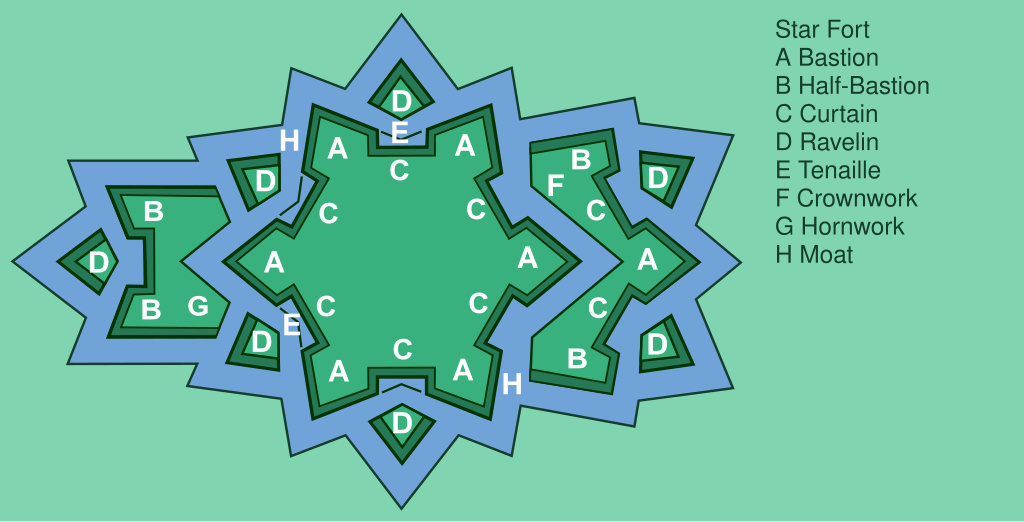
But the old projecting tower of the castle, you will recall, was designed to allow only a handful of defenders fire down any given section of wall; we still want that good enfilade fire effect, but we need a lot more space to get enough muskets up there to develop that fire. The solution: the bastion. A bastion was an often diamond or triangular-shaped projection from the wall of the fort, which provided a longer stretch of protected wall which could fire down the length of the curtain wall. It consists of two “flanks” which meet the curtain wall and are perpendicular to it, allowing fire along the wall; the “faces” (also two) then face outward, away from the fort to direct fire at distant besiegers. When places at the corners of forts, this setup tends to produce outward-spiked diamonds, while a bastion set along a flat face of curtain wall tends to resemble an irregular pentagon (“home plate”) shape [Wiki]. The added benefit for these angles? From the enemy siege lines, they present an oblique profile to enemy artillery, making the bastions quite hard to batter down with cannon, since shots will tend to ricochet off of the slanted line.
In the simplest trace italienne forts [Wiki], this is all you will need: four or five thick-and-low curtain walls to make the shape, plus a bastion at each corner (also thick-and-low, sometimes hollow, sometimes all at the height of the wall-walk), with a dry moat (read: big ditch) running the perimeter to slow down attackers, increase the effective height of the wall and shield the base of the curtain wall from artillery fire.
But why stay simple, there’s so much more we can do! First of all, our enemy, we assume, have cannon. Probably lots of cannon. And while our walls are now cannon resistant, they’re not cannon immune; pound on them long enough and there will be a breach. Of course collapsing a bastion is both hard (because it is angled) and doesn’t produce a breach, but the curtain walls both have to run perpendicular to the enemy’s firing position (because they have to enclose something) and if breached will allow access to the fort. We have to protect them! Of course one option is to protect them with fire, which is why our bastions have faces; note above how while the flanks of the bastions are designed for small arms, the faces are built with cannon in mind: this is for counter-battery fire against a besieger, to silence his cannon and protect the curtain wall. But our besieger wouldn’t be here if they didn’t think they could decisively outshoot our defensive guns.
But we can protect the curtain further, and further complicate the attack with outworks [Wiki], effectively little mini-bastions projecting off of the main wall which both provide advanced firing positions (which do not provide access to the fort and so which can be safely abandoned if necessary) and physically obstruct the curtain wall itself from enemy fire. The most basic of these was a ravelin (also called a “demi-lune”), which was essentially a “flying” bastion – a triangular earthwork set out from the walls. Ravelins are almost always hollow (that is, the walls only face away from the fort), so that if attackers were to seize a ravelin, they’d have no cover from fire coming from the main bastions and the curtain wall.
And now, unlike the Modern Major-General, you know what is meant by a ravelin … but are you still, in matters vegetable, animal and mineral, the very model of a modern Major-General?
But we can take this even further (can you tell I just love these damn forts?). A big part of our defense is developing fire from our bastions with our own cannon to force back enemy artillery. But our bastions are potentially vulnerable themselves; our ravelins cover their flanks, but the bastion faces could be battered down. We need some way to prevent the enemy from aiming effective fire at the base of our bastion. The solution? A crownwork. Essentially a super-ravelin, the crownwork contains a full bastion at its center (but lower than our main bastion, so we can fire over it), along with two half-bastions (called, wait for it, “demi-bastions”) to provide a ton of enfilade fire along the curtain wall, physically shielding our bastion from fire and giving us a forward fighting position we can use to protect our big guns up in the bastion. A smaller version of the crownwork, called a hornwork can also be used: this is just the two half-bastions with the full bastion removed, often used to shield ravelins (so you have a hornwork shielding a ravelin shielding the curtain wall shielding the fort). For good measure, we can connect these outworks to the main fort with removable little wooden bridges so we can easily move from the main fort out to the outworks, but if the enemy takes an outwork, we can quickly cut it off and – because the outworks are all made hollow – shoot down the attackers who cannot take cover within the hollow shape.
An ideal form of a bastion fortress to show each kind of common work and outwork.
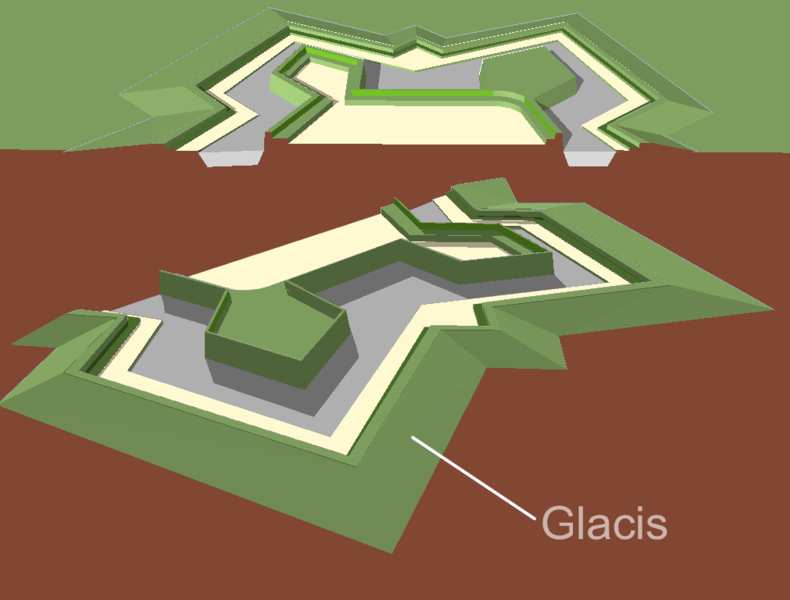
Drawing by Francis Lima via Wikimedia Commons.We can also do some work with the moat. By adding an earthwork directly in front of it, which arcs slightly uphill, called a glacis, we can both put the enemy at an angle where shots from our wall will run parallel to the ground, thus exposing the attackers further as they advance, and create a position for our own troops to come out of the fort and fire from further forward, by having them crouch in the moat behind the glacis. Indeed, having prepared, covered forward positions (which are designed to be entirely open to the fort) for firing from at defenders is extremely handy, so we could even put such firing positions – set up in these same, carefully mathematically calculated angle shapes, but much lower to the ground – out in front of the glacis; these get all sorts of names: a counterguard or couvreface if they’re a simple triangle-shape, a redan if they have something closer to a shallow bastion shape, and a flèche if they have a sharper, more pronounced face. Thus as an enemy advances, defending skirmishers can first fire from the redans and flèches, before falling back to fire from the glacis while the main garrison fires over their heads into the enemy from the bastions and outworks themselves.
A diagram showing a glacis supporting a pair of bastions, one hollow, one not.
Diagram by Arch via Wikimedia Commons.At the same time, a bastion fortress complex might connect multiple complete circuits. In some cases, an entire bastion fort might be placed within the first, merely elevated above it (the term for this is a “cavalier“) so that both could fire, one over the other. Alternately, when entire cities were enclosed in these fortification systems (and that was common along the fracture zones between the emerging European great powers), something as large as a city might require an extensive fortress system, with bastions and outworks running the whole perimeter of the city, sometimes with nearly complete bastion fortresses placed within the network as citadels.
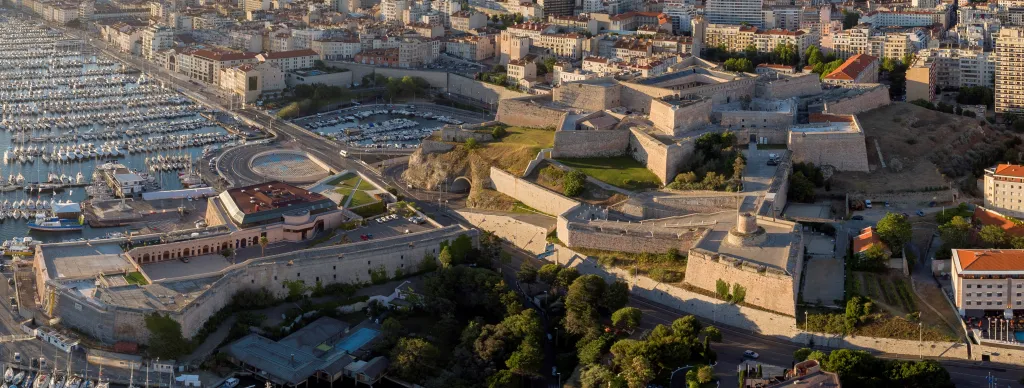
Fort Saint-Nicolas, which dominates the Old Port of Marseille. The fort forms part of a system with the low outwork you see here and also an older refitted castle, Fort Saint-Jean, on the other side of the harbor.
Photo via Wikimedia Commons.All of this geometry needed to be carefully laid out to ensure that all lines of approach were covered with as much fire as possible and that there were no blindspots along the wall. That in turn meant that the designers of these fortresses needed to be careful with their layout: the spacing, angles and lines all needed to be right, which required quite a lot of math and geometry to manage. Combined with the increasing importance of ballistics for calculating artillery trajectories, this led to an increasing emphasis on mathematics in the “science of warfare”, to the point that some military theorists began to argue (particularly as one pushes into the Enlightenment with its emphasis on the power of reason, logic and empirical investigation to answer all questions) that military affairs could be reduced to pure calculation, a “hard science” as it were, a point which Clausewitz (drink!) goes out of his way to dismiss (as does Ardant du Picq in Battle Studies, but at substantially greater length). But it isn’t hard to see how, in the heady centuries between 1500 and 1800 how the rapid way that science had revolutionized war and reduced activities once governed by tradition and habit to exercises in geometry, one might look forward and assume that trend would continue until the whole affair of war could be reduced to a set of theorems and postulates. It cannot be, of course – the problem is the human element (though the military training of those centuries worked hard to try to turn men into “mechanical soldiers” who could be expected to perform their role with the same neat mathmatical precision of a trace italienne ravelin). Nevertheless this tension – between the science of war and its art – was not new (it dates back at least as far as Hellenistic military manuals) nor is it yet settled.
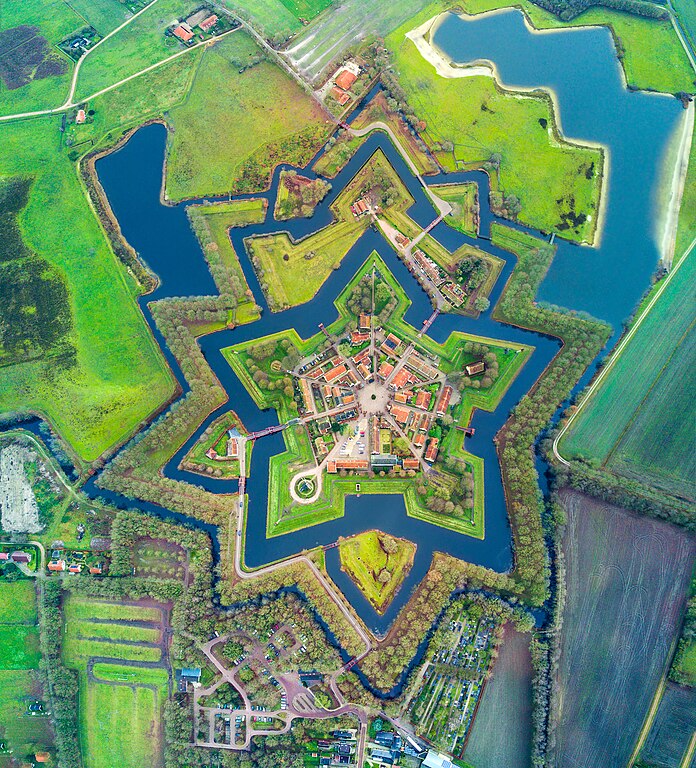
An aerial view of the Bourtange Fortress in Groningen, Netherlands. Built in 1593, the fort has been restored to its 1750s configuration, seen here.
Photo by Dack9 via Wikimedia Commons.But coming back to our fancy forts, of course such fortresses required larger and larger garrisons to fire all of the muskets and cannon that their firepower oriented defense plans required. Fortunately for the fortress designers, state capacity in Europe was rising rapidly and so larger and larger armies were ready to hand. That causes all sorts of other knock on effects we’re not directly concerned with here (but see the bibliography at the top). For us, the more immediate problem is, well, now we’ve built one of these things … how on earth does one besiege it?
Bret Devereaux, “Collections: Fortification, Part IV: French Guns and Italian Lines”, A Collection of Unmitigated Pedantry, 2021-12-17.
Comments Off on QotD: The trace italienne in fortification design


