Quotulatiousness

December 4, 2019

What Life Was Like for the Home Guard During WW2

Filed under: Britain, History, Military, WW2 — Tags: , , — Nicholas @ 02:00

Forces TV
Published 8 May 2014

Scrapbooks revealing what the Home Guard was really like during World War Two have been published online.

The collection of maps, photographs and secret documents were compiled by Lieutenant Colonel Sir Morgan Crofton.

Now they are available for all to see thanks to work by the New Forest Park Authority.

The scrapbooks can be viewed online here – http://www.newforestww2.org

November 29, 2019

England’s early search for new markets

Filed under: Britain, History — Tags: , , , , , , — Nicholas @ 05:00

In the latest installment of Anton Howes’ Age of Invention, he looks at the multiple crises that afflicted England in the mid-sixteenth century and some of the reactions to those setbacks:

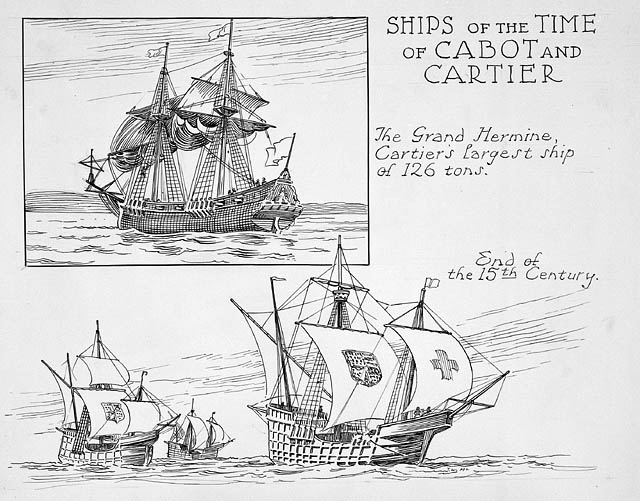
Ships from the period of John Cabot (Giovanni Caboto) and Jacques Cartier.
Illustration by Thomas Wesley McLean (1881-1951) via Wikimedia Commons.

From the 1540s through to the 1560s, [England] was beset by religious uproar, high inflation, hunger, rural and then urban unemployment, a fall-off in its major export trades, and widespread unrest. It was diplomatically isolated too. And I did not even mention the epidemics: the terrifying “sweating sickness” returned in 1551, deadly influenza swept the country in 1557, and in 1563 some 17,000 people in London were reportedly killed by the plague.

Yet, in the face of such problems, innovation in England began to pick up pace. The country, having once been a scientific and technological backwater, began to show signs of catching up. Why?

[…] The fall-off in trade with Europe, for example, seems to have had something to do with spurring the voyages of exploration in search of a north-west and north-east passage to the East Asia. Having lost Antwerp as a place to sell cloth in 1551, the English went in search of an arctic route to northern China and Japan. The expert geographers believed that those regions had a similar climate to that of Antwerp and the surrounding Netherlands, and so reasoned that the Japanese would therefore demand the same kinds of cloth. Although the English expeditions from 1553 onwards did not find a passage to Japan, they did establish trade routes with Russia via the White Sea, and they began to more actively consider the exploration and colonisation of North America. More importantly, with those voyages of exploration came greater experience of navigation, and it was not long before English ships were circumnavigating the globe (Francis Drake in 1577-80). Improvements to navigational techniques and instruments, as well as the ships themselves followed.

So it is tempting to think that necessity was initially the mother of invention, and that the many navigational and shipbuilding improvements of late-sixteenth-century England were its result. But I don’t think that this narrative quite works. I do not believe that necessity was the mother of invention.

For a start, voyages of navigation had already been attempted a number of times, long before the more successful ones in the early 1550s. The first explorers had reputedly gone west from Bristol in 1465, and certainly from 1480. And soon after the announcement of Columbus’s discoveries in the 1490s, the Venetian Zuan Chabotto (aka John Cabot), had sailed from Bristol with Henry VII’s blessing and claimed Newfoundland for both crown and Catholicism. Cabot had even hoped to found a penal colony on his second voyage in 1497, though for some reason the king did not provide the criminals. Throughout the early sixteenth century, the voyages continued. John Rastell, brother-in-law to Thomas More, the famous statesman and author of Utopia, in 1517 went in search of a north-west passage (though he never got beyond Ireland, because his crew decided it would be better to leave him there and sell the ship’s cargo in Bordeaux). Yet another voyage went west with Henry VIII’s support in 1527, but it mostly just found other Europeans — fishing fleets from Spain, Portugal, and France off the coast of Newfoundland (the English had made some catches there in the early 1500s, but apparently could not compete), and the Spanish everywhere else. The expedition made its way down to the Caribbean and then went home, with little to report. So people had already gone off exploring, long before the mid-sixteenth-century English commercial crisis. It suggests that there had already been both a latent supply and demand for such explorations.

Revolts, civil wars, and revolutions

Filed under: Britain, Government, History, Politics — Tags: , , , , , — Nicholas @ 03:00

Severian offers his taxonomy of protest with examples from English history:

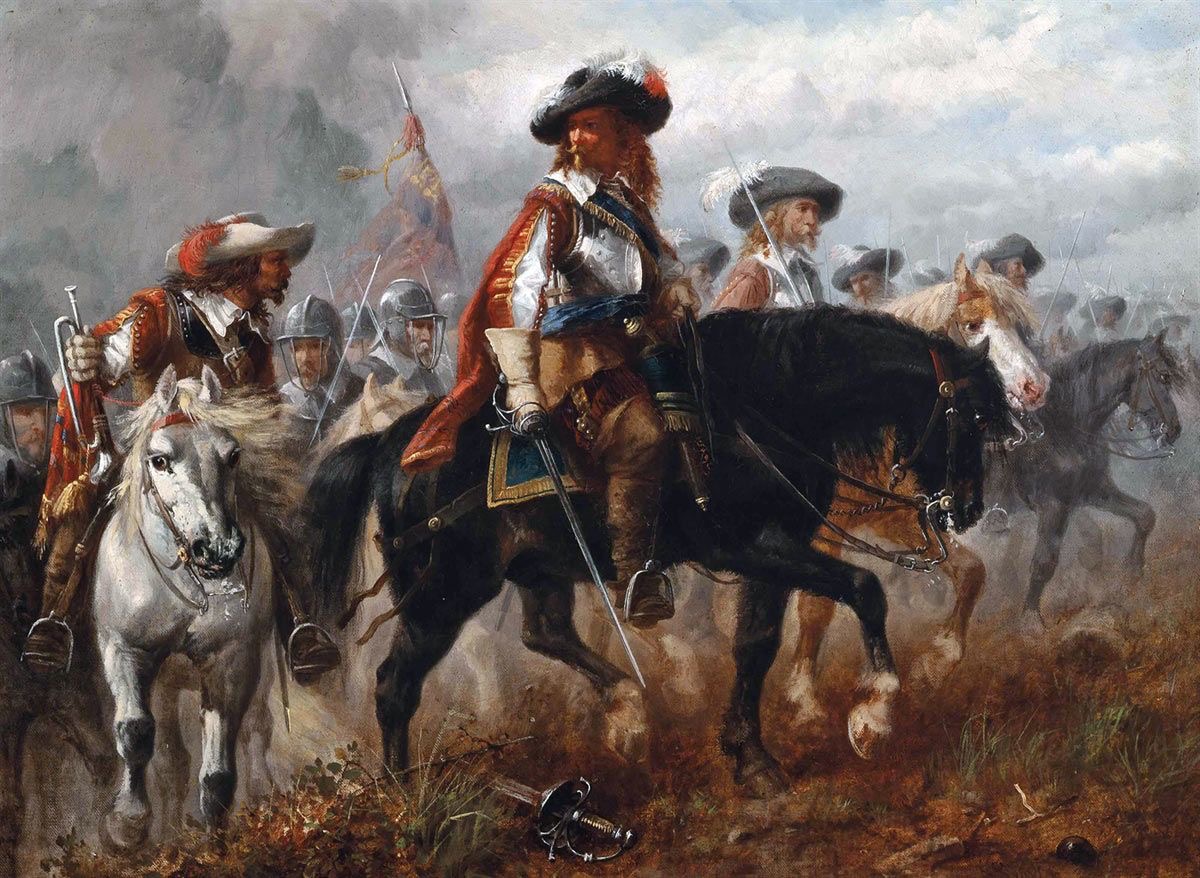
King Charles I and Prince Rupert before the Battle of Naseby 14th June 1645 during the English Civil War.
19th century artist unknown, from Wikimedia Commons.

  • A revolt is a large-scale, semi-organized riot. It aims, at best (e.g. Wat Tyler’s Rebellion), at the redress of specific grievances. At worst, it’s violent nihilism (e.g. the Jacquerie).
  • A civil war aims to replace one leader with another, leaving the underlying civil structure intact — e.g. any of the Roman civil wars post-Augustus.
  • A revolution‘s goal is total social transformation. We’re stipulating that it’s violent, because while stuff like the Industrial Revolution is fascinating, we’re not looking at peaceful change here in the Current Year. Revolutions are necessarily, fundamentally ideological.

I realize this can cause some confusion, as events I’d classify as “revolutions” are called civil wars in the history books, and vice versa. But the difference is important, because it sheds light on the development, course, and outcome of events.

The paradigm case is the English Civil War, 1642-51. This was clearly a revolution, as it aimed at — and achieved — the near-total overthrow of existing society. When Charles I took the throne in 1625, his kingdom was very much closer to a Continental-style divine-right monarchy than most Britons would like to admit. While the English had succeeded in clawing some of their liberties back from the crown after Henry VIII’s death, the fact remains that the Stuart state, like the Tudor state, was despotic. But by 1625, the despot was completely out of step with his people, and his times.

By 1642, the first revolutionary prerequisite was in place: No clear alternative. There were lots of revolts against Henry VIII, and one of them, the Pilgrimage of Grace, had the potential to turn into a civil war, or even a revolution. The revolts against Elizabeth I didn’t quite rise to that level, but the Northern Rebellion, and Essex’s Rebellion certainly imperiled her government. See also Wyatt’s Rebellion against Queen Mary, the Prayer Book Rebellion and Kett’s Rebellion against Edward VI, etc. In all of these, the alternative was clear — return to Rome, replacement of one court faction with another, or return to the old ways.

November 23, 2019

History Summarized: Ireland

Overly Sarcastic Productions
Published 22 Nov 2019

Get 3 months of Audible for just $6.95 a month — that’s more than half off the regular price. Choose 1 audiobook and 2 Audible Originals absolutely free. Visit http://www.audible.com/overlysarcastic or text “overlysarcastic” to 500 500.

While the rest of Europe was flailing aimlessly through the Dark Ages, Ireland was both preserving the ancient world and setting the stage for the Medieval Period. Then England showed up.

Sources & Further Reading:
How the Irish Saved Civilization: https://www.audible.com/pd/How-the-Ir…
Modern Ireland: 1600 — 1972 by R.F. Foster

Music from https://filmmusic.io
“Marked”, “Traveler”, “God Rest Ye Merry Celtishmen” by Kevin MacLeod (https://incompetech.com)
License: CC BY (http://creativecommons.org/licenses/b…)

Our content is intended for teenage audiences and up.

DISCORD: https://discord.gg/sS5K4R3

PATREON: https://www.Patreon.com/OSP

MERCH LINKS: https://www.redbubble.com/people/OSPY…

OUR WEBSITE: https://www.OverlySarcasticProductions.com
Find us on Twitter https://www.Twitter.com/OSPYouTube
Find us on Reddit https://www.Reddit.com/r/OSP/

November 9, 2019

Ten Minute English and British History #11 – King John and the Magna Carta

History Matters
Published 1 Jan 2018

Twitter: https://twitter.com/Tenminhistory
Patreon: https://www.patreon.com/user?u=4973164

This episode covers the reign of King John and the problems he had securing the Angevin inheritance and the subsequent issues his barons posed. These problems culminated in the signing of the Magna Carta in 1215 which severely limited the strength of John and his son, Henry III, whose reign was overshadowed by the document.

Ten Minute English and British History is a series of short, ten minute animated narrative documentaries that are designed as revision refreshers or simple introductions to a topic. Please note that these are not meant to be comprehensive and there’s a lot of stuff I couldn’t fit into the episodes that I would have liked to. Thank you for watching, though, it’s always appreciated.

November 6, 2019

In A Minute: War of the Roses

Filed under: Britain, History, Military — Tags: , , , — Nicholas @ 04:00

Overly Sarcastic Productions
Published 5 Nov 2019

Watch an entirely avoidable succession crisis spill out over the course of a whole century.

PATREON: https://www.Patreon.com/OSP

MERCH LINKS: https://www.redbubble.com/people/OSPY…

OUR WEBSITE: https://www.OverlySarcasticProductions.com
Find us on Twitter https://www.Twitter.com/OSPYouTube
Find us on Reddit https://www.Reddit.com/r/OSP/

October 31, 2019

A mathematical revolution in late medieval English ship design and construction

Filed under: Britain, History, Technology, Woodworking — Tags: , , , , — Nicholas @ 03:00

In the latest installment of Anton Howes’ newsletter on the Age of Invention, he discusses how geometry and mathematics helped transform late Medieval English shipbuilding:

An English ship of a slightly later period: this is a replica of the Susan Constant at the Jamestown Settlement in Virginia. The original ship was built sometime before 1607 and rented by the Virginia Company of London to transport the original settlers to Jamestown.
Photo by Nicholas Russon, March 2004.

Since about 1500, an Italian and Portuguese method of making ships had come into ever wider use in northern Europe. This was to construct the ship’s skeleton first, and then lay the planking around it. This contrasted with the older “clinker” method, by which the planks were laid from the keel upwards, with each plank slightly overlapping the one below – the rest of the skeleton was filled in later to strengthen it. The new “carvel” method, instead of having overlapping planks, allowed for a smooth hull. But it also required more planning.

The master shipwright had to first design full-sized templates, or frames, which were placed along the keel to determine the width and height of the hull, like cross-sections up and down the length of the ship. To the edges of these frames were then fixed ribbands — long, pliable boards running down the ship’s length. Altogether, the frames and ribbands formed a temporary, basket-like structure, to guide the moulding of the ship’s permanent hull around it.

But calculating the size of the frames at each point was tricky. After the placement of the first few, which might be pre-specified in size, the next ones along were typically determined according to the curve of the ribbands. Calculation was certainly involved, but it took place in the form or marking and adjusting the wood itself. Design and construction both took place in the shipyard, and through the medium of wood.

What Matthew Baker did in the 1570s was to take the design process out of the shipyard, and onto paper. He drew his ships, to scale. And by using pen and paper, with geometry to make such drawings possible, he opened up grand new possibilities for design. His process allowed him to jot down the latest innovations from the Mediterranean, to speculate about the designs of Noah’s ark and the ships of the ancient world, and to cheaply conduct his own experiments. He drew out new designs for frames, using geometry to work out how any variation would affect the overall shape of the hull, as well as its weight and carrying capacity – all at the cost of only time, ink, and paper, and avoiding the huge potential waste of conducting experiments at full scale in wood. His process allowed him to innovate more easily, and even to design new measuring instruments.

October 24, 2019

When the English (finally) met Euclid

Filed under: Britain, History — Tags: , — Nicholas @ 03:00

In the latest Anton Howes newsletter on the Age of Invention, he relates the introduction of Euclid’s geometric ideas to the English:

Illustrating Euclid’s proof of the Pythagorean Theorem.
Source: Wikimedia Commons.

Almost all of the late sixteenth-century English innovations seem to involve the application of geometry, following the maxims set down almost two thousand years earlier by Euclid of Alexandria. (Though at the time, most people mistakenly attributed his work to the even more ancient philosopher Euclid of Megara.) Manuscripts of Euclid’s work had circulated in western Europe throughout the Middle Ages, but was only accessible to the handful of people who could read Latin, or the even fewer who could read Arabic or ancient Greek. In 1482, however, the Latin version was printed in Venice, and throughout the sixteenth century it was translated into more and more modern languages.

The full edition would eventually appear in English in 1570, but Euclid’s geometry was revealed to English-speakers much earlier, through the intervention of the mathematician Robert Recorde. Recorde embarked on a project to comprehensively unveil the mysterious mathematical arts in print. He started in 1543 with The Ground of Arts, a basic introduction to arithmetic, which in 1551 he followed up with The Pathway to Knowledge, an introduction to geometry. Once the ground had been stood upon, and the pathway to knowledge had been followed, there was then a Gate of Knowledge (on practical geometry, sadly now lost), which revealed a Treasure of Knowledge (also lost, but presumably also on applied geometry), which was then kept in a Castle – you guessed it – of Knowledge (on applying the learning from the other books to some complex astronomical instruments). At this point he apparently ran out of places to go with his metaphor, returning in 1557 with a book on advanced arithmetic called the Whetstone of Wit. He unfortunately died the following year.

But his Pathway of Knowledge was the first book to introduce English-speakers to Euclid’s geometry. In fact, it was the first book in English on geometry ever. And he wrote it in a way that he thought would be more accessible than reading Euclid raw. The effect was revolutionary. He created the market for books on mathematics, opening the way to books on its applications by common gunners and navigators and makers of navigational instruments, as well as by scholars. And geometry began to creep into invention after invention. Recorde’s Pathway extolled the seemingly extraordinary achievements of the ancients – Archimedes, Daedalus, and others – which he argued had all been made possible by their understanding of geometry. Naturally, it inspired others to emulate or even exceed them.

October 18, 2019

QotD: England has become the Mother Hive

In 1908, Rudyard Kipling published a short story called “The Mother Hive”. In this, the bees in a hive decide to drop all outmoded ideas of hierarchy and to make everyone equal. This includes the right of workers to eat royal jelly and to mate with the drones. In the spreading chaos that results, traditionalist dissidents are first shunned and then murdered. Eventually, the bee keeper looks into the hive, and sees the empty honeycombs and the horribly deformed offspring of the workers. His response is to poison all the bees.

Now, something like this has happened in England. In the past few generations, the whole of national life has been taken over by the cultural Marxists. They run government and the administration, and the law, and education and the media, and business too. They have imposed on us a nasty hegemonic discourse. Cultural Marxism is ultimately to be traced to European thinkers like Antonio Gramsci and Louis Althusser and the Frankfurt School. But this has come to England in American clothing. It has prestige because it was taken up by the American universities.

In America, however, the progress of cultural Marxism has been resisted, or slowed, by a strong religious right and by a written constitution that it is taking a long time to subvert. Here, we have no religious right, nor an entrenched constitutional law. In the past, freedom and common sense were safeguarded by an hereditary land-owing aristocracy and gentry. These ran the country, and did much to determine its moral tone. During the twentieth century, they were marginalised and then eliminated from government. They remain as a class — still very rich — but the tacit deal since at least the 1940s has been that they will be left alone, so long as they keep out of politics. Government has been left to middle class lefties. The effect followed the cause only after several generations. But here it is.

It may be interesting for you, as foreigners, to learn an answer to the implied question in the title of this speech. But it is essential for the English to think about the question and its answers. You see, like both the Germans and the Russians, we have had a revolution. Unlike them, we have had no obviously revolutionary event. The Russians had the storming of the Winter Palace and the murder of their Royal Family. The Germans were utterly defeated in 1945. Their cities were bombed flat. Their country was occupied and divided. Every German knows either that German history came to an end in 1945, or at least that a new chapter in German history had begun.

We do not have that awareness, and it would be useful for us to understand, even so, that we are living in a state of revolution. England has become the Mother Hive.

Sean Gabb, “A Nation of Sheep: Understanding England and the English”, Libertarian Enterprise, 2017-09-23.

October 17, 2019

England in 1550 was a remarkably unpromising location for the later industrial revolution

Filed under: Britain, Economics, Europe, History — Tags: , , , , , , — Nicholas @ 03:00

Anton Howes, in his investigations on the Industrial Revolution looks back in time to see where or even if England deviated from the rest of Europe in ways that made the revolution possible, thinks he’s located the crucial time:

If a peaceful extraterrestrial visited the world in 1550, I often wonder where it would see as being the most likely site of the Industrial Revolution – an acceleration in the pace of innovation, resulting in sustained and continuous economic growth. So many theories about why it happened in Britain seem to have a sense of inevitability about them, but our extraterrestrial visitor would have found very few signs that it would soon occur there. There were many better candidates, on a multitude of metrics.

[…]

But England in 1550 was by global standards quite poor. Historical GDP per capita measures are notoriously difficult to obtain, even for some countries in the twentieth century let alone the sixteenth. The historical GDP per capita of England – by far the most studied region – is still hotly debated among economic historians. Nonetheless, according to the most recent collection of estimates – the Maddison project’s database of 2018 – in 1550 our extraterrestrial visitor would have been much more interested in Belgium. England at that stage lagged behind almost all of the areas for which we have estimates: Holland, Spain, Italy, Sweden, and France. In 1600, it was behind Portugal and India. Here are the figures in 2011 dollars; the colours are by row:

Such estimates should of course be taken with a hefty boulder of salt. (Note, also, that these particular figures, called “CGDPpc”, are something of an innovation by the team compiling the Maddison Project Database – they use multiple benchmarks to improve how we compare countries’ relative incomes in any particular year, which comes at the cost of not being able to compare their growth rates, for which there are separate figures. In other words, you should read the figures by row, not by column.) But it is worth noting that the more recent research on historical GDP per capita, finally filling in some details for regions other than England and Holland, often results in those other countries seeming richer in the sixteenth and seventeenth centuries. The more we know, the more the traces of an early English divergence seem to disappear.

Even without access to such statistics, however, our visitor would have noticed that in the mid-1550s England suffered severe food shortages. Indeed, the threat of famine would be present right up until the beginning of the eighteenth century: there was a major famine in the north of England in 1649, and even a famine in the 1690s that killed between five and fifteen percent of Scotland’s population. Britain would one day become perhaps the first famine-free region, but that did not occur until much later, when innovation had already begun to accelerate. It may even have been its result.

And England in 1550 was not just poor; it was also weak. If our visitor thought, as some historians do, that conquest and exploitation were essential for future growth, then it was Spain that had the major overseas empire, followed by Portugal. England in 1550 had no colonies in the New World, and its attempts to found them all failed until the seventeenth century, by which stage the Dutch and French had also begun to extend their own empires too. It was not until the eighteenth century that Britain began to exceed them.

September 27, 2019

England’s constitution before the shiny new Supreme Court was created

Filed under: Britain, History, Law, USA — Tags: , , , , , — Nicholas @ 05:00

Peter Hitchins provides a thumbnail sketch of the state of play before the Supreme Court was added to British constitutional arrangements:

Why did we never even have such a body until ten years ago? As we shall see, it would have been, and still is, a contradiction in terms. But in interesting times such as these, elephants fly, fishes walk, figs grow on thorns, and oxymorons inherit the earth.

The most powerful law court in the land was, by a curious paradox, not in the land at all, but based in tiny Luxembourg, across the Narrow Seas which have kept invaders from our door but are useless against bureaucratic takeovers by the European Union. There sits the European Court of Justice, which as long ago as 1990 established that it could tell British courts to overrule British Acts of Parliament when they conflict with E.U. law. It can carry on doing this until we eventually do leave the E.U., if we ever do.

These various messes came about because we are so old, and rely so much on convention and manners, that it is all too easy for unconventional and ill-mannered busybodies to come storming in with new ideas. England’s constitution was not planned and built, like America’s. Instead, it grew during a thousand years of freedom from invasion. Both are beautiful in their way. America’s fundamental law has the cold, orderly beauty of a classical temple. England’s has the warmer, more chaotic loveliness of an ancient forest. It seems to be wholly natural but, when examined closely, it shows many signs of careful cultivation and pruning. Our powers are not as separated as America’s, but slightly tangled. Still, it has worked well enough for us over time.

Any thinking person must admire both the American and the English constitutions as serious efforts in a world of chaos, despotism, and stupidity to apply human intelligence to the task of giving people ordered, peaceful, and free lives. They have a common origin in the miraculous Magna Carta, which Americans often revere more than modern Englishmen do. We in England have grown complacent about our liberty, and have become inclined to forget our great founding documents.

But the two constitutions are not the same, and in my view they are not compatible. For my whole life, until a few years ago, the very idea that England should have a Supreme Court was an absurdity. The Highest Court in England is the Crown in Parliament which, as I was once taught, had the power to do everything except turn a man into a woman. In these more gender-fluid times, that expression is not much used. But it contains the truth. Parliament can make any law and overturn any law, made by itself or by the courts.

That is why England (often to my regret) lacks a First Amendment and cannot have one unless we undergo a revolution. No law in England could possibly open with the words “Parliament shall make no law.” Our 1689 Bill of Rights, the model for the U.S. Bill of Rights a century later, tells the king what he cannot do and the courts what they cannot do. It grants me (as a Protestant) the right to have weapons for my defense. But while it draws its sword against arbitrary power, it puts a protective arm round Parliament.

September 19, 2019

Ancient technology: Saxon glass-working experiment

Filed under: Britain, History, Technology — Tags: , , , , , — Nicholas @ 02:00

Lindybeige
Published on 9 Aug 2019

Many thanks to Victoria Lucas for inviting me along to see her experiments in medieval glass-working. Fire! Craft! Mud!
Support me on Patreon: https://www.patreon.com/Lindybeige

Picture credits:

Natron deposit image
By Stefan Thüngen – Own work, Public Domain, https://commons.wikimedia.org/w/index…

Glass slab of BETH SHE’ARIM
Hanay [CC BY-SA 4.0 (https://creativecommons.org/licenses/…)]

Palm cup
Reptonix free Creative Commons licensed photos [CC BY 3.0 (https://creativecommons.org/licenses/…)]

Lindybeige: a channel of archaeology, ancient and medieval warfare, rants, swing dance, travelogues, evolution, and whatever else occurs to me to make.

▼ Follow me…

Twitter: https://twitter.com/Lindybeige I may have some drivel to contribute to the Twittersphere, plus you get notice of uploads.

websites:
http://www.Lindybeige.uk
http://www.LloydianAspects.co.uk

August 19, 2019

Joan of Arc – Lies – Extra History

Filed under: Britain, France, History, Religion — Tags: , , , , — Nicholas @ 04:00

Extra Credits
Published on 17 Aug 2019

Writer Rob Rath talks about all the cool stories and facts we didn’t get to cover in our recent series on the hated and beloved Joan of Arc.

Join us on Patreon! http://bit.ly/EHPatreon

From the comments:

Extra Credits
2 days ago

Recommended reading:

Joan of Arc: A History, by Helen Castor

Joan of Arc by Herself and Her Witnesses, by Régine Pernoud

Orléans, 1429: France Turns the Tide, by David Nicolle

4:01 – really cool side characters that didn’t make the final video script (but did show up in Game of Thrones??)

8:12 – multiple versions of Joan’s meeting with Charles

10:48 – all the other famous people we didn’t mention, including Gilles de Rais

13:11 – Joan really did have excellent tactical acumen, which we had to gloss over in her later battles

19:55 – what’s next on Extra History

21:17 – Six Degrees of Walpole

August 13, 2019

Hands on with the Sutton Hoo sword I Curator’s Corner Season 5 Episode 1

Filed under: Britain, History, Weapons — Tags: , , , , — Nicholas @ 04:00

The British Museum
Published on 5 Aug 2019

Sue Brunning and her trusty foam sword (newly dubbed Flexcalibur by commentator Pipe2DevNull) are back for another sword story. This time Sue takes us up close and personal with one of the most famous swords ever discovered.

Sue has also written a blog about Sutton Hoo available here: https://bit.ly/2yQkfYV (there are lots of other great articles there too!)

#CuratorsCorner #SwordswithSue #SuttonHooSue

August 5, 2019

Joan of Arc – Heroine or Heretic? – Extra History – #5

Filed under: Britain, France, History, Military, Religion — Tags: , , , , , — Nicholas @ 04:00

Extra Credits
Published on 3 Aug 2019

Join us on Patreon! http://bit.ly/EHPatreon

Joan had been sold out to the English. Bishop Pierre Cauchon was determined to prove the inaccuracy of her visions and her motivations so that Charles could have no claim to the throne. But Joan held on till the bitter end.

« Newer PostsOlder Posts »

Powered by WordPress