Quotulatiousness

June 4, 2020

Performance, Plague, and Politics in Shakespeare’s London

Filed under: Britain, Health, History, Humour, Media — Tags: , , , , , , , — Nicholas @ 06:00

Atun-Shei Films
Published 27 Mar 2020

Help us make the first feature film ever made (that we know of) spoken entirely in Original Pronunciation, the accent of Shakespeare: https://igg.me/at/sudburydevil/x/1502…

Did William Shakespeare write King Lear under quarantine? That is the question. In this video I introduce you to the actor’s process in Elizabethan theater; dive deep into first-hand accounts of the bubonic plague epidemics that Shakespeare lived through; explore the politics of late 16th and early 17th century England, onstage and off; and discuss OP, Original Early Modern English Pronunciation, the accent and dialect in which the Bard’s plays were originally performed.

The rest is silence.

Support Atun-Shei Films on Patreon ► https://www.patreon.com/atunsheifilms

#English #Theater #History

Watch our film ALIEN, BABY! free with Prime ► http://a.co/d/3QjqOWv
Reddit ► https://www.reddit.com/r/atunsheifilms
Twitter ► https://twitter.com/atun_shei
Instagram ► https://www.instagram.com/atunsheifilms
Merch ► https://atun-sheifilms.bandcamp.com

From the comments:

Atun-Shei Films
1 month ago
CORRECTION: The Great Vowel Shift was a SEPARATE linguistic trend to the R-dropping in 18th century English. My mistake, sorry!

May 22, 2020

First War of Scottish Independence | 3 Minute History

Filed under: Britain, France, History, Military — Tags: , , — Nicholas @ 02:00

Jabzy
Published 22 Jun 2015

The First Scottish War of Independence

April 29, 2020

Feudalism: A Brief Explanation

Thersites the Historian
Published 26 Oct 2017

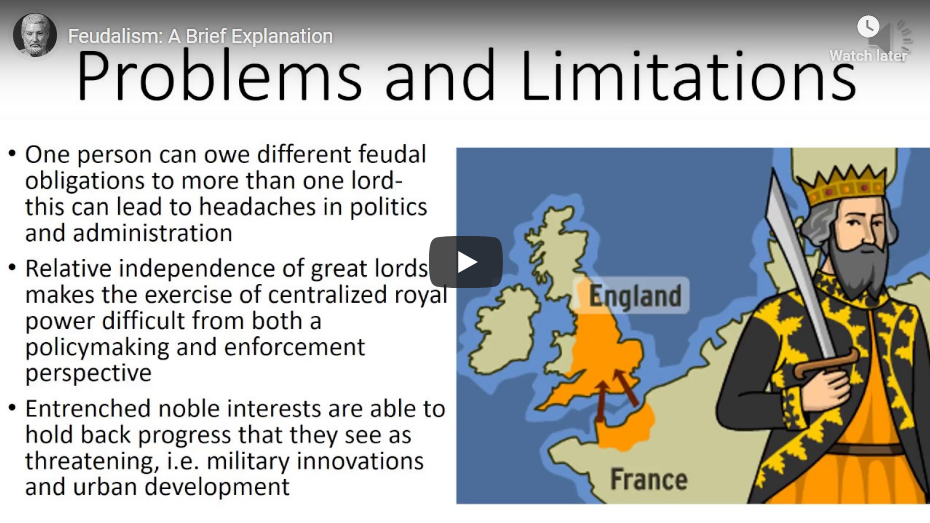
In this video, I try to bring order to the chaos that is feudalism and render it comprehensible.

April 25, 2020

History-Makers: Shakespeare

Overly Sarcastic Productions
Published 24 Apr 2020

“The Bard” is not only an essential class in any D&D party, but a byword for England’s most famous writer. We’ve covered a bit of Shakespeare before on OSP — just a bit, really, nothing major, only a dozen — but today we’ll look at how William got to Bard-ing, and how he accidentally became England’s biggest Historian.

SOURCES and Further Reading: The Introduction and play-texts of the Folger Shakespeare Library (The best way to read Shakespeare), “Shakespeare: A Very Short Introduction” by Wells

This video was edited by Sophia Ricciardi AKA “Indigo”. https://www.sophiakricci.com/
Our content is intended for teenage audiences and up.

PATREON: https://www.Patreon.com/OSP

DISCORD: https://discord.gg/h3AqJPe

MERCH LINKS: https://www.redbubble.com/people/OSPY…

OUR WEBSITE: https://www.OverlySarcasticProductions.com
Find us on Twitter https://www.Twitter.com/OSPYouTube
Find us on Reddit https://www.Reddit.com/r/OSP/

April 23, 2020

Trial by jury

Filed under: Britain, History, Law, Liberty — Tags: , , , , — Nicholas @ 03:00

Peter Hitchens recounts the essential role of the jury system in the evolution of the English (and, by inheritance, the Australian, Canadian, and even American) constitutional rights of the individual, which today seems to be in peril:

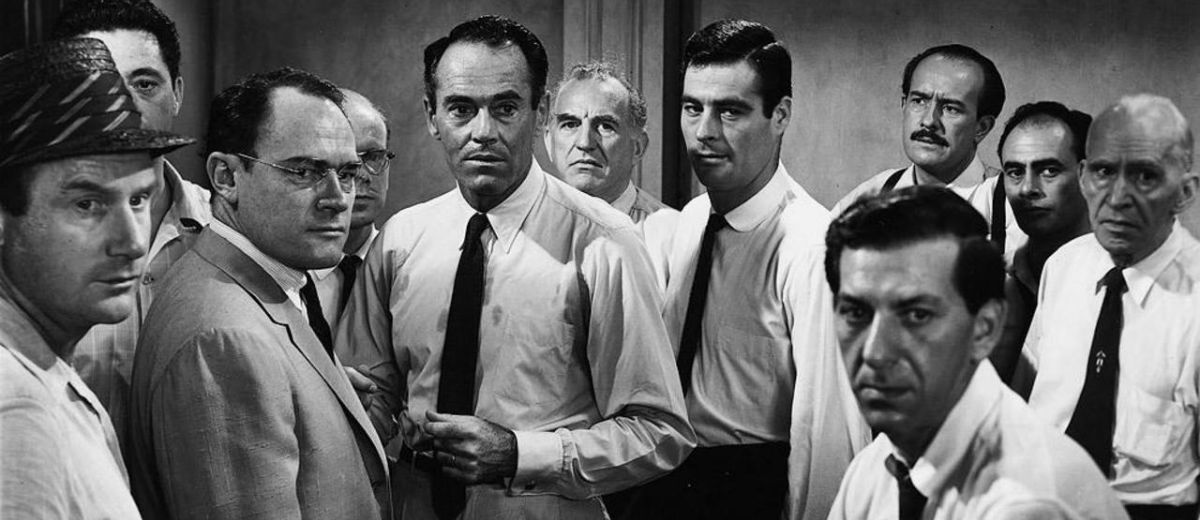
A still from the 1957 movie Twelve Angry Men, directed by Sidney Lumet, starring Henry Fonda, Lee J. Cobb, and Martin Balsam.

Am I going to have to fall out of love with juries? For decades I have defended these curious committees, which can ruin a man’s life in an afternoon. It has been a romance as much as it has been a reasoned position. Most people get their best lesson in jury trials from the 1957 movie Twelve Angry Men. In that version, a single determined juror, played by Henry Fonda, gradually wins the rest of the panel round to an acquittal, at great cost in emotion and patience. But what really won my heart was Thomas Macaulay’s account of the Trial of the Seven Bishops, in which a London jury defied the wishes of the would-be autocrat King James II in 1688. It was an astonishing event, a monarch’s authority challenged by — of all unlikely things — a collection of Anglican prelates. Their acquittal, perhaps more than anything else, led to James’s fall a few months later. It was the beginning of true constitutional monarchy in Europe, the genesis of the English Bill of Rights and the forerunner of the very similar American document of the same name. It could not have happened without a jury.

For without a jury, any trial is simply a process by which the state reassures itself that it has got the right man. A group of state employees, none of them especially distinguished, are asked to confirm the views of other state employees. With a jury, the government cannot know the outcome and must prove its case. And so the faint, phantasmal ideal of the presumption of innocence takes on actual flesh and bones and stands in the path of power. Juries grew up in England almost entirely by happy accident, and no government would nowadays willingly create them where they do not already operate. A brief fashion for them in 19th-century Europe was swiftly stamped out by governments that understood all too well how much they limited their power. I believe the last true Continental juries, sitting in the absence of a judge, were abolished in France in 1940 by the German occupation authorities. People in Anglosphere countries, unaware that true independent juries rarely exist outside the English-speaking world, have no idea what a precious possession they are.

I remember actually pounding the arm of my chair with delight as I read Macaulay’s account of the response of the bishops’ attorney, Francis Pemberton, when threatened by the chief Crown prosecutor, the solicitor general: “Record what you will. I am not afraid of you, Mister Solicitor!” So this was England after all, and even the majesty of the Stuart Crown could not overawe the defense. This was wholly thanks to the fact that the trial took place before a jury — which duly acquitted the bishops of “seditious libel,” the ludicrous charge by which James had hoped to crush opposition to his plans to reverse the Reformation. Without a jury, the king would of course have won his case, and England would have gone down the road to absolutism (already followed in France, Prussia, Russia, and the Habsburg dominions) with incalculable consequences for the whole world. Instead we had what came to be called the Glorious (or Bloodless) Revolution.

And my blood still runs faster when I recall this and other moments at which the mere existence of juries has made us all more free. Yet I also have terrible doubts. Is the independence of juries possible in the modern world, in which the English Bill of Rights is all but forgotten and a new dispensation reigns? All too often, I read reports of trials in my own country that fill me with doubt. I did my fair share of court reporting as an apprentice journalist many years ago, and I have a good understanding of how these things used to work and ought to work. Something has changed. There is a worrying number of sex cases now coming before the courts in which clear forensic proof of guilt is often unobtainable.

The alleged crimes themselves are repulsive, and the mere accusation is enough to nurture prejudice. The defendants have often been arrested in the scorching light of total publicity, in spectacular dawn raids totally unjustified by any immediate danger they present. Pre-trial media reporting has further undermined the presumption of innocence. In England there is still officially a strong rule against the media taking sides before the jury delivers its verdict. But this is not enforced as it once was. The prosecutions are frequently as emotional as they are unforensic, the opposite of the proper arrangement. Yet the defendants are often convicted even so (sometimes by majority verdicts, which in my view violate the whole jury principle). The state seems somehow to have turned the jury — often swayed by emotion — into its own weapon. And it is worse than the alternative. A wrongfully-convicted defendant, pronounced culpable by a jury of his peers, must feel a far deeper despair than one cast into prison by a mere panel of judges.

April 14, 2020

History Summarized: England

Overly Sarcastic Productions
Published 10 Apr 2020

English history has a reputation for being nigh incomprehensible — what with all the kings, civil wars, succession crises, and slapfights with France. But with the right perspective (and a little royal-restraint), England can become quite a straightforward story. So let’s take a look at this slice of Britain, and see how it grew into the master of the Isles.

SOURCES & Further Reading: “History of England from the Tudors to the Stuarts”, lecture series for The Great Courses by Robert Bucholz, a great look at Renaissance and Early Imperial England.
“Ten Minute History of England and Britain” Parts 1-18, by History Matters, a lengthy chronicle of English history from the Roman conquest through the Union of the Crowns. Good watch if you have the time.
Foundation by Peter Ackroyd, the first book in a mammoth 6-volume History of England, which covers everything up to the death of Henry VII. If you really want to dig into English history, this is the book for you.

This video was edited by Sophia Ricciardi AKA “Indigo”. https://www.sophiakricci.com/
Our content is intended for teenage audiences and up.

PATREON: https://www.Patreon.com/OSP

DISCORD: https://discord.gg/h3AqJPe

MERCH LINKS: https://www.redbubble.com/people/OSPY…

OUR WEBSITE: https://www.OverlySarcasticProductions.com
Find us on Twitter https://www.Twitter.com/OSPYouTube
Find us on Reddit https://www.Reddit.com/r/OSP/

April 7, 2020

Britain AD: The Invasion That Never Was – The Anglo-Saxon Invasion (BBC Documentary)

Filed under: Britain, Europe, History, Science — Tags: , , , — Nicholas @ 04:00

Johnny66
Published 21 Jun 2015

A well-considered documentary by the noted scholar, Dr Francis Pryor. The names Cerdic, Ceawlin, Cedda and Caedwalla are not exactly Germanic in origin? Cerdic’s father, Elesa, has been identified by some scholars with the Romano-Briton Elasius, the “chief of the region,” met by Germanus of Auxerre.

Classics Summarized: Beowulf

Filed under: Books, Britain, Europe, History — Tags: , , , , , , — Nicholas @ 02:00

Overly Sarcastic Productions
Published 28 Aug 2015

Beowulf! The tale of the baddest Geat to ever Geat.

Tolkien said that the Dragon in Beowulf is one of only two *true* dragons in all of literature — the other being Fafnir. The influence of both these dragons is very visible in a lot of our more modern fantasy: for instance, where Beowulf’s Dragon inspired Smaug, o chiefest and greatest of calamities, Fafnir inspired C. S. Lewis to include that cursed bracelet thing that turned Eustace into a dragon in Voyage of the Dawn Treader. And I think we all know the badder of those two dragons, so I guess Tolkien — and, by extension, Beowulf — wins this round.

Where was I? Right. BEOWULFFFFF

PATREON: https://www.patreon.com/user?u=4664797

MERCH LINKS:
Shirts – https://overlysarcasticproducts.threa…
All the other stuff – http://www.cafepress.com/OverlySarcas…

Find us on Twitter @OSPYouTube!

March 31, 2020

Third Crusade | 3 Minute History

Jabzy
Published 25 Jul 2015

Thanks to Xios, Alan Haskayne, Lachlan Lindenmayer, William Crabb, Derpvic, Seth Reeves and all my other Patrons. If you want to help out – https://www.patreon.com/Jabzy?ty=h

February 29, 2020

The metallic nickname of Henry VIII

Filed under: Britain, Germany, Government, History, Technology — Tags: , , , , — Nicholas @ 03:00

In the most recent Age of Invention newsletter, Anton Howes outlines the rocky investment history for German mining firms in England during the Tudor period:

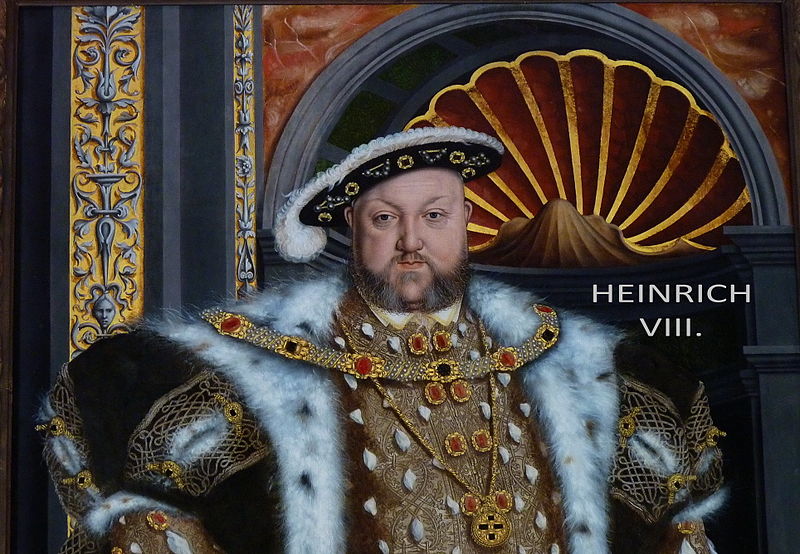
Cropped image of a Hans Holbein the Younger portrait of King Henry VIII at Petworth House.
Photo by Hans Bernhard via Wikimedia Commons.

It’s an especially interesting case of England’s technological backwardness, given that copper was a material of major strategic importance: a necessary ingredient for the casting of bronze cannon. And it was useful for other industries, especially when mixed with zinc to form brass. Brass was the material of choice for accurate navigational instruments, as well as for ordinary pots and kettles. Most importantly, brass wire was needed for wool cards, used to straighten the fibres ready for spinning into thread. A cheaper and more secure supply of copper might thus potentially make England’s principal export, woollen cloth, even more competitive — if only the English could also work out how to produce brass.

The opportunity to introduce a copper industry appeared in 1560, when German bankers became involved in restoring the gold and silver content of England’s currency. The expensive wars of Henry VIII and Edward VI in the 1540s had prompted debasements of the coinage, to the short-term benefit of the crown, but to the long-term cost of both crown and country. By the end of Henry VIII’s reign, the ostensibly silver coins were actually mostly made of copper (as the coins were used, Henry’s nose on the faces of the coins wore down, revealing the base metal underneath and earning him the nickname Old Coppernose). The debased money continued to circulate for over a decade, driving the good money out of circulation. People preferred to hoard the higher-value currency, to send it abroad to pay for imports, or even to melt it down for the bullion. The weakness of the pound was an especial problem for Thomas Gresham, Queen Elizabeth’s financier, in that government loans from bankers in London and Antwerp had to be repaid in currency that was assessed for its gold and silver content, rather than its face value. Ever short of cash, the government was constantly resorting to such loans, made more expensive by the lack of bullion.

Restoring the currency — calling in the debased coins, melting them down, and then re-minting them at a higher fineness — required expertise that the English did not have. From France, the mint hired Eloy Mestrelle to strike the new coins by machine rather than by hand. (He was likely available because the French authorities suspected him of counterfeiting — the first mention of him in English records is a pardon for forgery, a habit that apparently died hard as he was eventually hanged for the offence). And to do the refining, Gresham hired German metallurgists: Johannes Loner and Daniel Ulstätt got the job, taking payment in the form of the copper they extracted from the debased coinage (along with a little of the silver). It turned out to be a dangerous assignment: some of the copper may have been mixed with arsenic, which was released in fumes during the refining process, thus poisoning the workers. They were prescribed milk, to be drunk from human skulls, for which the government even gave permission to use the traitors’ heads that were displayed on spikes on London Bridge — but to little avail, unfortunately, as some of them still died.

Loner and Ulstätt’s payment in copper appears to be no accident. They were agents of the Augsburg banking firm of Haug, Langnauer and Company, who controlled the major copper mines in Tirol. Having obtained the English government as a client, they now proposed the creation of English copper mines. They saw a chance to use England as a source of cheap copper, with which they could supply the German brass industry. It turns out that the tale of the multinational firm seeking to take advantage of a developing country for its raw materials is an extremely old one: in the 1560s, the developing country was England.

Yet the investment did not quite go according to plan. Although the Germans possessed all of the metallurgical expertise, the English insisted that the endeavour be organised on their own terms: the Company of Mines Royal. Only a third of the company’s twenty-four shares were to be held by the Germans, with the rest purchased by England’s political and mercantile elite: people like William Cecil (the Secretary of State) and the Earl of Leicester, Robert Dudley (the Queen’s crush). It was an attractive investment, protected from competition by a patent monopoly for mines of gold, silver, copper, and mercury in many of the relevant counties, as well as a life-time exemption for the investors from all taxes raised by parliament (in those days, parliament was pretty much only assembled to legitimise the raising of new taxes).

February 24, 2020

Norman Conquest of England | 3 Minute History

Filed under: Britain, History, Military — Tags: , , , — Nicholas @ 02:00

Jabzy
Published 15 Jan 2015

Norman Conquest

February 20, 2020

So that’s why John Cabot got hired!

Filed under: Britain, History, Technology — Tags: , , , , — Nicholas @ 05:00

Anton Howes explains something that I’d wondered about in the latest edition of his Age of Invention newsletter:

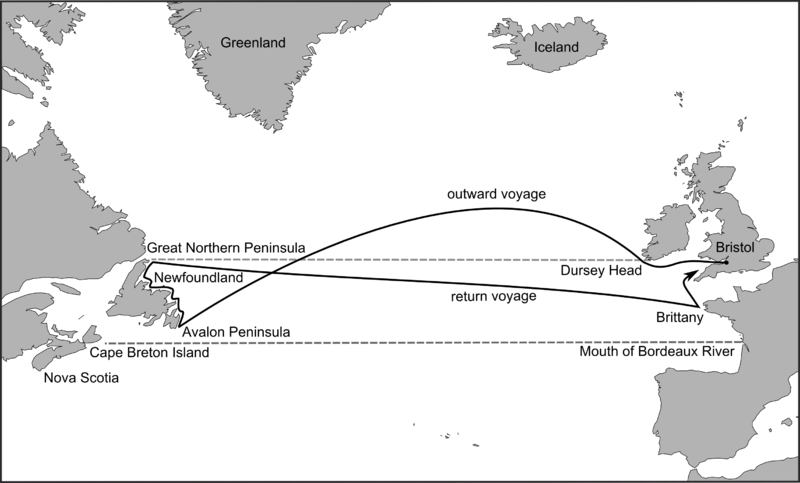
Route of John Cabot’s 1497 voyage on the Matthew of Bristol posited by Jones and Condon: Evan T. Jones and Margaret M. Condon, Cabot and Bristol’s Age of Discovery: The Bristol Discovery Voyages 1480-1508 (University of Bristol, Nov. 2016), fig. 8, p. 43.
Wikimedia Commons.

… in 1550 the English were still struggling with latitude. Their inability to find it, unlike their Spanish and Portuguese rivals, was one of the main things holding them back from voyages of exploration.

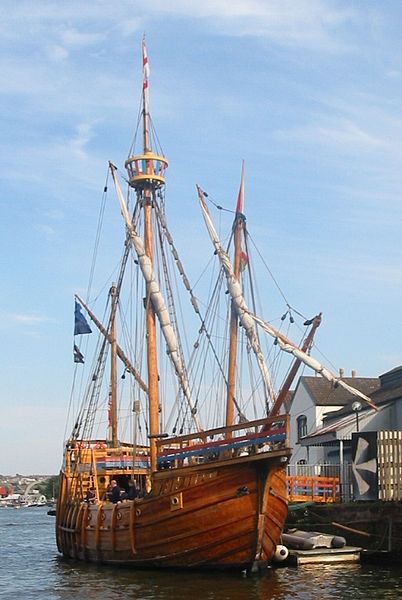
The replica of John Cabot’s ship Matthew in Bristol harbour, adjacent to the SS Great Britain.
Photo by Chris McKenna via Wikimedia Commons.

The traditional method of navigation for English pilots was to simply learn the age-old routes. They were trained through repetition and accrued experience, learning to recognise particular landmarks and using a lead and line – just a thin rope weighted with some lead – to determine their location from the depth of the water. Cover the lead with something sticky, and you might bring up some sediment from the sea floor to double-check: a pilot would learn the kinds of sand and pebbles from to expect from different areas. And when they travelled out to sea, away from the coastline, they used a basic system of dead reckoning, taking their compass bearings from a known location, estimating their speed, and keeping in a particular direction for long enough. Or at least hoping to. They might keep track of their progress on a wooden traverse table, inserting pegs to indicate how far they had sailed, but it was ultimately a matter of rough estimation. Should they make any mistake — in terms of their speed, heading, or point of departure — they might easily get lost. But it was still a matter of trying to follow an already-known route. And English mariners of the 1550s did not even know that many routes.

For a voyage of exploration, by contrast, landmarks and sediment from the sea floor would be seen for the first time rather than recalled. By definition, there was no route to follow. So to launch their own voyages of discovery, the English needed to learn a new skill. They needed to look to the heavens.

Celestial navigation — measuring the altitude of heavenly bodies and then using geometry to determine one’s latitude on the earth’s surface — was by the 1550s already hundreds of years old. It had primarily been used to cross the deserts of North Africa and the Middle East — seas of sand, in which there might also be no landmarks from which to take bearings — and to navigate the Indian Ocean. Thus, while pilots in the Atlantic and the Mediterranean stuck to dead reckoning and soundings, Islamic navigators had for centuries used quadrants and astrolabes to take their bearings at sea. By the mid-fifteenth century, these instruments and techniques had found their way to Europe, where they were put to use especially by Portuguese, Spanish, and Italian explorers, along with additional instruments such as the cross-staff.

[…]

So for decades, English explorations relied on foreigners who either knew the routes that the English pilots didn’t, or who at least possessed the skill of mathematical, celestial navigation. The Italian explorer John Cabot (Zuan Chabotto), when he sailed to Newfoundland from Bristol in the late 1490s, was able to take latitude readings (he may even have been familiar with the older Islamic navigational practices, as he claimed to have visited Mecca). When Cabot died, the English expeditions that set out from Bristol in 1501-3 relied on Portuguese pilots from the mid-Atlantic islands of the Azores. And John Cabot’s son, Sebastian Cabot, who was involved in a few English expeditions, was so expert in mathematical navigation that he was eventually appointed pilot major for the entire Spanish Empire, making him responsible for the training and licensing of all its pilots — a position he held for three decades. When he led a voyage of exploration on behalf of Spain in 1526-30, a few English merchants became investors so that they could justify sending with him an English mariner, Roger Barlow, to secretly learn the Spanish routes across the Atlantic and have immediate knowledge if an onward route to Asia was discovered (as it turned out, South America got in the way).

February 18, 2020

Viking Invasion of England | 3 Minute History

Filed under: Britain, Europe, History, Military — Tags: , , — Nicholas @ 02:00

Jabzy
Published 18 Oct 2016

https://www.patreon.com/Jabzy

Thanks to Xios, Alan Haskayne, Lachlan Lindenmayer, Victor Yau, William Crabb, Derpvic, Seth Reeves and all my other Patrons.

February 8, 2020

The Trial of Charles I (1649)

Filed under: Britain, Government, History, Law — Tags: , , — Nicholas @ 04:00

Historia Civilis
Published 6 Feb 2020

Join the Mailing List here: https://www.historiacivilis.com/

Patreon | http://patreon.com/HistoriaCivilis
Donate | http://www.paypal.com/cgi-bin/webscr?…
Merch | http://teespring.com/stores/historiac…
Twitter | http://twitter.com/HistoriaCivilis
Website | http://historiacivilis.com

Sources:
T. B. Howell “A Complete Collection of State Trials and Proceedings for High Treason and Other Crimes and Misdemeanors from the Earliest Period to the Year 1783,” Volume IV | https://bit.ly/2Q9tPOS
“The Sentence of the High Court of Justice upon the King,” January 27th, 1649 | https://bit.ly/2rooZVC

Diane Purkiss, The English Civil War: A People’s History | https://amzn.to/36YHkrb
Leanda de Lisle, White King: Traitor, Murderer, Martyr | https://amzn.to/2Qen9ir
Esmé Wingfield-Stratford, King Charles the Martyr: 1643-1649 | https://amzn.to/36XFvLg
Allan Massie, The Royal Stuarts: A History of the Family That Shaped Britain | https://amzn.to/2SonMZz
Michael B. Young, Charles I | https://amzn.to/35Jm9t7
John MacLeod, Dynasty: The Stuarts 1560-1807 | https://amzn.to/2MiJGt2
C. V. Wedgwood, The Trial of Charles I | https://amzn.to/372MDWy
Maurice Ashley, The House of Stuart | https://amzn.to/2PMvU42
Trevor Royle, Civil War: The Wars of the Three Kingdoms, 1638-1660 | https://amzn.to/2tKZNJP
Robert Ashton, The English Civil War: Conservatism and Revolution 1603-1649 | https://amzn.to/36WWOMz
J. P. Kenyon, The Civil Wars of England | https://amzn.to/2EIAJW3
Mark Kishlansky, A Monarchy Transformed: Britain 1603-1714 | https://amzn.to/371CSs0
Sean Kelsey, Politics and Procedure in the Trial of Charles I | https://www.jstor.org/stable/4141664
Clive Holmes, The Trial and Execution of Charles I | https://www.jstor.org/stable/40865689

Music:
“Heliograph,” by Chris Zabriskie
“John Stockton Slow Drag,” by Chris Zabriskie
“Your Mother’s Daughter,” by Chris Zabriskie
“Hallon,” by Christian Bjoerklund

We are a participant in the Amazon Services LLC Associates Program, an affiliate advertising program designed to provide a means for us to earn fees by linking to Amazon.com and affiliated sites.

February 6, 2020

The rise of the Saadi Empire of Morocco

Filed under: Africa, Britain, Europe, History, Military, Weapons — Tags: , , , , — Nicholas @ 05:00

In the latest Age of Invention newsletter, Anton Howes outlines the rise of a Morocco-based Islamic empire that beat the Portuguese and established a thriving smuggling network with England:

Panoramic view of the Old Medina in Fez, Morocco.
Photo by Michal Osmenda via Wikimedia Commons.

In 1500 you would have thought that Morocco’s golden ages were firmly in the past. The Portuguese in 1415 had conquered Ceuta, on the southern side of the Straits of Gibraltar, with minimal resistance. Over the next century they had then spread their influence across the Moroccan coastline, building forts, establishing small trading colonies, and interfering in local politics. Faced with constant raids, coastal towns like Safi, Massa, and Azammur submitted themselves to Portuguese vassalage in exchange for protection. And when local rulers failed to please them, the Portuguese installed new ones or even took direct control. A disunited Morocco was at the mercy of Portuguese colonial ambition — a source of grain destined for Portugal’s population, and of horses and patterned cloths for it to exchange in sub-Saharan Africa for gold and slaves.

In the 1510s, however, a new dynasty arose in Sus, in the south-west of the country, claiming direct descent from the Prophet Muhammad. These sharifs, the Saadi dynasty, began to fill the vacuum left by ineffective leadership from the sultans in Fez and Marrakech. And to address the massive power imbalance between themselves and the Portuguese, they began to cultivate sugar, selling it to other Europeans — Spanish, French, Genoese, Dutch, and English — in exchange for gunpowder weapons.

The English were especially expert smugglers, frequently able to sneak past the Portuguese fleets to where they could trade directly with the Saadis. Merchants from the Hanseatic league even approached the English government about using English mariners to get iron shot to Morocco. Their request was denied — Elizabeth I and her ministers were always careful never to explicitly allow the munitions trade, even in private letters, and often publicly disavowed it — but it was common knowledge among London’s merchants that the government supported the smuggling. This was partly about having a supply of sugar independent of Portuguese and Spanish control, but it was also a matter of national security. Because hidden among the sugar, marmalade, candied fruits, and almonds that the English transported from Morocco, were also copper and saltpetre — crucial materials for England’s own gunpowder weapons (I still haven’t quite worked out why England needed to import copper, given it had its own deposits in Cornwall, but it seems to have been important and a secure supply of saltpetre was definitely essential).

Both sides benefited from the arrangement. By the mid-1540s, the Saadis had bought the firearms and artillery necessary to take Marrakech and Fez, effectively unifying the country, and had earned sufficient wealth to buy the allegiance of the Moroccan population, providing grain during periods of intense famine. With that allegiance, they began isolating the Portuguese forts along the coastline, denying them access to food, workers, and trade. From the perspective of the Portuguese crown, the forts thus lost their economic value, while becoming increasingly expensive to maintain. Rather than providing Portugal with Moroccan grain, the forts increasingly needed grain from Portugal. With the added pressure of Saadi sieges, now aided by massive artillery, Portugal began to lose their footholds, abandoning many of the rest. Thus, in the space of a few decades, the export of sugar (and saltpetre) by the Saadis had put the mighty Portuguese empire on the back foot.

« Newer PostsOlder Posts »

Powered by WordPress