
There are lots of problems with instant communications, and they really need a whole post (or series, or book) to themselves, but one is particularly relevant here. As discussed above, it’s not the technology itself, it’s the application. The internet, like TV, is one of those gadgets that are almost impossible not to use. If it’s there, you’re going to log on – it takes serious, frustrating effort not to. Try it!
One obvious consequence of this is that it turns the whole world into a giant hen party. Karen has always been with us, probably with equal prevalence. But as late as the mid-1990s, she’d have to confine her scolding to PTA meetings and places like that. But now everyone has the Internet, and social media’s a thing, and it’s just sitting there, compelling you to use it. Woman’s natural role as the guardian of the tribe’s mores becomes Karen-ism on crack.
Severian, “Recent Evolution”, Rotten Chestnuts, 2020-09-28.
March 27, 2023
March 16, 2023
QotD: “In the tattoo parlour, the customer is always wrong”
One day, I arrived on the ward to discover an enthusiastic self-expresser in the first bed. Her two-inch-long nails were painted lime green, and looked as if they gave off the kind of radiation that meant instant leukaemia. That, however, was the least of it.
She was lying in the bed, décolleté, to reveal breasts pierced with many metal bars ending in steel balls to keep them in place, and for what is known round here as decoration. I couldn’t look at them without wincing; ex-President Clinton would no doubt have felt her pain. As for her face, it was the modern equivalent of the martyrdom of Saint Sebastian. It was also the refutation of the doctrine that the customer is always the right. In the tattoo parlour, the customer is always wrong.
She had a ring through the septum of her nose, and a ring through her upper lip, so that the two clacked when she spoke. She had a stud in her tongue, and two studs through her lower lip. She had so many rings through her ears that they looked like solenoids. She had a metal bar through the bridge of her nose and rings at the outer edges of her eyebrows. If she were to die, she could probably be sold to a scrap metal merchant.
Theodore Dalrymple, “Lady of the Rings”, Asian Age, 2005-12-27.
March 15, 2023
QotD: The coming generation isn’t the Millennials … it’s Gen X
That’s your next layer of political and social control. The youngest of us are in their late 30s (again, using the broadest definition); most of us are well into middle age, and some of us are plunging headfirst into late middle age. The chiefs of police, the military’s senior staff officers (including, by now, some general and flag officers), the CEOs and CFOs … they’re not Millennials, they’re Xers.
Admittedly we’re a forgettable bunch. We didn’t get a chance at natural, healthy teenage rebellion, because our parents, the goddamn Boomers, claimed a monopoly on rebellion, so we had to be all, you know, like, whatever about it. The Boomers thought Andy Warhol was a serious artist and Bob Dylan a talented musician; is it any wonder that Kurt Cobain’s godawful caterwauling was the best we could do?
All of that is water under the bridge, of course. But here’s where it gets really, really meta: This great social upheaval is, for us, a copy of a copy. It’s people who were actually alive in the 1960s cosplaying The Sixties™ — just like they did the entire time we were growing up. Just as we had no template for teenage rebellion, we don’t really have a template for riots and whatnot either. Some of us have decided to crank it up to eleven — all of the most obnoxious Karens are Gen Xers — but lots of us … haven’t. I really have no idea just what the majority of my generational cohort is doing right now while our most vocal idiots are out Karening, in much the same way I have no idea what the majority of Silents were doing while the Chicago Seven were out doing their thing.
All I know is, there’s an entire layer of political power between AOC and Pelosi. We haven’t really seen it up until now, but it’s there. Is Gen X finally, at long last, going to get its shit together? I suspect that the real drama is still waiting in the wings.
Severian, “Talkin’ ’bout My Generation!”, Rotten Chestnuts, 2020-06-11.
March 13, 2023
QotD: The components of an oath in pre-modern cultures
So when thinking about oaths, we want to think about them the way people in the past did: as things that work – that is they do something. In particular, we should understand these oaths as effective – by which I mean that the oath itself actually does something more than just the words alone. They trigger some actual, functional supernatural mechanisms. In essence, we want to treat these oaths as real in order to understand them.
So what is an oath? To borrow Richard Janko’s (The Iliad: A Commentary (1992), in turn quoted by Sommerstein [in Horkos: The Oath in Greek Society (2007)]) formulation, “to take an oath is in effect to invoke powers greater than oneself to uphold the truth of a declaration, by putting a curse upon oneself if it is false”. Following Sommerstein, an oath has three key components:
First: A declaration, which may be either something about the present or past or a promise for the future.
Second: The specific powers greater than oneself who are invoked as witnesses and who will enforce the penalty if the oath is false. In Christian oaths, this is typically God, although it can also include saints. For the Greeks, Zeus Horkios (Zeus the Oath-Keeper) is the most common witness for oaths. This is almost never omitted, even when it is obvious.
Third: A curse, by the swearers, called down on themselves, should they be false. This third part is often omitted or left implied, where the cultural context makes it clear what the curse ought to be. Particularly, in Christian contexts, the curse is theologically obvious (damnation, delivered at judgment) and so is often omitted.
While some of these components (especially the last) may be implied in the form of an oath, all three are necessary for the oath to be effective – that is, for the oath to work.
A fantastic example of the basic formula comes from Anglo-Saxon Chronicles (656 – that’s a section, not a date), where the promise in question is the construction of a new monastery, which runs thusly (Anne Savage’s translation):
These are the witnesses that were there, who signed on Christ’s cross with their fingers and agreed with their tongues … “I, king Wulfhere, with these king’s eorls, war-leaders and thanes, witness of my gift, before archbishop Deusdedit, confirm with Christ’s cross” … they laid God’s curse, and the curse of all the saints and all God’s people on anyone who undid anything of what was done, so be it, say we all. Amen.” [Emphasis mine]
So we have the promise (building a monastery and respecting the donation of land to it), the specific power invoked as witness, both by name and through the connection to a specific object (the cross – I’ve omitted the oaths of all of Wulfhere’s subordinates, but each and every one of them assented “with Christ’s cross”, which they are touching) and then the curse to be laid on anyone who should break the oath.
Of the Medieval oaths I’ve seen, this one is somewhat odd in that the penalty is spelled out. That’s much more common in ancient oaths where the range of possible penalties and curses was much wider. The Dikask‘s oath (the oath sworn by Athenian jurors), as reconstructed by Max Frankel, also provides an example of the whole formula from the ancient world:
I will vote according to the laws and the votes of the Demos of the Athenians and the Council of the Five Hundred … I swear these things by Zeus, Apollo and Demeter, and may I have many good things if I swear well, but destruction for me and my family if I forswear.
Again, each of the three working components are clear: the promise being made (to judge fairly – I have shortened this part, it goes on a bit), the enforcing entity (Zeus, Apollo and Demeter) and the penalty for forswearing (in this case, a curse of destruction). The penalty here is appropriately ruinous, given that the jurors have themselves the power to ruin others (they might be judging cases with very serious crimes, after all).
Bret Devereaux, “Collections: Oaths! How do they Work?”, A Collection of Unmitigated Pedantry, 2019-06-28.
March 10, 2023
The evolution of a slur
Scott Alexander traces the reasons that we can comfortably call British people “Brits” but avoid using the similar contraction “Japs” for Japanese people:

Someone asks: why is “Jap” a slur? It’s the natural shortening of “Japanese person”, just as “Brit” is the natural shortening of “British person”. Nobody says “Brit” is a slur. Why should “Jap” be?
My understanding: originally it wasn’t a slur. Like any other word, you would use the long form (“Japanese person”) in dry formal language, and the short form (“Jap”) in informal or emotionally charged language. During World War II, there was a lot of informal emotionally charged language about Japanese people, mostly negative. The symmetry broke. Maybe “Japanese person” was used 60-40 positive vs. negative, and “Jap” was used 40-60. This isn’t enough to make a slur, but it’s enough to make a vague connotation. When people wanted to speak positively about the group, they used the slightly-more-positive-sounding “Japanese people”; when they wanted to speak negatively, they used the slightly-more-negative-sounding “Jap”.
At some point, someone must have commented on this explicitly: “Consider not using the word ‘Jap’, it makes you sound hostile”. Then anyone who didn’t want to sound hostile to the Japanese avoided it, and anyone who did want to sound hostile to the Japanese used it more. We started with perfect symmetry: both forms were 50-50 positive negative. Some chance events gave it slight asymmetry: maybe one form was 60-40 negative. Once someone said “That’s a slur, don’t use it”, the symmetry collapsed completely and it became 95-5 or something. Wikipedia gives the history of how the last few holdouts were mopped up. There was some road in Texas named “Jap Road” in 1905 after a beloved local Japanese community member: people protested that now the word was a slur, demanded it get changed, Texas resisted for a while, and eventually they gave in. Now it is surely 99-1, or 99.9-0.1, or something similar. Nobody ever uses the word “Jap” unless they are either extremely ignorant, or they are deliberately setting out to offend Japanese people.
This is a very stable situation. The original reason for concern — World War II — is long since over. Japanese people are well-represented in all areas of life. Perhaps if there were a Language Czar, he could declare that the reasons for forbidding the word “Jap” are long since over, and we can go back to having convenient short forms of things. But there is no such Czar. What actually happens is that three or four unrepentant racists still deliberately use the word “Jap” in their quest to offend people, and if anyone else uses it, everyone else takes it as a signal that they are an unrepentant racist. Any Japanese person who heard you say it would correctly feel unsafe. So nobody will say it, and they are correct not to do so. Like I said, a stable situation.
He also explains how and when (and how quickly) the use of the word “Negro” became extremely politically incorrect:
Slurs are like this too. Fifty years ago, “Negro” was the respectable, scholarly term for black people, used by everyone from white academics to Malcolm X to Martin Luther King. In 1966, Black Panther leader Stokely Carmichael said that white people had invented the term “Negro” as a descriptor, so people of African descent needed a new term they could be proud of, and he was choosing “black” because it sounded scary. All the pro-civil-rights white people loved this and used the new word to signal their support for civil rights, soon using “Negro” actively became a sign that you didn’t support civil rights, and now it’s a slur and society demands that politicians resign if they use it. Carmichael said — in a completely made up way that nobody had been thinking of before him — that “Negro” was a slur — and because people believed him it became true.
QotD: Wine in French culture
When the French sought to reduce alcohol consumption in the 1950s, the government’s slogan was “No more than a litre of wine a day“, which must have seemed excessively nanny-statish at a time when primary school children were given cider for lunch. Wine consumption has quite drastically fallen in the decades since, by as much as two-thirds by some estimates.
Ed West, “The Frenchest things in the world … Part Deux”, Wrong Side of History, 2022-12-09.
February 27, 2023
The instinct to protect
Rob Henderson on the way that women react to men who demonstrate protective instincts toward them:
Human psychology evolved in environments far more violent than even the most dangerous modern U.S. cities. Overall, in the U.S., the average death rates from interpersonal violence are less than 1 in 10,000.
In contrast, in hunter-gatherer societies, 15 percent of deaths were the result of physical violence.
Our violent evolutionary past has shaped our minds. Even peaceable people in developed countries who have never even been in a fight can still readily estimate men’s physical strength from their face, body, and voice. These estimations tightly correlate with men’s actual physical strength.
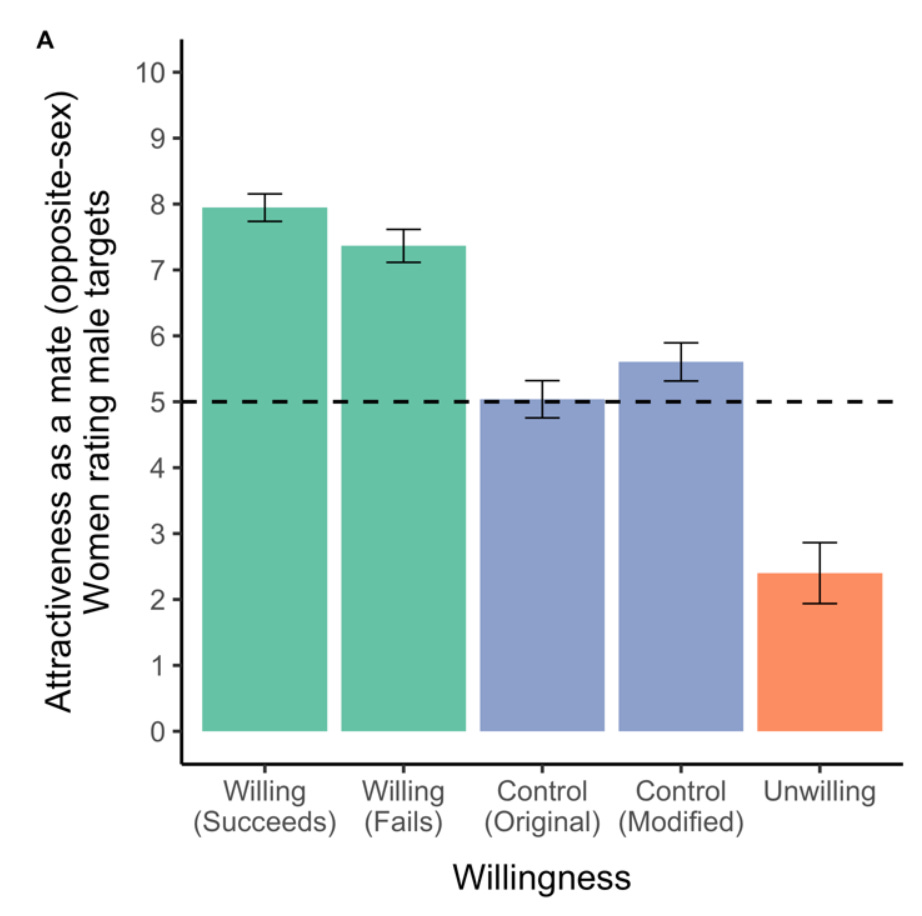
A 2022 paper (preprint link here) investigated whether people prefer romantic partners who are willing and able to protect them from violence.
Considering the frequency and intensity of violence in the human ancestral environment, affiliating with people who were able to protect you would have been advantageous. The authors of the paper suggest such preferences have shaped human mating psychology.
The authors (Barlev, Arai, Tooby, and Cosmides) explore the question of whether a potential partner’s ability to protect you from violence is valued. It seems obvious that the answer (especially for women) is almost certainly yes.
However, they also explore whether a potential partner’s willingness (independent of ability) is also considered attractive.
When a woman judges a man, does learning that he is willing to protect her from violence make him more attractive, even if he isn’t particularly effective at doing so?
What about when a woman learns that a man is able but unwilling to protect her? Imagine a muscular guy who, upon seeing his date get mugged, just stands there and does nothing, or runs away.
Is he still more attractive than a guy who is unable but willing to protect her? Picture a scrawny guy who, upon seeing his date get mugged, physically tries but is unsuccessful in his attempt to stop the mugger.
The paper explores these questions.
[…]
Here you see that women rate male dates (described in this particular version of the study as average in physical strength and average in physical attractiveness) who make no attempt to protect them as a 2 out of 10 in attractiveness. Women rate a man who attempts to protect them but fails as a 7.5 out of 10. And a man who attempts to protect them and succeeds is an 8 out of 10.
So the major bump in attractiveness comes from willingness, rather than ability.
February 22, 2023
Toward a taxonomy of military bullshit
Bruce Gudmundsson linked to this essay from “Shady Maples“, a serving officer in the Canadian Army, on the general topic of bullshit in the military:

Armies, as a rule, are quagmires of bullshit. The Canadian Army is no exception. We accept that bullshit is an occupational hazard in the Army, but it’s a hazard that we struggle to manage and it’s one that threatens our effectiveness as a force.
In order to understand bullshit we need a taxonomy, that is, a map of bullshit and the common varieties found in the wild. Using our taxonomy, we can develop diagnostic tools to detect bullshit and expose its corrosive effects on our integrity and professional culture. I assume that bullshit is also a hazard in other environments and government departments, but since my experience is in the land force I will be focusing my attention on that.
The subject of bullshit entered the mainstream in 2005 when Princeton University Press issued a hardcover edition of Harry G. Frankfurt’s 1988 essay “On Bullshit“. Frankfurt doesn’t mince words: “[one] of the most salient features of our culture is that there is so much bullshit. Everyone knows this. Each of us contributes his share.” He argues that even though we treat bullshit as a lesser moral offence than lying, it’s actually more harmful to a culture of truth. I believe this wholeheartedly, for reasons which will become clear.
In Frankfurt’s view, even though a liar and a bullshitter both aim to deceive their targets, bullshitting and lying require different mental states. In order to lie, someone must believe that they know the truth and intentionally make a false account of it. For example, if you believe that today is Monday but today is in fact Tuesday, and somebody asks you what day it is, you’re not a liar if you say “today is Monday”. You’re not lying because you really do believe that today is Monday, even though this belief is incorrect. In order to lie, you have to intentionally make a statement that is contrary to the truth as you understand it. In this example, you would be lying if you said “today is Tuesday” while believing that today is actually Monday. You would be accidentally correct, but you would still be lying because you are providing a false account of what you believe is true.
This means that lying actually requires a tacit respect for the truth on the part of the liar. The liar has to at least acknowledge the existence of truth in order to avoid it. To provide a false account of the truth, the liar must first believe in the truth.
The bullshitter, by contrast, does not operate under this constraint. Bullshit according to Frankfurt is speech without any regard for the truth whatsoever. To Frankfurt, “[the bullshitter] does not care whether the things he says describe reality correctly. He just picks them out, or makes them up, to suit his purpose.” Bullshit, Frankfurt argues, is speech that is disconnected from a concern for truth. The bullshitter will say anything if it helps them achieve their desired ends.
[…]
Let’s move on to the topic of “bull”, which is discussed at length by British psychologist Norman F. Dixon, author of On the Psychology of Military Incompetence. Dixon beat Frankfurt to the punch by publishing his own theory of bullshit in 1976, twelve years before “On Bullshit”. Dixon is a Freudian psychologist writing in the 1970s, so I am skeptical of the scientific merit of his book. Nonetheless, he provides an interesting outsider’s perspective of British military culture from the Crimean War up to the Second World War and how that culture enabled terrible officers while punishing competent ones (spoiler: aristocrats and nepotism are bad for meritocracy).
There is an entire chapter of the book about bullshit as a contributing factor to military incompetence. Dixon attributes the origin of the word “bullshit” to Australian soldiers, who in 1916 “were evidently so struck by the excessive spit and polish of the British Army that they felt moved to give it a label”. His theory of the Australian origin of bullshit is supported by Australian philosopher David Stove, who believed that it’s a signature national expression.
[…]
Canadian political philosopher G. A. Cohen added some depth to the discourse when he responded to Frankfurt in “Deeper into Bullshit“. Cohen wasn’t satisfied that Frankfurt had explored full range of bullshit as a social phenomenon. Frankfurt anchors his definition of bullshit in the intention or mental state of the speaker (the bullshitter) whose lack of concern for truth is what makes their statements bullshit. Cohen responds to this by pointing out that there are many people who honestly profess their bullshit beliefs. Reading this brought me back to my undergrad days. I had a TA in a 300-level philosophy course who claimed that he doubted his own existence. Personally, I wondered whether he would still doubt his own existence if I punched him in the balls for spewing such performative bullshit in class. So I think that Cohen makes a good point: there are bullshitters who honestly believe their own bullshit.
Cohen’s argument is squarely aimed at a certain style of academic writing, which he calls “unclarifiable unclarity.” These are intentionally vague statements which cannot be clarified without distorting their apparent meaning or dropping the veil of profundity altogether. If you want an example, you can try reading Hegel or a postmodernist philosopher, or just save yourself the effort and click on this postmodern bullshit generator (trust me, it’s indistinguishable from the real thing). Pennycook et al. label statements of this type as “pseudo-profound bullshit“. Hilariously, they ran a series of experiments to see if test subjects would find the appearance of profound truth in both real and algorithmically-generated Deepak Chopra tweets. The result, disappointingly, was yes.
Cohen adds a fourth type of bullshit to our taxonomy: “irretrievably speculative comment”. Basically, when someone is arguing for a proposition which they have no way of knowing is true or false, or they put forward an argument that’s completely unsupported by readily available evidence, then that argument is bullshit.
[…]
Still with me? So far we’ve identified and defined four types of bullshit (BS):
BS1 (Frankfurt): propositions made without concern for truth.
BS2 (Dixon): ritualistic activity which doesn’t serve its stated aim or justification.
BS3 (Cohen/Pennycook): unclarifiable unclarity aka pseudo-profound bullshit.
BS4 (Cohen): speculation beyond what’s reasonably permitted by the evidence.
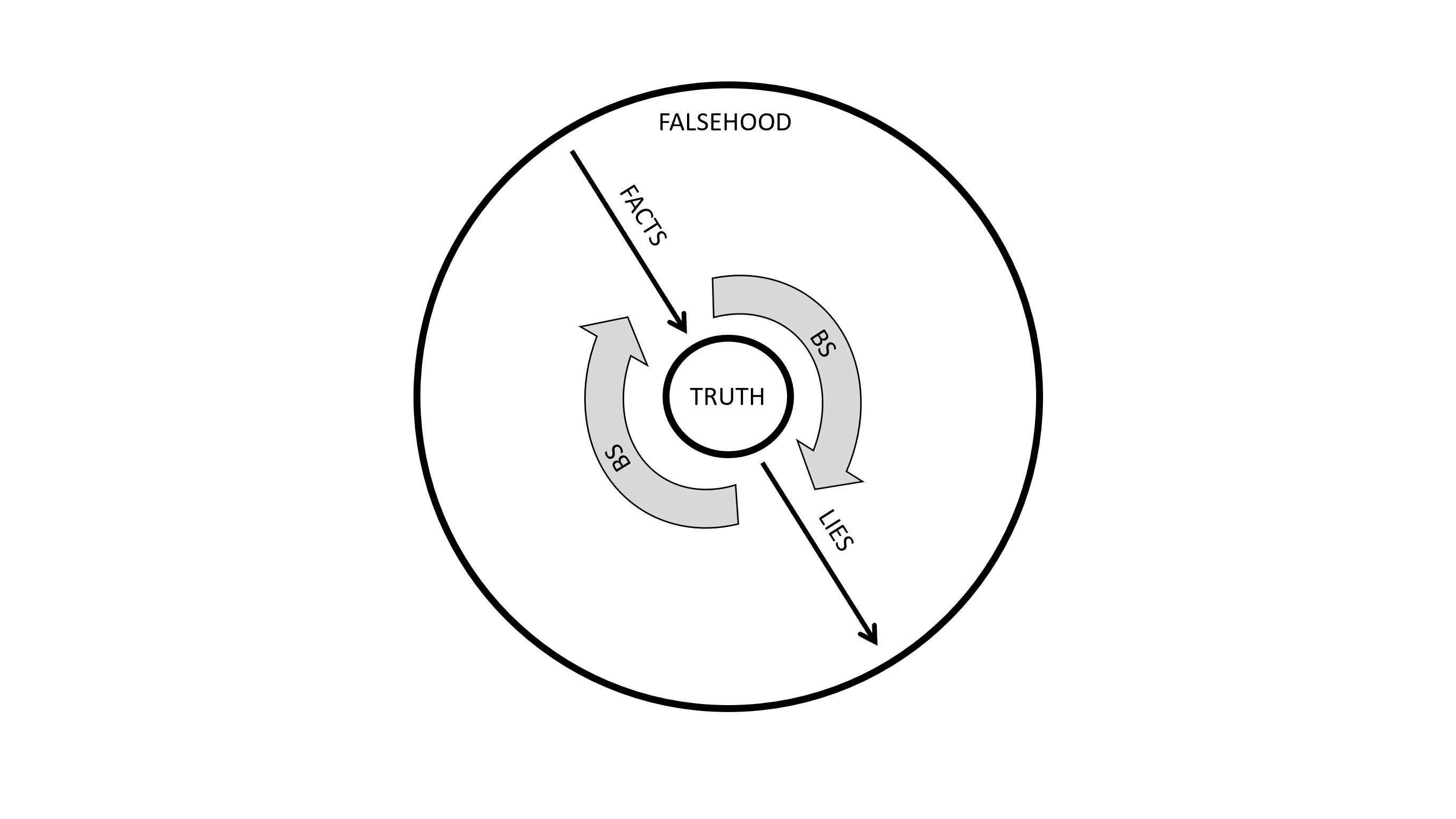
The common denominator of all four types of bullshit is their disconnection from reality. Bullshit statements don’t enhance our understanding and bullshit activity doesn’t get us any closer to achieving our goals in the real world. Bullshit doesn’t necessarily move us further away from truth, like lies do, but it certainly doesn’t get us any closer to it either. Essentially, bullshit lowers the signal-to-noise ratio of discourse.
The endless carousel of bullshit.
February 20, 2023
Monocultures are risky in agriculture … and even more so in politics
Unlike his usual bite-sized quips-with-links at Instapundit, Glenn Reynolds occasionally writes at length for his Substack page:
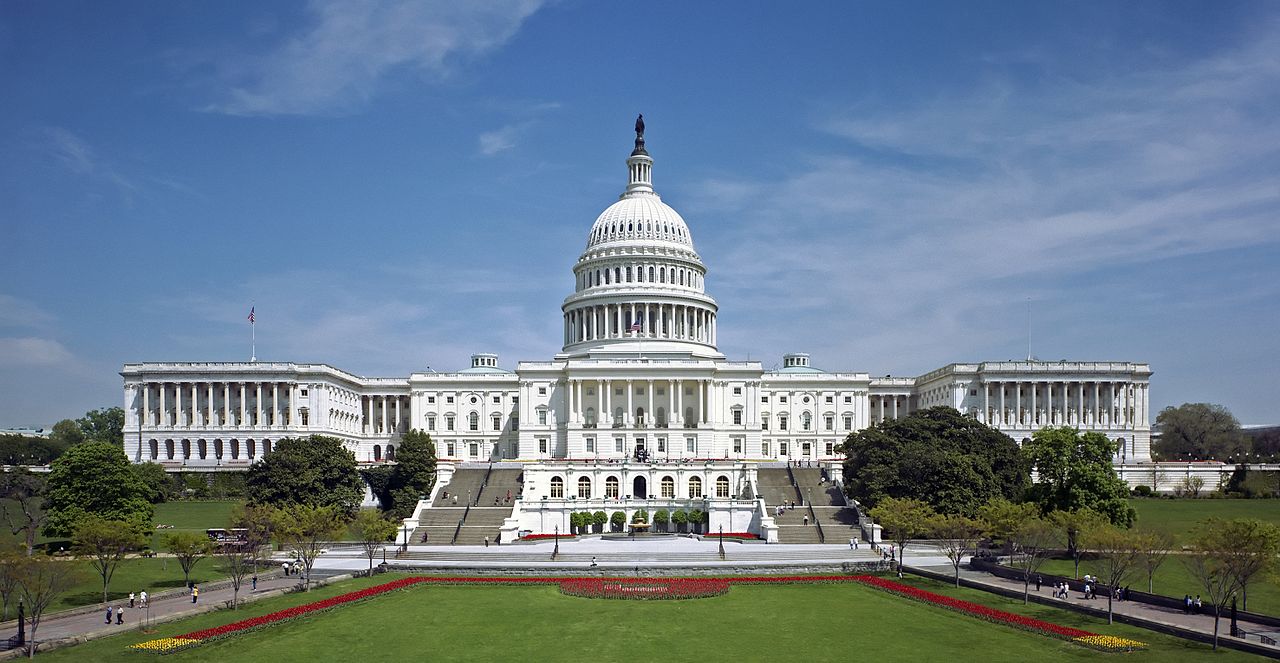
The western front of the United States Capitol. The Neoclassical style building is located in Washington, D.C., on top of Capitol Hill at the east end of the National Mall. The Capitol was designated a National Historic Landmark in 1960.
Photo via Wikimedia Commons.
Our modern ruling class is peculiar. One of its many peculiarities is its penchant for fads, and what can only be called mass hysteria. Repeatedly, we see waves in which something that nobody much cared about suddenly comes to dominate ruling class discourse. Almost in synchrony, a wide range of institutions begin to talk about it, and to be preoccupied by it, even as every leading figure virtue-signals regarding this subject which, only a month or two previously, hardly any of them even knew about, much less cared about.
There are several factors behind this, but one of the most important, I think, is that our ruling class is a monoculture.
In agriculture, a monoculture exists when just a single variety dominates a crop. “Monoculture has its benefits. The entire system is standard, so there are rarely new production and maintenance processes, and everything is compatible and familiar to users. On the other hand, as banana farmers learned, in a monoculture, all instances are prone to the same set of attacks. If someone or something figures out how to affect just one, the entire system is put at risk.”
In a monoculture, if one plant is vulnerable to a disease or an insect, they all are. Thus diseases or pests can rip through it like nobody’s business. (As John Scalzi observes in one of his books, it’s also why clone armies, popular in science fiction, are a bad idea in reality, as they would be highly vulnerable to engineered diseases.) A uniform population is a high-value target.
[…]
Codevilla wrote the essay [here] over a decade ago, and it has only grown more true in the interim. Despite its constant invocation of “diversity”, in many important ways our ruling class is much less diverse than it has ever been. And, as a monoculture, it is vulnerable to viruses of a sort. Including what amount to viruses of the mind.
When Elon Musk referred to the dangers of the “woke mind virus“, he knew exactly what he was talking about. Ideas can be contagious, and can be viewed as analogous to viruses, entities that reproduce by infecting individuals and coopting those individuals into spreading them to others. Richard Dawkins, in his The Selfish Gene, coined the term “meme” to describe these infectious ideas, though the term has since acquired a more popular meaning involving photos of cats, etc. with captions. And yet those pictures are themselves memes, to the extent they “go viral” and persuade others to copy and spread them.
Our ruling class is particularly vulnerable to mind viruses for several reasons. First, it is a monoculture, so that what is persuasive to one member is likely to be persuasive to many.
Second, it suffers from deep and widespread status anxiety – not least because most of its members have status, but few real accomplishments to rely on – and thus requires constant reassurance in the form of peer acceptance, reassurance that is generally achieved by repeating whatever the popular people are saying already. And third, it has few real deeply held values, which might otherwise provide guard rails of a sort against believing crazy things.
In a more diverse ruling class, ideas would not spread so swiftly or be received so uncritically. People with different worldviews would respond differently to ideas as they entered the world of discourse. There would be criticism and there would be debate. (Indeed, this is how things generally worked during the earlier, more diverse, era described by Codevilla, though intellectual fads – lobotomy, say, or eugenics – spread then, too, though mostly through the Gentry/Academic stratum of society that now dominates the ruling class.)
February 18, 2023
QotD: The rise of the “demisexuals”
But if the whole thing seemed frankly silly and, okay, snowflakey, it also seemed pretty harmless. Gender and sexuality were just the latest lens through which young people were trying to understand their place in the world; “demisexuality” was to 2013 what being a little goth-curious was for a teen in 1995, more or less — except that with so much of life happening online, this identity was less about how you moved through the world than about finding just the right flag to affix to your social media profile. But unlike shopping at Claire’s Accessories, demisexuality didn’t stay a teenage conceit; a combination of creeping identitarianism in mainstream culture plus a general obsession with What The Youths Are Into eventually made the concept irresistible to adult millennial women.
“IT HAPPENED TO ME: I’m A Demisexual,” read the headline on a 2015 essay on the site XOJane, where the author boldly proclaimed that her inability to feel sexual attraction toward strangers made her “not quite heterosexual”.
The essay was met with a fair amount of ridicule, for all the obvious reasons — “they want to be oppressed so bad” was the unkind but not entirely untrue thrust of the critiques — but there was something about the way it lamented “the many struggles of living in such a sexually charged culture” that spoke to the anxieties of digital natives trying to navigate a post-sexual revolution dating scene. Hookup culture, dating apps, the endless sorting and filtering of potential suitors in a manner that resembled online shopping more than human connection: it’s no surprise that people struggling in this system jumped on a term, a hard-wired identity, that offered an explanation as to why. The young women who adopted a “demisexual” label as a means of opting out were less angry than their closest analogue, the young male incel, but both shared a sense that the system was broken. If male incels were made miserable by the spectre of the sex they wanted but could have, the demisexuals were perhaps equally tormented by the pressure to want, full stop.
Seven years after the XOJane essay, demisexuality remains a contested notion but also a far more visible one, in everything from beer marketing to dating guides, as with this recent dispatch from the dating app Hinge. A hypothetical demisexual dater asks, “What’s the best way to set expectations around waiting to get sexual?”, prompting a supportive but altogether unintelligible response from the app’s resident therapist that is short on actionable information and long on inscrutable axioms like: “Boundaries are bridges, not fences.” (Are they, though?)
Demisexual visibility seems to have less to do with a grassroots shift in human sexuality, and more to do with its corporate profitability. In a world of identity-driven marketing, a massive piece of the pie awaited any advertiser who figured out how to make young, male-attracted women (the group that includes most demisexuals) feel special and seen — and, of course, not quite heterosexual, thus saving them from the curse of being just another basic cishet bitch.
Kat Rosenfield, “Demisexuals are scared of sex”, UnHerd, 2022-11-07.
February 17, 2023
Quebec suddenly realizes there are significant problems with Bill C-11
Michael Geist, who has been doing heroic work covering the federal government’s attempts to seize control of what Canadians can see and publish online, says that Quebec has finally woken up to the threat to their culture embedded in the federal government’s Bill C-11:

Bill C-11 – and its predecessor Bill C-10 – have long been driven by the government’s view that the bill was a winner in Quebec. Bill C-10 was headed for easy passage in 2021, but was derailed by the government’s decision to remove safeguards over regulating user generated content that came largely from the Quebec-based music lobby. Nearly two years later, Canadian Heritage Minister Pablo Rodriguez and his staff have ignored the concerns of thousands of digital creators, disrespected indigenous creators, and indicated that he will likely reject Senate amendments designed to craft a compromise solution, all in the name of keeping Quebec lobby interests satisfied. Yet as the government considers the Senate amendments, the Quebec legislative assembly this week passed a last minute motion calling for further changes to the bill, including scope to enact its own rules and mandatory consultations with the province on the contents of a policy direction to the CRTC that Rodriguez has insisted on keeping secret until after the bill receives royal assent (a full copy of the motion is contained at the bottom of this post). The Conservatives have been calling for the Quebec motion and the Senate amendments to be sent back to committee for further study, which the Globe reports may delay the government’s response to the Senate amendments.
It is not clear what prompted the Quebec government to finally wake up to the centralizing power over digital culture that comes from the bill (and just wait until it realizes that Bill C-18 encroaches on provincial jurisdiction with the regulation of newspapers). But this issue has been there from the beginning. In March 2021, Philip Palmer, a former Justice counsel, argued that Bill C-10 was unconstitutional, making the case it fell outside federal jurisdiction. In a post on his submission, I noted:
Quebec has a long history of taking issue with federal involvement in broadcasting, putting a potential challenge in play. Indeed, it is odd to see this legislation viewed as a political winner in Quebec, when it effectively asserts federal jurisdiction over an area that has long been contested in the province.
Palmer appeared before the House committee studying Bill C-11 and warned MPs about the constitutional jurisdictional overreach. His opening statement noted:
C-11 lacks a foundation in Canadian constitutional law. Internet streaming services do not transmit to the public by radio waves, nor do they operate telecommunications facilities across provincial boundaries. They and their audiences are the clients of telecommunications common carriers, which are subject to federal regulation. Netflix, for instance, in this case is no more a federal undertaking than a law firm such as McCarthy Tétrault or a chain store like Canadian Tire, both of which rely extensively on telecommunications services.
Liberal MP Anthony Housefather followed up on the issue, asking Palmer to cite caselaw to back his claim. His response:
The principal case for all federal regulation of broadcasting space is, of course, the radio reference of 1932. In that, the court relied upon the provisions of subsection 92(10) of the Constitution Act to find that, in transmitting radio waves, they necessarily exceeded provincial boundaries and, therefore, could only be effectively regulated at the federal level. The key is that, in order to be regulated by the federal government, the “undertaking”, as the Constitution uses the word, has to be one that has the facilities to exceed provincial limitations and provincial boundaries.
Housefather wasn’t convinced and asked Professor Pierre Trudel, a vocal supporter of Bill C-11, for his view. Trudel didn’t deny the issue. In fact, he confirmed it, suggesting that the Supreme Court would ultimately have to determine the question:
If this were unconstitutional, it would be because it would be a matter of provincial jurisdiction. The question would then have to be asked: is it better for 10 provinces to put in place regulations on these matters or for the federal authority to do so? There are arguments that radio waves are not the only basis for federal jurisdiction in these matters. There is, among other things, the question of national interest and the inherently interprovincial nature of the activity. In short, all these arguments may have to be argued before the Supreme Court. Either the federal government has authority, or the provinces do. Therefore, it is to be expected that the Canadian state will intervene sooner or later, whether through the provinces or through the federal government.
The takeaway from this exchange – a former justice lawyer citing caselaw to confirm the shaky constitutional foundation of the bill and a professor confirming the Supreme Court would have to decide – should have provided a wakeup call to Quebec, which has a long history of challenging federal jurisdiction in communications that dates back nearly 100 years with repeated efforts to enact provincial laws and policies in the area. Left unsaid is that if the “national interest” dictates federal regulation of anything that touches the Internet, there are few limits on federal powers and little left for the provinces.
February 13, 2023
QotD: Oaths in pre-modern cultures
Second, I should note that I’m drawing my definition of an oath from Alan Sommerstein’s excellent introduction in Horkos: The Oath in Greek Society (2007), edited by A. Sommerstein and J. Fletcher – one of the real “go-to” works on oath-taking in the ancient Mediterranean world. As I go, I’ll also use some medieval examples to hopefully convince you that the same basic principles apply to medieval oaths, especially the all-important oaths of fealty and homage.
(Pedantry note: now you may be saying, “wait, an introduction? Why use that?” As of when I last checked, there is no monograph (single author, single topic) treatment of oaths. Rather, Alan Sommerstein has co-authored a set of edited collections – Horkos (2007, with J. Fletcher), Oath and State (2013, with A. Bayliss) and Oaths and Swearing (2014, with I. Torrance). This can make Greek oaths a difficult topic to get a basic overview of, as opposed to a laundry list of the 101 ancient works you must read for examples. Discussions of Roman oaths are, if anything, even less welcoming to the beginner, because they intersect with the study of Roman law. I think the expectation has always been that the serious student of the classics would have read so many oaths in the process of learning Latin and Greek to develop a sort of instinct for the cultural institution. Nevertheless, Sommerstein’s introduction in Horkos presents my preferred definition of the structure of an oath.)
Alright – all of the quibbling out of the way: onward!
So what is an Oath? Is it the same as a Vow?
Ok, let’s start with definitions. In modern English, we often use oath and vow interchangeably, but they are not (usually) the same thing. Divine beings figure in both kinds of promises, but in different ways. In a vow, the god or gods in question are the recipients of the promise: you vow something to God (or a god). By contrast, an oath is made typically to a person and the role of the divine being in the whole affair is a bit more complex.
(Etymology digression: the word “oath” comes to us by way of Old English āþ (pronounced “ath” with a long ‘a’) and has close cousins in Dutch “Eed” and German “Eid”. The word vow comes from Latin (via Middle English, via French), from the word votum. A votum is specifically a gift to a god in exchange for some favor – the gift can be in the present tense or something promised in the future. By contrast, the Latin word for oath is ius (it has a few meanings) and to swear an oath is the verb iuro (thus the legal phrase “ius iurandum” – literally “the oath to be sworn”). This Latin distinction is preserved into the English usage, where “vow” retains its Latin meaning, and the word “oath” usurps the place of Latin ius (along with other words for specific kinds of oaths in Latin, e.g. sacramentum)).
In a vow, the participant promises something – either in the present or the future – to a god, typically in exchange for something. This is why we talk of an oath of fealty or homage (promises made to a human), but a monk’s vows. When a monk promises obedience, chastity and poverty, he is offering these things to God in exchange for grace, rather than to any mortal person. Those vows are not to the community (though it may be present), but to God (e.g. Benedict in his Rule notes that the vow “is done in the presence of God and his saints to impress on the novice that if he ever acts otherwise, he will surely be condemned by the one he mocks“. (RB 58.18)). Note that a physical thing given in a vow is called a votive (from that Latin root).
(More digressions: Why do we say “marriage vows” in English? Isn’t this a promise to another human being? I suspect this usage – functionally a “frozen” phrase – derives from the assumption that the vows are, in fact, not a promise to your better half, but to God to maintain. After all, the Latin Church held – and the Catholic Church still holds – that a marriage cannot be dissolved by the consent of both parties (unlike oaths, from which a person may be released with the consent of the recipient). The act of divine ratification makes God a party to the marriage, and thus the promise is to him. Thus a vow, and not an oath.)
So again, a vow is a promise to a divinity or other higher power (you can make vows to heroes and saints, for instance), whereas an oath is a promise to another human, which is somehow enforced, witnessed or guaranteed by that higher power.
An example of this important distinction being handled in a very awkward manner is the “oath” of the Night’s Watch in Game of Thrones (delivered in S1E7, but taken, short a few words, verbatim from the books). The recruits call out to … someone … (they never name who, which as we’ll see, is a problem) to “hear my words and bear witness to my vow”. Except it’s not clear to me that this is a vow, so much as an oath. The supernatural being you are vowing something to does not bear witness because they are the primary participant – they don’t witness the gift, they receive it.
I strongly suspect that Martin is riffing off of here are the religious military orders of the Middle Ages (who did frequently take vows), but if this is a vow, it raises serious questions. It is absolutely possible to vow a certain future behavior – to essentially make yourself the gift – but who are they vowing to? The tree? It may well be “the Old Gods” who are supposed to be both nameless and numerous (this is, forgive me, not how ancient paganism worked – am I going to have to write that post too?) and who witness things (such as the Pact, itself definitely an oath, through the trees), but if so, surely you would want to specify that. Societies that do votives – especially when there are many gods – are often quite concerned that gifts might go awry. You want to be very specific as to who, exactly, you are vowing something to.
This is all the more important given that (as in the books) the Night’s Watch oath may be sworn in a sept as well as to a Weirwood tree. It wouldn’t do to vow yourself to the wrong gods! More importantly, the interchangeability of the gods in question points very strongly to this being an oath. Gods tend to be very particular about the votives they will receive; one can imagine saying “swear by whatever gods you have here” but not “vow yourself to whatever gods you have here”. Who is to say the local gods take such gifts?
Moreover, while they pledge their lives, they aren’t receiving anything in return. Here I think the problem may be that we are so used to the theologically obvious request of Christian vows (salvation and the life after death) that it doesn’t occur to us that you would need to specify what you get for a vow. But the Old Gods don’t seem to be in a position to offer salvation. Votives to gods in polytheistic systems almost always follow the do ut des system (lit. “I give, that you might give”). Things are not offered just for the heck of it – something is sought in return. And if you want that thing, you need to say it. Jupiter is not going to try to figure it out on his own. If you are asking the Old Gods to protect you, or the wall, or mankind, you need to ask.
(Pliny the Elder puts it neatly declaring, “of course, either to sacrifice without prayer or to consult the gods without sacrifice is useless” (Nat. Hist. 28.3). Prayer here (Latin: precatio) really means “asking for something” – as in the sense of “I pray thee (or ‘prithee’) tell me what happened?” And to be clear, the connection of Christian religious practice to the do ut des formula of pre-Christian paganism is a complex theological question better addressed to a theologian or church historian.)
The scene makes more sense as an oath – the oath-takers are swearing to the rest of the Night’s Watch to keep these promises, with the Weirwood Trees (and through them, the Old Gods – although again, they should specify) acting as witnesses. As a vow, too much is up in the air and the idea that a military order would permit its members to vow themselves to this or that god at random is nonsense. For a vow, the recipient – the god – is paramount.
Bret Devereaux, “Collections: Oaths! How do they Work?”, A Collection of Unmitigated Pedantry, 2019-06-28.
February 11, 2023
Americans tend to think other countries are just like America, but with weird accents and quaint clothing
Sarah Hoyt on the common problem Americans (and to a lesser extent, Canadians) have in trying to understand other nations even if they’ve done some international travel:
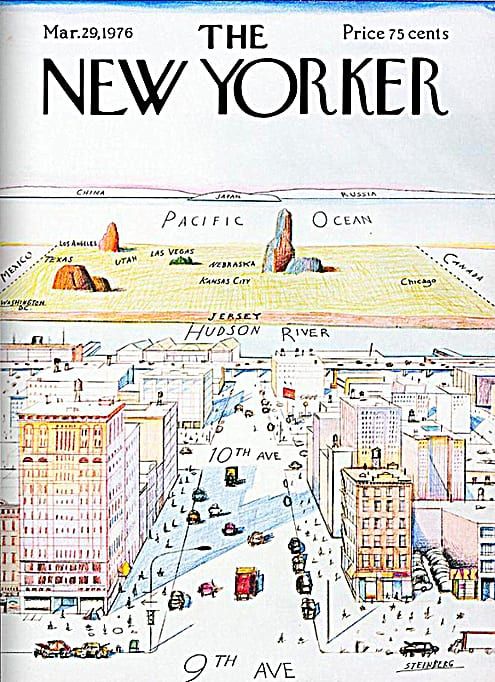
I also see every country, regardless of their history making the assumption that the modus operandi and motives of other cultures and organizations is exactly the same as theirs. I’ve now mentioned about a million times the idiots who went over as Human Shields to Iraq because “they can’t even provide drinking water for their people, how would they have missiles” thereby completely missing the fact that other countries — dictatorships at that — have different priorities than say the US or England, even. In the same way, Portugal assumes that every country is as fraught as corruption as they are. Which works fine for other Latin countries, but fails them when it comes to other places, because as corrupt as we are … yeah. It’s nowhere near there yet. Russia assumes everyone moves, breathes and thinks only about them, and that everyone’s intention is to threaten them or conquer them, because they are obsessed with their dreams of national glory, and they think they should rule the world. And the US by and large goes around like a large vaguely autistic child who really, really, really doesn’t understand how different it is from other nations, or if it does assumes it’s worse.
Look, it’s part of the reason our intelligence services are so sucky. To completely understand what other countries are doing and why, you have to know they have very different cultures. They’re not you. Most countries can sort of extrapolate other countries, but America is so different we suck at it. This is why we tend to think places like the USSR (Russia’s party mask) were totes super powers. Because for America to do and say the things they did and said, we’d have to be very sure of our power. But other countries aren’t America. So we go through the world acting like gullible giants.
In fact Americans have one of the weirder cultures in the world. It’s just not in your face weird as China (whose history reads like they should be extra-terrestrials.) It’s subtle and more in the mental furniture.
Because of this, and because we’re a continent-sized nation, born and bred Americans (as opposed to imports like me) read not just the rest of the world but history hilariously wrong. (The history part is because at least when I went through school here — one year — American schools suck at teaching history. It’s all names and dates, not “Why did France do that?” Yeah, probably not worse than the rest of the world, now that all the books have just-so Marxist explanations, but still stupid.)
I had friends in my writers’ group back when who were writing, say, ancient Egyptian families and couldn’t understand in most of them the teens wouldn’t be/act the same as American teens now. Heck, my dad’s generation in Portugal, less than 100 years ago weren’t “teens” really. Their equivalent was under ten. Because by 12 most of the boys in the village were apprenticed in the job they’d have for life. (And dad was in school, yes, but it was way tougher than even I had.) They didn’t have time. And even I — and you guys know my basic disposition — didn’t sass my parents as American teens do, because there was a deep “fund” of “respect the elders” in the culture. I still have trouble calling people older than I — even colleagues — by their first name.
And then there’s the hilarious — or sad — misunderstandings like the Human Shields mentioned above. It’s sad, because they will buy other countries at face value, but are willing to entertain their own country might be evil. Which is why we have a large contingent of open-mouth guppies who think that the US invented slavery. Even though places around the world still have slavery. Including China, where everyone is a slave, it’s the degree that varies, of course.
The problem is made worse — not better — by idiotic travel abroad.
To understand the differences in a country, you need to live with them, as one of them, for a while. You need to speak the language well enough you understand overheard conversations. Etc.
My experience coming over as an exchange student for 12th grade was about ideal. I lived with an American family, as one of their kids, and attended a school nowhere USA (okay, a suburb of Akron, Ohio) and yeah, I had slight celebrity status in the school — being one of three foreign exchange students — but not that much. So I got to experience the normal life of normal people in normal circumstances, which was an eye-opener.
I always wanted my kids to follow me in this experience, but you know, things got complicated around the time they were of age to do it. So they didn’t. They still have experienced life as an every day foreigner when we visit my parents. In fact the issue there is that they never get past the irritation “What do you mean we can’t do that” and towards “oh, it’s just different. Still sucky, but different.”
Going over for two weeks, with or without the guided tour, staying in nice hotels and associating only with people at your social level and not past the level of polite interaction does not enlarge the mind. Instead, it gives a false sense of knowing what the world is like. This is where we get the “socialists” who know it’s good, because look at all the magnificent buildings in Europe, and the fact everyone has time to sit in the coffee shop and socialize with friends. And look at all the amazing public transportation. And and and. If you lived there, or knew history, you’d know most of the buildings created by socialists in the 20th and 21st century are already crumbling. (Some start before being finished.) You’d know people sit around in coffee shops either because they are unemployed, they pretend to work and their boss pretends to pay them, or all of the above. And all of it is paid for in a significant reduction in lifestyle and just the general comfort of life. (Take it from me. Their lifestyle is two social economic levels down from us, for the same relative “income level.” So, you know, upper class is middle-middle class here.) And you’d know the frustration of waiting for the bus on a rainy, windy day, getting soaked, but the bus is late because all the bus drivers went out for a pint together. And suddenly there’s five of them in a row, but you’re already soaked and starting to cough. More importantly you’d know the public transport only works because everyone works in the city and lives in crowded suburbs, in stack-a-prole apartments, while the countryside is relatively empty. And the people who live there need to buy gas at ridiculous prices, so they can barely afford it.
February 9, 2023
“Prediction is very difficult, especially about the future” … but sometimes it’s almost prophetic
Once again, Ted Gioia’s Honest Broker Substack has something interesting I’d like to share with you (I wouldn’t blame you at all for cutting out the middleman and just subscribing for yourself):
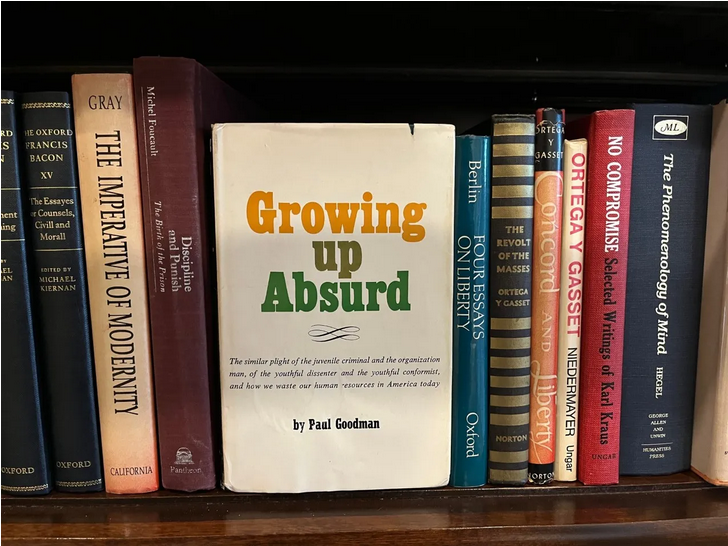
Today I want to focus on a single paragraph published in 1960.
You’re asking yourself: How much can a single paragraph matter — especially if it was written 63 years ago? But read it first and judge for yourself.
It’s a chilling paragraph.
[…]
By any measure, [Paul Goodman] was one of the most eccentric thinkers of the era. Yet he anticipated our current situation with more insight than any of his peers.
Let’s look at this one paragraph from the Preface to Growing Up Absurd. It’s a long paragraph — it takes up most of two pages. So we will break it down into pieces.
Goodman begins with a puzzle he needs to solve — society is stagnating everywhere, and we all can see it. But there’s no action plan to fix it. There’s a lot of huffing and puffing and finger-pointing everywhere, but nobody has even started on developing a practical agenda.
According to Goodman, this is because people “have ceased to be able to imagine alternatives”. Everybody accepts that the current system “is the only possibility of society, for nothing else is thinkable”.
Now comes his analysis, and — to my surprise — Goodman begins by talking about music. This was the last thing I expected in a social critique, but for Goodman the manufacturing of hit songs is a metaphor for everything else that’s wrong in a stagnant society.
He writes:
Let me give a couple of examples of how this [inability to imagine healthy alternatives] works. Suppose (as is the case) that a group of radio and TV broadcasters, competing in the Pickwickian fashion of semi-monopolies, control all the stations and channels in an area, amassing the capital and variously bribing Communications Commissioners in order to get them; and the broadcasters tailor their programs to meet the requirements of their advertisers of the censorship, of their own slick and clique tastes, and of a broad common denominator of the audience, none of whom may be offended: they will then claim not only that the public wants the drivel that they give them, but indeed that nothing else is being created. Of course it is not! Not for these media; why should a serious artist bother?
When I first read this, I was dumbstruck. Goodman wrote this during the winter of 1959 and 1960, when radio stations were independent and freewheeling. Back in my teen years, a single business was only allowed to control one AM station and one FM station. In 1985 this was increased to 12 stations on each band. And in 1994 this was raised again, this time to 20 AM stations and 20 FM stations.
But then all hell broke lose when the Telecommunications Act of 1996 passed in the Senate by a 91 to 5 margin and was signed into law. Now the sky was the limit — and all the airwaves it contained.
Soon Clear Channel Communications owned more than 1,200 radio stations in some 300 cities. The company began the process of standardizing and homogenizing our musical culture. We still suffer from that today.
Even after radio started losing influence in the Internet Age, huge streaming platforms (Spotify, Apple Music, etc.) ensured that access to the ears of America would be controlled by a tiny number of huge corporations. A musical culture that was once local, indie, and flexible has become centralized, corporatized, and stagnant.
How could Paul Goodman even dream of such a scenario back in 1960? That future was decades away at the time.
But we are only at the start of this visionary paragraph. Goodman now explains that the same thing will happen in universities.
Colleges and schools were small and non-bureaucratic back in 1960. Yet Goodman sees a crisis looming. On the next page Goodman warns against “the topsy-turvy situation that a teacher must devote himself to satisfying the administrator and financier rather than to doing his job, and a universally admired teacher is fired for disobeying an administrative order that would hinder teaching”.
Administration at US colleges has grown exponentially in the last two decades and has turned almost every academic institution into a plodding bureaucracy — but how in the world did Goodman anticipate this in 1960?
Now let’s return to our chilling paragraph. Immediately after discussing radio stations, Goodman adds a gargantuan sentence. It jumps all over the place but hits the target at every twist and turn:
Or suppose again (as is not quite the case) that in a group of universities only faculties are chosen that are “safe” to the businessmen trustees or the politically appointed regents, and these faculties give out all the degrees and licenses and union cards to the new generation of students, and only such universities can get Foundation or government money for research, and research is incestuously staffed by the same sponsors and according to the same policy, and they allow no one but those they choose, to have access to either the classroom or expensive apparatus: it will then be claimed that there is no other learning or professional competence; that an inspired teacher is not “solid”; that the official projects are the direction of science; that progressive education is a failure; and finally, indeed — as in Dr. James Conant’s report on the high schools — that only 15 per cent of the youth are “academically talented” enough to be taught hard subjects.
Here in a nutshell is the credentialing crisis of our times. Learning is replaced by exclusionary certification programs that limit career opportunities — unless you take out loans and “purchase” the necessary credential from these academic gatekeepers.
This has become so destructive in our own time that many are crushed by student loans, and others seek ingenious ways of bypassing college entirely. There’s no way that Goodman could have grasped this in 1960 — when only 7.7 percent of Americans had college degrees.
Nor could he have known about the replicability crisis in science or the destructive games now played in awarding of scientific grants. Those are the problems of our times — not his.
But somehow Paul Goodman saw it coming.

February 6, 2023
TikTok – threat and menace
At Wrong Side of History, Ed West linked to this post by Gurwinder on the TikTok threat to western civilization:

For thousands of years, humans sought to subjugate their enemies by inflicting pain, misery, and terror. They did this because these were the most paralyzing emotions they could consistently evoke; all it took was the slash of a sword or pull of a trigger.
But as our understanding of psychology has developed, so it has become easier to evoke other emotions in complete strangers. Advances in the understanding of positive reinforcement, driven mostly by people trying to get us to click on links, have now made it possible to consistently give people on the other side of the world dopamine hits at scale.
As such, pleasure is now a weapon; a way to incapacitate an enemy as surely as does pain. And the first pleasure-weapon of mass destruction may just be a little app on your phone called TikTok.
[…]
Other platforms, like Facebook and Twitter, use recommendation algorithms as features to enhance the core product. With TikTok, the recommendation algorithm is the core product. You don’t need to form a social network or list your interests for the platform to begin tailoring content to your desires, you just start watching, skipping any videos that don’t immediately draw your interest. Tiktok uses a proprietary algorithm, known simply as the For You algorithm, that uses machine learning to build a personality profile of you by training itself on your watch habits (and possibly your facial expressions.) Since a TikTok video is generally much shorter than, say, a YouTube video, the algorithm acquires training data from you at a much faster rate, allowing it to quickly zero in on you.
The result is a system that’s unsurpassed at figuring you out. And once it’s figured you out, it can then show you what it needs to in order to addict you.
Since the For You algorithm favors only the most instantly mesmerizing content, its constructive videos — such as “how to” guides and field journalism — tend to be relegated to the fringes in favor of tasty but malignant junk info. Many of the most popular TikTokers, such as Charli D’Amelio, Bella Poarch, and Addison Rae, do little more than vapidly dance and lip-sync.
Individually, such videos are harmless, but the algorithm doesn’t intend to show you just one. When it receives the signal that it’s got your attention, it doubles down on whatever it did to get it. This allows it to feed your obsessions, showing you hypnotic content again and again, reinforcing its imprint on your brain. This content can include promotion of self-harm and eating disorders, and uncritical encouragement of sex-reassignment surgery. There’s evidence that watching such content can cause mass psychogenic illness: researchers recently identified a new phenomenon where otherwise healthy young girls who watched clips of Tourette’s sufferers developed Tourette’s-like tics.
A more common way TikTok promotes irrational behavior is with viral trends and “challenges”, where people engage in a specific act of idiocy in the hope it’ll make them TikTok-famous. Acts include licking toilets, snorting suntan lotion, eating chicken cooked in NyQuil, and stealing cars. One challenge, known as “devious licks”, encourages kids to vandalize property, while the “blackout challenge”, in which kids purposefully choke themselves with household items, has even led to several deaths, including a little girl a few days ago.
The Chinese government — not wishing this kind of insanity spreading among their own people — have ensured that it’s only foreigners getting the full TikTok experience:
Last month FBI Director Chris Wray warned that TikTok is controlled by a Chinese government that could “use it for influence operations”. So how likely is it that one such influence operation might include addicting young Westerners to mind-numbing content to create a generation of nincompoops?
The first indication that the Chinese Communist Party is aware of TikTok’s malign influence on kids is that it’s forbidden access of the app to Chinese kids. The American tech ethicist Tristan Harris pointed out that the Chinese version of TikTok, Douyin, is a “spinach” version where kids don’t see twerkers and toilet-lickers but science experiments and educational videos. Furthermore, Douyin is only accessible to kids for 40 minutes per day, and it cannot be accessed between 10pm and 6am.
Has the CCP enforced such rules to protect its people from what it intends to inflict on the West? When one examines the philosophical doctrines behind the rules, it becomes clear that the CCP doesn’t just believe that apps like TikTok make people stupid, but that they destroy civilizations.


