
… war and conflict deeply shaped societies in the past and to the degree that we think that understanding those societies is important (a point on which, presumably, all historians may agree), it is also important to understand their conflicts. I am often puzzled by scholars who work on bodies of literature written almost entirely by combat veterans (which is a good chunk of the Greek and Latin source tradition), in societies where most free adult men probably had some experience of combat, who then studiously avoid ever studying or learning very much about that combat experience (that “war and society” lens there again). Famously, Aeschylus, the greatest Greek playwright of his generation, left no record of his achievements in writing in his epitaph. Instead he was commemorated this way:
Aeschylus, son of Euphorion, the Athenian lies beneath this marker
having perished in wheat-bearing Gela
Of his well-known prowess, the grove of Marathon can speak
And long-haired Mede knows it well.If a scholar wants to understand Aeschylus or his plays, don’t they also need to understand this side of his experience too? I know quite a number of scholars who ended up coming to military history this way, looking to answer questions that were not narrowly military, but which ended up touching on war and conflict. For that kind of research – for our potential scholar of Aeschylus – it is important that there be specialists working to understand war and conflict in the period. Of course this is particularly true in understanding historical politics and political narratives, given that most pre-modern states were primarily engines for the raising of revenues for the waging of war (with religious expenditures typically being the only ones comparable in scale).
Bret Devereaux, “Collections: Why Military History?”, A Collection of Unmitigated Pedantry, 2020-11-13.
May 15, 2023
QotD: How military history shapes cultures and societies
May 13, 2023
QotD: The inherent absurdity of “Canadian content”
But the real folly of CanCon is not that it is impractical, or prone to abuse, or even unnecessary, though it is all of those things. It is rather that it is nonsensical at its root, in its very purpose – again, so far as anyone can define it. Is the point, after all, artistic or political? But it cannot be artistic: there is no theory of aesthetics that prefers that Canadian artists should make Canadian art that teaches Canadians how Canadian they are.
It is, rather, a political project: the inculcation of national feeling in the public, for the purpose of creating a political community, separate and distinct from the colossus to the south. Without the Maginot Line of CanCon quotas, it is suggested, we would be overwhelmed: first the artists, then the country.
But note the assumptions built into this emotive appeal: that a separate nationality cannot be maintained without cultural difference; that our cultural differences with the Americans are both sufficient in themselves to justify our statehood and yet so fragile as to be washed away in an instant; that, left to their own choices, Canadians would unhesitatingly choose the products of an incomprehensibly alien culture over their own; and that, by virtue of this diet of foreignism, we would no longer be Who We Are as Canadians. Therefore we must not be left to our own choices.
Which is nonsense, because we would still be Who We Are, even in that hypothetical dystopian future: it might not be Who We Were, but so what? The Who We Are we are now at such pains to preserve is itself vastly different from Who We Were before.
And who, in the end are we? As the comedian Martin Short once put it: “we’re the people who watch a lot of American TV”. The wholesale ingestion of a foreign culture – albeit much of it made by expat Canadians – is an integral part of our distinct national identity, an irony that must forever elude our cultural nationalists.
Andrew Coyne, “The concept of CanCon is pure folly. That’s the problem at the heart of Bill C-11”, The Globe and Mail, 2023-02-08.
May 10, 2023
When scapegoating stops working
Chris Bray documents what he calls the “kingdom of the non-sequitur” today:
Americans have lost faith in a broad range of institutions: academia, government at every level and in every branch, media of all kinds, and crony corporations. I just linked to poll results to support that claim, but I suspect you don’t need to be convinced, and the sense of declining trust shows up in your daily discussions with friends and family. The institutional cartel, embodied in the form of a ruling class or new elite who are defined by their uniformity of thought and ritual expression, arrive at the discussion with a top-down model of culture: Trust the experts! “Dr. Fauci says to get vaccinated.”
So they see the loss of trust, and they instinctively look for the driver who’s making the bus go down the low-trust road — the high-status bad actor who’s inculcating the loss of faith in the helpless minds of the ignorant poors. In the current model, Donald Trump and Tucker Carlson tricked people into losing faith in institutions because they spread conspiracy theories and disinformation. So the problem is solved: Hit the off switch on Donald Trump and Tucker Carlson (and fascist billionaire Elon Musk’s mind control platform), and faith in institutions is necessarily reborn. If Donald Trump can’t be president again, people will trust the government again.
This confidence that the loss of faith is caused by top-down manipulation is so stupid it’s making me squirm in my seat as I think about it: Your true self actually likes Gavin Newsom, Congress, woke universities, homeless encampments, and drag queen story hour for children, but Fox News TRICKED YOUR BRAIN, peasant. You can’t possibly be losing faith in institutions yourself, on your own motive force. Have a Bud Light and an mRNA injection, and we’ll talk in the morning when you feel better.
And so the need to purge the folk devils, the manipulative purveyors of discontent, manifests itself over and over again in a ritual behavior as old as humanity itself, the performance of “the crops are failing because this woman is a witch.” Burn the witch, and we restore the corn and the hogs before winter arrives.
If [Person A] is a folk devil and a scapegoat, then everything [Person A] does is dark and cruel. OH MY GOD LOOK AT HIM PETTING THAT KITTEN NOW DO YOU SEE HOW DANGEROUS HE IS!?!?!? Cultural performers show up on the page with a kind of tacit assignment, an agreement they’ve made at the level of choosing an identity and seeking a social status. Folk devils are devils, because people who don’t hate folk devils are of a low-status outgroup. Yes, all of life is just like high school.
May 8, 2023
Grrrrrrl Power is the only acceptable mode for new female characters, it seems
Janice Fiamengo on the strictly monotone representation of female characters in recent years:
The trend to make female movie characters tough and abrasive has been proceeding for some time. We can all predict that the new partner in the police procedural, let’s say a petite black woman whose entrance surprises (and thus reveals the bigotry of) the white man she’ll be working with, will turn out to be the biggest badass on the force. She’ll almost certainly save her partner’s life — and unearth a crime-solving detail he’d overlooked — before the first episode is over. At the same time, viewers will be treated to her sneering refusal of the partner’s banter, her steely gaze, and her fearless embrace of outrider status. She’s a woman with wise-cracking disdain for men as a group who takes quick revenge for even the smallest hint of sexism, benevolent or otherwise, from her fellow officers. And she quickly earns not only their respect but also their unwilling awe.
Whether police officers, first responders, detectives, firefighters, FBI — or, for that matter, nurses, ER doctors, politicians, or lawyers — the message is clear: these women are at least as capable and fearsome as any man: tough-minded, smart as a whip, and street-wise. Even in this era of agitation about the trans peril to women’s sports, the fictional females are as physically strong and combat-ready as any male, their fists and kicks aimed with staggering accuracy. Even tiny Lucy Tara on NCIS Hawai’i comes to the rescue of her far-larger male colleagues in impressive physical struggles with suspects.
But physical characteristics, the notable fearlessness and strength, are to some extent less striking than the women’s personalities and demeanor. An entire character transformation has been taking place, as traditionally feminine characteristics have been decisively minimized and masculine bravura brought to the fore. These women are, seemingly without effort, brusque, foul-mouthed, and contemptuous, particularly of male authority — and we’re to love them for it. They’re often beautiful, but they never try to be. With hair pulled back and aggressive booted stride, they are independent, uninterested in male approval, and largely indifferent to men as romantic partners, unless they are shown pursuing their occasionally voracious sexual needs, at which times their approach is direct and unsentimental. After an evening of bronco-riding athleticism, they wake up in a tousled bed with a slight grimace and duck out of the lover’s offer of breakfast. They’re not interested in commitment or any continued intimacy. A call comes in on their cell phone, they pull on their clothes nonchalantly, and walk out of the man’s life. They’ve already forgotten him as they prepare to conquer evil once again.
A popular new Netflix series, The Diplomat, takes these now-standard elements to the next level, profiling an ambitious, sexy, oft-frowning, brilliant, and explosively hot-tempered woman, Kate Wyler, who engages in uncontrolled physical and verbal abuse of her husband without remorse or narrative comeuppance. Though one might expect that a portrait of reckless physical violence by one spouse against another would be evidence at least of a serious character flaw — if not criminality (as it certainly would be if the male spouse were delivering the blows) — it is not at all clear in this case that the character’s actions deserve any condemnation. Her violence is simply the most extreme manifestation of her (rather admirable and plucky) unconventionality in breaking the rules of propriety in order to save the liberal world order.

May 5, 2023
May 4, 2023
QotD: Gesamtkunstwerk
As I said, that’s awfully heavy for an album whose most famous song asks how can you have any pudding if you don’t eat your meat, but it’s nonetheless an accurate description of what Roger Waters was trying to do with the integrated concept album / movie / stage show. Whether or not he knew he was attempting a Gesamtkunstwerk in the full Wagnerian sense is immaterial, as is the question of whether or not he succeeded. Nor does it matter if The Wall is any good, musically or cinematically or lyrically.* The point is, he gave it one hell of a go … and nobody else has, even though these days it’d be far, far easier.
Consider what a band like Rush in their prime would’ve done with modern technology. I’m not a musician, but I’ve been told by people who are that you can make studio-quality stuff with free apps like Garage Band. Seriously, it’s fucking free. So is YouTube, and even high-quality digital cameras cost next to nothing these days, and even laptops have enough processor power to crank out big league video effects, with off-the-shelf software. I’m guessing (again, I’m no musician, let alone a filmmaker), but I’d wager some pretty good money you could make an actual, no-shit Gesamtkunstwerk — music, movie, the whole schmear — for under $100,000, easy. You think 2112-era Rush wouldn’t have killed it on YouTube?
I take a backseat to no man in my disdain for prog rock, but I have a hard time believing Neal Peart and the Dream Theater guys were the apex of rock’n’roll pretension. I realize I’ve just given the surviving members of Styx an idea, and we should all be thankful Kilroy Was Here was recorded in 1983, not 2013, because that yawning vortex of suck would’ve destroyed all life in the solar system, but I’m sure you see my point.** Why has nobody else tried this? Just to stick with a long-running Rotten Chestnuts theme, “Taylor Swift”, the grrl-power cultural phenomenon, is just begging for the Gesamtkunstwerk treatment. Apparently she’s trying real hard to be the June Carter Cash of the New Millennium™ these days, and hell, even I’d watch it.***
The fact that it hasn’t been attempted, I assert, is the proof that it can’t be done. The culture isn’t there, despite the tools being dirt cheap and pretty much idiot proof. Which says a LOT about the Current Year, none of it good.
* The obvious comment is that Roger Waters is no Richard Wagner, but that’s fatuous — even if you don’t like Wagner (I don’t, particularly), you have to acknowledge he’s about the closest thing to a universal artistic genius the human race has produced. It’s meaningless to say that Roger Waters isn’t in Wagner’s league, because pretty much nobody is in Wagner’s league. And philistine though I undoubtedly am, I’d much rather listen to The Wall than pretty much any opera — I enjoy the symphonic bits, but opera singing has always sounded like a pack of cats yodeling to me. I’m with the Emperor from Amadeus: “Too many notes.”
** If you have no idea what I’m talking about, then please, I’m begging you, do NOT go listen to “Mr. Roboto.” Whatever you do, don’t click that link …
… you clicked it, didn’t you? And now you’ll be randomly yelling “domo arigato, Mister Roboto!!” for days. You’ll probably get punched more than once for that. Buddy, I tried to warn you.
*** Anthropological interest only. I know I’m in the distinct minority on this one, but she never turned my crank, even in her “fresh-scrubbed Christian country girl” stage. Too sharp featured, and too obviously mercenary, even back then.
Severian, “More Scattered Thoughts”, Rotten Chestnuts, 2020-10-13.
May 2, 2023
QotD: The musical importance of the city of Córdoba
Is it New York or London? Paris or Tokyo? Los Angeles or Shanghai? Nashville or Vienna? Berlin or Rio de Janeiro?
That depends on what you’re looking for. Do you value innovation or tradition? Do you want insider acclaim or crossover success? Is your aim to maximize creativity or promote diversity? Are you seeking timeless artistry or quick money attracting a large audience?
Ah, I want all of these things. So I only have one choice — but I’m sure my city isn’t even on your list.
My ideal music city is Córdoba, Spain.
But I’m not talking about today. I’m referring to Córdoba around the year 1000 AD.
I will make a case that medieval Córdoba had more influence on global music than any other city in history. That’s probably not something you expected. But even if you disagree — and I already can hear some New Yorkers grumbling in the background — I think you will discover that the “Córdoba miracle,” as I call it, is an amazing role model for us.
It’s a case study in how communities foster the arts — and in a way that benefits everybody, not just the artists.
[…] a thousand years before New Orleans spurred the rise of jazz, and instigated the Africanization of American music, a similar thing happened in Córdoba, Spain. You could even call that city the prototype for all the decisive musical trends of our modern times.
“This was the chapter in Europe’s culture when Jews, Christians, and Muslims lived side by side,” asserts Yale professor María Rosa Menocal, “and, despite their intractable differences and enduring hostilities, nourished a complex culture of tolerance.”
There’s even a word for this kind of cultural blossoming: Convivencia. It translates literally as “live together.” You don’t hear this term very often, but you should — because we need a dose of it now more than ever. And when scholars discuss and debate this notion of Convivencia, they focus their attention primarily on one city: Córdoba.
It represents the historical and cultural epicenter of living together as a norm and ideal.
Even today, we can see the mixture of cultures in Spain’s distinctive architecture, food, and music. These are both part of Europe, but also separate from it. It is our single best example of how the West can enter into fruitful cultural dialogue with the outsider — to the benefit of both.
Ted Gioia, “The Most Important City in the History of Music Isn’t What You Think It Is”, The Honest Broker, 2023-01-26.
April 26, 2023
QotD: The vanishing “entertainer” of yore
It was still possible — barely — to be an entertainer as late as the early 2000s. Dwayne “The Rock” Johnson was one. Schwarzenegger’s dharma heir, he, along with guys like Jason Statham, made goofy shoot-em-up movies in which improbably muscled men killed a bunch of generic baddies in inventive ways. It’s a lot harder than it looks, since it calls for the lead actor to be fully committed to the role while being fully aware of how silly it all is. The fact that these guys aren’t “actors” in any real sense is no accident.
See also: the only real actor to take on such a role successfully: Liam Neeson, that poor bastard, who uses acting as therapy. (I don’t think it’s an accident that Neeson, too, was an athlete before he was an actor — Wiki just says he “discontinued” boxing at 17, but I read somewhere he was a real contender). Note also that Neeson’s Taken movies have a “real life” hook to them, human trafficking. They’re Schwarzenegger movies, and Neeson acquits himself well in them, but Neeson would fall flat on his face in all-out Arnold-style fantasies — a Conan or a Total Recall. Actors can’t make those movies; only entertainers can [cf. The A-Team, a role Arnold would’ve crushed].
In other words: you can make an “Arnold movie” without Arnold Schwarzenegger, the man, in the lead role, but you absolutely must have an entertainer as a leading man. Nothing could’ve saved the Total Recall “remake”, since it was clearly some other film with a tacked-on subplot to justify using the title, but Dwayne “The Rock” Johnson could’ve saved the Conan remake. It still wouldn’t have been very good — too self-consciously meta and gritty — but as a young guy trying to establish himself, poor ol’ Aquaman wasn’t up to it. He wanted to be a good actor; Arnold, in all his roles, just wanted to make a good movie. Arnold didn’t have to worry about his “performance”, because he was always just being Arnold (this seems to be the secret of Tom Cruise’s success, too). Aquaman had to worry about being taken seriously as an actor.
Severian, “The Entertainer”, Rotten Chestnuts, 2020-10-08.
April 25, 2023
QotD: What is military history?
The term for works of history in this narrow mold – all battles, campaigns and generals – is “drums and trumpets” history, a term generally used derisively. The study of battles and campaigns emerged initially as a form of training for literate aristocrats preparing to be officers and generals; it is little surprise that they focused on aristocratic leadership as the primary cause for success or failure. Consequently, the old “drums and trumpets” histories also had a tendency to glory in war and to glorify commanders for their “genius” although this was by no means universal and works of history on conflict as far back as Thucydides and Herodotus (which is to say, as far back as there have been any) have reflected on the destructiveness and tragedy of war. But military history, like any field, matured over time; I should note that it is hardly the only field of history to have less respectable roots in its quite recent past. Nevertheless, as the field matured and moved beyond military aristocrats working to emulate older, more successful military aristocrats into a field of scholarly inquiry (still often motivated by the very real concern that officers and political leaders be prepared to lead in the event of conflict) the field has become far more sophisticated and its gaze has broadened to include not merely non-aristocratic soldiers, but non-soldiers more generally.
Instead of the “great generals” orientation of “drums and trumpets”, the field has moved in the direction of three major analytical lenses, laid out quite ably by Jeremy Black in “Military Organisations and Military Charge in Historical Perspective” (JMH, 1998). He sets out the three basic lenses as technological, social and organizational, which speak to both the questions being asked of the historical evidence but also the answers that are likely to be provided. I should note that these lenses are mostly (though not entirely) about academic military history; much of the amateur work that is done is still very much “drums and trumpets” (as is the occasional deeply frustrating book from some older historians we need not discuss here), although that is of course not to say that there isn’t good military history being written by amateurs or that all good military history narrowly follows these schools. This is a classification system, not a straight-jacket and I am giving it here because it is a useful way to present the complexity and sophistication of the field as it is, rather than how it is imagined by those who do not engage with it.
[…]
The technological approach is perhaps the least in fashion these days, but Geoffery Parker’s The Military Revolution (2nd ed., 1996) provides an almost pure example of the lens. This approach tends to see changing technology – not merely military technologies, but often also civilian technologies – as the main motivator of military change (and also success or failure for states caught in conflict against a technological gradient). Consequently, historians with this focus are often asking questions about how technologies developed, why they developed in certain places, and what their impacts were. Another good example of the field, for instance, is the debate about the impact of rifled muskets in the American Civil War. While there has been a real drift away from seeing technologies themselves as decisive on their own (and thus a drift away from mostly “pure” technological military history) in recent decades, this sort of history is very often paired with the others, looking at the ways that social structures, organizational structures and technologies interact.
Perhaps the most popular lens for military historians these days is the social one, which used to go by the “new military history” (decades ago – it was the standard form even back in the 1990s) but by this point comprises probably the bulk of academic work on military history. In its narrow sense, the social perspective of military history seeks to understand the army (or navy or other service branch) as an extension of the society that created it. We have, you may note, done a bit of that here. Rather than understanding the army as a pure instrument of a general’s “genius” it imagines it as a socially embedded institution – which is fancy historian speech for an institution that, because it crops up out of a society, cannot help but share that society’s structures, values and assumptions.
The broader version of this lens often now goes under the moniker “war and society”. While the narrow version of social military history might be very focused on how the structure of a society influences the performance of the militaries that created it, the “war and society” lens turns that focus into a two-way street, looking at both how societies shape armies, but also how armies shape societies. This is both the lens where you will find inspection of the impacts of conflict on the civilian population (for instance, the study of trauma among survivors of conflict or genocide, something we got just a bit with our brief touch on child soldiers) and also the way that military institutions shape civilian life at peace. This is the super-category for discussing, for instance, how conflict plays a role in state formation, or how highly militarized societies (like Rome, for instance) are reshaped by the fact of processing entire generations through their military. The “war and society” lens is almost infinitely broad (something occasionally complained about), but that broadness can be very useful to chart the ways that conflict’s impacts ripple out through a society.
Finally, the youngest of Black’s categories is organizational military history. If social military history (especially of the war and society kind) understands a military as deeply embedded in a broader society, organizational military history generally seeks to interrogate that military as a society to itself, with its own hierarchy, organizational structures and values. Often this is framed in terms of discussions of “organizational culture” (sometimes in the military context rendered as “strategic culture”) or “doctrine” as ways of getting at the patterns of thought and human interaction which typify and shape a given military. Isabel Hull’s Absolute Destruction: Military Culture and the Practices of War in Imperial Germany (2006) is a good example of this kind of military history.
Of course these three lenses are by no means mutually exclusive. These days they are very often used in conjunction with each other (last week’s recommendation, Parshall and Tully’s Shattered Sword (2007) is actually an excellent example of these three approaches being wielded together, as the argument finds technological explanations – at certain points, the options available to commanders in the battle were simply constrained by their available technology and equipment – and social explanations – certain cultural patterns particular to 1940s Japan made, for instance, communication of important information difficult – and organizational explanations – most notably flawed doctrine – to explain the battle).
Inside of these lenses, you will see historians using all of the tools and methodological frameworks common in history: you’ll see microhistories (for instance, someone tracing the experience of a single small unit through a larger conflict) or macrohistories (e.g. Azar Gat, War in Human Civilization (2008)), gender history (especially since what a society views as a “good soldier” is often deeply wrapped up in how it views gender), intellectual history, environmental history (Chase Firearms (2010) does a fair bit of this from the environment’s-effect-on-warfare direction), economic history (uh … almost everything I do?) and so on.
In short, these days the field of military history, as practiced by academic military historians, contains just as much sophistication in approach as history more broadly. And it benefits by also being adjacent to or in conversation with entire other fields: military historians will tend (depending on the period they work in) to interact a lot with anthropologists, archaeologists, and political scientists. We also tend to interact a lot with what we might term the “military science” literature of strategic thinking, leadership and policy-making, often in the form of critical observers (there is often, for instance, a bit of predictable tension between political scientists and historians, especially military historians, as the former want to make large data-driven claims that can serve as the basis of policy and the later raise objections to those claims; this is, I think, on the whole a beneficial interaction for everyone involved, even if I have obviously picked my side of it).
Bret Devereaux, “Collections: Why Military History?”, A Collection of Unmitigated Pedantry, 2020-11-13.
April 22, 2023
QotD: The yawning vaccuum that used to be “white culture”
First: I think we can agree that there’s no such thing as a black hipster, or a Latino hipster, or an Asian hipster. What would be the point? Those groups already have a culture, in both the “personal identity” and “grievance group” sense. […]
The 1990s were the last time there was some common ground. Growing up as I did in the Tech Boom South, I saw it firsthand. It was just accepted that your Hispanic (not “Latino”, and certainly not “LatinX”) friends would have certain cultural specific things they’d have to do from time to time. If you were friends, they might invite you. If they were good friends, they wouldn’t invite you (do not, under any circumstances, go to your buddy’s sister’s quinceañera. You will meet a whole bunch of hot, horny young Mexican nubiles. You will also meet their brothers and fathers and cousins and uncles and etc., so you will spend the whole evening running around like a homo, doing everything in your power not to talk to girls. It’s torture*).
Same thing with the Chinese kids, and the Indian kids, and all the rest. You’d never see your Asian buddies on Friday nights, because that’s when they had Chinese school (yes, of course their parents would schedule something academic on a Friday night). Diwali was cool, because your friends’ moms would make those crazy-sweet Indian desserts and send you a care package (also known as “diabetes in a box”). That was just an accepted part of life, the same way those guys wouldn’t start a pickup basketball game until after 10 on a Sunday morning, because they knew we’d be in church. Nobody thought much of it, in the same way all our moms just kinda learned by osmosis to keep tortilla chips and salsa in the cupboard as an all-purpose snack (no worries about anyone’s religious food prohibitions).
This worked, because there was still enough of a monoculture back then — this is the late 1980s / early 1990s — to provide common ground. Alas, as White culture disintegrated, the other guys started subsuming their cultural identities into their grievance group identities: The Chinese kids were worried about being called “bananas” (yellow on the outside, White on the inside); the Indian kids were ABCDs (American-Born Confused Desis); and so on. And the White kids were the most anti-White of all, since they’d gone to college for a semester or two and had learned how to parrot pop-Marxism (technically, pop-Gramscianism and pop-Frankfurt School-ism and pop-Marcuse, but who’s counting?).
Thinking back on it, those were the ostentatious “slackers”; the real “Grunge” kids — White kids who found their own Whiteness “problematic” (a phrase debuting in egghead circles around that time). I always assumed it was a problem with traditional, cock-rocking masculinity — not least because that’s what all the male “Grunge” rock stars said it was — but in retrospect I think it was a rising problem with Whiteness itself. Maybe all the grievance groups had a point, and maybe they didn’t, but either way the dominant Boomer culture sucks, so what else can you do?
I know how naive that must sound now, but 30 years ago …
* It wasn’t my buddy’s fault. He warned me. But c’mon, man — his mom invited me. We’d spent the whole summer working together on his dad’s landscaping crew; I practically lived at their house. What was I gonna say, no? Looking back on it, Mrs. Rodriguez was either trying to set me up with her daughter, or was Aztec goddess-level sadistic.
Severian, “To Mock It, It Must Exist”, Founding Questions, 2022-12-29.
April 15, 2023
QotD: When the pick-up artist became “coded right”
Today, the global face of pickup artistry is Andrew Tate: sculpted former kickboxing champion, self-described “misogynist”, and, now, alleged human trafficker. Whatever results from the current allegations, his fall is a defining moment in the cultural history of the now inseparable worlds of the political manosphere and pickup artistry, and provides an opportunity to reflect upon their entangled history.
Pickup artistry burst onto the scene in the 2000s, propelled by the success of Neil Strauss’s best-selling book The Game. More a page-turning potboiler cataloguing the mostly empty lives of pickup artists (PUAs) than a how-to guide (though Strauss wrote one of those too), the methods in the book had been developed through years of research shared on internet forums. The “seduction underground”, as the large online community of people doing this research was called, then became the subject of widespread media attention. Through pickup artistry, the aggressive, formulaic predation of women was normalised as esteem boosting, and men such as those described in Strauss’s The Game could be viewed in a positive light: they had transformed from zero to hero and taken what was rightfully theirs.
The emergence of PUAs generated a swift backlash. The feminist blogs of the mid-to-late 2000s internet, of which publications like Jezebel still survive as living fossils, rushed to pillory them. The attacks weren’t without justification, but the world of PUAs during this period, much like the similarly wild-and-woolly bodybuilding forums, had no obvious political dimension beyond some sort of generic libertarianism. It was only after these initial critiques that it began to be coded as Right-wing by those on the Left. Duly labelled, PUAs and other associated manosphere figures drifted in that direction. MTV’s dating coaches were not part of the political landscape, merely feckless goofballs and low-level conmen capable of entertaining the masses. But their successors would be overtly political actors.
Oliver Bateman, “Why pick-up artists joined the Online Right”, UnHerd, 2023-01-08.
April 1, 2023
Athenian or Visigoth? Western civilization or barbarism?
Jon Miltimore recalls Neil Postman’s 1988 essay titled “My Graduation Speech”, which seems even more relevant today than when he wrote it:
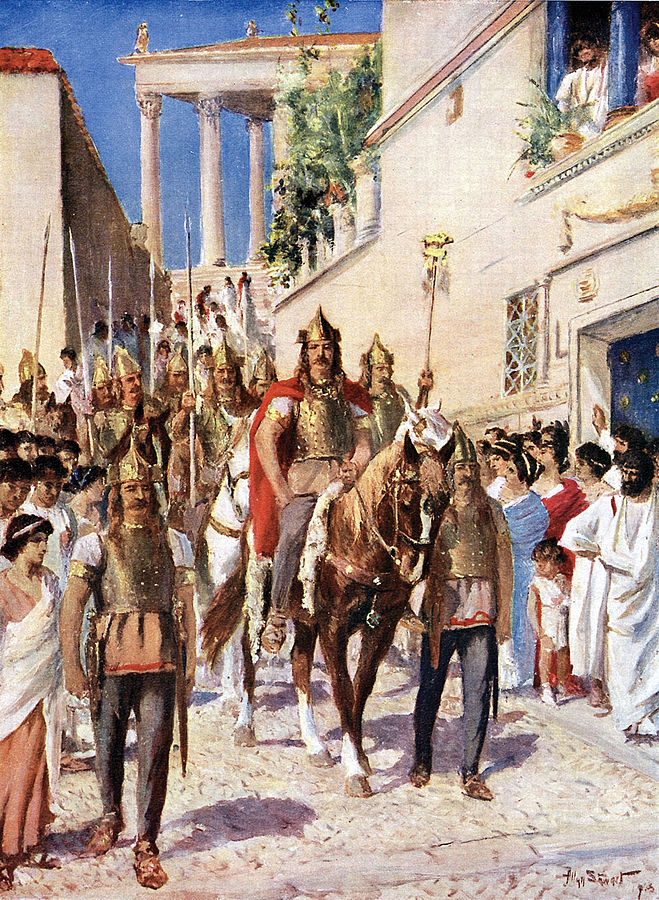
Alaric, King of the Visigoths, entering Athens in 395 AD.
Public domain illustration originally published in the Encyclopedia Britannica, 1920 via Wikimedia Commons.
What seemed to bother Postman was a nagging suspicion that modern humans were taking civilization for granted. This sentiment was more clearly expressed in one of Postman’s less-known literary works, his 1988 essay titled “My Graduation Speech“.
In his speech, Postman discusses two historic civilizations familiar to most people today — Athenians and Visigoths. One group, the Athenians, thrived about 2,300 years ago. The other, the Visigoths, made their mark about 1,700 years ago. But these civilizations were separated by much more than time, Postman explained.
The Athenians gave birth to a cultural enlightenment whose fruits are still visible today — in our art, education, language, literary works, and architecture. The Visigoths, on the other hand, are notable mostly for the destruction of civilization.
Postman mentions these peoples because, he argued, they still survive today. Here is what he wrote:
I do not mean, of course, that our modern-day Athenians roam abstractedly through the streets reciting poetry and philosophy, or that the modern-day Visigoths are killers. I mean that to be an Athenian or a Visigoth is to organize your life around a set of values. An Athenian is an idea. And a Visigoth is an idea.
But what ideas? What values? Postman explains:
To be an Athenian is to hold knowledge and, especially the quest for knowledge in high esteem. To contemplate, to reason, to experiment, to question — these are, to an Athenian, the most exalted activities a person can perform. To a Visigoth, the quest for knowledge is useless unless it can help you to earn money or to gain power over other people.
To be an Athenian is to cherish language because you believe it to be humankind’s most precious gift. In their use of language, Athenians strive for grace, precision, and variety. And they admire those who can achieve such skill. To a Visigoth, one word is as good as another, one sentence in distinguishable from another. A Visigoth’s language aspires to nothing higher than the cliché.
To be an Athenian is to understand that the thread which holds civilized society together is thin and vulnerable; therefore, Athenians place great value on tradition, social restraint, and continuity. To an Athenian, bad manners are acts of violence against the social order. The modern Visigoth cares very little about any of this. The Visigoths think of themselves as the center of the universe. Tradition exists for their own convenience, good manners are an affectation and a burden, and history is merely what is in yesterday’s newspaper.
To be an Athenian is to take an interest in public affairs and the improvement of public behavior. Indeed, the ancient Athenians had a word for people who did not. The word was idiotes, from which we get our word “idiot”. A modern Visigoth is interested only in his own affairs and has no sense of the meaning of community.
Postman said all people must choose whether to be an Athenian or a Visigoth. But how does one tell one from the other? One might be tempted to think that education is the proper path to becoming an Athenian. Alas, Postman argued that this was not the case.
I must tell you that you do not become an Athenian merely by attending school or accumulating academic degrees. My father-in-law was one of the most committed Athenians I have ever known, and he spent his entire adult life working as a dress cutter on Seventh Avenue in New York City. On the other hand, I know physicians, lawyers, and engineers who are Visigoths of unmistakable persuasion. And I must also tell you, as much in sorrow as in shame, that at some of our great universities, perhaps even this one, there are professors of whom we may fairly say they are closet Visigoths.
Postman concluded his speech by expressing his wish that the student body to which he was speaking would graduate more Athenians than Visigoths.
The production of educated barbarians was relatively low in 1988, despite Postman’s pessimism. The production of such modern-day Visigoths is unimaginably higher now than the tail end of the Cold War when he was writing. I fear we have already made our decision … and may God have mercy upon our souls.
March 28, 2023
WEIRD World – basing all our “assumptions about human nature on psych lab experiments starring American undergraduates”
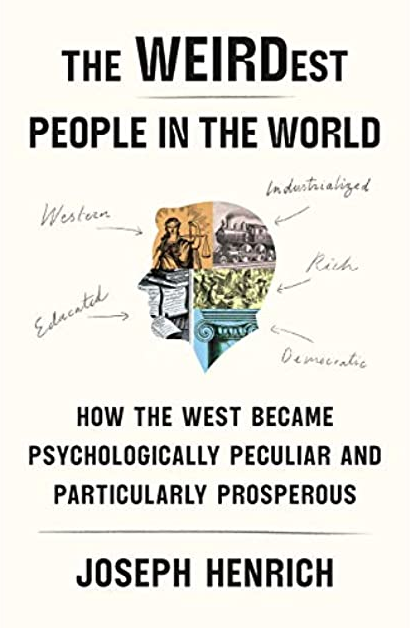
Jane Psmith reviews The WEIRDest People in the World: How the West Became Psychologically Peculiar and Particularly Prosperous by Joseph Henrich:
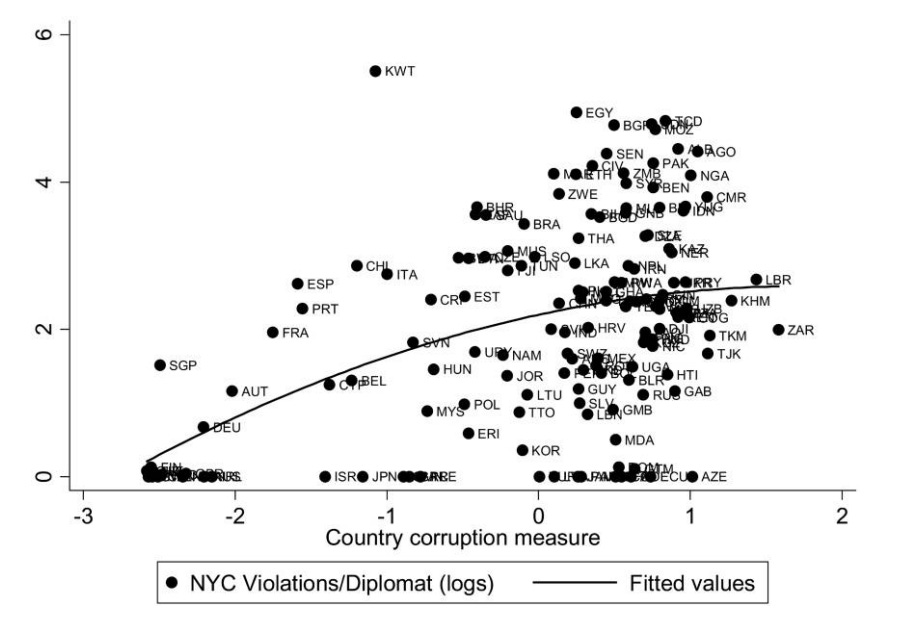
Until 2002, diplomats at the United Nations didn’t have to pay their parking tickets. Double-parking, blocking a fire hydrant, blocking a driveway, blocking an entire midtown Manhattan street — it didn’t matter; when you have diplomatic plates, they let you do it. In the five years before State Department policy changed in November 2002, UN diplomats racked up a whopping 150,000 unpaid parking tickets worth $18 million in fines. (Among other things, the new policy allowed the city to have 110% of the amount due deducted from the US foreign aid budget to the offending diplomats’ country. Can you believe they never actually did it? Lame.) Anyway, I hope you’re not going to be surprised when I say that the tickets weren’t distributed evenly: the nine members of Kuwait’s UN mission averaged almost 250 unpaid tickets apiece per year (followed by Egypt, Chad, Sudan, Bulgaria, and Mozambique, each between 100 and 150; the rest of the top ten were Albania, Angola, Senegal, and Pakistan). The UK, Canada, Australia, Denmark, the Netherlands, Sweden, and Norway had none at all. The rest of the rankings are more or less what you’d expect: for example, Italy averaged three times as many unpaid tickets per diplomat as France and fifteen times as many as Germany.
What did the countries with the fewest unpaid parking tickets have in common? Well, they generally scored low on various country corruption indexes, but that’s just another way of saying something about their culture. And the important thing about their culture is that these countries are WEIRD: western, educated, industrialized, rich, and democratic. But they’re also, in the grand scheme of human history, weird: their inhabitants think differently, behave differently, and value different things than most humans. Among other things, WEIRD people are individualistic, nonconformist, and analytical. They — okay, fine, we — are particularly hard-working, exhibit low time preference, prefer impersonal rules we apply universally, and elevate abstract principles over contextual and relationship-based standards of behavior. In other words, WEIRD people (as Joseph Henrich and his colleagues pointed out in the influential 2010 paper where they coined the phrase) are outliers on almost every measure of human behavior. Wouldn’t it be silly for an entire academic discipline (and therefore an entire society ideologically committed to Trusting The Experts) to base all its assumptions about human nature on psych lab experiments starring American undergraduates? That would give us a wildly distorted picture of what humans are generally like! We might even do something really dumb like assume that the social and political structures that work in WEIRD countries — impersonal markets, constitutional government, democratic politics — can be transplanted wholesale somewhere else to produce the same peace and prosperity we enjoy.
Ever since he pointed out the weirdness of the WEIRD, Henrich has been trying to explain how we got this way. His argument really begins in his 2015 The Secret of Our Success, which I reviewed here and won’t rehash. If you find yourself skeptical that material circumstances can drive the development of culture and psychology (unfortunately the term “cultural Marxism” is already taken), you should start there. Here I’m going to summarize the rest of Henrich’s argument fairly briefly: first, because I don’t find it entirely convincing (more on that below), and second, because I’m less interested in how we got WEIRD than in whether we’re staying WEIRD. The forces that Henrich cites as critical to the forging of WEIRD psychology are no longer present, and many of the core presuppositions of WEIRD culture are no longer taken for granted, which raises some thought-provoking questions. But first, the summary.
Henrich argues that the critical event setting the West on the path to Educated, Industrialized, Rich, and Democratic was the early medieval western Church’s ban on cousin marriage. That might seem a little odd, but bear in mind that most of the humans who’ve ever lived have been enmeshed in incredibly dense kin networks that dictate obligations, responsibilities, and privileges: your identity is given from birth, based simply on your role as a node in an interdependent network. When societies grow beyond the scale of a family, it’s by metaphorically extending and intensifying these kinship bonds (go read our review of The Ancient City for more on this). These kinship networks perpetuate themselves through marriage, and particularly through marriage to relatives, whether blood or in-laws, to strengthen existing connections. Familial or tribal identities come first, before even the claims of universal religions, as when Wali Khan, a Pakistani politician, phrased his personal allegiances as “I have been a Pashtun for six thousand years, a Muslim for thirteen hundred years, and a Pakistani for twenty-five.” You could imagine Edwin of Northumbria or Childeric saying something pretty similar.
Then, beginning in the 4th century, the western Church began to forbid marriages to relatives or in-laws, the kinship networks began to wither away, and alternative social technologies evolved to take their place. In place of the cousin-marriers’ strong tight bonds, conformity, deference to traditional authority, and orientation toward the collective, you get unmoored individuals who have to (or get to, depending on your vantage point) create their own mutually beneficial relationships with strangers. This promotes a psychological emphasis on personal attributes and achievements, greater personal independence, and the development of universalist social norms. Intensive kinship creates a strong in-group/out-group distinction (there’s kin and there’s not-kin): people from societies with strong kinship bonds, for instance, are dramatically more willing to lie for a friend on the witness stand. WEIRD people are almost never willing to do that, and would be horrified to even be asked. Similarly, in societies with intensive kinship norms, you’d be considered immoral and irresponsible if you didn’t use a position of power and influence to benefit your family or tribe; WEIRD people call that nepotism or corruption and think it’s wrong.
March 27, 2023
The war against fertility
The effacement of women’s bodies is changing from a cultural signal to a battlefield maneuver. The acceleration of the presence of men as dominant participants in women’s sports, the growing intensity of casually monstrous blue zone attacks on families and parenting, the emergence of drag queens — men playacting as women, burlesque cartoons about sexual identity — as The Most Important Symbol Ever (and something children should definitely see) …
… and now this:
That’s footage from a Let Women Speak event in Auckland, New Zealand, where women arguing that “women” are “adult human females” were physically attacked by a mob of “transwomen” — by men — and their allies. It’s very progressive when men dressed as women silence women and hurt them. More here, also linked above.
In the opening paragraph of this post, you may have thought that one of the things I mentioned was different than the other things — that the blue state assault on families and parenting isn’t specifically gendered, and is equally an assault on the role of mothers and fathers. And it is. But.
It seems to me that the very very strange thing breaking out all over the world — or all over the Anglosphere, because I don’t see Nigeria and Peru and Singapore going all-in on transgendered everything — is loaded with subtext about a febrile loathing for fertility. In policy, we’re incentivizing childlessness, and disincentivizing childbearing. Birthrates are declining sharply, and were declining even before the mRNA injections, while blue state governments work on laws that tell would-be parents their children can vanish from their custody on political pretexts. Who has the future children while the state says that hey, nice family you have there, be a shame if something were to happen to it?
I suspect the reason so much hate and rage is being directed at women is that their bodies can produce babies, which means that the hate and rage is being directed at the future. Peachy Keenan, who’s all over this stuff in multiple forums, wrote recently about Hicklibs on Parade, describing “how deeply the postmodern, anti-human gender ideology has penetrated into what we used to call ‘middle America'”:
In Plano, Texas last fall, an “all-ages” drag brunch attracted some unwanted attention from people who thought they lived in a conservative state. At the brunch — which was held at Ebb & Flow, an eatery in an upscale strip mall — a buffoonish man in a dress wearing cat ears sings, “My p*ssy good, p*ssy sweet, p*ssy good enough to eat”, while flashing his underwear.
In the video from the event, a four-year old girl stares in shock as the “drag” performer twerks and grinds for the ladies in attendance.
The people in the crowd watching this man systematically strip away a little girl’s innocence look like nice friendly Texans; plump grandmas and families and the types you’d run into at the local Costco. They are not hipsters; they are not edgy. They look normal!
This is what makes all of this so striking. These slightly downmarket Texan and Midwestern prairie home companion women have, historically, been the only thing holding this rickety old country together.

QotD: Homo electronicus and the problem of instant communications
One obvious consequence of this is that it turns the whole world into a giant hen party. Karen has always been with us, probably with equal prevalence. But as late as the mid-1990s, she’d have to confine her scolding to PTA meetings and places like that. But now everyone has the Internet, and social media’s a thing, and it’s just sitting there, compelling you to use it. Woman’s natural role as the guardian of the tribe’s mores becomes Karen-ism on crack.
Severian, “Recent Evolution”, Rotten Chestnuts, 2020-09-28.


