
Ich sitze in dem kleinsten Zimmer in meinem Hause. Ich habe Ihre Kritik vor mir. Im nächsten Augenblick wird sie hinter mir sein! (“I am sitting in the smallest room of my house. I have your review before me. In a moment it will be behind me!”).
Max Reger, responding to a review of his work by Rudolf Louis in the Münchener Neueste Nachrichten, 1906-02-07, as reported by Nicolas Slonimsky, Lexicon of Musical Invective, 1965.
May 16, 2019
QotD: Reacting appropriately to criticism
Comments Off on QotD: Reacting appropriately to criticism
May 15, 2019
Modern architecture as a generations-long art crime spree
Theodore Dalrymple is clearly quite a fan of Making Dystopia: The Strange Rise and Survival of Architectural Barbarism by James Stevens Curl, as this is at least the third review of the book I’ve seen by him (and you can probably tell I agree with much of his viewpoint that I’m blogging it yet again…)

In a recent debate in Prospect magazine on the question of whether modern architecture has ruined British towns and cities, Professor James Stevens Curl, one of Britain’s most distinguished architectural historians, wrote as his opening salvo:
Visitors to these islands who have eyes to see will observe that there is hardly a town or city that has not had its streets — and skyline — wrecked by insensitive, crude, post-1945 additions which ignore established geometries, urban grain, scale, materials, and emphases.
This is so self-evidently true that I find it hard to understand how anyone could deny it, but modern architects and hangers-on such as architectural journalists do deny it, like war criminals who, for obvious reasons, continue to deny their crimes in the face of overwhelming evidence.
This is true not only of Britain but of many, perhaps most, other countries that have or had any towns or cities to ruin. Anyone who rides into the center of Paris from Charles de Gaulle Airport, for example, will be appalled at the modernist visual hell that scours his eyes as he goes.
Nor is this visual hell the consequence of the need to build cheaply. Where money is no object, contemporary architects, like the sleep of reason in Goya’s etching, bring forth monsters. The Tour Montparnasse (said to be the most hated building in Paris), the Centre Pompidou, the Opéra Bastille, the Musée du quai Branly, the new Philharmonie, do not owe their preternatural ugliness to lack of funds, but rather to the incapacity, one might say the ferocious unwillingness, of architects to build anything beautiful, and to their determination to leave their mark on the city as a dog leaves its mark on a tree.
Professor Curl’s magnum opus is both scholarly and polemical. He has been observing the onward march of modernism and its effects for sixty years and is justifiably outraged by it. British architects have managed to reverse the terms of the anarchist Bakunin’s dictum that the urge to destroy is also a creative urge: Their urge to create is also a destructive urge. I could give many concrete examples (no pun intended).

Philharmonie at the Parc de la Villette, Paris.
Photo by Zairon via Wikimedia Commons.
Curl knows that he is arguing not against an aesthetic, but against an ironclad ideology. The architectural Leninists have been determined so to indoctrinate the public that they hope and expect a generation will grow up knowing nothing but modernism, and therefore will be unable to judge it. (All judgment is comparative, as Doctor Johnson said.) In Paris recently, I saw an advertisement on the Métro (a few days before the fire in Notre-Dame) to the effect that Paris would not be Paris without the Centre Pompidou — which, of course, has a good claim to be the ugliest building in the world. In the face of such an advertisement promoted by the cultural elite, what ordinary person would dare demur?
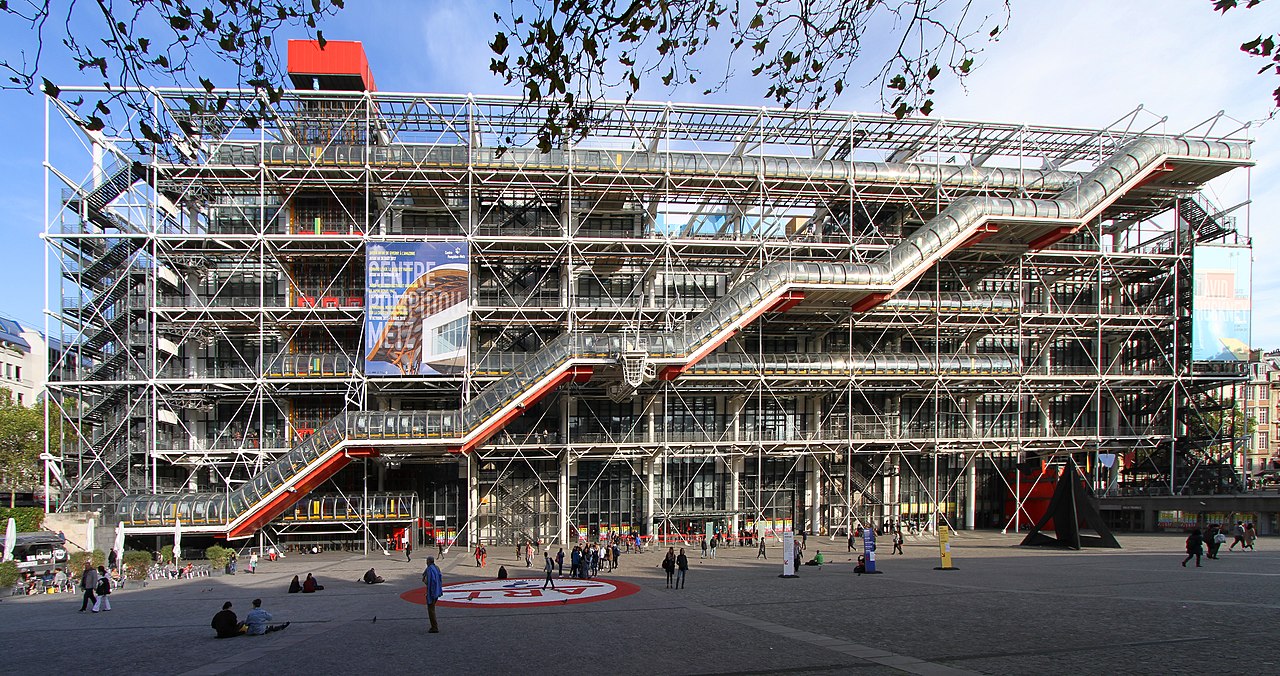
Centre Georges-Pompidou (no, this isn’t an under construction image … it’s from 2017 and the construction was technically complete in 1977)
Gerd Eichmann photo via Wikimedia Commons.
Could anyone imagine a worldwide outpouring of genuine and heartfelt grief, such as that which greeted the burning of Notre-Dame de Paris, if any building of the last seventy years burnt down? Indeed, the destruction of many would be a cause almost for rejoicing. Modernist buildings will never age as Notre-Dame aged; they will merely deteriorate, and usually do deteriorate even before completion.
Comments Off on Modern architecture as a generations-long art crime spree
May 8, 2019
Brave New World – Dystopias and Apocalypses – Extra Sci Fi
Extra Credits
Published on 7 May 2019We kick off a new season of Extra Sci Fi exploring the theme of dystopias and apocalypses. We begin with Aldous Huxley’s Brave New World — a very early novel that make a compelling argument for why the dystopia exists at all.
Dystopian literature really began when the two World Wars, the Great Depression, and more socio-political unrest in the world began to disrupt the utopian aspirations of science fiction at the time. So enters Brave New World.
Comments Off on Brave New World – Dystopias and Apocalypses – Extra Sci Fi
May 4, 2019
Justin Trudeau’s (French) language problem
Colby Cosh reports on a recent academic paper that sticks the boots into the little potato and his, um, problematical French language issues:
Thursday’s hot-off-the-press Post contained a short summary (by CP’s Giuseppe Valiante) of a recent academic paper about how Justin Trudeau’s handling of spoken French is regarded in Quebec. In case you didn’t read Valiante’s summary, I’ll give you a four-word abstract: it drives people nuts. Obviously it’s hard to know how many Quebeckers are really annoyed or nauseated by the prime minister’s French, but if you judge by the newspapers, as Binghamton University French-language scholar Yulia Bosworth did in her article for the American Review of Canadian Studies, it seems Trudeau is the equivalent of fingernails scraping a chalkboard forever.
Hungry with curiosity, I got hold of Bosworth’s paper, entitled “The ‘Bad’ French of Justin Trudeau: When Language, Ideology, and Politics Collide.” As writing it suffers from the typical defects of published scholarship in the humanities: as the title suggests, it is one of those things in which every mental construct of any kind becomes an “ideology.” As scholarship it is pretty good: it contains a useful potted history of Quebecois linguistic self-hatred, and how “Quebec French” went from being a perennial object of shame to a rigid conscious standard, enforced with the same pride and viciousness as Parisian French within France.
But as disguised comedy, the article can’t be beat. When Bosworth wants to give the flavour of her sample corpus of Quebec newspaper abuse of Trudeau, she has to clear her throat professorially first. “Titles, arguably, play an important role in constructing public images; they constitute visible and frequently consumed newspaper content and help construct a linguistic landscape.” Zzzz. But then you get to the good stuff, the distilled liquor:
In Justin Trudeau’s case, headline readers encountered ‘a beautiful empty shell,’ ‘the little boy,’ ‘a privileged target,’ ‘a thinker of nothingness,’ ‘a deserter,’ a ‘mythical hero,’ ‘window dressing for radical individualism,’ ‘a young dilettante,’ and ‘Justin-the-Red.’ Among the many examples of negative descriptors pinned on Trudeau are: ‘smokescreen,’ ‘the call of the void,’ ‘hypocrisy,’ ‘lack of courage,’ and ‘Pee-Wee’s revenge.’ In terms of adjectives, Trudeau was called ‘slimy,’ ‘tricked,’ ‘attacked,’ ‘targeted,’ ‘troubled,’ and ‘criticized.’
Obviously there is a lot of that sort of talk around, and certainly JT gets a rough ride in the Post and the Alberta broadsheet papers from time to time, but I think only in Quebec do you find this language in headlines, rather than in the comment threads or your uncle’s Facebook feed. (“Radical individualism”? Really?)
Comments Off on Justin Trudeau’s (French) language problem
April 30, 2019
You Will Never Do Anything Remarkable
exurb1a
Published on 28 Apr 2019Illegitimi non carborundum, yo.
So.
The original line was, “If they give you ruled paper, write the other way.” As far as I can tell it’s Juan Ramón Jiménez’s.I am also now painfully aware I’ve written a half as ‘2/1’. Sorry maths.
Please note that this wasn’t intended to be a diatribe against critics or experts. They obviously play an important role. It was more directed at the recreational cynicism one comes across in daily life from time to time, generally pointed at young artists. I have had the privilege to meet plenty of people 1000x more talented than me, who are simultaneously doubting their abilities because of some stupid comment made by an unpleasant teacher or jaded family member.
If you are that artist, I really just wanted to say: You’re in good company; the Greats doubted themselves too. Don’t let the bastards get you down and I hope you make all manner of interesting and fantastic things.
The music is the 3rd movement of Big Baus Brahms’ Violin Concerto in D Major: https://youtu.be/Ev45Knhdlp8
I like that piece lots. I hope you do too.
Again, all the very best of luck in your projects.
Comments Off on You Will Never Do Anything Remarkable
April 18, 2019
Shakespeare’s work is merely used to highlight the brilliance and originality of modern theatrical directors
Anthony Daniels reports for Quadrant Online of how he recently attended a performance of a play by some unimportant dead English white guy:
The precise date of the discovery by theatre directors that they are greater than Shakespeare cannot be specified: the discovery was more a process than an event. But by the time I saw a production of Richard II at the Almeida Theatre a few weeks ago, the superior genius of any director over that of Shakespeare was an established principle and indisputable fact.
[…]
But if I had an elevated conception of Shakespeare, how naive and mistaken I was! I knew nothing of Richard II — the play, that is, not the king — until I saw the production by Joe Hill-Gibbins. How narrow had been my previous conception of it! I discovered, among other things, that Richard was a short, fat fifty-eight-year-old in a black T-shirt, with a crown of the kind that is awarded to the person who finds the fève in the galette des rois that the French eat on the sixth of January, that the Duke of Norfolk was a woman dressed like a cleaning lady, and that all the action of the play takes place in what looks like a large biscuit tin, without exit or entrance. All this, of course, means something far deeper than anything that a mere Shakespeare could convey, being deeply symbolic, and therefore required real inventive genius on the part of the director to bring forth.
While the same actress took the parts of the Duke of Norfolk, Bushy and Green (all of them looking like cleaning ladies and each indistinguishable from the other because they could not leave the stage even to change costume), and the parts of both the Earl of Northumberland and the Bishop of Carlisle by other actresses, actual women’s roles such as that of Richard’s Queen were expunged entirely from the text. Between them, three actresses played five male parts and only one female. There is a profound lesson in this somewhere, no doubt in enlightened gender fluidity.
Most of the lines were delivered as if they were a religious incantation in a dead language that both the celebrants and the congregation desired to get over with as quickly as possible, clear diction being one of the many tools by which class hegemony is so unjustly exercised. The actor who took the part of Richard, it is true, was comprehensible, but made the acting of Sir Henry Irving appear taciturn by comparison. If emphasis is good, overemphasis must be better: no more stiff upper lip, we are all hysterics now, and can understand nothing that is not accompanied by gesticulation.
The director fortunately realised that Shakespeare got the order of his play wrong: Richard’s great speech in Act V scene 5 (“I have been studying how I may compare / This prison unto the world …”) was actually a prologue. The director is not the interpreter of Shakespeare, but rather Shakespeare is, and ought to be, the occasion, the opportunity, for the director to place his own immortal (and highly original) genius before the world.
Comments Off on Shakespeare’s work is merely used to highlight the brilliance and originality of modern theatrical directors
April 11, 2019
QotD: How to improve David Lynch’s Dune
Dune (1982) is a Lawrence of Arabia pastiche with a mad bucket of half-baked science fiction tropes bolted onto it. It includes so much extraneous, confusing detail from the novel’s world, but when you think of all the things it omits you really get a good sense of why Lynch (or anyone?) could not form it in 2 or 3-hours.
I think there are two things that could be done to fix it. Firstly, remove all the speaking and turn the whole thing into a hallucinatory Lynchean nightmare, perhaps to be accompanied by Brian Eno’s mythic 45-minute album of Dune music. […]
Secondly, use Lynch’s movie as the basis for a full-length animated TV miniseries by rotoscoping it and bringing back the original actors for several hours or so of newly-animated scenes.
Rob Beschizza, “Sorry, David Lynch’s Dune sucks (or does it?)”, Boing Boing, 2017-04-21.
Comments Off on QotD: How to improve David Lynch’s Dune
March 22, 2019
Debunking Stephen Jay Gould
Several years back, I linked to a David Friedman post on a study that contradicted a key argument in Stephen Jay Gould’s book The Mismeasure of Man. While I’ve read a few of his books, it’s been nearly 15 years since I last read anything by him … by now I only have a vague recollection of what he wrote, but his works were quite popular at the time. Much more recently Russell T. Warne looked at different problems in Gould’s work that are much more damaging to his reputation:
Stephen Jay Gould, the famous 20th century paleontologist, published his most celebrated work, The Mismeasure of Man, in 1981. Gould’s thesis is that throughout the history of science, prejudiced scientists studying human beings allowed their social beliefs to color their data collection and analysis. Gould believed that this confirmation bias was particularly powerful when a scientists’ beliefs were socially important to them. […] The Mismeasure of Man provides a great deal of evidence that scientists’ pre-existing beliefs color their judgment — but not in the way he intended. Rather, the book is a perfect example of the sin it purports to expose in others. Gould’s Marxist political beliefs made him attack intelligence research because he saw it as a threat to his egalitarian social goals. Ironically, it was this allegiance to ideology over data that made Gould himself a classic examplar of a biased scientist.
[…]
Most criticism of The Mismeasure of Man was confined to the recherché world of psychologists who study intelligence. However, a new debate opened up in 2011 when a team of anthropologists argued that Gould’s analysis of the data on cranium measurements from 19th century scientist Samuel George Morton was flawed. Gould cast Morton as a racist who fudged his data to match his beliefs about white racial superiority because of a supposed larger skull capacity. Instead, the anthropologists argued, it was Gould who manipulated the data to support his biases.
This ignited a series of follow-up articles in the scholarly literature by authors taking a variety of positions regarding Morton’s data and Gould’s interpretations. Weisberg believed that the re-analysis was flawed and Gould was mostly correct. Kaplan and his colleagues claimed that Morton’s interpretations were flawed, but that Gould was incorrect in believing that he could discern Morton’s actions and motivations. Finally, Mitchell believed that Morton’s data were accurate and that the interpretations were colored by the racism of the era, but the claim that Morton subtly manipulated the data was a fiction created by Gould.
Though still unresolved, the debate shows that a critical analysis of specific sections of The Mismeasure of Man is warranted. After writing an article about Lewis Terman, an important developer of early intelligence tests, I decided that a 23-page section of The Mismeasure of Man would be a valuable section of the book to analyze. This section is Gould’s description and analysis of the Army Beta test, one of the tests that Terman helped create. The Army Beta was used in World War I to screen illiterate recruits for military service.
Having read some of the primary scholarly work about the Army Beta, I knew that some of Gould’s claims were inaccurate. However, I was unprepared for the level of pervasive deception that I encountered when I carefully checked Gould’s claims against the historical record. Moreover, I discovered overwhelming evidence that any pretense of Gould being “objective” — even if defined as “fair treatment of data” — is a farce. In The Mismeasure of Man, Gould elevates his biases to the status of uncontestable facts and to great lengths to hide the truth from his readers.
Comments Off on Debunking Stephen Jay Gould
March 21, 2019
Theodore Dalrymple reviews a new Jeremy Corbyn biography
It certainly doesn’t paint a pleasant picture of the man:

Jeremy Corbyn, Leader of the Labour Party speaking at a Rally in Hayfield, Peak District, UK on 25th July 2018 in support of Ruth George MP.
Photo by Sophie Brown via Wikimedia Commons.
In normal circumstances, no one would dream of writing a biography of so dreary a man as Jeremy Corbyn; but political correctness has so eviscerated the exercise of wit that dreariness is no obstacle to political advancement and may even be of advantage to it. The dreary, alas, are inheriting the earth.
Tom Bower is a biographer of eminent living persons whose books tend to emphasise the discreditable — of which he usually finds more than enough to satisfy most people’s taste for salacity. His books are not well-written but they are readable; one sometimes dislikes oneself for enjoying them. So Bower’s latest book Dangerous Hero: Corbyn’s Ruthless Plot for Power, is a bit of a surprise.
Jeremy Corbyn is not a natural subject for Bower because he, Corbyn, is not at all flamboyant and has even managed to make his private life, which has been far from straightforward, uninteresting. Corbyn, indeed, could make murder dull; his voice is flat and his diction poor, he possesses no eloquence, he dresses badly, he has no wit or even humour, he cannot think on his feet, and in general has negative charisma. His main assets are his tolerable good looks, attractiveness to women, and an ability to hold his temper, though he seems to be growing somewhat more irritable with age.
Bower has written a book that is very much a case for the prosecution. If he has discovered in Corbyn no great propensity to vice as it is normally understood, neither has he discovered any great propensity to virtue as it is normally understood, for example personal kindness. His concern for others has a strongly, even chillingly abstract or ideological flavour to it; he is the Mrs. Jellyby de nos jours, but with the granite hardness of the ideologue added to Mrs. Jellyby’s insouciance and incompetence.
[…]
His probity, cruelty or stupidity, might appeal to monomaniacs, but it presages terrible suffering for millions if ever he were to achieve real power: for no merely empirical evidence, no quantity of suffering, would ever be able to persuade him that a policy was wrong or misguided if it were in accord with his abstract principle. This explains his continued loyalty to the memory of Hugo Chavez and to his successor. What happens to Venezuelans in practice is of no interest to him whatsoever, any more than the fate of Mrs. Jellyby’s children were of no interest to her. For Corbyn, the purity of his ideals are all-in-all and their consequences of no consequence.
From a relatively privileged background, he formed his opinions early and has never allowed any personal experience or historical reading to affect them. On any case, according to Bower, he reads not at all: in this respect, he is a kind of Trump of the left. He has remained what he was from an early age, a late 1960s and 70s student radical of the third rank.
His outlook on life is narrow, joyless and dreary. He is the kind of man who looks at beauty and sees injustice. He has no interests other than politics: not in art, literature, science, music, the theatre, cinema — not even in food or drink. For him, indeed, food is but fuel: the fuel necessary to keep him going while he endlessly attends Cuban, Venezuelan, or Palestinian solidarity meetings. He is one of those who thinks that, because he is virtuous, there shall be no more cakes and ale.
Comments Off on Theodore Dalrymple reviews a new Jeremy Corbyn biography
March 20, 2019
Over-Analyzing The Iconic Duel in The Princess Bride: How Accurate is It?
Skallagrim
Published on 16 Feb 2019Support My Channel! Download Free ⚔️ Vikings War Of Clans Here
➤ IOS: https://bit.ly/2TQVxjY
➤ Android: https://bit.ly/2TMlMbm
And Get 200 💰 Gold, And a ⛨ Protective Shield for FREEHave you ever wondered what Inigo Montoya and Westley chatter about while dueling with swords? What is Bonetti’s Defense? Does Thibault really cancel out Capo Ferro? And how realistic is the fighting overall?
You’ll find out in this video.
From the comments:
Skallagrim
2 days agoYes, you caught me… Should have said Thibault’s treatise was published in 1630. He did not write it after his death…
Although that would be pretty badass. Imagine you’re so dedicated to the art of fencing that you become a lich just to finish your work.
Comments Off on Over-Analyzing The Iconic Duel in The Princess Bride: How Accurate is It?
QotD: The Progressive view of American history
The debunking mind is typical of the American Left, which feels itself compelled to rewrite every episode in history in such a way as to put black hats on the heads of any and all American heroes: Jefferson? Slave-owning rapist. Lincoln? Not really all that enlightened on race. Saving the world from the Nazis? Sure, but what about the internment of the Japanese? Etc. […]
In high school, I had a very left-wing American history teacher who was a teachers’-union activist (a very lonely position in Lubbock, Texas, where the existence of such unions was hardly acknowledged) for whom the entirety of the great American story was slavery, the Triangle Shirtwaist fire, the Great Depression, and the momentary heroism of the New Deal (we were not far from New Deal, Texas), with the great arc of American history concluding on the steps of Central High School in Little Rock on September 23, 1957. It was, for reasons that remain mysterious to me, very important to her — plainly urgent to her — that the American story be one of disappointment, betrayal, and falling short of our founding ideals.
Kevin D. Williamson, “Bitter Laughter: Humor and the politics of hate”, National Review, 2016-08-11.
Comments Off on QotD: The Progressive view of American history
March 16, 2019
QotD: Teaching critical thinking
Traditionally, the “critical” part of the term “critical thinking” has referred not to the act of criticizing, or finding fault, but rather to the ability to be objective. “Critical,” in this context, means “open-minded,” seeking out, evaluating and weighing all the available evidence. It means being “analytical,” breaking an issue down into its component parts and examining each in relation to the whole.
Above all, it means “dispassionate,” recognizing when and how emotions influence judgment and having the mental discipline to distinguish between subjective feelings and objective reason — then prioritizing the latter over the former.
I wrote about all this in a recent post on The Chronicle of Higher Education’s Vitae website, mostly as background for a larger point I was trying to make. I assumed that virtually all the readers would agree with this definition of critical thinking—the definition I was taught as a student in the 1980s and which I continue to use with my own students.
To my surprise, that turned out not to be the case. Several readers took me to task for being “cold” and “emotionless,” suggesting that my understanding of critical thinking, which I had always taken to be almost universal, was mistaken.
I found that puzzling, until one helpful reader clued me in: “I share your view of what critical thinking should mean,” he wrote. “But a quite different operative definition has a strong hold in academia. In this view, the key characteristic of critical thinking is opposition to the existing ‘system,’ encompassing political, economic, and social orders, deemed to privilege some and penalize others. In essence, critical thinking is equated with political, economic, and social critique.”
Suddenly, it occurred to me that the disconnect between the way most people (including employers) define critical thinking and the way many of today’s academics define it can be traced back to the post-structuralist critical theories that invaded our English departments about the time I was leaving grad school, in the late 1980s. I’m referring to deconstruction and its poorer cousin, reader response criticism.
Both theories hold that texts have no inherent meaning; rather, meaning, to the extent it exists at all, is entirely subjective, based on the experiences and mindset of the reader.
Rob Jenkins, “Why College Graduates Still Can’t Think”, The James G. Martin Center for Academic Renewal, 2017-03-23.
Comments Off on QotD: Teaching critical thinking
March 15, 2019
Big business and the rise of Hitler and the Nazi party
Alec Stapp reviews a new book by Tim Wu which contends that big business in the US is going to enable the rise of fascism just as it did in Germany in the 1930s … except that wasn’t how it happened in the Weimar Republic:
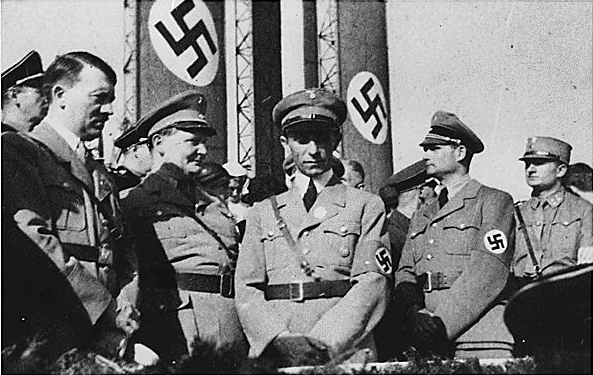
Hitler, Göring, Goebbels and Hess.
Photo via Wikimedia Commons.
The recent increase in economic concentration and monopoly power make the United States “ripe for dictatorship,” claims Columbia law professor Tim Wu in his new book, The Curse of Bigness. With the release of Senator Elizabeth Warren’s proposal to “break up” technology companies like Amazon and Google, fear of bigness is clearly on the rise. Professor Wu’s book adds a new dimension to that fear, arguing that cooperation between political and economic power are “closely linked to the rise of fascism” because “the monopolist and the dictator tend to have overlapping interests.” Economist Hal Singer calls this the book’s “biggest innovation.”
The argument is provocative, but wrong. As I show below, the claim that big business contributed to the rise of the Nazi Party is simply inconsistent with the consensus among German historians. While there is some evidence industrial concentration contributed in Hitler’s ability to consolidate power after he was appointed chancellor in 1933, there is no evidence monopolists financed Hitler’s rise to power, and ample evidence showing industry leaders opposed his ascent.
Thomas Childers, a professor of history at the University of Pennsylvania, calls the idea that Hitler was bankrolled by big corporate donors a “persistent myth.” This, among myriad other reasons, should give us pause before comparing 1930s Germany to the present-day United States. If fascism does come to the United States, big business won’t be to blame.
[…]
In the run-up to the presidential election in the spring of 1932, Hitler gave a speech to “a gathering of some 650 members of the Düsseldorf Industry Club in the grand ballroom of Düsseldorf’s Park Hotel.” British historian Sir Ian Kershaw recounts the event in Hitler: A Biography (p. 224):
Hitler’s much publicized address … did nothing, despite the later claims of Nazi propaganda, to alter the skeptical stance of big business. The response to his speech was mixed. But many were disappointed that he had nothing new to say, avoiding all detailed economic issues by taking refuge in his well-trodden political panacea for all ills. And there were indications that workers in the party were not altogether happy at their leader fraternizing with industrial leaders. Intensified anti-capitalist rhetoric, which Hitler was powerless to quell, worried the business community as much as ever. During the presidential campaigns of spring 1932, most business leaders stayed firmly behind Hindenburg, and did not favour Hitler … The NSDAP’s funding continued before the ‘seizure of power’ to come overwhelmingly from the dues of its own members and the entrance fees to party meetings. Such financing as came from fellow-travellers in big business accrued more to the benefit of individual Nazi leaders than the party as a whole. Göring, needing a vast income to cater for his outsized appetite for high living and material luxury, quite especially benefited from such largesse. Thyssen in particular gave him generous subsidies, which Göring — given to greeting visitors to his splendrously adorned Berlin apartment dressed in a red toga and pointed slippers, looking like a sultan in a harem — found no difficulty in spending on a lavish lifestyle.
As Ralph Raico, a professor of history at Buffalo State College, points out, the aim of these “relatively minor subsidies” to particular Nazis “was to assure (the donors) of ‘friends’ in positions of power, should the Nazis enter the state apparatus.” In Hitler: Ascent, 1889-1939, German historian and journalist Volker Ullrich details the extent of the industrialists’ support for center-right parties during the time of the Düsseldorf speech (p. 292):
[T]he American historian Henry A. Turner and others following in his footsteps have corrected this outmoded narrative about the relationship between National Socialism and major German industry. By no means had the entire economic elite of the Ruhr Valley attended Hitler’s speech… The crowd’s reaction to Hitler was also by no means as positive as (Nazi Press Chief Otto) Dietrich’s report had its readers believe. When Thyssen concluded his short word of thanks with the words “Heil, Herr Hitler,” most of those in attendance found the gesture embarrassing. Hitler’s speech also did little to increase major industrialists’ generosity when it came to party donations. Even Dietrich himself admitted as much in his far more sober memoirs from 1955: “At the ballroom’s exit, we asked for donations, but all we got were some well-meant but insignificant sums. Above and beyond that there can be no talk of ‘big business’ or ‘heavy industry’ significantly supporting, to say nothing of financing, Hitler’s political struggle.” On the contrary, in the spring 1932 Reich presidential elections, prominent representatives of industry like Krupp and Duisberg came out in support of Hindenburg and donated several million marks to his campaign.
The period immediately following Hitler’s speech to the Düsseldorf Industry Club was similarly fruitless for fundraising, as Richard J. Evans, a professor of history at the University of Cambridge, describes in The Coming of the Third Reich (p. 245):
Neither Hitler nor anyone else followed up the occasion with a fund-raising campaign amongst the captains of industry. Indeed, parts of the Nazi press continued to attack trusts and monopolies after the event, while other Nazis attempted to win votes in another quarter by championing workers’ rights. When the Communist Party’s newspapers portrayed the meeting in conspiratorial terms, as a demonstration of the fact that Nazism was the creature of big business, the Nazis went out of their way to deny this, printing sections of the speech as proof of Hitler’s independence from capital. The result of all this was that business proved not much more willing to finance the Nazi Party than it had been before.
Hitler lost the spring 1932 presidential election to Hindenburg. But the Nazi party achieved a plurality of seats in parliament for the first time in the July 1932 elections. Unable to form a government without Nazi cooperation after yet another round of elections in November 1932, Hindenburg appointed Hitler chancellor on January 30, 1933. With Hitler now in power, things changed.
In a 2014 review, Larry Schweikart wrote:
Still, more than a few voices critical of such historical hanky-panky have been raised. Perhaps the most influential is that of Henry A. Turner, Jr., who has provided an accurate and verifiable history of the Weimar period in his German Big Business and the Rise of Hitler. Turner sensibly avoids class struggle as a theme and simply asks if big business liked Hitler. Did business leaders support him? Did they give him money? Turner concludes that they did not. Only “through gross distortion can big business be accorded a crucial, or even major, role in the downfall of the Republic” (p. 340). Turner claims that bias “appears over and over again in treatments of the political role of big business even by otherwise scrupulous historians” (p. 350).
In his own examination of the evidence, Turner looked at the correspondence of German business leaders, minutes of their meetings, and their contributions. While it might be reassuring for some to think that Hitler came to power through the financial support of a few evil businessmen, the facts are that most of the Nazis’ money came from the German people. Turner carefully discusses Hitler’s policy stances toward business. Hitler was always wary of alienating the businessmen, but his failure to present a clear, procapitalistic economic program made the corporate leaders all the more leery of him. Modern Marxists, quite naturally, would like to implicate capitalism in the Holocaust. But, of course, Hitler’s themes were those of Stalin and, in our own day, Gorbachev. Nazism, as Turner suggests but never makes sufficiently clear, resembled Marxism in many ways, including Jew-hatred and hostility to the individual. In any case, Turner’s book has completely refuted the accepted notions that German corporations supported Hitler.
H/T to Colby Cosh for the initial link.
Comments Off on Big business and the rise of Hitler and the Nazi party
March 13, 2019
German politician floats the idea of a Franco-German aircraft carrier
Hmmm. What could they call it? The Charlemagne? The Louis XIV? The Napoleon? The Friedrich der Große? The Wilhelm II? The Maréchal Pétain? The possibilities are endless…

French aircraft carrier Charles De Gaulle (R91) at sea, 2009.
US Navy photo via Wikimedia Commons.
France and Germany should band together and build a European aircraft carrier to boost the continent’s defense capabilities, according to Annegret Kramp-Karrenbauer, a confidante and possible successor to German Chancellor Angela Merkel.
Kramp-Karrenbauer, who leads the Christian Democratic Union since Merkel stepped down from that job last fall, pitched the idea in a Sunday commentary in the Germany newspaper Die Welt. The article was meant as a response to French President Emmanuel Macron’s plea days earlier toward something of a European renaissance ahead of the European Parliament’s elections in May.
“Germany and France already are working on a future European combat aircraft, where other nations are invited to join,” Kramp-Karrenbauer wrote, referring to the Future Combat Air System, or FCAS. “As a next step, we could start the symbolic project of building an aircraft carrier to give shape to the role of the European Union as a global force for security and peace.”
On the one hand, the French navy (the Marine Nationale) does have current experience operating an aircraft carrier, the Charles de Gaulle, although a second carrier was cancelled due to budget constraints. The German navy, however, has been reported to be in dire straits both financially and operationally. I suspect it would take even longer than the time elapsed to negotiate, design, and build a carrier to get the German navy sufficiently well-staffed and trained to bear their part in the shared operations.
It has taken the Royal Navy several years of preparation — including much-needed allied assistance with crew members serving on US Navy carriers — to ensure that the latest British carrier, HMS Queen Elizabeth could be properly manned for working-up toward a first deployment next year. Aircraft carriers are not just bigger ships: they’re a unique type of ship and you don’t just build one (setting aside the highly specialized design requirements and finding a shipyard big enough) and then crew it with matelots from your existing fleet of frigates, corvettes, and patrol boats. I don’t think it’s expected that the Royal Navy will be able to operate both Queen Elizabeth and HMS Prince of Wales simultaneously except for brief operational surges or full-scale war.
Of course, I’m far from the only doubter about this idea:
“The ‘European aircraft carrier’ is such a ridiculous and meaningless proposal (don’t get me wrong, I can imagine some French politicians having the same ‘idea’) that it does not even deserve a rebuke,” Bruno Tertrais, deputy director at the Paris-based Fondation pour la Recherce Strategique, wrote in an email to Defense News.
Ulrike Franke, a London-based defense analyst with the European Council on Foreign Relations, struck a similar chord in a Monday post on Twitter: “I am all for strengthening European capabilities, yes please. … But this appears … not particularly well thought through…?”
And Wolfgang Ischinger, former German ambassador in Washington and doyen of the Munich Security Conference, suggested Germany wouldn’t really know what to do with such a ship.
“An aircraft carrier is an instrument of geopolitical/military power projection,” he wrote on Twitter. “A precondition for the employment would be a common strategy and decision-making process — Germany is light years away from that!”
That appears to be the crux of Germany’s defense debate: The Bundeswehr is so caught up in its disrepair that there is no space for formulating the kind of national strategy against which new capabilities could be evaluated. The lack of such a reference point gives all new military technology — from drones to artificial intelligence to naval power projection — the whiff of being far-fetched from the start, rightfully or not.
Comments Off on German politician floats the idea of a Franco-German aircraft carrier
March 8, 2019
QotD: Wine books as hagiography
Disasters of this sort happen much more rarely in books of the second category. Or rather, the things that do go wrong are sent from outside to try the heroic château-owners: items such as the French Revolution, the German occupation, hail, drought, floods, phylloxera, mildew and oidium. Disasters are there to be triumphed over; owners (or, at any rate, recent owners) are always doing their best, even when the world is less than the best possible. Greed, corruption, exploitation of employees and sharp practice turn up as rarely in the literary genre that is the château profile as does premarital bonking in Barbara Cartland. (And just out of interest, were there no collaborators in the vineyards during the last war? I’ve yet to read of any.) Of course, these books tend to be commissioned when the château is rich and its label famous; even so, it would be a nice change to read some day of an estate where the vineyards were wrecked, the workforce pissed, the proprietors fraudulent and the wine disgusting. In the meantime we have Asa Briggs: ‘I would not have written this book, however, had I not been invited to do so by the Duc and Duchesse de Mouchy, and they, along with other members of the Dillon family (who now own the vineyard) on both sides of the Atlantic, have given me great encouragement – and offered me memorable hospitality – throughout the inevitably protracted period of my research.’ Well, yes. Briggs does his little nods and bows, and writes with the bonhomie of a trusted courtier. He imparts all the key information that official sources will disclose about Haut-Brion; he writes effectively about the wider history of the Bordeaux wine trade (which perhaps should have been his subject in the first place), and fascinatingly about the city under the Revolution, when the owner of Haut-Brion was sent to the guillotine. But it is not for nothing that the name Asa Briggs, as a New Statesman competition entrant pointed out, is an anagram of Sir Gasbag. He just can’t help the pompous and the self-referential: ‘The year 1938, when I went up to university, was only an ‘average year’, rather like 1939, the first year I visited Bordeaux before war reached it … I have never tasted the 1955, the year of my marriage’. He is also a generous quoter of the gasbaggery of others. Take this insight from that ‘great citizen and long-time Mayor of Bordeaux’, Jacques Chaban-Delmas: ‘The spirit of a city takes bodily shape, so to say, across time and across the history that defines, affims and perpetuates both its identity and its raison d’être.’ Not much will have gone missing in the translation.
It is, no doubt, the fault of the genre, but Haut-Brion avoids controversy like a corked bottle. Briggs praises Edmund Penning-Rowsell’s ‘thoughtful and wide-ranging’ The Wines of Bordeaux, but does not quote its author’s judgement that ‘vinously the château has had its ups and downs in this century’. Briggs is ‘deeply impressed’ by Robert Parker and his ‘outstanding personality’, but does not refer to Parker’s assertion that the château produced ‘simplistic’ claret in the years 1966-74: ‘Whether this was intentional,’ Parker writes in Bordeaux, ‘or just a period in which Haut-Brion was in a bit of a slump remains a mystery. The staff at Haut-Brion is quick-tempered and sensitive about such a charge.’ Briggs also manages to blandify the potentially interesting anecdote. There is a story about Malcolm Forbes (‘who died while I was carrying out research for this book’), who at one extreme famously bought a bottle of Jefferson claret for $156,000, and at the other several hundred bottles of 1965 Haut-Brion for $5 a throw. ‘Forbes described himself as an appreciator of wine rather than as a collector, and he was a shrewd appreciator at that, a man who liked a bargain,’ Briggs notes. He records Forbes’s opinion that the 1965 got ‘better and better’ each time he drank it, the owner of Haut-Brion’s view that Forbes had been ‘quite right’ to have bought the wine, and ends by nervelessly quoting the Haut-Brion brochure to the effect that the wine is ‘astonishing for the vintage’. Sir Gasbag concludes: ‘Six thousand cases of Haut-Brion were produced in 1965. The comparative figures for 1964 and 1966 were 17,500 and 19,500. Forbes obviously knew what rarity meant.’ Among the fawning and the back-slapping lies a moderately interesting story about the penny-pinching of the super-rich. Of course, the reason the 1965 is ‘rarer’ than those on either side of it was because of climactic conditions which made it one of the crappiest of all postwar vintages, in which Haut-Brion produced a marginally less crappy wine than some of the other first growths. And would any vineyard-owner ever willingly dump on his own wine in overt contradiction of a millionaire client? I once attended a vertical tasting of a second-growth claret in the presence of the owner and her business manager. Among several excellent vintages there was an obvious super-dud of a 1958, which should long since have been emptied straight into the vinegar mother. When the owner arrived for the tasting she asked her manager in some puzzlement why they were showing the 1958. Because we have several hundred cases of it left,’ he replied. Whereupon, a few minutes later, she rose to her feet and gave measured praise to the lesser-known but arguably undervalued 1958.
Julian Barnes, “Did You Get Black Truffles on the Nose?”, Literary Review, 1994-10.
Comments Off on QotD: Wine books as hagiography


