Extra Credits
Published on 5 Mar 2019Charismatic leadership can conceal corruption, and Frank Herbert saw how dangerous this was in the political events he lived through. Leto Atreides, Valdimir Harkonnen, and Paul Atreides (Maud’dib) each represent different types of charismatic but very faulty leadership practices.
Join us in a few months for the continuation of Extra Sci Fi on Tuesdays! http://bit.ly/SubToEC
March 6, 2019
Dune – Maud’dib – Extra Sci Fi – #4
March 4, 2019
The history-pedants’ guide to The Last Kingdom – episode one
Lindybeige
Published on 11 Feb 2016The Last Kingdom – here I review the authenticity of episode one of this television series set in medieval England.
Support me on Patreon: https://www.patreon.com/Lindybeige
The Last Kingdom is a television series, eight hours long, based on the books by Bernard Cornwell. Here, I give the first episode the Lindybeige treatment – that is to say I go through it and in smarmy way point out various things it gets wrong.
People have pointed out in the comments that one character, Uhtred father of Uhtred, whom I describe as a ‘king’, is technically not a king at this point in the story. This is true. I decided not to spend half a minute of screen-time explaining the distinction. He is of a line of kings, has hopes to gain the title ‘king’ again, and is the ruler of Bernicia, and commander of the main force that engages in the battle, and is a very senior nobleman, variously described as ‘king’, ‘earl’, ‘lord’, and ‘ealdorman’.
Lindybeige: a channel of archaeology, ancient and medieval warfare, rants, swing dance, travelogues, evolution, and whatever else occurs to me to make.
▼ Follow me…
Twitter: https://twitter.com/Lindybeige I may have some drivel to contribute to the Twittersphere, plus you get notice of uploads.
website: http://www.LloydianAspects.co.uk
March 1, 2019
Theodore Dalrymple on Michel Houellebecq: “Houellebecq runs an abattoir for sacred cows”
At the New English Review:
Not reading many contemporary French novels, I am not entitled to say that Michel Houellebecq is the most interesting French novelist writing today, but he is certainly very brilliant, if in a somewhat limited way. His beam is narrow but very penetrating, like that of a laser, and his theme an important, indeed a vital one: namely the vacuity of modern life in the West, its lack of transcendence, lived as it is increasingly without religious or political belief, without a worthwhile creative culture, often without deep personal attachments, and without even a struggle for survival. Into what Salman Rushdie (a much lesser writer than Houellebecq) called “a God-shaped hole” has rushed the search for sensual pleasure which, however, no more than distracts for a short while.
Something more is needed, but Western man — at least Western man at a certain level of education, intelligence and material ease — has not found it. Houellebecq’s underlying nihilism implies that it is not there to be found. The result of this lack of transcendent purpose is self-destruction not merely on a personal, but on a population, scale. Technical sophistication has been accompanied, or so it often seems, by mass incompetence in the art of living. Houellebecq is the prophet, the chronicler, of this incompetence.Even the ironic title of his latest novel, Sérotonine, is testimony to the brilliance of his diagnostic powers and his capacity to capture in a single word the civilizational malaise which is his unique subject. Serotonin, as by now every self-obsessed member of the middle classes must know, is a chemical in the brain that acts as a neurotransmitter to which is ascribed powers formerly ascribed to the Holy Ghost. All forms of undesired conduct or feeling are caused by a deficit or surplus or malalignment of this chemical, so that in essence all human problems become ones of neurochemistry.
On this view, unhappiness is a technical problem for the doctor to solve rather than a cause for reflection and perhaps even for adjustment to the way one lives. I don’t know whether in France the word malheureux has been almost completely replaced by the word déprimée, but in English unhappy has almost been replaced by depressed. In my last years of medical practice, I must have encountered hundreds, perhaps thousands, of depressed people, or those who called themselves such, but the only unhappy person I met was a prisoner who wanted to be moved to another prison, no doubt for reasons of safety.
Houellebecq’s one-word title captures this phenomenon (a semantic shift as a handmaiden to medicalisation) with a concision rarely equalled. And indeed, he has remarkably sensitive antennae to the zeitgeist in general, though it must be admitted that he is most sensitive to those aspects of it that are absurd, unpleasant, or dispiriting rather than to any that are positive.
February 24, 2019
Another review of Curl’s Making Dystopia
Having read a few reviews of James Stevens Curl’s recent Making Dystopia: The Strange Rise and Survival of Architectural Barbarism, I’m likely to add it to my booklist (when I have a budget for new books again, that is). Here, Michael Mehaffy shares his comments on the book:

Cumbernauld Shopping Centre, voted as Britain’s most hated building in a Channel 4 poll.
Photo by Ed Webster via Wikimedia Commons.
For most reform-minded urbanists today, the complicity of architectural Modernism in the urban fiascoes of the last century is not in dispute. A representative (and seminal) criticism was Jane Jacobs’ withering 1961 attack, in The Death and Life of Great American Cities, in which she described Le Corbusier’s “wonderful mechanical toy” that “said everything in a flash, like a good advertisement” — but as to how a city actually works, it told “nothing but lies.” Jacobs’s work was of course a major inspiration in forming the Congress for the New Urbanism, along with the work of other reformists like Leon Krier, Christopher Alexander and Vincent Scully.
In fact, the 1996 Charter of the New Urbanism almost precisely inverts Le Corbusier’s 1933 Athens Charter: in place of the Modernists’ functional segregation, we would have mixed use; in place of their dominance of fast-moving vehicles (especially cars), we would have walkability and multi-modal streets; in place of wholesale demolition of historic districts and prohibition of historic styles, we would have preservation and renewal, and buildings that “grow from local climate, topography, history, and building practice.”
Yet in the last few decades, architectural Modernism has enjoyed a resurgence among some New Urbanists, as it has in the wider profession of architecture. For them, it’s reasonable to separate the urban mistakes of Modernism from its alleged architectural genius, which, as they see it, continues to offer inspiring building design ideas that can take their place happily within great new cities.
Of course, many critics would not agree — including many of the profession’s most prominent insiders. For them, the building-scale and urban-scale failures of Modernism have been of a piece, borne of a totalizing but defective theory of habitat, and even a dubious theory of architectural form itself. As the Post-Modernist Rem Koolhaas observed (in his 1995 book S,M,L,XL), “Modernism’s alchemistic promise, to transform quantity into quality through abstraction and repetition, has been a failure, a hoax: magic that didn’t work.” Nor was Koolhaas the first to attack the ideological foundations of Modernism. Similar criticisms came from earlier insiders like Sibyl Moholy-Nagy, wife of Bauhaus pioneer Lazslo, whose stinging 1968 essay on the Bauhaus labeled it “Hitler’s Revenge.” Its built works in the US carried, for her, “the browbeating symbolism of a negative ideology that was already bankrupt when the dying German Republic unloaded it on America.”
Yet for a movement that has been so frequently discredited, Modernism still has a curious grip on the profession even today. That’s because from the beginning, according to historian James Stevens Curl, the movement has been populated by “architectural bullies” who would stop at nothing to seize power, extinguish its competitors, re-write history, forbid all other styles (especially those with any ornament), and otherwise enforce a radical agenda — one that only seemed to offer all things alluring, progressive and historically inevitable. Beneath that marketable cover story, he says, the real agenda was an exhilarating quest for power and dominance, and especially later, for the wealth generated by a profitable industrialization of the human environment. Modernism sold, and no matter if it also sold out—cities, people, history, the future. For Curl, that approach was (and is) nothing less than “architectural barbarism.”
The Hobbit: The Desolation of Warners (Part 3/2)
Lindsay Ellis
Published on 20 Apr 2018Nothing is pure.
From the comments:
Special Agent Washing Tub
2 months agoMe; * watching this and feeling my childhood shatter*
“Why does it hurt so much?”
Lindsay: “BECAUSE IT WAS REAL.”
February 23, 2019
The Hobbit: Battle of Five Studios (Part 2/2)
Lindsay Ellis
Published on 3 Apr 2018So we’ve looked into what the problems were with these movies, the question now is … why? What happened, Peter Jackson? WHAT HAPPENED?
From the comments:
app
5 months agoThat interview clip with John Callen near the end broke my heart. I also grew up with the hobbit and was bored to tears by the movies. But I never thought about the actors of the Dwarves and how important it was that they got pushed aside. The hobbit could have been amazing if it was this band of actors, dressed like dwarves, trying to reclaim their culture and finding out what that really means. It’s a pure idea, and ironically it was corrupted by greed… you reminded me what I loved about the book! :'(
February 22, 2019
The Hobbit: A Long-Expected Autopsy (Part 1/2)
Lindsay Ellis
Published on 27 Mar 2018In which we look back at The Hobbit trilogy and try to give it a fair shake.
Twitter: @thelindsayellis
Patreon: https://www.patreon.com/loosecanon
From the comments:
J Girl
9 months agoWho else is waiting for the next video to be titled “part 2/3” as a slap in the face to the fact that they switched it from two movies to three
February 19, 2019
Judging a book by its cover (or people by their appearance)
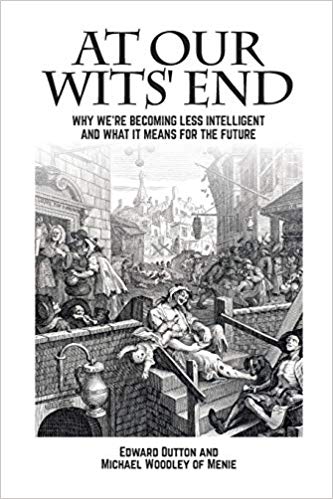
In the latest Libertarian Enterprise, Sean Gabb reviews How to Judge People by What They Look Like, by Edward Dutton:
This short book is equally naughty and entertaining. It bounces along, making its points in a light-hearted and generally a witty manner. It is naughty so far as it is a flat challenge to many of the pieties of our age.
We are told never to judge a book by its cover — that the substance of a person, this being character and intelligence, have no measurable relationship to his external form, this being his physical appearance. At the extreme, of looking at correlations between race and intelligence, you can get into serious trouble for disputing this piety. Even moderate dissent earns hostility or just ridicule. Look, for example, at the relevant textbooks. The phlogiston theory is covered as an early theory of combustion, superseded by the truth. Phrenology is denounced as barely short of a moral and intellectual failing. No one thinks ill of Lamarck for this theory of inherited characteristics. Lombroso and his measurement of criminal heads are seen as steps on the road to Auschwitz.
The author of this book takes aim at every one of these pieties. He begins with the easy targets. Within ethnic groups, he goes over the increasingly rehabilitated claim that intelligence is largely inherited — about 80 per cent. He adds the other increasingly rehabilitated claim that there are differences of average intelligence between groups—that the peaks of each distribution curve occur at different points along the scale.
[…]
Now, what follows from all this? The answer is that all truth is important — so far as this is the truth; and I do lack the statistical grounding and the time or inclination to check the author’s scholarship. Even when a particular truth has no practical value, a regard for truth is a generally useful prejudice. But there are certain conclusions that appear to follow.
First, there is has been a progressively greater diversity of external form since the industrial revolution. The stated reason for this is that the harsh conditions of a traditional society, in which about 40 per cent of children died, and the higher classes had more surviving offspring, created a strong bias towards the survival of the intelligent and conscientious. Since then, the fall of infant mortality towards zero has thrown this process into reverse. That may explain the growing fall in genius or just high intellectual quality as a fraction of modern populations. It may also explain the decay — and the author says nothing of this — of free institutions, and their replacement by less complex and more maternal forms of government. Old England was free because its people were capable of being free. Modern England is unfree because the people have changed.
February 18, 2019
Modernism as “architectural PTSD”
In Architect, the Journal of the American Institute of Architects, Witold Rybczynski reviews James Stevens Curl’s Making Dystopia: The Strange Rise and Survival of Architectural Barbarism:
The buildings in my neighborhood, Logan Square in downtown Philadelphia, fall roughly into two categories. There are those that offer visual pleasure, whether they are modest run-of-the-mill brick row houses or the rather grand Board of Education Building, an Art Deco-ish pile topped by busts of Sir Isaac Newton, Ben Franklin, and Alexander Graham Bell. “How nice that someone actually took the trouble,” I think as I walk by. And then there is the second category: utilitarian apartment slabs with unrelieved gridded façades, infill condo housing that looks as if it had been trucked in from the suburbs, a grim precast concrete retirement home that takes up a whole block. “I wish they hadn’t built that,” is my all too common reaction. The Board of Education Building dates from 1932. That’s the approximate cut-off date. Before the 1930s, the buildings are pretty good; after that, not so much. What happened?
The answer to that question is the subject of James Stevens Curl’s controversial new book, Making Dystopia: The Strange Rise and Survival of Architectural Barbarism (Oxford University Press, 2018). Curl is a British architectural historian, professor emeritus at De Montfort University in Leicester, and the author of more than 40 books, including the well-regarded The Victorian Celebration of Death (most recently updated in 2004) and The Oxford Dictionary of Architecture (1999). According to Curl, what happened was “architectural barbarism,” which is how he characterizes modern architecture. He does not mince words. Describing the emergence of the International Style in the 1920s, he writes: “It became apparent that something very strange had occurred: an aberration, something alien to the history of humanity, something destructive aesthetically and spiritually, something ugly and unpleasant, something that was inhumane and abnormal, yet something that was almost universally accepted in architectural circles, like some fundamentalist quasi-religious cult that demanded total allegiance, obedience, and subservience.”[…]
Buildings like PSFS were not the result of the First World War, of course, but it was the war that opened the door to radical change — whether it was political (Nazism), economic (the New Deal), or architectural (Modernism). This, rather than Curl’s theory of a quasi-religious cult, is a more convincing explanation for the “strange rise” of modern architecture. As the title of his book suggests, the author assumes malevolence on the part of Gropius, Le Corbusier, et al., but what if the International Style was instead the result of a sort of postwar architectural PTSD?
[…]
The ultimate failure of modern architecture is not that it was incapable of producing beautiful works of individual art. There have been plenty of those, pace Professor Curl. The real drawback is that while the Modern Movement effectively suppressed an architectural language that had taken hundreds of years to evolve, it proved incapable of developing a successful substitute, the weak-kneed antics of Postmodernism notwithstanding. The strength of pre-modern architecture was that it provided a rich variety of modes of expression. It permitted complicated things to be said in complicated ways, and simpler things in simpler ways, analogous to the spoken language, which can be used to write drama and poetry or instruction booklets.
February 17, 2019
QotD: Nanotechnology and quantum computing
When I say Quantum Computing is a bullshit field, I don’t mean everything in the field is bullshit, though to first order, this appears to be approximately true. I don’t have a mathematical proof that Quantum Computing isn’t at least theoretically possible. I also do not have a mathematical proof that we can make the artificial bacteria of K. Eric Drexler’s nanotech fantasies. Yet, I know both fields are bullshit. Both fields involve forming new kinds of matter that we haven’t the slightest idea how to construct. Neither field has a sane ‘first step’ to make their large claims true.
Drexler and the “nanotechnologists” who followed him, they assume because we know about the Schroedinger equation we can make artificial forms of life out of arbitrary forms of matter. This is nonsense; nobody understands enough about matter in detail or life in particular to do this. There are also reasonable thermodynamic, chemical and physical arguments against this sort of thing. I have opined on this at length, and at this point, I am so obviously correct on the nanotech front, there is nobody left to argue with me. A generation of people who probably would have made first rate chemists or materials scientists wasted their early, creative careers following this over hyped and completely worthless woo. Billions of dollars squandered down a rat hole of rubbish and wishful thinking. Legal wankers wrote legal reviews of regulatory regimes to protect us from this nonexistent technology. We even had congressional hearings on this nonsense topic back in 2003 and again in 2005 (and probably some other times I forgot about). Russians built a nanotech park to cash in on the nanopocalyptic trillion dollar nanotech economy which was supposed to happen by now.
Similarly, “quantum computing” enthusiasts expect you to overlook the fact that they haven’t a clue as to how to build and manipulate quantum coherent forms of matter necessary to achieve quantum computation. A quantum computer capable of truly factoring the number 21 is missing in action. In fact, the factoring of the number 15 into 3 and 5 is a bit of a parlour trick, as they design the experiment while knowing the answer, thus leaving out the gates required if we didn’t know how to factor 15. The actual number of gates needed to factor a n-bit number is 72 * n^3; so for 15, it’s 4 bits, 4608 gates; not happening any time soon.
It’s been almost 25 years since Peter Shor had his big idea, and we are no closer to factoring large numbers than we were … 15 years ago when we were also able to kinda sorta vaguely factor the number 15 using NMR ‘quantum computers.’
I had this conversation talking with a pal at … a nice restaurant near one of America’s great centers of learning. Our waiter was amazed and shared with us the fact that he had done a Ph.D. thesis on the subject of quantum computing. My pal was convinced by this that my skepticism is justified; in fact he accused me of arranging this. I didn’t, but am motivated to write to prevent future Ivy League Ph.D. level talent having to make a living by bringing a couple of finance nerds their steaks.
Scott Locklin, “Quantum computing as a field is obvious bullshit”, Locklin on Science, 2019-01-15.
February 7, 2019
Dunkirk (2017) | Based on a True Story
The Cynical Historian
Published on 25 Jan 2018Dunkirk is a 2017 war film written, directed, and produced by Christopher Nolan that depicts the Dunkirk evacuation of World War II. Its ensemble cast includes Fionn Whitehead, Tom Glynn-Carney, Jack Lowden, Harry Styles, Aneurin Barnard, James D’Arcy, Barry Keoghan, Kenneth Branagh, Cillian Murphy, Mark Rylance, and Tom Hardy. The film is a British, American, French, and Dutch co-production, and was distributed by Warner Bros.
————————————————————
Wiki:
Dunkirk portrays the evacuation from three perspectives: land, sea, and air. It has little dialogue, as Nolan sought instead to create suspense from cinematography and music. Filming began in May 2016 in Dunkirk and ended that September in Los Angeles, when post-production began. Cinematographer Hoyte van Hoytema shot the film on IMAX 65 mm and 65 mm large-format film stock. Dunkirk has extensive practical effects, and employed thousands of extras as well as historic boats from the evacuation, and period aeroplanes.
————————————————————
Hashtags: #History #Dunkirk #WWII #Review #BasedOnATrueStory #PhoneyWar
February 4, 2019
Jane Austen – Sarcasm and Subversion – Extra History
Extra Credits
Published on 2 Feb 2019Jane Austen wrote in the name of making critical social commentary of the privileges she and others held while the rest of Europe was in political turmoil. Her novels like Pride and Prejudice, Mansfield Park, and Emma made waves in their time for how they criticized
VictorianRegency-era society.
Join us on Patreon! http://bit.ly/EHPatreon
From the comments:
Extra Credits
2 days ago
Jane Austen saw the hypocrisy of an entire class of the most powerful empire on Earth taking tea and planning balls while the world burned. And from a young age she took up arms against that hypocrisy with the only weapon she had: her pen.(Comment from Belinda) I don’t know if anyone else has had this experience with Jane Austen’s works, but in the educational culture I grew up in, the historical context of Austen’s writing was almost never emphasized. Pride & Prejudice in particular is frequently reduced to being the original formula for romantic comedies (to say nothing of its own spin-off movies of the same name). I remember in high school class it seemed really weird to me that we would be talking about this 19th century novel as a progressive feminist work because it’s already a given in the 21st century world that marrying for love is extremely commonplace. I’m really proud of our writers Jac and Rob, and our artist Ali, for bringing to life the “extra History” of Jane Austen that gets glossed over by popular culture. <3
January 31, 2019
QotD: Top-down solutions
The closest analogy I can think of right now – maybe because it’s on my mind – is this story about check-cashing shops. Professors of social science think these shops are evil because they charge the poor higher rates, so they should be regulated away so that poor people don’t foolishly shoot themselves in the foot by going to them. But on closer inspection, they offer a better deal for the poor than banks do, for complicated reasons that aren’t visible just by comparing the raw numbers. Poor people’s understanding of this seems a lot like the metis that helps them understand local agriculture. And progressives’ desire to shift control to the big banks seems a lot like the High Modernists’ desire to shift everything to a few big farms. Maybe this is a point in favor of something like libertarianism? Maybe especially a “libertarianism of the poor” focusing on things like occupational licensing, not shutting down various services to the poor because they don’t meet rich-people standards, not shutting down various services to the poor because we think they’re “price-gouging”, et cetera?
Maybe instead of concluding that Scott is too focused on peasant villages, we should conclude that he’s focused on confrontations between a well-educated authoritarian overclass and a totally separate poor underclass. Most modern political issues don’t exactly map on to that – even things like taxes where the rich and the poor are on separate sides don’t have a bimodal distribution. But in cases there are literally about rich people trying to dictate to the poorest of the poor how they should live their lives, maybe this becomes more useful.
Actually, one of the best things the book did to me was make me take cliches about “rich people need to defer to the poor on poverty-related policy ideas” more seriously. This has become so overused that I roll my eyes at it. “Quantitative easing could improve GDP growth…but instead of asking macroeconomists, let’s ask this 19-year old single mother in the Bronx!” But Scott provides a lot of situations where that was exactly the sort of person they should have asked. He also points out that Tanzanian natives using their traditional farming practices were more productive than European colonists using scientific farming. I’ve had to listen to so many people talk about how “we must respect native people’s different ways of knowing” and “native agriculturalists have a profound respect for the earth that goes beyond logocentric Western ideals” and nobody had ever bothered to tell me before that they actually produced more crops per acre, at least some of the time. That would have put all of the other stuff in a pretty different light.
Finally, I understand Scott is an anarchist. He didn’t really try to defend anarchism in this book. But I was struck by his description of peasant villages as this unit of government which were happily doing their own thing very effectively for millennia, with the central government’s relevance being entirely negative – mostly demanding taxes or starting wars. They kind of reminded me of some pictures of hunter-gatherer tribes, in terms of being self-sufficient, informal, and just never encountering the sorts of economic and political problems that we take for granted. They make communism (the type with actual communes, not the type where you have huge military parades and kill everyone) look more attractive. I think Scott was trying to imply that this is the sort of thing we could have if not for governments demanding legibility and a world of universal formal rule codes accessible from the center? Since he never actually made the argument, it’s hard for me to critique it. And I wish there had been more about cultural evolution as separate from the more individual idea of metis.
Overall, though, I did like this book. I’m not really sure what I got from its thesis, but maybe that was appropriate. Seeing Like A State was arranged kind of like the premodern forests and villages it describes; not especially well-organized, not really directed toward any clear predetermined goal, but full of interesting things and lovely to spend some time in.
Scott Alexander, “Book Review: Seeing Like a State”, Slate Star Codex, 2017-03-16.
January 30, 2019
QotD: Political memoirs
We’re told not to judge books by their covers, but faced with these two it’s hard not to. Harman’s is one of those thick, expensive tomes which, understandably, politicians write when they’ve had enough earache and, unbelievably, publishers keep buying for vast sums, despite the fact that a fortnight after publication you can pick them up cheaper than an adult colouring book in a remainder bin. The old saw that ‘all political careers end in failure’ might now better be: ‘All political careers end with a book on Amazon going for less than the price of the postage.’
Julie Burchill, “Harriet Harman and Jess Phillips: poles apart in the sisterhood”, The Spectator, 2017-02-25.
January 21, 2019
Responding to “Konmari”‘s book de-cluttering advice
I haven’t read any of her work, but based on David Warren’s response to it, I doubt I’d find it interesting or enjoyable:
Among the proposals of this “Konmari,” as she is called by her followers, is to jettison all books that have not been read. Too, all those which have been read already. The one you are reading may be kept, but only till it is finished, lest it create a temptation to re-reading. I would certainly apply this principle to self-help books.
But every book I have retained, sparks joy; and their spines alone may trigger an imaginative recollection of the contents, and the times and spaces among which it was once read. As Coleridge said, books are corporeal, living things; at any moment their wings may re-open, for another flight into one’s soul.
A correspondent in western Massachusetts was recently married. She moved in with her new husband, together with fifty cartons of books — an amount he may have deemed excessive. My advice: any number of cartons that can be counted, is too few.
“Have you read all these books?” I have been asked by visitors, so many times, that I have run out of clever replies. Among them: “Are you insinuating that this is all I’ve ever read?” … Or, “Dear me, yes, good point. All my other flats are like this, too.” … Or: “No, I can’t read, but I hired a highly literate interior decorator.”
The other day I was asked this by a policeman. He was gathering information on a burglar who had happened to pass my way. I hope he doesn’t report me for hoarding. Apparently there are now laws against that; Twisted Nanny State never sleeps.
When my son has a new acquaintance over to our place, one of the almost inevitable first comments from the new visitor is about “all the books”, and they rarely get to see the actual library…