
spiked
Published 27 Jan 2023Tom Slater, Fraser Myers and Ella Whelan discuss the World Economic Forum, men in women’s prisons and Facebook’s unbanning of Donald Trump. Plus, Timandra Harkness explains the dangers of the UK’s Online Safety Bill.
(more…)
January 30, 2023
Eff the WEF | The spiked podcast
Comments Off on Eff the WEF | The spiked podcast
January 29, 2023
D.C. Public Schools – “if this were a corporation, it would be in liquidation. If it were a house, it would be condemned”
Andrew Sullivan on the latest PR campaign by the disaster that is the DC Public School system:
In my web-reading this week, I stumbled across two statistics that made me sit up straight. The first came from a devastating story last September about my home city’s public schools. I had just watched a slick new video from DC Public Schools about their new “equity” push, which aims to go “beyond students’ academics” and “call out inequities”. The video is full of vague-sounding pabulum — they never define what they mean by “equity”, for example, apart from invoking Ibram X Kendi’s term “antiracism” — but the message is very clear: “equity” is now the central focus of the school district. And it’s a bright new day!
Now check out the data on how the DC Public School system is faring. A key metric is what they call “proficiency rates” — a test of whether the kids are passing the essentials of reading and math at every stage of their education. Overall, only 31 percent of DC students have proficiency in reading and just 19 percent have proficiency in math. Drill down further in the racial demographics and the picture is even worse: among African-American kids, the numbers are 20 percent and 9 percent, respectively. Among black boys, it’s 15 percent and 9 percent. Which means to say that DC Public Schools graduate kids who are overwhelmingly unable to do the most basic reading and math that any employer would need.
This is not a function of money. In the most recent federal analysis: DC spends far more per student — $30,000 a year — than any other state, double the amount in many states across the country.
Let’s put it this way: if this were a corporation, it would be in liquidation. If it were a house, it would be condemned. But since it’s a public school system, it can avoid this catastrophic failure by emphasizing “equity”!
Call this the woke dodge. As they fail to educate kids in the very basics, they brandish a shiny object over there — “Diversity! Equity! Inclusion!” — to distract us. Or they claim that these scores are caused by “white supremacy” or “systemic racism”. Or they argue that now, they are educating “the whole child”. From the DCPS video: “The racial equity lens is a critical component of ‘whole child’ for us because being a whole child means thinking about all of your identities, but certainly the racial identity is a gap in what we’re discussing as a country.” Anything but do the basic job of teaching math and reading as they are supposed to do.
The truth is: they obviously can’t teach those subjects successfully. I’m sure many are good teachers doing their best, and some manage to rescue some of these kids, who often face terrible trauma in their homes and neighborhoods. But the data overall are damning. Imagine spending $30K a year on a student, any kid, in any country, and after 12 years, he still can’t spell or do basic math. It must be really hard to pull that off. And as a reward, you get a shitload of money from the city and the feds to keep it up. Criticize them? You’re a “white supremacist”.
Then there’s the other stat that blew my mind — on the post-BLM surge in murders of African-Americans, including many children. The rise in homicide has cooled off somewhat, as Robert Verbruggen notes. But check this out:
Between the 2018–2019 and 2020–2021 periods, the black homicide rate went up by about 40 percent and the white one by 15 percent — already a glaring disparity. But since the black homicide rate started out so much higher than the white one, this translated to an increase of just 0.4 per 100,000 for whites and 9.7 per 100,000 for blacks — nearly 25 times as large. The increase in the black homicide rate was greater than the total homicide rate for the nation as a whole.
Read that last sentence again.
Comments Off on D.C. Public Schools – “if this were a corporation, it would be in liquidation. If it were a house, it would be condemned”
January 27, 2023
Post-pandemic travelling on the TTC: ride the Red Rocket … cautiously
Matt Gurney posted a series of tweets about his recent subway experiences in Toronto:
I rode the TTC three times today. Once to downtown from my home in midtown. Once within downtown to a different place. And then home from downtown.
On two of those three rides, there was someone having a very obvious mental-health crisis on the vehicle with us.
The first one was a young man who clapped his hands over his ears and shrieked incoherently at random intervals. And then he got off.
The second, an older man sat in a chair and screamed nonsense constantly for ten stops. Maybe more. That’s just when I got off.
I’m working on a bigger piece for later so I’ll save any complex thoughts and big conclusions for then. But there was something interesting I noticed today. I’m a regular TTC rider. Not daily but frequent. And for the first time today, I’m noticing gallows humour and planning.
“Good luck to everyone,” cracked one guy. There was laughter. Everyone knew what he meant.
But I’m also seeing little groups of strangers agreeing to each keep watch on one direction or another. Sometimes also joking about it.
None of this is funny, but my gut tells me that if Torotonians are now so thoroughly convinced that riding the TTC is so risky that it’s worth a dark joke, any politician who reacts to the next unprovoked attack or murder with a proposal for a national summit is gonna get smoked.
I like the TTC. I have great access to it. It’s super convenient and affordable. It’s a huge asset for me. I have token cufflinks. I’m a fan, is what I’m saying.
I’m now at the point where I’d think twice before taking my kids on it. And we used to ride it just to kill the time.
My son used to stand on the couch in our living room looking out the window counting buses as they went by, loudly shouting to announce each one. Getting to go on a bus or subway or a streetcar was an event for him. My daughter, maybe a bit less excited. Still loved it.
Ah man.
Anyway. I hope tomorrow is better.

Update: You might think the increased concern over using the TTC might be merely a bit of confirmation bias informed by recent reporting, but apparently the situation is serious enough that Toronto Police will be stepping up their presence on the system.
Comments Off on Post-pandemic travelling on the TTC: ride the Red Rocket … cautiously
January 18, 2023
L’affaire Dreyfus
Robert Zaretsky on an espionage scandal that convulsed the French Third Republic and still has resonance down to today:
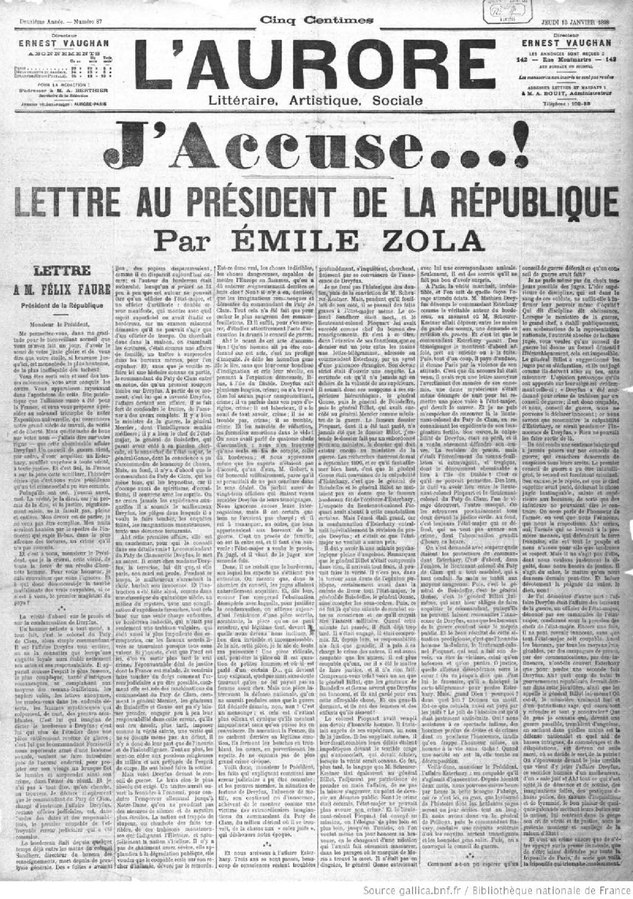
Front page of L’Aurore for 13 January, 1898 with Zola’s J’Accuse headline.
Wikimedia Commons.
On January 13, 1898, Parisians awoke to the chorus of hundreds of news criers who, striding along the grand boulevards and brandishing copies of the newspaper L’Aurore, were shouting passages from the article that sprawled across the front page. It had originally been titled by its author, the novelist Émile Zola, “A Letter to M. Félix Faure, President of the Republique”. But with a flair for the sensational, the newspaper’s editor, Georges Clemenceau, slapped on a punchier headline. Stepping out of a department store or stepping down from a carriage, sitting at a café or standing at an intersection, pedestrians were greeted by two words that continue to resonate 125 years to the day after their first publication: “J’Accuse!”
With this exclamation, Zola’s letter transformed une affaire judiciare into l’affaire Dreyfus or, more simply, the Dreyfus Affair. It catapulted the French novelist onto the world stage at a critical moment in the history of his country, which was reeling from the forces of globalisation and industrialisation and riven by opposing understandings of its revolutionary heritage. It is thus hardly surprising that Zola’s fame rests more heavily on the letter than on his sweeping 20-volume masterpiece of literary realism, the Rougon-Macquart. It took a novelist to heave the facts of this affair into a narrative which, more than a century later, thrums with equal urgency. Moreover, as with the novels of the Rougon-Macquart, the letter thrusts onto centre-stage a lone individual swept up, and all too often swept under, the political and social, irrational and ideological forces of the modern age.
It all began with the contents of a rubbish bin. In September 1894, a cleaning woman at the German Embassy, in the pay of France’s military intelligence service, delivered her nightly harvest to her employers. Buried in the mound of discarded papers was a memorandum, known as the bordereau or note, revealing top secret advances in French artillery technology and tactics. In a frantic scramble to find its author, the war ministry’s suspicion settled on Captain Alfred Dreyfus, an officer in the High Command who stood out for his standoffishness and Jewishness.
Upon being arrested and charged, a bewildered Dreyfus denied the charges, pointing out several things mentioned in the bordereau he could not possibly have known. The seven members of the military tribunal, ignoring these inconsistencies as well as the insistence of their own graphologist that Dreyfus’s handwriting did not match the bordereau‘s, unanimously found him guilty. He was sentenced to life imprisonment in solitary confinement on Devil’s Island, a malarial rock off the coast of French Guyana.
But first came a remarkable ritual of public humiliation. Dreyfus was marched into the courtyard of the École militaire, the renowned military academy a short distance from the recently erected Eiffel Tower. In the shadow of that monument to modernity, an officer preceded to snap Dreyfus’s sword — broken and soldered back together with tin the night before, to make the gesture seem effortless — and tear off his insignia — whose threads were already loosened — while a dense crowd howled with calls for the death of the “Jewish traitor!”
Two years later, as Dreyfus wasted away in solitary confinement, Colonel Georges Picquart, the newly appointed head of military intelligence, found that another missive about French military plans had ended up in the rubbish bin at the German Embassy. Moreover, the handwriting on this new document, which matched that of the bordereau, also matched the hand of Ferdinand Esterhazy, an officer notorious for his womanising and gambling.
Picquart disliked Jews as much as his many of his fellow officers did. But when his commanding officer asked him why it mattered if “this Jew remains on Devil’s Island”, Picquart replied: “Because he is innocent!” The answer earned Picquart a rapid transfer to a desert outpost in North Africa. Before he was packed off, though, Picquart vowed that he would not “carry this secret to my grave”. He then shared what he knew with Auguste Scheurer-Kestner, the leader of Dreyfusards, a small but growing coterie of politicians and writers seeking a retrial for Dreyfus.
In late 1897, Zola met with Scheurer-Kestner, who told him about Picquart’s discovery. As the mesmerised novelist listened, he glimpsed the theatrical as well as moral dimensions of the affair. “It’s thrilling!” he gasped. “It’s frightful! But it is also drama on the grand scale!” It took Zola to scale it to greatness by flipping Oscar Wilde’s sly quip that anyone could make history, but only a great man could write it. Instead, Zola showed, a man becomes truly great only by, in every sense of the word, making history.
Comments Off on L’affaire Dreyfus
January 11, 2023
Al Capone’s Soup Kitchen
Tasting History with Max Miller
Published 10 Jan 2023
(more…)
Comments Off on Al Capone’s Soup Kitchen
January 5, 2023
The injustices inherent in “asymmetrical multiculturalism”
Ed West traces the start of “asymmetrical multiculturalism” to a 1916 article in The Atlantic by Greenwich Village intellectual Randolph Bourne and traces the damage that resulted from widespread adoption of the policy:

“Asymmetrical multiculturalism” was first coined by demographer Eric Kaufmann in his 2004 book The Rise and Fall of Anglo-America, and later developed in his more recent Whiteshift, in a chapter charting Bourne’s circle, the “first recognisably modern left-liberal open borders movement”.
Kaufmann wrote how asymmetrical multiculturalism “may be precisely dated” to the article where Bourne, “a member of the left-wing modernist Young Intellectuals of Greenwich Village and an avatar of the new bohemian youth culture,” declared “that immigrants should retain their ethnicity while Anglo-Saxons should forsake their uptight heritage for cosmopolitanism.”
Kaufmann suggested that: “Bourne’s desire to see the majority slough off its poisoned heritage while minorities retained theirs blossomed into an ideology that slowly grew in popularity. From the Lost Generation in the 1920s to the Beats in the ’50s, ostensibly ‘exotic’ immigrants and black jazz were held up as expressive and liberating contrasts to a puritanical, square WASPdom. So began the dehumanizing de-culturation of the ethnic majority that has culminated in the sentiment behind, among other things, the viral hashtag #cancelwhitepeople.”
The hope, as John Dewey said of his New England congregationalist denomination around the same time as Bourne, was that America’s Anglo-Saxon core population would “universalise itself out of existence” while leading the world towards universal civilisation.
These ideas certainly didn’t remain in New England or even the United States, as Britain has certainly seen just how destructive they can be recently:
Late last year I wrote about the tragedy of Telford, a town in the English midlands where huge numbers of young girls had been sexually abused. Telford, along with Rotherham in South Yorkshire, had become synonymous with this form of sexual abuse, mostly committed by men of Kashmiri origin against girls who were poor, white and English.
This is the subject of an upcoming GB News documentary by journalist Charlie Peters, and it is quite clear, from all the various reports, that grooming had been allowed to carry on in part because of the different ways the system treats different groups.
Had the races of the perpetrators and victims been reversed, this tragedy would almost certainly be the subject of countless documentaries, plays, films and even official days of commemoration. But it wouldn’t have come to that, because the authorities would have intervened earlier, and more journalists would have been on the case.
Sex crime is perhaps the most explosive source of conflict between communities, and most recently the 2005 Lozells riots began over such a rumour. It is understandable why journalists and reporters were nervous about this subject; less forgivable is the way that, away from the public eye, those in charge signal how gravely they view what happened.
Until Peters revealed the story, Labour had planned to make the former head of Rotherham council its candidate for Rother Valley; this week Peters revealed that one of the councillors named in a report into the town’s failures to deal with the grooming gangs scandal has gone onto become a senior Diversity & Inclusion Manager working for the NHS. Presumably the people who hired Mahroof Hussain knew about his previous job, and still felt that it was appropriate to have him in a “diversity and inclusion” position. Again, were things different, would a Mr Smith whose council had been condemned for its handling of the gang rape of Asian girls have landed that job? The whole thing seems as morbidly comic as Rotherham becoming Children’s Capital of Culture.
Such a clear inconsistency can only exist because of socially-enforced taboos and norms which have developed over race. In Whiteshift, Kaufmann cited sociologist Kai Erikson’s description of norms as the “accumulation of decisions made by the community over a long time” and that “each time the community censures some act of deviance … it sharpens the authority of the violated norm and re-establishes the boundaries of the group”. Every time an individual is punished for violating the anti-racism norm, it strengthens society’s taboo around the subject, to the point where it begins to overwhelm other moral imperatives.
Then there is regalisation, the name for the process “in which adherents of an ideology use moralistic politics to entrench new social norms and punish deviance”, in Kaufmann’s words. This has proved incredibly effective; after paedophilia or sexual abuse, racism is perhaps the most damaging allegation that can be made.
Few people wish to be accused of deviance, which perhaps explains why Peters’s story has received so little coverage in the press this week. Again, were the roles reversed, it’s not wild speculation to suggest that it would feature on the Today programme, seen as clear evidence of racism at the heart of Britain. When the Telford story broke, it did not even feature on the BBC’s Shropshire home page.
Comments Off on The injustices inherent in “asymmetrical multiculturalism”
December 28, 2022
The Myth of the Nazi Police State – WW2 Documentary Special
World War Two
Published 27 Dec 2022The popular image of the Gestapo is as black leather-jacketed fiends whose spies keep the nation under constant surveillance. They are so powerful that the terrified population has no choice but to sell out its family and friends. But how true is this? Are all Germans living in fear of the Gestapo all the time?
(more…)
Comments Off on The Myth of the Nazi Police State – WW2 Documentary Special
December 17, 2022
Capital punishment
Tam at View From The Porch expresses some of her concerns about the death penalty and government’s fitness to carry out such punishments fairly:

“Tombstone Courthouse State Historic Park” by August Rode is licensed under CC BY-NC-SA 2.0


I’ve written numerous times that I’m pretty ambivalent about capital punishment. There are some crimes so heinous that you can’t just walk back from them and say “Hey, I’m sorry I ate grandma’s face with some fava beans and a nice chianti, but I was off my meds. I’m feeling better now and ready to be a productive member of society!” I’m comfortable with the concept of having society’s lifeguard blow the whistle and order that dude out of the pool.
Thing is, it turns out that a lot of people wind up on death row for Felony Being Black In A Lineup with a further count of Aggravated Having A Bad Lawyer. It’s bad enough having to try to make things right with a dude you’ve locked in a cell for years by mistake, but it’s impossible to do with a dude you’ve put in a coffin.
Conservatives don’t trust the government to do most anything right, from writing & enforcing gun laws to delivering the mail, but when it comes to making sure they strap the right guy in Ol’ Sparky, suddenly y’all act like the government couldn’t possibly screw up.
So while in theory I’m pretty okay with the idea of capital punishment, in some frictionless setting where all cows are spherical and have equal mass and libertarianism works, here in the real world I just don’t trust people to implement it right.
If we as a society screw up and off the wrong dude, who gets the sentence for that? Or do we all get ¹⁄₃₃₃,₀₀₀,₀₀₀ of a sentence?
Comments Off on Capital punishment
QotD: The female murderer
Each volume of Notable British Trials came with a lengthy introduction by its editor, many of whom were distinguished writers — for example, William Roughead, the originator of the true-crime genre and much admired by Henry James; or F. Tennyson Jesse, the poet’s great-niece, a good novelist and author of a wonderful study of murderers, Murder and Its Motives, which remains in use. She wrote with cool irony about the worst crime in the criminal code; she says, for instance, of some women murderers:
The woman who murders her husband has nearly always ceased to think of him as such, and cannot really believe that he ever stood in that relationship towards her. It is only a tiresome insistence on the part of the law that makes her drastic step necessary. She loves another man who is her husband “in the sight of God”, and it is to her both unreasonable and indecent that the first man should be obstructing her path.
Jesse writes things that I think would nowadays call down upon her all the anathemata of which right-thinking intellectuals are capable. In describing the trial of a Mrs. Carew, who poisoned her husband in order to join her illicit lover, Jesse says:
Her counsel made a point that did not succeed in weighing the scales in her favour … but which shows him to have been a man of some penetration in the matter of female psychology. He said: “It must be borne in mind that a woman never thinks it wrong for a man to be in love with her”, and when he said that he said something profoundly true. A woman may think it shows a lack of pride, utter shamelessness, complete lack of all decent feeling for another woman to be in love with her husband, but she will always feel convinced that it is a sign of something nice and perspicacious in a man for him to be in love with her.
This was written in 1924. Subsequently, it seems to me, male psychology has — in this regard, anyway — become feminized; what once applied specially to women now applies equally to men.
Theodore Dalrymple, “A Quiet Evening’s Reading: Notable British Trials is as complete an inventory of human depravity as has ever been assembled”, City Journal, 2018-06-24.
Comments Off on QotD: The female murderer
December 12, 2022
The “masher” in US towns and cities
Virginia Postrel wrote an article for the Wall Street Journal on how changes in US retailing in the late 19th century helped women achieve more equal status with men (non-paywalled here). Some interesting parts had to be cut for space reasons, so she’s posted them on her Substack:
As I write in the essay, urban department stores helped to liberate women:
Urban shopping districts were where women claimed the right to dine outside their homes, walk unescorted and take public transportation without loss of reputation. Thousands of female sales clerks flowed out of stores in the evenings, when downtowns had previously been male territory. Department stores provided ladies’ rooms that gave women places to use the toilet and refresh their hair and clothing. They offered female-friendly tearooms. Directly and indirectly, modern shopping enlarged women’s public role.
But as “respectable” women claimed their right to public space, they also attracted unwanted male attention:
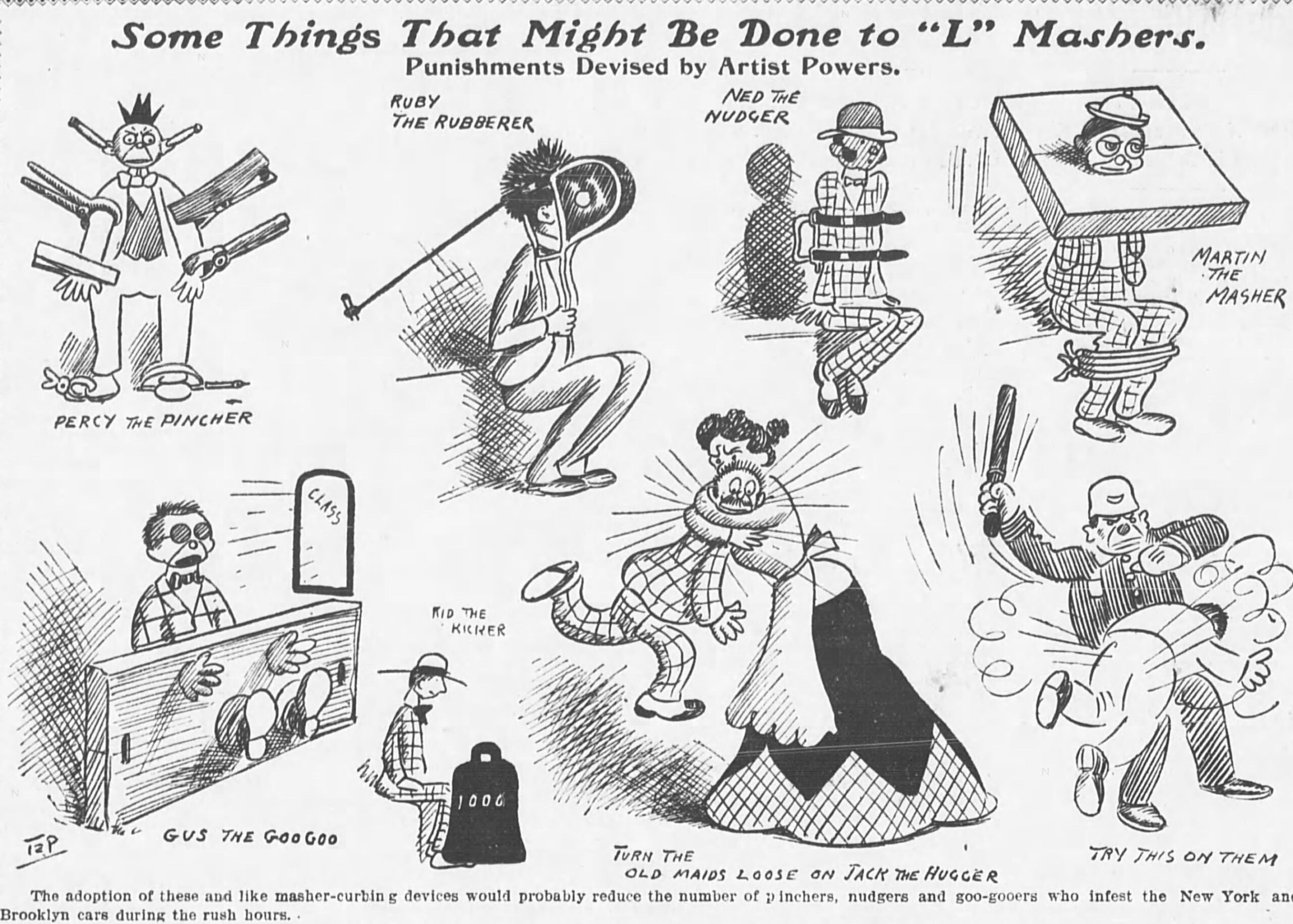
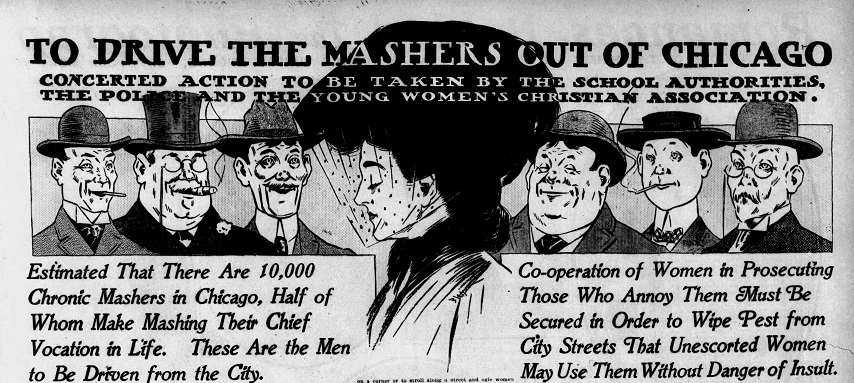
It also made sexual harassment a more prominent issue. Men known as “mashers” gathered in shopping districts to ogle and chat up women. Some were no more than well-dressed flirts, violating Victorian norms in ways that few today would find objectionable. Many contented themselves with what an outraged clubwoman termed “merciless glances”. Others followed, catcalled and in some cases fondled women as they strolled between stores, paused to look in windows or waited for trams.
This cartoon from the October 30, 1902 New York Evening World gives some idea of the public outrage toward “mashers”, in this case on streetcars.
Mores were in flux. By old-fashioned standards, everything from a friendly smile or conversation starter to stalking and groping was an insult to a woman’s virtue. Newspapers launched anti-masher crusades and prominent women demanded stricter law enforcement and stern punishment.
“No other feature of city life offers so many opportunities for making life a burden to the woman who for any reason must go about the city alone or with a woman companion,” opined the Chicago Tribune in 1907, leading a crusade against mashers. Outraged society ladies called for hard labor or public flogging as punishment. “Ogling is just as disgusting and offensive to a good woman as any other mode of attack,” declared the president of the Chicago Women’s Club.
When the Chicago police chief suggested that women avoid harassment by staying home and limiting their time in stores, he was roundly denounced by prominent women, business interests and civic leaders. A clergyman declared it “humiliating … that the authorities responsible for the maintenance of public order should feel themselves compelled to refuse the right of the road to any of the city’s citizens.” Americans increasingly assumed that women deserved the same freedom as men to move about in public — a freedom in which retailers and their suppliers had a large economic stake.
But there’s a darker side to the story that didn’t make it into the essay’s published version. The crusade against mashers, while based on a real problem, had a strong element of moral panic.
In Chicago, where the police chief was soon out of office, police won the power to arrest vagrants, including mashers, without warrants and to seek punishment by hard labor rather than fines. Crusading newspapers didn’t give mashers a chance to defend themselves. Nor did they report on the wrongly accused. In the same era that society women were calling for mashers to be publicly whipped, lynching reached its peak — often sparked by the allegation of masher-type offenses that crossed color lines.
Giving police broad powers to arrest men who made shoppers uncomfortable was an extreme solution. (Many women declined to testify in court, so prosecutions were spotty.) It did help to make streets safer for women, but so did a shift in mores that more clearly distinguished between flirtation and assault.
Comments Off on The “masher” in US towns and cities
December 5, 2022
“… when confronted, our self-proclaimed warriors against fake news and misinformation are just lying about what they’re doing”
From the free-to-cheapskates excerpt from this weekend’s dispatch from The Line:

A typical haul of weapons confiscated by Toronto Police Services in 2012. Most of these guns are in the “restricted” or “prohibited” category of Canadian firearms and would not be available for legal purchase by anyone who had not gone through a rigorous RCMP background check and passed multiple training courses. Almost certainly none of them came from a legal owner.
We hate this as much as you do, but we must discuss guns with you again. We think the Liberals have screwed up, and we aren’t sure yet they realize it. (But they’re probably clueing in.)
You know why we’re suspicious? The Liberals are extremely good at marketing. A depressing amount of the time, it’s all they’ve got. They can take the smallest morsel of accomplishment and make it the centrepiece of a coordinated nation-wide grassroots mobilization campaign and fundraising drive. They have memes and other social shareables ready to go. Cabinet ministers release cringe videos captured by staffers who probably realize, in the very moment of their filming, that they’ve wasted their God-given potential on … this.
Outcomes? The hell with those. Let’s talk about those inputs, baby! In both official languages.
But this time? When the Liberals have actually embarked on what would be the most significant overhaul of our firearms laws in a generation? Not only have they not said boo. They’re going out of their way to deny that they’ve done anything. Or, when confronted, our self-proclaimed warriors against fake news and misinformation are just lying about what they’re doing.
So either they don’t know what they’re doing (very possible), regret what they’ve done (also very possible) or it’s a confused mix of both (our working theory).
But let us explain. And forgive us, but things will get a bit technical. (We’ll keep it as simple as possible, but guns are complicated.)
Canadian firearms policy has generally tried to classify firearms by their technical specifications. Three broad categories were created by the major reforms of the 1990s. “Prohibited” firearms essentially were machine guns, automatic assault rifles of the kind used by modern militaries, and easily concealed short-barrelled handguns; prohibited licences were issued in the 1990s to a relatively small number of individuals who already owned such firearms and their immediate descendants (to cover family heirlooms), but prohibited firearms otherwise are not available to the public. “Non-restricted” firearms were the very common rifles and shotguns suited (and frequently used) for hunting or target shooting sports, and require the least onerous level of licensing (but still, you do need a licence that involves background checks and vetting). In the middle we had “restricted” firearms — mostly handguns — that require a special licence beyond the normal licence, requiring extra training and conditions.
These broad categories do not always reflect the reality of how the laws actually shaped up. The prohibited and restricted categories were often stretched by meddling politicians to apply more broadly than they ought to have, so that politicians (mainly Liberals) could claim to be “tough on guns” in particular instances. But these three categories have been generally stable for a generation, and functioned well, more or less. Perfectly? No. But our gun-control laws worked for the public at large, which is why violent gun crime by licensed individuals is rare despite a relatively high rate of firearms ownership in Canada.
You wouldn’t think it given all the political controversy, but Canadian gun control has been a fundamentally successful public-policy program, for decades. The very real problem we have with gun violence in this country is overwhelmingly committed with illegal guns smuggled in from the United States, and fall outside the scope of our gun-control system, which works well doing what it is supposed to do: licensing lawful gun owners, regulating the legal uses of guns and regulating, as well, the lawful hunting and shooting sports industry.
For all its success as public policy, though, the system didn’t work for the Liberals politically. So they decided to get cute. And that’s where their problems began.

Comments Off on “… when confronted, our self-proclaimed warriors against fake news and misinformation are just lying about what they’re doing”
November 27, 2022
Aleksandr Solzhenitsyn and One Day in the Life of Ivan Denisovich
In Quillette, Robin Ashenden discusses the life experiences of Aleksandr Slozhenitsyn that informed the novel that made him famous:
The book was published less than 10 years after the death of Joseph Stalin, the dictator who had frozen his country in fear for nearly three decades and subjected his people to widespread deportation, imprisonment, and death. His successor Nikita Khrushchev — a man who, by his own admission, came to the job “elbow deep in blood” — had set out on a redemptive mission to liberalise the country. The Gulags had been opened and a swathe of prisoners freed; Khrushchev had denounced his predecessor publicly as a tyrant and a criminal and, at the 22nd Party Congress in October 1961, a full programme of de-Stalinisation had been announced. As for the Arts, previously neutered by the Kremlin’s policy of “Socialist Realism” — in which the values of Communism had to be resoundingly affirmed — they too were changing. Now, a new openness and a new realism was called for by Khrushchev’s supporters: books must tell the truth, even the uncomfortable truth about Communist reality … up to a point. That this point advanced or retreated as Khrushchev’s power ebbed and flowed was something no writer or publisher could afford to miss.
Solzhenitsyn’s book told the story of a single day in the 10-year prison-camp sentence of a Gulag inmate (or zek) named Ivan Denisovich Shukhov. Following decades of silence about Stalin’s prison-camp system and the innocent citizens languishing within it, the book’s appearance seemed to make the ground shake and fissure beneath people’s feet. “My face was smothered in tears,” one woman wrote to the author after she read it. “I didn’t wipe them away or feel ashamed because all this, packed into a small number of pages … was mine, intimately mine, mine for every day of the fifteen years I spent in the camps.” Another compared his book to an “atomic bomb”. For such a slender volume — about 180 pages — the seismic wave it created was a freak event.
As was the story of its publication. By the time it came out, there was virtually no trauma its author — a 44-year-old married maths teacher working in the provincial city of Ryazan — had not survived. After a youth spent in Rostov during the High Terror of Stalin’s 1930s, Solzhenitsyn had gone on to serve eagerly in the Red Army at the East Prussian front, before disaster struck in 1945. Arrested for some ill-considered words about Stalin in a letter to a friend, he was handed an eight-year Gulag sentence. In 1953, he was sent into Central Asian exile, only to be diagnosed with cancer and given three weeks to live. After a miraculous recovery, he vowed to dedicate this “second life” to a higher purpose. His writing, honed in the camps, now took on the ruthless character of a holy mission. In this, he was fortified by the Russian Orthodox faith he’d rediscovered during his sentence, and which had replaced his once-beloved, now abandoned Marxism.
Solzhenitsyn had, since his youth, wanted to make his mark as a Russian writer. In the Gulag, he’d written cantos of poetry in his head, memorized with the help of matchsticks and rosary beads to hide it from the authorities. During his Uzbekistan exile, he’d follow a full day’s work with hours of secret nocturnal writing about the darker realities of Soviet life, burying his tightly rolled manuscripts in a champagne bottle in the garden. Later, reunited with the wife he’d married before the war, he warned her to expect no more than an hour of his company a day — “I must not swerve from my purpose.” No friendships — especially close ones — were allowed to develop with his fellow Ryazan teachers, lest they take up valuable writing time, discover his perilous obsession, or blow his cover. Subterfuge became second nature: “The pig that keeps its head down grubs up the tastiest root.” Yet throughout it all, he was sceptical that his work would ever be available to the general public: “Publication in my lifetime I must put out of my mind.”
After the 22nd Party Congress, however, Solzhenitsyn recognised that the circumstances were at last propitious, if all too fleeting. “I read and reread those speeches,” he wrote later, “and the walls of my secret world swayed like curtains in the theatre … had it arrived, then, the long-awaited moment of terrible joy, the moment when my head must break water?” It seemed that it had. He got out one of his eccentric-looking manuscripts — double-sided, typed without margins, and showing all the signs of its concealment — and sent it to the literary journal of his choice. That publication was the widely read, epoch-making Novy Mir (“New World”), a magazine whose progressive staff hoped to drag society away from Stalinism. They had kept up a steady backwards-forwards dance with the Khrushchev regime throughout the 1950s, invigorated by the thought that each new issue might be their last.
Comments Off on Aleksandr Solzhenitsyn and One Day in the Life of Ivan Denisovich
November 13, 2022
Corruption in US politics? Where’s the fainting couch?
Elizabeth Nickson looks at several recent books covering political corruption in US politics:
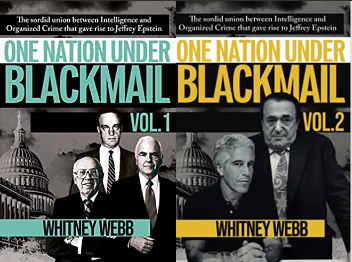
Whitney Webb’s One Nation under Blackmail published late last month, explains in exhaustive detail how the American government was taken over by well-dressed thieves. Webb writes from the left, but she is dispassionate. In 1,000 pages, she explains the history of the turning of democracy, starting post WW2 with the heinous Dulles brothers, moving through Reagan with country club thugs calling themselves The Enterprise, to Jeffrey Epstein’s seduction of Bill and Hillary Clinton. Promising riches beyond their imaginings, the seduction led the couple, by increments, to sell out the country to China and Wall Street.
Webb explains how Epstein set up the Clinton and Gates Foundations promising a new iteration in “charity”, one that made profits, and pushed forward the founders as Saviours. Clinton in her years as Sec State, flew around the world eating brownies and demanding tithes for herself, in return for every beneficence she gave courtesy of the American taxpayer. The ’08 crisis was brought to us by the same crooks, and the same methods, chipping away at regulation. The head Fannie and Freddie Mae bureaucrat, James A Johnson walked away with $100 million leaving the world in crisis. Tens of millions lost everything.
Add this to [Profiles in Corruption] Peter Schweizer’s extraordinary detailing of how Pelosi etc. made their hundreds of millions using taxpayer money, pinpointed deregulation and insider trading.
Schweizer describes how the mega-criminal dealing of the Bidens with China and the Ukraine has walked us into a potential nuclear conflict with both Russia and China. The Lords of Easy Money shows how Wall Street and all the pension funds, all the index funds, have been rolling over corporate debt and taking profits, then borrowing more, selling, borrowing more, selling, and repeat. Which means that every American enterprise that is traded and somehow functional, is laden with corporate debt it cannot possibly pay the interest on, as interest rates rise. Jay Powell made his $50 million that way.
Webb shows how Epstein coached Gates through invading and then purchasing public health both at home and through the UN. Add in the Covid mess, and another bunch of corporate and government thieves walked away with $3 Trillion, in the US alone.
Do you really think they’d allow the endless prosecutions they deserve? Do you really think they want to give back the money they stole?
Comments Off on Corruption in US politics? Where’s the fainting couch?
November 7, 2022
Inside the Gulag System – WW2 Special
World War Two
Published 4 Nov 2022Even as the Allied powers condemn the German crimes against humanity, their recent victories are in part thanks to the massive system of forced labour built by Joseph Stalin’s Soviet Union. Over one million prisoners work in the Gulag to power the Soviet war economy.
(more…)
Comments Off on Inside the Gulag System – WW2 Special
The only way to get a Grammy Award rescinded
I don’t follow the various entertainment industry awards (Oscar, Emmy, Grammy, Tony, etc.), so I wasn’t aware that only one Grammy Award has ever been taken back since they started handing them out. Given how disturbing the career lowlights of celebrities can be, what level of horrifying behaviour or criminal action does it take to have the award rescinded? Ted Gioia has the details:
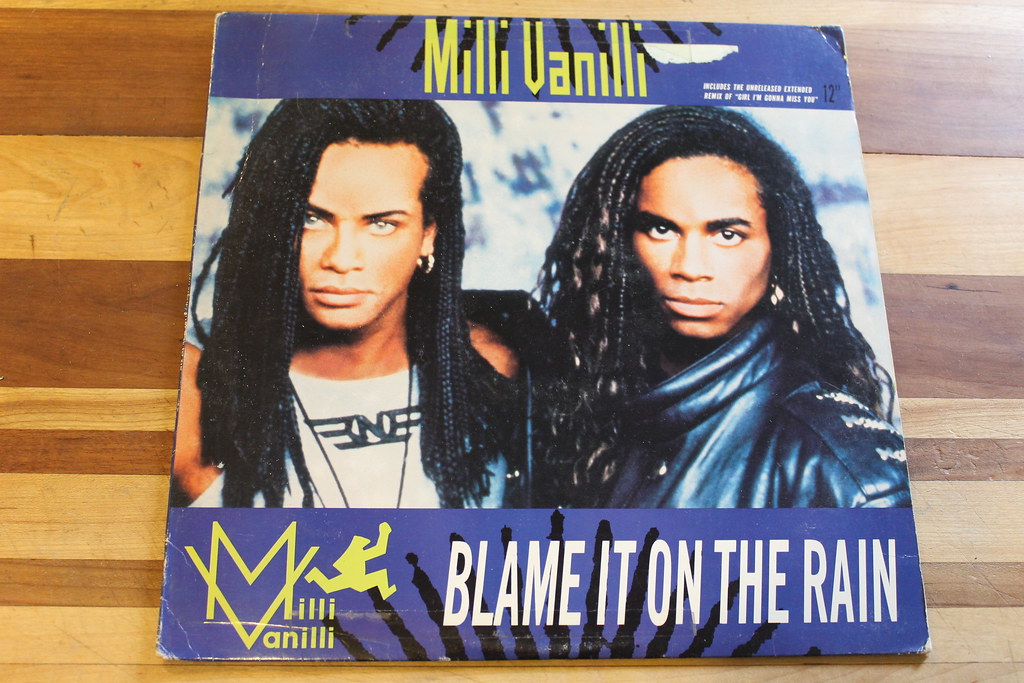
“Milli Vanilli Blame it on the Rain (12 inch single)” by acme401 is licensed under CC BY-SA 2.0 

 .
.
Milli Vanilli, a pop duo act from Munich, will never enter the Rock & Roll Hall of Fame. They were hot back in 1990, and even won the Grammy for Best New Artist. Their debut album eventually sold ten million copies. But Fab Morvan and Rob Pilatus, the two musicians who performed as Milli Vanilli, are remembered today as a scandal and blot of shame on the music business.
What terrible thing did they do to get blacklisted and cancelled? You may already know, and if not, I’ll tell you.
Milli Vanilli’s Grammy was rescinded — the first and only time that has happened in the history of the award. I note that Bill Cosby still has his eight Grammy Awards. Even after Phil Spector’s murder conviction, nobody took away his prizes and honors.
But allow me to put matters in context first.
Looking back on the music stars of that era, it would be hard to create a greater scandal than, say, Michael Jackson. He was eventually arrested and charged with child molestation. Although Jackson never got convicted, the cumulative evidence is very troubling — even so, he gets plenty of airplay nowadays and is still lauded as the King of Pop. A high-profile musical celebrating his artistry opened on Broadway earlier this year.
The songs are great. I won’t deny it.
Jackson escaped a prison sentence, but many other music stars have served time for high-profile crimes without losing their fans. When R. Kelly recently got convicted of kidnapping, sexual exploitation of a child, and racketeering, his sales soared 500% in the aftermath. I’d prefer to disagree with those glib experts who claim “all publicity is good publicity” — but it’s hard to argue with those numbers.
Just a few weeks after the Milli Vanilli scandal, Rick James was charged with kidnapping and sexual assault — and then got arrested again for similar abuses three months later while out on bail. He continued to make recordings after his release from Folsom Prison, and returned to the Billboard chart. Health problems, not James’s criminal record, finally curtailed his career. And in 2020, his estate got a big payday by selling his masters and publishing rights to the Hipgnosis Song Fund.
Other music industry legends have committed murder or manslaughter. Suge Knight won’t become eligible for parole until 2034, and Phil Spector died while incarcerated for murder in 2021. The latter was widely praised in published obituaries, and his recordings remain cherished by fans.
And now let’s turn to Milli Vanilli.
Milli Vanilli haven’t fared so well. You might even say they have been wiped out of pop music history, lingering on merely as a joke or worse. But no one got raped or murdered by their antics. They didn’t even trash their hotel rooms or get arrested buying weed.
So what did they do that led to permanent cancellation?
Their crime was posing as vocalists on their recordings, when they didn’t actually sing. When they went on the road, they lip-synced on stage. And — if I can be blunt — their greatest transgression was making the people who vote on Grammy awards look foolish.
Comments Off on The only way to get a Grammy Award rescinded


