
Scenic Routes to the Past
Published 13 Jan 2023This video explores the surprising traces of French and American colonial history along the 150 miles of Mississippi River between St. Louis and Cairo, Illinois.
(more…)
January 14, 2023
Colonial History on the Mississippi River
Comments Off on Colonial History on the Mississippi River
January 12, 2023
The Early Emperors, Part 10 – The Year of the Four Emperors
seangabb
Published 27 Dec 2022This is a video record of a lecture given by Sean Gabb, in which he discusses the three Emperors who followed in swift succession between the fall of Nero and the accession of Vespasian — Galba, Otho, and Vitellius.
The Roman Empire was the last and the greatest of the ancient empires. It is the origin from which springs the history of Western Europe and those nations that descend from Western Europe.
(more…)
Comments Off on The Early Emperors, Part 10 – The Year of the Four Emperors
December 27, 2022
Marcus Licinius Crassus, the richest man in Rome
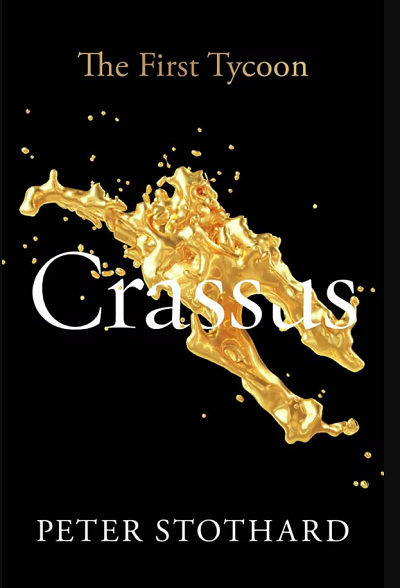
In The Critic, Bijan Omrani reviews Crassus: The First Tycoon by Peter Stothard:
If you are feeling despondent about the dismal quality of the current generation of politicians, it may be some comfort to remember that even in the golden age of Rome such complaints were legion.
The poet Horace wrote at length about how the ruling class had gone downhill. Once, there had been paragons of virtue such as Cincinnatus, who after saving Rome as dictator laid down his power without demur and returned to live on his humble farm; or the consul Regulus, who refused to make any concessions after being captured by the Carthaginians, although he knew they would torture him to death. Instead of these titans, the modern age had brought forth a base generation. Marcus Licinius Crassus, the richest man in Rome and subject of this new biography, was foremost among them.
The formidable influence wielded by Crassus in the final years of the Roman Republic — he was an ally, and rival, of Julius Caesar and Pompey the Great — came not by way of old-fashioned heroics and victories on the battlefield. His methods were recognisably modern. Peter Stothard characterises him as a “disrupter of old rules, fixer and puller of the puppet strings of power”. His tools were money and the economy of favours. He employed them with a coldness, ruthlessness and level of calculation that makes him unappetising, but deeply compelling. Stothard’s description of him as “The First Tycoon” is apt. He is the sort of character one might expect to find wearing red braces in a New York boardroom, rather than a brocaded toga in the Roman Forum.
By origin, Crassus was a member of one of Rome’s blue-blooded families. His pursuit of political influence by means of business rather than military prowess would seem at first sight unexpected, given the traditional prohibition against the senatorial aristocracy engaging in trade. Yet, the turmoil of Crassus’s formative years overturned these niceties. The last sight he had of his father, who had served as a consul, was of his head on a spike in the Forum.
He was a victim of the perennial strife that plagued Rome at the beginning of the 1st century BC, caused by imbalances in wealth and tensions between Rome and wider Italy, not to mention discord over land, military and constitutional reforms. With the death of his father and two of his brothers, Crassus had to flee Rome and hide in a cave for eight months in Spain, where his family still had allies. It is doubtless these upheavals — similar to those of Julius Caesar, who lost his father young and had to go into hiding during this chaos — led Crassus to seek an inviolable security, regardless of whether he trampled on old Roman conventions and upset others to do so.
When the aristocratic faction seized power in the late 80s BC, Crassus was able to return to Rome. There, he pursued every commercial method, no matter how disreputable, to accumulate wealth. It satisfied not only his needs for security but, as Stothard argues, it was also a way of seeking revenge for the death of his father. He bought up the properties of those families allied to the earlier populist regime which had just been displaced.
These came at a knock-down price, as the families had been outlawed, with some executed and others sent into exile. Crassus appears to have been on a committee which determined the loyalty of citizens to the new government and appears not to have scrupled to condemn those whose property he coveted. His other prime method for enlarging his portfolio was to buy up cheaply buildings that were on fire, or else in the path of a fire. He organised his slaves along military lines, using them with relentless efficiency to acquire, rebuild and sell on property for a huge profit.
Comments Off on Marcus Licinius Crassus, the richest man in Rome
December 6, 2022
QotD: Mao Zedong’s theory of “Protracted War”
The foundation for most modern thinking about this topic begins with Mao Zedong’s theorizing about what he called “protracted people’s war” in a work entitled – conveniently enough – On Protracted War (1938), though while the Chinese Communist Party would tend to subsequently represent the ideas there are a singular work of Mao’s genius, in practice he was hardly the sole thinker involved. The reason we start with Mao is that his subsequent success in China (though complicated by other factors) contributed to subsequent movements fighting “wars of national liberation” consciously modeled their efforts off of this theoretical foundation.
The situation for the Chinese Communists in 1938 was a difficult one. The Chinese Red Army has set up a base of power in the early 1930s in Jiangxi province in South-Eastern China, but in 1934 had been forced by Kuomintang Nationalist forces under Chiang Kai-shek to retreat, eventually rebasing over 5,000 miles away (they’re not able to straight-line the march) in Shaanxi in China’s mountainous north in what became known as The Long March. Consequently, no one could be under any illusions of the relative power of the Chiang’s nationalist forces and the Chinese Red Army. And then, to make things worse, in 1937, Japan had invaded China (the Second Sino-Japanese War, which was a major part of WWII), beating back the Nationalist armies which had already shown themselves to be stronger than the Communists. So now Mao has to beat two armies, both of which have shown themselves to be much stronger than he is (though in the immediate term, Mao and Chiang formed a “United Front” against Japan, though tensions remained high and both sides expected to resume hostilities the moment the Japanese threat was gone). Moreover, Mao’s side lacks not only the tools of war, but the industrial capacity to build the tools of war – and the previous century of Chinese history had shown in stark terms how difficult a situation a non-industrial force faced in squaring off against industrial firepower.
That’s the context for the theory.
What Mao observed was that a “war of quick decision” would be one that the Red Army would simply lose. Because he was weaker, there was no way to win fast, so trying to fight a “fast” war would just mean losing. Consequently, a slow war – a protracted war – was necessary. But that imposes problems – in a “war of quick decision” the route to victory was fairly clear: destroy enemy armed forces and seize territory to deny them the resources to raise new forces. Classic Clausewitzian (drink!) stuff. But of course the Red Army couldn’t do that in 1938 (they’d just lose), so they needed to plan another potential route to victory to coordinate their actions. That is, they need a strategic framework – remember that strategy is the level of military analysis where we think about what our end goals should be and what methods we can employ to actually reach those goals (so that we are not just blindly lashing out but in fact making concrete progress towards a desired end-state).
Mao understands this route as consisting of three distinct phases, which he imagines will happen in order as a progression and also consisting of three types of warfare, all of which happen in different degrees and for different purposes in each phase. We can deal with the types of warfare first:
- Positional Warfare is traditional conventional warfare, attempting to take and hold territory. This is going to be done generally by the regular forces of the Red Army.
- Mobile Warfare consists of fast-moving attacks, “hit-and-run”, performed by the regular forces of the Red Army, typically on the flanks of advancing enemy forces.
- Guerrilla Warfare consists of operations of sabotage, assassination and raids on poorly defended targets, performed by irregular forces (that is, not the Red Army), organized in the area of enemy “control”.
The first phase of this strategy is the enemy strategic offensive (or the “strategic defensive” from the perspective of Mao). Because the enemy is stronger and pursuing a conventional victory through territorial control, they will attack, advancing through territory. In this first phase, trying to match the enemy in positional warfare is foolish – again, you just lose. Instead, the Red Army trades space for time, falling back to buy time for the enemy offensive to weaken rather than meeting it at its strongest, a concept you may recall from our discussions of defense in depth. The focus in this phase is on mobile warfare, striking at the enemy’s flanks but falling back before their main advances. Positional warfare is only used in defense of the mountain bases (where terrain is favorable) and only after the difficulties of long advances (and stretched logistics) have weakened the attacker. Mobile warfare is supplemented by guerrilla operations in rear areas in this phase, but falling back is also a key opportunity to leave behind organizers for guerrillas in the occupied zones that, in theory at least, support the retreating Red Army (we’ll come back to this).
Eventually, due to friction (drink!) any attack is going to run out of steam and bog down; the mobile warfare of the first phase is meant to accelerate this, of course. That creates a second phase, “strategic stalemate” where the enemy, having taken a lot of territory, is trying to secure their control of it and build new forces for new offensives, but is also stretched thin trying to hold and control all of that newly seized territory. Guerrilla attacks in this phase take much greater importance, preventing the enemy from securing their rear areas and gradually weakening them, while at the same time sustaining support by testifying to the continued existence of the Red Army. Crucially, even as the enemy gets weaker, one of the things Mao imagines for this phase is that guerrilla operations create opportunities to steal military materiel from the enemy so that the factories of the industrialized foe serve to supply the Red Army – safely secure in its mountain bases – so that it becomes stronger. At the same time (we’ll come back to this), in this phase capable recruits are also be filtered out of the occupied areas to join the Red Army, growing its strength.
Finally in the third stage, the counter-offensive, when the process of weakening the enemy through guerrilla attacks and strengthening the Red Army through stolen supplies, new recruits and international support (Mao imagines the last element to be crucial and in the event it very much was), the Red Army can shift to positional warfare again, pushing forward to recapture lost territory in conventional campaigns.
Through all of this, Mao stresses the importance of the political struggle as well. For the guerrillas to succeed, they must “live among the people as fish in the sea”. That is, the population – and in the China of this era that meant generally the rural population – becomes the covering terrain that allows the guerrillas to operate in enemy controlled areas. In order for that to work, popular support – or at least popular acquiescence (a village that doesn’t report you because it supports you works the same way as a village that doesn’t report you because it hates Chiang or a village that doesn’t report you because it knows that it will face violence reprisals if it does; the key is that you aren’t reported) – is required. As a result both retreating Red Army forces in Phase I need to prepare lost areas politically as they retreat and then once they are gone the guerrilla forces need to engage in political action. Because Mao is working with a technological base in which regular people have relatively little access to radio or television, a lot of the agitation here is imagined to be pretty face-to-face, or based on print technology (leaflets, etc), so the guerrillas need to be in the communities in order to do the political work.
Guerrilla actions in the second phase also serve a crucial political purpose: they testify to the continued existence and effectiveness of the Red Army. After all, it is very important, during the period when the main body of Communist forces are essentially avoiding direct contact with the enemy that they not give the impression that they are defeated or have given up in order to sustain will and give everyone the hope of eventual victory. Everyone there of course also includes the main body of the army holed up in its mountain bases – they too need to know that the cause is still active and that there is a route to eventual victory.
Fundamentally, the goal here is to make the war about mobilizing people rather than about mobilizing industry, thus transforming a war focused on firepower (which you lose) into a war about will – in the Clausewitzian (drink! – folks, I hope you all brought more than one drink for this …) sense – which can be won, albeit only slowly, as the slow trickle of casualties and defeats in Phase II steadily degrades enemy will, leading to their weakness and eventual collapse in Phase III.
I should note that Mao is very open that this protracted way of war would be likely to inflict a lot of damage on the country and a lot of suffering on the people. Casualties, especially among the guerrillas, are likely to be high and the guerrillas own activities would be likely to produce repressive policies from the occupiers (not that either Chiang’s Nationalists of the Imperial Japanese Army – or Mao’s Communists – needed much inducement to engage in brutal repression). Mao acknowledges those costs but is largely unconcerned by them, as indeed he would later as the ruler of a unified China be unconcerned about his man-made famine and repression killing millions. But it is important to note that this is a strategic framework which is forced to accept, by virtue of accepting a long war, that there will be a lot of collateral damage.
Now there is a historical irony here: in the event, Mao’s Red Army ended up not doing a whole lot of this. The great majority of the fighting against Japan in China was positional warfare by Chiang’s Nationalists; Mao’s Red Army achieved very little (except preparing the ground for their eventual resumption of war against Chiang) and in the event, Japan was defeated not in China but by the United States. Japanese forces in China, even at the end of the war, were still in a relatively strong position compared to Chinese forces (Nationalist or Communist) despite the substantial degradation of the Japanese war economy under the pressure of American bombing and submarine warfare. But the war with Japan left Chiang’s Nationalists fatally weakened and demoralized, so when Mao and Chiang resumed hostilities, the former with Soviet support, Mao was able to shift almost immediately to Phase III, skipping much of the theory and still win.
Nevertheless, Mao’s apparent tremendous success gave his theory of protracted war incredible cachet, leading it to be adapted with modifications (and variations in success) to all sorts of similar wars, particularly but not exclusively by communist-aligned groups.
Bret Devereaux, “Collections: How the Weak Can Win – A Primer on Protracted War”, A Collection of Unmitigated Pedantry, 2022-03-03.
Comments Off on QotD: Mao Zedong’s theory of “Protracted War”
November 30, 2022
QotD: The rise of liberalism
In sum, as one of the Levellers in the English Civil War of the 1640s, Richard Rumbold, said from the scaffold in 1685, “there was no man born marked of God above another, for none comes into the world with a saddle on his back, neither any booted and spurred to ride him.” It was a shocking thought in a hierarchical society. In 1685 the crowd gathered to see Rumbold hanged surely laughed at such a sentiment. By 1885 it was a solemn cliché.
Dierdre McCloskey, “How Growth Happens: Liberalism, Innovism, and the Great Enrichment (Preliminary version)” [PDF], 2018-11-29.
Comments Off on QotD: The rise of liberalism
November 29, 2022
Near Peer: Russia
Army University Press
Published 25 Nov 2022AUP’s Near Peer film series continues with a timely discussion of Russia and its military. Subject matter experts discuss Russian history, current affairs, and military doctrine. Putin’s declarations, advances in military technology, and Russia’s remembrance of the Great Patriotic War are also addressed. “Near Peer: Russia” is the second film in a four-part series exploring America’s global competitors.
Comments Off on Near Peer: Russia
November 28, 2022
Near Peer: China (Understanding the Chinese Military)
Army University Press
Published 29 Jul 2022This film examines the Chinese military. Subject matter experts discuss Chinese history, current affairs, and military doctrine. Topics range from Mao, to the PLA, to current advances in military technologies. “Near Peer: China” is the first film in a four-part series exploring America’s global competitors.
(more…)
Comments Off on Near Peer: China (Understanding the Chinese Military)
November 19, 2022
QotD: Canada from the American Revolution to the Riel Rebellion
Unfortunately, as the Revolutionary and Napoleonic wars unfolded, the British could not resist the temptation to employ their mastery of the high seas to impose blockades and harass the shipping of neutral powers. The young United States did not have the military force to deter such treatment, and in 1812 those countries went to war. Canada was the blameless focal point of most of the fighting. Canada with the continuing solidarity of the French-Canadians, was able to mount a very solid defense. The many thousands of recently arrived Americans did not support the United States and the generous policy of enticing settlement from the United States was completely vindicated. There were pressures to expel them, monitor them, disqualify them from holding local offices and positions. But it was soon agreed that they could become citizens after eight years of residency. This affected about 40 percent of English-Canadians and this must count as another very successful chapter in Canada’s early record of respect for civil and human rights.
As reasonably successful wars do, considerable national sentiment was created and encouraged by the successful joint struggle to avoid American occupation. Out of these experiences came increased ambitions for democratic self-rule in domestic matters as the British and Americans enjoyed, instead of autocratic rule by British governors. Canada’s position was complicated by the fact that it could not agitate for home rule too energetically or the British would lose patience and sell Canada to the United States for cash or other territory or for a comprehensive alliance. Outright rebellion was not an option for Canada as it had been for the Americans, as the United States would seize Canada if it were not under British protection.
The Canadian solution for agitating but not completely exasperating Great Britain was the Gilbert and Sullivan rebellions of 1837 led by William Lyon Mackenzie in Ontario and Louis-Joseph Papineau in Québec. The Ontario uprising was just a rowdy group of malcontents who became disorderly and were easily chased off, and the French-Canadian group were essentially pamphleteers, though there were some exchanges of fire and small rebel and military units marched to and fro in poor winter weather. A total of about 300 people died, there were 14 executions and 92 people were transported as prisoners to Australia. The rebel leaders fled but were eventually pardoned and returned.
There was enough commotion to get Britain’s attention, but the loyalty of most of the population gratified the British, and they determined to put things right. London sent the well-known reformer Lord Durham to Canada in 1840 to make recommendations. After a year of research by a couple of biased examiners, Durham came to the insane conclusion that the source of Canadian discontent was that the French-Canadians wanted to be relieved of the intolerable burden of being French. Durham proposed uniting Upper and Lower Canada and assumed that the slight resulting English majority would assimilate the French in about 10 years. Of course, this was precisely what the French feared, and the English-Canadians had no desire for it either. But after several years of rearguard action by British governors, the movement for autonomous government succeeded, after the 25-year-old Queen Victoria sent Lord Elgin to Canada as governor to give the Canadians what they wanted. Elgin and Robert Baldwin and Louis-Hippolyte LaFontaine achieved this and secularized a great deal of territory owned by the principal churches so that they could be more easily settled and made the principal universities officially nondenominational. These were again great and non-violent steps in the civil rights of Canadians who now numbered over two million people.
All of North America was now walking on eggshells over the immense problem of American slavery. Slavery was abolished throughout the British Empire in 1834. In practice, there had not ever been more than a couple of hundred slaves in Canada, apart from the natives enslaving each other. Slaves had been imported to the southern states because of their efficiency at harvesting tropical crops such as cotton, so Canada was effectively spared that horrible institution, because of its climate more than its virtue. Canada consistently had a fine record in accepting about 40,000 fugitive slaves that reached the Canadian border in the thirty years before the U.S. Civil War. The leading American anti-slavery advocates Harriet Tubman and John Brown, and Josiah Henson, the model for the chief character in Harriet Beecher Stowe’s novel Uncle Tom’s Cabin, which sold an unheard-of two million copies in the 1850s, all lived in Canada for years. There were at least 11 black Canadian doctors who were fugitive slaves or sons of fugitive slaves who served in the Union Army in the Civil War, and the white Canadian anti-slavery activist, Dr. Alexander Ross, at the request of President Lincoln, assisted in breaking up a Confederate spy ring in Montréal. Escaped slave Joseph Taper, of St. Catharine’s, wrote this letter back to his former and still putative owner in 1839: “I now take this opportunity to inform you that I’m in a land of liberty, in good health … In the Queen’s dominions, man is as God intended he should be; all are born free and equal, not like the southern laws, which put man on a level with brutes. All the coloured population is supplied with schools. My boy Edward, who will be six years next January, is now reading and I intend keeping him at school until he becomes a good scholar. My wife and self are sitting by a good comfortable fire, happy, knowing that there are none to molest us or make us afraid. God save Queen Victoria.”
As many as 40,000 Canadian volunteers served in the Union Army in the Civil War and Canada was thanked on several occasions by President Lincoln for infiltrating Confederate exile organizations. This was an issue in which all Canadians were united and is a legitimate matter of national pride.
The next major civil rights challenge that Canada had to face was that of the Métis — the mixed white and indigenous people on the Great Plains of Canada. The territory of the natives had been steadily reduced by white settlement and the nutritious content of their diet had been reduced by the heavy depletion of the herds of plains Buffalo. There were also many other grievances and undoubtedly a number of violations of the Indian treaties and of the Indian Act and a flamboyant Metis lawyer, Louis Riel, led an uprising on the western plains in 1878. This was eventually suppressed with little violence, as Prime Minister John A. Macdonald dispatched an adequate military force under Field Marshal Garnet Wolseley, Gilbert and Sullivan’s “very model of the modern major general”. Riel fled to the U.S. and the Canadian government made a number of useful concessions to the aggrieved natives. But in 1885, Riel returned and led a rebellion in northwest Saskatchewan. At the same time, the Canadian Pacific Railway ran out of money and was about to flounder into bankruptcy. Macdonald brilliantly sent Canadian forces West on the railway and they surprised and defeated the insurgents and captured Riel. By emphasizing the railway’s role in saving the country (as Riel was making both annexationist and secessionist noises), Macdonald won passage of a bill to finance completion of the railway. Macdonald also gave the natives the right to vote and rewarded his allies among the native leaders. However, he created a lasting grievance by allowing the execution of Riel. Although 15 people died in the uprising, he should have commuted the sentence for insanity — Louis Riel was delusional.
Conrad Black, “Canada’s excellent history of civil and human rights”, New English Review, 2022-08-18.
Comments Off on QotD: Canada from the American Revolution to the Riel Rebellion
November 15, 2022
How Was The Soviet Union Founded?
The Great War
Published 11 Nov 2022Vladimir Lenin had led the Bolshevik movement through the October Revolution and the Russian Civil War but by 1922 his health was failing and infighting among Bolshevik leadership caused friction. In the end Josef Stalin was able to prevail over Leon Trotsky and lead the newly founded Soviet Union until his death in 1953.
(more…)
Comments Off on How Was The Soviet Union Founded?
November 14, 2022
QotD: The first modern revolution
One of the dark little secrets of my past is my teenage membership of the English Civil War Society. I spent weekends dressed in 17th-century costumes and oversized helmets, lined up in fields or on medieval streets, re-enacting battles from the 1640s. I still have my old breeches in the loft, and the pewter tankard I would drink beer from afterwards with a load of large, bearded men who, just for a day or two, had allowed themselves to be transported back in time.
I was a pikeman in John Bright’s Regiment of Foote, a genuine regiment in the parliamentary army. We were a Leveller regiment, which is to say that this part of the army was politically radical. For the Levellers, the end of the monarchy was to be just the beginning. They aimed to “sett all things straight, and rayse a parity and community in the kingdom”. Among their varied demands were universal suffrage, religious freedom and something approaching modern parliamentary democracy.
The Levellers were far from alone in their ambitions to remake the former Kingdom. Ranters, Seekers, Diggers, Fifth Monarchists, Quakers, Muggletonians: suddenly the country was blooming with radical sects offering idealistic visions of utopian Christian brotherhood. In his classic study of the English Revolution, The World Turned Upside Down, historian Christopher Hill quotes Lawrence Clarkson, leader of the Ranters, who offered a radical interpretation of the Christian Gospel. There was no afterlife, said Clarkson; only the present mattered, and in the present all people should be equal, as they were in the eyes of God:
“Swearing i’th light, gloriously”, and “wanton kisses”, may help to liberate us from the repressive ethic which our masters are trying to impose on us — a regime in which property is more important than life, marriage than love, faith in a wicked God than the charity which the Christ in us teaches.
Modernise Clarkson’s language and he could have been speaking in the Sixties rather than the 1640s. Needless to say, his vision of free love and free religion, like the Leveller vision of universal equality, was neither shared nor enacted by those at the apex of the social pyramid. But though Cromwell’s Protectorate, and later the restored monarchy, attempted to maintain the social order, forces had been unleashed which would change England and the wider world entirely. Some celebrated this fact, others feared it, but in their hearts everyone could sense the truth that Gerard Winstanley, leader of the Diggers, was prepared to openly declare: “The old world … is running up like parchment in the fire”.
Paul Kingsnorth, “The West needs to grow up”, UnHerd, 2022-07-29.
Comments Off on QotD: The first modern revolution
September 30, 2022
History Re-Summarized: The Roman Empire
Overly Sarcastic Productions
Published 16 Sept 2022
The plot twist of Rome is that it was always a mess, now sit back and enjoy the marble-covered mayhem.This video is a Remastered, Definitive Edition of three previous videos from this channel — “History Summarized: The Roman Empire”, “History Hijinks: Rome’s Crisis of the Third Century”, and “History Summarized: The Fall of Rome”. This video combines them all into one narrative, fully upgrading all of the visuals and audio, with a substantially re-written script in parts 1 and 3.
(more…)
Comments Off on History Re-Summarized: The Roman Empire
September 14, 2022
QotD: The Wars of Religion and the (eventual) Peace of Westphalia
There’s simply no possible compromise with an opponent who thinks you’re in league with the Devil, if not the literal Antichrist. Nothing Charles I could have done would’ve satisfied the Puritans sufficient for him to remain their king, because even if he did everything they demanded — divorced his Catholic wife, basically turned the Church of England into the Presbyterian Kirk, gave up all but his personal feudal revenues — the very act of doing these things would’ve made his “kingship” meaningless. No English king can turn over one of the fundamental duties of state to Scottish churchwardens and still remain King of England.
This was the basic problem confronting all the combatants in the various Wars of Religion, from the Peasants’ War to the Thirty Years’ War. No matter what the guy with the crown does, he’s illegitimate. It took an entirely new theory of state power, developed over more than 100 years, to finally end the Wars of Religion. In case your Early Modern history is a little rusty, that was the Peace of Westphalia (1648), and it established the modern(-ish) sovereign nation-state. The king is the king because he’s the king; matters of religious conscience are not a sufficient casus belli between states, or for rebellion within states. Cuius regio, eius religio, as the Peace of Augsburg put it — the prince’s religion is the official state religion — and if you don’t like it, move. But since the Peace of Westphalia also made heads of state responsible for the actions of their nationals abroad, the prince had a vested interest in keeping private consciences private.
I wrote “a new theory of state power”, and it’s true, the philosophy behind the Peace of Westphalia was new, but that’s not what ended the violence. What did, quite simply, was exhaustion. The Thirty Years’ War was as devastating to “Germany” as World War I, and all combatants in all nations took tremendous losses. Sweden’s king died in combat, France got huge swathes of its territory devastated (after entering the war on the Protestant side), Spain’s power was permanently broken, and the Holy Roman Empire all but ceased to exist. In short, it was one of the most devastating conflicts in human history. They didn’t stop fighting because they finally wised up; they stopped fighting because they were physically incapable of continuing.
The problem, though, is that the idea of cuius regio, eius religio was never repudiated. European powers didn’t fight each other over different strands of Christianity anymore, but they replaced it with an even more virulent religion, nationalism.
Severian, <--–>”Arguing with God”, Rotten Chestnuts, 2020-01-20.
Comments Off on QotD: The Wars of Religion and the (eventual) Peace of Westphalia
September 7, 2022
“For those brave right-wing Americans… if you want to fight against the country, you need an F-15. You need something little more than a gun.”
Kurt Schlichter begs to differ with Joe Biden’s “Triumph of the Shrill” warmongering from last week:

Hmmmm, but do they? Really?
Grandpa Badfinger’s premise is that all you tens of millions of semi-fascists out there with your AR-15s would have no shot stopping the woke military, which would eagerly crush you with their potent force package of F-15s and esoteric pronouns. It is a flawed premise on more grounds than one column can cover (hence my book), but we need to focus and that means we will need to overlook some important questions. These important questions include:
– Why do you imagine your sorry band of socialist creeps who treat the Constitution like Jerry Nadler treats his boxers constitutes “the country”?
– The useless senior officer corps aside, why do you believe the normals who make up the vast majority of America’s combat forces will gleefully butcher their friends and family for the amusement of a bunch of Chardonnay-swilling blue checks?
– Have you ever heard of Afghanistan?
Let’s focus on his key sound bite. Gun vs. Jets … who ya got?
I’m putting my money on the guns. You dumb progressives can go for the jets and the points.
Now, let’s start raising the kind of facts that tend to undermine the soundbite that launched a thousand MSNBCgasms.
First up, what does a gun do? What does a fighter-bomber do?
Well, a gun gives an individual soldier – and that’s what civilian freedom fighters would be – the ability to dominate the space on the ground around them out to a couple hundred meters of open territory (let’s not argue about maximum effective ranges, or the fact that civilians have a lot of weapons that outrange the 5.56mm weapons systems currently used by the military – a weapon system whose bullets Mr. 10% Off The Top thinks fly “five times as rapidly as a bullet shot out of any other gun“). In other words, a gun controls space on the ground. Coincidentally, the ground happens to be where people live.
A jet fighter dominates air space and keeps other planes away. Few people actually live in the air. Now, a jet fighter bomber like the F-15 can drop bombs on the enemy – which is, according to Crusty, us freedom-loving American citizens. Of course, this kind of tactical employment works to support guys on the ground dominating terrain with guns. Planes don’t hold territory; they help soldiers hold territory. So, it’s an apples and oranges thing at the threshold, which is appropriate since the whole discussion Slow Joe began is pretty much Fruit Loops.
Biden assumes he’s got soldiers to support with his jets. How many? Who knows? Some. But lots of colonels and generals, the kind who add (he/him) or (zip/zap) to their official signature blocks – would salute and carry out order to kill other Americans. Hey, maybe they can win this war and finally get one in the “Win” column after three decades! They’re due!
But the problem for them is quantity. There are tens of millions of American patriots with guns, AR-15s being only one color in the rainbow of freedom-defending firearms. Real diversity is 5.56mm alongside 7.62mm and .30-06 and 12 gauge and .45 and others, all firing together for a brighter tomorrow. So, there better be a lot of airplanes to balance out millions of patriots.
Um, how many fighter-bombers do we have anyway?
Well, let’s give America’s Greatest Matlock Superfan the benefit of the doubt and include all types of fighter-bombers – F-25s, F-16s, F-18s, F-35s and even A-10s. Let’s see – there are about 1750 planes for the Air Force, about 1100 planes for the Navy, and maybe 300 for the Marines, so call it 3150 aircraft. Okay, where are they? You have to have them here in America if you want to kill Americans for refusing to obey, so how many are in the continental United States and available for Hunter’s Dad’s open season on dissidents?
Call it two-thirds. We have lots of planes forward deployed – Europe, Asia, on ships. He’s got about 2000 aircraft to use to kill other Americans – that’s what he was saying, so we’ll take him at his slurred, semi-coherent word. Add maybe another 400 combat drones in the USA.
Now, there’s a thing called the OR Rate – operational readiness. That’s the percentage of planes that are ready to go at a given time. Planes need maintenance. They break, and even routine use requires massive upkeep efforts. And parts can be hard to get, especially when you are spending all your money on woke nonsense. What’s the real OR Rate? I don’t know – it’s probably classified and, as we know, today exposing classified material is bad and we can’t wait for it to go back to being A-OK when Hillary does it again, or when someone leaks something classified to the NYT or WaPo and they publish it. Let’s assume 75% – that loud laughing you just heard is military aviation professionals scoffing at a consistent 75% OR Rate.
This means President Gumby has 1500 planes and 300 drones to suppress those millions of dissenters. Hey, that’s 36 aircraft a state!
Comments Off on “For those brave right-wing Americans… if you want to fight against the country, you need an F-15. You need something little more than a gun.”
September 2, 2022
QotD: Historical parallels between the British and American empires
England was colonised by the Norman Empire (a tribe that spread across France, Britain, Italy, and the Middle East can be referred to as an empire I believe), in 1066. After some initial fierce resistance, they settled well, integrated with the local economy, and started developing a more advanced economic society.
North America was colonised by the British Empire (and Spanish and French of course), in the sixteenth century. After some initial fierce resistance, they settled well, integrated with the local economy, and started developing a more advanced economic society.
Norman England spent the next few centuries gradually taking out its neighbours. Wales, Ireland, and eventually Scotland (though the fact that the Scottish King James I & VI actually inherited England confuses this concept a bit). The process was fairly violent.
The North American “English” colonies spent the next few centuries taking out their neighbours. Indian tribes, Dutch, Spanish and French colonists, etc. The process was fairly violent.
England fought a number of wars over peripheral areas, particularly the Hundred Years war over claims to lands in France.
The North American colonies enthusiastically joined (if not blatantly incited) the early world wars, with the desire of taking over nearby French and Spanish colonies
The English fought a civil war in the 1640s to 50s over the issue of how to share power between the executive government, the oligarchs, and the commons. It appears that the oligarchs incited the commons (which was not very common in those days anyway). It was extremely bloody, and those on the periphery — particularly the Scots and Irish — came out badly (and with a long term bad taste for their over-mighty neighbour).
The Colonies fought their first civil war over the issue of how to share power between the executive, the oligarchs and the commons in the 1770s to 80s. It is clear that the oligarchs incited the commons (who in the US were still not very common — every male except those Yellow, Red or Black. An improvement? Certainly not considering the theoretical philosophical base of the so-called Revolution!). It was not really so bloody, but those on the periphery — particularly the Indians and slaves (both of which were pro-British), and the Loyalists and Canadians — came out badly. (60-100,000 “citizens” were expelled or forced to flee for being “loyalists”, let alone Indians and ex-slaves). Naturally the Canadians and their new refugee citizens developed a long term bad taste for their over-mighty neighbour — who attempted to attack them at the drop of a hat thereafter.
The British spent the next century and a half accumulating bits of empire — the Dominions, the Crown Colonies, and the Protectorates — in a haphazard fashion. Usually, but not always, troops followed traders and settlers.
The United States spent the next century and a half accumulating bits of empire — conquests from the Indians, purchases from France and Russia, conquests from Mexico and Spain, annexations of places like Hawaii, etc. — in a haphazard fashion. Usually, but not always, troops followed traders and settlers.
Nigel Davies, “The Empires of Britain and the United States – Toying with Historical Analogy”, rethinking history, 2009-01-10.
Comments Off on QotD: Historical parallels between the British and American empires
July 31, 2022
QotD: Intervention and non-intervention in the Spanish Civil War
The most baffling thing in the Spanish war was the behaviour of the great powers. The war was actually won for Franco by the Germans and Italians, whose motives were obvious enough. The motives of France and Britain are less easy to understand. In 1936 it was clear to everyone that if Britain would only help the Spanish Government, even to the extent of a few million pounds’ worth of arms, Franco would collapse and German strategy would be severely dislocated. By that time one did not need to be a clairvoyant to foresee that war between Britain and Germany was coming; one could even foretell within a year or two when it would come. Yet in the most mean, cowardly, hypocritical way the British ruling class did all they could to hand Spain over to Franco and the Nazis. Why? Because they were pro-Fascist, was the obvious answer. Undoubtedly they were, and yet when it came to the final showdown they chose to stand up to Germany. It is still very uncertain what plan they acted on in backing Franco, and they may have had no clear plan at all. Whether the British ruling class are wicked or merely stupid is one of the most difficult questions of our time, and at certain moments a very important question. As to the Russians, their motives in the Spanish war are completely inscrutable. Did they, as the pinks believed, intervene in Spain in order to defend Democracy and thwart the Nazis? Then why did they intervene on such a niggardly scale and finally leave Spain in the lurch? Or did they, as the Catholics maintained, intervene in order to foster revolution in Spain? Then why did they do all in their power to crush the Spanish revolutionary movements, defend private property and hand power to the middle class as against the working class? Or did they, as the Trotskyists suggested, intervene simply in order to prevent a Spanish revolution? Then why not have backed Franco? Indeed, their actions are most easily explained if one assumes that they were acting on several contradictory motives. I believe that in the future we shall come to feel that Stalin’s foreign policy, instead of being so diabolically clever as it is claimed to be, has been merely opportunistic and stupid. But at any rate, the Spanish civil war demonstrated that the Nazis knew what they were doing and their opponents did not. The war was fought at a low technical level and its major strategy was very simple. That side which had arms would win. The Nazis and the Italians gave arms to the Spanish Fascist friends, and the western democracies and the Russians didn’t give arms to those who should have been their friends. So the Spanish Republic perished, having “gained what no republic missed”.
Whether it was right, as all left-wingers in other countries undoubtedly did, to encourage the Spaniards to go on fighting when they could not win is a question hard to answer. I myself think it was right, because I believe that it is better even from the point of view of survival to fight and be conquered than to surrender without fighting. The effects on the grand strategy of the struggle against Fascism cannot be assessed yet. The ragged, weaponless armies of the Republic held out for two and a half years, which was undoubtedly longer than their enemies expected. But whether that dislocated the Fascist timetable, or whether, on the other hand, it merely postponed the major war and gave the Nazis extra time to get their war machine into trim, is still uncertain.
George Orwell, “Looking back on the Spanish War”, New Road, 1943 (republished in England, Your England and Other Essays, 1953).
Comments Off on QotD: Intervention and non-intervention in the Spanish Civil War


