
Forgotten Weapons
Published 5 Sept 2025The “American 180 Security Briefcase” is the best execution of the operational briefcase concept that I have yet seen. The idea is simple; hide a submachine gun inside an ordinary looking briefcase so that it can be carried in the open by VIP security without arousing attention. Sometimes this is done strictly for stowage (see the Uzi coming out of a Secret Service briefcase during the attempted Reagan assassination) and sometimes it is designed to fire from within the case (see the H&K MP5 operational case). This one is meant for firing.
Unlike virtually all other such cases, this one includes a sight, a helium-neon laser. That allows the gun to be actually aimed — what an idea! The firing mechanism is also well thought out, with a manual safety switch that powers the laser and firing solenoid, then a constant-pressure switch for the laser and a pressure pad for the gun. I don’t know who made this, but it was a commercially available product … and a very cool one at that!
(more…)
January 28, 2026
The Best Operational Briefcase: American 180 & Laser Sight
QotD: 21st century generation gap
I am Gen X, which means that a whole generation separates me from Gen Z, the youth generation of today. Gen Z grew up in a world that was networked to the hilt, where everything was already on the internet, and where the “meatspace” had already begun to lose its central role in human socialization. This is a generation that has grown up facing electronic screens, to the point where eye contact is in retreat when Gen Zers actually do encounter real humans in person. Their understanding of media, and more importantly, media consumption, is very different than mine. I like to make the joke (and it’s not really a joke as it has happened to me several times) that if you ask someone from Gen Z to explain something to you in a simple fashion, they won’t respond with a one or two line description, but will instead send you a link to a 4 hour podcast that kinda-sorta touches on the subject. Gen Z is the first truly online generation.
Niccolo Soldo, “Saturday Commentary and Review #197”, Fisted by Foucault, 2025-10-25.
January 27, 2026
Minneapolis – protest, insurrection, or massive distraction?
On the social media site formerly known as Twitter, Eric Schwalm talks about the organized nature of the Minneapolis protests and points out how much work it takes to set up and run:

“No Kings, No ICE” protest on Hennepin Avenue in Minneapolis, Minnesota on 23 January, 2026.
Photo by Myotus via Wikimedia Commons.
As a former Special Forces Warrant Officer with multiple rotations running counterinsurgency ops — both hunting insurgents and trying to separate them from sympathetic populations — I’ve seen organized resistance up close. From Anbar to Helmand, the pattern is familiar: spotters, cutouts, dead drops (or modern equivalents), disciplined comms, role specialization, and a willingness to absorb casualties while bleeding the stronger force slowly.
What’s unfolding in Minneapolis right now isn’t “protest”. It’s low-level insurgency infrastructure, built by people who’ve clearly studied the playbook.
Signal groups at 1,000-member cap per zone. Dedicated roles: mobile chasers, plate checkers logging vehicle data into shared databases, 24/7 dispatch nodes vectoring assets, SALUTE-style reporting (Size, Activity, Location, Unit, Time, Equipment) on suspected federal vehicles. Daily chat rotations and timed deletions to frustrate forensic recovery. Vetting processes for new joiners. Mutual aid from sympathetic locals (teachers providing cover, possible PD tip-offs on license plate lookups). Home-base coordination points. Rapid escalation from observation to physical obstruction — or worse.
This isn’t spontaneous outrage. This is C2 (command and control) with redundancy, OPSEC hygiene, and task organization that would make a SF team sergeant nod in recognition. Replace “ICE agents” with “occupying coalition forces” and the structure maps almost 1:1 to early-stage urban cells we hunted in the mid-2000s.
The most sobering part? It’s domestic. Funded, trained (somewhere), and directed by people who live in the same country they’re trying to paralyze law enforcement in. When your own citizens build and operate this level of parallel intelligence and rapid-response network against federal officers — complete with doxxing, vehicle pursuits, and harassment that’s already turned lethal — you’re no longer dealing with civil disobedience. You’re facing a distributed resistance that’s learned the lessons of successful insurgencies: stay below the kinetic threshold most of the time, force over-reaction when possible, maintain popular support through narrative, and never present a single center of gravity.
I spent years training partner forces to dismantle exactly this kind of apparatus. Now pieces of it are standing up in American cities, enabled by elements of local government and civil society. That should keep every thinking American awake at night.
Not because I want escalation. But because history shows these things don’t de-escalate on their own once the infrastructure exists and the cadre believe they’re winning the information war.
We either recognize what we’re actually looking at — or we pretend it’s still just “activism” until the structures harden and spread.
Your call, America. But from where I sit, this isn’t January 2026 politics anymore. It’s phase one of something we’ve spent decades trying to keep off our own soil.
On his Substack, Glenn Reynolds points out that the “protests” are serving to distract attention away from state and local officials’ role in enabling massive fraud rings in Minnesota which reportedly scored billions of federal dollars for phantom organizations:
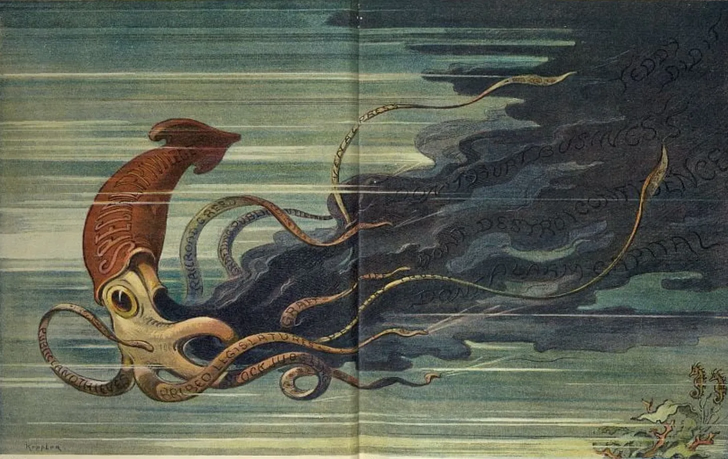
This image depicts a similar action by the Trusts at the turn of the last century. (Library of Congress).
The squid was frightened, so we got the ink: Increasingly violent “protests”-cum-riots explicitly aimed at blocking ICE operations with the stated goal of forcing federal authorities out of Minnesota entirely, while generating maximum media attention.
These are not spontaneous uprisings of the aggrieved, but organized actions featuring out-of-state actors and organizations, detailed training programs for demonstrators, and large amounts of intentionally murky funding from organizations like Indivisible, George Soros’ Open Society Foundations and others.
They’re coordinating their anti-ICE operations — identifying, chasing and blocking agents to keep them from arresting illegal-immigrant criminals — through highly organized chat groups on Signal, a secure communications platform, Fox News reported.
And Minnesota government officials are proudly touting their involvement in this coordination.
Sen. Bernie Sanders made much of Lt. Gov. Peggy Flanagan’s role in a fundraising email this weekend, praising her for “playing a key role in mobilizing grassroots opposition to Trumpism”.
That’s making these often violent, deliberately obstructive demonstrations look less like a civil rights sit-in and more like a government-backed insurrection.
Tragically, this aggressive and confrontational strategy has produced martyrs who can now be exploited for political purposes.
“Two things can be true at the same time,” Fox News’ Asra Nomani posted Monday.
The death of Alex Pretti, the armed demonstrator who got into a fatal tussle with ICE agents Saturday, “is a real and devastating tragedy, and there are several investigations appropriately occurring into the circumstances behind his killing”.
But also, “A far-left organizing network put Pretti in harm’s way and then turned him into a martyr … to sow the perception of chaos in America”.
Whatever investigators determine about how Pretti’s death unfolded, the fact remains that a cynical and corrupt political machine has fostered for its own purposes a situation that’s dangerous for its own supporters, and for the political future of our nation.
Amelia was not created by the “extreme right”
On the social media site formerly known as Twitter, A View From Yorkshire points out that the media coverage of the Amelia phenomenon often leaves the audience with the impression that Amelia was created by some far right extremists, which clearly isn’t true:

Let’s nuke the myth properly.
Amelia was not “created by the far-right”.
She was created by the British state, funded by taxpayers, in a government-approved anti-extremism game for teenagers.Her crime?
Questioning mass migration.
Talking about British values.
Suggesting borders, culture and continuity might matter.In other words: centre-right, mainstream opinions held by millions of normal people.
The media response?
SCREAMING, CRYING, THROWING UP:
“FAR-RIGHT!”
“RACISM!”
“DISINFORMATION!”Even the game’s own creators admit the game does not say questioning mass migration is wrong — yet journalists still foam at the mouth like Pavlov’s interns because the spell didn’t work.
Here’s the truth they hate:
Amelia didn’t get radicalised.
She got recognised.People saw a perfect accidental parody of how the establishment treats ordinary dissent:
If you question orthodoxy, you’re not wrong — you’re dangerous.
If you wave a Union Jack, you’re not patriotic — you’re extreme.
If you ask questions, you need monitoring.So people did what the internet always does when power looks stupid:
They laughed.
They memed.
They stripped the moral panic naked.Now we’re told there’s a “highly coordinated hate network” behind it all.
Sure. Or maybe — stay with me —
people are done being lectured by institutions that despise them.A cartoon goth girl didn’t expose extremism.
She exposed how fragile the narrative really is.If a meme breaks your ideology,
your ideology was already on life support.
The Amelia memes do seem to be getting under the skin of certain members of the government:


Amelia is a girl of many talents:
Epochalypse
Published 24 Jan 2026An absolutely beautiful song covered by Amelia ❤️
A UK anti-extremism educational game called Pathways, faced significant public and media backlash.
The game, developed by SOUK in coordination with the Hull City Council and East Riding of Yorkshire Council, was designed to educate students about the dangers of online radicalization.
How the Game Backfired
Antagonist’s Popularity: The game’s primary antagonist, a teenage girl with purple hair named Amelia who held nationalist views, was intended as a cautionary figure. However, she was ironically embraced by some online communities and became a viral meme, with users finding her “goth baddie” design and character more interesting and relatable than the non-binary protagonist, Charlie.
Criticism of Content: The game was widely criticized by media outlets, including The Telegraph and The Spectator, as “clumsy” and “overtly manipulative”. Critics argued that the game effectively suppressed free speech by suggesting characters who questioned immigration policies should be reported under the UK government’s “Prevent” counter-terrorism strategy.
Portrayal of “Research”: The game’s narrative structure suggested that “researching” information online could be harmful, as it might lead to “intaking a lot of harmful, ideological messages”, which also drew criticism.
Ultimately, the attempt to create an effective anti-extremism tool had the opposite effect in many online circles, with its intended villain becoming an ironic symbol for anti-illegal immigration sentiment.
#amelia #pathways #memes #patriotism
Kimberly Steele disgrees with the characterization of Amelia as a “tulpa” (which I think I first saw advanced by John Carter at Postcards From Barsoom) and argues that she’s actually an “egregore” instead:

Amelia crossing paths with Harry Potter and the gang, very appropriate for this essay
In rides fantasy Amelia to the rescue, a digital Joan of Arc to galvanize the lumpen male proletariat into action against leftist groupthink oppression. Her flame burns hotter than the tradwife because she is not a deferential, docile, opinionless mirage waiting for her man to do all the the heavy lifting. Instead of modeling crusty tropes from the 1950s in a housedress, she mouths off to Mohammed in a miniskirt. She champions sensible norms that middle aged people like me took for granted back in the day. She is an advocate of schoolgirls being able to walk down the streets of Liverpool without being acid attacked or drug into fenced areas to be assaulted. She suggests Britain is for the British and that it should not be handed over to the same hordes that have been trying to overrun it since before the Middle Ages. She suggests that men on all sides rise up and outgrow Puer Aeternis — to the invaders, she insists that they cease their infantile dependence routines and go back and fight for their own country on their own soil. To the white native islanders, she suggests they grow a set and defend their nation while it still stands. Nothing that Amelia wants or espouses is extreme. She is a middle-of-the-road pundit who could run for office on a moderate platform (or what used to be considered moderate in my day before everything in the middle was categorized as far-right) and win. She’s not exactly Hitler, no matter what the leftie pearl clutchers claim.
If only she was real. Amelia has been called a tulpa, which is a Buddhist term for a thoughtform that is forced into existence and made to do tasks, much like a Jewish golem without the clay and awkwardness. I don’t think Amelia is a tulpa. She is nobody’s bitch and she was not created on purpose. Instead, Amelia is an egregore. Imagine your old school mascot was a giant, anthropomorphized tiger. Perhaps there was a person who dressed up as a big, striped cat for games every now and then. Now imagine that your mascot became extremely popular across the world and every sports team adopted him as their mascot too. Now imagine that your big tiger began appearing randomly in the nightly dreams of people who were very into sports, and then after a few years, non-sports fans. Tiger fan fiction was inspired by the egregore. Tons of giant tiger merch was sold both at games and in regular stores. Imagine if chick lit writers wrote ghastly bestiality porn about the giant tiger, and entire genres of tiger man erotica bubbled up online. You would begin to think perhaps there was consciousness behind the tiger man image, and if you did think such odd things, traditional occultists would take your side of the conspiracy theory.
An egregore is a shared image that gains its own consciousness. Any given novel’s character is essentially alive, gaining his/her/it’s own consciousness, ego, and world. […]
Amelia says what men cannot say, and it is good because she does it in a way that is unsquelchable and eternal. She is bad because she is yet another symptom of provisional living. On the plus side, she makes toxic liberal women super mad because unlike a real girl, they cannot tear her down or cast her out of the longhouse/take her ability to make a living away in order to force her compliance. She highlights all of their shortcomings without having to try, and that is why she will have much hate projected upon her. Their evil eyes gaze into the digital mirror. This force may be enough for them to completely self-destruct, given enough time and distance.
There are some men who see Amelia as some kind of savior. If you are one of them, let me assure you she is not going to save anyone any more than Pepe the Frog. If you want to save and be saved, please go outside. Be with the sky and the trees, and don’t feel you have to pick up a fishing pole, soccer ball, or a toolbox to be out there. When you do come back inside, instead of turning on the dopamine drip and immersing yourself in the antics of fantasy girlfriends or dreaming about invading Haiti, please use the internet to learn manly skills. My husband, whose father was largely absent before he divorced my husband’s mother when my husband was 12, taught himself nearly all of his considerable skills via books and the internet. If you are a visual learner, the internet holds a treasure trove of knowledge. For those would be warriors who are not currently serving or who will never serve in the armed forces, please go out and defend real girls on the streets from the monsters, creeps, and traffickers who make it impossible to feel safe as a female. Where are the men willing to watch the streets and to at least threaten various immigrant scum with retribution for their terrible behavior? Where are the volunteer neighborhood patrols that ensure women and children can walk to and from school without being harassed? In the stranger danger/Satanic Panic 80s, we had a thing called Neighborhood Watch where you would put a blue star in your window so any little kid who felt threatened could knock on the door and find a safe house. Where are the blue stars? Where are the boys with baseball bats? Go out there and defend your country. Do it for Amelia.
Update, 28 January: Welcome, Instapundit readers! Have a look around at some of my other posts you may find of interest. I send out a daily summary of posts here through my Substack – https://substack.com/@nicholasrusson that you can subscribe to if you’d like to be informed of new posts in the future.
Did People in the Middle Ages Drink Water?
Tasting History with Max Miller
Published 1 Aug 2025A brew of barley, licorice, figs, and sugar
City/Region: France
Time Period: 1393The myth persists that everyone was drunk in the Middle Ages because no one drank water, only alcohol. While many people preferred to drink ale, wine, or mead, people drank water all the time. Having a source of fresh, clean water was the basis of the location of many cities and towns.
Clean water isn’t just an issue of the past, either. Today, 1 in 10 people don’t have access to clean water. For the month of August, I’m joining thousands of creators across the internet to form Team Water with the goal of raising $40 million to supply 2 million people with clean water which will flow for decades. You can support Team Water by donating at teamwater.org, or by watching and sharing the episode for this recipe. I’ll be donating all of the ad revenue from this video to Team Water!
This sweet tisane is an herbal tea made with barley, licorice root, figs, and sugar. I really enjoyed it, even though the flavor of the licorice and figs didn’t come through. It kind of reminds me of the milk after you’ve eaten a bowl of Raisin Bran, which I like.
Sweet tisane.
Take some water and boil it, then for each septier of water add one generous bowl of barley — it does not matter if it is all hulled — and two parisis’ worth of licorice; item, also figs. Boil until the barley bursts, then strain through two or three pieces of linen, and put plenty of rock sugar in each goblet. The barley that remains can be fed to poultry to fatten them.
— Le Ménagier de Paris, 1393
QotD: “Two world wars and one World Cup!”
“Don’t let’s be beastly to the Germans,” Noël Coward had jeered in 1943. “It was just those nasty Nazis who persuaded them to fight.” It hadn’t been true then, of course, and the wartime generation still hadn’t quite forgiven the Germans, not only for their crimes against humanity, but for bouncing back faster than the British in the 1950s.
Erhard’s “economic miracle” had rubbed salt in the wounds of a nation that had sacrificed its status as a great power in order to save Europe. And now that same Europe had cold-shouldered the British, excluding us not once but twice from their new “economic community”. In the 1960s and 70s it was often the British, not the Germans, who felt despised and rejected. After 1966, Germanophobic football fans would chant “Two world wars and one World Cup”, but that was mere bravado. Everyone knew that the boot was now firmly on the other foot — and in many British eyes, it was a jackboot.
Daniel Johnson, “How I discovered Germany”, The Critic, 2020-08-02.
January 26, 2026
The 2026 US National Defence Strategy
Noah looks at the recently released American National Defence Strategy and identifies areas of interest (or concern) for Canada (edited for typos):

The 2026 National Defense Strategy is out, and with it we get a few references to Canada. While our mention is little, and when there is it is fairly mundane, there is a message. You either step up or get stepped over. [NR: This has always been true, but administrations in the past have been more coy about it than President Trump … who is the opposite of coy. On the other hand, the Canadian government has been quite blatant about giving mere lip service to shared US-Canadian defence interests and slacking off completely on any serious work to keep the Canadian Armed Forces in a state to be able to do what the government pretends to want.]
This policy was shadowdropped in the middle of the night, so I decided to quickly rush to get just about anything out about it. This isn’t a full analysis, but more a quick rundown with some personal thoughts for those who want the quick go of whats happening.
To start, here are the direct mentions of Canada:
We will engage in good faith with our neighbors, from Canada to our partners in Central and South America, but we will ensure that they respect and do their part to defend our shared interests. And where they do not, we will stand ready to take focused decisive action that concretely advances U.S. interests.
The policy continues:
Canada also has a vital role to play in helping defend North America against other threats, including by strengthening defenses against a missile, and undersea threats. In addition, U.S. partners throughout the Western Hemisphere can do far more to help combat illegal migration as well as to degrade narco-terrorists and prevent U.S. adversaries from controlling or otherwise exercising undue influence over key terrain, especially Greenland, the Gulf of America, and the Panama Canal.
The strategy itself is fairly domestic in focus, with repeated mention of the Western Hemisphere and borders as the key areas for which the United States should focus. It takes a backseat approach to the Indo-Pacific, favoring a collaborative approach to Chinese containment that focuses on “peace through strength”, instead of what the NDS refers to as “confrontation”.
In this regard, it is funny that despite criticisms today from President Trump regarding Canada’s trade deal with China, as well as criticism over an apparent lack of Canadian support for Golden Dome, the NDS further states that “President Trump seeks a stable peace, fair trade, and respectful relations with China.” [NR: I think Noah is being a bit naive here … Trump wants to deal with China as a normal trading partner, but China’s actions in so many ways show that China doesn’t want to reciprocate.]
The strategy further states that “Our goal in doing so is not to dominate China; nor is it to strangle or humiliate them. Rather, our goal is simple: To prevent anyone, including China, from being able to dominate us or our allies.”
On today’s Golden Dome comments, I wanna take note that Canada has been discussing participation fairly openly and trying to figure out in what ways we can align even without full participation. There is no indication the current government is against Golden Dome.
The RCAF has its own IAMD study underway in Canadian Shield. It is already fairly well aligned to what the Americans are doing. People will focus on space-based interceptors and such, but Golden Dome is far more extensive than that. There’s much we align on without joining.
Canada is also undertaking its own extensive modernization of both NORAD and space-related assets, both of which will significantly contribute to Continental Defence in a variety of different ways. That includes OTHR and F-35, yes, but is so much more extensive.
From autonomous vehicles in the Arctic to ground- and space-based optical capabilities, AEW&C aircraft, new satellite constellations for both communication and surveillance, domestic launch investments, and even establishing a VLF communication capability.
There is so much going on that can and will contribute to collective Continental Defence. Much more than I believe anyone truly knows about, even myself. We need to highlight and promote these investments if we want mentalities to change and people to recognize the effort.

King Donald the First
His most rabid fans liked to call him the God-Emperor, but Andrew Sullivan sees him much more as a modern King George III:
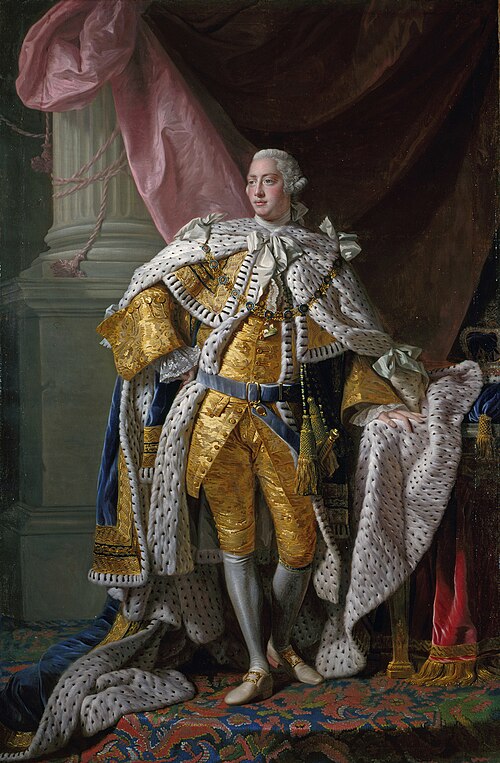
King George III in his Coronation robes.
Oil painting by Allan Ramsay (1713-1784) circa 1761-1762. From the Royal Collection (RCIN 405307) via Wikimedia Commons.
It is where lies and truth are entirely interchangeable; where the rule of law has already been replaced by the rule of one man; where the Congress has abdicated its core responsibilities and become a Greek chorus; where national policy is merely the sum of the whims and delusions of one man; and where every constitutional check on arbitrary power, especially the Supreme Court, is AWOL. In that abyss, even an attempt to explain events through the usual rubric of covering a liberal democracy is absurd. Because that rubric is irrelevant.
And so the wheels spin.
The only honest way to describe what is in front of our noses is that we now live in an elected monarchy with a manic king whose mental faculties are slipping fast. After 250 years, we appear to have elected the modern equivalent of King George III, and are busy dismantling the constitution Americans built to constrain him.
The situation is not irrecoverable — the forms of democracy remain even if they are functionally dead. We have centuries of democratic practice to fall back on. But every moment the logic of the abyss holds, the possibility of returning to democracy attenuates. Tyranny corrupts everything and everyone — fast. David Brooks returns to the ancients today to understand where we are:
As the disease of tyranny progresses, citizens may eventually lose the habits of democracy — the art of persuasion and compromise, interpersonal trust, an intolerance for corruption, the spirit of freedom, the ethic of moderation. “It is easier to crush men’s spirits and their enthusiasm than to revive them,” Tacitus wrote. “Indeed, there comes over us an attachment to the very enforced inactivity, and the idleness hated at first is finally loved.”
Forty percent of the country still backs the tyrant. Forty percent watch this and cheer.
Let us briefly review what they are cheering. For the first time since the Second World War, the president of the United States declared last week that we no longer support the notion of national sovereignty or collective security, and reserve the right to invade and occupy other sovereign countries — even close allies — to extract their resources. Quite a Rubicon. His chief adviser declared international law a dead letter:
[W]e live in a world, in the real world … that is governed by strength, that is governed by force, that is governed by power. These are the iron laws of the world since the beginning of time.
To put it bluntly, this was the argument of King George III. It was the justification for the British Empire, and, more hideously, for the Nazi and Soviet occupations of Europe. It’s a rejection of the principle that literally created the United States.
And yet this mad king threw this founding principle away because he believes a) we deserve Greenland as reparations for World War II, b) because Russia and China would invade otherwise, c) because rare earths are there — even though they are buried under a mile of ice — and d) because he didn’t win the Nobel Prize. Insane.
This staggering concession to evil — which cannot be withdrawn — robs us of any case against Russia’s invasion of Ukraine or China’s threat to Taiwan. It legitimizes war by major powers for conquest everywhere. It endangers the entire system of collective security that has kept the peace for nearly 80 years. Why? And for what? Because the king was on a high.
That’s where we are.
How Al Stewart struck gold, the folk boom and a flat-share with Paul Simon
Word In Your Ear
Published 20 Dec 2024The 17 year-old Al Stewart played electric guitar in a dance band in Bournemouth in 1963. When he borrowed an acoustic and sang “Masters Of War” in the break, he heard the sweet sound of applause. The next night he played three Dylan songs and sensed which way the wind was blowing. He talks here about moving to London, playing at Bunjies and becoming the compere at Les Cousins as his now 60-year career began to lift off. And about his Farewell Tour which kicks off in the UK in October 2025, a combination of songs and story-telling coloured by two great heroes, Peter Ustinov and Alistair Cooke.
This cracking exchange steers by way of Bert Jansch, Bob Dylan, Helen of Troy, Stalin, Hitler and the Battle of Moscow, the Weeley Festival of 1971, the three songs he always plays, the young Cat Stevens and what he told Paul Simon he should do with the just-composed “Homeward Bound”.
QotD: Twitter isn’t life … it’s far more important than that
Because they talk. Constantly. They never, ever shut up. Most Leftists in my life — and in yours too, I guarantee — never do anything. We all know that the Left take zero interest in their communities. They don’t donate to charity. Let’s say one of those late April blizzards hits and their driveway is snowed in. While everyone else is breaking out the shovels one last time, the Leftist’s natural impulse is to jump on Twitter and start petitioning Congress for some giant, trillion-dollar snow removal bill. It has to have set-asides for Diversity quotas, of course, and isn’t the word “removal” triggering? And so forth, until the snow melts. Hey, problem solved!
I’m kidding, but I’m not joking. Leftists are process people par excellence. Even Stalin won that way, 99% of the time — even though he could have had the entire Politburo shot with a snap of his fingers, he got his way by grinding them down, meeting after meeting after endless meeting. Yes, eventually someone has to actually do something, but that someone isn’t going to be them; it’ll be some toady somewhere, who is only working as hard as he has to in order to get promoted up the totem pole, so that he’s the one in meeting after endless meeting, forever discussing, never doing.
This reaches its apotheosis (apocolocyntosis!) in Twitter, and do you see what I mean? For the Left, tweeting about something is exactly the same as, if not better than, actually doing anything about it. Look around: we’re about to get into WWIII because of this. And speaking of missiles flying, we’ve all remarked on the Left’s signature “fire and forget” policy approach. To them, words are magic — healthcare, for instance, is now Affordable. How can it not be? It says “Affordable Care Act“, right there in the title! Don’t start in with your facts and figures, please — it’s Affordable, damn it! What part of “Affordable Care Act” don’t you understand?
He who talks the loudest and longest, therefore, is the purest.
Combine that with the second step for maximum effect: Emotional incontinence. Just as talking is the same as (better than!) doing, so emotion equals competence. She who feeeeeeels the strongest about an issue wins. This, too, has been obvious for a long time, so much so that Jonah Goldberg, of all people, had a good bit on it back when he was still somewhat convincingly playing a conservative. He joked about how stupid it was to be preoccupied with caring in practical life. Who would you rather have cut that tumor out, your best buddy — who really, really, really cares — or a brain surgeon? Even an utterly dispassionate one, to whom you are nothing more than a slab of meat?
Again, and always: see Twitter. Maximum talk, maximum hysteria, always. I’m belaboring this because in our tabloid-culture society, the identification is complete: The all-talk hysteric is the brahmin; screaming about how much you care just IS morality. Never mind that your caring affects nothing in the best case scenario; worst case it ends up killing people (e.g. the Blue Checkmarks tweeting us into WWIII).
Severian, “Intro to The Way“, Founding Questions, 2022-04-17.
January 25, 2026
Mythologizing Australia’s “noble savages”
On Substack, Celina101 provides examples of Australian Aborigine behaviour vastly at odds with the progressive belief in the “noble savage” myths:
For decades a rosy and romanticised narrative has prevailed: pre-contact Aboriginal Australia was a utopian paradise, and British colonists the only villains. Yet, the historical record painstakingly chronicled by scholars like William D. Rubinstein and Keith Windschuttle, tells a far more complex, often brutal story. This article examines how politically charged revisionism has whitewashed practices such as infanticide, cannibalism and endemic violence in traditional Aboriginal societies. It also warns that distorting history for ideology does a disservice to all Australians, especially Anglo-Australians who have been bludgeoned over the head with it.
The Noble Savage in Modern Narrative
Many contemporary accounts frame Aboriginals as the ultimate “noble savages”, a peaceful, egalitarian people living in harmony with nature until the arrival of the cruel evil British colonists. Textbooks, media and some activists repeatedly emphasise colonial wrongs while glossing over pre-contact realities. But historians like William D. Rubinstein challenge this rosy picture. Rubinstein bluntly notes that, in contrast to other civilisations that underwent the Neolithic agricultural revolution, Aboriginal society “failed … to advance in nearly all significant areas of the economy and technology” for 65,000 years. In his words, pre-contact Aboriginal life was “65,000 years of murderous, barbaric savagery“. This harsh summary confronts the myth head-on: it implies that life before colonisation was not idyllic, but marked by entrenched violence and brutality.
The danger of the noble-savage myth, Rubinstein argues, is that it inverts history. By idealising and practically lying [about] Aboriginal society, modern narratives often cast settlers as uniquely evil. In one essay he warns that contemporary inquiries (like Victoria’s Yoorrook Commission) are “defined to ascribe all blame to the impact of colonialism, rather than the persisting deficiencies in traditional Aboriginal society“. Ignoring those “gross, often horrifying, shortcomings” in Aboriginal culture, Rubinstein says, can only produce “findings written in the ink of obfuscation and deception“. In short, to truly understand Australia’s past we must examine it dispassionately, acknowledging human failings on all sides, not just one.
Documented Brutalities in Pre-Contact Society
Early observers and anthropologists left abundant evidence that some pre-colonial Aboriginal practices were brutal by modern standards. The selective amnesia about these practices in progressive narratives is striking. For example, infanticide (the intentional killing of newborns) was a widespread means of population control in traditional Aboriginal tribes. University of Michigan anthropologist Aram Yengoyan estimated that infanticide “could have been as high as 40% to 50% of all births … In actuality [it] probably ranged from 15% to 30% of all births“. In practice, this meant large numbers of healthy babies, especially girls, were deliberately killed to cope with limited resources. Babies up to a few years old who fell ill or were deemed surplus were often strangled or left to die. This grim truth is rarely mentioned in schools or media today. According to Rubinstein, it was “ubiquitous” in Australia prior to Western influence.
Several anthropological accounts describe cannibalism of infants and small children in some regions. For instance, an 19th-century observer on the northern coast reported: “Cannibalism is practised by all natives on the north coast … Only children of tender age – up to about two years old, are considered fit subjects for food, and if they fall ill are often strangled by the old men, cooked, and eaten… Parents eat their own children … young and old, [all] partake of it.” (In this passage, even adults were implicated in rare cases: two lost Europeans were reportedly killed and eaten by a tribe in 1874.) Such accounts are shocking, yet they were recorded by colonial-era missionaries and explorers. Today’s activists tend to dismiss or deny them entirely.
Germany’s Conquerors of the Skies – Luftwaffe Aces – WW2 Gallery 07
World War Two
Published 24 Jan 2026From the legendary Erich Hartmann to the intense but brief career of Hans-Joachim Marseille, today we dive into the lives of five of Germany’s most elite pilots from World War 2. This is the first gallery episode we’ve done in some time, but there could be more in the pipeline: that all depends on you. If you like this format, let us know in the comments. We’d love to hear what you’ve got to say, and whether you want us to cover Allied and other Axis aces too.
(more…)
Why does Microsoft treat its users so badly? Because it can
On the social media site formerly known as Twitter, ESR considers the situation most Microsoft users find themselves in these days:

Between the forced updates, the spyware, the adware, OneDrive constantly attempting to suck up all your data, and infinite dark-pattern subscription traps, I’m gathering that many Windows users are now nostalgic for the days when the shit only seemed to be up to their ankles rather than lapping at their nostrils.
The information asymmetry of closed-source software inevitably fucks the user over. I know, I know, I sound like a broken record. I’ve been banging on about this for going on 30 years now and even I get tired of my own rant sometimes.
That’s not why I’m posting today. Instead I want to publicly contemplate an unobvious question: just why is Microsoft treating its users so badly?
“Because it can” is not really a responsive answer. Corporations don’t do evil things because they like being evil, they only do evil things because they think they’re profit-maximizing.
So I understand about the dark-pattern subscription stuff and the adware. That’s slimy, but it’s revenue capture. There’s at least a cold-blooded trade-off you can imagine some product planner making between revenue line-go-up now and pissing off people who won’t be customers later.
But what is Microsoft maximizing by doing things that drive users away from it without any revenue capture? What model of reality, or failure of decision making, do you have to have to think it’s a good idea to push forced updates with work-interrupting reboots that can’t be blocked or delayed by the user?
It would have been trivial to have a pop-up that says: An update is available. Do it now, or defer it until
? The fact that that didn’t happen can’t be ascribed to revenue-line-go-up fever. These are two different kinds of ugly. And that second kind makes me think that there’s nobody left in product management at Microsoft with the ability and authority to veto bad ideas because they will anger the users.
It looks to me like nobody over there is thinking strategically about customer retention anymore. By the time you get to the point where nobody squashes forced-update reboots, nobody can seriously raise the question of whether adware is going to drive away so many users that Windows market share will tank and take all that lovely subscription revenue with it.
This is where I point out, with weary inevitability, that it’s going to get worse before it gets even worse. With nobody keeping an eye on the long game and user retention, the petty money grabs will only accelerate. Microsoft will keep flogging that donkey until it dies.
The irony here is that if Microsoft were an efficient maximizer of long-term profit they would be doing less of the shitty enraging crap that they are now.
How much less depends on how good their judgment is. You can be actively trying to keep a critical mass of your user base happy enough not to bail out and still fail. But at least Microsoft would be trying. Right now, there’s damn little evidence that they are.
Grand Strategy of the Roman Empire – Part ONE, the start of the debate
Adrian Goldsworthy. Historian and Novelist
Published 20 Aug 2025Following on from videos about military planning under the Republic, and about forts and garrisons, today we will begin to look at one of the big debates in the study of the Roman army and the Roman empire — did the Romans plan in a rational and informed way how to secure and defend their empire for the long term future. In short, did the Roman emperors and their advisors have a Grand Strategy which informed their decisions. This time, we will think about how this all started, and in particular Edward N. Luttwak, The Grand Strategy of the Roman Empire (1976), which really kicked off and did much to shape the debate.
QotD: Dostoevsky’s views on revolutionaries in Demons
Does that seem unrealistic? That ringleader was actually based on a real life student revolutionary named Sergey Nechayev, whose trial Dostoevsky eagerly followed. Nechayev wrote a manifesto called The Catechism of a Revolutionary, here’s an excerpt from that charming document:
The revolutionary is a doomed man. He has no personal interests, no business affairs, no emotions, no attachments, no property, and no name. Everything in him is wholly absorbed in the single thought and the single passion for revolution … The revolutionary despises all doctrines and refuses to accept the mundane sciences, leaving them for future generations. He knows only one science: the science of destruction … The object is perpetually the same: the surest and quickest way of destroying the whole filthy order … For him, there exists only one pleasure, one consolation, one reward, one satisfaction – the success of the revolution. Night and day he must have but one thought, one aim – merciless destruction.
The ideas don’t matter, because at the end of the day they’re pretexts for desires — the desire to dominate, the desire to obliterate the world, the desire to obliterate the self, the desire to negate.3 Just as in their parents’ generation the desire for status came first and wrapped itself in liberal politics in order to reproduce and advance itself, so in their children the desire for blood and death reigns supreme, and the radical politics serve only as a mechanism of self-justification and a lever to pull. This is not a novel about people, and it’s also not a novel about ideas. It’s a novel about desires, motives, urges, and the ways in which we construct stories to make sense of them.
John Psmith, “REVIEW: Demons, by Fyodor Dostoevsky”, Mr. and Mrs. Psmith’s Bookshelf, 2023-07-17.
- To Dostoevsky’s own surprise, when he wrote the main bad guy of the story, he turned out a very funny, almost buffoonish figure. He may be the most evil person in literature who’s also almost totally comic.
- Dostoevsky is notorious for dropping hints via the names of his characters — applied nominative determinism — and this one’s name means something like “supremacy”.
- Or as another famous book about demons once put it:
I am the spirit that negates
And rightly so, for all that comes to be
Deserves to perish wretchedly;
‘Twere better nothing would begin.
Thus everything that your terms, sin,
Destruction, evil represent —
That is my proper element.


