Quotulatiousness

September 4, 2019

Viewing WW2 as “the Air-Sea Super Battlefield”

Filed under: Economics, Germany, History, Japan, Military, Russia, WW2 — Tags: , , — Nicholas @ 05:00

According to Phillips Payson O’Brien, it’s old-fashioned to view large land battles as being “decisive” in modern warfare:
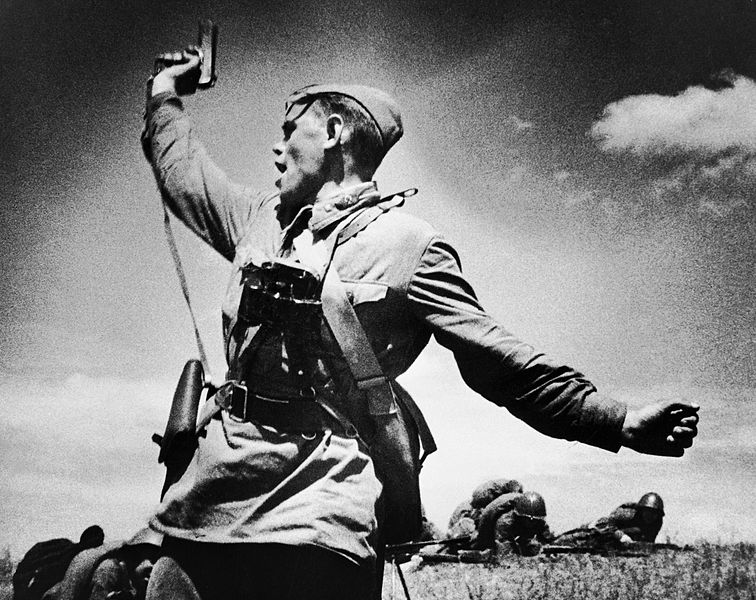
Kombat (Russian: Комбат, lit. “battalion commander”) is a black-and-white photograph by the Soviet photographer Max Alpert. It depicts a Soviet military officer armed with a TT pistol who is raising his unit for an attack during World War II. This work is regarded as one of the most iconic Soviet World War II photographs, yet neither the date nor the subject is known with certainty. According to the most widely accepted version, the photograph depicts junior politruk (political officer) Aleksei Gordeyevich Yeryomenko, minutes before his death on 12 July 1942, in Voroshilovgrad Oblast, Ukraine.
Wikimedia Commons.

Allied victory in WWII is usually viewed through the lens of large land battles, from Stalingrad to Kursk to D-Day. However, battlefield losses of equipment in these “great” land battles were relatively small and easily replaceable. This column demonstrates that the real effort of the major powers was put into the construction of air and sea weapons. The Allies used their air and sea power to destroy the Axis’s in a multi-layered campaign. This was the true battlefield of WWII: a massive air-sea super battlefield that stretched for thousands of miles. Victory in this super-battlefield led to victory in the war.

Every aspect of WWII is discussed in a vast literature. Considering its diversity, explanations of why Germany lost the war are surprisingly predictable. It remains widely argued that the Nazis were beaten mostly by the Soviet Union’s powerful Red Army (Hastings 2005: 508, Kennedy 2013: 183).

From June 1941 to May 1945, German “power” was supposedly engaged and destroyed by the Russians. At some points, more than two-thirds of German infantry were engaged against the Red Army. The famous battles of the Eastern Front, such as Stalingrad and Kursk, supposedly caused the Germans’ crippling losses. The upshot of this lopsided deployment was that most German soldiers died in the East. Fighting against the Americans and British, conversely, is often portrayed as a secondary concern (Roberts 2010: 573).

What’s wrong with a focus on battles?

This battle-centric view, like much history of WWII, is old-fashioned. Historians of strategy have moved away from seeing battles as determinative. Nolan (2017) has argued that attrition losses are more important than battle losses in explaining outcomes.

The battle-centric analysis implies that infantry deployment is the best way to analyse effort. Yet, human-power was rarely the key factor in deciding combat in WWII. Equipment and specialised training mattered more. Possessing and operating the largest stores of modern weapons, not only tanks and artillery but also aircraft and naval vessels, determined the course of battles and the war.

If we reframe the discussion of the war to look not only at what equipment was made but also at how it was destroyed, it emerges that the war was decided far from the land battlefield (O’Brien 2015). The most striking sign of this is how little war production went to the land war and how much went to the combined air-sea war. This was the case for all the powers except the USSR.
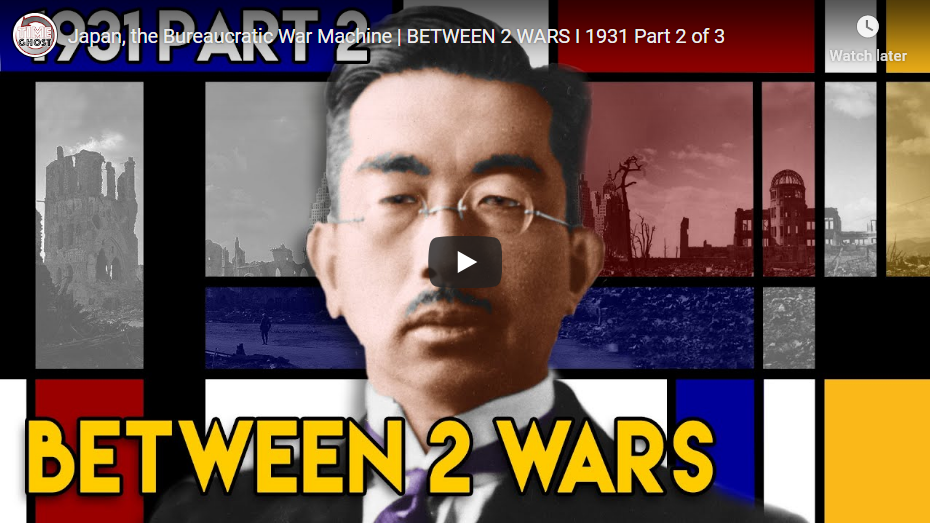

Japan, the Bureaucratic War Machine | BETWEEN 2 WARS I 1931 Part 2 of 3

Filed under: Bureaucracy, China, History, Japan, Military — Tags: , , , , , — Nicholas @ 04:00

TimeGhost History
Published on 3 Sep 2019

In Japan there has been a gradual increase of militarism since the Great War and in 1931 the country goes to war again when they invade Chinese Manchuria based on a false flag terrorist strike at the Mukden railway junction.

Join us on Patreon: https://www.patreon.com/TimeGhostHistory

Subscribe to our World War Two series: https://www.youtube.com/c/worldwartwo…

Hosted by: Indy Neidell
Written by: Spartacus Olsson
Directed by: Spartacus Olsson and Astrid Deinhard
Executive Producers: Bodo Rittenauer, Astrid Deinhard, Indy Neidell, Spartacus Olsson
Creative Producer: Joram Appel
Post-Production Director: Wieke Kapteijns
Research by: Joram Appel and Spartacus Olsson
Edited by: Danile Weiss
Sound design: Marek Kaminsky

Sources:

A TimeGhost chronological documentary produced by OnLion Entertainment GmbH.

Sources:

James Fulcher, The Bureaucratization of the State and the Rise of Japan (1988)

Katō Yōko, “The debate on fascism in Japanese historiography”, in: Sven Saaler and Christopher W.A. Szpilman (ed.), Routledge Handbook of Modern Japanese History (2018), 225-236.

Ethan Mark, “Japan’s 1930s crisis, fascism, and social imperialism”, in: Sven Saaler and Christopher W.A. Szpilman (ed)., Routledge Handbook of Modern Japanese History (2018), 237-250.

Penolepe Francks, “The path of economic development from the late nineteenth centre to the economic miracle”, in: Sven Saaler and Christopher W.A. Szpilman (ed)., Routledge Handbook of Modern Japanese History (2018), 267-278.

Sandra Wilson and Robert Cribb, “Japan’s colonial empire”, in: Sven Saaler and Christopher W.A. Szpilman (ed)., Routledge Handbook of Modern Japanese History (2018), 77-91.

Mark R. Peattie, “Nanshin: The ‘Southward Advance’, 1931-1941, as a Prelude to the Japanese Occupation of Southeast Asia”, in: Peter Duus e.a., The Japanese Wartime Empire, 1931-1945 (2010), 190-242.

From the comments:

TimeGhost History
13 minutes ago
This is the third of several episodes that cover the developments in East Asia leading to World War Two. In this episode we look at how Japan by 1931 has developed to be on the brink of a fascist state without anyone specifically taking power or staging a coup. The democratic reforms from the past four decades are dying a death by a thousand cuts as the Japanese administration and military simply take one small decision after the other that erodes freedom, dials back democracy, and inevitably leads to war. It’s an anonymous, mechanic, gradual movement towards global conflict proceeding with clockwork precision.

This episode also sees the first change to the Between 2 Wars set as Astrid and Wieke have started adapting the set to the changing themes, while we move closer and closer to the outbreak of WW2 — we’d love to hear what you think!

Poor Greta Thunberg

Filed under: Environment, Media, Politics — Tags: , , — Nicholas @ 03:00

Theodore Dalrymple on the grim-visaged child star of the environmental movement:

Greta Thunberg at the EU Parliament, 16 April, 2019.
European Parliament photo via Wikimedia Commons.

Poor Greta Thunberg! She is to self-righteousness and self-satisfaction what Mozart was to music, namely an astonishing youthful prodigy. Unlike Mozart, however, she is a very unattractive child, her unattractiveness arising not from her natural physical endowment but from the sheer grimness of her humourless puritanism which is inscribed on her face for all to see. She has succeeded in adding a new vision of hell to the many that I already have, namely being preached at by her for all eternity without intermission.

It is said that she suffers from a psychiatric condition, but whether or not this is so, her awfulness (of which, of course, she is blithely unaware) is not really her fault. Her transformation into a celebrity is the work of adults. It is they who have turned her into the Ayatollah Thunberg, the Khomeini of climate change.

In the days when reaching old age was exceptional, almost implying some kind of personal virtue, it was the elderly who were accorded respect and regarded as the repositories of wisdom. But as the old begin to outnumber the young, it is the young to whom falls the mantle. This is because we value the rare. No only does little Greta belong to a minority, but to a minority of that minority, for no one can deny that she is articulate, however monotonous, programmed or lacking in spontaneity her lines might be.

Adolescence in particular is now regarded as the acme of human existence, from which only decline is possible (and Greta exudes an air of permanent adolescence). I still have not quite made up my mind whether our age is the first of the geriatric adolescent or that of the adolescent geriatric, but I not infrequently notice around me seventy- and even eighty-year-olds who try to dress and comport themselves as if they were still about eighteen or nineteen. I find it sad, for of course the march of time is inexorable in its effects, albeit that it is true that it has slowed somewhat and people now age more slowly than they once did thanks, ultimately, to the material prosperity brought about by the creative destruction of capitalism. Nevertheless, the pretence that we have not aged is futile, though it is not futile only: it is both sad and shallow, in that it implies that life subsequent to adolescence has not brought its own rewards, and moreover that one has in effect learned nothing in the meantime, that the very best that can be hoped for is that one’s knowledge and wisdom, which plateaued at the age of eighteen, have maintained that elevated level ever since.

Based upon my experience of the elderly, I view the arrival of the adolescent geriatric, or the geriatric adolescent, with some consternation or trepidation. From a very early age I have had a liking for the elderly, often preferring them to the young, especially the young of my own and subsequent generations, but I have to admit that when an old person is nasty or querulous, he or she tends to be very nasty or querulous indeed, and exceedingly difficult to handle. In so far as adolescence is an age of egoistic querulousness, therefore, the prospect is daunting of an increase in bad-tempered geriatrics, angry that, despite their wish that they should remain adolescent forever (a wish that they are likely to confuse with a right because they have lived through a period when wishes rapidly transformed themselves into rights), they continue to age and will one day die. The Bible might tell us that there is a time and place for everything, but in the worldview of the geriatric adolescent, there is no time or place for old age.

English spelling – a bit mad, but perhaps the best system around

Filed under: Britain, China, History, USA — Tags: , — Nicholas @ 02:00

Lindybeige
Published on 12 Nov 2015

Support me on Patreon: https://www.patreon.com/Lindybeige

Many people think that the English system of spelling is just mad. The random quirks of history have certainly played their part, and today we have spellings that follow so many different rules that at times it can seem just random. However, here I argue that actually the fact that our spelling does not match our pronunciation is a strength, not just a weakness.

I see from the comments that several viewers have misunderstood me, and have thought that I am saying that only when people are reading English do they recognise words in the same way as we recognise faces. No, this is how people read in all languages. This being the case, phonetic spelling is not such a great advantage, since people are not decoding the words using sound, and spelling based on derivation has advantages.

Lindybeige: a channel of archaeology, ancient and medieval warfare, rants, swing dance, travelogues, evolution, and whatever else occurs to me to make.

QotD: Goth problems

Filed under: Humour, Quotations — Tags: , , , — Nicholas @ 01:00

I’ve never actually seen an extremely beautiful goth girl myself — most of them seem to have weight problems, which has always struck me as strangely contradictory. From the neck up, the look cultivated by goth girls seems to say, “O, we despair of this world and long for the sweet embrace of death!” From the neck down, their look seems to say, “I’ll take the bacon cheeseburger, two orders of fries, and a Diet Coke, please.”

Dan Savage, The Onion A/V Club, 2004-08-04.

September 3, 2019

An alternative end to the Molotov-Ribbentrop Pact?

Filed under: Germany, History, Military, Russia, WW2 — Tags: , , , — Nicholas @ 05:00

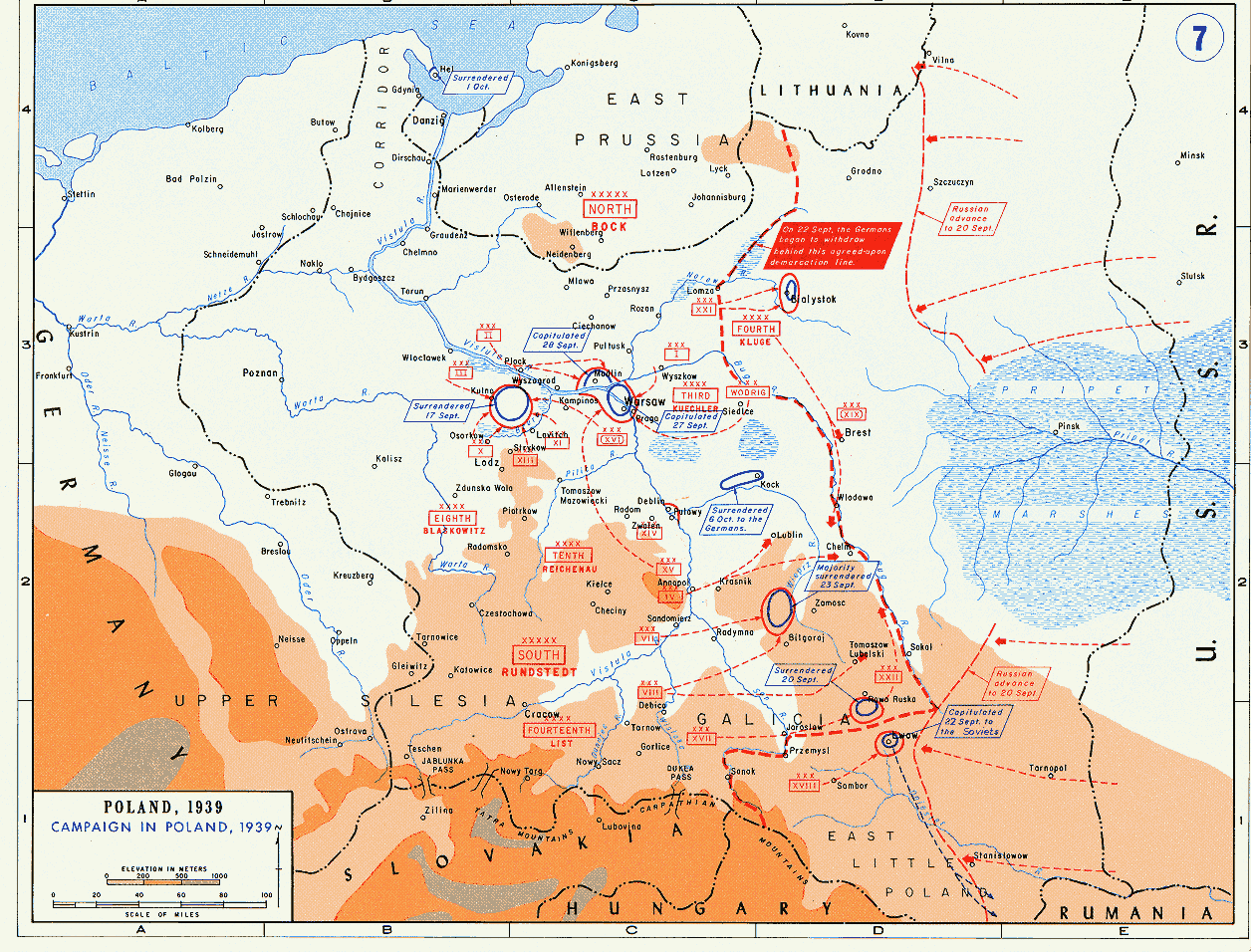
On the anniversary of the German invasion of Poland, Arthur Chrenkoff wonders if Stalin’s greatest miscalculation wasn’t refraining from attacking the Nazi forces after they’d been fighting the Polish army for three weeks in 1939:

Military situation in Poland, 14 September 1939 (map does not show Slovak Army activity in southern Poland).
United States Military Academy, Department of History via Wikimedia Commons.

In late August, the Soviet Union signed the infamous Ribbentrop-Molotov non-aggression pact with Germany, effectively green-lighting Hitler’s invasion of Poland a few days later. The secret protocols attached to the pact stipulated for the division of Central Europe between the two powers, with the Soviet Union being rewarded for its cooperation with the Nazis with the gift of eastern Poland, the Baltic states and Bessarabia, or the north-eastern Romania (as well as, it transpired later, the German non-interference during the Soviet invasion of Finland).

The Soviets were not naive (even if Stalin discounted all the indications of the coming German attack in 1941) to believe in a long-term friendship with Nazi Germany. There are strong indications that the Soviet Union intended to attack Germany, perhaps sometime in 1942, but Hitler beat it to the punch. The official Russian justification for the Ribbentrop-Molotov pact has certainly always been that the Soviet Union needed to buy itself extra time to prepare for this eventual showdown, since in 1939 it was still nowhere near ready (not least because of Stalin’s decapitation of the Red Army’s top leadership during the Great Terror a few years before).

But what if that was Stalin’s greatest miscalculation ever? By 17 September, when the Red Army crossed the eastern borders of Poland in accordance with the secret partition agreement, it was pretty clear to all that Poland was close to a military defeat (it would have hold on for longer, of course, without the Soviet stab in the back, but this would not have changed much without the Western allies’ military involvement, which never eventuated). While the German armed forces were winning, they were also overcommitted and overstretched. The German high command expected a quicker and easier victory and were taken aback by the ferocity of Polish resistance, despite clear German superiority in armour, air power and logistics. By the second half of September, some ammunition stocks were beginning to run low (particularly bombs) and motorised equipment, from tanks to trucks, has been significantly degraded through a combination of attrition and significant wear and tear in Polish autumn.

So what if the Red Army, instead of eventually coming to a halt along the previously agreed demarcation line, kept going west? There was no significant Polish military force to take into account and German army was tired and weakened after three weeks of hard fighting (losing a third of its tanks and 25 per cent of its air force in the process). While Wehrmacht had numerical advantage on the ground, this was only because the Red Army chose to invade Poland with half a million men, which was certainly enough to subdue the thinly-held eastern marches, but should they have needed it, the Soviets had reserves to draw upon to even out the field against the Germans. Even with their 33 committed divisions, the Red Army had a significant advantage over the German armed forces in the Polish theatre in terms of armour and air power (two to one for the former).

Who would have triumphed in this 1939 clash of the rival totalitarian war machines? We don’t know, of course, except that at the time of the invasion of Poland, Germany was militarily at its weakest point it would be until the final months of World War Two. Should the Red Army have proven victorious in September and October 1939, it would have likely ended up in Berlin in a matter of weeks, instead of years it eventually took. It’s a reasonable guess that Great Britain and France, faced with the Soviet invasion of the Reich and the looming defeat of Hitler, would have overcome their initial inertia and moved into Germany from the west so as to prevent having the communists proverbially water their horses in the Rhine. In this scenario, we would have ended up with a divided Germany and a divided Europe (though without much of the rest of Central and south-Eastern Europe in the Soviet camp) some six years earlier and without the tens of millions of dead, a ruined continent, and the Holocaust that accompanied World War Two as it actually unfolded.

Alas.

The Forgotten Soldiers of the Revolutionary War

Filed under: Britain, Europe, Germany, History, Military, USA — Tags: , , — Nicholas @ 04:00

Townsends
Published on 25 Jan 2018

Get the book here! ▶ https://www.amazon.com/Hessians-Three…

Visit Our Website! ▶ http://www.townsends.us/

Help support the channel with Patreon ▶ https://www.patreon.com/townsend

Sign up for the YouTube Mailing List! ▶ http://www.townsends.us/youtube_list.htm

When “raising awareness” works too well

Filed under: Business, Media, Politics, USA — Tags: , , — Nicholas @ 03:00

Dylan Gibbons reports on a recent finding from the Harvard Business Review:

A new study published by the Harvard Business Review shows that in addition to men’s growing fears about women in the workforce and potentially being falsely accused, women are becoming more aware of the backlash and are actually less likely to hire certain women, specifically attractive women.

“Most of the reaction to #MeToo was celebratory; it assumed women were really going to benefit,” said Leanne Atwater, a management professor at the University of Houston. However, Atwater was skeptical. Rather than seeing an endless trail of steps forward before her, she and her colleagues forecasted a backlash.

“We said, ‘We aren’t sure this is going to go as positively as people think — there may be some fallout.'” And so, they tested their hypothesis.

The study began in early 2018. Two surveys were created, one for men and one for women. These surveys were then distributed to workers in various professional fields. In the end, they collected a large amount of data from 152 male and 303 female responders.

According to the study, 74% of women now say they are more willing now to speak out against harassment, while 77% of men anticipated being more careful about potentially inappropriate behaviour.

As for the idea that men do not know what constitutes harassment, the researchers found the opposite was true. Both genders appear to both know what constitutes harassment, and women may be more lenient with some of their own definitions of what constitutes harassment.

According to the report, “The surveys described 19 behaviors — for instance, continuing to ask a female subordinate out after she has said no, emailing sexual jokes to a female subordinate, and commenting on a female subordinate’s looks — and asked people whether they amounted to harassment.”

“Most men know what sexual harassment is, and most women know what it is,” Atwater says. “The idea that men don’t know their behavior is bad and that women are making a mountain out of a molehill is largely untrue. If anything, women are more lenient in defining harassment.”

Another recent action intended to increase the number of women in STEM subjects at an Australian university — by selectively lowering academic standards for admission — will almost certainly not achieve its stated goals, but will work to increase negative views of those women in the working world:

[A female engineer] also rightly points out that this lowering the bar for women is unfair to men losing the university places to women with lesser qualifications.

She points out that male students will notice that women are struggling more with the course material — the women allowed in because the bar was lowered.

She feels this is a net negative for women in the engineering sector in general, and I have to agree.

How, she asks, can employers be expected to see a woman’s engineering degree the same as a man’s if the employer knows the women got a break getting into the program?

She uses the term “positive discrimination” to describe the leg-up practices, and I really prefer that to “affirmative action” to describe it because the word “discrimination” is plain in it. And that’s exactly what it is. Discrimination against qualified people that will ultimately harm women who are qualified.

As she puts it, the only way to ensure that a woman’s qualifications mean as much as a man’s is to have equal hurdles for women.

I’m completely with her.

Making Dowels with a Homemade Dowel Plate

Filed under: Tools, Woodworking — Tags: — Nicholas @ 02:00

Pask Makes
Published on 30 Nov 2017

Even though my old dowel plate (if you can call it that) worked ok, I decided a new one was called for. It’s a big improvement but the old one shows that there is little effort needed to make dowels and that one has made hundreds of dowels and still works.

I had some fun making my dowel collection, hope you like it 😉

Template download http://bit.ly/DowelPlate

As always I’m happy to answer any questions.

If you would like to support this channel you can do so here
https://www.patreon.com/PaskMakes

You can also help me out by purchasing one of my shirts, you can find them here https://paskmakes.threadless.com

Check out my new website
http://paskmakes.com/

Check out my Instagram to see more of my work https://www.instagram.com/paskmakes/

Also you can check out my photography at my website (nothing to do with making but you may be interested in what I do) http://www.neilpaskin.com

My email can be found in the about section of this channel.
For real mail,

Pask Makes
P.O BOX 768
Yandina
Queensland
4561
Australia

QotD: Fencing out the London poor

Filed under: Britain, History, Quotations, WW2 — Tags: , , , , — Nicholas @ 01:00

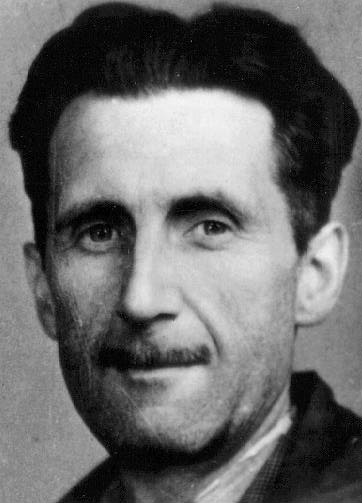
Orwell’s press card portrait, 1943


I see that the railings are returning — only wooden ones, it is true, but still railings — in one London square after another. So the lawful denizens of the squares can make use of their treasured keys again, and the children of the poor can be kept out.

When the railings round the parks and squares were removed, the object was partly to accumulate scrap-iron, but the removal was also felt to be a democratic gesture. Many more green spaces were now open to the public, and you could stay in the parks till all hours instead of being hounded out at closing times by grim-faced keepers. It was also discovered that these railings were not only unnecessary but hideously ugly. The parks were improved out of recognition by being laid open, acquiring a friendly, almost rural look that they had never had before. And had the railings vanished permanently, another improvement would probably have followed. The dreary shrubberies of laurel and privet — plants not suited to England and always dusty, at any rate in London — would probably have been grubbed up and replaced by flower beds. Like the railings, they were merely put there to keep the populace out. However, the higher-ups managed to avert this reform, like so many others, and everywhere the wooden palisades are going up, regardless of the wastage of labour and timber.

George Orwell, “As I Please” Tribune, 1944-08-04.

September 2, 2019

The Inca Empire – Earth-Shaker – Extra History – #2

Filed under: Americas, History, Military — Tags: , , , — Nicholas @ 04:00

Extra Credits
Published on 31 Aug 2019

Join us on Patreon! http://bit.ly/EHPatreon

Pachacuti, the Earth-Shaker, was the ninth leader of the Inca and the one who took the ambitions of the city of Cusco into an all-out military campaign to expand the empire — alongside bribing and engineering and negotiating their way to expansion.

Pachacuti turned out to be a good name for this ninth ruler of the Inca, because while the name did mean “earth-shaker” it was also a philosophical concept. In Quechua, the Inca’s primary language, a pachacuti was a historic event, a cataclysm that overturns space and time, remaking the world. It was a good title for the man who would forge the Kingdom of Cusco into an empire.

The economics of climate change policies

Filed under: Economics, Environment, Government, Politics — Tags: , , — Nicholas @ 03:00

Tim Worstall explains the economic implications for the various demands that we consume less in order to fight climate change:

A major contention from economists is that if we decide to fight global heating in the wrong manner then we’ll make ourselves poorer than we need be. A major contention from the same economists is that if we don’t fight global heating at all then we’ll make ourselves poorer than we need be. That being the economic point about all of this, we must fight global heating in the correct manner.

The correct manner not being vast plans by bureaucracies. Instead, change market prices with the one intervention – a crowbar into the system just the once with a carbon tax – and then let the economy itself chew through the implications of that.

Do note that the argument is not “poorer than we are now”, it’s poorer in the future than we need to be in that future.

And then we’ve got the varied Green, New Deal, unsoaped hippies and socialist idiots whose demand is rather different. They are insisting that we must be poorer, now, than we are, now. These people really do have to be told to bugger off:

    A sustainable environment means consuming less, not differently.

The only useful measure of how rich you are is “What are you able to consume?” Insisting that you consume less is therefore insisting upon being poorer.

It’s also entirely wrong that consuming differently won’t make a difference. Because again those economists. The thing we consume is value. That’s also the thing that we produce. That Gross Domestic Product, GDP, that is so bewailed as a societal target is nothing but the value added in the economy. GNP is the value which accrues to the people in the economy. NNI is the net value that goes as income to those in the economy. And so on through the different possible combinations of net and gross, national and domestic, production and income.

They’re all measures of value added. Not of resources consumed at all. So, if we face resource constraints all we need to do is change the value we’re producing by using fewer of those scarce resources to do so. Then we can carry on consuming ever greater quantities of value that we’ve gone and created. This must obviously be so – we do quite obviously face resource constraints currently. All economic resources are scarce, that’s what makes them economic resources in the first place, their scarcity. We don’t actually have an economics of atmospheric nitrogen because it’s not scarce. We do have an economics of soil nitrogen because it is scarce. The conversion of one to the other comes at a price – many prices in fact. The conversion itself, the algal blooms from having done so and so on. But the doing also adds value – which is then what humans consume, the value added.

So, the idea that consuming differently won’t make a difference is dribble. Plus, the idea that we must all be poorer in order to sustain that environment is drivel. Simple observation tells us that places with poor people have worse environments than places with rich.

What You Didn’t Know About the 1968 Machine Gun Amnesty

Filed under: Bureaucracy, History, Law, USA, Weapons — Tags: , , , — Nicholas @ 02:00

Forgotten Weapons
Published on 11 Oct 2017

Sold for $23,000.

When the 1968 machine gun amnesty was announced in the US, it was treated with widespread suspicion among gun collectors. Some thought it would merely a pretense to find and arrest owners of unregistered machine guns. Others though it was just the first step in a prohibition and confiscation of machine guns. Both of these groups would prove to be wrong, however and the amnesty was in fact a true amnesty.

In fact, the amnesty was even more substantial than people recognize even today. It was not just an amnesty for possession of an unregistered machine gun, but also pretty much any crime associated with the gun. For example, it would legalize guns that had been stolen from military property rooms, and guns with defaced serial numbers. In fact, it even allowed felons to register machine guns, and retain the legal right to own them to this very day.

http://www.patreon.com/ForgottenWeapons

Cool Forgotten Weapons merch! http://shop.bbtv.com/collections/forg…

If you enjoy Forgotten Weapons, check out its sister channel, InRangeTV! http://www.youtube.com/InRangeTVShow

QotD: The abolition conspiracy of the 1850s

Filed under: History, Law, Military, Quotations, USA — Tags: , , , — Nicholas @ 01:00

… the “slave power conspiracy” was a misnomer. Oh, the Southern senators all voted together, but that’s not a conspiracy. “Conspiracy” implies an end, a goal, and the slave power simply didn’t have one. Their actions were purely negative, and if that meant absolutely nothing got done, well, so be it. They were deeply skeptical of federal power anyway; if vetoing anything and everything that might somehow affect slavery meant that the nation would simply drift along, directionless, that suited them just fine.

But there was another conspiracy afoot in the 1850s: The abolition conspiracy. You don’t hear about this one in high school history because the victors write the textbooks, but it was quite real. And this one really was a conspiracy, in that they had a clear goal: The end of chattel slavery. And it was a conspiracy in a more fundamental sense, in that it was illegal. The so-called “slave power conspiracy” was obstructionist to the bone, but it’s perfectly legal for legislators to vote against proposed legislation. It’s not legal to advocate armed insurrection but that’s what the abolitionists did.

On October 16, 1859, a lunatic abolitionist named John Brown led a partisan band in an attack on the Federal arsenal at Harper’s Ferry, Virginia. He wanted to distribute the stolen guns to local slaves, thus sparking a race war. We know this because Brown was captured alive, and the great state of Virginia put him on trial, as they were legally required to do. Being a fanatic, and knowing that he was a dead man already, Brown took the opportunity to advertise his cause to the world …

At which point it became obvious that not only did Brown have the financial backing of several prominent Northerners, but he had the moral backing of a large segment of the Northern population. Brown became a martyr, literally — he was frequently compared to Jesus Christ in Northern periodicals. The important thing to note is this: Brown was captured in armed insurrection against the United States, and lots of the country was ok with it. This man simply decided that the legal processes could never result in the outcome he deemed morally necessary, so he took the law into his own hands — with the active connivance of prominent Northern financiers and intellectuals, and the avid approval of many Northern citizens.

Remember that, and Southern belligerency makes a whole lot more sense. The North was obviously ready to go to the gun in 1861, because they’d already gone to the gun in 1859. The “John Brown Moment,” then, is the point at which violence becomes inevitable, because one significant, influential segment of the country not only passively tolerates it, but actively cheers it.

Severian, “The John Brown Moment”, Rotten Chestnuts, 2019-07-16.

September 1, 2019

366 Days of Crushed Hopes, Suffering and Death – WW2 – 053 – August 31 1940

Filed under: Britain, China, Germany, History, Japan, Military, WW2 — Tags: , , , , — Nicholas @ 04:00

World War Two
Published on 31 Aug 2019

As the war turns one year old, there seems to be no end in sight. The Luftwaffe starts targeting civilian areas of London, the peoples of Eastern Europe switch country without moving houses, in occupied territory the population continues to be terrorized, and an end to the Chinese war that has been raging on for years now seems ever further away.

Join us on Patreon: https://www.patreon.com/TimeGhostHistory
Or join The TimeGhost Army directly at: https://timeghost.tv

Follow WW2 day by day on Instagram @World_war_two_realtime https://www.instagram.com/world_war_t…
Join our Discord Server: https://discord.gg/D6D2aYN.
Between 2 Wars: https://www.youtube.com/playlist?list…
Source list: http://bit.ly/WW2sources

Written and Hosted by: Indy Neidell
Produced and Directed by: Spartacus Olsson and Astrid Deinhard
Executive Producers: Bodo Rittenauer, Astrid Deinhard, Indy Neidell, Spartacus Olsson
Creative Producer: Joram Appel
Research by: Indy Neidell
Edited by: Karolina Dołęga
Map animations: Eastory

Colorisations by Norman Stewart and Julius Jääskeläinen https://www.facebook.com/JJcolorization/

Sources:
Soviet occupation of Bessarabia and Northern Bukovina. Military parade in Kishinev on the 4th of July 1940, ANRM, Fototeca, 24950 from http://anr.infoideea.ro/basarabia1940…

Eastory’s channel: https://www.youtube.com/channel/UCEly…
Archive by Screenocean/Reuters https://www.screenocean.com.

A TimeGhost chronological documentary produced by OnLion Entertainment GmbH.

From the comments:

World War Two
6 days ago (edited)
Tomorrow, the war turns one year old, just like our channel. It doesn’t feel like a year, but when you think about what has happened all over the world since the Germans invaded Poland, it feels like a lifetime. Since then, our project has grown significantly, with new editors, community managers, and other people that help us out to make this series the best that it could be. We owe that to each and every one of you who stuck around and watched, shared, and engaged with our channel. We’re especially grateful to our supporters on Patreon and the TimeGhost website. It’s your support that makes this show possible and helps us to keep improving our quality. Our next goal is to raise enough money to go abroad and film on location, so that we can give you a real look of what it was like, and get in-depth knowledge from local historians. So please, support us on Patreon at https://www.patreon.com/TimeGhostHistory or at our website at https://timeghost.tv.

A big virtual hug from all of us,
The TimeGhost Team

« Newer PostsOlder Posts »

Powered by WordPress