Quotulatiousness

November 8, 2019

Cooey: The Unassuming Canadian Workhorse

Filed under: Cancon, History, Weapons — Tags: , , — Nicholas @ 04:00

Forgotten Weapons
Published 6 Nov 2019

http://www.patreon.com/ForgottenWeapons

Cool Forgotten Weapons merch! http://shop.bbtv.com/collections/forg…

Cooey is a brand name that will be immediately recognized by Canadians, but pretty much unknown everywhere else. Founded in 1903 by Herbert Cooey, the company would produce a series of simple and practical firearms that became hugely popular and common in Canada. The basic models were the single-shot .22 Model 39, the bolt action magazine-fed .22 Model 60, and the break action single-shot Model 84 shotgun (and the Model 64 semiautomatic .22, made after the company was sold out of the Cooey family). These are not particularly exciting firearms, but they are ubiquitous across Canada, having served Canadian families reliably for a
century now.

Contact:
Forgotten Weapons
6281 N. Oracle #36270
Tucson, AZ 85704

Don’t hold your breath waiting for the Feds to tackle Quebec’s ongoing repression against minorities

Filed under: Cancon, Law, Liberty, Politics — Tags: , , , — Nicholas @ 03:00

Chris Selley on the situation in Quebec, where first-class citizenship is only available to those who speak French and don’t expect their religious beliefs to be respected:

One of the fascinating things about Quebec politics is that it’s often impossible to predict which absurdities will become controversial and which will be accepted as reasonable. The province’s linguistic and more recently cultural debates operate in an atmosphere so divorced from normal reality that it’s impossible to know how any new idea or event might react to its unique and volatile mixture of gases.

The classic example is Pastagate: An inspector from the Office québécois de la langue française found an Italian restaurant’s menu was riddled with Italian — calamari, antipasti — and issued the appropriate cease-and-desist notice. At no point did anyone suggest he had misinterpreted the law. Despite universal scorn and worldwide mockery, at no point did anyone successfully explain why this inspector’s actions were obviously ultra vires, while the OQLF’s other insane diktats — say, forcing a bilingual community newspaper to segregate English-language and French-language content such that English-only advertising will never appear on the same page as a French-language article — were reasonable.

As a result, Quebec politics is like a festival of trial balloons. Most recently we saw languages minister Simon Jolin-Barrette float the idea of banning merchants from greeting customers with “bonjour-hi” — a Downtown Montreal-ism that turns language hawks crimson with rage — only to have Premier François Legault shoot it down a couple of days later amidst widespread ridicule.

By contrast, we’re supposed to think it’s totally reasonable that the National Assembly voted merely to request that merchants use state-sanctioned greetings. Unanimously. Twice.

Ban religious symbols for all civil servants, or only those “in a position of authority”? Which civil servants are “in a position of authority”? Should currently employed civil servants affected by Bill 21 be grandfathered in or not? You can poll all you like, but until any given idea goes through Quebec’s intense media ringer, no one knows how it’ll shake out. With fundamental rights at stake, the majoritarian randomness of it all is truly alarming.

Shakespeare Summarized: Macbeth

Filed under: Britain, Humour, Media — Tags: , , , , , — Nicholas @ 02:00

Overly Sarcastic Productions
Published 12 April 2014

Here it is! The Scottish Play. The bloodiest of the bloody. An epic tale of magic, madness and stabbing. It’s so gory, even Tarantino thinks it’s over the top.

Making it funny was pretty tough. 😀

QotD: Exports are costs; imports are benefits

Filed under: Economics, Quotations — Tags: — Nicholas @ 01:00

You write that “exports are at least as much a benefit to us as our imports are.”

With respect, you’re mistaken. To see why, look at the matter at the level of your household. What you export from your household is your labor; what you import are the goods and services that you purchase with your income. Suppose that you were given the option of continuing to do one or the other of these activities but not both. That is suppose that you could either (a) continue to export (that is, continue to work) but no longer import (that is, no longer bring into your household any goods and services) or (b) continue to import into your household goods and services for your consumption but no longer work. Which option – (a) or (b) – would you choose?

You would clearly choose option (b).* The reason is that you supply the fruits of your labor to others in order to increase your ability to consume. What you export from your household is a cost that you willingly incur in order to be able to import into your household the goods and services that you and your family consume. What is true at the level of the household is here true at the level of the national economy: the goods and services that Americans export to foreigners are the costs that we willingly incur in order to be able to import into our country the goods and services that we receive from foreigners in exchange. Exports are the means; imports are the end.

* If I’m mistaken and you’d choose option (a), please call me as I have several household repairs to be done and I’d be delighted to have you do the repairs for me for free.

Don Boudreaux, “Exports are Costs; Imports are Benefits”, Café Hayek, 2017-10-17.

November 7, 2019

Blanchard’s transsexualism typology

Filed under: Health, Science — Tags: , , , — Nicholas @ 05:00

At Quillette, Louise Perry interviews Dr. Ray Blanchard about transsexualism, and his controversial-in-the-LGBT-community typology of transsexualism:

Ray Blanchard, PhD.
Image from his Twitter profile.

Ray Blanchard is an adjunct Professor of Psychiatry at the University of Toronto who specialises in the study of human sexuality, with a particular focus on sexual orientation, paraphilias, and gender identity disorders. In the 1980s and 1990s he developed a theory around the causes of gender dysphoria in natal males that became known as “Blanchard’s transsexualism typology“. This typology — which continues to attract a great deal of controversy — categorizes trans women (that is, natal males who identify as women) into two discrete groups.

The first group is composed of “androphilic” (sometimes termed “homosexual”) trans women, who are exclusively sexually attracted to men and are markedly feminine in behaviour and appearance from a young age. They typically begin the process of medical transition before the age of 30.

The second group are motivated to transition as a result of what Blanchard termed “autogynephilia”: a sexual orientation defined by sexual arousal at the thought or image of oneself as a woman. Autogynephiles are typically sexually attracted to women, although they may also identify as asexual or bisexual. They are more likely to transition later in life and to have been conventionally masculine in presentation up until that point.

Although Blanchard’s typology is supported by a wide range of sexologists and other researchers, it is strongly rejected by most trans activists who dispute the existence of autogynephilia. The medical historian Alice Dreger, whose 2015 book Galileo’s Middle Finger included an account of the autogynephilia controversy, summarises the conflict:

    There’s a critical difference between autogynephilia and most other sexual orientations: Most other orientations aren’t erotically disrupted simply by being labeled. When you call a typical gay man homosexual, you’re not disturbing his sexual hopes and desires. By contrast, autogynephilia is perhaps best understood as a love that would really rather we didn’t speak its name. The ultimate eroticism of autogynephilia lies in the idea of really becoming or being a woman, not in being a natal male who desires to be a woman.

I interviewed Blanchard over email and Skype. The text has been lightly edited for clarity.

The instant shave-horse

Filed under: Tools, Woodworking — Tags: , , — Nicholas @ 04:00

Rex Krueger
Published 6 Nov 2019

More video and exclusive content: http://www.patreon.com/rexkrueger
(more…)

Replacing “dead, white male” writers with contemporary First Nations writers

Filed under: Books, Cancon, Education, Politics — Tags: , , , — Nicholas @ 03:00

Barbara Kay, as you would expect is not a fan of this move by this school board in the Windsor area:

Some years ago, the late, great writer George Jonas asked me about my intellectual influences. Who did I remember as especially formative? Oh, George Orwell, of course. I read Animal Farm in my mid-teens, 1984 a little later, and most of his other writings over the course of my salad years. It would be hard to overstate his effect on my understanding of concepts like “freedom,” “power” and “decency.”

Since Orwell has never been “owned” by the right or the left, both admiring his prose as a model for clarity and coherence, he is the one English-language writer I would consider indispensable for any high school literature curriculum.

Up to now, most educators have concurred. But the Windsor, Ont.-area Greater Essex County District School Board has announced that, in accordance with the spirit of the Truth and Reconciliation Commission (TRC), Orwell and other canon favourites in the Grade 11 literature curriculum, including Shakespeare, will be set aside in favour of a course wholly devoted to Indigenous writing. Eight of the district’s 15 schools have already replaced former standards with such books as Indian Horse, In This Together and Seven Fallen Feathers under the rubric of Understanding Contemporary First Nations, Métis and Inuit Voices.

“This decision wasn’t made lightly,” said Tina DeCastro, a teacher consultant with the school board’s Indigenous Education Team. The decision arose from a motion passed by the school board’s trustees as a response to TRC calls for action. Eastern Cherokee Sandra Muse Isaacs, Professor of Indigenous Literature at the University of Windsor, defends the radical change as necessary on the grounds that Indigenous stories have been ignored in the past. “Our stories predate Canada. It’s as simple as that.”

Is it really that simple?

I don’t think there is a sentient Canadian today who isn’t aware that Indigenous voices have been neglected in the past, and who would not wholeheartedly support the addition of Indigenous writing to contemporary literature curricula. But an entire year devoted to Indigenous literature that supplants revered works by great writers from the civilization that produced Canada as a nation-state, in order to redress the offence of historical inattention to Indigenous people, is to rob the majority of Canadian students of their cultural patrimony.

Boer Lee-Speed Rifle from the Jameson Raid

Filed under: Africa, Britain, History, Military, Weapons — Tags: , , , — Nicholas @ 02:00

Forgotten Weapons
Published on 29 Aug 2019

The Jameson Raid in December 1895 was one of the key events in the lead to the second Boer War. Leander Jameson took a force of about 600 men on December 1895 to make a surprise attach on Johannesburg, incite support for the multitude of British miners who felt oppressed by the Boer government, and ultimately bring in British forces to take over. The plan failed in a complete and public manner, though, as Boer forces knew about it from the very beginning. The raiding party was ambushed at Doornkop outside Johannesburg and forced to surrender. It was a tremendous public relations setback for supporters of British intervention.

In addition, the Boers captured a nice selection of very modern arms, including half a dozen artillery pieces, a dozen Maxim machine guns, and about 500 Lee rifles. This Lee-Speed is one of them, given to a Boer burgher who used it in the war that eventually broke out in 1899. He carved his name into the stock, as was common for the Boers. This is one of only two known and documented surviving rifles from the Jameson Raid, and it is both a very cool piece of history for that reason as well as a great time capsule of the Lee-Metford MkI pattern of rifle. Most of the early Lees in British military service were updated and repurposed over the decades, and finding them in original configuration is quite difficult today.

http://www.patreon.com/ForgottenWeapons

Cool Forgotten Weapons merch! http://shop.bbtv.com/collections/forg…
Contact:
Forgotten Weapons
PO Box 87647
Tucson, AZ 85754

QotD: Evolved sexual differences

Filed under: Health, Humour, Media, Quotations — Tags: , , , — Nicholas @ 01:00

Because male sexuality is all about the visuals, men’s magazines are filled with pictures of naked women with freakishly large breasts and women’s magazines are filled with pictures of beauty products and ass-cantilevering $2,000 stilettos. Men evolved to go for signs of reproductively hot prospects — an hourglass figure, youth, clear skin, symmetrical faces and bodies, and long shiny hair: all indicators that a woman is a healthy, fertile candidate to pass on a man’s genes.

Women co-evolved to try to make themselves look reproductively hot, though that’s not how we think of it. […] Because men are turned on by disembodied photos of boobs, butts, and coochies, they’re quick to pull down their pants, click their cameraphone, and text some woman they just met a close-up of their zipperwurst. Really bad idea.

Men who’ve done this should pick up a Harlequin romance, which is basically porn for women (from the ravishing by some hot gazillionaire to the final commitment-gasm).

See any photo spreads of male crotch shots tucked in there anywhere, boys?

This is not an error of omission. Women aren’t fantasizing about seeing your willy; they’re fantasizing that somebody in the royal family will pluck them out of suburbia and marry them in Westminster Abbey.

Amy Alkon, Good Manners for Nice People Who Sometimes Say F*ck, 2014.

November 6, 2019

War in 3 Fascist Ways: Slovakia, Spain, and Greece – WW2 – OOTF 005

Filed under: Europe, Greece, History, Military, WW2 — Tags: , , , , , — Nicholas @ 06:00

World War Two
Published 5 Nov 2019

What role did Slovakia play during the invasion of Poland? How did Franco view the war in Europe? And did Greece see an invasion coming? We answer all of this in this episode of Out of the Foxholes.

Submit your own question: https://community.timeghost.tv/c/Out-…

Join us on Patreon: https://www.patreon.com/TimeGhostHistory
Or join The TimeGhost Army directly at: https://timeghost.tv

Follow WW2 day by day on Instagram @World_war_two_realtime https://www.instagram.com/world_war_t…
Join our Discord Server: https://discord.gg/D6D2aYN.
Between 2 Wars: https://www.youtube.com/playlist?list…
Source list: http://bit.ly/WW2sources

Hosted by: Indy Neidell
Produced and Directed by: Spartacus Olsson and Astrid Deinhard
Executive Producers: Bodo Rittenauer, Astrid Deinhard, Indy Neidell, Spartacus Olsson
Creative Producer: Joram Appel
Post Production Director: Wieke Kapteijns
Research by: Rune Vaever Hartvig
Edited by: Mikołaj Cackowski
Map animations: Eastory

Colorisations by Norman Stewart and Julius Jääskeläinen https://www.facebook.com/JJcolorization/

Eastory’s channel: https://www.youtube.com/channel/UCEly…
Archive by Screenocean/Reuters https://www.screenocean.com.

A TimeGhost chronological documentary produced by OnLion Entertainment GmbH.

Whitewashing the Vikings

Filed under: Europe, Health, History, Politics — Tags: , , , , — Nicholas @ 05:00

Sarah Hoyt notices the way history is being presented to subtly (or not-so-subtly) denigrate the recent past and idealize (some of) the distant past:

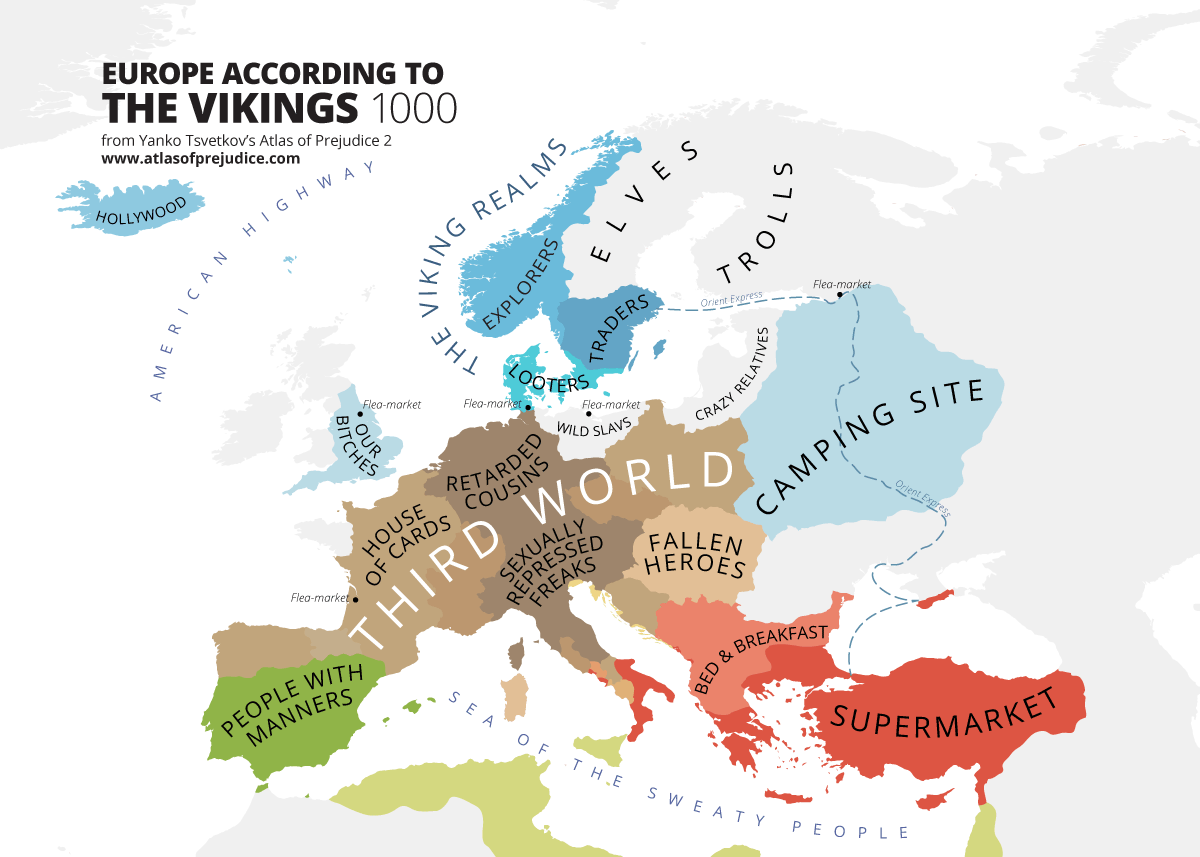
Europe According to the Vikings (1000) from Atlas of Prejudice 2 by Yanko Tsvetkov.

Their distortion of history so that everything America ever did is wrong and evil-bad is designed to make our own kids hate their own country and imagine themselves as “citizens of the world” which is to say citizens of nowhere.

Which in turn allows for wide open borders which bring in the population of 3rd world serfs the statists count on to keep them in power forever.

For the last ten years I’ve been disquieted and disturbed by the persistent myth of: Our ancestors were far more cleanly, happy and prosperous than we think. Yep. Your foot-in-the-mud ancestor didn’t suffer under the lash of his feudal overlord. Oh, no. He had hot running water, regular baths, religious holidays off and–

Spits. And the girls sang as they wove garlands on Mayday, I suppose.

Most of these myths are arrant nonsense. Some are arrant nonsense on stilts with a dash of oikophobia thrown in.

I’ve mentioned here that I went to the Viking exhibit at the museum some years back, and it was all about how free and egalitarian the Vikings were, male and female. Which I suppose was true, if you miss the large component of slavery. And the fact that they raided foreign shores for slaves and loot. And that almost every skilled artisan was a slave. And–

Then there is the continuous “The Vikings were much cleaner than the Christians and women preferred them.”

First let’s cut the crap. We have zero clue if women preferred them. When the raiders come to town, they don’t stop to ask thee fleeing women to sign “affirmative consent” forms.

Second, yeah, I’m sure in some Viking villages they were cleaner. We do have have reason to suspect some areas had functioning saunas. But then some of the areas raided had functioning Roman baths still extant.

I’m sure for some times and places, that was true. I’m also absolutely sure that for most times and places the Vikings were about as clean as everyone else, which is to say not very, due to the lack of easy-accessible soap (yes, it existed. In certain times and places. NOT everywhere and not of a kind you’d want to use on your skin) of easily accessible acceptable-temperature water, and/or of warm enough places to bathe in.

No, medieval people weren’t as utterly filthy as it’s imagined (though there were some, I’m sure) but I’m also utterly sure, having experienced this in a temperate climate, that washing in winter would be limited, careful, and therefore maybe not as thorough as we imagine. Or to put it another way, when the Victorians went on about catching a chill, they weren’t just blowing smoke, guys. People didn’t willingly strip down and dip in lukewarm water in the dead of winter and when clothes would take forever to dry, unless they had other clothes, and facilities for getting warm right after.

In other words, Vikings and the rest of the Middle Ages were, from our POV a little wiffy. As were most places until the late 20th century.

So why the cleanly and perfumed Vikings (Particularly since the records of the time don’t support this view, except in very few, highly publicized circumstances?)

Oh, that’s the “don’t go imagining Christians were better” wing of the oikophobe chorus. They will tell us Christians were filthy. The pagans, on the other hand, were cleanly and perfumed.

Weirdly the one people we know were cleaner than Christians, also more literate and prone to less domestic violence never come in for praise in these comparisons. I suspect being part of the foundational build of the West, the Jews aren’t considered “wonderfully other” enough. Or given some of the recent bs on the left and the people they embrace, perhaps it’s a hate thing.

BTW that Christians being filthy is bullshit. Later on, in defense of “but medieval people weren’t that filthy” they’ll bring in the injunction to change your underwear daily. Which is more than a little confusing when you researched the heck out of “underwear use” in various places in the renaissance and know most women at least wore none. Eventually you find out the injunction to change underwear was in monasteries. Monk’s orders in fact, also had various guidelines on cleanliness which, for their time, were amazingly enlightened. Even if, yes, by our standards, they were all a bit wiffy.

The same applies to a ton of other things. These revisionists tell us they ate better than we think, oh, and by the way, except for infant mortality they lived as long as we do.

All this is insanity on stilts.

In A Minute: War of the Roses

Filed under: Britain, History, Military — Tags: , , , — Nicholas @ 04:00

Overly Sarcastic Productions
Published 5 Nov 2019

Watch an entirely avoidable succession crisis spill out over the course of a whole century.

PATREON: https://www.Patreon.com/OSP

MERCH LINKS: https://www.redbubble.com/people/OSPY…

OUR WEBSITE: https://www.OverlySarcasticProductions.com
Find us on Twitter https://www.Twitter.com/OSPYouTube
Find us on Reddit https://www.Reddit.com/r/OSP/

Sage words from Zim Tzu

Filed under: Football, Humour — Tags: , , , — Nicholas @ 03:00

The National Football League has certain rules and requirements of the head coaches of all the teams, including a certain amount of mandatory contact with … ugh! … the media. Minnesota Vikings head coach Mike Zimmer follows these rules — probably unwillingly, and certainly without much enjoyment or enthusiasm — but generally guards his tongue very carefully, not giving out any more information than he absolutely has to and couching that information in ways that are obscure and often inscrutable to the uninitiated media schlub or everyday fan. Fortunately, the Daily Norseman has on their staff Ted Glover, the world’s leading Zimmerologist, who can unwrap the verbal enigmas and decrypt the encoded truth and share with true Vikings fans:
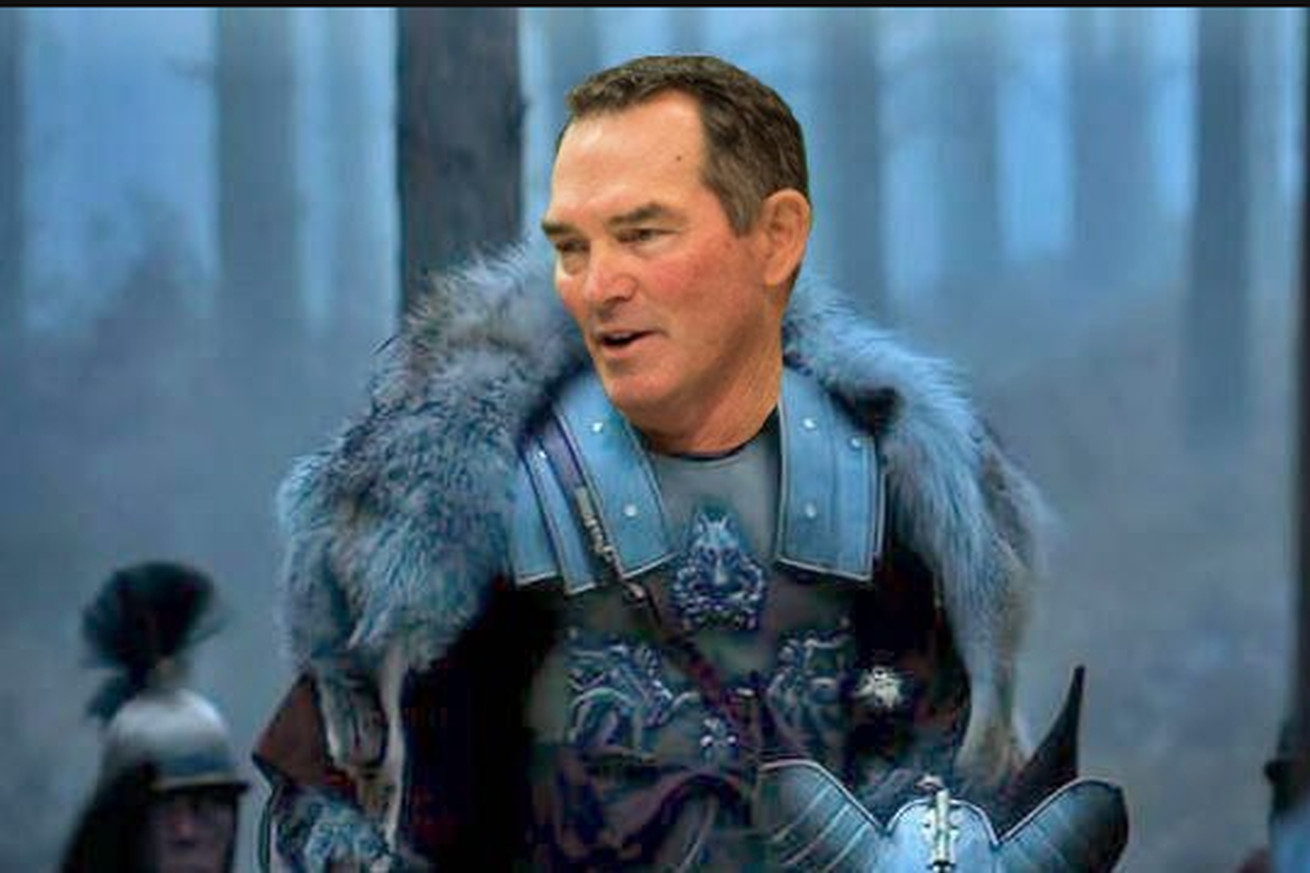
Zim Tzu, image by Eric Thompson, Daily Norseman.

The Vikings warrior poet coach dispenses his words of wisdom

ED NOTE: This has bad words. None of the other things we write on here do, but this one does. It seems to be a popular bit, so until the law catches up with me, I’m going to keep doing it. Thanks for understanding, and thanks for not reading and not letting your kids read it if bad language isn’t your thing. Hope you enjoy the rest of our articles—Ted

Warrior poets don’t have time for deep, philosophical conversations once they’re in the maelstrom of conflict. You need accurate information, the lay of the land, and then you must make a decision. Good or bad, decisions must be made, because indecision is certain death. Good decisions could still end up with a bad result, for a number of reasons. Poor execution, faulty equipment, any number of things. But at least you give yourself the best chance of success.

And bad decisions? Bad decisions are more than likely going to result in your demise, but fuck it, at least go out with your boots on. And sometimes, even a bad decision can turn out okay with a stroke of luck, or poor execution of your adversary. And when that happens you feel invincible. Glory or death, bay.

Glory or death. Pain is temporary, chicks dig scars, but glory is forever. Unless you really fuck things up and lose, then you’re just a loser looking for answers, and you vow to not fuck things up like that again.

Because you are Zim Tzu, Scalper of the Capital, True King Of The Jungle, Potentate Of Those Who Eat Feces, The Biggest Apple, Commodore Of Outlaw Sailors, Master Falconer, The Once And Future King In The North, High Septon Of Eagan, Lord Commander Of The Iron Range And Twin Cities, Master Of Fortress TCO, Honorary Elder Of Mankato and Protector Of The Realm.

And when you need to explain setbacks, you’ll need help discussing things, because the proletariat has no concept of the shit you’ve gone through, man. None. So you need someone* to take your words and turn them into language that folks understand.**

You’re welcome.***

*Look, you don’t need anyone to help you figure this out. You’re a Vikings fan. Just shut up, drink, and bury those goddamn feelings.

**This whole post is incomprehensible bullshit. All the answers are made up, by me, because I need an outlet to vent and meth, apparently, is frowned upon in my house.

***Seriously, enjoy. Glad you guys like these remarkably bad interpretations of Zimmer’s press conferences.

How Did The Saturn 5 Rocket Work? | James May: On The Moon | Earth Lab

Filed under: History, Space, Technology, USA — Tags: , , , , — Nicholas @ 02:00

BBC Earth Lab
Published 3 Jan 2017

James May meets Harrison Schmitt, one of the last men to ride Saturn 5 and learns a bit about the science behind a rocket with six million components.

Taken From James May: On the Moon

Welcome to BBC Earth Lab! Here we answer all your curious questions about science in the world around you (and further afield too). If there’s a question you have that we haven’t yet answered let us know in the comments on any of our videos and it could be answered by one of our Earth Lab experts.

QotD: “Fake news” is nothing new

Filed under: Books, History, Media, Politics, Quotations — Tags: , , , , , — Nicholas @ 01:00

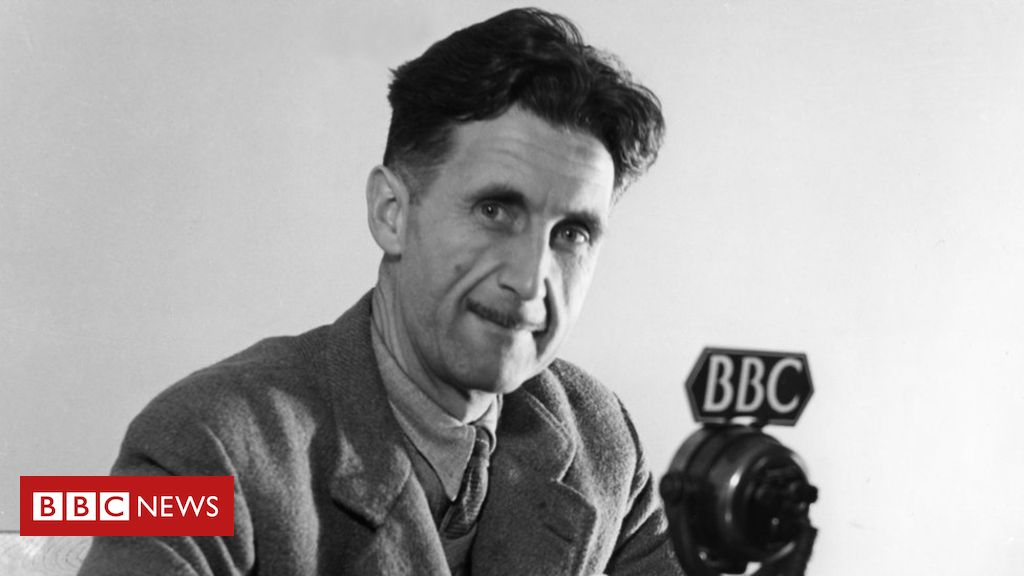
… the basic ideas of “alternative facts” and “fake news” — our updated, revved-up forms of disinformation — were not foreign to Orwell. Working at the BBC as a news producer — a fancy term for war propagandist — he heard some of the Axis powers’ propaganda as well as that of his own side (even if he kept his own hands fairly clean). He justifiably feared that the very concept of objective truth was fading from the modern world. Winston Smith’s job at the Ministry of Truth is to rewrite or “rectify” history, so that it follows the current party line, whatever it may be at that moment.

Orwell himself saw all this happen when he read Catalan newspapers as well as British ones during the Spanish Civil War, several years before joining the BBC. Condemning press distortions, above all how several English newspapers reported the war, he wrote: “I saw great battles where there had been no fighting and complete silence where hundreds of men had been killed … I saw, in fact, history being written not in terms of what happened but what ought to have happened according to various ‘party lines.'” Given the gridlock in American politics, and the never-ending verbal warfare between news outlets on the Right such as Fox News and on the Left such as MSNBC, Orwell appears all too accurate in his “predictions.”

One of the features of the world of Oceania reflecting Orwell’s prescience is its official language, Newspeak, an argot resembling a kind of Morse code that satirizes advertising norms, political jargon, and government bureaucratese. The purpose of Newspeak is to limit thought, on the view that “you can’t think what you lack the words for.” Ultimately, this impoverished language seeks to narrow and control human thought. (Does Twitter represent a step in that direction?) Purged of all nuance and subtlety, denuded of variety, and reduced to a few hundred simple words, Newspeak ultimately promises to render all independent thought (or “thoughtcrime”) impossible. If it cannot be expressed in language, it cannot be thought. And anything can fill the vacuum, such as 2 + 2 = 5. That is the equation — a perfect example of “doublethink” — which O’Brien indoctrinates Winston to accept in Room 101 and which marks the final step of the latter’s brainwashing. As the Party defines it, “doublethink” consists in holding “two contradictory beliefs in one’s mind simultaneously, and accepting both of them.” In 2018, Trump’s lead lawyer, former New York mayor Rudy Giuliani, declared in a TV interview: “Truth isn’t truth.” A few months later, a talking head defended a critical news report on the grounds that, just because it is “not accurate doesn’t mean it’s not true.”

It testifies both to the brilliance of Orwell’s vision and to the bane of our times that Nineteen Eighty-Four retains so much relevance.

John Rodden and John Rossi, “George Orwell Warned Us, But Was Anyone Listening?”, The American Conservative, 2019-10-02.

« Newer PostsOlder Posts »

Powered by WordPress