Anyone who deals with the general UK public (coercive) sector regularly, knows it is a cesspit of laziness, incompetence, arrogance and corruption, riddled with civil servants that are neither civil nor servants.
And I’m not suggesting that the levels of corruption and incompetence are comparable to those found in third world hellholes. A local official in your county council is very unlikely to demand a bribe and then have your daughter raped by his buddies if you decline. He’s especially unlikely to get away with it, and then douse your family in petrol and burn them alive if you complain – those are the levels of corruption found elsewhere in the world, so we need to retain some perspective here.
But those countries have not benefited from a thousand years of sacrifice to earn us a culture that has learned through bitter experience how to run a country. Our civil servants should be performing at the highest standard and be the best in the world, because what they inherited was a culture that conquered that world, and brought civilisation and progress (often at great cost) to every corner of it.
That they have fallen from these heights and now occupy such low places should be a matter for great national shame. And yet they continue to lord it over those they pretend to serve – try calling your local planning department if you want instruction in how supercilious a local functionary feels able to be when speaking to those he claims to serve. If you just want them to do their job, you better be prepared to beg.
Whereas on the flip side, we might agree that the private (voluntary) sector is largely filled with honest and hardworking people and entrepreneurs, but there are crony capitalists out there too.
Your local butcher and baker (those that have survived the regulatory avalanches under which the crony capitalists have begged their pet politicians to bury them) remain staunch servants of their customers (through regard to their own interests), whereas oligoplists (supermarkets, telcos, insurance companies, banks, energy suppliers or transport companies) deliver to us just what the monopolists of government do – an icy contempt that would soon turn to withering small arms fire if the laws allowed it.
Alex Noble, “Corruption In The Coercive And Voluntary Sectors: Rotten Apples? Or The Tips of Icebergs?”, Continental Telegraph, 2019-12-02.
March 3, 2020
QotD: Public service and competitive private enterprise
March 2, 2020
The Trouble With Tumbleweed
CGP Grey
Published 1 Mar 2020Director’s commentary: https://www.youtube.com/watch?v=rbHQO…
## Crowdfunders:
Bob Kunz, Steven Snow, John Buchan, Nevin Spoljaric, Donal Botkin, Phil Gardner, Chris Chapin, Richard Jenkins, Martin, Steven Grimm, سليمان العقل, Colin Millions, Michael Mrozek, Saki Comandao, Jason Lewandowski, Andrea Di Biagio, David F Watson, rictic, Ben Schwab, Marco Arment, Elliot Lepley, Shantanu Raj, emptymachine, Bobby, Chris Amaris, George Lin, Mikko, Derek Bonner, Derek Jackson, Orbit_Junkie, Ron Bowes, Tómas Árni Jónasson, Henry Ng, Jordan Earls, Joshua Jamison, Nick Fish, Nick Gibson, Robert Webb, Jeffrey Podis, Thunda Plum, Awoo, David Tyler, Fuesu, iulus, Kevin Costello, Michael Reilly, Tyler Bryant, Kermit Norlund, chrysilis, David Palomares, Erik Parasiuk, ken mcfarlane, Leon, Tristan Watts-Willis, Veronica Peshterianu, Bear, Emi, Esteban Santana Santana, Freddi Hørlyck, John Rogers, Maarten van der Blij, Peter Lomax, Rhys Parry, ShiroiYami, Dag Viggo Lokøen, John Lee, Maxime Zielony, Elizabeth Keathley, Frederick The Great, Luxe Gifts, Rebecca Wortham, Bryan McLemore
Music by Music by: http://www.davidreesmusic.com
Wikipedia says:
A tumbleweed is a structural part of the above-ground anatomy of a number of species of plants, a diaspore that, once it is mature and dry, detaches from its root or stem, and rolls due to the force of the wind. In most such species, the tumbleweed is in effect the entire plant apart from the root system, but in other plants, a hollow fruit or an inflorescence might serve the function. Tumbleweed species occur most commonly in steppe and arid ecosystems, where frequent wind and the open environment permit rolling without prohibitive obstruction.
Apart from its primary vascular system and roots, the tissues of the tumbleweed structure are dead; their death is functional because it is necessary for the structure to degrade gradually and fall apart so that its seeds or spores can escape during the tumbling, or germinate after the tumbleweed has come to rest in a wet location. In the latter case, many species of tumbleweed open mechanically, releasing their seeds as they swell when they absorb water.
The tumbleweed diaspore disperses seeds, but the tumbleweed strategy is not limited to the seed plants; some species of spore-bearing cryptogams — such as Selaginella — form tumbleweeds, and some fungi that resemble puffballs dry out, break free of their attachments and are similarly tumbled by the wind, dispersing spores as they go.
[…]
In the family Amaranthaceae (i.e. broadly defined to include Chenopodiaceae), several annual species of the genus Kali are tumbleweeds. They are thought to be native to Eurasia, but when their seeds entered North America in shipments of agricultural seeds, they became naturalized in large areas. In the cinema genre of Westerns, they have long been symbols of frontier areas. Kali tragus is the so-called “Russian thistle”. It is an annual plant that breaks off at the stem base when it dies, and forms a tumbleweed, dispersing its seeds as the wind rolls it along. It is said to have arrived in the United States in shipments of flax seeds to South Dakota, perhaps about 1870. It now is a noxious weed throughout North America, dominating disturbed habitats such as roadsides, cultivated fields, eroded slopes, and arid regions with sparse vegetation. Though it is a troublesome weed, Kali tragus also provides useful livestock forage on arid rangelands.

History-Makers: Anna Komnena
Overly Sarcastic Productions
Published 28 Feb 2020She’s a Princess! She’s a Poet! She’s a Historian! She’s Anna Komnena — the COOLEST writer in the Byzantine Empire! On this episode of History-Makers, jump into the reign of Alexios Komnenos from the perspective of his daughter Anna, and learn about the emperor who saved the Byzantines from certain doom, as well as the traits that make Anna’s Alexiad a masterpiece.
This video was edited by Sophia Ricciardi, AKA “Indigo”.
Our content is intended for teenage audiences and up.Sources & Further Reading: The Alexiad — obviously, what are you waiting for? (Also Norwich’s Byzantium)
PATREON: https://www.Patreon.com/OSP
DISCORD: https://discord.gg/h3AqJPe
MERCH LINKS: https://www.redbubble.com/people/OSPY…
OUR WEBSITE: https://www.OverlySarcasticProductions.com
Find us on Twitter https://www.Twitter.com/OSPYouTube
Find us on Reddit https://www.Reddit.com/r/OSP/

The unexpected electricity bill for Bitcoin
At the Continental Telegraph, Tim Worstall points out that Bitcoin transactions now consume a huge amount of electricity:

“Bitcoin – from WSJ”by MarkGregory007 is licensed under CC BY-NC-SA 2.0


Some will take this as proof that the system of Bitcoin shouldn’t exist, even that we should attempt to close it down. For it is, according to these calculations, using vast amounts of energy:
Just one Bitcoin transaction uses the same amount of electricity as a British household for nearly two months, new figures have shown.
The amount of energy needed to run the cryptocurrency has soared to record annual highs of 77.78 terawatt hours the same as the entire electrical consumption of Chile.
The carbon footprint of a single transaction is the same as 780,650 Visa transactions or spending 52,043 hours watching YouTube, according to calculations by Alex de Vries, a blockchain specialist, at PWC.
“People react with disbelief, but the figures are true,” said Mr de Vries who founded the Digiconomist blog to highlight the impact.
All those calculations are over here.
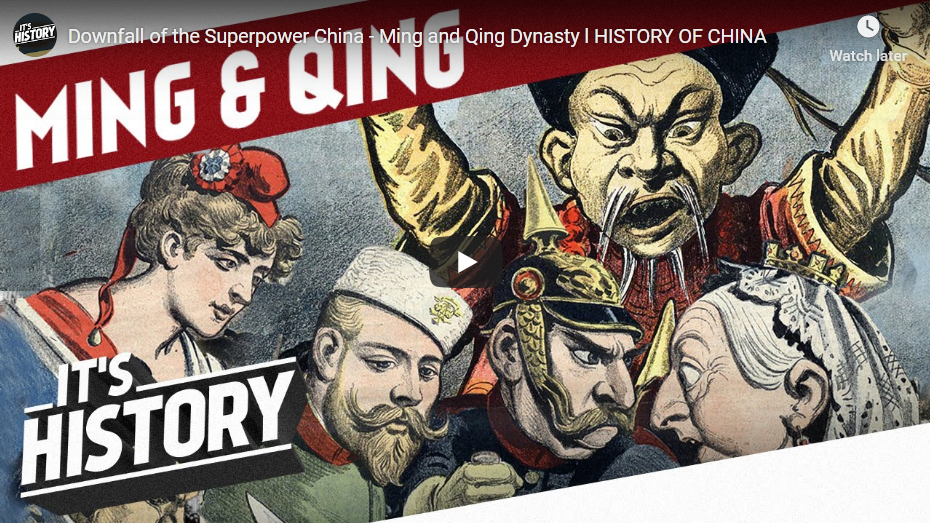
Downfall of the Superpower China – Ming and Qing Dynasty l HISTORY OF CHINA
IT’S HISTORY
Published 17 Aug 2015With the dynasties of the Ming and the Qing came social security and flourishing international trade. The White Lotus Movement advocated progressive thinking in the time of the conservative Ming dynasty. In 1616 the Qing dynasty came to power. Also known as the Manchu dynasty, the Qing refused to open their borders to limitless trade which led to frustrated European merchants. This caused hostility and mistrust of the “barbaric Chinese”. Shortly thereafter China’s economy lost its race against European Colonialism and would lose military influence after gunpowder reached Europe. All about the fall of the former Chinese superpower in this episode on IT’S HISTORY!
» SOURCES
Videos: British Pathé (https://www.youtube.com/user/britishp…)
Pictures: mainly Picture Alliance
Content:
Twitchett, Denis and Loewe, Michael. The Cambridge History of China. Cambridge University Press.
Wilkinson, Endymion, Chinese History: A New Manual. Harvard University, Asia Center
Loewe, Michael; Shaughnessy, Edward L. The Cambridge History of Ancient China. Cambridge University Press
John M. Roberts A Short History of the World. Oxford University Press
Xu, Pingfang The Formation of Chinese Civilization: An Archaeological Perspective. Yale University Press.
Fairbank, J. K.; Goldman, M. China: A New History. Harvard University Press. ”» ABOUT US
IT’S HISTORY is a ride through history – Join us discovering the world’s most important eras in IN TIME, BIOGRAPHIES of the GREATEST MINDS and the most important INVENTIONS.» HOW CAN I SUPPORT YOUR CHANNEL?
You can support us by sharing our videos with your friends and spreading the word about our work.» CAN I EMBED YOUR VIDEOS ON MY WEBSITE?
Of course, you can embed our videos on your website. We are happy if you show our channel to your friends, fellow students, classmates, professors, teachers or neighbors. Or just share our videos on Facebook, Twitter, Reddit etc. Subscribe to our channel and like our videos with a thumbs up.» CAN I SHOW YOUR VIDEOS IN CLASS?
Of course! Tell your teachers or professors about our channel and our videos. We’re happy if we can contribute with our videos.» CREDITS
Presented by: Guy Kiddey
Script by: Guy Kiddey
Directed by: Daniel Czepelczauer
Director of Photography: Markus Kretzschmar
Music: Markus Kretzschmar
Sound Design: Bojan Novic
Editing: Markus KretzschmarA Mediakraft Networks original channel
Based on a concept by Florian Wittig and Daniel Czepelczauer
Executive Producers: Astrid Deinhard-Olsson, Spartacus Olsson
Head of Production: Michael Wendt
Producer: Daniel Czepelczauer
Social Media Manager: Laura Pagan and Florian WittigContains material licensed from British Pathé
All rights reserved – © Mediakraft Networks GmbH, 2015
QotD: The legend of Rommel and the Afrika Korps
It’s an attractive image all around, and it is unfortunate that practically all of it is false. The desert was hardly a haven of beauty or romance. It was a pain, and fighting in it was a nightmare for both sides. Far from letting the respective tank fleets roam free, the desert chained them irresistibly to their supply lines, and a single failed supply convoy or a lost column of trucks could stop an entire offensive dead in its tracks. Contrary to the alleged mobility of desert warfare, both sides would spend far more time in static defensive positions, often quite elaborate, then they would launching tank charges.
That leaves us with Rommel. Here, too, we should challenge the mythology. He was hardly apolitical. His entire career had been based on Hitler’s favor, and we might reasonably describe his attitude toward the Führer as worshipful. He was Hitler’s fair-haired boy, a young officer repeatedly promoted over more senior candidates. He was a media creation. Nazi propaganda painted him not only as a garden-variety hero, but as a model National Socialist and Aryan, a man who could overcome stronger enemies through the sheer force of his will. He was not merely a passive bystander to the hype; he was an active accomplice. He loved nothing better than having a camera crew along with him on campaign, and he would regularly order scenes to be reshot if his posture was insufficiently heroic or the lighting had not shown him to best advantage. As is often the case, his relationship to the media was both self-serving and self-destructive. During the years of victory, the German propaganda machine used him as an example to the nation. When things went sour, he became a diversion from the increasingly bad news on other fronts. Finally, when he was no longer useful for any purpose at all, the regime dropped him altogether and eventually killed him.
Robert Citino, “Drive to Nowhere: The Myth of the Afrika Korps, 1941-43″, The National WWII Museum, 2012. (Originally published in MHQ, Summer 2012).
March 1, 2020
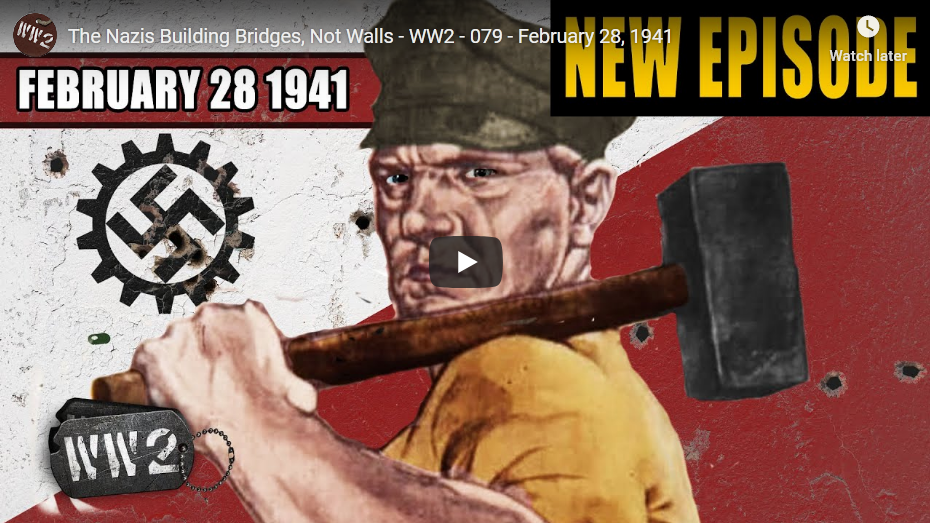
The Nazis Building Bridges, Not Walls – WW2 – 079 – February 28, 1941
World War Two
Published 29 Feb 2020Parts of the British forces in North-Africa are being send to Greece to strengthen the Allied position there. While the remaining British plan for the near future, others make huge advances in East-Africa and Hitler plans his attack on Greece through Bulgaria.
Join us on Patreon: https://www.patreon.com/TimeGhostHistory
Or join The TimeGhost Army directly at: https://timeghost.tvFollow WW2 day by day on Instagram @World_war_two_realtime https://www.instagram.com/world_war_t…
Join our Discord Server: https://discord.gg/D6D2aYN.
Between 2 Wars: https://www.youtube.com/playlist?list…
Source list: http://bit.ly/WW2sourcesWritten and Hosted by: Indy Neidell
Produced and Directed by: Spartacus Olsson and Astrid Deinhard
Executive Producers: Bodo Rittenauer, Astrid Deinhard, Indy Neidell, Spartacus Olsson
Creative Producer: Joram Appel
Post-Production Director: Wieke Kapteijns
Research by: Indy Neidell
Edited by: Mikołaj Cackowski
Map animations: Eastory (https://www.youtube.com/c/eastory)
Additional animation: Ryan WeatherbyColorizations by:
– Julius Jääskeläinen – https://www.facebook.com/JJcolorization/
– Norman Stewart – https://oldtimesincolor.blogspot.com/Sources:
IWM: E 2386, E 2372, E 2368, E 2388, E 450, E 1579, FL 10025
National Portrait Gallery
Letter by Mochammad Kafi from the Noun Project
Mil.ru
BASA (3K-15- 84-2, 3K-7-436-41)
Narodowe Archiwum Cyfrowe
Museum of Science and Technology BelgradeArchive by Screenocean/Reuters https://www.screenocean.com.
A TimeGhost chronological documentary produced by OnLion Entertainment GmbH.
The Black Death of the 14th Century
Ed West looks at what we know of the spread of the worst plague to hit western Europe in the 1300s:
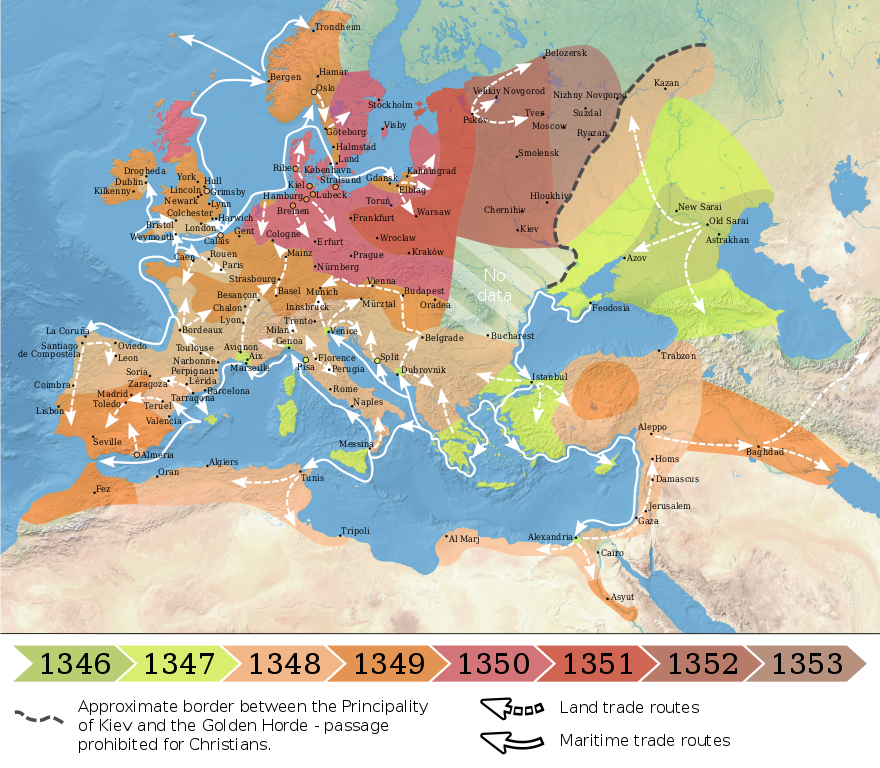
Map showing the spread of the Black Death in Europe between 1346 and 1353.
Map by Flappiefh via Wikimedia Commons.
There had never been a terror like it, and the “Great Mortality” as it was known — and much later, the “Black Death” — has seared itself in the European imagination. It changed the culture and tested the institutions of the time, and as we anxiously await the arrival of another — thankfully far less deadly — contagion from Italy its legacy and impact are worth remembering.
Epidemics have been around as long as civilization. Plaga — from the Greek for “strike” or “hit” — devastated classical Athens in the 5th century BC, when the historian Thucydides nursed sufferers; the Antonine Plague — probably smallpox or measles — killed as many as five million Romans at the empire’s peak. Far more deadly was the Plague of Justinian in the sixth century, which had a toll of 25 million and emptied whole regions of the eastern (Byzantine) Empire. Only in the 21st century did researchers confirm that this was the same illness that would appear eight centuries later — the Bubonic Plague.
Empires were particularly affected by these horrific epidemics, because empires are a form of globalisation — bringing different people into contact with each other and, more dangerously, into contact with other mammals, who act as disease vectors.
Another danger is climate change, which might turn a mild virus into a deadly one, or cause disease-carrying animals to migrate. This is what happened during the 14th century when the northern hemisphere became considerably cooler, soon after the Mongols had created the largest contiguous empire in history.
Genghis Khan’s people have generally received a historical bad press — people are more likely to recall the pyramid of skulls and the Tigris flowing black and red — yet their rule had opened up trade routes, allowing goods and people to cross Asia. Whether brought at the point of a sword or a trade deal, globalisation always brings the new: new cultures, new ideas, new languages and new pathogens.
Yersinia pestis had been living on gerbils and other rodents in central Asia, but unstable climate conditions in 1330s caused the disease to jump onto the rat flea. It was killing people by 1339, and in the mid-1340s Christians first heard of a disease raging in the Islamic world, which some at least took as divine punishment for the crusades.
After two centuries of Holy War this was understandable, yet hatred was not universal and during these conflicts Italian merchants had continually done business with Muslims, much to the Church’s fury. Now this trade, once the source of prosperity and peace, proved deadly: plague reached Europe via the Genovese colony of Caffa on the Black Sea (now Feodosiya, in the Ukraine). In October 1347, four ships escaping the diseased city had turned up in Sicily, condemning Italy to its fate.
The Freikorps Marches On Berlin – The Kapp Putsch I THE GREAT WAR 1920
The Great War
Published 28 Feb 2020Sign up for Curiosity Stream and Nebula: https://curiositystream.com/thegreatwar
Dissatisfied with the new German Republic and the terms of the Treaty of Versailles, parts of the new Reichswehr and the paramilitary Freikorps decide to take matters into their own hands. The Marinebrigade Ehrhardt marches on Berlin to topple the government: It’s the Kapp Putsch.
» SUPPORT THE CHANNEL
Patreon: https://www.patreon.com/thegreatwar
Merchandise: https://shop.spreadshirt.de/thegreatwar/» SOURCES
Grevelhörster, Ludwig: Kleine Geschichte der Weimarer Republik. 1918-1933. Ein
problemgeschichtlicher Überblick, 2000.
Haffner, Sebastian: Die Deutsche Revolution 1918/1919. 2010.
Heiden, Konrad: Adolf Hitler: Das Zeitalter der Verantwortungslosigkeit. Ein Mann gegen
Europa, 2016.
Kotowski, Georg (Hrsg.): Historisches Lesebuch. 1914-1933, 1968.
Möller, Horst: Die Weimarer Republik. Demokratie in der Krise, 2018.
Pöppinghege, Rainer: Republik im Bürgerkrieg. Kapp-Putsch und Gegenbewegung an Ruhr
und Lippe 1919/1920, 2019.
Stackelberg, Roderick & Winkle, Sally (Ed.), The Nazi Germany Sourcebook: An Anthology of Texts, (Florence : Taylor and Francis, 2003)
Ulrich, Volker: Adolf Hitler. Band 1: Die Jahre des Aufstiegs 1889-1939. 2013.
Sturm, Reinhard (2011). “Weimarer Republik, Informationen zur politischen Bildung”. Bonn: Bundeszentrale für politische Bildung.» SOCIAL MEDIA
Instagram: https://instagram.com/the_great_war
Twitter: https://twitter.com/WW1_Series
Reddit: https://reddit.com/r/TheGreatWarChannel»CREDITS
Presented by: Jesse Alexander
Written by: Mark Newton
Director: Toni Steller & Florian Wittig
Director of Photography: Toni Steller
Sound: Toni Steller
Editing: Toni Steller
Mixing, Mastering & Sound Design: http://above-zero.com
Maps: Daniel Kogosov (https://www.patreon.com/Zalezsky)
Research by: Markus Linke
Fact checking: Florian WittigChannel Design: Alexander Clark
Original Logo: David van StepholdA Mediakraft Networks Original Channel
Contains licensed material by getty images
All rights reserved – Real Time History GmbH 2020

“When you’re driving a fancy car, you’re an avatar for everyone else’s bad boss, useless trust-fund roommate, or absent workaholic father”
At Car and Driver, Ezra Dyer confirms what most of us already suspected about the folks who drive expensive rides:

Excuse us if you’ve already devoured the latest volume of the Journal of Transport & Health, but the March issue contains the results of a novel experiment that tested a cherished automotive stereotype. The study is entitled “Estimated Car Cost as a Predictor of Driver Yielding Behavior for Pedestrians,” but you can think of it as, “Are BMW drivers really jerks or what?”
Okay, so it was more nuanced than that. The authors of the study sent four pedestrians — black female, black male, white female, white male — to crosswalks in the Las Vegas area to see how many drivers would yield. The overall results were pretty dismal, with a yield rate of only about 28 percent out of 461 cars. Cars yielded more often to female and white pedestrians than male and nonwhite pedestrians, although not enough either way to register as statistically significant. The only factor that consistently predicted yielding behavior was the value of the car. Notably, the study’s authors estimated the book value on all 461 cars, so the 2004 Mercedes S-class that’s worth $5000 didn’t get ascribed automatic snob appeal.
[…]
However, if you’re driving an actual exotic, something way far up the food chain, behavior changes again. Everyone yields to the Rolls or the Lambo because cars like that are so over the top, they make you interesting by association. Plus: most people don’t know anybody with a car like that; thus they can’t associate it with anyone awful. The ultra-expensive car, and the driver, are a curiosity. What’s that guy’s deal? He probably invented that fake grass that goes between the pieces of sushi. And good for him! But the guy in the 911? He can wait an extra two turns at the four-way intersection. Probably deserves it.
Our not-scientific conclusions: If you expect fellow road users to demonstrate courtesy, you should drive either a 1984 Renault Alliance or a Lamborghini Aventador SVJ roadster. But either way, and to everybody in between: Yield at the damn crosswalks.
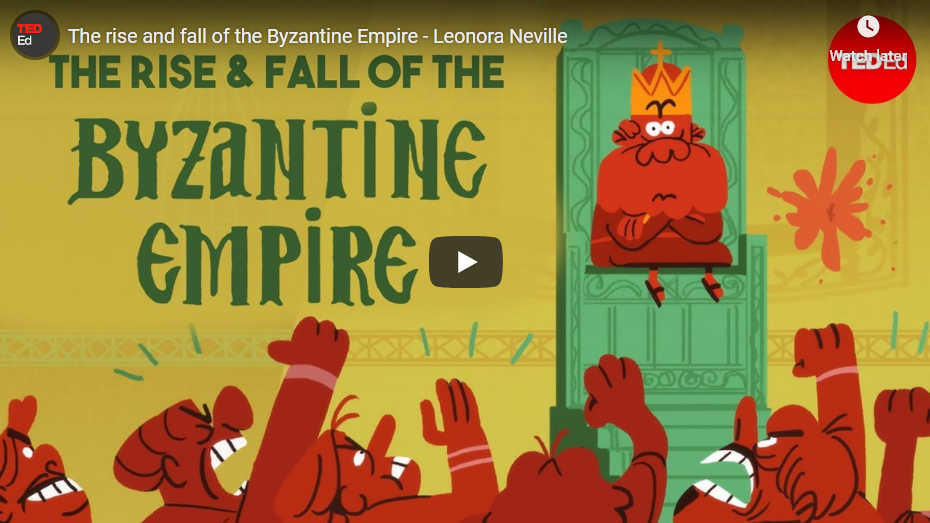
The rise and fall of the Byzantine Empire – Leonora Neville
TED-Ed
Published 9 Apr 2018Check out our Patreon page: https://www.patreon.com/teded
View full lesson: https://ed.ted.com/lessons/the-rise-a…
Most history books will tell you that the Roman Empire fell in the fifth century CE, but this would’ve come as a surprise to the millions who lived in the Roman Empire through the Middle Ages. This Medieval Roman Empire, today called the Byzantine Empire, began when Constantine, the first Christian emperor, moved Rome’s capital. Leonora Neville details the rise and fall of the Byzantine Empire.
Lesson by Leonora Neville, animation by Remus & Kiki.
Thank you so much to our patrons for your support! Without you this video would not be possible! Abhijit Kiran Valluri, Mandeep Singh, Sama aafghani, Vinicius Lhullier, Connor Wytko, Marylise CHAUFFETON, Marvin Vizuett, Jayant Sahewal, Quinn Shen, Caleb ross, Elnathan Joshua Bangayan, Gaurav Rana, Mullaiarasu Sundaramurthy, Jose Henrique Leopoldo e Silva, Dan Paterniti, Jose Schroeder, Jerome Froelich, Tyler Yoshizumi, Martin Stephen, Justin Carpani, Faiza Imtiaz, Khalifa Alhulail, Tejas Dc, Govind Shukla, Srikote Naewchampa, Ex Foedus, Sage Curie, Exal Enrique Cisneros Tuch, Vignan Velivela, Ahmad Hyari, A Hundred Years, eden sher, Travis Wehrman, Minh Tran, Louisa Lee, Kiara Taylor, Hoang Viet, Nathan A. Wright, Jast3 , Аркадий Скайуокер, Milad Mostafavi, Singh Devesh Sourabh, Ashley Maldonado, Clarence E. Harper Jr., Bojana Golubovic, Mihail Radu Pantilimon, Sarah Yaghi, Benedict Chuah, Karthik Cherala, haventfiguredout, Violeta Cervantes, Elaine Fitzpatrick, Lyn-z Schulte, cnorahs, Henrique ‘Sorín’ Cassús, Tim Robinson, Jun Cai, Paul Schneider, Amber Wood, Ophelia Gibson Best, and Cas Jamieson.
QotD: Women who “drag home strangers for a little nail-and-bail”
So, no, Sex and the City‘s Samantha isn’t a completely fictional character in how, after sex, she brushes men off herself like large, penis-equipped crumbs. […] I referenced research from anthropologist John Marshall Townsend, who discovered that Samantha’s post-sex detachment is pretty atypical — that many women who intend to use and lose a guy often find themselves going all clingypants the next morning.
Understanding what allows the Samantha type to escape this takes separating the women who have casual sex from those who feel okay about it afterward.
Women have casual sex for various reasons. For some, it seems the feminist thing to do — to prove they can do anything a man can do, whether it’s working on an oil rig or dragging home strangers for a little nail-and-bail. Townsend notes that women hook up because they aren’t ready for a relationship, because they’re trying to punch up their sex skills, or — as with rock groupies — to get some small piece of a guy they know is out of their league. Other women see hookups as the “free candy!” they can use to lure some unsuspecting man into the relationship van.
There’s a widespread belief, even held by some researchers, that higher testosterone levels in women mean a higher libido, but testosterone’s role in female desire is like that Facebook relationship status: “It’s complicated.” Research by clinical psychologist Nora Charles, among others, suggests that “factors other than … hormones” are behind which women become the Princess Shag-a-lots.
Personality seems to be one of those factors. In looking at what’s called “sociosexuality” — what sort of person has casual sex — psychologist Jeffrey A. Simpson finds that extraversion (being outgoing, exhibitionistic, and adventure-seeking), aggressiveness, and impulsivity are associated with greater willingness to have an uncommitted tumble.
However, once again, all the reasons a woman’s more likely to have casual sex don’t stop her from getting tangled up in feelings afterward. The deciding factor seems to be where she falls on what the late British psychiatrist John Bowlby called our “attachment system.” According to Bowlby, how you relate in close relationships — “securely,” “anxiously,” or “avoidantly” — appears to stem from how well your mother (or other primary caregiver) sussed out and responded to your needs and freakouts as an infant.
If she was consistently responsive (but not overprotective), you’re probably “securely attached,” meaning you have a solid emotional base and feel you can count on others to be there for you. This allows you to be both independent and interdependent.
Being “anxiously attached” comes out of having a caregiver who was inconsistently there for you (perhaps because they were worn thin) or who was overprotective. This leads to fear and clinginess in relationships (the human barnacle approach to love).
And finally, being “avoidantly attached” is a response to a cold, rejecting caregiver — one who just wasn’t all that interested in showing up for you. Not surprisingly, perhaps to avoid risking all-out rejection by being too demanding, the avoidantly attached tend to adapt by becoming people who push other people away.
It’s avoidantly attached women who social psychologist Phillip Shaver and his colleagues find can have casual sex without emotional intimacy — and, in fact, tend to see their “discard after using” attitude as a point of pride. (It sounds better to be a “sexual shopaholic” than a person with unresolved psychological problems.)
Amy Alkon, “Shaggedy Ann”, Advice Goddess, 2016-09-27.
February 29, 2020
Paul Sellers’ Desktop Organiser | Episode 4
Paul Sellers
Published 28 Feb 2020Our Desktop Organiser series was originally released for free on Woodworking Masterclasses, to see Episode 5 straight away click here: https://woodworkingmasterclasses.com/…
Episode 5 will be released on YouTube on Friday 13th March.
The main body of the box is ready for fitting the drawer front in preparation for cutting the half-lap dovetails. Precise fitting ensures neatness to the drawer’s final appearance, and here Paul focuses on the small details he uses in the day to day of drawer making. Small sizes demand higher levels of precision, and this box is a design Paul came up with to create this level of high-demand. Will you rise to the challenge?
For a free PDF of the drawing and cutting list, click here: https://paulsellers.com/desktop-organ…
——————–Want to learn more about woodworking?
Go to Woodworking Masterclasses for weekly project episodes: http://bit.ly/2JeH3a9
Go to Common Woodworking for step-by-step beginner guides and courses: http://bit.ly/35VQV2o
http://bit.ly/2BXmuei for Paul’s latest ventures on his blog
——————–
Instagram: http://bit.ly/2oWpy7W
Twitter: http://bit.ly/33S7RFa
Pinterest: http://bit.ly/35X5uTf

“And then, somewhat astonishingly, the Ontario Provincial Police actually upheld the law”
Chris Selley calls for some answers in the still-not-fully resolved railway disruptions by First Nations and climate activists and the calling-it-spineless-is-a-compliment reactions of various levels of government to widespread contempt for the law:
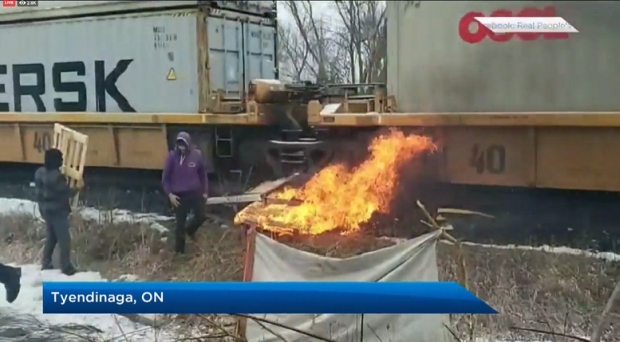
Screencap from a TV report on Mohawk Warriors attempting to set a freight car on fire along the Canadian National mainline through Tyendinaga near Belleville, Ontario.
When Canada’s ongoing spate of rail blockades finally peters out, this country has some work to do. A parliamentary committee might be up to the job, but even a full-on independent inquiry might not be excessive. A small group of Mohawks in Tyendinaga, Ont., in solidarity with an even smaller group of hereditary Wet’suwet’en chiefs, managed to blockade the Canadian National Railway for two weeks, not just holding hostage a chunk of the country’s economy, productivity and mobility, but demanding as ransom the cancellation of a liquefied natural gas pipelines that all First Nations affected by it, and it seems a comfortable majority of their residents, support.
It’s not a national disaster or anything. But as Prime Minister Justin Trudeau belatedly realized, it’s simply not an acceptable outcome in a democracy operating under the rule of law. And there is every reason to believe it could happen again — especially because we don’t really know how or why it ended when it did.
Operating at peak obnoxiousness, Trudeau had scolded those who demanded enforcement of a court order against the Tyendinaga blockade as boors, violence-mongers and idiots: “We are not the kind of country where politicians get to tell the police what to do,” he huffed. And then, frustrated by a lack of Sunny Ways among the federal government’s negotiating partners, he suddenly told the police what to do — or at the very least what he thought should happen.
[…]
The relatively undramatic end to the Tyendinaga blockade, after two weeks of dire warnings about Oka and Ipperwash reruns, raises another key question: Is there any reason we should believe it was safer to enforce the injunction on Day 14, as opposed to Day One or Two or Six?
Attempting negotiations was a perfectly sensible approach, even though it was very difficult to discern any room for compromise when one of the blockaders’ demands was so simple, blunt and inconceivable: shutting down the Coastal GasLink pipeline project. But the government is likely to face similarly unbending demands from future blockaders: Shutting down the Trans Mountain pipeline project, for example. Surely we can’t establish “two weeks of futility and then enforcement” as a policy moving forward. (Some might argue it was already established by a 13-day blockade of CN tracks near Sarnia, Ont., in 2013 — but that wasn’t nearly as crippling a blow to the railway’s operations.)
Police in Quebec were perfectly happy to enforce an injunction against a blockade on Montreal’s South Shore, which ended swiftly and without incident. Another on Mohawk territory in Kahnawake remains in place, and Premier François Legault has been excoriated for suggesting police face a heavily armed populace there — but at least it’s an attempt at an explanation. When it comes to the OPP’s inaction, we have none. For that matter, we probably deserve some insight into how protesters were able to set a roaring bonfire next to a moving train in Tyendinaga, wholly unmolested, just a couple of days after the blockade came down.
Forced-Air Cooling in an Experimental Ross Machine Gun
Forgotten Weapons
Published 28 Feb 2020http://www.patreon.com/ForgottenWeapons
https://www.floatplane.com/channel/Fo…
Cool Forgotten Weapons merch! http://shop.bbtv.com/collections/forg…
In addition to building three main patterns of straight-pull bolt action rifle for the Canadian military and the commercial market, Sir Charles Ross also experimented with self-loading rifles. Starting with a standard Ross Mk III, this experimental rifle has a gas piston and trigger to allow automatic fire and a very neat forced-air cooling system. A one-way ratchet mechanism (now broken, unfortunately) spins the fan when the bolt cycles, pushing air into a barrel shroud similar to that of a Lewis gun. This rifle was most likely made in 1915 or 1916 with an eye to a military light machine gun or automatic rifle contract — which never happened.
Thanks to the Canadian War Museum for providing me access to film this Ross for you!
Contact:
Forgotten Weapons
6281 N. Oracle #36270
Tucson, AZ 85740