The “mercantile system” is […] what we today commonly call “protectionism” or “economic nationalism.” By duping the general public into believing that the artificially promoted and protected profits and wages reaped by a handful of highly visible and politically powerful firms and workers are the same as — or are evidence of — a high standard of living for ordinary people nationwide, mercantilists convince members of the general public to accept government-imposed restrictions on their freedom to trade with foreigners. More succinctly, protectionists pull off the rather amazing feat of convincing ordinary people that their standard of living rises when government artificially increases the scarcity of the goods and services that they wish to consume.
Don Boudreaux, “Quotation of the Day…”, Café Hayek, 2017-12-17.
March 6, 2020
QotD: Mercantilism
March 5, 2020
True Beginner: Basic Sandpaper Sharpening
Rex Krueger
Published 4 Mar 2020Learn the cheapest and simplest beginner method for sharpening.
More video and exclusive content: http://www.patreon.com/rexkrueger
(more…)
“Maybe … Trump’s victory caused an unusual number of spontaneous abortions in Ontario”
Colby Cosh on the recently published findings of a p-hacking conspiracy study on how the election of President Donald Trump was reflected in the birth ratio of liberals in Ontario:

Front view of Toronto General Hospital in 2005. The new wing, as shown in the photograph, was completed in 2002.
Photo via Wikimedia Commons.
On Monday there came a surprising piece of science news from BMJ Open, an open-access title affiliated with the British Medical Journal. It seems two researchers from Mount Sinai Hospital in Toronto, an endocrinologist and a statistician, have convinced themselves that the election of Donald Trump to the American presidency in November 2016 had a nerve-shattering effect on Ontario. The province of Ontario, that is, not the Los Angeles suburb.
Trump’s victory, according to the researchers, was so awful that, like a war or a disaster, it briefly altered the sex ratio in live births in the province. This is, I should say, a fairly well-established effect of extreme social traumas. When mothers experience physiological stress, the uterine environment becomes less hospitable, and male fetuses, more vulnerable to such changes, become less likely to survive pregnancy. (This makes sense from a Darwinian standpoint, because girls are more valuable than boys in replacing population after a calamity.)
In 2020 nobody should need me to say that a cute, counterintuitive scientific “result” like this, appearing in the newspapers on literally the day of its publication, should be greeted with extreme skepticism. The sex ratio at birth, always expressed in medical literature as a ratio of boys to girls, tends to hover around 1.06 under natural circumstances. (Even in an advanced civilization, things even out within the age cohort over the next 20 years as the lads explore dirt bikes, rock fights, and roofs.)
The Mount Sinai researchers, Ravi Retnakaran and Chang Ye, had records of the sexes of all children born in Ontario from April 2010 to October 2017. Even in a place as large as Ontario, the ratio naturally bounces around randomly between 1.1 and 1.0, and there are seasonal effects that the duo corrected for.
There is no obvious signature of a Trump effect in a scatterplot of the adjusted data, which serves as a warning that the effect being claimed may be an artifact of analysis. But when you apply “segmented regression” using the same parameters as Retnakaran and Ye, you find that the (unadjusted) ratio dipped to 1.03 in March 2017, the fifth month after Trump’s win, and then climbed to 1.08 in June and July before reverting to the long-term norm.
Chain Your Woman to the Stove – Feminism in the 1930s | BETWEEN 2 WARS I 1938 Part 2 of 4
TimeGhost History
Published 4 Mar 2020Under the yoke of economic depression and more and more authoritarian rulers, Western women face renewed misogyny, patriarchy, and decreasing independence. But not all women think this is such a bad thing.
Join us on Patreon: https://www.patreon.com/TimeGhostHistory
Hosted by: Indy Neidell
Written by: Spartacus Olsson
Directed by: Spartacus Olsson and Astrid Deinhard
Executive Producers: Bodo Rittenauer, Astrid Deinhard, Indy Neidell, Spartacus Olsson
Creative Producer: Joram Appel
Post-Production Director: Wieke Kapteijns
Research by: Spartacus Olsson
Edited by: Daniel Weiss
Sound design: Marek KamińskiSources:
Bundesarchiv_Bild:
101III-Alber-174-14A, 102-04517A, 102-17313, 102-17818,
111-098-069, 137-055879, 146-1973-010-31, 146-1975-069-35,
146-1976-112-03A, 146-2006-205, 146-2008-0271,
183-2000-0110-500, 183-2005-0502-502, 183-2005-0530-500,
183-E10868, 183-E20457, 183-H28245, 183-J02040,
183-S08630, 183-S68014, 183-S68021, 183-S68029,
noun_pipe By Icon Lauk,
noun_company By wardehpillai,
noun_Farmer By Francisca Muñoz Colina.Colorizations by:
– Daniel Weiss
– Norman StewartSoundtracks from Epidemic Sound:
– “Sophisticated Gentlemen” – Golden Age Radio
– “The Inspector 4” – Johannes Bornlöf
– “Magnificent March 3” – Johannes Bornlöf
– “Last Point of Safe Return” – Fabien Tell
– “Step On It 5” – Magnus Ringblom
– “First Responders” – Skrya
– “Step Lightly” – Farrell Wooten
– “Try and Catch Us Now” – David Celeste
– “Not Safe Yet” – Gunnar Johnsen
– “The Dominion” – Bonnie Grace
– “The Charleston 3” – Håkan ErikssonA TimeGhost chronological documentary produced by OnLion Entertainment GmbH.
From the comments:
TimeGhost History
2 days ago (edited)
So, we take a little break from the geopolitical developments in 1938 to look at the situation of women in the Western World in 1938. We’ve received a lot of requests on the WW2 channel to cover the situation on the home fronts. While we do mention it in the weekly episodes, and War Against Humanity covers the horrid parts of it, WWII was so much more. It literally changed the world’s culture in just six years. To do that subject justice we have asked Anna to join us as host for a new monthly WW2 series: On the Homefront.A few years back Anna was a regular feature on German YouTube on her own channel and some of the bigger YouTube entertainment channels. She left YouTube to finish her studies, and because she was searching for more depth than YT entertainment content was offering her. As Astrid’s and my daughter, and having grown up with Indy around all the time, she has a passion for human history form childhood, especially cultural history.
She also has a personal relationship to this time through her grandparents, Herbert and Renate, Astrid’s parents who served in Germany during the war, on the front and at home. Herbert, a career administrator and later NCO in the Wehrmacht engineer corps, went on after the war to work for the British as translator, and then as a public servant supporting the creation of the Bundeswehr, the German defense forces, and eventually Germany’s contribution as NATO member.
Renate’s father, a bank director, died under mysterious circumstance in 1936 after repeatedly refusing to pay out money belonging to Jewish families to the Nazis. Her mother and sisters soldiered on under the Nazis as best they could, When the war broke out they first suffered under the Allied bombing, losing their home three times. When the bombing became a daily occurrence, Renate was drafted to the German flak and only barely survived the war.
Several years after the war Herbert and Renate met and started a family together. They both passed away only a few years ago, late enough so that Anna had a chance to spend countless hours over 23 years listening to their war stories, and what they took away from it: hope for a better world, and the knowledge that what happened in Germany between 1933 and 1945, must never happen again. Please join us to welcome Anna, our daughter to TimeGhost.
Spartacus

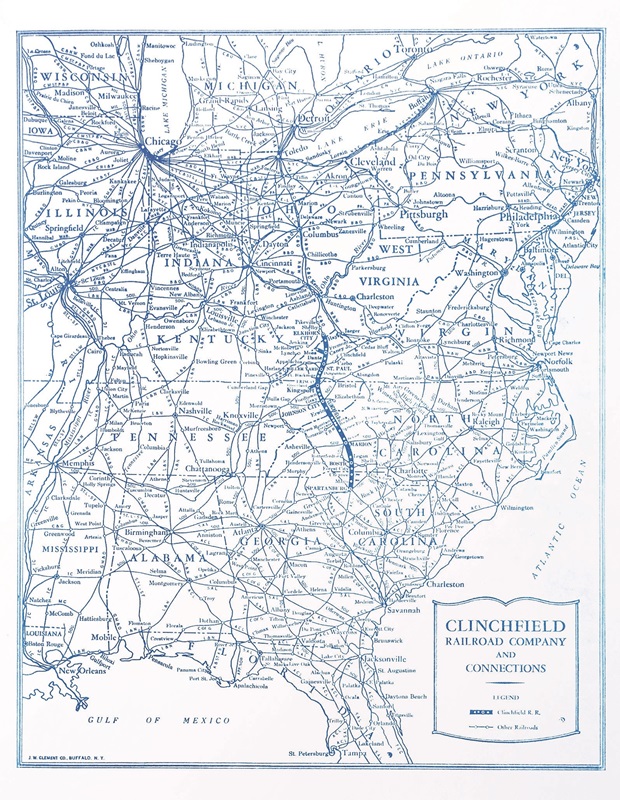
Fallen flag — The Clinchfield Railroad
This month’s fallen flag article in Classic Trains magazine recounts the story of the Carolina, Clinchfield & Ohio, later known as the Clinchfield Railroad:

Clinchfield Railroad SD40 locomotive number 3002 at Spartanburg, SC in February 1968.
Roger Puta photo via Wikimedia Commons.
The Clinchfield was different. It was conceived by men who had the vision and resources to do things right. It was built to the highest engineering standards of the early 20th century. It never went through a financial failure or reorganization. Indeed, the Carolina, Clinchfield & Ohio Railway was the antithesis of traditional railroad evolution.
In 1902, a wealthy regional businessman, George L. Carter, began stitching together an integrated industrial enterprise to develop vast coal deposits in the Clinch (River) Fields of southwest Virginia and to deliver the coal across the southern Appalachian mountains to markets in the Carolinas and to ships calling at Wilmington, Charleston, Savannah, and Jacksonville. Carter, from whom Howard Hughes could have learned a thing to two about secrecy, operated using the South & Western Railway banner. The name said everything … and nothing. The S&W was chartered from any point on the Atlantic Ocean to any point on the Great Lakes. Carter agents seized by legal means and/or physical occupation key terrain features through the mountains in competition with the Chesapeake & Ohio and the Southern Railway.
Clinchfield Railroad map. The Clinchfield’s 277-mile, 5-state line stretched from Elkhorn City, Kentucky, to Spartanburg, South Carolina.
Map via Classic Trains.Within that generous charter was the idea of building a railroad to haul coal south and merchandise in both directions between the Midwest and the Southeast. The plans also incorporated development of several on-line cities to consume coal and make products from regional resources to diversify and grow the freight business. Finally, a steamship line was organized to move coal beyond the ports to customers in the Caribbean.
By 1905, Carter realized he needed far more capital than he could personally provide. Reluctantly, he managed to convince Blair & Co., a big Wall Street investment house, to finance the project. M. J. Caples, an engineer with mining and railroad experience, laid out and then built a magnificent low-grade, high-capacity railroad. Tunnels, steel viaducts, generous fills, and rocky cuts appeared as needed. More than 4 percent (almost 10 miles) of the line was underground in 55 tunnels. With construction of the 277-mile railroad well advanced, its name was changed to Carolina, Clinchfield & Ohio Railway in 1908.
Coal began flowing across the 242 miles from Dante, Va., to Spartanburg, South Carolina, in 1909 while the owners and engineers debated how to cross the Cumberland mountains into the Ohio River valley. Between 1912 and 1915, a 35-mile extension including what was then the 10th-longest tunnel in the U.S. created a through route connecting Chesapeake & Ohio at Elkhorn City, Kentucky, with the three major southeastern carriers (Seaboard at Bostic, North Carolina; Atlantic Coast Line and Southern at Spartanburg). In constant-value dollars, the five-state CC&O was the most expensive railroad ever built in the U.S.
First Crusade | 3 Minute History
Jabzy
Published 20 Mar 2015I will try and cover the other Crusades soon

QotD: Champagne
Lily Bollinger
March 4, 2020
Resistance in China – Myth or Reality? – WW2 – War Against Humanity 009
World War Two
Published 3 Mar 2020The war in China already started in 1931 when Japan invaded Manchuria. Early resistance was small and was met by heavy Japanese retaliations. But throughout the 30’s, the movement started to grow.
Join us on Patreon: https://www.patreon.com/TimeGhostHistory
Or join The TimeGhost Army directly at: https://timeghost.tvFollow WW2 day by day on Instagram @World_war_two_realtime https://www.instagram.com/world_war_t…
Join our Discord Server: https://discord.gg/D6D2aYN.
Between 2 Wars: https://www.youtube.com/playlist?list…
Source list: http://bit.ly/WW2sourcesHosted by: Spartacus Olsson
Written by: Francis van Berkel
Produced and Directed by: Spartacus Olsson and Astrid Deinhard
Executive Producers: Bodo Rittenauer, Astrid Deinhard, Indy Neidell, Spartacus Olsson
Creative Producer: Joram Appel
Post-Production Director: Wieke Kapteijns
Research by: Francis van Berkel
Edited by: Mikołaj Cackowski
Map animations: Eastory (https://www.youtube.com/c/eastory)Colorizations by:
Norman Stewart – https://oldtimesincolor.blogspot.com/Sources:
Library of Congress
Narodowe Archiwum Cyfrowe
Chinese anti-Japanese posters, courtesy of pictoright
SHANGHAI, CHINA-1921Soundtracks from the Epidemic Sound:
Johan Hynynen – “Dark Beginning”
Yi Nantiro – “Watchmen”
Yi Nantiro – “A Single Grain of Rice”
Reynard Seidel – “Deflection”
Fabien Tell – “Last Point of Safe Return”
Andreas Jamsheree – “Guilty Shadows 4”
Rannar Sillard – “Split Decision”Archive by Screenocean/Reuters https://www.screenocean.com.
A TimeGhost chronological documentary produced by OnLion Entertainment GmbH.

Sir Philip Rutnam, former civil servant and new hero of the resistance
Brendan O’Neill on the unlikely new hero of the British bien pensant classes:
The liberal-left and even some on the supposedly radical left have a new hero: Sir Philip Rutnam. Yes, they’re now worshipping functionaries. They’re now falling at the feet of starched, bureaucratic civil servants. Worse, they seem to have completely forgotten about the Windrush scandal and the hostile environment policy – both of which were overseen by Sir Philip in his role as permanent secretary at the Home Office – in the rush to make him the hero of the hour. Why? Because Rutnam has crossed swords with Priti Patel, and the EU-pining, Boris-hating, populism-fearing left loathes nobody more than Priti Patel. Genghis Khan could have a pop at Priti and they’d be calling him a legend, such is the depth of their dislike for that “nasty woman”.
Official portrait of the Right Honourable Priti Patel, MP.
Photo by Richard Townshend.The speed and obsequiousness with which leftish people canonised Rutnam following his resignation on Saturday was alarming. Most of them probably hadn’t heard of him prior to his flounce, but suddenly he was a cross between Mother Teresa and Winston Churchill, the bestest civil servant of our time, the steady, wise, clever counter to the rabid ideologism of the Boris mob. A breathless Guardian editorial likened Boris Johnson’s government to the Jacobin terror, with its use of “studied recklessness” to “disrupt [and] demoralise” representatives of “the ancien regime“, like Sir Philip, the People’s Civil Servant, the Bureaucrat of our Hearts. Steady on, Guardianistas: Rutnam has only lost his job, not his head.
The rash, highly political beatification of Sir Philip hasn’t only airbrushed out of view the various screw-ups he has overseen, from fairly mundane screw-ups (while he was in transport) to truly immoral ones (like the Windrush scandal while he was at the Home Office). No, it also turns a blind eye to the unusualness and the cynicism of his extravagant resignation. Civil servants have been falling out with governments for as long as both have existed. But normally the civil servant in question would take it on the chin, slink off into obscurity (or maybe the Lords), and live out a plush retirement. Not Rutnam. He made his resignation into a political weapon. He seems to be out to undermine the elected government. That is more scandalous than Priti Patel allegedly asking civil servants why they are all so “fucking useless”.
The Patel / Rutnam clash is more than a personality problem. It’s about politics, and democracy. According to reports – and we must wait to see how true all this is – Rutnam “obstructed” Patel. He reportedly thought she wasn’t up to the job of home secretary and allegedly tried to hinder some of her priorities. If this is true, it looks like the unelected wing of government – the machinery of the civil service – seeking to block the wishes and programme of the elected wing of government. And now Rutnam is threatening to sue the government for constructive dismissal, which would further weaken Patel’s position, potentially hamper her Home Office work, and posit the bureaucracy against elected ministers.

England’s Secret Weapon: The Two Million Ton Megacarrier Made of Ice
Today I Found Out
Published 16 Feb 2018If you happen to like our videos and have a few bucks to spare to support our efforts, check out our Patreon page where we’ve got a variety of perks for our Patrons, including Simon’s voice on your GPS and the ever requested Simon Whistler whistling package: https://www.patreon.com/TodayIFoundOut
This video is sponsored by World of Warships
In this video:
Britain was taking a beating from the German ships and submarines and were looking for something to build a ship out of that couldn’t be destroyed by torpedoes, or at least could take a major pounding without incurring a fatal amount of damage. With steel and aluminum in short supply, Allied scientists and engineers were encouraged to come up with alternative materials and weapons.
Want the text version?: http://www.todayifoundout.com/index.p…

QotD: Tax cuts “for the rich”
This is why populism and nationalism, taken to their natural conclusions, always lead to statism. The state is the only expression of the national or popular will that encompasses everybody. So, the more you talk about how the fundamental unit of society is a mythologized collective called “The People” or the nation, the more you are rhetorically empowering the state.
Sure, the Constitution begins with the words “We the People,” but that is not a populist sentiment — it’s a statement of precedence in terms of authority: The people come before the government (not the European notion of the state). The spirit of the Constitution is entirely about the fact that The People are not all one thing. It places the rights of a single person above those of the entire federal government! It assumes not only that the people will disagree among themselves, but that the country will be better off if there is such disagreement. No populist frets about the tyranny of the majority. American patriots do.
But if you recognize that humans create wealth with their brains and their industry and that it therefore belongs to them, you’ll be a little more humble about the state’s “right” to take as much as it wants to spend how it wants. Human ingenuity is the engine of wealth creation, and there is no other.
But that doesn’t mean government doesn’t play a role. Because, as I said, there will be no wealth creation if there is no rule of law. There will be no investment or ingenuity if there is no guarantee that you will be able to collect on that investment or reap the benefits of your innovation. Without such an environment, the biggest mob wins. And when the mob wins, children starve to death in what should be one of the richest countries in the world.
Jonah Goldberg, “America and the ‘Original Position'”, National Review, 2017-12-22.
March 3, 2020
Michael Bloomberg, self-appointed nanny
Via Instapundit, Karen Kataline shares a look at the things that bother Michael Bloomberg about you:

Former New York City Mayor Mike Bloomberg speaking with supporters at a campaign rally in Phoenix, Arizona on 1 February, 2020.
Photo by Gage Skidmore via Wikimedia Commons.
Take Michael Bloomberg … please! What drives this man with the freedom to enjoy his wealth in 65 billion different ways, to spend his time trying to curtail the freedoms and choices of others, even down to the size soda they drink and the amount of salt they ought to be allowed to sprinkle on their spinach?
Coloradans know all too well that the former New York Mayor and Democratic Presidential Candidate spent boatloads of cash pushing state legislators to clamp down on their God-given right to defend themselves and their families. He has pushed freedom-sucking and blatantly biased “Red Flag” bills in numerous other states around the country.
Mayor Busybody simply can’t stop telling others what to do. It seems to be an obsession with him — or maybe, a compulsion too. I gained insight into this when I returned to a New York Times article from 2009 that described Bloomberg’s eating habits.
“He dumps salt on almost everything, even saltine crackers. He devours burnt bacon and peanut butter sandwiches. He has a weakness for hot dogs, cheeseburgers, and fried chicken, washing them down with a glass of merlot. And his snack of choice? Cheez-Its.”
Obsessive-Compulsive Disorder (OCD) is about control. Controlling one’s out-of-control thoughts, feelings, and behavior by attempting to control his external environment. Consciously or unconsciously, those afflicted do this in vain, to the point where they feel unable to control the compulsion as well (as in excessive hand-washing).
Most sufferers aren’t dangerous unless they have 65 billion dollars and a God-complex.
The Times went on to report this delicious insight:
“… he (Bloomberg) is known to grab food off the plates of aides and, occasionally, even strangers. (‘Delicious,’ he declared recently, after swiping a piece of fried calamari from an unsuspecting diner in Staten Island.)”
Behavior like this exhibits a staggering and extreme lack of boundaries. The Times seems to only snicker at this, but it’s painfully clear that Bloomberg has great difficulty respecting the basic boundaries of civil society. No wonder it’s so easy for him to help himself to your freedoms and your choices when he can’t stop helping himself to your calamari.
Arnhem by Antony Beevor Book Review
TIK
Published 18 Jun 2018Antony Beevor’s book Arnhem is good — but it contains a flawed argument. So flawed, that there’s a ton of counter evidence that shows it doesn’t work. Here, I will explain the events of the Nijmegen battle, what Beevor’s incorrect statement is, why he has to say it like he did, and how he could have done things differently.
Check out the pinned comment below for more information, notes, links, and sources.
Don’t forget to subscribe if you like history or gaming! And hit the little bell icon to be notified when videos like this are uploaded.
Please consider supporting me on Patreon and help make more videos like this possible https://www.patreon.com/TIKhistory
From the comments:
TIK
1 year agoSelected Bibliography/Sources
Brereton, L. The Brereton Diaries: The War in the Air in the Pacific, Middle East and Europe, 3 October 1941-8 May 1945. Kindle, 2014.
Frost, J. A Drop Too Many. Kindle, 2009.
Hastings, M. Armageddon. Pan Books, 2004.
Robert J. Kershaw, It Never Snows in September. Ian Allan Publishing, 2007.
Mead, R. General Boy: The Life of Lieutenant General Sir Frederick Browning. Kindle, 2010.
Middlebrook, M. Arnhem 1944: The Airborne Battle, 17-29 September. 2009.
Neillands, R. The Battle for the Rhine 1944. Kindle, 2014.
Poulussen, R.G. Lost at Nijmegen. Kindle, 2011.
Ryan, C. A Bridge Too Far. Kindle, 1974
Urquhart, R. Arnhem. Kindle, 1958.
Sosabowski, S. Freely I Served. Kindle, 1982.Links
My “REAL Operation Market Garden” documentary https://youtu.be/vTUC79o4Kmc
“The BAD BOY of Operation Market Garden” A video on General ‘Boy’ Browning https://youtu.be/Dvv8GQIRYVU
The “Who to Blame? John Frost on Operation Market Garden’s Failure” video https://youtu.be/7C_HoMVhKAI
My discussion of Market Garden’s True Purpose using Monty vs Eisenhower’s Memoirs https://youtu.be/f79KgQVL3MM
A video on Kampfgruppen where I talk about some of the Market Garden Kampfgruppen https://youtu.be/zKWczZkQ130
My Book review of It Never Snows in September https://youtu.be/-RRdWCyHpG8
My A Bridge Too Far Book Review video https://youtu.be/D6vDlbsOkQEAdd me on Twitter @TIKhistory
Thanks for watching, bye for now!

The bottled water and toilet paper hoarders of 2020
Arthur Chrenkoff on one of the oddest features of the current infectious disease panic:

“sold out of bottled water?” by Klara Kim is licensed under CC BY-NC-SA 2.0


This is happening alright, and it’s not some isolated incidents; on my Facebook news feed, at least half a dozen posts from friends in Sydney and Brisbane display photos of Venezuela-style empty shelves at their local supermarkets. The fear is real, and so is the hoarding.
OK, I can understand face masks and hand sanitisers walking off the shelves, as these are the crucial tools in containing the spread of the pandemic. Most face masks – as with so many other products in our shops – are made in China and in the current crisis conditions any new and additional supplies won’t make it out of the country, so whatever is already here is it. And it isn’t, as masks have been the first item to disappear from retail outlets from your local pharmacy to a Bunnings store.
I can also understand the non-perishable food supplies. Even though Australia could be quite self-sufficient if need be (minus the out of season imported fruit and veg), possibly people are stocking up not so much in fear the food will run out but out of reluctance to go out in the public in a few weeks’ time should the situation really turn into a zombie apocalypse. In any case, there is nothing wrong with having a well stocked pantry.
Where I start to no longer understand the consumers is bottled water. We are fortunate to live in a developed country where one can safely drink from a tap. There won’t be shortages of drinkable water under any circumstances – except for a complete societal collapse – and coronavirus is not a water-borne pathogen like those causing cholera or typhoid. If you are still paranoid, you can boil your water before ingesting (just make sure you cool it down).
But it’s the toilet paper that really gets me. Trust me, if things go really belly up, toilet paper is the least of your worries. Humanity has survived for tens of millennia without sanitary tissues, and in their absence any paper or rag or even running water will substitute nicely. Food, water, medicines, electricity, to name just four, are much more crucial in a time of crisis or emergency. Again, it’s true that a lot of toilet paper is manufactured in China or generally overseas and so potentially susceptible to shortages if manufacturing and international transport are affected as they are already. But how much toilet paper does your household require to function? Are you expecting you might need the iron rations of your favourite rolls to last for at least a few months? And if you think that you might not be able to restock on toilet paper until later this year, then – let me repeat myself – don’t you think you will have much bigger problems with ensuring your continuing survival to worry about?
As Norman Lewis points out, the worst hysterics are among the “elites”, not us lumpenproles:
Last week, the world stock markets suffered their worst week since the financial crisis in 2008, with $6 trillion wiped from shares and, in some markets, a sell-off at a rate not seen since the Great Depression almost a century ago. Why? Because global investors are in a panic about the potential economic fallout from the coronavirus epidemic.
Many commentators are making the point that this is mad. Ross Clark argues convincingly in the Spectator that the “most dangerous thing about coronavirus is the hysteria”. Philip Aldrick, economics editor of The Times, agrees. He says it is the “panic we should fear more than the virus itself”.
Our appetite for doom and fear of the unknown are offered as explanations for this behaviour. Risk culture and a predisposition to overreacting to threats are also certainly components of what is happening. But there is another equally important element linked to these that is not being raised – that this madness is not being driven by the “low-information”, knuckle-dragging, gullible ignorant masses, but by the information-rich, university-educated and refined global business and government elites.
The contrast between the responses to coronavirus from the elites and ordinary people has been stark. Even as the level of panic in the mainstream reporting around coronavirus has risen, ordinary people have just gotten on with their lives. The supposedly well-informed elites, who often accuse the “dumb” masses of being vulnerable to hysteria and “fake news”, have themselves been prodded into panic. Meanwhile, where they are not in lockdowns, ordinary people are still going to work, commuting, going to bars … They’re simply getting on with their lives, while taking note of the potential risks.
The elites are in free-falling panic; like a herd of wildebeest, panicked by the sight of a predator and rushing blindly across crocodile-infested waters, they have sparked a potential global economic meltdown. Meanwhile, we see stoic common sense, simple but profound wisdom, on the part of the “great unwashed”.
Type 89 Knee Mortar
Forgotten Weapons
Published 23 Sep 2015http://www.patreon.com/ForgottenWeapons
Hammer price: $2,500
The Type 89 grenade discharger, commonly known as the “knee mortar” was a Japanese light infantry weapon introduced in 1929 which blurs the lines between grenade launcher and mortar. Like a mortar, it fires propelled explosive bombs in a high-angle indirect fire role, but it has a rifled barrel and uses a range adjustment mechanism very different from most mortars.
The knee mortar proved to be a very capable and effective weapon in WWII against US forces. It was accurate, effective, and perhaps most importantly, light and very fast to put into action. The closest comparable US weapon was the 60mm light mortar, which had a more effective projectile but was significantly slower to use.
Of course, the “knee mortar” nickname was based on the theoretical belief that one was supposed to rest the curved baseplate of the weapon on a leg while firing, which would actually have resulted in a broken leg. The baseplate was curved to allow it to dig into soft soil and be used against objects like logs and roots.