
Rex Krueger
Published 14 Apr 2021How many clamps does it take to hold your woodwork? Turns out … not many.
More video and exclusive content: http://www.patreon.com/rexkrueger
Get my Five Essential Clamps (Links Below)
(more…)
April 15, 2021
Woodworking with very few clamps (maybe only 5)
Comments Off on Woodworking with very few clamps (maybe only 5)
Eichmann in Budapest
Alexander Faludy outlines the horrific “success” of Adolf Eichmann’s activities in Hungary in 1944:
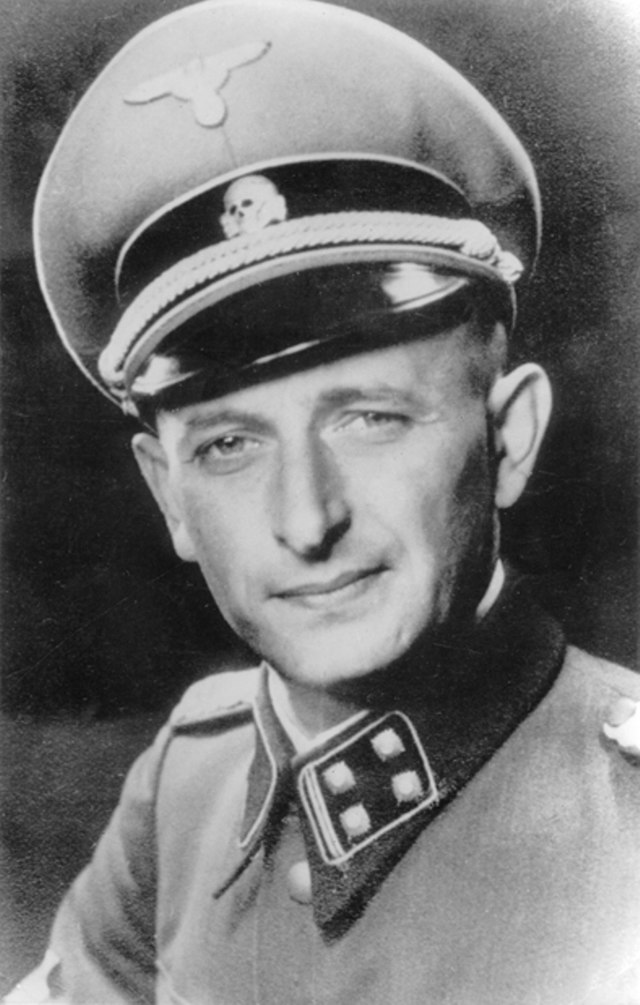
SS-Obersturmbannführer Adolf Eichmann (1906–1962), head of Reichssicherheitshauptamt (RSHA, Reich Security Central Office) Department IV B4 (Jewish affairs), who organized the deportation of Jews to the Auschwitz concentration camp in German-occupied Poland during the Holocaust. Taken in or around 1942, this appears to have been Eichmann’s official RSHA ID photograph.
Photographer unknown, public domain image via Wikimedia Commons.
SS Obersturmbannführer (Lt. Col.) Adolf Eichmann, head of Reich Security Main Office IV.B.4 (Jewish Affairs), arrived at Budapest’s Keleti railway station together with 19 subordinates on 21 March 1944. Just 48 hours had passed since German troops had marched into the country, and a car was waiting to take Eichmann to the city’s Astoria Hotel close to the Pest riverbank. From these incongruously elegant surroundings Eichmann would commence the most feverous episode in the Final Solution of the Jewish question in Europe: the destruction of the Jews of Hungary, the only chapter in its history he was to supervise in person and in full.
For speed and scale the deportations went unmatched: 424,000 people were despatched by train in just 52 days, from 14 May to 9 July. In this fleeting window Hungarian Jews became the single largest group gassed at Auschwitz. The crematoria couldn’t cope with such “over-supply”, and Commandant Rudolf Höß ordered special fire pits dug — filling the camp with noxious smoke. According to Primo Levi, “there were weeks when only Hungarian was heard in Auschwitz”.
Physical annihilation was undergirded by Eichmann’s elaborate psychological strategy. Sophisticated Budapest Jews who might escape or resist were pacified by newspaper reports that only “ost Juden” from Hungary’s nether regions were being removed as “undesirables”. Many only saw through the lie, if at all, when deportations reached Budapest’s outer suburbs in early July — just before Admiral Miklós Horthy, Hungary’s Head of State, halted them under diplomatic pressure from the Western Allies and neutrals.
Throughout the deportations, and across Hungary’s length, Eichmann deluged Jews with ever more complex regulations covering the minutiae of daily life. These instilled a false sense of permanence which inhibited hiding or escape: “why would the authorities go to all this trouble if they were just going to get rid of us?”
Even as deportations rolled on, Eichmann conducted elaborate negotiations for fanciful “rescue schemes” including, but not limited to, the infamous “Blood for Trucks” project involving Rudolf Kastner — the proposed barter of one million Jewish lives for 10,000 Western motor vehicles for use on the Eastern front against the USSR. The aim, Eichmann later acknowledged, was not just to split Western powers from the Soviets, but also to distract Hungary’s Jewish leaders from counter-organising: keeping minds busy and hopes alive.
All the while Eichmann treated Jewish leaders in Budapest to flashes of menace. One day he promised them a return to normality “after the war”, the next he would snarl “Do you know who I am? I am a bloodhound!” With studied cruelty Eichmann arranged the ghettoisation of Hungary’s Jews to begin on Sunday, 16 April: the first day of Passover, 1944.
Eichmann did many things in Hungary; the one thing he did not do was simply “obey orders” — indeed over time he defied them with gathering frequency. That autumn as inevitable defeat became ever more apparent Eichmann, helped by local enthusiasts, intensified his efforts, instigating newly inventive means of eliminating Jews in Hungary and the Balkans through “death marches” and localised killing sprees. In doing so, Eichmann subverted instructions from Himmler who ordered cessation as part of a delusional plan to negotiate with the allies.
This “Eichmann in Budapest” should be recalled while contemplating the later Eichmann in Jerusalem.
Comments Off on Eichmann in Budapest
Britain Goes From Trainer to Competition: the No 8 Mk I
Forgotten Weapons
Published 18 Jun 2018http://www.forgottenweapons.com/brita…
http://www.patreon.com/ForgottenWeapons
Cool Forgotten Weapons merch! http://shop.bbtv.com/collections/forg…
Initially intended to be used only by the British Army (the Land Service), in 1950 the No8 rifle’s role was expanded to cover all three services. Unlike the other trainers made up to this point, the No8 MkI was designed as a target and competition rifle, instead of a service rifle reduced in caliber. It has a heavy barrel, a nice trigger converter to cock on open, and a heavy competition type stock. Adopted in 1948 or 1949 (sources differ), a whopping 76,000 were ordered and manufactured by BSA and Fazackerly — they remained in service until finally declared obsolescent by the British in 2014.
If you enjoy Forgotten Weapons, check out its sister channel, InRangeTV! http://www.youtube.com/InRangeTVShow
Contact:
Forgotten Weapons
6281 N Oracle #36270
Tucson, AZ 85704

Comments Off on Britain Goes From Trainer to Competition: the No 8 Mk I
QotD: The “evil” of profits
The slogan into which the Nazis condensed their economic philosophy, viz., Gemeinnutz geht vor Eigennutz (i.e., the commonweal ranks above private profit), is likewise the idea underlying the American New Deal and the Soviet management of economic affairs. It implies that profit-seeking business harms the vital interests of the immense majority, and that it is the sacred duty of popular government to prevent the emergence of profits by public control of production and distribution.
Ludwig von Mises, Planned Chaos, 1947.
Comments Off on QotD: The “evil” of profits
April 14, 2021
War Stories We Didn’t Get to Tell – WW2 – Reading Comments
World War Two
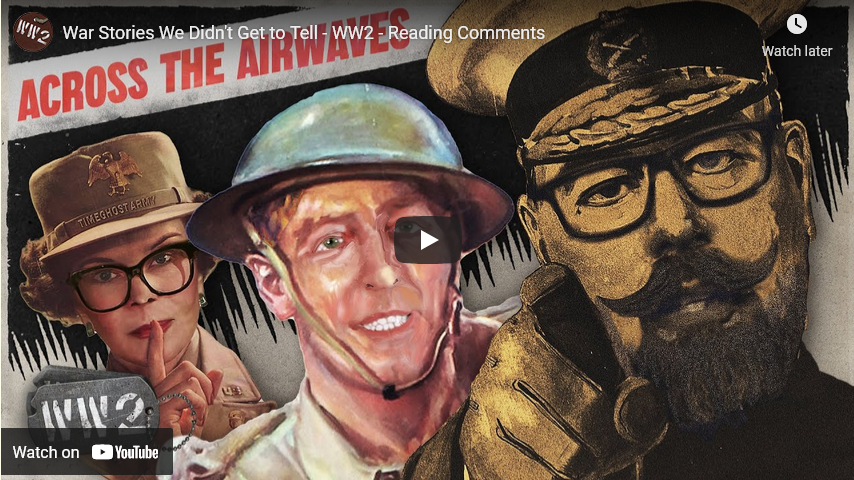
Published 13 Apr 2021Another edition of Across the Airwaves, where Indy, Sparty, and Astrid look at interesting and unique comments from our videos. In this episode, some amazing war stories that we didn’t get to tell.
Join us on Patreon: https://www.patreon.com/TimeGhostHistory
Or join The TimeGhost Army directly at: https://timeghost.tvFollow WW2 day by day on Instagram @ww2_day_by_day – https://www.instagram.com/ww2_day_by_day
Between 2 Wars: https://www.youtube.com/playlist?list…
Source list: http://bit.ly/WW2sourcesHosted by: Indy Neidell, Spartacus Olsson, and Astrid Deinhard
Director: Astrid Deinhard
Producers: Astrid Deinhard and Spartacus Olsson
Executive Producers: Astrid Deinhard, Indy Neidell, Spartacus Olsson, Bodo Rittenauer
Creative Producer: Maria Kyhle
Post-Production Director: Wieke Kapteijns
Edited by: Karolina Dołęga
Sound design: Marek Kamiński
Map animations: Eastory (https://www.youtube.com/c/eastory), Karolina DołęgaSources:
– Bundesarchiv
– Library of Congress
– Australian War Memorial
– Icons from the Noun Project: Boat by Richard Cordero, captain by Gan Khoon Lay, Mine Ship by Luke Anthony Firth, Wrench by Gregor Cresnar
– Explosion animation by Ignisium from YouTube
– Uboat.net, picture of SS Oklahoma courtesy of Texaco ArchivesSoundtracks from Epidemic Sounds:
– “Other Sides of Glory” – Fabien Tell
– “London” – Howard Harper-Barnes
– “Deflection” – Reynard Seidel
– “The Inspector 4” – Johannes Bornlöf
– “What Happens in the Park” – Claude SignetArchive by Screenocean/Reuters https://www.screenocean.com.
A TimeGhost chronological documentary produced by OnLion Entertainment GmbH.
From the comments:
World War Two
2 hours ago (edited)
Day in day out, we review thousands of comments from people across the world. It’s always heartening to come across the ones that are particularly interesting, educational, touching, or even funny. This format, “Across the Airwaves”, is a great way for us to interact directly with our community and in this episode, Indy, Sparty and Astrid mainly look at comments from people offering extra details and analysis that we didn’t have the chance to include in our regular content.Hope you enjoy hearing them. A big thanks to our community, especially our TimeGhost Army members.
Comments Off on War Stories We Didn’t Get to Tell – WW2 – Reading Comments
Schrödinger’s photo ID requirements
Mark Steyn notes the odd inconsistency of US authorities insisting on or ignoring the need for photo ID for different demographics. So much for equal treatment in the United States.

“TSA Checkpoint” by phidauex is licensed under CC BY-NC-SA 2.0


Whenever you fly anywhere in America, you require picture ID — so that, when you get to the head of the great endless security line, the TSA agent can get out his jeweler’s loupe and examine how the ink lies on the paper. And, when he’s finished doing that, he can fish out his UV light to study the watermark on your ID.
Which is all bollocks even by the standards of American security-state bureaucracy. Why bother going to all the tedious trouble of fake ID when real ID is so easy to acquire? On September 11th 2001, four of the terrorists boarded the flight with genuine, valid picture ID issued by the state of Virginia and obtained through the illegal-immigrant day-workers’ network run out of the parking lot of the 7-Eleven in Falls Church.
If that didn’t get Americans mad about the cosseting of the undocumented, I doubt they’ll care a fig about this latest privilege. But I thought it worth mentioning anyway: While you’re stuck with the Loupe & Light guy poring over your ID, the federal government announced last week that migrants crossing the southern border will be permitted to fly within the United States without any valid ID. You’re on orange alert now and forever, they’re in the express check-in.
This is where selective enforcement of the laws always leads — to a broader contempt for all law, and an end to equality before the law. In 2021 no developed nation needs mass unskilled immigration. Some have it for historical reasons — a hangover of empire, as in Britain and France; some have it for sentimentalist pseudo-humanitarian reasons, as in Sweden and Norway. But neither of these rationales account for what the laughably misnamed Department of Homeland Security is doing at America’s southern border.
Comments Off on Schrödinger’s photo ID requirements
Tank Chat #103 | Laird Centaur | The Tank Museum
The Tank Museum
Published 15 May 2020David Fletcher looks at this curiosity from the 1970’s, a Land Rover with tracks. Currently housed in The Tank Museum’s Vehicle Conservation Centre.
Support the work of The Tank Museum on Patreon: ► https://www.patreon.com/tankmuseum
Visit The Tank Museum SHOP & become a Friend: ► tankmuseumshop.orgTwitter: ► https://twitter.com/TankMuseum
Instagram: ► https://www.instagram.com/tankmuseum/
Tiger Tank Blog: ► http://blog.tiger-tank.com/
Tank 100 First World War Centenary Blog: ► http://tank100.com/
#tankmuseum #tanks

Comments Off on Tank Chat #103 | Laird Centaur | The Tank Museum
QotD: Emmanuel Goldstein, the Enemy of the People
Goldstein was delivering his usual venomous attack upon the doctrines of the Party — an attack so exaggerated and perverse that a child should have been able to see through it, and yet just plausible enough to fill one with an alarmed feeling that other people, less level-headed than oneself, might be taken in by it …
The sight or even the thought of Goldstein produced fear and anger automatically … But what was strange was that although Goldstein was hated and despised by everybody, although every day and a thousand times a day, on platforms, on the telescreen, in newspapers, in books, his theories were refuted, smashed, ridiculed, held up to the general gaze for the pitiful rubbish that they were — in spite of all this, his influence never seemed to grow less. Always there were fresh dupes waiting to be seduced by him. A day never passed when spies and saboteurs acting under his directions were not unmasked by the Thought Police.
George Orwell, Nineteen Eighty-Four, 1949.
Comments Off on QotD: Emmanuel Goldstein, the Enemy of the People
April 13, 2021
The Washington Naval Treaty – The parties, the motives, the negotiations, the loophole abuse…
Drachinifel
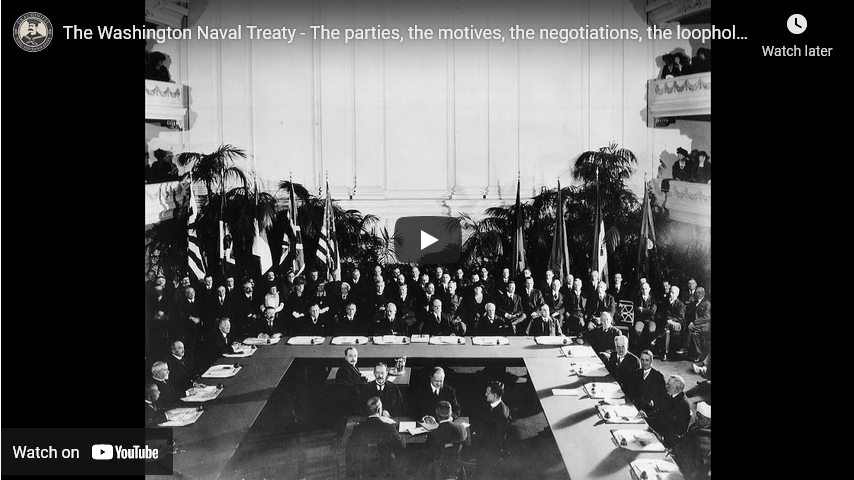
Published 10 Feb 2021Today we look at the Washington Naval Treaty, why it came to be, the broad aspects of negotiation, what it meant and how people turned it into a legal pretzel.
Sources:
http://www.ibiblio.org/pha/pre-war/19…
www.amazon.co.uk/dp/B00KIXWLE2
www.amazon.co.uk/Kaigun-Strategy-Technology-Imperial-1887-1941-ebook/dp/B01DRYEMH2
www.amazon.co.uk/Treaty-Cruisers-RE-ISSUE-International-Competition/dp/1526748509
www.amazon.co.uk/Naval-Policy-Between-Wars-Anglo-American/dp/1473877407Free naval photos and more – www.drachinifel.co.uk
Want to support the channel? – https://www.patreon.com/Drachinifel
Want a shirt/mug/hoodie – https://shop.spreadshirt.com/drachini…
Want a poster? – https://www.etsy.com/uk/shop/Drachinifel
Want to talk about ships? https://discord.gg/TYu88mt
Want to get some books? www.amazon.co.uk/shop/drachinifelDrydock
Episodes in podcast format – https://soundcloud.com/user-21912004
From the comments:
Gamebook
2 months ago (edited)
The Americans didn’t want to build the ships, but could have afforded to do so.
The Japanese did want to build the ships, but couldn’t have afforded to do so.
The French wanted other people to think that they wanted to build the ships and could afford to do so, but in fact they didn’t want to and couldn’t have afforded to do so.
The Italians did not want the French to build the ships, and thought they had prevented them from doing so, but in fact see above. The Italians themselves could not afford to build the ships any more than the French could.
The British sort of wanted to build the ships, and could sort of have afforded to do so, but would rather everyone just restrained themselves as that would leave the Royal Navy in a better position than they could have paid for in the event of another naval arms race.
Comments Off on The Washington Naval Treaty – The parties, the motives, the negotiations, the loophole abuse…
“… loving a country also means being honest. We should never get high on our own own flag-covered, syrup-scented supply.”
In The Line, Lauren Dobson-Hughes sits Canada down for a bit of an intervention:

Once upon a time, there was a fairytale castle with soaring turrets and gabled windows. The castle had long been undergoing renovations, so the owners draped the scaffolding with trompe l’oeil cloths — fabric imprinted with the image of the historical building beneath, to maintain an impression of the beauty hidden below.
From the cloth, you imagined the castle must be stunning. And yet behind the façade, it is crumbling. Its walls are mold-ridden, and the floors are rotten. The scaffolding props up a shell.
This metaphor has come to represent the way I’ve come to think about Canada since this pandemic began. As a country, we are so fixated on the mythology we project out to others — the trompe l’oeil cloth — that we’ve allowed the actual capacities, systems and structures of our country to crumble.
The first inkling came early in the pandemic. As COVID-19 numbers rose, it was revealed that the Public Health Agency of Canada did not have nationwide case numbers. This piece delves further, but “Ottawa does not have automatic access to data in [provincial and territorial] systems.” Provinces were sending daily case numbers to Ottawa on paper. This is one small example, but a revealing one. In fact, we lack a nationwide public-health system at all. And as the auditor-general’s report showed, we also lack the knowledge and expertise — the skilled people — to manage crises like this, too.
Then came protracted discussions about financial support for Canadians affected by lockdowns. The debate was not about whether Canadians deserved help — it was that Canada’s financial systems are so outdated and disjointed, that we literally could not work out how to get money from the federal government into bank accounts. It shouldn’t be this complex. In a functioning country, the central revenue agency should be able to transfer money to people without task forces of bureaucrats and experts, the establishment of new IT systems, and McGyvering an assortment of existing programs.
[…]
The list it goes on — the chaotic vaccine roll-out, the fractured public communications, the devolving of responsibilities to the very most local level with little overarching purpose or even organization. All of it marked by disjointed, outdated systems, lack of skills and know-how, and no overall goal or narrative. We need to face it — we have allowed our nation to crumble from the inside, while holding tight to the mythology that we’re an effective, functioning country.
At this point, I feel the need for a disclaimer that I love Canada. But loving a country also means being honest. We should never get high on our own own flag-covered, syrup-scented supply.
Comments Off on “… loving a country also means being honest. We should never get high on our own own flag-covered, syrup-scented supply.”
Was it REALLY the WAR of NORTHERN AGGRESSION?!?!?!
Atun-Shei Films
Published 28 Apr 2020Checkmate, Lincolnites! Debunking the Lost Cause myths that Abraham Lincoln was a tyrant, that nobody in the North cared about slavery or abolitionism, and that the warmongering Union invaded the South without provocation or just cause during the Civil War. Featuring some special guest appearances from your favorite kooky historical characters!
[Update, 8 Feb, 2023: Here’s a Vlogging Through History reaction video that amplifies several of the points Atun-Shei makes – https://www.youtube.com/watch?v=rTQzXG15QsU]
(more…)
Comments Off on Was it REALLY the WAR of NORTHERN AGGRESSION?!?!?!
QotD: The Hundred Years’ War and information velocity
… at least in the early phases of the war. Low information velocity meant that even big changes at the top — the capture of the King at Poitiers, say — didn’t have much impact out in the sticks. By the time you found out about it, you’d been “subjects” of “England” for months, years, decades. Whatever, it didn’t matter, since the whole thing worked like loan sharking in Mob movies. Does it matter if it’s Rocco or Vito who’s collecting the vig this week? Maybe the Godfather got rubbed out, and now all the under-bosses from the Solozzo family report to the new capos of the Corleone family. None of that matters to you. All you know is, the new guy is going to break your legs if you don’t pay, same as the old guy would’ve done.
By the war’s later phases, though, the velocity of information had dramatically increased. Necessity is the mother of invention, and the French have always had a knack for cultural propaganda. Joan of Arc wasn’t worth much, militarily, but it’s one hell of a story, the kind that rallies troops. Nobody cares who the legal King of France is — that is, the guy whose name the lawyers finally hack out of the undergrowth of however-many family trees. The guy who is divinely anointed, though, by a prophet, in person? That’s a big deal. That’s the kind of story that spreads like lightning; the kind of story that makes “France” far more than just the name at the top of the org chart.
Moreover, the new guy — the divinely ordained guy — is competent. You can tell, because he’s winning. Your average feminist scholar knows as much about strategy as she does about heterosexuality, so we can ignore all their claims about Joan’s military genius. There are times when total incompetence is, in fact, a virtue, and this was one of them. Joan’s military strategy didn’t make any sense, because she wasn’t thinking in military terms — which is why it worked. Victory followed victory, until the English got wise … by which point it didn’t matter, because the Dauphin had been crowned as Charles VII and had solidified power behind him. In fact, you don’t have to be Machiavelli to see that Joan’s capture and execution by the English were all to Charles’s benefit — Charles gained a martyr to his cause, but only after Henry VI finally managed to beat a little girl. Information velocity guaranteed that both stories were all over France almost from the minute they happened.
Over in England, meanwhile, it was their turn to have an insane, incompetent king, and we know how that turned out. The point is, you can have a bad king. You can have a mad king. You can even have a bad, mad king and things can still work out ok — see Charles VI, who remained King of France for 42 years of the Hundred Years’ War despite believing he was made of glass — provided your mad, bad king reigns in a period of low information velocity. Not that things were hunky-dory in France from 1380-1422 — you know, Agincourt and all that — but the Charles VII who was anointed by God via Joan of Arc was the mad, bad guy’s direct lineal descendant. Charles VII’s main antagonist, Henry VI, was also a mad, bad king, and his successor, Henry Tudor … well, you know. I don’t think it’s an accident that the printing press was invented in the 1440s and made its first appearance in England in 1476, in the nastiest part of the Wars of the Roses.
Severian, “Crises”, Rotten Chestnuts, 2020-12-25.
Comments Off on QotD: The Hundred Years’ War and information velocity
April 12, 2021
The Constitution of the Spartans
Historia Civilis
Published 11 Sep 2017Patreon | http://historiacivilis.com/patreon
Donate | http://historiacivilis.com/donate
Merch | http://historiacivilis.com/merch
Mailing List | http://historiacivilis.com/mailinglist
Twitter | http://historiacivilis.com/twitter
Website | http://historiacivilis.comSources:
The Constitution of the Spartans, by Xenophon: http://amzn.to/2j7JXTB
The Moralia, by Plutarch: http://amzn.to/2gNMYHU
Parallel Lives: The Life of Lycurgus, by Plutarch: http://amzn.to/2xS29nI
Politics, by Aristotle: http://amzn.to/2wMq5ss
Rhetoric, by Aristotle: http://amzn.to/2xS3niO
Laws, by Plato: http://amzn.to/2wLpsiN
On the Republic, by Cicero: http://amzn.to/2j7Flgg
The Histories, by Herodotus: http://amzn.to/2xdH4a7
The Spartan Regime, by Paul A. Rahe: http://amzn.to/2vPmRqS
Property and Wealth in Classical Sparta, by Stephen Hodkinson: http://amzn.to/2xdV7MS
The Rise of Athens, by Anthony Everitt: http://amzn.to/2j69uMS
Persian Fire, by Tom Holland: http://amzn.to/2vPyCxEWe are a participant in the Amazon Services LLC Associates Program, an affiliate advertising program designed to provide a means for us to earn fees by linking to Amazon.com and affiliated sites.
Music:
“Air Hockey Saloon,” by Chris Zabriskie
“Candlepower,” by Chris Zabriskie
“CGI Snake,” by Chris Zabriskie
“Heliograph,” by Chris Zabriskie
“Hallon,” by Christian Bjoerklund
From the comments:
Temporary Fakename
3 years ago
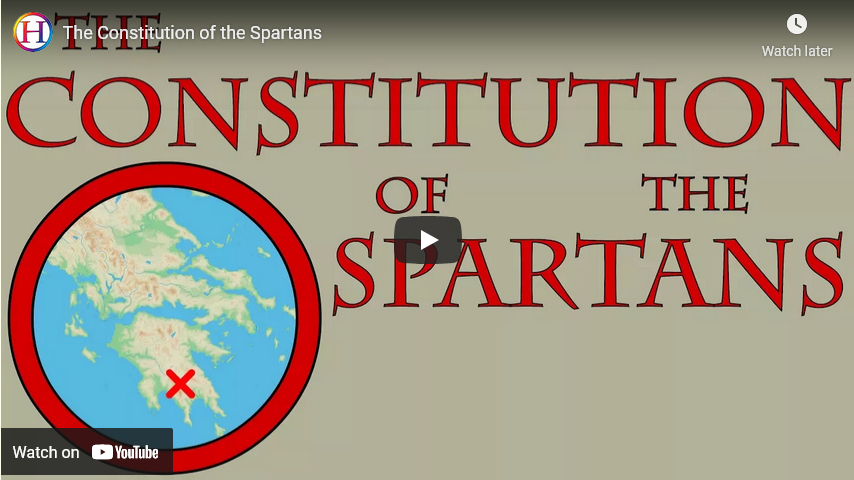
You know, i thought the Roman political system was pretty odd and arcane. But the Spartans have a dual monarchy that has absolute power, except when it doesn’t, an elected Senate that is chosen partially randomly that can pass whatever the hell they want with a public assembly and punish kings, except when an all-male aristocracy decided no, a female aristocracy that is overwhelmingly rich but can’t vote, and a population so terrified of its own slaves that it ritually committed atrocities against them. Compared to that Roman politics look simple and elegant.
I found the presentation quite interesting and informative, but I felt that some discussion of the differences between the terrible plight of the Helots and the not-quite-free status of the Perioikoi was merited. I also felt that the final segment on the eventual decline of Sparta missed a major factor — Spartan military defeats in the Battle of Leuctra in 371 BC and the Battle of Mantinea in 362 BC — but reading down in the comments, I saw someone else had already brought this up:
xelena
2 years ago (edited)
This is a good video, but is missing a super important point at the end: The cause for the decline of Spartan power was its defeat by Epaminondas of Thebes and his freeing of Messenia (the land of the Helots). He also founded Messene in Messenia and Megalopolis in Arcadia for the Helots, which became a powerful check to Sparta. Spartan power never recovered from this death blow to its slave economy and continued to wither away into the nothingness you describe.Epaminondas is mostly forgotten today, but he was one of the greatest men of antiquity. It was him and Pelopidas who put to bed the myth of Spartan invincibility and freed an entire people who had been enslaved for centuries. So in a way, the crippling blow did come from other Greeks, and the Helots did participate in it.
Comments Off on The Constitution of the Spartans
“War Communism” in the Soviet Union, 1917-1921
J.W. Rich outlines the economic and humanitarian disaster of Soviet “War Communism” that eventually forced Lenin to bring back some limited elements of capitalism to save the country:
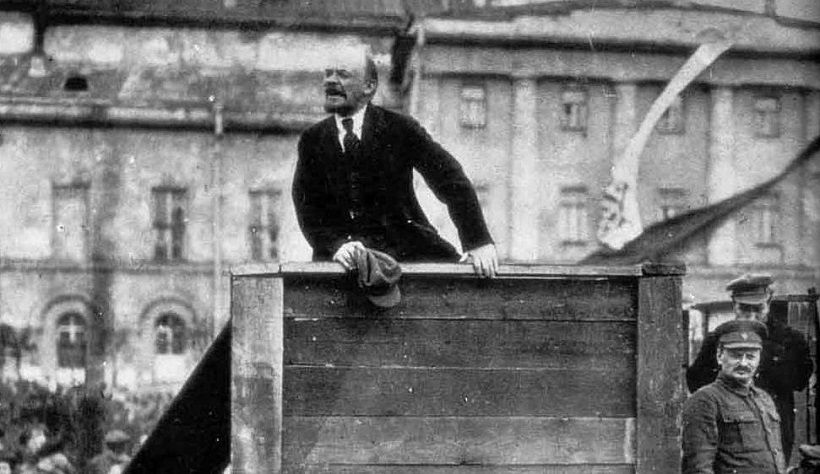
In 1917, the Bolsheviks seized power in Moscow after the deposition of the democratic provisional government which had replaced the Tsar. However, the Bolsheviks’ hold on power was far from secure. There was little affection anywhere for the Tsar, but there was no agreement on what form of government should replace the monarchy. Bolshevism had been on the rise for years, but ideas of democracy and liberalism were gaining popularity as well. Shortly after the 1917 revolution, the Russian Civil War broke out between the Reds, the Bolsheviks, and the Whites, a coalition of anti-Bolsheviks that were generally democratic.
Through the course of the civil war, the Bolsheviks gained more power and control over increasingly large amounts of Russia. With this control, they began to implement their Marxist economic ideas into reality. On January 28, 1918, it was decreed that all factories should be directed by state-appointed managers. In effect, this amounted to a near-complete nationalization of industry. In one fell swoop, the vast majority of the production of Russia’s consumer goods was now under the purview and direction of the state.
On May 9, 1918, a grain monopoly was announced over grain production in the country. All grain harvested across the country was now the property of the state. This was extended even further when a general food levy was announced in January 1919. Any and all food was now the property of the state. In addition, local farm authorities were no longer allowed to set the levy based on harvest estimates. In essence, the state would take however much it wanted from the peasants without any concern if they had enough food to feed themselves and their families.
It was at this point that large-scale forced rationing was introduced. Money was made worthless overnight as ration cards were mandated to the entire population. No longer could you buy whatever you wished with the money you had. The goods allocated for you were predetermined on your ration card.
By late 1920, going into 1921, the Russian Civil War was all but over. The Whites had been soundly defeated by the Reds, giving the Bolsheviks control of nearly the entirety of the country. However, despite the victory in the Civil War, the economy at home was beginning to fall apart. Industrial production was at 20% of pre-war levels by 1920. As a result of this lagging production, there were few goods in the cities available. This resulted in a flight from the cities to the countryside. From 1918 to 1920, eight million people emigrated from the cities to the villages, where there was better hope of finding food or some goods. In Moscow and Petrograd, the population declined by 58.2%
The agricultural situation was not much better. Sheldon Richman records that from 1909-1913, gross agricultural output averaged 69 million tons. By 1921, it was just 31 million. From 1909-1913, sown area was over 224 million acres. In 1921, only 158 million acres were sown. This lack of food resulted in a mass loss of population. From 1917 to 1922, the entire population declined by 16 million, not counting immigration and deaths from the civil war.
War Communism was now fully implemented and the Marxist aspirations of Lenin and the Bolsheviks were now fulfilled. For the people that had to live under War Communism, however, the conditions had become intolerable. In February 1921, labor strikes began to emerge all over Russia. With the end of the civil war and living standards continuing to fall, resistance to the Bolsheviks began to spread throughout the country. Moscow was the first city to strike, with other large cities, such as Petrograd, following. The protestors demanded an end to War Communism and a restoration of private enterprise and civil liberties, such as the freedom of speech and assembly.
The protests escalated when the Kronstadt Naval Base mutinied against the government. Once a bastion of Bolshevik support and fervor, the sailors joined with the laborers in demanding reform and change. A force led by Trotsky was dispatched to deal with the mutiny, but Lenin knew that change was needed. The writing was on the wall for War Communism.
Comments Off on “War Communism” in the Soviet Union, 1917-1921
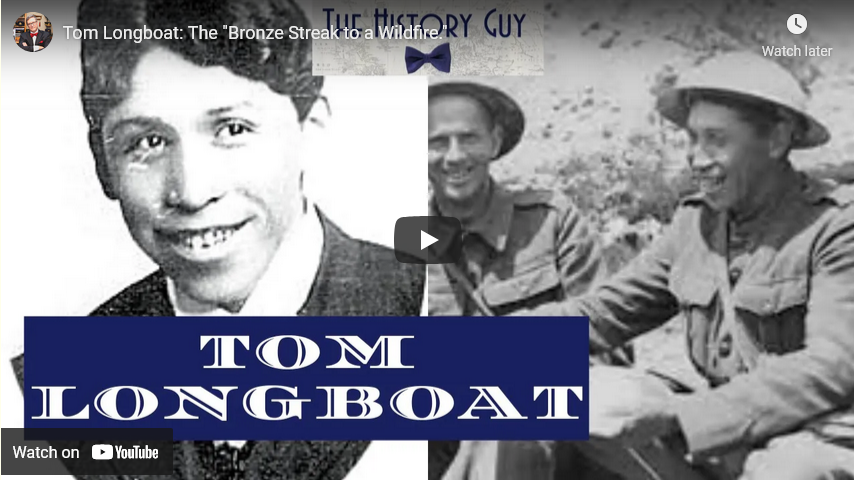
Tom Longboat: The “Bronze Streak to a Wildfire”
The History Guy: History Deserves to Be Remembered
Published 6 May 2019Tom Longboat has been called Canada’s first professional athlete. But amid his setting records and gaining accolades, he served his country in the Great War and fought discrimination. His life is history that deserves to be remembered.
This is original content based on research by The History Guy. Images in the Public Domain are carefully selected and provide illustration. As images of actual events are sometimes not available, images of similar objects and events are used for illustration.
All events are portrayed in historical context and for educational purposes. No images or content are primarily intended to shock and disgust. Those who do not learn from history are doomed to repeat it. Non censuram.
Patreon: https://www.patreon.com/TheHistoryGuy
The History Guy: History Deserves to Be Remembered is the place to find short snippets of forgotten history from five to fifteen minutes long. If you like history too, this is the channel for you.
Awesome The History Guy merchandise is available at:
teespring.com/stores/the-history-guyScript by HCW
#wwi #thehistoryguy #canada
Comments Off on Tom Longboat: The “Bronze Streak to a Wildfire”


