Quotulatiousness

April 18, 2021

America Strikes Back – Tokyo in Flames – WW2 -138 – April 18 1942

World War Two
Published 17 Apr 2021

The Doolittle Raid is just a little bombing raid over Tokyo that doesn’t do that much physical damage. It does, however, have big repercussions — partly in terms of future offensive plans for the Japanese fleet, and partly in terms of the thousands of Chinese lives taken in reprisals for allowing the US bombers to land in China. There is small scattered action on the Eastern Front, more Japanese advances in Burma, and a French VIP escapes captivity in Germany and heads for Switzerland and freedom.

Join us on Patreon: https://www.patreon.com/TimeGhostHistory
Or join The TimeGhost Army directly at: https://timeghost.tv

Follow WW2 day by day on Instagram @ww2_day_by_day – https://www.instagram.com/ww2_day_by_day
Between 2 Wars: https://www.youtube.com/playlist?list…
Source list: http://bit.ly/WW2sources

Written and Hosted by: Indy Neidell
Director: Astrid Deinhard
Producers: Astrid Deinhard and Spartacus Olsson
Executive Producers: Astrid Deinhard, Indy Neidell, Spartacus Olsson, Bodo Rittenauer
Creative Producer: Maria Kyhle
Post-Production Director: Wieke Kapteijns
Research by: Indy Neidell
Edited by: Iryna Dulka
Sound design: Marek Kamiński
Map animations: Eastory (https://www.youtube.com/c/eastory​)

Colorizations by:
– Mikołaj Uchman
– Norman Stewart – https://oldtimesincolor.blogspot.com/

Sources:
– Stan S. Katz
– IWM: IND 3595
– Image of ‘The Fortress of Königstein from the North-West’ by Bernardo Bellotto, © National Gallery of Art, Washington

Soundtracks from the Epidemic Sound:
– Rannar Sillard – “Easy Target”
– Howard Harper-Barnes – “London”
– Jo Wandrini – “Dragon King”
– Dream Cave – “The Beast”
– Reynard Seidel – “Rush of Blood”
– Wendel Scherer – “Out the Window”
– Brightarm Orchestra – “On the Edge of Change”
– Gunnar Johnsen – “Not Safe Yet”
– Johan Hynynen – “Dark Beginning”
– Philip Ayers – “Trapped in a Maze”

Archive by Screenocean/Reuters https://www.screenocean.com​.

A TimeGhost chronological documentary produced by OnLion Entertainment GmbH.

Take a moment to reflect on the plight of those poor, alienated students at Haverford College in Pennsylvania

Filed under: Education, Health, USA — Tags: , , , , , , — Nicholas @ 03:00

In Quillette, Jonathan Kay outlines some of the issues faced by the students of an expensive elite academic institution and how it impacts their mental health:

In December, I wrote a detailed report for Quillette about the race-based social panic that had recently erupted at Haverford College in Pennsylvania. One of the reasons why the meltdown seemed so surreal, I noted, is that this elite school appears to the outside world as picturesque and serene. The average annual cost of attendance is about US$76,000. And most of these students live extremely privileged lives, insulated (physically and otherwise) from what any normal person would regard as suffering. Nor is there much in the way of substantive political discord on campus. According to survey results released in late 2019, 79 percent of Haverford students self-identify as politically liberal, while only 3.5 percent self-identify as conservative. It’s as close to an ideological monoculture as you can find outside of a monastery or cult. On paper, it resembles one of those utopian micro-societies conceived by science-fiction writers or 19th-century social theorists.

The survey results I’m alluding to originate with Haverford’s “Clearness Committee,” an excellent resource for anyone seeking to understand the attitudes of students at hyper-progressive schools. The most recent Clearness survey, completed by more than two-thirds of Haverford students in 2019, contained 133 survey questions pertaining to everything from how much students sleep, to how many friends they have, to how they feel about campus jocks. There is also a substantial section dedicated to the theme of “marginalization.” Amazingly, 43 percent of respondents said they felt personally marginalized on campus because of some aspect of their identity. This included 61 percent of gay students, and more than 90 percent of trans students.

This is an odd-seeming result given the sheer number of LGBT individuals on Haverford’s campus. No fewer than 31 percent of student respondents identified themselves as something other than straight. In regard to gender, almost six percent self-identified as trans or some variant of non-binary. Both of these percentages exceed the overall American average by an order of decimal magnitude. Despite having only about 1,300 students (smaller than many public high schools), Haverford has a resource center for LGBT students, a pro-LGBT hiring policy, an LGBT studies program, dedicated LGBT living arrangements, a health insurance policy that covers hormone replacement therapy, and numerous other resources. Outside of other similarly liberal campuses, it is hard to imagine a more welcoming environment for LGBT youth anywhere on the planet.

It’s also telling that self-reported marginalization rates for Haverford’s gay students are almost identical to those for self-described bisexuals (62 percent) and asexuals (59 percent); and that the rate for students who self-identify under the loose category of “non-binary” (89 percent) is almost identical to the rate for students who, being trans, experience actual gender dysphoria (91 percent). The report authors conclude that there is “a series of immediate crises facing Haverford’s transgender population.” Yet despite the abundant write-in information supplied by surveyed students, no real evidence of these crises appears. What we get instead are vague testimonials about perceived attitudes and atmosphere. (“As a nonbinary person, athletics is inherently exclusive because it is gendered. We need to put that phrase to rest and start talking about the real divisions on campus—such as who feels comfortable going to parties hosted by athletes and who doesn’t.”) Even amidst the melodramatic throes of last year’s student strike, at a time when every imaginable identity-based grievance was described in lengthy student manifestos, no one could point to a single recent incident of real homophobia or transphobia targeting Haverford students.

Boys Mk I Anti-Tank Rifle at the Range

Filed under: Britain, History, Military, Weapons, WW2 — Tags: , , , — Nicholas @ 02:00

Forgotten Weapons
Published 2 Jan 2021

http://www.patreon.com/ForgottenWeapons

https://www.floatplane.com/channel/Fo…

Cool Forgotten Weapons merch! http://shop.bbtv.com/collections/forg…

(Edit: Tungsten carbine is, of course *denser* than steel, not lighter. Sorry.)

I have done several previous videos on the Boys antitank rifle, but never actually fired one — until today! We’re out at the range with a MkI Boys and five rounds of its .55 Boys ammunition. So let’s see if it’s as painful to shoot as people say …

Contact:
Forgotten Weapons
6281 N. Oracle #36270
Tucson, AZ 85740

QotD: Two centuries on, Ricardo still right

Filed under: Economics, Quotations — Tags: , — Nicholas @ 01:00

One of David Ricardo’s foundational assertions was the law of one price. That tradeable goods will cost the same, when their transport costs are included, in different places. The insight being that if they weren’t then people would buy in one, sell in the other, thereby equalising prices. A reasonable corollary to this idea is that exchange rates should move based upon purchasing parity or interest rate parity. The second is because people can move their money, just like anything else, to arbitrage between prices – here, the interest rate. The other because, well, that’s what arbitrage will do, equalise those PPP exchange rates. Not wholly, not perfectly, but roughly enough.

Tim Worstall, “Ricardo Still Right 201 Years Later”, Continental Telegraph, 2018-11-01.

April 17, 2021

“Today’s Liberal government is […] the most anti-Internet government in Canadian history”

Filed under: Cancon, Government, Media, Technology — Tags: , , , , — Nicholas @ 05:00

Michael Geist gives both barrels to Justin Trudeau’s government, then reloads and fires again:

Canadian Heritage Minister Steven Guilbeault, 3 February 2020.
Screencapture from CPAC video.

As I watched Canadian Heritage Minister Steven Guilbeault yesterday close the Action Summit to Combat Online Hate, I was left with whiplash as I thought back to those early days. Today’s Liberal government is unrecognizable by comparison as it today stands the most anti-Internet government in Canadian history:

  • As it moves to create the Great Canadian Internet Firewall, net neutrality is out and mandated Internet blocking is in.
  • Freedom of expression and due process is out, quick takedowns without independent review and increased liability are in.
  • Innovation and new business models are out, CRTC regulation is in.
  • Privacy reform is out, Internet taxation is in.
  • Prioritizing consumer Internet access and affordability is out, reduced competition through mergers are in.
  • And perhaps most troublingly, consultation and transparency are out, secrecy is in.

This is not hyperbole. The Action Summit is a case in point. I was part of the planning committee and I am proud that the event produced two days of thoughtful discussion and debate, where the both the importance and complexity of addressing online hate brought a myriad of perspectives, including from the major Internet platforms. There was none of that nuance in Guilbeault’s words, who spoke the evil associated with the “web behemoths” and promised that his legislation would target content and Internet sites and services anywhere in the world provided it was accessible to Canadians. The obvious implications – much discussed in Internet circles in Ottawa – is that the government plans to introduce mandated content blocking to keep such content out of Canada as a so-called “last resort”. When combined with a copyright “consultation” launched this week that also raises Internet blocking, Guilbeault’s vision is to require Internet providers to install blocking capabilities, create new regulators and content adjudicators to issue blocking orders, dispense with net neutrality, and build a Canadian Internet firewall.

If that wasn’t enough, his forthcoming bill will also mandate content removals within 24 hours with significant penalties for failure to do so. The approach trades due process for speed, effectively reducing independent oversight and incentivizing content removal by Internet platforms. Just about everyone thinks this is a bad idea, but Guilbeault insists that “it is in the mandate letter.” In other words, consultations don’t matter, expertise doesn’t matter, the experience elsewhere doesn’t matter. Instead, a mandate letter trumps all. If this occurred under Stephen Harper’s watch, the criticism would be unrelenting.

In fact, one of the reasons that the government finds itself committed to dangerous policy is that it did not conduct a public consultation on its forthcoming online harms bill. Guilbeault was forced yesterday to admit that the public has not been consulted, which he tried to justify by claiming that it could participate in the committee review or in the development of implementation guidelines once the bill becomes law. This alone should be disqualifying as no government should introduce censorship legislation that mandates website blocking, eradicates net neutrality, harms freedom of expression, and dispenses with due process without having ever consulted Canadians on the issue.

Neoclassical Architecture

Filed under: Architecture, Europe, History, Italy — Tags: , , — Nicholas @ 04:00

Overly Sarcastic Productions
Published 16 Apr 2021

You asked, I deliver: the Neoclassicism tangent receives the full-video spotlight it deserves. But there’s plenty more architectural and art-historical analysis where that came from. So if this kind of thing seems fun, please comment and let me know!

SOURCES & Further Reading: Francesco’s Venice by Francesco Da Mosto, A History of Venice by John Julius Norwich, “Renaissance Architecture” via Britannica, and many many many hours spent staring at buildings in Italy.

This video was edited by Sophia Ricciardi AKA “Indigo”. https://www.sophiakricci.com/​

Our content is intended for teenage audiences and up.

PATREON: https://www.Patreon.com/OSP

PODCAST: https://overlysarcasticpodcast.transi…

DISCORD: https://discord.gg/osp

MERCH LINKS: http://rdbl.co/osp​

OUR WEBSITE: https://www.OverlySarcasticProductions.com
Find us on Twitter https://www.Twitter.com/OSPYouTube​
Find us on Reddit https://www.Reddit.com/r/OSP/

Considering the costs and benefits of extreme specialization

Filed under: Economics — Tags: , , , , — Nicholas @ 03:00

In the latest post on Matt Gurney’s Code 47 Substack blog, he considers the trade-off between population density and the range of specialization that can be supported at various densities:

“Model A Ford in front of Gilmore’s historic Shell gas station” by Corvair Owner is licensed under CC BY-SA 2.0

I wish I remembered where I read this. It was a book I was blowing through for a university paper; only one chapter was really of interest to me when I was trawling for footnotes but I stumbled upon an interesting section that talked about services and specialization in a modern economy. The author offered a simple explanation of service specialization that I’ve never forgotten. Imagine a village with 100 people, the author said. Now imagine what services are available there. There’s probably a gas station, and maybe you can get a few services done to your car there, too. Basic repairs. Tire rotations. Oil changes. Things like that. There’s probably also a convenience store, and the store might also have a place to send or receive mail, or maybe even to rent a movie. (Back when that was a thing we did.) You might have a coffee shop of some kind, maybe a diner. But that’s marginal. You almost certainly don’t have a school, full post office, bank branch or medical centre of any kind. Not in a village of 100 people.

When you itemize out all the services you can get, it’s probably about five or maybe 10 — gas pumped, tires changed, oil changed, basic engine repairs, store clerk, movie rental, mail sent and received. Maybe someone to pour you a cup of coffee and get you a sandwich — but only maybe. The point isn’t to be precise in our list or count, but just to contemplate the relationship between the population and the number and type of available services.

Now scale that village up 10 fold, the author said. Now it’s a town of 1,000. The number of services explodes. You still have everything you did before. But now you’ve also got specialized shops, restaurants, a bank or two (and all the services they provide), probably a house of worship, medical services of various kinds (including eye care, dentistry, etc), personal-care services, better access to home and lawn care, various repair and maintenance service, technical services, a post office … the list goes on. You also start to see competition and the efficiency that brings — our village of 100 would have a gas station and a convenience store (quite possibly at the same location!). But our town of 1,000 would have a few of each. You’d get more services, and start to see prices dropping for the commonly available offerings.

You get the idea — the more you scale up a population, the more specialized services that are available and the more accessible they become. And this includes not just categories of service, but also increasing degrees of specialization. Our village of 100 probably has no full-time doctor. Our town of 1,000 probably has a family physician. But after we bump things up to 10,000, 100,000 and then a million people, we’re getting not just doctors, but highly trained, specialized physicians, surgeons and diagnosticians. Our town of 1,000 has a dentist, but our city of a million has dental surgeons who’ve specialized in repairing specific kinds of trauma and injury.

Anyway. I don’t remember what book this was from. But I do remember this short section. I think about it a lot. We Canadians of 2021 are, for the most part, hyper-specialized. I’ve written columns about this before, including this one from 2019, which I’m going to quote liberally below:

    Human history is, in one simplified viewing, the story of specialization. As our technology advanced, a smaller and smaller share of the labour pool was required just to keep everyone alive. Perhaps the easiest way to summarize this is to note that 150 years ago, even in the most advanced industrial countries, something close to 50 per cent of the population was directly engaged in agriculture — half the people tilled fields so the other half could eat. Today, in both Canada and the United States, it’s closer to two per cent — one person’s efforts feed 49 others. Those 49 can pursue any of the thousands of specialized jobs that allow our technological civilization to exist. … Those 49 people are our artists and doctors and scientists and teachers. Human advancement depends on this — a civilization that’s scrambling to feed itself doesn’t build particle colliders or invent new neonatal surgeries and cancer-stopping wonderdrugs.

I stand by those remarks. But I’ve been pondering them of late with a different perspective. I’ve spent much of this week talking with doctors and medical experts in Ontario, where the third wave of COVID-19 is threatening to overwhelm the health-care system, with tragic results. And one recurring theme that comes up in these conversations is how this disaster is going to take place almost entirely out of public view. There won’t be any general mobilizations or widespread damage. People are going to die, behind closed doors or tent flaps, and other people will be forever scarred by their inability to save those people. But for most of us — those who aren’t sick, or highly specialized medical professionals — life is going to be something reasonably close to normal.


Can you build a Starter Set Model Kit using ONLY the included paints and glue?

Filed under: Military, Randomness, WW2 — Tags: , , — Nicholas @ 02:00

Model Minutes
Published 10 Dec 2020

Quite often I get asked if you can build a Starter Set Model Kit using ONLY the included paints and glue? Well, why not? What would it actually look like? I feel like there might be a bit of a CHALLENGE coming on …

Join me in this video as I build (and review) the Airfix Messerschmitt Bf109E-3 plastic model kit in 1/72 scale which comes as part of a starter set — with glue, paint and brush included. I will be building this kit with only these products to see how it turns out.

Unboxing review of this kit:
https://youtu.be/NWHsWtxot_c

Please consider pledging your support to help keep the channel growing from strength to strength. Find out what’s in-store and how to unlock additional perks here: https://www.patreon.com/modelminutes

If you like what I do, why not buy me a coffee over at http://ko-fi.com/modelminutes

Come join the live conversation over at Discord, chat to other modellers in real time! https://discord.gg/JP4tk2n

If you want to buy any of the kits I’ve built or recommend — take a look here (it helps support the channel):
https://www.amazon.co.uk/shop/modelmi…

Let’s get social!
https://twitter.com/ModelMinutes
https://www.instagram.com/modelminutes/

This video is intended for adult scale model enthusiasts.

Model Minutes holds no responsibility for any accidents, damage or injury that could occur as a result of attempting to replicate any steps depicted in this video.

All music used from the YouTube Audio Library.

#Airfix #Model #Modelkit #starterset #scale #bf109

From the comments:

Model Minutes
4 days ago
Before you leave a comment about thinning the paint or using extra tools/products, read this:

I don’t think a lot of people watching this one quite “got” what I was going for here. My aim (if it wasn’t clear) was to see how good I could make this model kit using only the included products and a knife. I gave myself really strict rules to follow in an attempt to get a “best case” model out of a “worst case” situation.

Many people seem to think that beginners would instantly know that they are supposed to thin their paints, sand the plastic, fill the gaps, use extra brushes … and if, as a beginner you knew that, then you were so fortunate!

But this video is for those of us (me included) who knew nothing about model building, had no one to help us and nothing to look to for reference. When I started, YouTube didn’t exist (the internet wasn’t really a thing for me growing up either) and if I wanted to read up about modelling it meant buying magazines and looking for the information.

My build in this video is a throwback to my early days, where I built what I wanted, how I wanted, and usually with only what I had, could borrow, recycle or afford with my small amount of pocket money.

Ultimately though, I think the point of this build and video has been missed by some.

It’s meant to be fun, a light and entertaining look at our hobby. After all, isn’t this hobby supposed to be fun anyway?

I’d also like to think that some beginners out there see this one and realise that you don’t have to build a model kit with all these extra things that so many youtubers use these days. Although it’s good to have aspirations I think it’s unrealistic and can put newcomers off. If my video encourages just one new person to start building, then that’s a success right? We should be encouraging new members to the hobby because it’s in our interest too! If you agree, send someone this video and encourage them to start!

TLDR: I made this video for entertainment. It’s not a tutorial. I added extra restrictions because otherwise it wouldn’t be a “challenge” — it would be a normal build video.

QotD: Erasing the Maldives from the atlas

Filed under: Asia, Books, Britain, Environment, Humour, Quotations — Tags: , , , — Nicholas @ 01:00

Maldivian media outlets this morning published as fact a satirical Telegraph news blog citing “unconfirmed rumours” that the 14th edition of the Times Comprehensive Atlas of the World will omit the Maldives, Tuvalu, “and major parts of Bangladesh” as a statement on global warming.

The blog post, written by climate change skeptic James Delingpole who describes himself as “a writer, journalist and broadcaster who is right about everything”, features comments by a “Times Atlas spokesman” David Rose.

In a UK press scandal this year, “David Rose” was found to be a psuedonym used by left-wing Independent journalist and climate change writer Johaan Hari to edit his own Wikipedia entry, advocate his own position and attack his critics.

Rose, who in Delingpole’s article holds “a doctorate in Cambridge in Climate Change and Sinking Islands Studies so I know what I’m talking about, and if you don’t believe me, ask my friend Johaan Hari who taught me everything I know”, acknowledges that it “may not be strictly geographically accurate to say the Maldives and Tuvalu will definitely have disappeared in about ten years time when our next edition appears.”

“But did you see that picture of the Maldives cabinet holding a meeting underwater? If the Maldives government says the Maldives are drowning, they must be drowning. And frankly I think it’s despicable, all those deniers who are saying it was just a publicity stunt, cooked up by green activist Mark Lynas, to blackmail the international community into giving the Maldives more aid money while simultaneously trying to lure green Trustafarians to come and spend £1500 a night in houses on stilts with gold-plated organic recyclable eco-toilets made of rare earth minerals from China. Why would a government lie about something as serious as climate change?”

Rose goes on to state that “I’m pleased to say that this is a view of the world shared by my colleagues at Times Comprehensive Atlas Of The World. They understand that maps based on accurately recorded geographical features belong in the Victorian age of child chimney sweeps. What we need now is maps that change the world, transforming into something which it isn’t actually yet but might be one day if we don’t act NOW!”

“Delingpole Satire Dupes Maldives Media”, The Global Warming Policy Forum (GWPF), 2011-09-21.

April 16, 2021

Following Bienville: The Founding of New Orleans

Filed under: France, History, Humour, USA — Tags: , , , — Nicholas @ 06:00

Atun-Shei Films
Published 15 Apr 2021

The origin story of New Orleans is a tale of rampant corruption, unchecked greed, fiendish vice, and gross incompetence – not much has changed!

Join me on an epic journey of discovery as I trace the route of the first French explorers to this area by paddling down Bayou St. John and walking overland to the French Quarter, exploring the geography and history of the city along the way.

Support Atun-Shei Films on Patreon ► https://www.patreon.com/atunsheifilms​

Leave a Tip via Paypal ► https://www.paypal.me/atunsheifilms

Buy Merch ► teespring.com/stores/atun-shei-films​

#NewOrleans​ #Louisiana​ #History​

Maps by Carl Churchill ► https://twitter.com/Cchurchili​
Reddit ► https://www.reddit.com/r/atunsheifilms​
Twitter ► https://twitter.com/atun_shei​
~REFERENCES~

[1] B.F. French. Historical Collections of Louisiana and Florida, Including Translations of Original Manuscripts Relating to Their Discovery and Settlement (1875). Albert Mason, Page 24-25

[2] Lawrence N. Powell. The Accidental City: Improvising New Orleans (2012). Harvard University Press, Page 11-15

[3] Philomena Hauck. Bienville: Father of Louisiana (1998). Center for Louisiana Studies, University of Louisiana at Lafayette, Page 12-13

[4] Richard Campanella. “Link to the Past: From French Colonists to the Beginnings of Jazz, Spanish Fort Traces its History Across Three Centuries” (2019). Times Picayune/New Orleans Advocate https://richcampanella.com/wp-content…

[5] Hauck, Page 23-25

[6] Hauck, Page 6

[7] Hauck, Page 44-57

[8] Powell, Page 25-32

[9] Richard Campanella. Bienville’s Dilemma: A Historical Geography of New Orleans (2008). Center for Louisiana Studies, University of Louisiana at Lafayette, Page 109-110

[10] Campanella, Page 77-78

[11] Andrea P. White. “Archaeology of the New Orleans Area.” 64Parishes https://64parishes.org/entry/archaeol…​

[12] Campanella, Page 111

[13] Powell, Page 43-51

[14] Powell, Page 68-73

[15] Karen Ordahl Kupperman. A True and Exact History of the Island of Barbados by Richard Ligon (2011). Hackett Publishing Company, Page 19

[16] Hauck, Page 89

[17] Powell, Page 56-58

“Students will find in Shakespeare absolutely no moral compass”

Filed under: Britain, Education, History, Media — Tags: , , , — Nicholas @ 05:00

Sky Gilbert responds more than adequately to a demand to “Cancel Shakespeare” that also appeared in The Line recently:

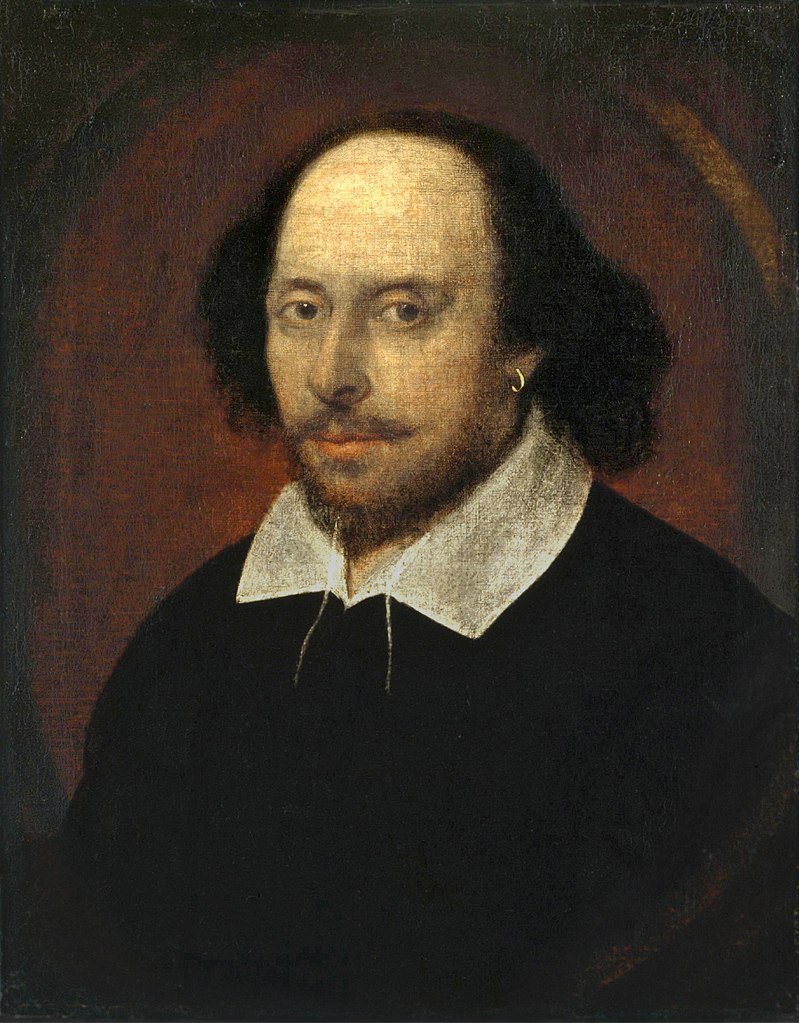
This was long thought to be the only portrait of William Shakespeare that had any claim to have been painted from life, until another possible life portrait, the Cobbe portrait, was revealed in 2009. The portrait is known as the “Chandos portrait” after a previous owner, James Brydges, 1st Duke of Chandos. It was the first portrait to be acquired by the National Portrait Gallery in 1856. The artist may be by a painter called John Taylor who was an important member of the Painter-Stainers’ Company.
National Portrait Gallery image via Wikimedia Commons.

Allan thinks that Shakespeare’s language is difficult and old fashioned, and that students today find analyzing the complexities of his old-fashioned rhetoric boring and irrelevant. Yes, Shakespeare essentially writes in another language (early modern English). And reading or even viewing his work can be a tough slog. Not only did he invent at least 1,700 words (some of which are now forgotten today), he favoured a befuddling periodic syntax in which the subject does not appear until the end of a sentence.

But a study of Shakespeare’s rhetoric is important in 2021. There is one — and only one — exceedingly relevant idea that can be lifted from Shakespeare’s congested imagery, his complex, sometimes confusing metaphors — one jewel that can be dragged out of his ubiquitous references to OVID and Greek myth (references which were obviously effortless for him, but for most of us, only confound). And this idea is very relevant today. Especially in the era of “alternate facts” and “fake news.”

This idea is the only one Shakespeare undoubtedly believed. I say this because he returns to it over and over. Trevor McNeely articulated this notion clearly and succinctly when he said that Shakespeare was constantly warning us the human mind “can build a perfectly satisfactory reality on thin air, and never think to question it.” Shakespeare is always speaking — in one way or another — about his suspicion that the bewitching power of rhetoric — indeed the very beauty of poetry itself — is both enchanting and dangerous.

Shakespeare lived at the nexus of a culture war. The Western world was gradually rejecting the ancient rhetorical notion that “truth is anything I can persuade you to believe in poetry” for “truth is whatever can be proved best by logic and science.” Shakespeare was fully capable of persuading us of anything (he often does). But his habit is to subsequently go back and undo what he has just said. He does this so that we might learn to fundamentally question the manipulations of philosophy and rhetoric — to question what were his very own manipulations. Shakespeare loved the beautiful hypnotizing language of poetry, but was also painfully aware that it could be dangerous as hell.

In fact, Shakespeare’s work is very dangerous for all of us. That’s why students should — and must — read it. Undergraduates today hotly debate whether The Merchant of Venice is anti-Semitic, or whether Prospero’s Caliban is a victim of colonial oppression. Education Week reported that “in 2016, students at Yale University petitioned the school to ‘decolonize’ its reading lists, including by removing its Shakespeare requirement.”

It’s true that Shakespeare is perhaps one of the oldest and whitest writers we know. (And sometimes he’s pretty sexist too — Taming of the Shrew, anyone?). But after digging systematically into Shakespeare’s work even the dullest student will discover that for every Kate bowing in obedience to her husband, there is a fierce Lucrece — not only standing up to a man, but permanently and eloquently dressing him down. (And too, the “colonialist” Prospero will prove to be just as flawed as the “indigenous” Caliban.) William Hazlitt said: Shakespeare’s mind “has no particular bias about anything” and Harold Bloom said: “his politics, like his religion, evades me, but I think he was too wary to have any.”

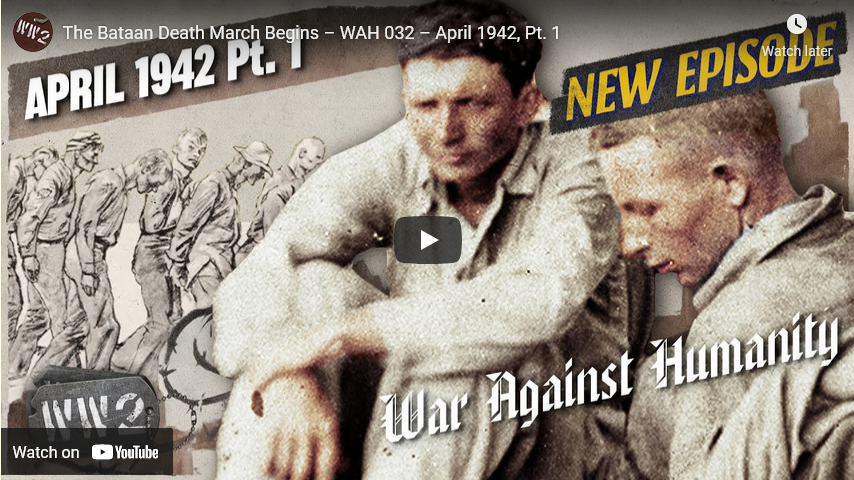
The Bataan Death March Begins – WAH 032 – April 1942, Pt. 1

Filed under: Britain, Europe, Germany, History, Japan, Military, Pacific, USA, WW2 — Tags: , , , , , , — Nicholas @ 04:00

World War Two
Published 15 Apr 2021

Malta and British cities are victim to German bombs, while the Japanese advance in Burma causes a refugee crisis. In the Philippines, 80,000 Allied POWs walk the Bataan Death March.

Join us on Patreon: https://www.patreon.com/TimeGhostHistory
Or join The TimeGhost Army directly at: https://timeghost.tv

Follow WW2 day by day on Instagram @ww2_day_by_day – https://www.instagram.com/ww2_day_by_day
Between 2 Wars: https://www.youtube.com/playlist?list…
Source list: http://bit.ly/WW2sources

Hosted by: Spartacus Olsson
Written by: Spartacus Olsson and Joram Appel
Director: Astrid Deinhard
Producers: Astrid Deinhard and Spartacus Olsson
Executive Producers: Astrid Deinhard, Indy Neidell, Spartacus Olsson, Bodo Rittenauer
Creative Producer: Maria Kyhle
Post-Production Director: Wieke Kapteijns
Research by: Joram Appel
Edited by: Miki Cackowski
Sound design: Marek Kamiński
Map animations: Miki Cackowski and Eastory (https://www.youtube.com/c/eastory​)

Colorizations by:
Mikołaj Uchman
Election1960 https://commons.wikimedia.org/wiki/Fi…​

Sources:
IWM C 4743, CL 2377
Bundesarchiv
From the Noun Project: Watchtower by Eliricon

Soundtracks from the Epidemic Sound:
Johan Hynynen – “Dark Beginning”
Fabien Tell – “Weapon of Choice”
Wendel Scherer – “Defeated”
Philip Ayers – “Trapped in a Maze”
Cobby Costa – “From the Past”
Cobby Costa – “Flight Path”
Wendel Scherer – “Growing Doubt”
Jon Bjork – “For the Many”

Archive by Screenocean/Reuters https://www.screenocean.com​.

A TimeGhost chronological documentary produced by OnLion Entertainment GmbH.

From the comments:

World War Two
3 days ago (edited)
Under our previous episode I told you about how YouTube has been age restricting these videos, effectively censoring them and turning the format into an echo chamber that doesn’t reach beyond the viewers who already know about it. As I explained we feel that it’s a great disservice to education and remembrance, and it has affected me deeply personally making me question why we do this. Two things happened:

1. You collectively gave us the most amazing reception and reminded us of how important the work we do is. I can’t thank you enough for the amazing comments, many of them where kind, supportive, and motivating far beyond what I feel we deserve. You lifted my spirits and brought me out of the slump I was in, cementing, and confirming that what we do matters. In the name of the entire team: thank you so much, it is an immense honor to have you all with us.

2. YouTube did not age restrict the video, and even cleared it for monetization, leading to that it once again reached a viewership like before the string of age restrictions we were struck with. We haven’t heard any explanation from YouTube and we won’t. Furthermore, I am painfully aware that these decisions depend completely on the whims of the individuals at Google who review the videos. We also know that these individuals are different for every video, so I fear that that this state of affairs will not remain. Already, this video was judged as “not suitable for all advertisers” and will therefore be recommended to viewers less often in YouTube’s system. Hence, although it pains us, and is against the principles we stand for, we have also prepared a version of this video with all images documenting the atrocities we expose blurred out – we can only hope that we don’t need it.

I’d like to end with an anecdote out of my motivation to create this series. Many, many moons ago, when I was in senior high at boarding school in Sweden, Elie Wiesel – author, chronicler of the Holocaust, and survivor of Auschwitz and Buchenwald came to our school. It was in 1986, the same year that he received the Nobel Peace Prize for his work, and if I remember correctly he had connected a lecture tour to his reception of the award.

In any case — I had the privilege of speaking to Mr. Wiesel in a small group. He explained something that has stayed with me ever since. To him, his experiences were not defeating, the entire Holocaust was not a defeat, not only had humanity been victorious in the end, but he and others had survived to tell the tale — which to him was a special kind of victory that came with the responsibility of sharing and educating.

Mr. Wiesel, a kind, warm hearted man, full of humor and life despite the horrors he had lived, passed five years ago. It is for him, for the other survivors of every ethnicity faced by any kind or terror, and for those who didn’t make it through that we do this — to celebrate their life and continue turning their suffering from defeat into victory by remembering even after they are gone.

Yours,
Spartacus

The continued evolution of the Marxist class struggle – “Goodbye the working class, hello to the wokeing class”

Filed under: History, Politics — Tags: , , , , , , — Nicholas @ 03:00

Arthur Chrenkoff provides some background on the evolution of Marxist thought as they abandon efforts to rouse the working classes of the west against their capitalist oppressors and switch to attempting to rouse the “wokeing class” against their deplorable racist, homophobic, transphobic, sexist white male cisgendered oppressors:

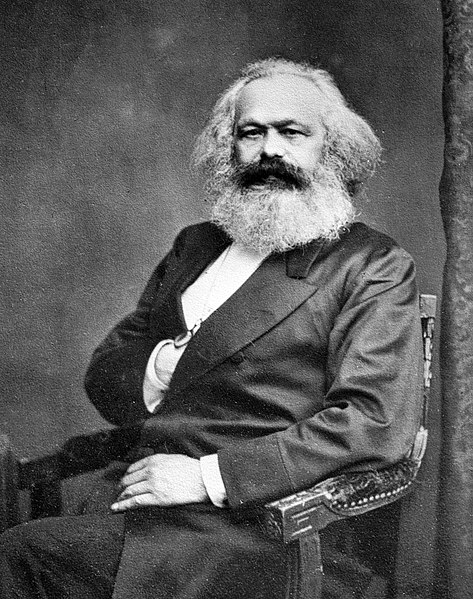
In developing his philosophy, Karl Marx posited human history as a struggle of two sections of society: the minority who hold the all power and the powerless majority. In Marx’s time, the minority was termed the capitalist class, the bourgeoisie, or simply The Capital, those controlling (owning and benefitting from) the means of production, while the majority was called the working class, or the proletariat, the masses who sell their labour, and whose collective toil makes the capitalists rich. The essential dynamic of a society is one of power: who has it and who doesn’t, and how it’s exercised (or as Lenin said, “who whom?”). It’s a zero sum equation: all or nothing, the one or the other, the powerful and the powerless, the oppressors and the oppressed. There is a moral dimension to this dichotomy: the former, by virtue of their position, are the villains, the latter the virtuous. It’s also absolutist: the individual doesn’t matter and individuality is an irrelevant illusion; you are the class to which you belong.

One of the most important aspects of this group dynamic is that the dominant class uses its position and power to shape the society in accordance with its needs. Thus, all the institutions, laws, traditions and phenomena reflect the interests of the ruling class; they are designed to benefit them and only them and keep their power entrenched. And what benefits one class invariably harms the other: the masses. You can thus say that in a capitalist society everything’s classist.

The twentieth century dashed the hopes of Marx’s disciples that the proletariat would revolt against and overthrow their capitalist oppressors. The working class was bought off with better working conditions and rising incomes: a house, a car, and a football game. While elsewhere communism triumphed through coups and foreign invasions, in the Western world genuine revolutions did not happen; capitalism is still around. While the working class might have disappointed and let down Marxists, the basic Marxist thinking has not changed: the society is divided into two mutually hostile groups, the oppressors and the oppressed. Now we just need to find the different oppressed and we’ll have another crack at destroying capitalism and creating our socialist utopia. Out with the purely economic divisions, in with racial, gender and sexual ones. Goodbye the working class, hello to the wokeing class.

Fast forward to 2021, and the neo-Marxist struggle continues to gather wind in its sail. On the one side the power-holders: white, male, straight; on the other the powerless: women, people of colour, other sexualities. The actors might have been changed but the essential drama remains the same: the struggle of the virtuous but powerless oppressed majority against their dastardly rulers and the system created for their benefit and everyone else’s disadvantage. Just as in the past every aspect of society was biased against and harmful to the proletariat, so now it is against the proletariat 2.0: everything’s racist – and sexist, and homophobic and transphobic. This is also why the activists describe racism as “systemic”; not because there are still Jim Crow laws in existence, and legal segregation and discrimination, but because the system created by the “white” society by its very nature must be oppressive and hostile to anyone non-white. Piecemeal fixing problems and gradual reforms are useless; the only solution is a radical societal transformation that elevates the oppressed and casts down the oppressors.

Shakespeare Summarized: King Lear

Filed under: History, Humour, Media — Tags: , , — Nicholas @ 02:00

Overly Sarcastic Productions
Published 22 Jul 2014

Sorry it’s been a while. Summer vacation plays merry hell with both my work ethic and my voice. *discreetly hacks up a lung*

King Lear! He’s not a very good king, and he’s not a very good father! Good thing that, by the end, he’s neither of those things.

QotD: “Declaring passionate belief in freedom of speech”

Filed under: Books, Britain, Media, Quotations — Tags: , , , , — Nicholas @ 01:00

One of the phrases in the mouth of managers or bureaucrats that indicates almost unfailingly that they are about to commit an act of betrayal is, “We believe passionately in.”

The only thing that most managers or bureaucrats believe in passionately is their career, in the broad sense of that term: for they are quite willing to abandon or sacrifice a career completely in the narrow sense if it is in the interest of their career in a broader sense.

I learned this in the hospitals in which I worked. As soon as a hospital manager said “I believe passionately in the work that Department X has been doing,” I knew that Department X was about to be closed down by that very same manager.

Thus, when I read that a publisher claimed that “We believe passionately in freedom of speech,” I knew at once that the publisher was about to withdraw a book from publication that it had previously advertised for publication.

Theodore Dalrymple, “‘Passionate’ Belief in Freedom of Speech and Multiplying Orthodoxies”, New English Review, 2020-12-22.

« Newer PostsOlder Posts »

Powered by WordPress