World War Two
Published 22 Apr 2021Ever wonder what life was like in Taiwan during the Second World War? Or if German U-Boats were active in the Mediterranean? You can find out the answers in this episode of Out of the Foxholes!
Join us on Patreon: https://www.patreon.com/TimeGhostHistory
Or join The TimeGhost Army directly at: https://timeghost.tvFollow WW2 day by day on Instagram @ww2_day_by_day – https://www.instagram.com/ww2_day_by_day
Between 2 Wars: https://www.youtube.com/playlist?list…
Source list: http://bit.ly/WW2sourcesHosted by: Indy Neidell
Written by: Ian Sowden, Lewis Braithwaite, Timothy Smith
Director: Astrid Deinhard
Producers: Astrid Deinhard and Spartacus Olsson
Executive Producers: Astrid Deinhard, Indy Neidell, Spartacus Olsson, Bodo Rittenauer
Creative Producer: Maria Kyhle
Post-Production Director: Wieke Kapteijns
Research by: Ian Sowden, Lewis Braithwaite, Timothy Smith
Edited by: Miki Cackowski
Sound design: Marek Kamiński
Map animations: Miki Cackowski and Eastory (https://www.youtube.com/c/eastory)Sources:
David Rumsey Map Collection, David Rumsey Map Center, Stanford Libraries
Chapman University Digital CommonsSoundtracks from the Epidemic Sound:
Yi Nantiro – “Watchman”
Max Anson – “Ancient Saga”
Skrya – “First Responders”Archive by Screenocean/Reuters https://www.screenocean.com.
A TimeGhost chronological documentary produced by OnLion Entertainment GmbH.
April 23, 2021
Taiwan Under Occupation, Axis Solidarity, and U-Boats in the Med – WW2 – OOTF 022
Treaties and War, The Washington Naval Conference
The History Guy: History Deserves to Be Remembered
Published 17 Aug 2017The History Guy remembers the Washington Naval Conference, a watershed in diplomacy.
The episode discusses events and shows some artwork depicting warships, which some viewers may find disturbing. All events are described for educational purposes and are presented in historical context.
The History Guy uses images that are in the Public Domain. As photographs of actual events are often not available, I will sometimes use photographs of similar events or objects for illustration.
Patreon: https://www.patreon.com/TheHistoryGuy
The History Guy: Five Minutes of History is the place to find short snippets of forgotten history from five to fifteen minutes long. If you like history too, this is the channel for you.
Awesome The History Guy merchandise is available at:
teespring.com/stores/the-history-guyThe episode is intended for educational purposes. All events are presented in historical context.
#ushistory #thehistoryguy #militaryhistory
QotD: Why the British despise the middle class
… any observer of that British class system will know that it is indeed a little different from that in other places.
The aristocracy have always looked down upon the middle class. That gross and inelegant disdain for trade for example. The insistence that actually doing something for a living – even professionally – just isn’t as good as doing nothing off a rent roll.
From the other end we’ve that very bolshie – in the colloquial sense – insistence that the middle class are just parasites upon the toil of the workers. This being what also informs – misinforms – that idea that we’d be better off if we had much more manufacturing. Men in flat caps doing something physical etc.
That is, much of the society dislikes the very existence of the middle class. Actually, more than dislikes, from above they’re – we’re – despised and from below hated to the point that we bourgeoisie should be eliminated as a class.
The surprise that fewer claim to be of that section of the hierarchy than are is thus, well, it’s a surprise, right?
Tim Worstall, “Sociologist Can’t Do Sociology”, Continental Telegraph, 2021-01-19.
April 22, 2021
Al Capone, Prohibition, and the American Dream | B2W: ZEITGEIST! I E.16 – Summer 1922
TimeGhost History
Published 21 Apr 2021The Prohibition era is still just getting started, but criminal enterprises have already sprung up everywhere to supply thirsty Americans with their drink. In the “summer of sin” of 1922, one man in particular is making waves in the Chicago underworld.
Join us on Patreon: https://www.patreon.com/TimeGhostHistory
Hosted by: Indy Neidell
Written by: Francis van Berkel
Director: Astrid Deinhard
Producers: Astrid Deinhard and Spartacus Olsson
Executive Producers: Astrid Deinhard, Indy Neidell, Spartacus Olsson, Bodo Rittenauer
Creative Producer: Maria Kyhle
Post-Production Director: Wieke Kapteijns
Research by: Francis van Berkel and Lewis Braithwaite
Image Research by: Daniel Weiss
Edited by: Daniel Weiss
Sound design: Marek KamińskiColorizations:
Daniel Weiss – https://www.facebook.com/TheYankeeCol…Sources:
Library of CongressSoundtracks from Epidemic Sound
– “One More for the Road” – Golden Age Radio
– “London” – Howard Harper-Barnes
– “Infinity Pool & Pool Tables” – Mythical Score Society
– “Rush of Blood” – Reynard Seidel
– “It’s Not a Game” – Philip Ayers
– “Please Hear Me Out STEMS INSTRUMENTS” – Philip Ayers
– “Not Safe Yet” – Gunnar Johnsen
– “On the Edge of Change” – Brightarm Orchestra
– “British Royalty” – Trailer Worx
– “Break Free” – Fabien Tell
– “Steps in Time” – Golden Age Radio
– “Magnificent March 3” – Johannes BornlöfArchive by Screenocean/Reuters https://www.screenocean.com.
A TimeGhost chronological documentary produced by OnLion Entertainment GmbH.
From the comments:
TimeGhost History
3 days ago
As you hopefully realized from the title, thumbnail, description, and first words coming out of Indy’s mouth, a big focus of this episode is the beginning of the gangland Prohibition era and the rise of Al Capone.It’s a fascinating topic, but something else to draw attention to in this episode is the Catholic Church’s campaign against modernity. Last episode we saw how religion was forced into retreat by the Bolshevik regime in Russia, well this episode we’re seeing one of the oldest religious institutions in the world make its fightback. It shows that the story of modernity isn’t just “old things” fading away and being replaced by “new things”. Instead, it is a story of continual tension, negotiation, and adaption, between the old and the new.
Anyway, philosophical musings on religion aside, this really is an exciting episode and there will be much more on Al Capone and the Beer War in years to come.
The Winter War
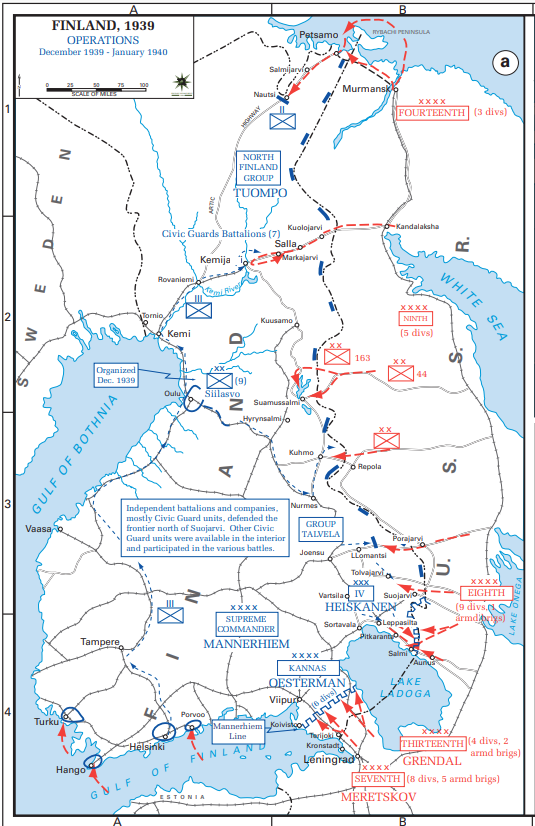
In Quillette, Sean McMeekin outlines the disaster of the first Soviet offensive against Finland in the opening battles of the 1939-40 Winter War:
While Finland, with a tiny population of scarcely 3.5 million, could hardly have threatened the Soviet colossus, it had fought fiercely for independence during the Russian Civil War, conquering Helsinki in April 1918 and dealing the Reds a series of painful blows. The Finnish White Guards — as the Bolsheviks referred to the forces then commanded by the redoubtable Gustaf Mannerheim — had also, Stalin remembered, worked with German troops and collaborated with the British Baltic fleet. Had Mannerheim’s connections with the Germans not been so strong, the British might have lent his Finnish guards more support in the critical days of fall 1919, when Petrograd nearly fell to the Whites. But this was small consolation to Stalin, who mostly remembered the humiliation of losing Finland and Finnish double-dealing with outside powers. The fear that Finland might once again invite in a power hostile to the USSR, whether Britain or Germany, was never far from Stalin’s mind.
When Molotov summoned a Finnish delegation to the Kremlin on October 12th, 1939, Stalin made a personal appearance to heighten the intimidation factor, and he handed the Finns a brutal ultimatum demanding, among other things, “that the frontier between Russia and Finland in the Karelian Isthmus region be moved westward to a point only 20 miles east of Viipuri, and that all existing fortifications on the Karelian Isthmus be destroyed.” Stalin made it clear that this was the price that Finland had to pay to avoid the fate of Poland.
Aggressive and insulting as the Soviet demands on Finland were, Stalin and Molotov fully expected them to be accepted. As the Ukrainian party boss and future general secretary Nikita Khrushchev later recalled, the mood in the Politburo at the time was that “all we had to do was raise our voice a little bit and the Finns would obey. If that didn’t work, we could fire one shot and the Finns would put up their hands and surrender.” Stalin ruled, after all, a heavily armed empire of more than 170 million that had been in a state of near-constant mobilization since early September. The Red Army had already deployed 21,000 modern tanks, while the tiny Finnish Army did not possess an anti-tank gun. The Finnish Air Force had maybe a dozen fighter planes, facing a Red Air armada of 15,000, with 10,362 brand-new warplanes built in 1939 alone. Finnish Army reserves still mostly drilled with wooden rifles dating to the 19th century. By contrast, the Red Army was, in late 1939, the largest in the world, the most mechanized, the most heavily armored, and the most lavishly armed, even if surely not — because of Stalin’s purges — the best led.
[…]
Just past dawn on November 30th, Stalin’s undeclared war against Finland began with a furious artillery barrage on all fronts, followed by the scream of warplanes overhead. The only difference between the bald acts of territorial aggression in Finland and Poland was that the Soviet blitzkrieg was less efficient. Soviet medium bombers — mostly SB-2s cautiously dropping one-ton payloads from heights of 3,000 feet or more — weren’t especially accurate. In Helsinki, Russian bombers failed to knock out a single docking bay, airfield runway, Finnish warplane, or oil tank (although one airport hangar was destroyed). A stray bomb hit the Soviet legation building. According to eyewitnesses, Red fighter pilots strafed Helsinki suburbs as well, “machine-gunning women and children who had fled their houses to the fields.” Similar scenes of horror were repeated in Viipuri (Vyborg), as well as in provincial towns such as Lahti, Enso, and Kotka.
Meretskov’s landward assault on the Karelian Isthmus fared poorly. During the interval between the border incident of November 26th and the Russian onslaught early on November 30th, Mannerheim had wisely evacuated most of the civilian population. A series of clever booby traps were set for the invaders, including “pipe mines” — steel tubes crammed with explosives buried in snowdrifts and set off by hidden trip wires. The most effective defense of all was the Molotov cocktail, first used in Spain but ingeniously updated by the Finns, who would fill liquor bottles with a blend of gasoline or kerosene, tar, and potassium chloride. In fits of derring-do, Finnish soldiers on skis would drop these into the turrets of advancing tanks, ram branches or crowbars into the tank treads, or slice holes in the ice to sink them. Despite boasts in the Russian high command that the campaign would be over in 12 days, by mid-December, most of the Soviet Seventh and Thirteenth Armies were still blundering along short of the Mannerheim Line. On December 17th, in fact, the Thirteenth Army actually went into reverse, retreating after bloody losses in a clash at Taipale. By then, even the tiny Finnish Air Force of old Dutch Fokker fighters had joined the rout, knocking down Soviet bombers — one Finnish ace took out six in four minutes — and doing wonders for the morale of the Finns below. Further north, the Soviet Ninth Army was nearly destroyed in a battle near a burned-out Suomussalmi on December 9th. One Finnish ski sniper, a farmer named Simo Häyhä, personally killed, according to (improbable) legend, more than 500 Russians[*]. Wounded Russians overwhelmed the hospitals of Leningrad. One overworked Soviet surgeon complained in early December that he was dealing with nearly 400 wounded Red Army soldiers every day.
* The story of Simo Häyhä was set to music by Sabaton in their song “White Death” on the Coat of Arms album. Indy Neidell discussed the history behind the music in a Sabaton History video in 2019.

Charger-Loading Lee Enfields: The CLLE MkI* and MkII
Forgotten Weapons
Published 6 Jan 2020http://www.patreon.com/ForgottenWeapons
https://www.floatplane.com/channel/Fo…
Cool Forgotten Weapons merch! http://shop.bbtv.com/collections/forg…
In our continuing series on the development of the British Lee Enfield rifles, we are looking at the CLLE conversions today. In 1907 the British adopted a new universal short rifle (the SMLE) that used charger (aka stripper) clips. Previous models of the Lee in British service had to be loaded one round at a time by hand. In order to make use of the hundreds of thousands of “Long Lee” (and Metford) rifles already manufactured, the British instituted a program to update them with charger guides. The began in 1908 and ran to 1914, although the majority were done in 1909 and 1910. In addition to removing the dust cover and fitting the charger guide, the front sight, rear sight, magazine, and volley sights were all updated. The new sights were windage-adjustable on both front and rear, and calibrated for Mk VI ammunition (although many were later updated again and re-re-calibrated for Mk VII ammunition).
These CLLE rifles would serve as second-line rifles in World War One and even through the end of World War Two.
Contact:
Forgotten Weapons
6281 N. Oracle #36270
Tucson, AZ 85740
QotD: Moderation in war
[T]he essence of war is violence and moderation in war is imbecility.
Admiral of the Fleet Lord Fisher, 1913.
April 21, 2021
Hitler’s Money and How He Stole It – WW2 Special
World War Two
Published 20 Apr 2021On paper, Hitler never made a lot of money. Yet he became one of the wealthiest people of his time. This is how he stole his fortune.
Between 2 Wars: Zeitgeist!
https://www.youtube.com/watch?v=KThHc…
Hitler Never Gave the Order – So Who Did? – WW2 Special
https://www.youtube.com/watch?v=uQsGU…
The Nazis: Most Notorious Art Thieves in History – WW2 Special: https://www.youtube.com/watch?v=tXvo-…
Why the Nazis Weren’t Socialists – “The Good Hitler Years” | BETWEEN 2 WARS I 1937 Part 2 of 2
https://www.youtube.com/watch?v=YHAN-…Join us on Patreon: https://www.patreon.com/TimeGhostHistory
Or join The TimeGhost Army directly at: https://timeghost.tvFollow WW2 day by day on Instagram @ww2_day_by_day – https://www.instagram.com/ww2_day_by_day
Between 2 Wars: https://www.youtube.com/playlist?list…
Source list: http://bit.ly/WW2sources
—
Hosted by: Spartacus Olsson
Written by: Joram Appel and Spartacus Olsson
Director: Astrid Deinhard
Producers: Astrid Deinhard and Spartacus Olsson
Executive Producers: Astrid Deinhard, Indy Neidell, Spartacus Olsson, Bodo Rittenauer
Creative Producer: Maria Kyhle
Post-Production Director: Wieke Kapteijns
Research by: Joram Appel
Edited by: Karolina Dołęga
Sound design: Marek KamińskiColorizations by:
– Daniel Wiess
– Dememorabilia – https://www.instagram.com/dememorabilia/
– KlimbimSources:
Picture of building appartement on Prinzregentenplatz 16, Munich in 1910. courtesy of Stadtarchiv München, DE-1992-FS-NL-PETT1-2847 https://stadtarchiv.muenchen.de/scope…
– Bundesarchiv
– National Archives NARA
– Imperial War Museum: IWM Art.IWM PST 4099
– United States Holocaust Memorial Museum
– Narodowe Archiwum Cyfrowe
– Nationaal Archief
– The picture of the Eagle’s Nest in 2020 courtesy of Marcus Hebel from Wikimedia – https://commons.wikimedia.org/wiki/Fi…
– The picture of the Eagle’s Nest in 2014 courtesy of Nordenfan – from Wikimedia https://commons.wikimedia.org/wiki/Fi…
– Icons from The Noun Project: barracks by Smalllike, Cook by Alice Design, Farm by Laymik, football field by Mavadee, House by Abhimanyu Bose, Kitchen by RD Design, Library by Adrien Coquet, Housekeeper by Richie Romero, Old Car by Halfazebra Studio, Pool by Loritas Medina, Projector by Ralf Schmitzer, Waiter by chris dawson, Woman by Deemak Daksina, Woman by Wilson Joseph, Woman hat by Xinh Studio, Woman With a Hat by Graphic EnginerSoundtracks from Epidemic Sound:
– “The Inspector 4” – Johannes Bornlöf
– “London” – Howard Harper-Barnes
– “Other Sides of Glory” – Fabien Tell
– “Rememberance” – Fabien Tell
– “Deviation In Time” – Johannes Bornlof
– “Break Free” – Fabien Tell
– “March Of The Brave 10” – Rannar Sillard – Test
– “Ominous” – Philip Ayers
– “Symphony of the Cold-Blooded” – Christian Andersen
– “Please Hear Me Out” – Philip AyersArchive by Screenocean/Reuters https://www.screenocean.com.
A TimeGhost chronological documentary produced by OnLion Entertainment GmbH.
“The error in Western thinking was to view CCP officials as civilised counterparts”
In Quillette, Aaron Sarin traces the last twenty years of successful diplomacy, industrial espionage, and ever-increasing CCP media influence in China’s relationships with western nations:

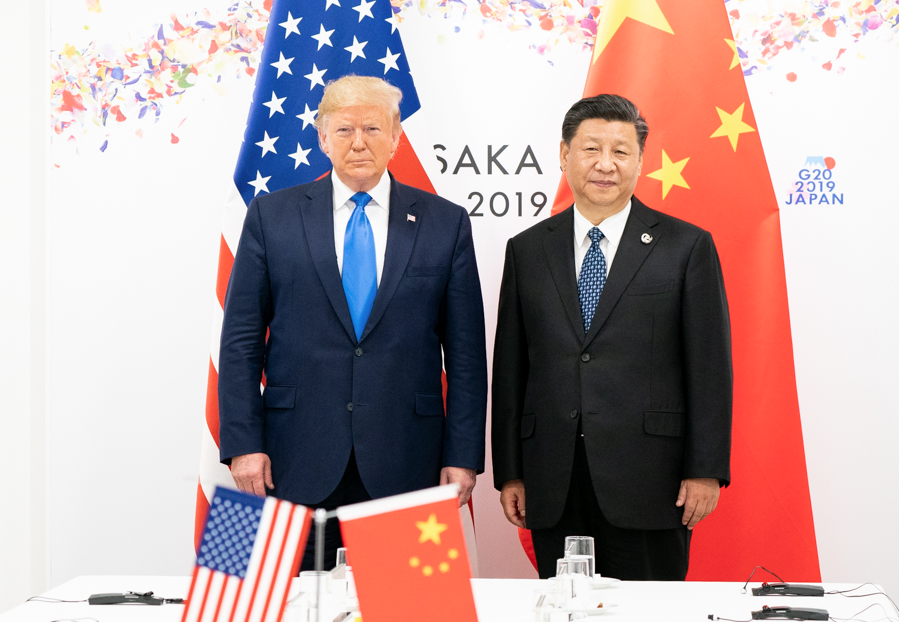
President Donald Trump and PRC President Xi Jinping at the G20 Japan Summit in Osaka, 29 June, 2019.
Cropped from an official White House photo by Shealah Craighead via Wikimedia Commons.
By the end of 2020, China’s relationships with the US and Australia had reached their lowest point in living memory, while Sino-British relations weren’t far behind. Yet the European Commission chose this moment to sign a major new investment treaty with Beijing. The deal appeared to have been rushed to completion just before Joe Biden’s inauguration, as if to avoid the fuss that a new American administration would be sure to make. Indeed, incoming National Security Adviser Jake Sullivan felt sore enough to send a pointed tweet: “The Biden-Harris administration would welcome early consultations with our European partners on our common concerns about China’s economic practices.”
The truth is that Brussels has been drifting further and further from Washington ever since the election of Donald Trump, and there are few signs the winds will change now that Biden has taken office. In 2017, Merkel said that Europe could no longer rely on America. By 2020, it seemed truer to say that Europe would rely on China from now on. Indeed, diplomats like Emmanuel Bonne (Macron’s foreign policy adviser) have been most enthusiastic about “France’s readiness to step up strategic communication with China.” In his gushing deference, Bonne can sometimes sound like a man with a gun to his head: “France respects China’s sovereignty, appreciates the sensitivity of Hong Kong-related issues, and has no intention of interfering in Hong Kong affairs.” There are times when the language of neutrality reveals with painful clarity that a side has been chosen.
Brussels officials talk of “strategic autonomy,” of course. They hope to carve out a path to self-sufficiency while at the same time enjoying mutually beneficial relationships with partners like Beijing. The problem is that mutually beneficial relationships are not possible with predators. As successive American administrations have found, those who maintain close connections with the Communist Party will eventually suffer large-scale intellectual property theft and the loss of millions of manufacturing jobs.
Brussels can hardly expect that Beijing will respect this new agreement. Recall the various promises that were made regarding Hong Kong: all of them were broken. Party officials may have signed a legal document recognising the city’s special administrative status, but this was purely for show. In 2017, having apparently now ascended to a position above the law, they declared that the document had “no practical significance.” Remember how Barack Obama was given firm assurance that Beijing would never militarize the South China Sea? There were handshakes and smiles all round, and then Beijing proceeded to militarize the South China Sea.
Indeed, some of the commitments included as part of the new deal echo those made 20 years ago, when China first joined the World Trade Organisation. It was agreed in 2001 that prices in every sector would be determined by market forces; that state-owned enterprises would begin operating free of state influence; that international norms regarding intellectual property would be respected; and so on. After two decades, we can see that the Communist Party has kept not one of its promises.
The error in Western thinking was to view CCP officials as civilised counterparts. We failed to see that we were dealing with a pack of thugs and grifters — men for whom the rule of law is neither reality nor ideal, but façade. This lesson has now been learned in some quarters, but clearly not in the upper echelons of the European Union. This new investment deal even includes a reference to “commitments on forced labour,” which is little short of an insult when we consider the hundreds of thousands of Uyghurs who have been made to toil all day till dusk in the cotton fields of Xinjiang. The truth is that the EU has been fooled. There will be no “win-win situation.” Not when dealing with the Communist Party, which has always viewed geopolitics as a zero-sum game. In the words of Bilahari Kausikan, once Singapore’s top diplomat, “only the irredeemably corrupt or the terminally naïve take seriously Beijing’s rhetoric about a ‘community of common destiny.'”
Tank Chats #104 | T-54 & T-55 | The Tank Museum
The Tank Museum
Published 14 Aug 2020Here Curator David Willey discusses the T-54, and its successor the T-55, tanks which can source their roots back to the Second World War and are probably the most produced tanks of all time.
Support the work of The Tank Museum on Patreon: ► https://www.patreon.com/tankmuseum
Visit The Tank Museum SHOP & become a Friend: ► tankmuseumshop.orgTwitter: ► https://twitter.com/TankMuseum
Instagram: ► https://www.instagram.com/tankmuseum/
#tankmuseum #tanks
QotD: Freedom of speech in Canada
We have nothing like the First Amendment; our Supreme Court is a Leftist institution par excellence and has even decreed in effect that truth is no defense in cases where “protected groups” are insulted or offended. Paragraph 140 of a 2013 Judgment finds “that not all truthful statements must be free from restriction. Truthful statements can be interlaced with harmful ones or otherwise presented in a manner that would meet the definition of hate speech.” Section 15 (2) of the Constitution Act of 1982 abridges the rights that section 15(1) guarantees Canadian citizens.
Further, our Human Rights Tribunals are Soviet-style shadow courts that discard due process in adjudicating cases of supposed discrimination or “hate speech.” As Canadian Human Rights Commissioner Dean Steacy said: “Freedom of speech is an American concept, so I don’t give it any value.” Openness to everything except freedom of speech, chartered principle and practical reason is the hallmark of our justice system, as it is of the nation. As Carl Sagan quipped in The Demon-Haunted World: “It pays to keep an open mind, but not so open your brains fall out.”
David Solway, “The Canadian Mind: A Culture So Open, Its ‘Brains Fall Out'”, PJ Media, 2018-10-10.
April 20, 2021
Why do the Queen Elizabeth-class carriers have twin islands?
Not What You Think
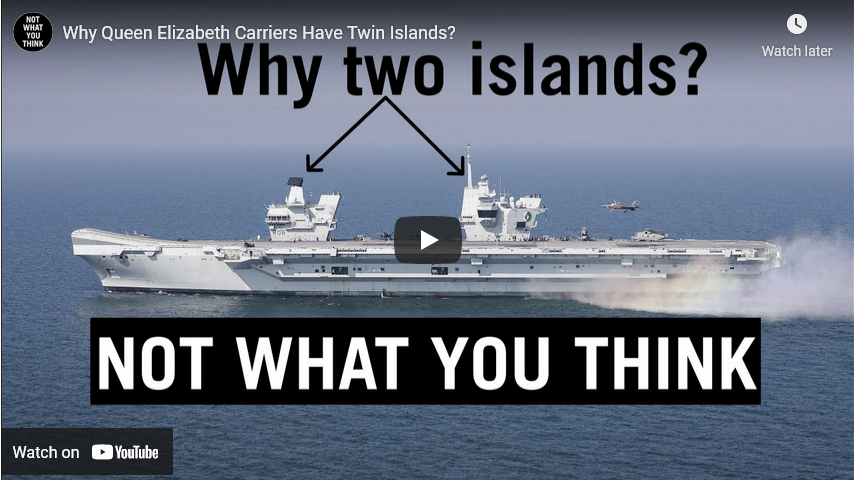
Published 28 Dec 2020There are at least five advantages to having two separate islands on the Royal Navy’s Queen Elizabeth-class aircraft carriers. But the main reason for such a design can only be found below the deck. Enjoy!
All the footage used in this video is under MOD license from Royal Navy Imagery archive. https://www.royalnavy.mod.uk/news-and…
REFERENCES:
https://ukdefencejournal.org.uk/why-d…
https://www.savetheroyalnavy.org/the-…
QotD: The Atlantropa project
Ever heard of Atlantropa? Probably not. It was a nutty scheme hatched by a nutty guy, and it never had even the remotest chance of ever coming to pass. In the 1920s, Europe was suffering from a myriad of post–World War I problems. There was a refugee crisis, the result of the shifting borders and population transfers that occurred at the war’s end. There was an energy crisis, and a serious shortage of natural resources. And, of course, there was the economic depression. Several years before a madly gesticulating Austrian with a wacky mustache would rise to power with his own solution to the continent’s ills, a plucky architect from Bavaria named Herman Sörgel proposed a different one: Drain the Mediterranean! Dam the Med and partially drain it, in order to form a contiguous body of land between Europe and Africa. A new continent that would be called Atlantropa. To Sörgel, this would cure Europe of all that ailed her. The dammed Mediterranean would create hydroelectric power plants to relight Europe’s recently dimmed lamps, and the elimination of pesky ocean crossings would allow millions of European refugees to stream into Africa, where they would take their rightful place as lord and master. Better still, this newly conquered African land would be ripe with fertile soil, minerals, and a plethora of natural resources for the taking.
Oh, Herman Sörgel, you pie-in-the-sky dreamer! You were the Elon Musk of your day (but slightly more grounded). The idea never took off, not just because of the fact that it was batshit insane, but also because, at that time, the left’s intellectual elite — the League of Nations crowd, the “forward-thinkers” — understood that you don’t cure one nation or one continent’s refugee problem by sending all of the huddled, wretched refuse to another people’s nation or continent. Back then, the left understood that this would pose serious problems for the host nation or continent. And the left was right. Atlantropa would have been a nightmare for native Africans, and eventually, there would have been a Rhodesia- or South Africa-style reckoning.
In the 1920s, if anyone had suggested that the specter of millions of European refugees streaming into Africa did not constitute an invasion, that person would have been dismissed as a lunatic, because of course it would have been an invasion. Those in favor of Atlantropa, and those against it, all got that point. The European refugees would not have been content to live like Africans, or to live under African rule. Europe’s refugee crisis would have become Africa’s domination crisis. So to the liberal elites, the best solution was to tell the refugees to stay put.
David Cole, “When Refugees Were Conquerors”, Taki’s Magazine, 2018-10-29.
April 19, 2021
How to Crosscut Square with a Handsaw | Paul Sellers
Paul Sellers
Published 8 Jan 2021Having struggles cutting square with a hand saw?
Paul has put this video together to show exactly how he does it to get perfectly square end cuts across the grain that are always square in both directions.
——————–
Want to learn more about woodworking?
Go to Woodworking Masterclasses for weekly project episodes: http://bit.ly/2JeH3a9
Go to Common Woodworking for step-by-step beginner guides and courses: http://bit.ly/35VQV2ohttp://bit.ly/2BXmuei for Paul’s latest ventures on his blog
——————–
Instagram: http://bit.ly/2oWpy7W
Twitter: http://bit.ly/33S7RFa
Pinterest: http://bit.ly/35X5uTf
QotD: Logistics and training
Logistics is more than just ensuring that the bullets and beans get sent forward to the infantry companies … it encompasses the whole business of manufacturing, stockpiling, shipping, handling and delivering everything the sailors, soldiers and air force members need, on time and to the right place. It is a complex science, and, when bombs are falling and bullets are whizzing about, a bit of an art, too. As I mentioned a couple of days ago, […] the administrative and logistics services are always “soft targets” for cuts when admirals and generals don’t want to cut their own pet components. The admirals and generals who always try to cut too much of the support “tail” before pulling a few teeth are always wrong.
When we consider logistics and training we should consider then both, together, as part of Support ~ with a capital S. Support also includes keeping facilities (barracks and training areas and workshops and supply depots) up to date.
Training is not just teaching selected skills; it involves planning on how many people will be needed, each with specific skill sets, to crew ships, to serve in regiments and battalions, to fly airplanes and to repair and maintain ships and tanks and trucks and aircraft over the long haul. Training also involves ensuring that teams know how to work together … training is how we prepare for war.
The capital S Support base […] must be properly staffed, properly funded (which means funding must be stable, over the years and decades) and properly organized and managed. Supporting our troops and fleets of ships, vehicles and aircraft requires a mix of civil and military people: some in uniform, some civil servants and some on contract from the private sector. There is no perfect model … most modern, Western states, including America, Australia, Britain, Canada, Denmark and so on, use a mix of military, civil service and contractor support service. each trying to get the right mix of operational effectiveness and economy. The key, as I mentioned above, is stability. The support system need to be properly staffed and funded year in and year out, decade after decade. Those elements ~ dockyards and depots and workshops and schools and agencies comprise the firm base upon which the nation’s war-fighting (combat) powers depend.
Ted Campbell, “My Plan (3)”, Ted Campbell’s Point of View, 2018-09-15.