Forgotten Weapons
Published 19 Jan 2021http://www.patreon.com/ForgottenWeapons
https://www.floatplane.com/channel/Fo…
Cool Forgotten Weapons merch! http://shop.bbtv.com/collections/forg…
Correction: Browning invented the pistol slide, but not the overall short recoil system. Maxim was the first to successfully create a short recoil firearm.
Short recoil is the most common system used today in self-loading handguns, and it also used to be fairly popular in machine gun designs. The basic principle is that the bolt and barrel (in a handgun, slide and barrel) are locked together for an initial travel substantially less than the overall length of the cartridge. After typically a few millimeters of travel, the barrel stops and the bolt or slide is able to continue rearward to extract and eject the empty case. Short recoil can be paired with virtually any locking system, but today the Browning tilting barrel system is most common.
Short recoil has never been popular in shoulder rifle, as the reduction in mechanical accuracy from the moving barrel can be undesirable. In handguns and machine guns, this accuracy reduction is generally below the threshold of relevance.
Contact:
Forgotten Weapons
6281 N. Oracle #36270
Tucson, AZ 85740
April 28, 2021
How Does it Work: Short Recoil Operation
QotD: George Orwell’s other novels
[Orwell’s] major work remains canonical, and cited on a daily basis in virtually every context imaginable, appropriately or otherwise. It seems unlikely that virtually any well-read man or woman is a stranger to his two most famous novels, which have established him, even seven decades after his death, as one of the bestselling writers in the English language. But once-popular works such as The Road to Wigan Pier are now in danger of falling into obsolescence, as the social circumstances that Orwell describes seem less and less relevant to a 21st-century readership, and even his great work of Spanish Civil War reportage Homage to Catalonia might be dismissed as a period piece, written with undeniable fire and conviction but saying little to a contemporary audience.
This would be a harsh and rather glib judgement, but many writers have faced worse. The book that suggested Wigan Pier, JB Priestley’s English Journey, was once hugely influential, even being credited with winning Labour the 1945 election, and is now regarded as a quaint piece of social commentary. That Priestley conducted his travels from a chauffeur-driven car, while Orwell willingly subjected himself to filthy evenings in slum bed and breakfasts and hostels, is a telling distinction between the two writers and their approaches: it is also undeniably true that Priestley died at 89, a grand old man of letters, and that Orwell’s premature death was one brought on by the tuberculosis that had affected him for years before his death. Yet Priestley is now remembered mainly for An Inspector Calls, and Orwell remains an iconic figure, beloved by millions. His canonisation was made explicit by a statue of him by Martin Jennings being erected outside Broadcasting House in 2017, complete with the phrase “If liberty means anything at all, it means the right to tell people what they do not want to hear”.
Yet it is doubtful that many of his admirers have read his earlier novels, namely Burmese Days, A Clergyman’s Daughter, Keep the Aspidistra Flying and Coming Up For Air. All four were brought out by the left-wing publisher Victor Gollancz, between 1934 and 1939, and each of them is autobiographical in nature. Burmese Days draws on Orwell’s faintly unlikely time in Burma in the Twenties with the Indian Imperial Police, and A Clergyman’s Daughter uses both his life with his family in Southwold (which appears faintly disguised in the novel as “Knype Hill”) and his days tramping for its narrative. Keep the Aspidistra Flying finds Orwell mining his experiences in the lower reaches of the London literary scene, including his time working in a bookshop in Hampstead, and Coming Up For Air, written while Orwell was recuperating in Marrakesh, is suffused with an intense nostalgia for an England that may never have really existed, but is of a piece with the fascination, and repulsion, for the tenets of “Englishness” that Orwell wrote about over and over again in his essays and reportage.
Alexander Larman, “The lesser-known Orwell: are his novels deserving of reappraisal?”, The Critic, 2021-01-07.
April 27, 2021
QotD: Modern Vienna
There are four ages of modern Vienna. Before the First World War, it was cultured and rich; from 1918 until the Anschluss with Nazi Germany, it was cultured and poor; from 1938 to the end of the Allied occupation, it was just poor; and from 1955 to the present, it has just been rich.
Daniel Johnson, “The broken circle”, The Critic, 2021-01-09.
April 26, 2021
Was GENERAL SHERMAN a WAR CRIMINAL?!?!?!?!
Atun-Shei Films
Published 11 Aug 2020Checkmate, Lincolnites! Debunking the Lost Cause myths surrounding William Tecumseh Sherman during the American Civil War, including the Atlanta Campaign, the March to the Sea, and the burning of Columbia — and tackling the “slavery would have gone away on its own” thing while we’re at it. Surprisingly, Johnny Reb gets in one or two really solid points.
[Updated 8 Feb 2023: Vlogging Through History’s reaction video to Atun-Shei’s interpretation is here – https://youtu.be/CTVr4YgB5VI]
(more…)
QotD: Maple-flavoured schadenfreude
Schadenfreude is of course the German word for taking pleasure in the discomfort of others. There should be a specific Canadian variant to indicate our enjoyment of Americans’ discomfort, which is and always has been a major source of satisfaction for many of our media elites. Maybe schadenfreud-eh?
William Watson, “Smug Canada probably wouldn’t let in a caravan of migrants either”, Financial Post, 2018-10-26.
April 25, 2021
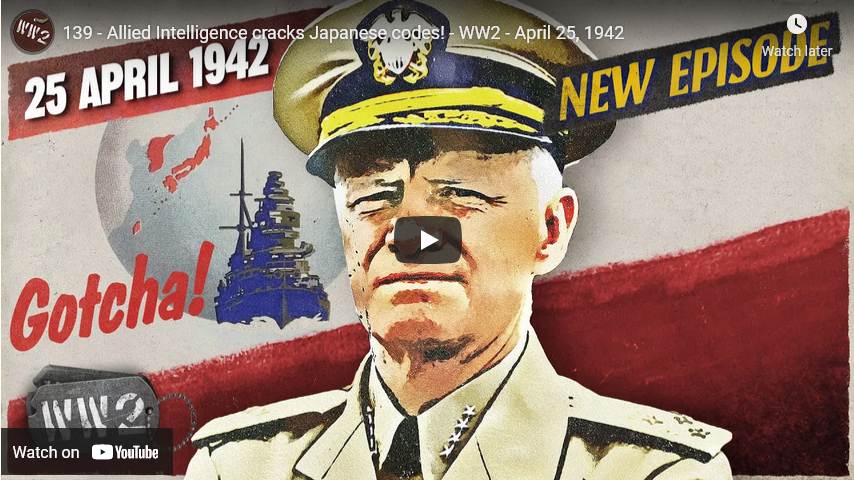
Allied Intelligence cracks Japanese codes! – 139 – WW2 – April 25, 1942
World War Two
Published 24 Apr 2021After last week’s Doolittle Raid on Tokyo, pretty much the entire Japanese fleet is sent out looking for American ships. They do not find them, but the enormous amount of radio traffic they generate is a treasure trove for Allied codebreakers to work on. The Allies ship 46 British Spitfire planes to Malta … and all of them are destroyed by the Axis within 48 hours. Germany begins bombing tourist and cultural destinations in Britain, and to make things even worse for the British this week, they realize they can’t hold Burma and are now making tracks for India, with the Japanese Army in hot pursuit.
Get Collectibles here: https://timeghost.tv/collectibles/
Join us on Patreon: https://www.patreon.com/TimeGhostHistory
Or join The TimeGhost Army directly at: https://timeghost.tvFollow WW2 day by day on Instagram @ww2_day_by_day – https://www.instagram.com/ww2_day_by_day
Between 2 Wars: https://www.youtube.com/playlist?list…
Source list: http://bit.ly/WW2sourcesWritten and Hosted by: Indy Neidell
Director: Astrid Deinhard
Producers: Astrid Deinhard and Spartacus Olsson
Executive Producers: Astrid Deinhard, Indy Neidell, Spartacus Olsson, Bodo Rittenauer
Creative Producer: Maria Kyhle
Post-Production Director: Wieke Kapteijns
Research by: Indy Neidell
Edited by: Iryna Dulka
Sound design: Marek Kamiński
Map animations: Eastory (https://www.youtube.com/c/eastory)Colorizations by:
– Mikołaj Uchman
– Daniel WeissSources:
– National Portrait Gallery
– Naval History and Heritage Command
– Book by Rob Crosswell, Arrow by 4B Icons – from the Noun Project
– Russian International News AgencySoundtracks from the Epidemic Sound:
– Rannar Sillard – “Easy Target”
– Jo Wandrini – “Dragon King”
– Howard Harper-Barnes – “Underlying Truth”
– Edward Karl Hanson – “Spellbound”
– Craft Case – “Secret Cargo”
– Johan Hynynen – “Dark Beginning”
– Andreas Jamsheree – “Guilty Shadows 4”Archive by Screenocean/Reuters https://www.screenocean.com.
A TimeGhost chronological documentary produced by OnLion Entertainment GmbH.
The First SMLE Trials Rifles: Lessons From the Boer War
Forgotten Weapons
Published 13 Jan 2021http://www.patreon.com/ForgottenWeapons
https://www.floatplane.com/channel/Fo…
Cool Forgotten Weapons merch! http://shop.bbtv.com/collections/forg…
In the aftermath of the Boer War, the British military needed to address critical issues of practical marksmanship with its troops. The Long Lee rifles it had deployed to South Africa suffered significant problems in making real-world hits on the battlefield. In addition to investing in better musketry training, the military chose to radically change its rifles.
In place of the Lee rifles and carbines, a single short rifle pattern would be issued for all branches of service (cavalry, artillery, and infantry). A stripper clip loading system was introduced to speed reloading and a full-length handguard for improving bayonet handling and reducing sight mirage. A windage adjustable rear sight was mandated, and a stout full protective hood added around the front sight. A new nosecap design was implemented to put the weight of the bayonet onto the stock, and not on the barrel where it would impact the rifle’s zero.
Two different patterns of rear sight were considered. The A pattern design was a tangent type sight like a Mauser, pinned at the front. The B pattern used a ladder sight, pinned at the rear. Five hundred of each were made, and put through a rigorous set of remarkably practical field trials. The testing involved not just static shooting for accuracy, but also shooting against timed disappearing targets, camouflaged targets, and snap shooting. The trial winner was the A pattern design, and it went into mass production in 1904 as the Short, Magazine, Lee Enfield Mark I — the first SMLE.
As adopted a few minor changes were made from the trials rifles, most notably a change from a full front sight hood to a pair of stout protective wings, to allow more light onto the sight. In addition, the design was almost immediately updated to a MkI* pattern, with a stronger rear sling swivel, rounded corners on the receiver, and a storage trap added to the buttplate.
Contact:
Forgotten Weapons
6281 N. Oracle #36270
Tucson, AZ 85740
QotD: “The Great Satan”
As soon as you see the recommendation from Noam Chomsky on the cover of the book, you can pretty much guess where McQuaig is coming from. I refer to the Chomskyan school of thought as American Monist: in short, the only actor on the world stage is America. It is the sole source of evil and depredation. Everyone else is motivated solely by love and concern for humanity, whilst America is, singularly, motivated only by greed, lust for power and a general animus for all things good, sunny and nice. Only America acts; everyone else is acted upon by the Hegemon, and can’t be blamed for the consequences of their actions. America is the Primus Mobilis. And America is bad. So, for example, the notion that an economy-based increased lust for oil is driving foreign policy is solely a characteristic of America; no other nation on earth appears to give a shit about oil. Certainly not France, Russia or China; McQuaig hardly mentions them. While McQuaig is forced to acknowledge that French, Russian and Chinese support for Saddam (and attendant undermining of UN sanctions) was related in some fashion to the oil deals they had each struck with Iraq, she airily dismisses the role that oil plays in their respective foreign policies. So the “oil as the root of all evil” trope is batted away in the space of two sentences when talking about other countries, but more than 300 pages are required to explain how oil and America are mutually catalyzing demon twins. When the rapaciousness of oil companies is discussed, it is almost exclusively American oil companies which are named; hardly ever any of the European, Russian or other oil companies. Because those other oil companies don’t possess the true indicia of evil, you see: they don’t stamp their barrels “Made in the USA”.
Bob Tarantino, “LIB Review: It’s the Crude, Dude”, Let It Bleed, 2005-03-05.
April 24, 2021
[“white” evil is] “not only objectivity, individualism, and writing, but linear thinking, quantitative reasoning, the Protestant work ethic, planning for the future, and being on time”
The latest post by John McWhorter at It Bears Mentioning discusses the “white” behaviours and thought patterns that many activists believe are as harmful to American blacks as outright white supremacism:
The organization 1776Unites, founded by my mentor and model Bob Woodson, has tweeted out a video where various black people decry a now fashionable idea that “whiteness” includes being smart. As in, precise, objective, fond of the written word, oriented towards dispassion, on time.
Those things are all manifestations of intelligence, vigilance, discipline. But according to our Elect folk, we black people are best off channeling our Crazy Badass Mothafucka. Because that’s more “authentic.” And, I get the feeling, fun to watch.
Because so many think that the battle that I and others are waging against Critical Race Theory’s transmogrification into education for children is an obsession with something that isn’t a real problem, I want to explore a bit. Someone I deeply respect not long ago surmised to me that the idea that black kids should be exempt from real standards is something being promulgated via mere paper “handouts,” and that the real problem is censorship from the right. I just don’t think so.
First, watch this, the 1776Unites video. Just a few minutes.
And now, as to what we are referring to, it starts actually before last summer. I knew something was really wrong when in 2019 at a conference in New York City for the city’s principals and superintendents, participants were presented with an idea that to teach with sensitivity to race issues meant keeping certain issues in mind.
These included ways of looking at things that are “white” rather than correct: namely, objectivity, individualism, and valuing the written word. Schools Chancellor Richard Carranza was fine with this, happily telling the media that it’s white people’s job to do the “work” of identifying the racist assumptions in how they go about their business.
So: to stand outside of matters and analyze them with one’s own private mind, and perhaps couch one’s conclusions with the considered artifice of writing rather than the spontaneity of speaking, is inauthentic for black and Latino people. It is racist to impose such things on black and Latino (and Native American?) kids. Or at best, brown kids should be taught this uptight “white” business only as a gloomy alternative to the realness of just hanging out sharing passing personal impressions via chatting.
[…]
This view of precision and detachment as white is a view about, more economically, reason. The idea is that to master close reasoning is suspect. It is exactly the roots of the “Math is Racist” notion, and if you want a whiff of how religiously people can glom on to such ideas, take a look at my Twitter feed in the week after I posted about that here.
Yet, seeing this educational philosophy laid out in the sunlight, The Elect cannot dismiss it as fringe “kookiness” — unless they want to insult the curators of a national museum devoted to celebrating the very black people The Elect live to liberate. At the African-American History Museum in Washington, D.C., for a hot minute or two in 2020 you could see a variation on the Jones-Okun business, an expanded presentation of what we must reject as “white” evil. An educational poster was displayed that slammed not only objectivity, individualism, and writing, but linear thinking, quantitative reasoning, the Protestant work ethic, planning for the future, and being on time.

This Insane Helicopter Was The Largest Ever Built: The Mil V-12 Story
Mustard
Published 10 Sep 2020Sign up for an annual CuriosityStream subscription and you’ll also get a free Nebula subscription (the new streaming platform built by creators) here: http://CuriosityStream.com/mustard
Research and writing in collaboration with Tomás Campos.
The Soviets built some of the largest and most technically advanced helicopters in the world. By 1957, the Mil Mi-6 had already emerged as the largest helicopter ever built, far out-sizing helicopters built in the west. But for the Soviet Union, the need to build a helicopter far larger than even the Mi-6, soon became a matter of national security.
By 1960, American U-2 spy planes conducting high altitude reconnaissance flights over the Soviet Union were beginning to uncover the location of the country’s Intercontinental Ballistic Missile (ICBM) sites. These first generation R-7 Semyorka ICBMs were being deployed throughout the Soviet Union as fast as possible, but their enormous size and weight meant they could only be delivered to launch sites using trains. The need to build rail lines to launch sites made the ICBM sites easy to spot in U.S. reconnaissance photos.
Keeping the missile sites hidden was a matter of national security. The Soviets devised a bold plan to airlift ICBMs into the vast and remote Soviet wilderness, thereby eliminating the need for rail lines or even roads. This would make it virtually impossible for spy planes to track down missile sites hidden in over twelve million square kilometres of forests. But to make the plan work, the Soviets would need to build a helicopter with at least twice the lifting power of the Mi-6.
Design studies for the new enormous helicopter began in 1959, with the Soviet Council of Ministers formally approving development in 1962. But development of such an ambitious helicopter would progress slowly, as various configurations (single rotor, tandem and transverse) were studied. Construction of testing-rigs, transmission systems and mock-ups began in 1963, and construction of the first prototype started in 1965. The new prototype would be designated as the Mil V-12 (with plans to designate the production version as Mil Mi-12). The first test flight in 1967 ended in failure as the V-12 crashed back to earth sustaining minor damage due to oscillations caused by control problems. A second test flight a year later proved the helicopter’s airworthiness.
The V-12 would go on to break numerous world records for lifting capacity, but its fate had already been sealed by a rapidly changing strategic situation. The introduction of spy satellites, and the development of new lighter and mobile ICBMs made hiding nuclear missiles strategically irrelevant.
In 1970, the Soviet Air Force refused to accept the V-12 into state acceptance trials, due to a lack of need. Although a second V-12 prototype would be constructed in 1972, there were simply too few scenarios that would require such a large and complex helicopter. In 1974 development of the V-12 was cancelled and the Mil Design Bureau shifted efforts to designing the Mil Mi-26, the largest helicopter to enter service.
Select footage courtesy the AP Archive:
AP Archive website: http://www.aparchive.com YouTube: https://www.youtube.com/c/aparchive and https://www.youtube.com/c/britishmovi…Special thanks to Nick Arehart for helping clean up our audio:
https://twitter.com/airhrt_Link to the Mustard Store:
teespring.com/stores/mustard-storeMusic used in this production (reproduced under license):
Intro Song: “Space Cinematic”- https://www.pond5.com/royalty-free-mu…
Song 2: “Yet Another Chase” – https://www.epidemicsound.com/track/X…
Song 3: “The Board Is Set” – https://www.epidemicsound.com/track/g…
Song 4: “Grim March” – https://www.pond5.com/royalty-free-mu…
Song 5: “Like the Wind” – https://www.pond5.com/royalty-free-mu…
Song 6: “Synthwave Industrial Technology” – https://audiojungle.net/item/synthwav…
Thanks for watching!
QotD: Marxism and the teenage mind
Marxism just seems right to teenagers of all ages. Teenagers’ only frame of reference is their parents, and to the inexperienced — as all teenagers by definition are — even the best parents seem willful and capricious, if not outright tyrannical. (The gray, wrinkled teenagers who refuse to learn merely substitute “society” for “their parents” in their emotional incontinence). Teenagers live in a weirdly binary world, where the switches can only be “on” or “off,” yet all terms are undefined.
That’s why the worst thing a teenager can think of is “unfair.” It’s wrong because it feels wrong, and anything that’s wrong must be somebody’s fault — again, how could it be otherwise? Parents can’t afford to let their kids learn big lessons the hard way. Literally can’t afford it, in that teenagers can’t see why, for example, you can’t take that turn at 85 mph on an icy road. You can explain it to them until you’re blue in the face, but as anyone who has spent any time around teenagers knows, there’s a large subset of them that will simply refuse to get it. Alas, those tend to be the brighter ones, and so a large part of the subtle art of teenager management is setting up smaller, less catastrophic situations for them to fuck up, such that they hopefully learn by analogy. Which is still, of course, the grownups’ fault …
A big part of growing up, then, is: realizing that not everything is someone’s fault. Every effect has a cause, that’s a simple truth of logic, but not every event has a cause. The real world, grownups know, is what Buddha said it is, a nexus of causes and conditions. Even the simplest event has innumerable proximate causes, necessary-but-not-sufficient conditions, and so on. If you want to argue, in terms of pure logic, that every event is an intersection of a long series of causal chains that are all, in theory, perfectly discoverable, go nuts, but for all practical purposes, shit just happens. Accepting that is one of the foundation stones of adulthood.
From that perspective, one’s youthful Marxism seems silly, and nothing seems sillier than Marx’s endless ranting against the perfidy of “the capitalists.” Just as your parents aren’t really the capricious tyrants you thought they were when they wouldn’t let you use the car on Friday night, so even the biggest of businessmen are just people. Marx paints them as cartoonishly evil, but though a guy like Andrew Carnegie was a real bastard in his youth, no doubt about that, he too grew up, becoming a staunch philanthropist and anti-imperialist. So, too, with the labor theory of value, which is the closest thing to the quintessence of the teenage mind ever put to paper — those Air Jordans are “overpriced,” no one denies that, but it’s simply not true that selling $5 shoes for $200 is “exploitation.” There’s this thing called “demand,” and … well, you get it.
Severian, “Marx Was Right After All (on ongoing series”, Rotten Chestnuts, 2021-01-12.
April 23, 2021
Taiwan Under Occupation, Axis Solidarity, and U-Boats in the Med – WW2 – OOTF 022
World War Two
Published 22 Apr 2021Ever wonder what life was like in Taiwan during the Second World War? Or if German U-Boats were active in the Mediterranean? You can find out the answers in this episode of Out of the Foxholes!
Join us on Patreon: https://www.patreon.com/TimeGhostHistory
Or join The TimeGhost Army directly at: https://timeghost.tvFollow WW2 day by day on Instagram @ww2_day_by_day – https://www.instagram.com/ww2_day_by_day
Between 2 Wars: https://www.youtube.com/playlist?list…
Source list: http://bit.ly/WW2sourcesHosted by: Indy Neidell
Written by: Ian Sowden, Lewis Braithwaite, Timothy Smith
Director: Astrid Deinhard
Producers: Astrid Deinhard and Spartacus Olsson
Executive Producers: Astrid Deinhard, Indy Neidell, Spartacus Olsson, Bodo Rittenauer
Creative Producer: Maria Kyhle
Post-Production Director: Wieke Kapteijns
Research by: Ian Sowden, Lewis Braithwaite, Timothy Smith
Edited by: Miki Cackowski
Sound design: Marek Kamiński
Map animations: Miki Cackowski and Eastory (https://www.youtube.com/c/eastory)Sources:
David Rumsey Map Collection, David Rumsey Map Center, Stanford Libraries
Chapman University Digital CommonsSoundtracks from the Epidemic Sound:
Yi Nantiro – “Watchman”
Max Anson – “Ancient Saga”
Skrya – “First Responders”Archive by Screenocean/Reuters https://www.screenocean.com.
A TimeGhost chronological documentary produced by OnLion Entertainment GmbH.