Overly Sarcastic Productions
Published 30 Apr 2021
History is full of Rulers, but most of them (especially some famous ones) can be Kind Of Terrible upon closer inspection. So let’s take a look at two kings we can actually consider to be Good — not perfect, not blameless, but a heck of a lot more virtuous than the average ruler, that’s for sure.
This topic was requested by our patron Duncan! Thank you for your patronage, and for the topic suggestion.
SOURCES & Further Reading: The Great Courses Plus lectures “Being Persian” by Robert Garland, “The Persian Era” by Jean-Pierre Isbouts, “Saladin: Chivalry and Conquest – 1187” by Eamonn Gearon, and “Saladin and the Defeat of the Crusaders” by Dorsey Armstrong.
Our content is intended for teenage audiences and up.
TRACKLIST: “Monkeys Spinning Monkeys,” “Pippin the Hunchback” Kevin MacLeod (incompetech.com)
Licensed under Creative Commons: By Attribution 4.0 License https://creativecommons.org/licenses/…
In another of a series of book reviews by Astral Codex Ten readers, Scott Alexander posted this review of Double Fold by Nicholson Baker, which helps to indicate just when libraries — and librarians — lost their mojo:
If you enter a major research library in the US today and request to see a century-old issue of a major American newspaper, such as Chicago Tribune, The Wall Street Journal, or major-but-defunct newspapers such as the New York “World”, odds are that you will be directed to a computer or a microfilm reader. There, you’ll get to see black-and-white images of the desired issue, with individual numbers of the newspaper often missing and much of the text, let alone pictures, barely decipherable.
The libraries in question mostly once had bound issues of these newspapers, but between the 1950s and the 1990s, one after another, they ditched the originals in favor of expensive microfilmed copies of inferior quality. They continued doing this even while the originals became perilously rare; the newspapers themselves were mostly trashed, or occasionally sold to dealers who cut them up and dispersed them. As a consequence, many of these publications are now rarer than the Gutenberg Bible, and some 19th and 20th century newspapers have ceased to exist in a physical copy anywhere in the world.
When Double Fold by Nicholson Baker came out in 2001, it was described as The Jungle of the American library system. After 20 years, the book remains universally known, sometimes admired but often despised, among librarians. The reason for their belligerence is that Baker publicly revealed a decades-long policy of destruction of primary materials from the 19th and 20th centuries, based on a pseudoscientific notion that books on wood-pulp paper are quickly turning to dust, coupled with a misguided futuristic desire to do away with outdated paper-based media. As a consequence, perfectly well preserved books with centuries of life still ahead of them were hastily replaced with an inferior medium which has, at the moment that I am writing this review, already mostly gone the way of the dodo. Despite its notoriety among librarians, however, Double Fold is little-known among the general public, even compared to Baker’s other non-fiction and his novels.
This is a shame, since the mass destruction of books and newspapers by libraries in the post-war era deserves to be better known as one of the most egregious failures of High Modernism, comparable with the wackiest plans of Le Corbusier. The story combines an excessive reliance on simplistic mathematical models, wilful ignorance to the desires of actual library-users and scholars, embracement of miniaturization and modernization as terminal values, and an almost complete disregard of 19th century books as historical artefacts. Unlike industrial farms, which can be broken up, and Brasília-style skyscrapers, which can be torn down and replaced with something else, the losses caused by the mass deaccessioning of books and newspapers from libraries were often irreplaceable.
As part of the uproar that followed the book’s publication, the Association of Research Libraries published an online anti-Baker FAQ, and in 2002, the book Vandals in the Stacks? by Richard J. Cox came out, presenting an attempted refutation of Baker’s theses. I have read both of these and discuss Cox’s arguments later on, but I must admit in advance that I was mostly convinced by Baker’s argumentation much more than by that of his opponents. Nonetheless, it is uncommon to have a polemical book receive a book-length response, and anyone interested in Baker’s thesis is advised to check out Cox as well.
In 1907, the British adopted the final major pattern in the evolution of the Short, Magazine, Lee Enfield. Designated the ShtLE MkIII (Short Lee Enfield) at the time, it would be retroactively renamed Rifle No1 MkIII in the 1920s. This new design was simpler and more durable than its predecessors while actually improving the practical accuracy of the rifle. The rear sight protector wings were substantially strengthened, the front sight became a square post, the front sight protectors were opened up to allow more light in, and the rear sight windage adjustment was simplified — while retailing 1 MOA adjustment clicks and 25m elevation adjustments. A new bayonet was also adopted in 1907 for the MkIII. The previous 1903 pattern bayonet was deemed too short, and the British essentially copied the Japanese Type 30 Arisaka bayonet as its new Pattern 1907 — hooked quillion and all.
The example we are looking at in today’s video is a fantastic specimen, as it was sold out of service to an Australian reservist in 1912 having not received any post-production modifications or updates. It is still sighted for the early MkVI round-nose ammunition, for example, and its bayonet retains the hooked quillion. The rifle’s owner died prior to World War One, and the gun remained stored away and forgotten through both World Wars, where virtually all existing service rifles were taken back into service and updated. Only in the 1960s was this one found, making it a pristine collector’s example to show how the MkIII was originally produced.
Contact:
Forgotten Weapons
6281 N. Oracle #36270
Tucson, AZ 85740
Comments Off on SMLE MkIII: The Iconic Smelly of World War One
Yes, false conspiracy theories are dangerous. One of the best defences a polity has against them is a reasonable level of trust in the authorities and the media. In the long run the only way to gain this trust is to be worthy of it, i.e. not to lie and not to hide the truth. By their promiscuous propagation of any story, however baseless, that might harm the Republicans and their enthusiastic censorship of any story, however credible, that might make the Democrats look bad, the American Woke Media, old and new, have lost this trust. As a result reality ensues, to quote TV Tropes. Or if you prefer the same truth in an older format, take your quote from William Caxton’s summary at the end of his retelling of the fable of the boy who cried wolf, “men bileve not lyghtly hym whiche is knowen for a lyer“.
Sources:
IWM MH 24764, HU 36196, Q(HS) 256, D 16649
Yad Vashem 48AO3, 953, 86FO2, 3116/71
Bundesarchiv
Tito giving a speech in Foča, courtesy of Музеј Старе Херцеговине
Narodowe Archiwum Cyfrowe
Star of David, courtesy of Jacek Proszyk https://commons.wikimedia.org/wiki/Fi…
Picture of Gustav Braun von Stumm, courtesy of Thomas Föhl https://www.geni.com/photo/view/60000…
Soundtracks from the Epidemic Sound:
Wendel Scherer – “Defeated”
Johan Hynynen – “Dark Beginning”
Jon Bjork – “Disposal”
Christian Andersen – “Barrel”
Wendel Scherer – “Growing Doubt”
Jon Bjork – “For the Many”
Reynard Seidel – “Deflection”
Gavin Luke – “Drifting Emotions 3”
Jon Bjork – “Icicles”
Gunnar Johnsen – “Not Safe Yet”
A TimeGhost chronological documentary produced by OnLion Entertainment GmbH.
Update: TimeGhost had to repost a censored version of this episode and provided this explanation:
World War Two
1 hour ago (edited)
The original version of this video was age restricted by YouTube for containing pictures of dead bodies. We do not feel that it is correct to document these events by finessing history and self censoring, but YouTube has left us no choice. We have several problems with these age restrictions, but let’s start off with what an age restriction means on YouTube. In theory it simply restricts the video from anyone who isn’t over 18 and logged in to the YouTube platform, but in effect it does much more than that;
1. It takes the video out of most subscribers’ feeds and notification lists
2. In some countries like for instance South Korea, for legal reasons it is not accessible at all, for anyone
3. YouTube ranks it lower in their recommendation engines sending out recommendations to view to only a fraction of the ‘normal’ recommendations
4. It can no longer be viewed off YouTube as an embedded video – meaning that it won’t display even on our own website
5. It gets a boiler plate informing the viewer that the content has been “identified by the community as offensive to some viewers”
6. On many mobile devices it cannot be shared with the YouTube app
7. In countries were legal proof of age is required for adult content you have to provide a driver’s license, or credit card proving you are over 18
In effect that means that YouTube is soft censoring the video from a large section of potential viewers. The result is that we get around half, or less of the views on videos that are age restricted. And we should note that according to YouTube’s own system more than 90% of our viewers are over 18, so it’s not just an effect of losing underage viewers.
Now, this content is without any doubt hard to watch, but it’s educational content based on solid facts, documented through crystal clear academic research. It is about the crimes against humanity during WW2. It documents events that are to this day in 2021, denied by sympathizers of extreme ideologies. Because of the special importance for new generations to learn about these events, many countries, especially in the EU and North America, do not require in their youth protection laws or media regulation that this kind of content shall be for 18+ only. To the contrary many countries have these topics, told just as graphically as we document them on their school curriculum for ages 13 and above. Moreover, YouTube has in their own community guidelines a provision that allows for displays of violence, dead bodies, and so on in an educational context also for under 18s.
So in effect YouTube is here choosing to restrict, even censor content of high educational importance although they are not legally required to do so, and they have their own provisions to allow it to be unrestricted. Why do they do that? Well, we can’t read their minds, but we have some indications that;
A) they ere on the side of caution to avoid ANY legal risk.
B) They fear any kind of content that has to do with extremism, even when unmasking it after the advertising boycotts they faced a couple of years back.
C) when the community complains they put extra weight on those complaints
It is item C that troubles us the most. We have over 500 videos on our channels – very many of them contain graphic images of death and violence for reasons of the topics we document. Among these videos, a few dozen have been age restricted, while the rest have not. The common denominator between the age restricted videos is that they document events, or phenomena that unmask extremism by historical Communists, Nazis, and Imperialists. Its is difficult to not see the common interest by sympathizers of these groups and YouTube. If you want something suppressed, and there’s an easy way to just get it suppressed by just pressing a button – is it not reasonable to assume that you would use that button? We’re not conspiracy mythologists, we don’t believe there is a conspiracy here, but just by creating a simple path to fulfill different, but in effect common interests YouTube has made it easy for deniers of crimes against humanity, and war crimes to suppress information about these events.
We have explained to YouTube that inadvertently they are supporting the exact kind of hateful extremism they are fighting against with their other sword arm. We have implored them to lift the age restrictions in the interest of what society has decided: that content like this needs to be freely accessible in the public space. Despite an otherwise good and healthy relationship to the platform operators who are after all our distribution partners,, we have been met with standard replies, and a denial for our request.
Once again we express our dismay, sadness, and disappointment that YouTube chooses to restrict access to content that should serve a greater good; that we do not forget the victims of atrocities and extremism so that we can learn from our past and improve our societies.
Never Forget.
Comments Off on The Horrors of Partisan Warfare – WAH 033 – April 1942, Pt. 2
Michael Geist continues to sound the alarm about the federal government’s bill to vastly increase CRTC control over Canadians’ access to information and entertainment options online, including the Heritage minister’s mendacity when challenged about how the CRTC’s powers will increase to censor individual Canadians in what they post to online services like YouTube:
Canadian Heritage Minister Steven Guilbeault and the Liberal government’s response to mounting concern over its decision to remove a legal safeguard designed to ensure the CRTC would not regulate user generated content has been denial. The department’s own officials told MPs that all programming on sites like Youtube would be subject to regulation, yet Guilbeault insisted to the House of Commons that user generated content would be excluded from regulation as part of Bill C-10, his Broadcasting Act reform bill.
However, based on new documents I recently obtained, it has become clear that Guilbeault and the government have misled the Canadian public with their response. In fact, the government effectively acknowledges that it is regulating user generated content in a forthcoming, still-secret amendment to Bill C-10. Amendment G-13, submitted by Liberal MP Julie Dabrusin on April 7th and likely to come before the committee studying the bill over the next week, seeks to amend Section 10(1) of the Broadcasting Act which specifies the CRTC’s regulatory powers. It states:
(4) Regulations made under paragraph (1)(c) do not apply with respect to programs that are uploaded to an online undertaking that provides a social media service by a user of the service – if that user is not the provider of the service or the provider’s affiliate, or the agent or mandatary of either of them – for transmission over the Internet and reception by other users of the service.
The amendment is a clear acknowledgement that user generated content are programs subject to CRTC’s regulation making power. Liberal MPs may claim the bill doesn’t do this, but their colleagues are busy submitting amendments to address the reality.
But it is not just that the government knew that its changes would result in regulating user generated content. The forthcoming secret amendment only covers one of many regulations that the CRTC may impose. The specific regulation – Section 10(1)(c) of the Broadcasting Act – gives the CRTC the power to establish regulations “respecting standards of programs and the allocation of broadcasting time for the purpose of giving effect to the broadcasting policy set out in subsection 3(1).”
Comments Off on Bill C-10, despite frequent government denials, would regulate user-generated content on the internet
Piero Tosi died last week and it made me really sad. he was one of the first to understand how staying close to history can actually make the film costumes fascinating, not boring. sadly, I’m beginning to think he was also one of the last — today’s mainstream cinema is all about “making things relatable for the modern viewer”.
________
My Instagram: https://bit.ly/2Qo9rrI
My nudes: https://bit.ly/2KypPpn
My merch: bit.ly/2CCq5jE
Comments Off on Period drama costume designers these days
The Scots were now under the leadership of the Bruce (not to be confused with the Wallace), who, doubtful whether he had slain the Red Comyn or not, armed himself with an enormous spider and marched against the English, determined if possible to win back the Great Scone by beating the English three times running.
The fact that the English were defeated has so confused Historians that many false theories are prevalent about the Bannockburn Campaign. What actually happened is quite clear from the sketch map shown above. The causes of the English defeat were all unfair and were:
The Pits. Every time the Wallace saw some English Knights charging at him he quickly dug one of these unnatural hazards into which the English Knights, who had been taught to ride straight, galloped with flying colours.
Superior numbers of the English (four to one). Accustomed to fight against heavy odds the English were uneasy, and when the Scots were unexpectedly reinforced by a large body of butlers with camp stools the English soldiers mistook them for a fresh army of Englishmen and retreated in disgust.
Foul riding by Scottish Knights. This was typified even before the battle during an exhibition combat between the Brace and the English Champion, Baron Henry le Bohunk, when Brace, mounted on a Shetland pony, galloped underneath the Baron and, coming up unexpectedly on the blind side, struck him a foul blow behind and maced him up for life.
This is the story of “Tokyo Rose”, a Japanese-American from LA who broadcast propaganda for the Japanese during WW2. Was she a traitor or a victim?
Dr. Mark Felton is a well-known British historian, the author of 22 non-fiction books, including bestsellers Zero Night and Castle of the Eagles, both currently being developed into movies in Hollywood. In addition to writing, Mark also appears regularly in television documentaries around the world, including on The History Channel, Netflix, National Geographic, Quest, American Heroes Channel and RMC Decouverte. His books have formed the background to several TV and radio documentaries. More information about Mark can be found at: https://en.wikipedia.org/wiki/Mark_Fe…
Visit my audio book channel ‘War Stories with Mark Felton’: https://youtu.be/xszsAzbHcPE
Disclaimer: All opinions and comments expressed in the “Comments” section do not reflect the opinions of Mark Felton Productions. All opinions and comments should contribute to the dialogue. Mark Felton Productions does not condone written attacks, insults, racism, sexism, extremism, violence or otherwise questionable comments or material in the “Comments” section, and reserves the right to delete any comment violating this rule or to block any poster from the channel.
Comments Off on “Tokyo Rose” – WW2 Traitor or Victim?
Economist Douglas W. Allen of Simon Fraser University recently published his Covid Lockdown Cost/Benefits:A Critical Assessment of the Literature where he concludes that “it is possible that lockdown will go down as one of the greatest peacetime policy failures in Canada’s history”:
In my forty years as an academic, I’ve never seen anything like the response and reaction to Covid-19. The research response has been immense, with estimates of over 40,000 papers related to the topic produced in one year. This research covers every imaginable aspect of Covid-19, and over the course of the past year knowledge about the virus, the human reactions to it, and the consequences of these reactions has exploded. In one word, the Covid-19 information cascade has been “overwhelming.”
In contrast, the ubiquitous media, public health, and political response to the pandemic has been one-sided, incomplete, and almost unchanging over the past year. With respect to lockdown policies, many political jurisdictions have repeated the same spring 2020 programs in 2021, ignoring what has been learned in the meantime. Often public announcements were made that were inconsistent with basic Covid-19 facts that were easy to look up if you know where to look. Furthermore, when research results contrary to the official government response were shared on social media, they were often pulled from social media platforms. As a result, for average Canadians the public media and official public health news conferences have been the only source of Covid-19 information.
This review of a small segment of the literature is intended to give some guidance for those who would otherwise not have access to academic research. The focus is to only critically assess the cost/benefit studies that have been written over the past year on lockdown policies related to the Covid-19 pandemic.
The report covers over 80 different academic studies and related Covid-19 datasites. I have sought out studies that i) dealt with matters of “lockdown” either directly or indirectly, and ii) were related directly or indirectly to issues relevant to the costs or benefits of lockdown.
The term “lockdown” is used to generically refer to state actions that imposed various forms of non-pharmaceutical interventions. That is, the term will be used to include mandatory state-enforced closing of non-essential business, education, recreation, and spiritual facilities; mask and social distancing orders; stay-in-place orders; and restrictions on private social gatherings.
“Lockdown” does not refer to cases of “isolation,” where a country was able to engage in an early and sufficient border closure that prevented trans-border transmission, followed by a mandated lockdown that eliminated the virus in the domestic population, which was then followed by perpetual isolation until the population is fully vaccinated. This strategy was adopted by a number of island countries like New Zealand. Here I will only consider lockdown as it took place in Canada and most of the world; that is, within a country where the virus became established.
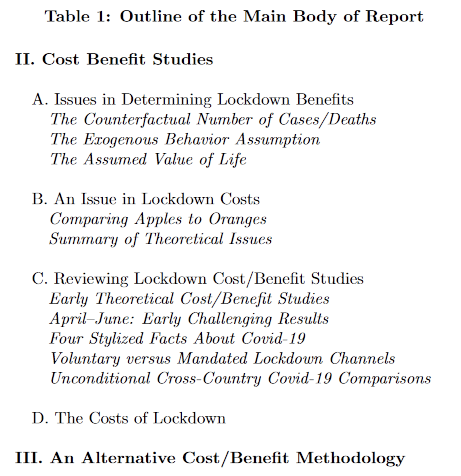
This is a complicated report because it covers a wide range of studies, and deals with a wide range of issues. Table 1 outlines the substance of the report. Sections II: A and B, discuss four critical assumptions often made within the context of estimating benefits and costs. Understanding these assumptions explains why early studies claimed that the benefits of lockdown were so high, and also explains why the predictions of those models turned out to be false.
Section II: C, examines major cost/benefit studies completed over the first six months of the pandemic, and then focuses on what I believe to be the critical factor: distinguishing between mandated and voluntary changes in behavior. This section concludes with an interpretation of some unconditional death comparisons across countries that are typically reported in the media. Section II: D surveys the research done on the costs of lockdown. Finally, Section III. presents a simple alternative cost/benefit methodology to generate two cost/benefit ratios of lockdown.
David Fletcher is back! Join him as he discusses the FV601 Saladin — a six wheeled armoured car developed by Crossley Motors and later produced by Alvis. The Saladin has had a long service life and despite its dated design, is still in service with some countries.
Support the work of The Tank Museum on Patreon: ► https://www.patreon.com/tankmuseum
Visit The Tank Museum SHOP & become a Friend: ► tankmuseumshop.org
The room, in addition to its other drawbacks, was always underlit. But it’s proving a major challenge to find nifty lamps that also give enough light to read by. All the cool Art Nouveau sort of stuff only go up to 60 watts max, which, for a reader, is like switching on the darks. And the lamps in stores are not logically arranged by wattage; one has to wander about turning them upside down and peering at the little sticky labels on the sockets for a clue, for yea verily, the sales staff has none. They are not readers either, sigh.
Lois McMaster Bujold, letter to Baen’s Bar, 2004-10.
Comments Off on QotD: Searching for useful reading lights
From inspiring their subjects to plotting international strategy, the world’s monarchies still have a crucial role to play in their country’s war effort during the Second World War. As you’ll find out, some sovereigns are much more successful at this than others.
Sources:
– National Archives NARA
– National Portrait Gallery
– FDR Presidential Library & Museum
– Imperial War Museums: HU 55966, H 1971,
– Girl Guides of Canada
– Narodowe Archiwum Cyfrowe
– Australian War Memorial: AWM 4067471
Soundtracks from the Epidemic Sound:
– “Other Sides of Glory” – Fabien Tell
– “London” – Howard Harper-Barnes
– “Break Free” – Fabien Tell
– “Last Point of Safe Return” – Fabien Tell
– “Weapon of Choice” – Fabien Tel
– “Please Hear Me Out” – Philip Ayers
– “Disciples of Sun Tzu” – Christian Andersen
– “Dragon King” – Jo Wandrini
– “Remembrance” – Fabien Tell
– “Ominous” – Philip Ayers
A TimeGhost chronological documentary produced by OnLion Entertainment GmbH.
From the comments:
World War Two
1 day ago (edited)
With recent events surrounding the death of Prince Phillip, the British Royal Family has been front-and-center of the worldwide news cycle as of late. In 2021, it is rare for the royals to be at the center of people’s lives, but this wasn’t the case in the days of World War Two. Even though the age of kingdoms was largely over when war came around, sovereigns still had a role to play in their country’s war effort all over the world.
In this episode, we are taking a closer look at the role royalty played during the war. Is there still a monarchy where you live and if so, what is your experience with it? We would love to hear about that in the comments!
Correction: Browning invented the pistol slide, but not the overall short recoil system. Maxim was the first to successfully create a short recoil firearm.
Short recoil is the most common system used today in self-loading handguns, and it also used to be fairly popular in machine gun designs. The basic principle is that the bolt and barrel (in a handgun, slide and barrel) are locked together for an initial travel substantially less than the overall length of the cartridge. After typically a few millimeters of travel, the barrel stops and the bolt or slide is able to continue rearward to extract and eject the empty case. Short recoil can be paired with virtually any locking system, but today the Browning tilting barrel system is most common.
Short recoil has never been popular in shoulder rifle, as the reduction in mechanical accuracy from the moving barrel can be undesirable. In handguns and machine guns, this accuracy reduction is generally below the threshold of relevance.
Contact:
Forgotten Weapons
6281 N. Oracle #36270
Tucson, AZ 85740
Comments Off on How Does it Work: Short Recoil Operation
[Orwell’s] major work remains canonical, and cited on a daily basis in virtually every context imaginable, appropriately or otherwise. It seems unlikely that virtually any well-read man or woman is a stranger to his two most famous novels, which have established him, even seven decades after his death, as one of the bestselling writers in the English language. But once-popular works such as The Road to Wigan Pier are now in danger of falling into obsolescence, as the social circumstances that Orwell describes seem less and less relevant to a 21st-century readership, and even his great work of Spanish Civil War reportage Homage to Catalonia might be dismissed as a period piece, written with undeniable fire and conviction but saying little to a contemporary audience.
This would be a harsh and rather glib judgement, but many writers have faced worse. The book that suggested Wigan Pier, JB Priestley’s English Journey, was once hugely influential, even being credited with winning Labour the 1945 election, and is now regarded as a quaint piece of social commentary. That Priestley conducted his travels from a chauffeur-driven car, while Orwell willingly subjected himself to filthy evenings in slum bed and breakfasts and hostels, is a telling distinction between the two writers and their approaches: it is also undeniably true that Priestley died at 89, a grand old man of letters, and that Orwell’s premature death was one brought on by the tuberculosis that had affected him for years before his death. Yet Priestley is now remembered mainly for An Inspector Calls, and Orwell remains an iconic figure, beloved by millions. His canonisation was made explicit by a statue of him by Martin Jennings being erected outside Broadcasting House in 2017, complete with the phrase “If liberty means anything at all, it means the right to tell people what they do not want to hear”.
Yet it is doubtful that many of his admirers have read his earlier novels, namely Burmese Days, A Clergyman’s Daughter, Keep the Aspidistra Flying and Coming Up For Air. All four were brought out by the left-wing publisher Victor Gollancz, between 1934 and 1939, and each of them is autobiographical in nature. Burmese Days draws on Orwell’s faintly unlikely time in Burma in the Twenties with the Indian Imperial Police, and A Clergyman’s Daughter uses both his life with his family in Southwold (which appears faintly disguised in the novel as “Knype Hill”) and his days tramping for its narrative. Keep the Aspidistra Flying finds Orwell mining his experiences in the lower reaches of the London literary scene, including his time working in a bookshop in Hampstead, and Coming Up For Air, written while Orwell was recuperating in Marrakesh, is suffused with an intense nostalgia for an England that may never have really existed, but is of a piece with the fascination, and repulsion, for the tenets of “Englishness” that Orwell wrote about over and over again in his essays and reportage.