Here are the main points of the Bank of Canada’s lessons in free trade. It starts off with a bang. “Trade is dominating the news these days. With the barrage of headlines and the talk about protectionism and tariffs, it’s easy to forget that much of our economic growth and prosperity comes from international trade.”
Below are the lessons, taken almost entirely verbatim from the bank’s online lesson (except where I’ve provided a bit of additional description). It’s a terrific lesson and all within a mere 1,400 words and a short video.
Lesson 1: All parties reap the rewards of free trade.
Specialization means focusing on what each country produces most efficiently and trading for the rest. And because specialization is more efficient, it creates more wealth than if each country tried to do it all on its own. International trade is no different from domestic specialization and internal trade — few of us grow our own food or do our own dry cleaning. Instead, we specialize and trade. The lesson includes a short cartoon video featuring “Mark and Lucy” — aimed at kids but worth a presidential view — that explains the concepts of comparative advantage and opportunity costs.
Lesson 2: Trade protectionism makes everyone worse off.
While freer trade — in both exports and imports — makes us better off, the opposite is also true. Barriers to free trade, such as tariffs, have a negative impact on our economic well being.
Lesson 3: The pie isn’t divided equally.
Freer trade has raised incomes across the global economy, but it has not benefited everyone. Countries engaged in free trade are better off overall, but some sectors and communities within countries have suffered. Governments have used policies such as ongoing learning and retraining programs to help affected workers adjust. This a better approach than shrinking the pie through trade protection. That would be worse for everyone.
Lesson 4: Trade deficits and surpluses are not a scorecard.
It’s important to debunk the myth that cheap imports are the cause of all the pain and that a trade deficit with another country is a bad thing. Looking at trade balances between a country and its trade partners, we should expect to see surpluses with some and deficits with others. This is specialization in action.
Terence Corcoran, “Amazing! Canada has one government department that actually comprehends free trade!”, Financial Post, 2018-10-04.
April 12, 2021
QotD: Four lessons on free trade
April 11, 2021
America Surrenders – The Fall of Bataan – 137 – April 10, 1942
World War Two
Published 10 Apr 2021After holding out since the beginning of the year, the American and Filipino defenders at Bataan can do so no more, and they surrender to the Japanese — the Bataan Death March for the 75,000 prisoners begins. Meanwhile, the Japanese carrier fleet launches a raid on Colombo and shipping in the Bay of Bengal, wrecking Britain’s Eastern Fleet in the process and forcing them to move to African coastal bases. Adolf Hitler issues the directive outlining his plans for a summer offensive against the USSR that aim south toward the Caucasus.
Join us on Patreon: https://www.patreon.com/TimeGhostHistory
Or join The TimeGhost Army directly at: https://timeghost.tvCheck out Indy’s Tie Barn to get your own tie right here: https://www.youtube.com/c/IndysTieBar…
Follow WW2 day by day on Instagram @ww2_day_by_day – https://www.instagram.com/ww2_day_by_day
Between 2 Wars: https://www.youtube.com/playlist?list…
Source list: http://bit.ly/WW2sourcesWritten and Hosted by: Indy Neidell
Director: Astrid Deinhard
Producers: Astrid Deinhard and Spartacus Olsson
Executive Producers: Astrid Deinhard, Indy Neidell, Spartacus Olsson, Bodo Rittenauer
Creative Producer: Maria Kyhle
Post-Production Director: Wieke Kapteijns
Research by: Indy Neidell
Edited by: Iryna Dulka
Sound design: Marek Kamiński
Map animations: Eastory (https://www.youtube.com/c/eastory)Colorizations by:
– Mikołaj Uchman
– Daniel Weiss
– Norman Stewart – https://oldtimesincolor.blogspot.com/Sources:
– IWM A 25477, A 10499Soundtracks from Epidemic Sound:
– Rannar Sillard – Easy Target
– Jo Wandrini – Dragon King
– Farrell Wooten – Duels
– Andreas Jamsheree – Guilty Shadows 4
– Howard Harper-Barnes- Underlying Truth
– Johan Hynynen – Dark Beginning
– Gunnar Johnsen – Not Safe Yet
– Flouw – A Far Cry
– Brightarm Orchestra – On the Edge of ChangeArchive by Screenocean/Reuters https://www.screenocean.com.
A TimeGhost chronological documentary produced by OnLion Entertainment GmbH.
HMCS Warrior (R31) – Colossus-class Light Aircraft Carrier
canmildoc
Published 30 Mar 2013HMS Warrior (R31) was a Colossus-class light aircraft carrier which served in the Royal Canadian Navy from 1946 to 1948 (as HMCS Warrior). She was transferred to the Royal Canadian Navy, commissioned as HMCS Warrior and placed under the command of Captain Frank Houghton. She entered Halifax harbour on 31 March 1946, a week after leaving Portsmouth. She was escorted by the destroyer HMCS Micmac and the minesweeper HMCS Middlesex. The RCN experienced problems with the unheated equipment during operations in cold North Atlantic waters off eastern Canada during 1947. The RCN deemed her unfit for service and, rather than retrofit her with equipment heaters, made arrangements with the Royal Navy to trade her for a more suitable aircraft carrier of the Majestic class which became HMCS Magnificent (CVL 21) on commissioning. [Original text from Wikipedia]
Tags: Colossus Class Light Aircraft Carrier, HMCS Warrior, HMCS, RCN, Royal Canadian Navy, aircraft carrier, CV, Halifax
From the Wikipedia description of HMCS Warrior:
Warrior was a Colossus-class light aircraft carrier that was 630 feet 0 inches (192.0 m) long between perpendiculars and 695 feet 0 inches (211.8 m) overall with a beam at the waterline of 80 feet 0 inches (24.4 m) and an overall width of 112 feet 6 inches (34.3 m). The ship had a mean draught of 23 feet 3 inches (7.1 m). Warrior had a standard displacement of 13,350 long tons (13,560 t) when built and a full load displacement of 18,300 long tons (18,600 t). The aircraft carrier had a flight deck 690 feet 0 inches (210.3 m) long that was 80 feet 0 inches (24.4 m) wide and was 39 feet 0 inches (11.9 m) above the water. The flight deck tapered to 45 feet (14 m) at the bow. For takeoffs, the flight deck was equipped with one BH 3 aircraft catapult capable of launching 16,000-pound (7,257 kg) aircraft at 66 knots (122 km/h). For landings, the ship was fitted with 10 arrestor wires capable of stopping a 15,000-pound (6,804 kg) aircraft, with two safety barriers rated at stopping a 15,000-pound aircraft at 40 knots (74 km/h). Warrior had two aircraft elevators located along the centreline of the ship that were 45 by 34 feet (13.7 by 10.4 m) and could handle aircraft up to 15,000 pounds on a 36-second cycle. The aircraft hangar was 275 by 52 feet (83.8 by 15.8 m) with a further 57 by 52 feet (17.4 by 15.8 m) section beyond the aft elevator, all with a clearance of 17 feet 6 inches (5.3 m). The hangar was divided into four sections by asbestos fire curtains. The hangar was fully enclosed and could only be entered by air locks and the lifts, due to the hazardous nature of aviation fuel and oil vapours. The vessel had stowage for 98,600 Imperial gallons (448,244 l; 118,414 US gal) of aviation fuel.
The ship was powered by steam created by four Admiralty 3-drum type boilers driving two Parsons geared turbines, each turning one shaft. The machinery was split into two spaces, each containing two boilers and one turbine, separated by 24-foot (7.3 m) spaces containing aviation fuel. The spaces were situated en echelon within the ship to prevent a single disabling torpedo strike. The engines were rated at 42,000 shaft horsepower (31,319 kW) and the vessel had a capacity for 3,196 long tons (3,247 t) of fuel oil, with an range of 8,300 nautical miles (15,372 km) at 20 knots (37 km/h). The ship’s maximum speed was 25 knots (46 km/h). There was no armour aboard the vessel save for mantlets around the torpedo storage area. There were no longitudinal bulkheads, but the transverse bulkheads were designed to allow the ship to survive two complete sections of the ship being flooded.
Warrior was designed to handle up to 42 aircraft. The aircraft carrier carried a wide range of ordnance for their aircraft from torpedoes, depth charges, bombs, 20 mm cannon ammunition and flares. For anti-aircraft defence, the aircraft carrier was initially armed with four twin-mounted and twenty single-mounted 40 mm Bofors guns. The original radar installation included the Type 79 and Type 281 long-range air search radars, the Type 293 and Type 277 fighter direction radar and the “YE” aircraft homing beacon. The ship had a maximum ship’s company of 1,300, which was reduced in peacetime.
After service with the RCN, Warrior was returned to the Royal Navy, and subsequently sold to Argentina, entering service as ARA Independencia until 1971 when she was struck from the Argentinian navy list and scrapped.
QotD: Canada’s “Natural Governing Party”
Checks and balances? Canada? Third parties can’t even participate fully in electoral campaigns here. Checks and balances are very few in this centralized, caucus whipped, PMO-run federal government. Let us pass on quickly lest the good doctor/statesman becomes completely embarrassed by his own rhetoric.
John the Mad, “Lloyd’s Unworthy Letter”, John the Mad, 2005-03-05.
April 10, 2021
The monarchy is a weird anachronism from our history … but it’s better than any likely replacement
I’m a very soft monarchist myself, largely for the same reasons that The Line articulates here:
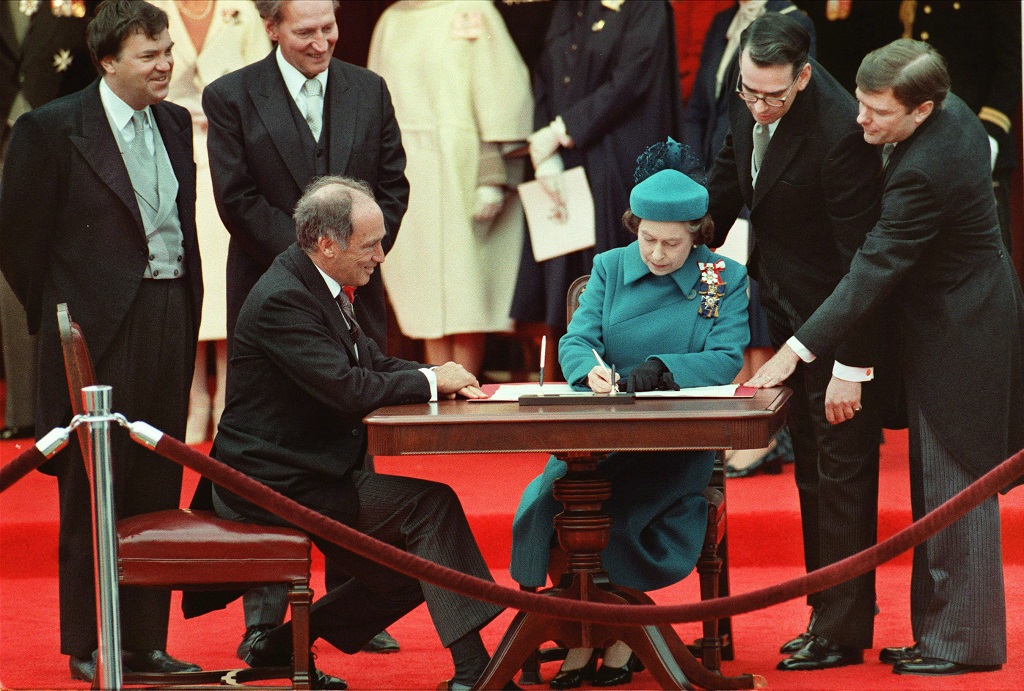
Queen Elizabeth II signs Canada’s constitutional proclamation in Ottawa on April 17, 1982 as Prime Minister Pierre Trudeau looks on.
THE CANADIAN PRESS/Stf-Ron Poling
A little more seriously, though your Line editors wouldn’t describe themselves as ardent monarchists, we do believe that we shouldn’t invest much time and energy into trying to fix what ain’t broke. Canada’s system of government doesn’t always deliver optimal outcomes — we mean, look around, folks — but it is stable, reliable and proven. Given our track record at big new policies, those are three things we have absolutely zero confidence any successor system to the monarchy would be, even in the fantastically unlikely chance we could design and implement one.
Is it weird putting a ton of our reserve powers and our very sovereignty inside the living essence of an old woman on an island across the ocean? Yes. Does it work? Also yes. Would we botch any effort to replace said old lady with literally any other system? A resolute yes. The monarchy is weird, and it’s not how we’d design Canada if we were starting Canada from scratch today, but it works, folks, and these days, there’s not much else we can say that about. Further, it’s hard not to like Her Majesty. Our thoughts are with her today. Whatever your qualms with royalty or the royals may be, surely you can spare a thought to a woman who lost her husband … oh, who are we kidding? Lots of people can’t or won’t.
Miscellaneous Myths: Loki
Overly Sarcastic Productions
Published 9 Apr 2021I started researching this goddamn video in june of 2019. I was so young. So innocent. This video is a precious relic of The Before Times, and unlike those inconsiderate vikings, I went out of my way to take *actual notes!*
Our content is intended for teenage audiences and up.
PARTIAL TRACKLIST: Starfall, Hall Of The Mountain King, Sky Becomes Water, Flight Of The Silverbird, Lacrimosa, Reign Of Vengeance, He Who Brings The Night
“Scheming Weasel” Kevin MacLeod (incompetech.com)
Licensed under Creative Commons: By Attribution 3.0
http://creativecommons.org/licenses/b…“Elevator” Kevin MacLeod (incompetech.com)
Licensed under Creative Commons: By Attribution 3.0
http://creativecommons.org/licenses/b…PATREON: https://www.Patreon.com/OSP
PODCAST: https://overlysarcasticpodcast.transi…
DISCORD: https://discord.gg/osp
MERCH LINKS: http://rdbl.co/osp
OUR WEBSITE: https://www.OverlySarcasticProductions.com
Find us on Twitter https://www.Twitter.com/OSPYouTube
Find us on Reddit https://www.Reddit.com/r/OSP/

Galen of Pergamon
Scott Alexander asked some of his readers to submit book reviews that he’ll be publishing anonymously to allow the rest of the readership to vote on. Friday’s submission was a review of the work of Galen of Pergamon … to help determine if he deserves all the kicks he’s received from other writers over the last two millennia:
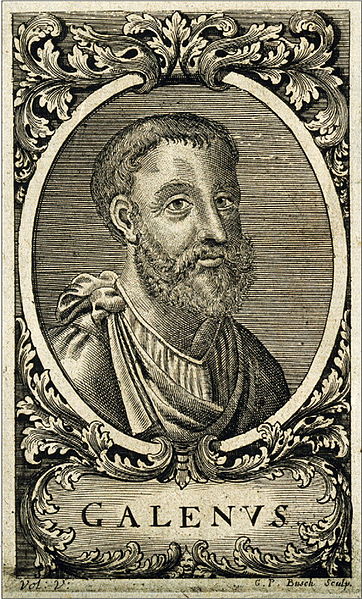
Portrait of Galen from The Lancet.
Engraving by Georg Paul Busch via Wikimedia Commons.
Aelius Galenus or Claudius Galenus (henceforth “Galen”) was born in Pergamon, a town in modern-day Turkey, in 129 CE. At the time, it was a part of the Roman empire, and a major intellectual center. Galen’s father was an architect; while rich, he was not considered to be particularly high status. Since there was little pressure for his son to go into a traditional career, instead of the “safe” subjects of literature and rhetoric that most Romans studied, Galen got an unusual education in mathematics and geometry.
(His father’s patient encouragement has its foil in his mother, who “flew into rages and bit her servants, a practice of which Galen disapproved.”)
When Galen was a teenager, however, his father had a dream where the god of medicine appeared and told him that his son should study medicine, so Galen started training as a doctor.
During this training Galen became familiar with the writings of Hippocrates, who had lived about 600 years earlier. Hippocrates had introduced the idea of the four humors to medicine — four fluids that congeal together to form our flesh and organs, and which co-mingle in our veins in their liquid form. Hippocrates came up with this system, but Galen would be the one to make it world-famous.
I could try to describe the theory myself, but actually Hippocrates does a great job on his own:
The Human body contains blood, phlegm, yellow bile and black bile. These are the things that make up its constitution and cause its pains and health. Health is primarily that state in which these constituent substances are in the correct proportion to each other, both in strength and quantity, and are well mixed. Pain occurs when one of the substances presents either a deficiency or an excess, or is separated in the body and not mixed with others.
All disease and illness, in this system, were the result of an imbalance in the four humors. From this perspective, treatments like bloodletting make perfect sense. By opening up the veins, the excessive humors drain away, leaving the patient more balanced — in better humors.
Long-term trends towards any of the humors were responsible for what we would call personality. Hence the terms sanguine, phlegmatic, melancholy and so on for different personal traits and emotional conditions.
This is the theory that he would put his weight behind, and which he would eventually be responsible for bringing to the majority of the western world.
When Galen was 19, his father died, leaving him independently wealthy. Hippocrates wrote that a good doctor should travel, so Galen ended up spending a decade studying with medical experts from various schools in cities all around the Mediterranean, including Alexandria.
After this, he came back to Pergamon where he got a job as the doctor treating the gladiators of the city. This was an unusual step for someone of his wealth and education, because despite their popularity as a form of entertainment, gladiators at the time were considered extremely low-class.
It’s not clear why he took this job, but it seems likely that it influenced how he thought about medicine. Spending long hours stitching gladiators back together gave him a detailed knowledge of human anatomy, which other doctors of the time lacked. It sounds like he did a great job, too, because only five of the gladiators died during his time there — compared to 60 under the guy who had the job before.
Eventually all roads lead to Rome, of course, and Galen arrived in 162 CE. His lectures and demonstrations made such an impression, and ruffled so many feathers, that he was afraid of getting poisoned by the Roman doctors and eventually left to save his life. In 169 CE, however, a great plague (probably smallpox) broke out, and Marcus Aurelius summoned him back to Rome to serve as court physician. Marcus Aurelius died the next year (according to some sources, of the plague), but Galen ended up with a longterm post in Rome as physician to the new Emperor, Commodus.
Galen himself died some time between 199 and 216 CE, at the the ripe old age of between 70 and 87.
Britain’s Only Repeating Enfield Trainer: the No7 Mk I
Forgotten Weapons
Published 12 Jun 2018http://www.forgottenweapons.com/brita…
http://www.patreon.com/ForgottenWeapons
Cool Forgotten Weapons merch! http://shop.bbtv.com/collections/forg…
Developed by BSA immediately after World War Two, the No7 MkI training rifle was the only one of the British Enfield trainers to use a magazine. Only 2500 of these rifles were produced, contracted by the Royal Air Force and delivered in 1948. Their magazine is a commercial BSA 5-round magazine modified slightly to latch into a housing inside a regular No4 Enfield magazine body. This makes them a particularly enjoyable rifle for range shooting, as well as one of the scarcest of the standard British trainers.Note that Canada also developed and adopted a No7 MkI .22 rimfire trainer, but that type is a single shot design, and does not share any parts with the British No7 MkI.
If you enjoy Forgotten Weapons, check out its sister channel, InRangeTV! http://www.youtube.com/InRangeTVShow
Contact:
Forgotten Weapons
6281 N Oracle #36270
Tucson, AZ 85704

QotD: “Too proud to fight”
Woodrow Wilson, speech in Philadelphia, 1915-05.
April 9, 2021
HRH Prince Philip, Duke of Edinburgh, 1921-2021
Sad, but not unexpected news this morning as His Royal Highness Prince Philip has died. Along with all of his many earthly titles and awards, he was considered divine by villagers in Vanuatu. Janet Davison reports for the CBC:
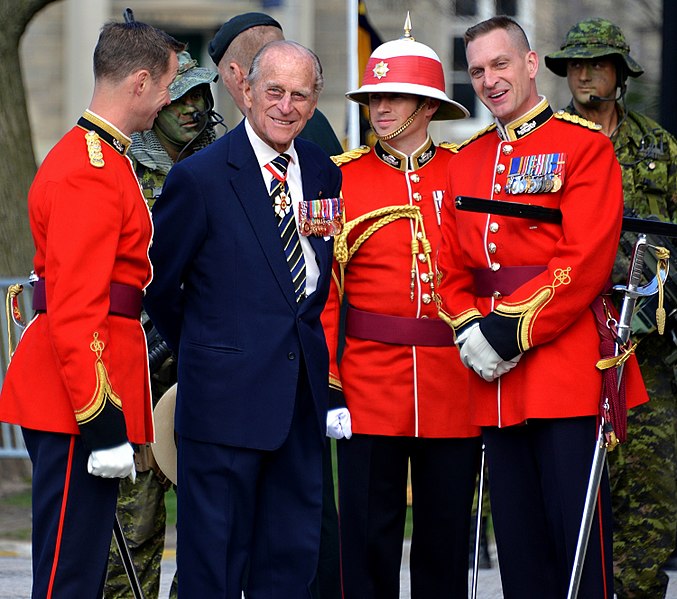
HRH Prince Philip was the Colonel-in-Chief of the Royal Canadian Regiment. In April 2013, he presented the Regimental Colours to the 3rd Battalion.
Photo by Jamie McCaffrey via Wikimedia Commons.
Prince Philip, the Duke of Edinburgh and husband of Queen Elizabeth, died today at 99. He was the longest-serving royal consort in British history.
His death, announced by Buckingham Palace, came more than three-and-a-half years after Philip formally stepped back from public life, a retreat that had been happening gradually for several years.
In an interview in June 2011 with the BBC, the no-nonsense Philip spoke about “winding down” and reducing his workload as a member of the Royal Family.
“I reckon I’ve done my bit so I want to enjoy myself a bit now, with less responsibility, less frantic rushing about, less preparation, less trying to think of something to say,” he said.
His final official public engagement came on Aug, 2, 2017, when he attended a parade of Royal Marines at Buckingham Palace and met servicemen who had taken part in a charity race.
Prime Minister Justin Trudeau issued a statement Friday calling Philip “a man of great service to others” who maintained a special relationship with the Canadian Armed Forces and was a patron to more than 40 Canadian organizations.
“Prince Philip was a man of great purpose and conviction, who was motivated by a sense of duty to others,” he said. “He will be fondly remembered as a constant in the life of our Queen – a lifelong companion who was always at her side offering unfailing support as she carried out her duties.”
Through the Queen’s 69 years on the throne, the man whom she had called her “strength and stay” carried out more than 22,000 solo engagements and made nearly 5,500 speeches. He attended events periodically with the Queen and other members of the Royal Family after stepping back from official duties.
Update: Colby Cosh recounts a story about Prince Philip’s WW2 naval career that I’d never heard before:
Socially he was entitled to the style of “royal highness” in his own right, yet he was looked down on by mere aristocrats, and even commoners, who had superior public-school credentials and polish. Marriage to a princess might have been impossible if Philip hadn’t impressed George VI personally. As a junior officer he was well-liked, but strict about shipboard order and neatness. He was said to have a natural intuition for command. If he wanted something done, his word put everything in motion at once.
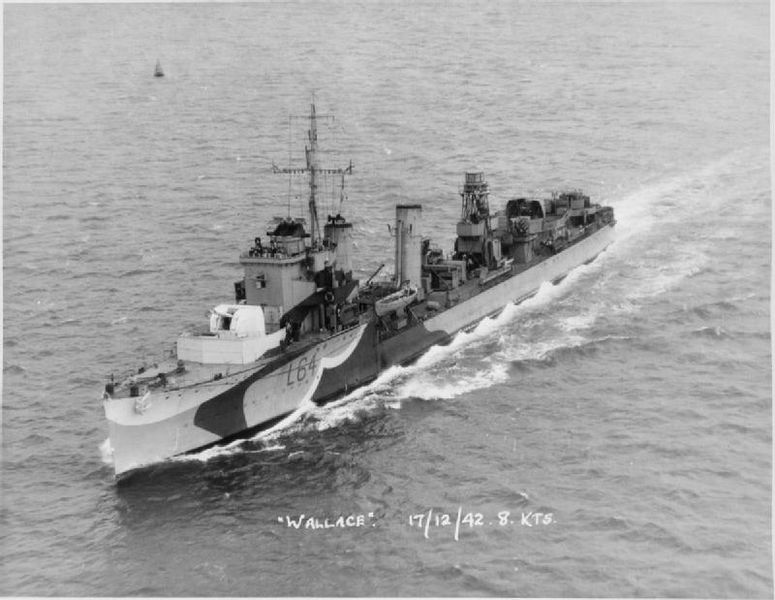
The Royal Navy destroyer HMS Wallace in December, 1942.
Imperial War Museum photo FL 10546 of collection 8308-29 via Wikimedia Commons.He performed well throughout the war, but his finest moment as an officer was not common knowledge until Harry Hargreaves, a Royal Navy yeoman who ended up in Westport, Ont., published a memoir of his own service in 1999. Hargreaves served with Philip aboard HMS Wallace, an old “flotilla leader” ship that had been finished in 1919 and modified for speed. Its original shore-bombardment hardware was pulled in favour of anti-aircraft guns and submarine-killing equipment.
Wallace’s and the prince’s great moment came in July 1943 when the ship was assigned to escort Convoy KMF18 from the Algerian harbour of Bône to the beaches of Sicily. As it happens, this convoy carried the First Canadian Division, which Mackenzie King had lobbied to put in action for the first large-scale amphibious invasion of occupied Europe. Wallace was to ward off U-boats on the trans-Mediterranean journey and then protect the landing party from German air attacks.
On the evening of July 8, Wallace was spotted on a clear, bright night and attacked by flights of Stuka dive-bombers. One damaging near-miss, Hargreaves wrote, had everybody prepared to die when the Stukas came back. Philip, the ship’s first lieutenant, quickly cooked up a plan to build a raft and set it afloat with smoke floats attached, hoping it would look enough like the wreckage of a destroyed ship to distract the returning planes.
“It had been marvellously quick thinking,” Hargreaves said, “conveyed to a willing team and put into action as if rehearsed.” But it required Wallace to steam away from the decoy and await its fate in silence and darkness. When the Stukas came back into earshot, the yeoman “screwed up (his) shoulders in anticipation of the bombs.”
The Germans took the bait and attacked the decoy. “Prince Philip,” Hargreaves concluded, “saved our lives that night.” He also saved the ship, which went on to cover the British-Canadian landing near Pachino.
Having survived the scrape, the prince was alive and intact to attend the Royal Family’s Christmas pantomime at Windsor Castle. Princess Elizabeth’s governess, Marion Crawford, found that combat had turned a “bumptious boy” into a “grave and charming man.” But the princess’s already longstanding crush on her distant cousin had not flagged, and never would.
Leading the Resistance – WW2 – Gallery 03
World War Two
Published 8 Apr 2021Under the violent occupation by Axis forces, dozens all over the globe resisted or took up arms to fight for the survival of their nation, ethnicity, ideology or ideals.
Join us on Patreon: https://www.patreon.com/TimeGhostHistory
Or join The TimeGhost Army directly at: https://timeghost.tvFollow WW2 day by day on Instagram @ww2_day_by_day – https://www.instagram.com/ww2_day_by_day
Between 2 Wars: https://www.youtube.com/playlist?list…
Source list: http://bit.ly/WW2sourcesHosted by: Spartacus Olsson
Written by: Spartacus Olsson and Joram Appel
Director: Astrid Deinhard
Producers: Astrid Deinhard and Spartacus Olsson
Executive Producers: Astrid Deinhard, Indy Neidell, Spartacus Olsson, Bodo Rittenauer
Creative Producer: Maria Kyhle
Post-Production Director: Wieke Kapteijns
Research by: Joram Appel
Edited by: Miki Cackowski
Sound design: Marek Kamiński
Map animations: Eastory (https://www.youtube.com/c/eastory)Colorizations by:
Mikołaj Uchman
Dememorabilia – https://www.instagram.com/dememorabilia/Sources:
Marxist Internet Archive
Picture of Tito during a Partisan gathering, courtesy of Музеј Старе Херцеговине
Yad Vashem 75FO4, 4613/899, 4248/20, 1605/91
Bundesarchiv
USHMM
IWM NA 15129Soundtracks from the Epidemic Sound:
Phoenix Tail – “At the Front”
Reynard Seidel – “Deflection”
Hakan Eriksson – “Epic Adventure Theme 4”
Johannes Bornlof – “The Inspector 4”
Fabien Tell – “Last Point of Safe Return”
Howard Harper-Barnes – “London”
Rannar Sillard – “March Of The Brave 10”Archive by Screenocean/Reuters https://www.screenocean.com.
A TimeGhost chronological documentary produced by OnLion Entertainment GmbH.

Where does the atmosphere end? | Head Squeeze
BBC Earth Lab
Published 7 Feb 2013How many layers does the atmosphere have, and what’s in all of them? James May explains…
Outtakes for this video here: http://www.youtube.com/watch?v=gdSu9Y…
Check out Felix Baumgartner’s space dive here:
http://www.youtube.com/watch?v=FHtvDA…Welcome to BBC Earth Lab! Here we answer all your curious questions about science in the world around you (and further afield too). If there’s a question you have that we haven’t yet answered let us know in the comments on any of our videos and it could be answered by one of our Earth Lab experts.

QotD: Instant expertise
One of the effects of the COVID-19 epidemic has been to reveal to a very large percentage of the population the joys of instant expertise. The world now has hundreds of millions, if not several billions, of epidemiologists, virologists, and clinicians, all of whom know best how to deal with the pandemic. The only problem is that their solutions are at variance with one another.
It sometimes seems as if the certainty with which views are held is inversely proportional to the solidity of the factual basis on which they are founded. If commentary on the internet is anything to go by (it might not be, of course, for those who avail themselves of this means of self-expression are a self-selected rather than a representative sample), people often take a religious attitude toward their own doctrine and condemn as heretics all those who express doubts about it. I don’t want to sound like a psychoanalyst, that class of person who believes that he unfailingly knows the real meaning of what is said rather than its merely apparent meaning, but stridency of views is often indicative of unacknowledged uncertainties. Zinc supplementarians and others of the type cling to their beliefs with a fervor that evidence does not merit.
Theodore Dalrymple, “Everyone’s an Expert”, Taki’s Magazine, 2020-10-16.
April 8, 2021
Rediscovering the Fish-Head Marking Gauge // Make your own woodworking tools!
Rex Krueger
Published 7 Apr 2021This nearly forgotten layout tool is a powerful addition to your hand tool shop.
More video and exclusive content: http://www.patreon.com/rexkrueger
Get the Plans: https://www.rexkrueger.com/store/plan…
(more…)
Andrew Doyle defends freedom of speech in his new book
In The Critic, Simon Evans reviews Free Speech And Why It Matters by Andrew Doyle (who is perhaps best known on this side of the pond for his ultrawoke Twitter persona “Titania McGrath”):
When I am weaker than you, I ask you for Freedom, because that is according to your principles; when I am Stronger than you, I take away your freedom because that is according to my principles.
Frank Herbert, Children of DuneIt is most peculiar. If the counter-culture had a dominant theme, it was the right to criticise the establishment and to question orthodoxy of all kinds. Back in the Sixties, it was central to its mission to Expand your Consciousness, man. And it worked. Walls came tumbling down. Yet now, everywhere you look, it seems the elements of society — students, academics, comedians — that one would most naturally associate with that freedom of expression, are introducing caveats and qualifiers to that principle faster than you can cry “Stop Little Pol-Pot, Stop!” They are turning, before our very eyes, into actual scolds.
It must be supposed that what was once the siege army, camped outside the moat like Occupy Wall Street, has captured the castle, for they are demanding that the walls be re-erected. That “hate” speech be distinguished from free speech and dealt with accordingly. That freedom of speech need not mean freedom from consequences. And a general suspicion is at large, among the young, that free speech is some sort of artefact of complacent boomer self-indulgence, like Steely Dan and second homes. No longer counter-culture, but decidedly counter-revolutionary.
I’m a comedian, and these have been strange times for our trade. Brexit saw comedians side with the mirthless neo-liberal consensus, against the humorous, sceptical grumble of the common rabble. The same thing happened in America, with bar-room stand-ups horrified by the vulgarity of Trump. And now the latest revision sees many of my fellow jesters and fools unsure whether people can really be trusted with free speech.One might have thought this issue had been settled long ago, in this country, and in liberty’s favour. But no, it seems we need to sharpen our tools once again, and Andrew Doyle’s new book is an excellent place to start.
Making the case for the defence, Doyle’s book is terse, restrained and as carefully argued as a QC’s summing-up in a top-drawer courtroom drama. Whether his command of the material comes from his doctorate in Renaissance literature or his experience of defending the comedy character Titania McGrath from infuriated wokerati, who knows? It is a beautifully balanced and comprehensive overview that will of course be read by no one who needs to hear it.
It is admirably historically literate. Doyle takes a quote from Milton’s Areopagitica as his epigram, with the old poet, declaiming over the din of the Civil War, as defiant as Satan himself, “Give me liberty to know, to utter, and to argue freely according to conscience, above all liberties.”
This sets the tone for the whole book, but Doyle also presents arguments intended to appeal to those who insist that we live in a society. With the compromises that entails. This was most famously recognised by notorious cis-hetero white man and free speech absolutist John Stuart Mill, who was surveying the world from the heights of Victorian Exceptionalism when he published the still unsurpassed On Liberty.